BY PROF. LIWAYWAY MEMIJE-CRUZ
Basic Guidance Techniques
for Teachers
Introduction
`Guiding children’s behavior is something done
throughout the day, not just when a child acts in a
way that is unsafe or unacceptable. You guide
behavior by establishing predictable routines,
setting clear rules with children, and modeling
kindness and respect. You are also attentive and
aware of what is going on. Together, these actions
help children feel noticed, confident, and secure.
Children experience your attention and guidance as
a caring embrace holding everything together. They
know you’re on their team. - (Dombro, Jablon, &
Stetson 2011, 58)
 HELP OR ADVICE THAT
TELLS YOU WHAT TO DO
 THE ACT OR PROCESS OF
GUIDING SOMEONE OR
SOMETHING
Guidance
Counselling
ADVICE
OPINION OR INSTRUCTION GIVEN
IN DIRECTING THE
JUDGMENT OR CONDUCT OF
ANOTHER.
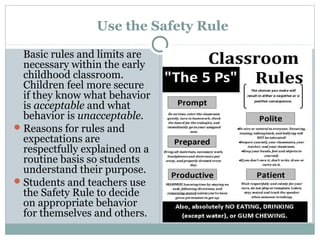
Use the Safety Rule
Basic rules and limits are
necessary within the early
childhood classroom.
Children feel more secure
if they know what behavior
is acceptable and what
behavior is unacceptable.
Reasons for rules and
expectations are
respectfully explained on a
routine basis so students
understand their purpose.
Students and teachers use
the Safety Rule to decide
on appropriate behavior
for themselves and others.
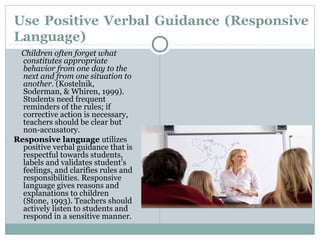
Use Positive Verbal Guidance (Responsive
Language)
Children often forget what
constitutes appropriate
behavior from one day to the
next and from one situation to
another. (Kostelnik,
Soderman, & Whiren, 1999).
Students need frequent
reminders of the rules; if
corrective action is necessary,
teachers should be clear but
non-accusatory.
Responsive language utilizes
positive verbal guidance that is
respectful towards students,
labels and validates student’s
feelings, and clarifies rules and
responsibilities. Responsive
language gives reasons and
explanations to children
(Stone, 1993). Teachers should
actively listen to students and
respond in a sensitive manner.
State rules in positive terms.
Tell students what
to do instead of
what not to do. Try
to eliminate "stop,"
"don't" and "no"
from your
statements to
students (except to
keep a student safe
in an emergency).
Model the Behavior You Want a Student
to Follow
All young children benefit
from a visual model of
what to do, but this is
especially important for
pupils/students with
developmental or language
delays. Couple the
modeling or
demonstration of proper
procedure, with direct
explanation—otherwise
pupils/students may not
imitate the desired
behavior themselves at a
later time.
Reinforce Appropriate Behavior
 Behaviors that are followed
by positive reinforcement are
likely to be strengthened and
repeated.
 Use social reinforcers
(smiles, praise, pat on the
back, wink, OK sign) and
activity reinforcers
(engaging in a special activity
as a reward for desired
behavior). Tangible
reinforcers (stickers, stars,
prizes) should be used only
for short periods of time
when other types of
reinforcement fail to work
with a particular child.
 Use effective praise: praise
that is selective, specific, and
positive.
Effective praise (called "encouragement" by Hitz
& Driscoll, 1988) is more likely to provide
meaningful feedback and foster healthy self-
esteem. Ineffective praise may actually lower
children's self-confidence, inhibit achievement,
and make children depend on external praise
(Katz, 1993; Kohn, 1993; Kohn, 2001).
Ignore Non-Disruptive Inappropriate
Behavior
Limit attention to students
who are used to negative
responses from adults.
"Catch the student being
good" and then use
effective praise when
students are engaging in
desired behaviors. Too
often students get attention
for inappropriate behaviors
and are left alone when
they are playing
appropriately or when
things are quiet and
controlled in early
childhood settings.
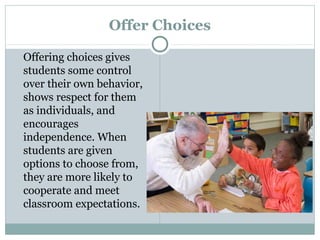
Offer Choices
Offering choices gives
students some control
over their own behavior,
shows respect for them
as individuals, and
encourages
independence. When
students are given
options to choose from,
they are more likely to
cooperate and meet
classroom expectations.
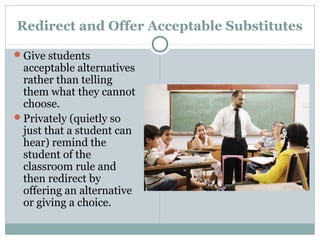
Redirect and Offer Acceptable Substitutes
Give students
acceptable alternatives
rather than telling
them what they cannot
choose.
Privately (quietly so
just that a student can
hear) remind the
student of the
classroom rule and
then redirect by
offering an alternative
or giving a choice.
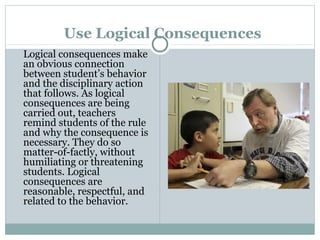
Use Logical Consequences
Logical consequences make
an obvious connection
between student’s behavior
and the disciplinary action
that follows. As logical
consequences are being
carried out, teachers
remind students of the rule
and why the consequence is
necessary. They do so
matter-of-factly, without
humiliating or threatening
students. Logical
consequences are
reasonable, respectful, and
related to the behavior.
Teachers
“When you study
great teachers...
you will learn
much more from
their caring and
hard work than
from their style.”
William Glasser―
Source: http://www.education.com/reference/article/positive-guidance-techniques/
Thank you…

Basic guidance techniques for teachers

  • 1.
    BY PROF. LIWAYWAYMEMIJE-CRUZ Basic Guidance Techniques for Teachers
  • 2.
    Introduction `Guiding children’s behavioris something done throughout the day, not just when a child acts in a way that is unsafe or unacceptable. You guide behavior by establishing predictable routines, setting clear rules with children, and modeling kindness and respect. You are also attentive and aware of what is going on. Together, these actions help children feel noticed, confident, and secure. Children experience your attention and guidance as a caring embrace holding everything together. They know you’re on their team. - (Dombro, Jablon, & Stetson 2011, 58)
  • 3.
     HELP ORADVICE THAT TELLS YOU WHAT TO DO  THE ACT OR PROCESS OF GUIDING SOMEONE OR SOMETHING Guidance
  • 4.
    Counselling ADVICE OPINION OR INSTRUCTIONGIVEN IN DIRECTING THE JUDGMENT OR CONDUCT OF ANOTHER.
  • 5.
    Use the SafetyRule Basic rules and limits are necessary within the early childhood classroom. Children feel more secure if they know what behavior is acceptable and what behavior is unacceptable. Reasons for rules and expectations are respectfully explained on a routine basis so students understand their purpose. Students and teachers use the Safety Rule to decide on appropriate behavior for themselves and others.
  • 6.
    Use Positive VerbalGuidance (Responsive Language) Children often forget what constitutes appropriate behavior from one day to the next and from one situation to another. (Kostelnik, Soderman, & Whiren, 1999). Students need frequent reminders of the rules; if corrective action is necessary, teachers should be clear but non-accusatory. Responsive language utilizes positive verbal guidance that is respectful towards students, labels and validates student’s feelings, and clarifies rules and responsibilities. Responsive language gives reasons and explanations to children (Stone, 1993). Teachers should actively listen to students and respond in a sensitive manner.
  • 7.
    State rules inpositive terms. Tell students what to do instead of what not to do. Try to eliminate "stop," "don't" and "no" from your statements to students (except to keep a student safe in an emergency).
  • 8.
    Model the BehaviorYou Want a Student to Follow All young children benefit from a visual model of what to do, but this is especially important for pupils/students with developmental or language delays. Couple the modeling or demonstration of proper procedure, with direct explanation—otherwise pupils/students may not imitate the desired behavior themselves at a later time.
  • 9.
    Reinforce Appropriate Behavior Behaviors that are followed by positive reinforcement are likely to be strengthened and repeated.  Use social reinforcers (smiles, praise, pat on the back, wink, OK sign) and activity reinforcers (engaging in a special activity as a reward for desired behavior). Tangible reinforcers (stickers, stars, prizes) should be used only for short periods of time when other types of reinforcement fail to work with a particular child.  Use effective praise: praise that is selective, specific, and positive.
  • 10.
    Effective praise (called"encouragement" by Hitz & Driscoll, 1988) is more likely to provide meaningful feedback and foster healthy self- esteem. Ineffective praise may actually lower children's self-confidence, inhibit achievement, and make children depend on external praise (Katz, 1993; Kohn, 1993; Kohn, 2001).
  • 11.
    Ignore Non-Disruptive Inappropriate Behavior Limitattention to students who are used to negative responses from adults. "Catch the student being good" and then use effective praise when students are engaging in desired behaviors. Too often students get attention for inappropriate behaviors and are left alone when they are playing appropriately or when things are quiet and controlled in early childhood settings.
  • 12.
    Offer Choices Offering choicesgives students some control over their own behavior, shows respect for them as individuals, and encourages independence. When students are given options to choose from, they are more likely to cooperate and meet classroom expectations.
  • 13.
    Redirect and OfferAcceptable Substitutes Give students acceptable alternatives rather than telling them what they cannot choose. Privately (quietly so just that a student can hear) remind the student of the classroom rule and then redirect by offering an alternative or giving a choice.
  • 14.
    Use Logical Consequences Logicalconsequences make an obvious connection between student’s behavior and the disciplinary action that follows. As logical consequences are being carried out, teachers remind students of the rule and why the consequence is necessary. They do so matter-of-factly, without humiliating or threatening students. Logical consequences are reasonable, respectful, and related to the behavior.
  • 15.
    Teachers “When you study greatteachers... you will learn much more from their caring and hard work than from their style.” William Glasser―
  • 16.