OBJECTIVES
1. Provide opportunityto trainers for self-reflection and
self-analysis.
2. Explain the importance of facilitation skills; and
3. Describe the five basic facilitation skills needed by a
trainer
3.
ACTIVITY
1. Divide theclass by region.
2. Recall your experience/s with a very effective
facilitator.
3. What did the facilitator do that made him/her
effective?
4. Have the participants print each of these actions
(of the effective facilitators) on meta strips.
4.
ACTIVITY
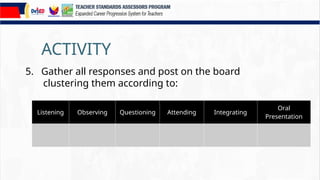
5. Gather allresponses and post on the board
clustering them according to:
Listening Observing Questioning Attending Integrating
Oral
Presentation
WHAT FACIS SHOULDKNOW?
1. People are moved by hopes and
dreams.
2. Problems can be solved; obstacles
are opportunities through which to
realize the future.
14.
WHAT FACIS SHOULDKNOW?
3. People find their fulfilment in taking
responsibility, not in avoiding it.
4. Teams are tension-filled.
15.
WHAT FACIS SHOULDDO?
Thinks through procedure and formats.
- to gather cumulative insights
- to order them
- to decide on a course of action
with consensus and
commitment.
16.
KEY SKILLS OFA FACILITATOR
• Observing group behavior
• Analyzing group behavior
• Listening actively
• Effectively paraphrasing
content and feelings
• Expressing ideas and feelings
• Using non-verbal behavior
• Employing effective
communication skills
• Presenting accurate content
• Summarizing ideas,
thoughts and feelings
• Focusing group attention
• Focusing group thoughts
and feelings
• Evoking new approaches or
insight
FACILITATION IN TRAINING
WHATIS A FACILITATOR?
“ One who makes it easy for others to
perform their tasks”
-John Epps
20.
WHAT IS AFACILITATOR?
“ One who makes it easy for others to
perform their tasks”
-John Epps
21.
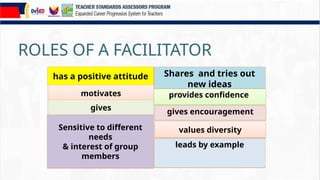
ROLES OF AFACILITATOR
has a positive attitude
motivates
gives
Sensitive to different
needs
& interest of group
members
Shares and tries out
new ideas
provides confidence
gives encouragement
values diversity
leads by example
22.
Facilitation is aboutempowering others.
It involves letting go of control over the
outcome of a process and giving that
responsibility to the group.
A facilitated participatory process will take
time and patience
23.
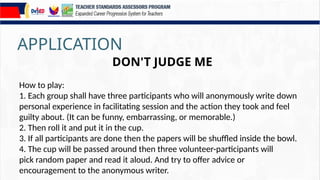
APPLICATION
DON'T JUDGE ME
Howto play:
1. Each group shall have three participants who will anonymously write down
personal experience in facilitating session and the action they took and feel
guilty about. (It can be funny, embarrassing, or memorable.)
2. Then roll it and put it in the cup.
3. If all participants are done then the papers will be shuffled inside the bowl.
4. The cup will be passed around then three volunteer-participants will
pick random paper and read it aloud. And try to offer advice or
encouragement to the anonymous writer.
24.
Only the peoplewho take learning,
growth and skills development into their
hands will be tomorrow’s leaders.
-Ally Worthington
Editor's Notes
#1 Say: Good afternoon!How are you this afternoon? Still good? Okay, please tap your seatmate to your right and say, You are beautiful/handsome inside out and to your left say so as you! I am Elsie B. Bajade and I will be facilitating the topic on session 9 which is Facilitation Skills Inside Out. I can see familiar faces and friends in here. Well, actually we are all facilitators of learning because we are teachers. Right? May I see the hands of those who have the experience in facilitating a training just like this? Erase the board of your achievements and allow yourself to be a beginner again-Steve Jobs
#2 Say: In this session, you will be able to Provide opportunity to trainers for self-reflection and self-analysis. What is self-reflection & self-analysis? Examining, Thinking deeply, evaluating insights, thoughts, behaviors & actions.(SR-SA are essential skills for personal & professional growth). So in self-reflection & self analysis, what do we get from it? Strengths & Areas for dev’t) (What drives you most & what’s most important to you). At the end of the session, you will also be able to Explain the importance of facilitation skills and Describe the five basic facilitation skills needed by a trainer.
The whole point of bringing a group together is not to
give them eyestrain. It is to change the way they think, act,
or work. We want to create “learning that sticks.” (knowledge skills & experiences that are retained and applied over time)
Say: THINK DIFFERENTLY (As a learning Facilitator we think differently.) Distinct and standard based manner of learning facilitation.
#4 Listening Attentively-paying close attention, Actively-engaged or take actions
Observe- A facilitator is keenly aware of and attentive to the dynamics, needs, and cues within a group or session, using the awareness to guide the process and ensure effective outcomes.(come up with good results)
Uses listening and observing skills in monitoring participants' behavior and level of engagement to
respond appropriately.
Questioning-Uses attending and questioning skills in creating a positive/non-threatening learning atmosphere
(engaging, supportive, and safe) for diverse
participants.
• Asks higher-order thinking skills (HOTS) questions
that are clear and relevant to elicit participants’ ideas
and ensure understanding of concepts.
• Stimulates Higher Order Thinking Skills (HOTS) from
participants by presenting real-life examples and
engaging activities.
Attending- helps/guides a group to achieve specific goals.
Ability to take responsibility for one’s behavior and well-being by optimizing one’s strengths, pursuing
opportunities for improvement, and exhibiting a positive mindset to build a harmonious relationship
with self, fellow learning facilitators, and participants.
• Accepts feedback without being defensive and
offensive and reflects on the feedback for self-
improvement.
• Recognizes strengths and addresses areas of
improvement for continuous self-development.
Integrating- Uses integrating skills to synthesize the responses of the participants and the activities of the session.
-Employs various strategies to draw out key learning concepts from the participants.
Uses appropriate technology with ease and
confidence to enhance learning delivery.
• Integrates various virtual applications or tools (e.g.
chat, quizzes, polls, whiteboards, digital journal) for
maximum engagement and learning.
Font size-24 points for body text and 36-44 points for headings-ensuring readability for all audience esp those further away
7 x 7 rule in PPt 7 lines or bullet points 7 words
Oral Presentation-Delivers accurate content clearly and in an organized
manner while ensuring alignment with session
objectives.
• Delivers concepts and ideas while exhibiting a good
command of the language.
• Demonstrates effective verbal (voice) and non-verbal
cues (body language, gestures, facial expressions,
posture, etc.) to affirm ideas and gain the participants’
attention, interest, and engagement.
• Exhibits flexibility and adaptability in the delivery of
the session to ensure an appropriate response to
unforeseen situations.
#5 Listening Attentively-paying close attention, Actively-engaged or take actions
Observe- A facilitator is keenly aware of and attentive to the dynamics, needs, and cues within a group or session, using the awareness to guide the process and ensure effective outcomes.(come up with good results)
Uses listening and observing skills in monitoring participants' behavior and level of engagement to
respond appropriately.
Questioning-Uses attending and questioning skills in creating a positive/non-threatening learning atmosphere
(engaging, supportive, and safe) for diverse
participants.
• Asks higher-order thinking skills (HOTS) questions
that are clear and relevant to elicit participants’ ideas
and ensure understanding of concepts.
• Stimulates Higher Order Thinking Skills (HOTS) from
participants by presenting real-life examples and
engaging activities.
Attending- helps/guides a group to achieve specific goals.
(Physical presence, eye contact, body language, active listening, non-verbal cues-like nodding, gesturing & facial expressions)
Integrating- Uses integrating skills to synthesize the responses of the participants and the activities of the session.
-Employs various strategies to draw out key learning concepts from the participants.
-Uses appropriate technology with ease and
confidence to enhance learning delivery.
• Integrates various virtual applications or tools (e.g.
chat, quizzes, polls, whiteboards, digital journal) for
maximum engagement and learning.
Font size-24 points for body text and 36-44 points for headings-ensuring readability for all audience esp those further away
7x7 rule in PPt 7 lines or bullet points 7 words
Oral Presentation-Delivers accurate content clearly and in an organized
manner while ensuring alignment with session
objectives.
• Delivers concepts and ideas while exhibiting a good
command of the language.
• Demonstrates effective verbal (voice) and non-verbal
cues (body language, gestures, facial expressions,
posture, etc.) to affirm ideas and gain the participants’
attention, interest, and engagement.
• Exhibits flexibility and adaptability in the delivery of
the session to ensure an appropriate response to
unforeseen situations.
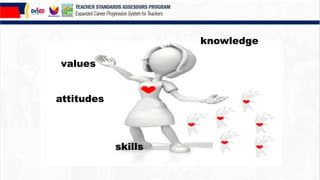
#6 Understanding Yourself
Must – basics
Skills
communication skills, active listening, questioning, conflict management, & time management (manages time to ensure that the session finishes time w/out compromising the achievement of objectives)
Values & Attitudes
-ability to take responsibility for one's behavior & well-being
-positive mindset to build harmonious relationship with self, fellow facis & participants.
-observes proper decorum & warm & respectful behavior at all times
-show humility, respect & sincerity when dealing with other members of the pmt
-exhibits reflective behavior to influence others positively
-relate to others with sensitivity and a caring attitude
Knowledge
-Be prepared
-Establish your credibility
-Include a goal early in the presentation
-Ask thought provoking questions
-Engage & energize
• Delivers concepts and ideas while exhibiting a good
command of the language.
• Demonstrates effective verbal (voice) and non-verbal
cues (body language, gestures, facial expressions,
posture, etc.) to affirm ideas and gain the participants’
attention, interest, and engagement.
• Exhibits flexibility and adaptability in the delivery of
the session to ensure an appropriate response to
unforeseen situations.
USING TECHNOLOGY EFFECTIVELY
• Uses appropriate technology with ease and
confidence to enhance learning delivery.
• Integrates various virtual applications or tools (e.g.
chat, quizzes, polls, whiteboards, digital journal) for
maximum engagement and learning.
Font size-24 points for body text and 36-44 points for headings-ensuring readability for all audience esp those further away
7 x 7 rule in PPt 7 lines or bullet points 7 words
MANAGING ONSELF
• Ability to take responsibility for one’s behavior and well-being by optimizing one’s strengths, pursuing
opportunities for improvement, and exhibiting a positive mindset to build a harmonious relationship
with self, fellow learning facilitators, and participants.
Developing Self
• Accepts feedback without being defensive and
offensive and reflects on the feedback for self-
improvement.
• Recognizes strengths and addresses areas of
improvement for continuous self-development.
• Observes proper decorum and warm and respectful and
behavior at all times to show respect towards oneself
and others.
• Manages time to ensure that the session finishes on
time without compromising the achievement of
objectives.
Working with Others
• Shows humility, respect, and sincerity when dealing
with other members of the program management
team.
• Exhibits reflective behavior to influence others positively
Relates to others with sensitivity and a caring attitude
#8 A great point! Facilitation indeed focuses on participation, rather than just the end result. Here's why:
By focusing on the process of participation, facilitators can create an env't that's conducive to learning, growth, & collaboration, ultimately leading to more effective & sustainable outcomes.
Understanding Audience
Use Audience Heat Map
• Emotion
• Vision
• Action
Facilitation encourages participants to share their knowledge, experiences and perspectives
Fosters collaboration- building rel & trust
Enhances creativity and innovation- Diverse perspectives leading to more innovative and creative solutions
Develop skills such as effective communication, active listening & conflict resolution
TIPS FOR AN EXCELLENT AND POWERFUL
PRESENTATION
● Be prepared
● Establish your credibility right up front.
● Include a goal early in the presentation.
● Begin separate ideas with powerful quotations or
Establish your credibility right up front.
● Include a goal early in the presentation.
● Begin separate ideas with powerful quotations or
images.
● Ask thought provoking questions.
● Make startling statements.
● Be prepared for difficult questions.
Engage and energize
Anticipate.
● Connect the dots.
● Respect the agenda and break times.
● Celebrate with gratitude.
Develop the capacities you already posses
Energy capacity- push on physically
Emotional Capacity – manage your emotions.
● Thinking Capacity – think effectively.
● People Capacity – building relationships.
● Creative Capacity – see options and find answers.
● Production Capacity – accomplish results.
● Leadership Capacity – lift and lead others.
● Discipline Capacity – focus now and follow through.
● Attitude Capacity - be positive regardless of
circumstances.
● Risk Capacity – get out of your comfort zone.
● Growth Capacity – focus on how far you can go.
Partnership Capacity- collaborate with others
#9 Employs various strategies to draw out key learning concepts
from participants.
#11 Reduce burden- Effective facilitation skills indeed help reduce burden- Facilitation encourages participants to share their knowledge, experiences and perspectives.
Fosters collaboration- building rel & trust
Enhances creativity and innovation-
Diverse perspectives leading to more innovative and creative solutions
Develop skills such as effective communication, active listening & conflict resolution
Epitome _uh-pi-tuh-mee
TIPS FOR AN EXCELLENT AND POWERFUL
PRESENTATION
● Be prepared
● Establish your credibility right up front.
● Include a goal early in the presentation.
● Begin separate ideas with powerful quotations or
Establish your credibility right up front.
● Include a goal early in the presentation.
● Begin separate ideas with powerful quotations or
images.
● Ask thought provoking questions.
● Make startling statements.
● Be prepared for difficult questions.
Engage and energize
Anticipate.
● Connect the dots.
● Respect the agenda and break times.
● Celebrate with gratitude.
Develop the capacities you already posses
Energy capacity- push on physically
Emotional Capacity – manage your emotions.
● Thinking Capacity – think effectively.
● People Capacity – building relationships.
● Creative Capacity – see options and find answers.
● Production Capacity – accomplish results.
● Leadership Capacity – lift and lead others.
● Discipline Capacity – focus now and follow through.
● Attitude Capacity - be positive regardless of
circumstances.
● Risk Capacity – get out of your comfort zone.
● Growth Capacity – focus on how far you can go.
Partnership Capacity- collaborate with others
MANAGING ONESELF
Ability to take responsibility for one’s behavior and well-being by optimizing one’s strengths, pursuing opportunities for improvement, and exhibiting a positive mindset to build a harmonious relationship with self, fellow learning facilitators, and participants.
Developing Self
Accepts feedback without being defensive and offensive and reflects on the feedback for self-improvement.
#13 Cross- reference: Filters to Communication by William Pfeiffer
Preoccupation
Mind wandering
Past experiences
Self-esteem
Status in a group
Emotional State
Bias/prejudice/stereotype
Physical state
Volume of voice
Articulateness
Language difference
Amount of information
Culture
+ Mental Models (What we believe will occur) -Creates expectations, predictions & decisions-Reality (What actually occurs-New influencing factors
1.By acknowledging and facilitating hopes & dreams, facilitators can help unlock people's potential, foster creativity & innovation, & drive positive change. Hopes and dreams have the power to inspire, motivate, and energize individuals to work towards a common goal.
2. It highlights the importance of reframing challenges as opportunities for growth, innovation & progress.
#14 A profound insight! Culture of Responsibility- Lead by example, demonstrating accountability and ownership.
A realistic perspective! Teams can indeed be tension-filled, as individuals with different backgrounds, perspectives, and work styles come together to achieve a common goal.
#15 Effective facilitating involves guiding participants through structured process to gather insights, build on each other's ideas, and make informed decisions.
#16 Note to facilitator:
Explain briefly the relevance of each skill with realistic examples in cross-reference to Adult Learning Principles by Dr. Juan A. Kanapi Jr.
Readiness to learn begins with and is sustained by a “felt need.”
A felt need comes from and / or connects to the direct experience of the adult learner
Each adult learner has a learning style
Learning happens in stages through trial and error / repetitive practice
A “safe,” supportive environment increases the probability of long-term learning
An adult learner will choose what to learn
#17 Note to Facilitator:
Refer to the key skills when discussing this slide
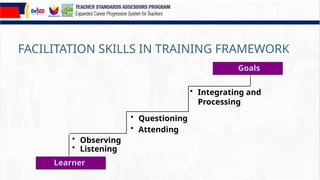
Observing
Notes participants’ level of involvement in all activities
Monitors the energy level of the participants during sessions
Senses the needs, potentials, strengths, and weakness of the participants that may affect the learning process
Assesses and communicates group progress
2. Questioning
Asks questions that are clear and focused
Asks follow-up questions to clarify participants’ responses and to check understanding of content
Asks questions that involve Higher Order Thinking Skills (HOTS)
Acknowledges participants’ responses
Solicits, accepts and acts on feedback from participants
Processes responses with probing questions to elicit the desired outcome
Paraphrases questions for clarity
3. Responding
Understands and responds to what had been said
Responds positively to participants’ insights; delivers constructive feedback
Reacts to ideas not to the person
Acknowledges greetings and responses of the participants
4. Attending
Creates an accepting and non-threatening learning atmosphere based on adult learning principles
Directs and redirects the participants’ awareness to the learning tasks
Manages the learning atmosphere throughout the sessions (Expectation setting and MOL)
Manages disruptive and group behavior
Manages time allotted so as to get the job done and reach timely closure
5. Integrating and Processing
Highlights important results of the activity that lead to the attainment of the objectives of the session
Deepens and broadens participants’ outlook on the significance of the group outputs
Demonstrates convergent and divergent thinking in processing ideas
Process information quickly/differentiates content issues and isolates critical points
Guides the group to consensus and desired outcomes by means of
#18 In the context of training and facilitation, inputs or actions by the trainer can indeed play a crucial role in helping trainees achieve their goals. Inputs (clear instructions, demonstrations & modeling, guided practice, feedback & coaching & encouragement & support)
#19 Enable other to take ownership of their work and decisions.
Provide support and guidance to help others overcome obstacles and challenges.
Encourage them to take initiative and move forward.
Connect people, and resources to facilitate collaboration & innovation.
#21 Cross-reference: Process of Emerging New Ideas
Art of Hosting Workbook, Art of Hosting Workshop, Singapore, 2012
Additional Information for the facilitator:
Appreciative Inquiry-Inquiry into a selected topic to discover strengths & capacities that are already present in an individual, group and / or organization
Appreciative Inquiry 4D Cycle
Discovery- appreciating the best of what is
Dream- envisioning what might be
Design- constructing desired structures/processes
Destiny- implementing the process of change
Reference: Appreciative Inquiry by Dr. David Cooperrider & Suresh Srivastva
#22 Notes to the Facilitator:
AI Foundation Principles
Constructionist Principle
Words create worlds
A person’s reality is created by the mental images one sponsors, the language one consistently uses and the stories repeatedly told
What we constantly think and talk about becomes our reality
Placebo Effect / Dr. Langer studies
2. Simultaneity Principle
Change begins the moment you ask the question
The first question starts the process of change
What we ask about today is what we create for tomorrow
What we ask about determines what we “find,” and what we “discover” becomes the stories out of which the future is shaped
3. Poetic Principle
Reality is open to multiple interpretations
However, what we focus on grows
We can choose to focus on the positive (e.g. creativity, innovation) or negative aspects of reality (e.g. stress, inefficiency)
4. Anticipatory Principle
We are only limited by our imagination
Imagination is the only limit to our future
A desired future can only be created consciously if it can be first imagined
Mental image inspires action
Pygmalion Effect / Dr. Seligman’s Learned Helplessness, Optimism
5. Poetic Principle
The more positive the questions, the more positive the desire for change
Positive affect leads to positive action
The more positive the stories, the easier it is to sustain a change process
If you’re going to ask a question, ask a positive one
6. Constructionist Principle
Words create worlds
A person’s reality is created by the mental images one sponsors, the language one consistently uses and the stories repeatedly told
What we constantly think and talk about becomes our reality
Placebo Effect / Dr. Langer studies
#23 Assign group tasks such as:
Performers- to analyze the scenario and present/establish best practice
Assessors- to evaluate the presentation using the rubric.
Processors- to suggest/recommend points for improvement, focusing only on facilitation skills
Note: Rubric should be used for the workshop.
#24 SAY:
Given this quote from Ally Worthington, what is your takeaway from this session?
Why do you think it is important?
By embracing "Self-Directed Learning", you can develop the skills, knowledge and mindset necessary to succeed in an ever changing world.
Continuous Improvement
Tomorrow's leaders are those who take ownership of their learning, growth and skills development
How do you intend to continue on improving your facilitation skills?
Ideas can be challenged
Ambiguity is tolerated
Diversity is valued
Okay it make mistakes
People are engaged
People feel respected and accepted
People are encouraged to trust self & other resources
Evaluation by self and others is facilitated
Uniquely personal and subjective nature of learning is emphasized
Discovery of personal meaning of ideas is facilitated
DO: Thank the participants. Tell them that you are willing to provide TA whenever necessary.