Fundamentals of PLANTPATHOLOGY
Dr Bhagyashree Khamari
Assistant Professor
Department of Plant Pathology
Institute of Agricultural Sciences
Siksha o Anusandhan (Deemed to be University)
Bhubaneswar, Odisha
• Loss of quality and quantity of product
• Loss of aesthetic value
• Change in crop system
• Increase in cost of production
• Change in food habit
• Loss of employment
• Destroy agricultural industries
• Affect International trade
Importance of Plant disease
Important plant disease Epidemics
Irish Famine – 1845
(Late blight of Potato)
Coffee rust in Sri lanka (1870)
Bengal famine (1943)
Brown spot of rice
Other Famines
• Wheat rust epidemics occurred from time to time in many
countries which forced farmers to change their cropping
pattern from wheat to corn.
• Powdery mildew of grapevines caused by Uncinula
necator in 1854 which reduced the French wine
production by 80 per cent.
• In 1878, the downy mildew of grapes caused by
Plasmopara viticola ultimately led to the discovery of
Bordeaux mixture.
Earlier Concepts regarding causeof Plant diseases:
• Jews – regarded that disease is due to anger of God.
• Yunani – worshiped Suryanarayan for protecting their
crops from diseases.
• Roman – Roman worship Robigo and Robigus (Rust
God and Goddess respectively) and celebrated
“Rubigalia” festival for protecting their crops from rust
What is Plant Pathology?
Phytopathology (Phyton : plant) Greek - Pathos
(suffering) + Logos (study) = The study of the
suffering plant
Plant pathology is that branch of agricultural,
botanical or biological sciences which deals
with the study of:
 cause of the disease
 Resulting losses and
 Control of plant diseases
OBJECTIVES OF PLANT PATHOLOGY
To study the biotic, abiotic and environmental
causes ofplant diseases.
To study the mechanism of disease development.
To study the interaction between plant and
pathogen in relation to environmental conditions.
To develop the methods of plant disease
management.
Disease:
It is a malfunctioning that is caused by continuous
irritation by biotic and abiotic factors resulting in
production of symptoms.
Disorder or physiological disorders.
The diseases caused by abiotic factors such as the
deficiency of nutrients or unfavourable environmental
condition.
 Pathogen: Disease causing organisms are known as
pathogen.
 Pathogenicity : It is the ability of a pathogen to cause
disease under a given set of environmental conditions.
 Virulence : It is a measure or degree of pathogenicity.
 Aggressiveness: It is capacity of a pathogen to invade
and grow in the host plant and to reproduce on or in it.
 Pathogenesis or disease cycle : It is the chain of
events that leads to development of a disease in the host.
 Parasite: Organisms which depends on other organism
(the host) for their food and shelter. All the pathogens are
parasites but all the parasites are not pathogens.
 Biotrophs or obligate parasites : organisms which obtain
their food from living tissues where it completes its life
cycle. e.g., rusts, smuts, powdery mildews etc.
 Facultative parasite: Organism which are generally
saprophyte but occasionally under favourable condition
behaves as parasite.
 Saprophytes/saprobes: Organisms which live and
derive their nutrition from the dead and decay organic
matter.
 Facultative saprophytes or hemibiotrophs:
Organism that are generally parasite but under certain
unfavorable condition behaves as saprophyte.
 Necrotroph or perthotroph or perthophytes : A
parasite when kills the host tissue in advance
of entry and then lives saprophytically, e.g. Sclerotium
rolfsii and Pythium species.
Infection is the establishment of the parasitic
relationship between the pathogen and host after entry.
Incubation period is the period between pathogen
entry and development of the disease symptoms.
Invasion and colonization is the growth and
multiplication of the pathogen through the tissue of the
host varying extent.
Latent infection: When the host is infected by
pathogen but doesn’t express any symptom.
Host
Host
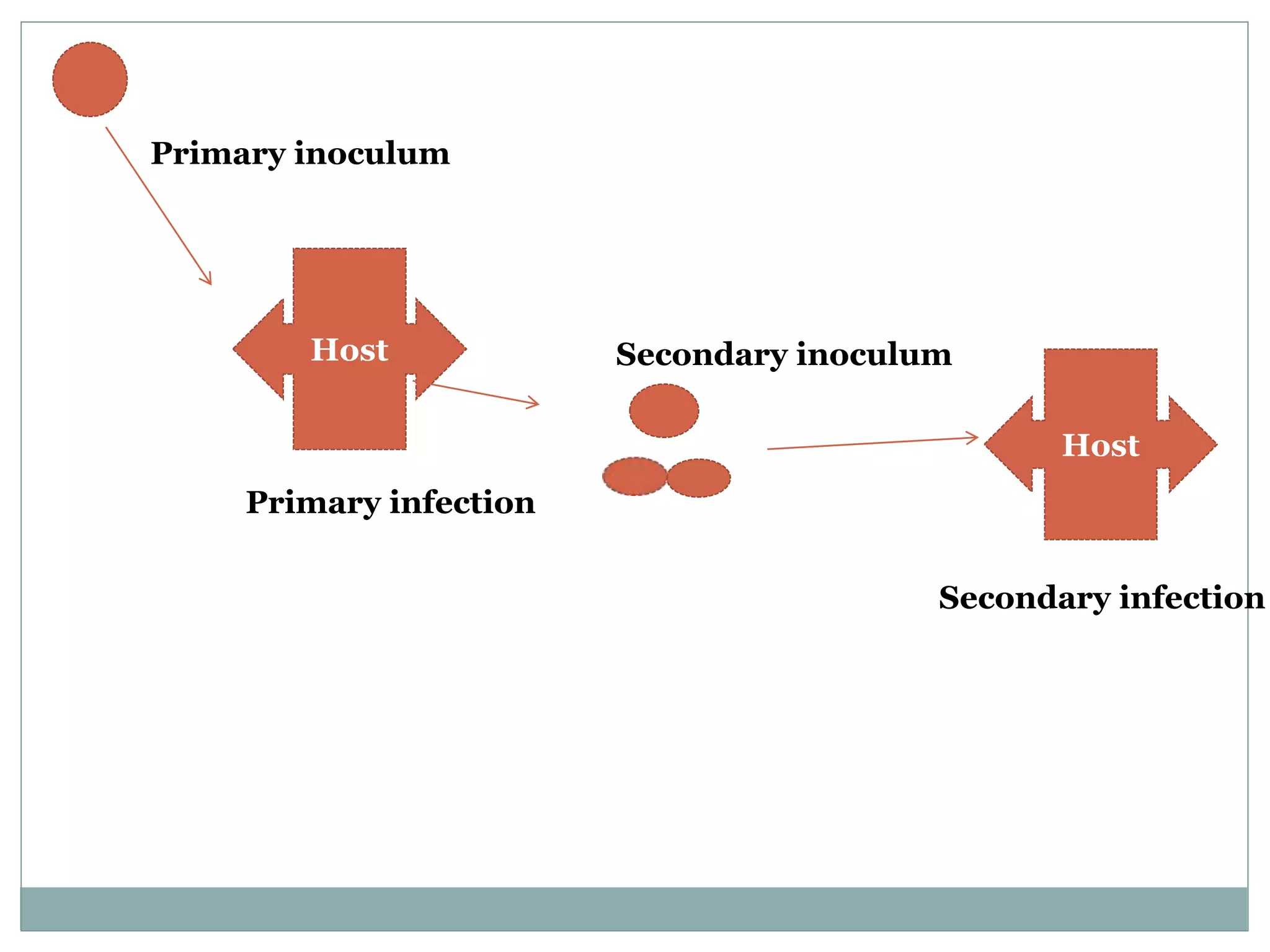
Primary inoculum
Primary infection
Secondary inoculum
Secondary infection
Inoculum: Pathogen or its part which cause infection.
Inoculum potential: It is the minimum amount of
inoculum to cause infection.
Primary inoculum: The dormant pathogen or its spores
which initiates infection (Primary infection).
Secondary inoculum : Pathogen or its spore produced
primary infection and cause secondary infection.
Inoculation: It is the process of transferring pathogen to
a host.
Isolation: It is the process of separation of pathogen from
its host and culture in nutrient media.
• Epiphytotic: Organism growing on the surface of plant
• Endophytic: Organism growing inside the plant
• Phylloplane: on the surface of leaf
• Phyllosphere: area surrounding the leaf
• Rhizoplane: on the surface of root
• Rhizosphere: Area around the root
• Predisposition: It is the set of conditions that makes the
plant vulnerable to the attack of a pathogen.
Phyllosphere
Rhizosphere
Pathogenicity: Ability of an organism to cause disease.
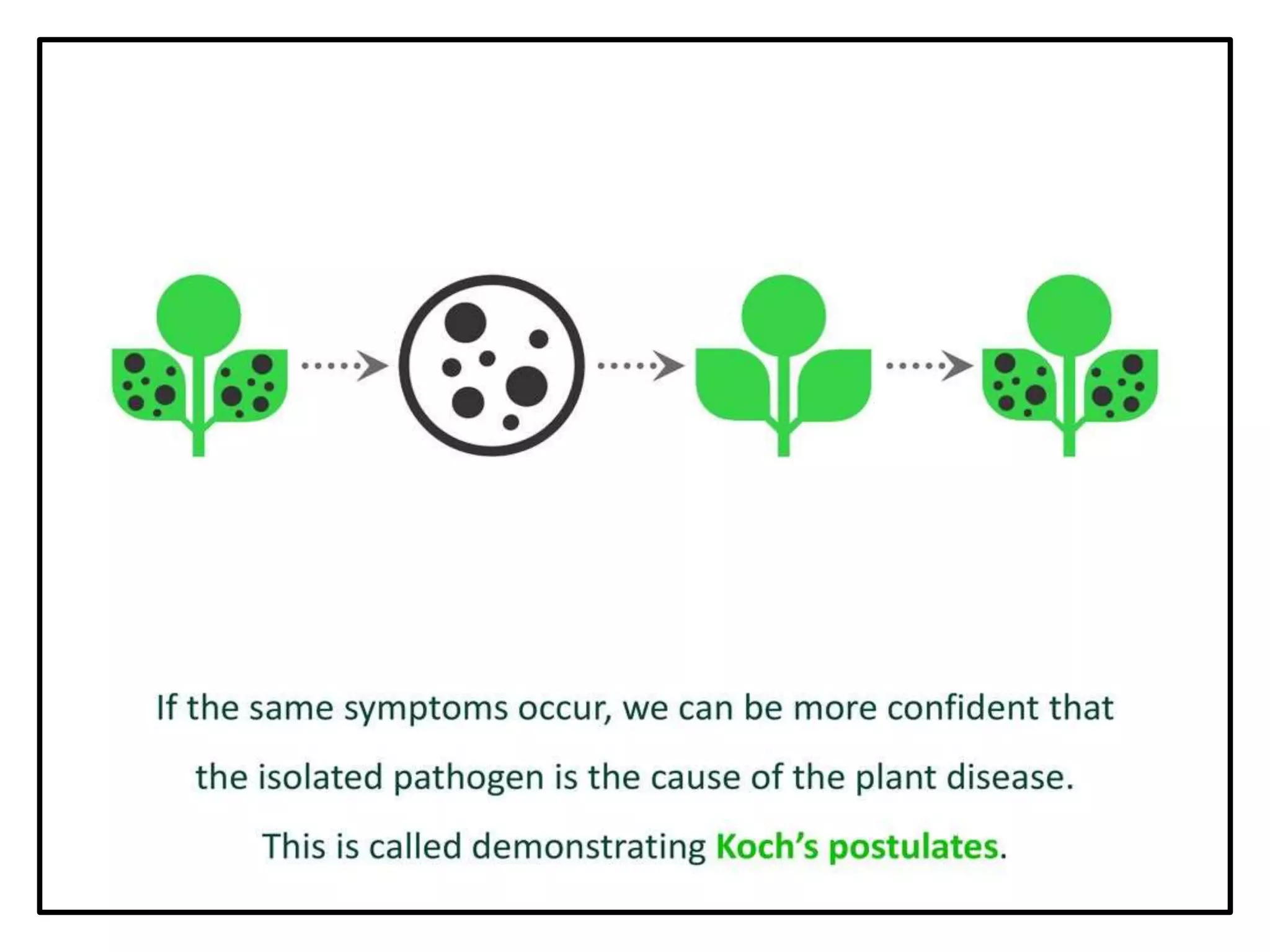
Koch’s Postulate(By Robert koch)
(1)The microorganism must be found in diseased but not
healthy individuals
(2)The microorganism must be cultured from the diseased
individual.
(3)Inoculation of a healthy individual with the cultured
microorganism must recapitulated the disease.
(4)The microorganism must be re-isolated from the
inoculated, diseased individual and matched to the original
microorganism.
Steps to prove that the organism from infected
plant tissue caused the original infection.
(A) Isolation of pathogen from infected tissue.
(B) Inoculation in susceptible host
(C) Re-isolate the pathogen form the susceptible host
and examine in microscope.
(D) Comparison between isolated and reisolated
pathogen.
Exceptions to Koch’s Postulates
– Microorganisms that are unable to cultured on
artificial media .
– When 2 or more organism work in synergy to cause a
disease.
– Symptoms or diseases that can be caused by several
microbes.
– Highly contagious, virulent, or dangerous strains
• We obviously do not want to create more of a dangerous
disease.
Fundamentals of plant pathology

Fundamentals of plant pathology

  • 1.
    Fundamentals of PLANTPATHOLOGY DrBhagyashree Khamari Assistant Professor Department of Plant Pathology Institute of Agricultural Sciences Siksha o Anusandhan (Deemed to be University) Bhubaneswar, Odisha
  • 2.
    • Loss ofquality and quantity of product • Loss of aesthetic value • Change in crop system • Increase in cost of production • Change in food habit • Loss of employment • Destroy agricultural industries • Affect International trade Importance of Plant disease
  • 3.
    Important plant diseaseEpidemics Irish Famine – 1845 (Late blight of Potato) Coffee rust in Sri lanka (1870) Bengal famine (1943) Brown spot of rice
  • 4.
    Other Famines • Wheatrust epidemics occurred from time to time in many countries which forced farmers to change their cropping pattern from wheat to corn. • Powdery mildew of grapevines caused by Uncinula necator in 1854 which reduced the French wine production by 80 per cent. • In 1878, the downy mildew of grapes caused by Plasmopara viticola ultimately led to the discovery of Bordeaux mixture.
  • 5.
    Earlier Concepts regardingcauseof Plant diseases: • Jews – regarded that disease is due to anger of God. • Yunani – worshiped Suryanarayan for protecting their crops from diseases. • Roman – Roman worship Robigo and Robigus (Rust God and Goddess respectively) and celebrated “Rubigalia” festival for protecting their crops from rust
  • 6.
    What is PlantPathology? Phytopathology (Phyton : plant) Greek - Pathos (suffering) + Logos (study) = The study of the suffering plant Plant pathology is that branch of agricultural, botanical or biological sciences which deals with the study of:  cause of the disease  Resulting losses and  Control of plant diseases
  • 7.
    OBJECTIVES OF PLANTPATHOLOGY To study the biotic, abiotic and environmental causes ofplant diseases. To study the mechanism of disease development. To study the interaction between plant and pathogen in relation to environmental conditions. To develop the methods of plant disease management.
  • 8.
    Disease: It is amalfunctioning that is caused by continuous irritation by biotic and abiotic factors resulting in production of symptoms. Disorder or physiological disorders. The diseases caused by abiotic factors such as the deficiency of nutrients or unfavourable environmental condition.
  • 9.
     Pathogen: Diseasecausing organisms are known as pathogen.  Pathogenicity : It is the ability of a pathogen to cause disease under a given set of environmental conditions.  Virulence : It is a measure or degree of pathogenicity.  Aggressiveness: It is capacity of a pathogen to invade and grow in the host plant and to reproduce on or in it.  Pathogenesis or disease cycle : It is the chain of events that leads to development of a disease in the host.
  • 10.
     Parasite: Organismswhich depends on other organism (the host) for their food and shelter. All the pathogens are parasites but all the parasites are not pathogens.  Biotrophs or obligate parasites : organisms which obtain their food from living tissues where it completes its life cycle. e.g., rusts, smuts, powdery mildews etc.  Facultative parasite: Organism which are generally saprophyte but occasionally under favourable condition behaves as parasite.
  • 11.
     Saprophytes/saprobes: Organismswhich live and derive their nutrition from the dead and decay organic matter.  Facultative saprophytes or hemibiotrophs: Organism that are generally parasite but under certain unfavorable condition behaves as saprophyte.  Necrotroph or perthotroph or perthophytes : A parasite when kills the host tissue in advance of entry and then lives saprophytically, e.g. Sclerotium rolfsii and Pythium species.
  • 12.
    Infection is theestablishment of the parasitic relationship between the pathogen and host after entry. Incubation period is the period between pathogen entry and development of the disease symptoms. Invasion and colonization is the growth and multiplication of the pathogen through the tissue of the host varying extent. Latent infection: When the host is infected by pathogen but doesn’t express any symptom.
  • 13.
  • 14.
    Inoculum: Pathogen orits part which cause infection. Inoculum potential: It is the minimum amount of inoculum to cause infection. Primary inoculum: The dormant pathogen or its spores which initiates infection (Primary infection). Secondary inoculum : Pathogen or its spore produced primary infection and cause secondary infection. Inoculation: It is the process of transferring pathogen to a host. Isolation: It is the process of separation of pathogen from its host and culture in nutrient media.
  • 15.
    • Epiphytotic: Organismgrowing on the surface of plant • Endophytic: Organism growing inside the plant • Phylloplane: on the surface of leaf • Phyllosphere: area surrounding the leaf • Rhizoplane: on the surface of root • Rhizosphere: Area around the root • Predisposition: It is the set of conditions that makes the plant vulnerable to the attack of a pathogen.
  • 16.
  • 17.
    Pathogenicity: Ability ofan organism to cause disease. Koch’s Postulate(By Robert koch) (1)The microorganism must be found in diseased but not healthy individuals (2)The microorganism must be cultured from the diseased individual. (3)Inoculation of a healthy individual with the cultured microorganism must recapitulated the disease. (4)The microorganism must be re-isolated from the inoculated, diseased individual and matched to the original microorganism.
  • 18.
    Steps to provethat the organism from infected plant tissue caused the original infection. (A) Isolation of pathogen from infected tissue. (B) Inoculation in susceptible host (C) Re-isolate the pathogen form the susceptible host and examine in microscope. (D) Comparison between isolated and reisolated pathogen.
  • 20.
    Exceptions to Koch’sPostulates – Microorganisms that are unable to cultured on artificial media . – When 2 or more organism work in synergy to cause a disease. – Symptoms or diseases that can be caused by several microbes. – Highly contagious, virulent, or dangerous strains • We obviously do not want to create more of a dangerous disease.