Welcome to unacademy
Lecture by –Dhanendra Dhanuka
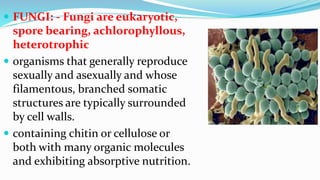
 FUNGI: - Fungi are eukaryotic,
spore bearing, achlorophyllous,
heterotrophic
 organisms that generally reproduce
sexually and asexually and whose
filamentous, branched somatic
structures are typically surrounded
by cell walls.
 containing chitin or cellulose or
both with many organic molecules
and exhibiting absorptive nutrition.
Somatic structures:
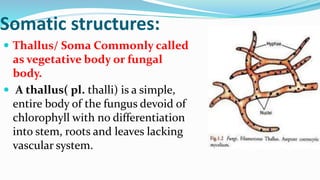
 Thallus/ Soma Commonly called
as vegetative body or fungal
body.
 A thallus( pl. thalli) is a simple,
entire body of the fungus devoid of
chlorophyll with no differentiation
into stem, roots and leaves lacking
vascular system.
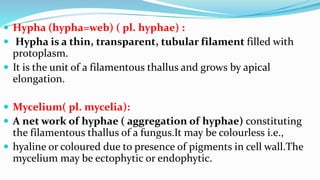
 Hypha (hypha=web) ( pl. hyphae) :
 Hypha is a thin, transparent, tubular filament filled with
protoplasm.
 It is the unit of a filamentous thallus and grows by apical
elongation.
 Mycelium( pl. mycelia):
 A net work of hyphae ( aggregation of hyphae) constituting
the filamentous thallus of a fungus.It may be colourless i.e.,
 hyaline or coloured due to presence of pigments in cell wall.The
mycelium may be ectophytic or endophytic.
Types of fungal thalli:
 1.Plasmodium (plasma = moulded
body): It is a naked,multinucleate
mass of
 protoplasm moving and feeding in
amoeboid fashion . Eg.
Plasmodiophora brassicae.
 2.Unicellular thallus:consisting
of a single cell. Eg. Chytrids,
Synchytrium
 3.Multi cellular or filamentous
thallus: Majority of fungi i.e., a
true fungi are
 filamentous, consisting of a
number of branched, thread like
filaments called
 hyphae.Eg.Many fungi,Alternaria.
hytrids, Synchytrium
Fungi based on reproductive structures:
 Holocarpic (holos=whole+karpos=fruit): If the thallus is entirely converted into
 one or more reproductive structures, such thallus is called holocarpic thallus.
Eg.Synchytrium
 Eucarpic (Eu=good+karpos=fruit):If the thallus is differentiated into a
vegetative
 part which absorbs nutrients and a reproductive part which forms reproductive
 structures, such thallus is called eucarpic thallus. Eg.Pythium
 Ectophytic fungus: If the fungal thallus is present on the surface of the host
 plant, it is called ectophytic.Eg. Oidium .
 Endophytic fungus: If the fungus penetrates into the host cell / present inside
the
 host, it is called endophytic.Eg. Puccinia. Endophytic fungus may be intercellular
 (hypha grows in between the cells), or intra cellular ( hypha penetrates into host
 cell).Eg.Ustilago, or vascular (xylem vessels) Eg. Fusarium oxysporum
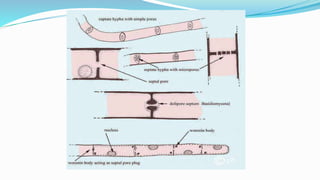
Septation in Fungi
 Some fungal hyphae are provided with
partitions or cross walls which divide the
fungus into a number of compartments
/cells. These cross walls are called septa.
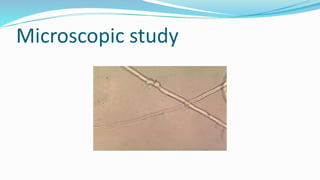
 Aseptate hypha/coenocytic hypha:
 hypha with out septa is called aseptate
/non-septate/ coenocytic hypha wherein
the nuclei are embedded in cytoplasm.
 Eg. lower fungi like Oomycetes and
Zygomycetes.
Microscopic study
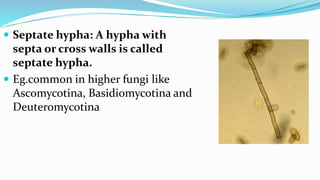
 Septate hypha: A hypha with
septa or cross walls is called
septate hypha.
 Eg.common in higher fungi like
Ascomycotina, Basidiomycotina and
Deuteromycotina
Fungal tissues:
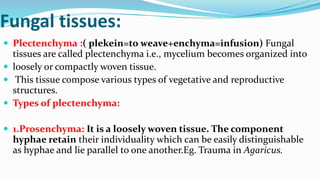
 Plectenchyma :( plekein=to weave+enchyma=infusion) Fungal
tissues are called plectenchyma i.e., mycelium becomes organized into
 loosely or compactly woven tissue.
 This tissue compose various types of vegetative and reproductive
structures.
 Types of plectenchyma:
 1.Prosenchyma: It is a loosely woven tissue. The component
hyphae retain their individuality which can be easily distinguishable
as hyphae and lie parallel to one another.Eg. Trauma in Agaricus.
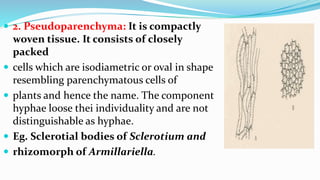
 2. Pseudoparenchyma: It is compactly
woven tissue. It consists of closely
packed
 cells which are isodiametric or oval in shape
resembling parenchymatous cells of
 plants and hence the name. The component
hyphae loose thei individuality and are not
distinguishable as hyphae.
 Eg. Sclerotial bodies of Sclerotium and
 rhizomorph of Armillariella.
3. MODIFICATION OF MYCELIUM/ SPECIALISED SOMATIC
STRUCTURES
 Purpose:
 1. to obtain nourishment i. e., for nutrition .
 2. to resist or tolerate unfavourable conditions for their
survival i.e., over wintering, over summering.
 3. for reproduction.
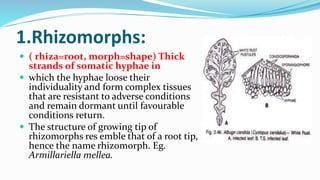
1.Rhizomorphs:
 ( rhiza=root, morph=shape) Thick
strands of somatic hyphae in
 which the hyphae loose their
individuality and form complex tissues
that are resistant to adverse conditions
and remain dormant until favourable
conditions return.
 The structure of growing tip of
rhizomorphs res emble that of a root tip,
hence the name rhizomorph. Eg.
Armillariella mellea.
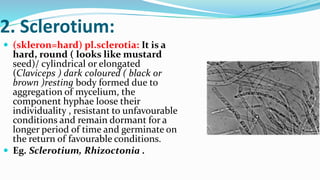
2. Sclerotium:
 (skleron=hard) pl.sclerotia: It is a
hard, round ( looks like mustard
seed)/ cylindrical or elongated
(Claviceps ) dark coloured ( black or
brown )resting body formed due to
aggregation of mycelium, the
component hyphae loose their
individuality , resistant to unfavourable
conditions and remain dormant for a
longer period of time and germinate on
the return of favourable conditions.
 Eg. Sclerotium, Rhizoctonia .
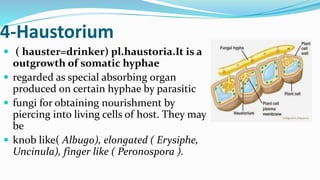
4-Haustorium
 ( hauster=drinker) pl.haustoria.It is a
outgrowth of somatic hyphae
 regarded as special absorbing organ
produced on certain hyphae by parasitic
 fungi for obtaining nourishment by
piercing into living cells of host. They may
be
 knob like( Albugo), elongated ( Erysiphe,
Uncinula), finger like ( Peronospora ).
mycology plant pathology

mycology plant pathology

  • 1.
    Welcome to unacademy Lectureby –Dhanendra Dhanuka
  • 2.
     FUNGI: -Fungi are eukaryotic, spore bearing, achlorophyllous, heterotrophic  organisms that generally reproduce sexually and asexually and whose filamentous, branched somatic structures are typically surrounded by cell walls.  containing chitin or cellulose or both with many organic molecules and exhibiting absorptive nutrition.
  • 3.
    Somatic structures:  Thallus/Soma Commonly called as vegetative body or fungal body.  A thallus( pl. thalli) is a simple, entire body of the fungus devoid of chlorophyll with no differentiation into stem, roots and leaves lacking vascular system.
  • 4.
     Hypha (hypha=web)( pl. hyphae) :  Hypha is a thin, transparent, tubular filament filled with protoplasm.  It is the unit of a filamentous thallus and grows by apical elongation.  Mycelium( pl. mycelia):  A net work of hyphae ( aggregation of hyphae) constituting the filamentous thallus of a fungus.It may be colourless i.e.,  hyaline or coloured due to presence of pigments in cell wall.The mycelium may be ectophytic or endophytic.
  • 6.
    Types of fungalthalli:  1.Plasmodium (plasma = moulded body): It is a naked,multinucleate mass of  protoplasm moving and feeding in amoeboid fashion . Eg. Plasmodiophora brassicae.
  • 7.
     2.Unicellular thallus:consisting ofa single cell. Eg. Chytrids, Synchytrium  3.Multi cellular or filamentous thallus: Majority of fungi i.e., a true fungi are  filamentous, consisting of a number of branched, thread like filaments called  hyphae.Eg.Many fungi,Alternaria. hytrids, Synchytrium
  • 8.
    Fungi based onreproductive structures:  Holocarpic (holos=whole+karpos=fruit): If the thallus is entirely converted into  one or more reproductive structures, such thallus is called holocarpic thallus. Eg.Synchytrium  Eucarpic (Eu=good+karpos=fruit):If the thallus is differentiated into a vegetative  part which absorbs nutrients and a reproductive part which forms reproductive  structures, such thallus is called eucarpic thallus. Eg.Pythium  Ectophytic fungus: If the fungal thallus is present on the surface of the host  plant, it is called ectophytic.Eg. Oidium .  Endophytic fungus: If the fungus penetrates into the host cell / present inside the  host, it is called endophytic.Eg. Puccinia. Endophytic fungus may be intercellular  (hypha grows in between the cells), or intra cellular ( hypha penetrates into host  cell).Eg.Ustilago, or vascular (xylem vessels) Eg. Fusarium oxysporum
  • 9.
    Septation in Fungi Some fungal hyphae are provided with partitions or cross walls which divide the fungus into a number of compartments /cells. These cross walls are called septa.  Aseptate hypha/coenocytic hypha:  hypha with out septa is called aseptate /non-septate/ coenocytic hypha wherein the nuclei are embedded in cytoplasm.  Eg. lower fungi like Oomycetes and Zygomycetes.
  • 10.
  • 11.
     Septate hypha:A hypha with septa or cross walls is called septate hypha.  Eg.common in higher fungi like Ascomycotina, Basidiomycotina and Deuteromycotina
  • 13.
    Fungal tissues:  Plectenchyma:( plekein=to weave+enchyma=infusion) Fungal tissues are called plectenchyma i.e., mycelium becomes organized into  loosely or compactly woven tissue.  This tissue compose various types of vegetative and reproductive structures.  Types of plectenchyma:  1.Prosenchyma: It is a loosely woven tissue. The component hyphae retain their individuality which can be easily distinguishable as hyphae and lie parallel to one another.Eg. Trauma in Agaricus.
  • 14.
     2. Pseudoparenchyma:It is compactly woven tissue. It consists of closely packed  cells which are isodiametric or oval in shape resembling parenchymatous cells of  plants and hence the name. The component hyphae loose thei individuality and are not distinguishable as hyphae.  Eg. Sclerotial bodies of Sclerotium and  rhizomorph of Armillariella.
  • 15.
    3. MODIFICATION OFMYCELIUM/ SPECIALISED SOMATIC STRUCTURES  Purpose:  1. to obtain nourishment i. e., for nutrition .  2. to resist or tolerate unfavourable conditions for their survival i.e., over wintering, over summering.  3. for reproduction.
  • 16.
    1.Rhizomorphs:  ( rhiza=root,morph=shape) Thick strands of somatic hyphae in  which the hyphae loose their individuality and form complex tissues that are resistant to adverse conditions and remain dormant until favourable conditions return.  The structure of growing tip of rhizomorphs res emble that of a root tip, hence the name rhizomorph. Eg. Armillariella mellea.
  • 17.
    2. Sclerotium:  (skleron=hard)pl.sclerotia: It is a hard, round ( looks like mustard seed)/ cylindrical or elongated (Claviceps ) dark coloured ( black or brown )resting body formed due to aggregation of mycelium, the component hyphae loose their individuality , resistant to unfavourable conditions and remain dormant for a longer period of time and germinate on the return of favourable conditions.  Eg. Sclerotium, Rhizoctonia .
  • 18.
    4-Haustorium  ( hauster=drinker)pl.haustoria.It is a outgrowth of somatic hyphae  regarded as special absorbing organ produced on certain hyphae by parasitic  fungi for obtaining nourishment by piercing into living cells of host. They may be  knob like( Albugo), elongated ( Erysiphe, Uncinula), finger like ( Peronospora ).