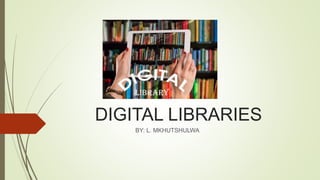
DIGITAL LIBRARIES
BY: L. MKHUTSHULWA
OVERVIEW
 INTRODUCTION
 DEFINITIONS
 CHARACTERISTICS
 FUNCTIONS
 ADVANTAGES
 DISADVANTAGES
 CONCLUSION
 REFERENCES
INTRODUCTION
 Digital libraries expand on and incorporate methods adopted
in traditional libraries, as well as in dispersed information
systems, to produce high-end information systems, services,
and institutions. They are being developed for diverse
communities and in various fields such as education,
development, and science. The development of digital
libraries makes availability of a wide range of resources that
can be accessed worldwide and anywhere through cell
phones, computer, iPads, and other electronic devices.
DIFINITIONS
 A digital library is a collection of electronic resources and related
technical capabilities for creating, searching, and using information.
They are extensions and improvements of information storage and
retrieval systems that manipulate digital data in any medium
(Borgman,1999)
 Digital libraries are those libraries that are automated and all
resources are retrieved online and the access to available
information is provided electronically to remote users as well as
conventional users (Singh, 2014).
 Digital libraries are libraries that store and organize information for
users to access resources electronically.
CHARACTERISTICS
 Digital libraries provide storage of information in digital form
(Singh, 2014).
 They provide digital materials that are accessible outside the
physical environment.
 They provide coherent view of resources available in the
digital library.
 Digital library encompass both electronic and paper
resources.
 Usage of communication networks to access and obtain
information.
FUNCTIONS OF DIGITAL LIBRARIES
 The main function of digital libraries is to conveniently
organize and offer access to the generally vast amounts of
digital information.
 To advance the methodical creation of processes for
gathering, storing, and organizing information in digital form.
 Provide information that can be stored for a very long time.
ADVANTAGES OF DIGITAL LIBRARIES
 Resources can be accessed remotely anywhere and anytime.
 They are convenient and effective.
 They provide multiple access.
 There are no physical boundaries.
 They can store large amount of information.
 Easy access
 Preservation and conservation
DISADVANTAGES OF DIGITAL
LIBRARIES
 They are costly
 They are prone to cyber crimes.
 Speed access to resources may be slow because due to
many computers connected.
 There are to many resources, but finding the most effective
can be a problem.
 Information organization
 Copyright
CONCLUSION
 Digital libraries play an effective role in people’s lives because
it makes life easier. Information can be accessed anywhere
and anytime. Digital libraries are easy to which then benefits
everyone. However, they are likely to be exposed to
cybercrimes because information and resources can be
tempered with. Digital libraries are redefining the role of
libraries in the society and that of the librarians.
REFERENCES
 Borgman, C., L. 1999. What are digital libraries? Competing visions. Information processing and
management,35 (3), pp.227-243
 Dozier, C. 2012. Digital Libraries. [SlideShare]. Available from: https://www.slideshare.net/ckdozier/digital-
libraries-power-point-13609080 (Accessed 18 August 2022
 Gujjar, M. 2014. Digital Library. [SlideShare]. Available from:
https://slideshare.net/vickychaudharywaqar/gigital-library-35068015 (Accessed 18 August 2022)
 IvyPanda. 2020. Digital Libraries Pros and Cons. Available from: https://ivypanda.com/essays/digital-
libraries-pros-and-cons/#ivy-csf-section (Accessed: 18 August 2022).
 https://www.elibrarysoftware.com/functions-of-the-digital-library-software.html (Accessed 18 August 2022)
 Janssen, O. 2013. Introduction to digital libraries- definitions, examples, concepts, and trends (2016
version). [SlideShare]. Available from: https://www.slideshare.net/OlafJanssenNL/introduction-to-digital-
libraries-concepts-example-trends (Accessed 18 August 2022)
 Negi, D. 2014. Digital Libraries. [SlideShare]. Available from:
https://www.slideshare.net/dheerajsnegi9/digital-libraries-37611417 (Accessed 18 August 2022)
 Singh, N. 2014. Digital Library. [SlideShare]. Available from:
https://www.slideshare.net/NirmalSingh33/nirmal-42381186 (Accessed 18 August 2022)

DIGITAL LIBRARIES POWERPOINT PRESENTATION.pptx

  • 1.
  • 2.
    OVERVIEW  INTRODUCTION  DEFINITIONS CHARACTERISTICS  FUNCTIONS  ADVANTAGES  DISADVANTAGES  CONCLUSION  REFERENCES
  • 4.
    INTRODUCTION  Digital librariesexpand on and incorporate methods adopted in traditional libraries, as well as in dispersed information systems, to produce high-end information systems, services, and institutions. They are being developed for diverse communities and in various fields such as education, development, and science. The development of digital libraries makes availability of a wide range of resources that can be accessed worldwide and anywhere through cell phones, computer, iPads, and other electronic devices.
  • 5.
    DIFINITIONS  A digitallibrary is a collection of electronic resources and related technical capabilities for creating, searching, and using information. They are extensions and improvements of information storage and retrieval systems that manipulate digital data in any medium (Borgman,1999)  Digital libraries are those libraries that are automated and all resources are retrieved online and the access to available information is provided electronically to remote users as well as conventional users (Singh, 2014).  Digital libraries are libraries that store and organize information for users to access resources electronically.
  • 6.
    CHARACTERISTICS  Digital librariesprovide storage of information in digital form (Singh, 2014).  They provide digital materials that are accessible outside the physical environment.  They provide coherent view of resources available in the digital library.  Digital library encompass both electronic and paper resources.  Usage of communication networks to access and obtain information.
  • 7.
    FUNCTIONS OF DIGITALLIBRARIES  The main function of digital libraries is to conveniently organize and offer access to the generally vast amounts of digital information.  To advance the methodical creation of processes for gathering, storing, and organizing information in digital form.  Provide information that can be stored for a very long time.
  • 8.
    ADVANTAGES OF DIGITALLIBRARIES  Resources can be accessed remotely anywhere and anytime.  They are convenient and effective.  They provide multiple access.  There are no physical boundaries.  They can store large amount of information.  Easy access  Preservation and conservation
  • 9.
    DISADVANTAGES OF DIGITAL LIBRARIES They are costly  They are prone to cyber crimes.  Speed access to resources may be slow because due to many computers connected.  There are to many resources, but finding the most effective can be a problem.  Information organization  Copyright
  • 10.
    CONCLUSION  Digital librariesplay an effective role in people’s lives because it makes life easier. Information can be accessed anywhere and anytime. Digital libraries are easy to which then benefits everyone. However, they are likely to be exposed to cybercrimes because information and resources can be tempered with. Digital libraries are redefining the role of libraries in the society and that of the librarians.
  • 11.
    REFERENCES  Borgman, C.,L. 1999. What are digital libraries? Competing visions. Information processing and management,35 (3), pp.227-243  Dozier, C. 2012. Digital Libraries. [SlideShare]. Available from: https://www.slideshare.net/ckdozier/digital- libraries-power-point-13609080 (Accessed 18 August 2022  Gujjar, M. 2014. Digital Library. [SlideShare]. Available from: https://slideshare.net/vickychaudharywaqar/gigital-library-35068015 (Accessed 18 August 2022)  IvyPanda. 2020. Digital Libraries Pros and Cons. Available from: https://ivypanda.com/essays/digital- libraries-pros-and-cons/#ivy-csf-section (Accessed: 18 August 2022).  https://www.elibrarysoftware.com/functions-of-the-digital-library-software.html (Accessed 18 August 2022)  Janssen, O. 2013. Introduction to digital libraries- definitions, examples, concepts, and trends (2016 version). [SlideShare]. Available from: https://www.slideshare.net/OlafJanssenNL/introduction-to-digital- libraries-concepts-example-trends (Accessed 18 August 2022)  Negi, D. 2014. Digital Libraries. [SlideShare]. Available from: https://www.slideshare.net/dheerajsnegi9/digital-libraries-37611417 (Accessed 18 August 2022)  Singh, N. 2014. Digital Library. [SlideShare]. Available from: https://www.slideshare.net/NirmalSingh33/nirmal-42381186 (Accessed 18 August 2022)