
LECTURER: CHONA ARAGA ,MD
1. Matter
  - occupies space and has mass
-   No mass but can be measured
-   Drives the chemical process
-   Ultimate source of energy is the sun
-   Plants convert the energy into high energy
    bonds through the process of photosynthesis
- Fundamental substance composing of matter
-   Building block of elements
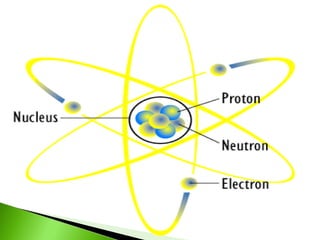
-   Contain inner core called nucleus
-   Nucleus contains proton and neutrons
-   Surrounding the nucleus is a region containing a
    negatively charge particles called electrons
- Combination of 2 or more atoms of the same
  element held together by chemical bonds
- 2 or more atoms of different elements bound
  together
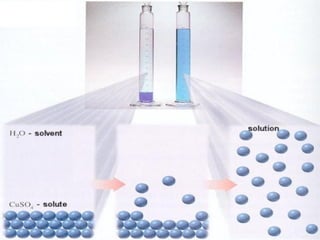
- 2 or more components physically mixed
  together
1. solution
  - homogenous mixture of 2 or more components
  - solute and solvents
2. Colloids- heterogeneous mixture that appear
  milky or translucent. Ex gelatin, cytosol
3. Suspension- heterogeneous mixture with large
  visible solutes. Ex: blood
-   Charged particles
-   Cation
-   Anion
-   Ions dissolved in a solution are called
    electrolytes ex: Na+, K+, Cl -, PO4 -
- Chemical union of 2 or more atoms .
1. Ionic
  - electrons are completely transferred from 1
  atom to another
  ex: Na+ + Cl¯ NaCl
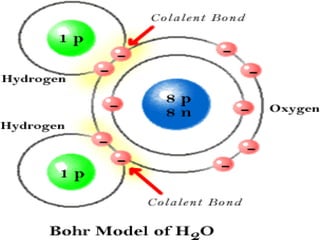
2. Covalent bond- sharing of electrons
  ex: 02
3. Hydrogen bond- hydrogen atoms are already
  linked to one electronegative atom is attracted
  to another electronegative atom
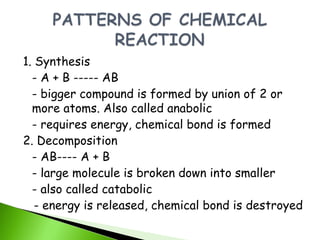
1. Synthesis
  - A + B ----- AB
  - bigger compound is formed by union of 2 or
  more atoms. Also called anabolic
  - requires energy, chemical bond is formed
2. Decomposition
  - AB---- A + B
  - large molecule is broken down into smaller
  - also called catabolic
   - energy is released, chemical bond is destroyed
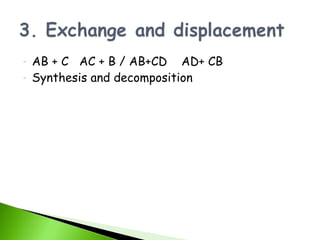
-   AB + C AC + B / AB+CD AD+ CB
-   Synthesis and decomposition
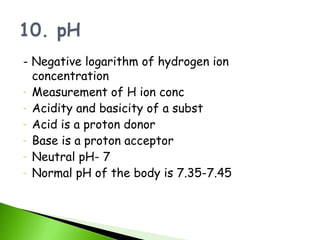
- Negative logarithm of hydrogen ion
  concentration
- Measurement of H ion conc
- Acidity and basicity of a subst
- Acid is a proton donor
- Base is a proton acceptor
- Neutral pH- 7
- Normal pH of the body is 7.35-7.45
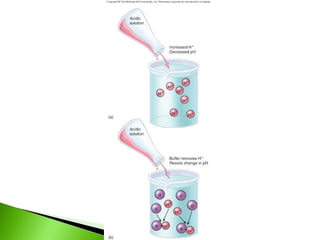
-   Anything that will resist any change in pH
-   Ex: blood
pH and BUFFER
pH = - log [ H + ]
        ACID – donates H+
        BASE – accepts H+

   ACIDOSIS - high [ H+] , low pH
   ALKALOSIS – low [ H+] , high pH

BUFFER - contains an acid and its conjugate base
     - resists ph changes
        - e.g. BICARBONATE BUFFER SYSTEM
                     H2CO3
                     HCO3¯
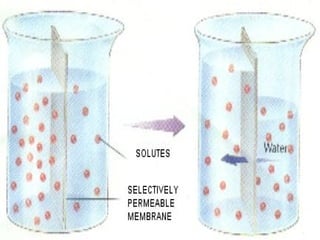
1. Simple diffusion
     - movement from area of
 greater concentration to area
    of lesser concentration
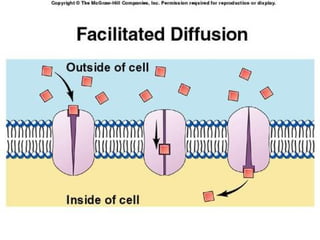
- With  carrier
- Moves bigger particles like
  glucose
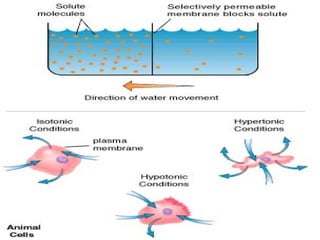
- Movement of water from area
 of lesser to area of greater
 concentration
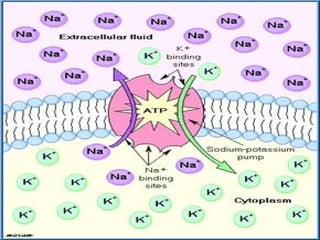
- Movement against conc gradient
- From lesser to greater
- Uses energy
- Ex: Na-K pump
CHEMICAL CONSTITUENTS OF LIVING MATTER

C. CARBOHYDRATES
         - mono-, di-, polysaccharides
         - Functions: structural, energy storage, transport,
                regulatory, catalytic, antigen-antibody reaction,
                cell lubrication, supportive
H. LIPIDS
        - simple, complex, derived lipids
        - Functions: structural, energy storage, transport form
                of metabolic fuel, receptors, determinants of
                immunologic specificity, enzyme cofactors

C. PROTEINS
      - simple, compound
      - fibrous, globular
      - Functions: structural, catalytic, contraction, gene
              regulation, transport, protection, regulatory

D. NUCLEIC ACIDS
      - DNA, RNA
A. Carbohydrates
 - consist of Carbon, hydrogen and oxygen
 1. monosaccharide- glucose, fructose, mannose
 and galactose
 2. Disaccharide-
     lactose = glucose + galactose
     maltose = glucose + glucose
     sucrose = glucose + fructose
 3. Polysaccharides- long chain of
 monosaccharides. Starch, glycogen, cellulose
1.   Structural- cellulose, chitin
2.   Energy storage- starch, glycogen
3.   Transport – glycoprotein
4.   Regulatory- glycoprotein
5.   Catalytic- ribonuclease, deoxyribonuclease
6.   Antigen-antibody rxn- interferon, Rh factor
7.   Cell lubrication- supportive
8.   Component of cell membrane
9.   Component of protective cellular coat
-   Compounds with diverse chemical structure and
    composition
-   Classified according to their solubility
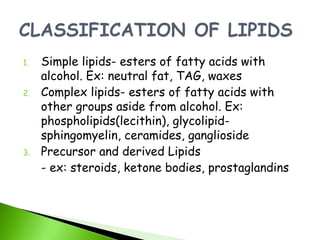
1.   Simple lipids- esters of fatty acids with
     alcohol. Ex: neutral fat, TAG, waxes
2.   Complex lipids- esters of fatty acids with
     other groups aside from alcohol. Ex:
     phospholipids(lecithin), glycolipid-
     sphingomyelin, ceramides, ganglioside
3.   Precursor and derived Lipids
     - ex: steroids, ketone bodies, prostaglandins
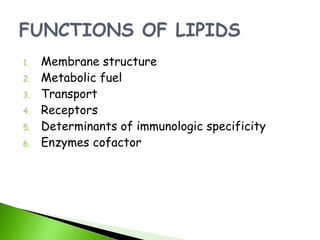
1.   Membrane structure
2.   Metabolic fuel
3.   Transport
4.   Receptors
5.   Determinants of immunologic specificity
6.   Enzymes cofactor
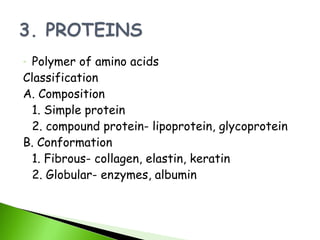
- Polymer of amino acids
Classification
A. Composition
  1. Simple protein
  2. compound protein- lipoprotein, glycoprotein
B. Conformation
  1. Fibrous- collagen, elastin, keratin
  2. Globular- enzymes, albumin
1.   Catalytic role- enzymes
2.   Contraction- actin and myosin
3.   Gene regulation- histones,
4.   Transport- transferrin
5.   Protection- immuneglobulin
6.   Regulatory- protein hormones
7.   Structural- collagen
-   Made up of nucleotides, a molecule composed of
    nitrogenous base, phosphate and pentose sugar
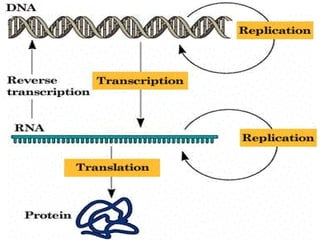
-   DNA- central storage of information
        - carrier of genetic material
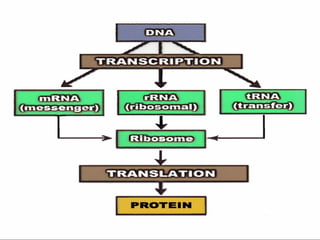
-   RNA- needed in protein synthesis
    - Ex: mRNA, tRNA, rRNA
Basic chemistry and chemical composition edited (1)

Basic chemistry and chemical composition edited (1)

  • 1.
  • 2.
    1. Matter - occupies space and has mass
  • 3.
    - No mass but can be measured - Drives the chemical process - Ultimate source of energy is the sun - Plants convert the energy into high energy bonds through the process of photosynthesis
  • 4.
    - Fundamental substancecomposing of matter
  • 5.
    - Building block of elements - Contain inner core called nucleus - Nucleus contains proton and neutrons - Surrounding the nucleus is a region containing a negatively charge particles called electrons
  • 7.
    - Combination of2 or more atoms of the same element held together by chemical bonds
  • 8.
    - 2 ormore atoms of different elements bound together
  • 9.
    - 2 ormore components physically mixed together 1. solution - homogenous mixture of 2 or more components - solute and solvents 2. Colloids- heterogeneous mixture that appear milky or translucent. Ex gelatin, cytosol 3. Suspension- heterogeneous mixture with large visible solutes. Ex: blood
  • 11.
    - Charged particles - Cation - Anion - Ions dissolved in a solution are called electrolytes ex: Na+, K+, Cl -, PO4 -
  • 12.
    - Chemical unionof 2 or more atoms . 1. Ionic - electrons are completely transferred from 1 atom to another ex: Na+ + Cl¯ NaCl 2. Covalent bond- sharing of electrons ex: 02 3. Hydrogen bond- hydrogen atoms are already linked to one electronegative atom is attracted to another electronegative atom
  • 14.
    1. Synthesis - A + B ----- AB - bigger compound is formed by union of 2 or more atoms. Also called anabolic - requires energy, chemical bond is formed 2. Decomposition - AB---- A + B - large molecule is broken down into smaller - also called catabolic - energy is released, chemical bond is destroyed
  • 15.
    - AB + C AC + B / AB+CD AD+ CB - Synthesis and decomposition
  • 16.
    - Negative logarithmof hydrogen ion concentration - Measurement of H ion conc - Acidity and basicity of a subst - Acid is a proton donor - Base is a proton acceptor - Neutral pH- 7 - Normal pH of the body is 7.35-7.45
  • 17.
    - Anything that will resist any change in pH - Ex: blood
  • 18.
    pH and BUFFER pH= - log [ H + ] ACID – donates H+ BASE – accepts H+ ACIDOSIS - high [ H+] , low pH ALKALOSIS – low [ H+] , high pH BUFFER - contains an acid and its conjugate base - resists ph changes - e.g. BICARBONATE BUFFER SYSTEM H2CO3 HCO3¯
  • 20.
    1. Simple diffusion - movement from area of greater concentration to area of lesser concentration
  • 22.
    - With carrier - Moves bigger particles like glucose
  • 24.
    - Movement ofwater from area of lesser to area of greater concentration
  • 26.
    - Movement againstconc gradient - From lesser to greater - Uses energy - Ex: Na-K pump
  • 28.
    CHEMICAL CONSTITUENTS OFLIVING MATTER C. CARBOHYDRATES - mono-, di-, polysaccharides - Functions: structural, energy storage, transport, regulatory, catalytic, antigen-antibody reaction, cell lubrication, supportive H. LIPIDS - simple, complex, derived lipids - Functions: structural, energy storage, transport form of metabolic fuel, receptors, determinants of immunologic specificity, enzyme cofactors C. PROTEINS - simple, compound - fibrous, globular - Functions: structural, catalytic, contraction, gene regulation, transport, protection, regulatory D. NUCLEIC ACIDS - DNA, RNA
  • 29.
    A. Carbohydrates -consist of Carbon, hydrogen and oxygen 1. monosaccharide- glucose, fructose, mannose and galactose 2. Disaccharide- lactose = glucose + galactose maltose = glucose + glucose sucrose = glucose + fructose 3. Polysaccharides- long chain of monosaccharides. Starch, glycogen, cellulose
  • 30.
    1. Structural- cellulose, chitin 2. Energy storage- starch, glycogen 3. Transport – glycoprotein 4. Regulatory- glycoprotein 5. Catalytic- ribonuclease, deoxyribonuclease 6. Antigen-antibody rxn- interferon, Rh factor 7. Cell lubrication- supportive 8. Component of cell membrane 9. Component of protective cellular coat
  • 31.
    - Compounds with diverse chemical structure and composition - Classified according to their solubility
  • 32.
    1. Simple lipids- esters of fatty acids with alcohol. Ex: neutral fat, TAG, waxes 2. Complex lipids- esters of fatty acids with other groups aside from alcohol. Ex: phospholipids(lecithin), glycolipid- sphingomyelin, ceramides, ganglioside 3. Precursor and derived Lipids - ex: steroids, ketone bodies, prostaglandins
  • 33.
    1. Membrane structure 2. Metabolic fuel 3. Transport 4. Receptors 5. Determinants of immunologic specificity 6. Enzymes cofactor
  • 34.
    - Polymer ofamino acids Classification A. Composition 1. Simple protein 2. compound protein- lipoprotein, glycoprotein B. Conformation 1. Fibrous- collagen, elastin, keratin 2. Globular- enzymes, albumin
  • 35.
    1. Catalytic role- enzymes 2. Contraction- actin and myosin 3. Gene regulation- histones, 4. Transport- transferrin 5. Protection- immuneglobulin 6. Regulatory- protein hormones 7. Structural- collagen
  • 36.
    - Made up of nucleotides, a molecule composed of nitrogenous base, phosphate and pentose sugar - DNA- central storage of information - carrier of genetic material - RNA- needed in protein synthesis - Ex: mRNA, tRNA, rRNA