BASIC BIOLOGICAL CONCEPTS  AND  BASIC GENETICS   BHARTI MPH
BASIC  BIOLOGICAL  CONCEPTS
CELL A cell is a smallest unit that is capable of performing life function
Cell Theory  All living things are made up of cell Cells are the smallest working units of all living things. All cells come from preexisting cells through cell division.
 
TYPES OF CELLS Prokaryotic cell Eukaryotic cell
CHARACTERSTICS OF  PROKARYOTIC CELL 1.Do not have structures surrounded by membranes. 2.Few internal structures. 3. One –celled organism , Bacteria
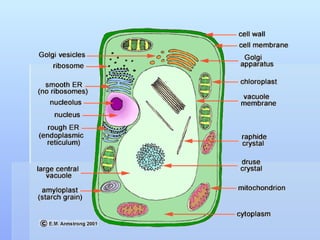
CHARACTERSTICS OF EUKARYOTIC CELL Contain organelles surrounded by membranes. Most living organisms. IT IS OF TWO TYPES: Animal cell Plant cell
 
 
DIFFERENT ORGANELLES OF ANIMAL CELL Ribosome's Endoplasmic Reticulum (ER) Golgi Apparatus Lysosomes Mitochondria Cytoplasm Nucleus Cell Membrane
BACTERIA Simple structure Lacks membrane – bound nucleus Enormous range of metabolic activities Few bacteria causes disease Usually they contain peptidoglycan Gives shape & mechanical strength to the cell
CLASSIFICATION ON THE BASIS OF STAINING Bacteria can be divided into  two groups on the basis of gram staining. Gram positive bacteria Gram negative bacteria
SHAPES Round shape (cocci) Rod shape (bacilli) Spiral shape (Spring like)
BACTERIAL DISEASE Diptheria Tuberculosis Whooping cough Tetanus Cholera Typhoid fever Bacterial Dysentry
VIRUS Sub-microscopic infectious agent  Unable to grow or reproduce outside a host cell Consist of genetic material (DNA,RNA)
VIRAL DISEASES Influenza Common cold Small pox Mumps Measles German measles Poliovirus Yellow fever
FUNGI Eukaryotic organism Heterotrophic organisms possessing a chitinous cell wall Some fungal species grow as single cell Examples: yeasts, molds, mushrooms Symptoms: fluffy white patches, reed inflamed skin under patch, severe irritation
DISEASE CAUSED BY FUNGI Athlete's foot Head ringworm Candidiasis
PROTOZOA One –celled animals Smallest of all animals Most of them can only be seen under a microscope They do breathe, move, reproduce like multi celled animals
Live in water where it is damp Example: paramecium, euglena, amoeba Some are harmful to man ,cause serious diseases Helpful because they eat harmful bacteria and are food for fish and other animal Also called fission
DISEASE CAUSED BY PROTOZA Malaria Amoebiasis
BASIC CONCEPTS IN  GENETICS
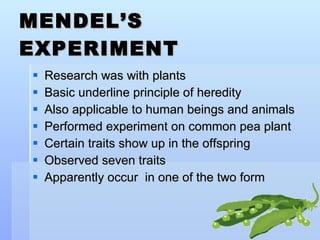
MENDEL’S EXPERIMENT Research was with plants Basic underline principle of heredity Also applicable to human beings and animals Performed experiment on common pea plant Certain traits show up in the offspring  Observed seven traits Apparently occur  in one of the two form
TRAITS Flower color is purple or white Flower position is axil or terminal  Stem length is long or short  Seed shape is round or wrinkled Seed color is yellow or green Pod shape is inflated or constricted Pod color is yellow or green
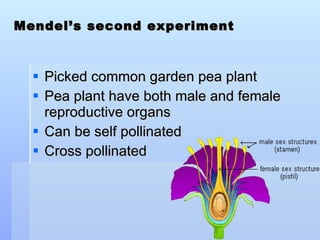
Mendel’s second experiment Picked common garden pea plant  Pea plant have both male and female reproductive organs Can be self pollinated  Cross pollinated
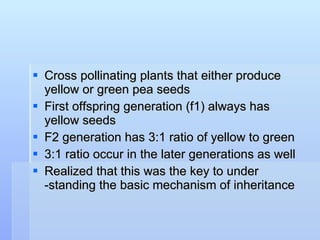
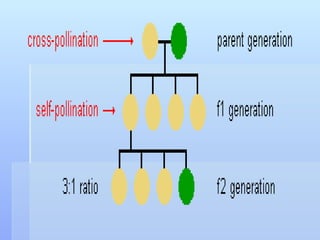
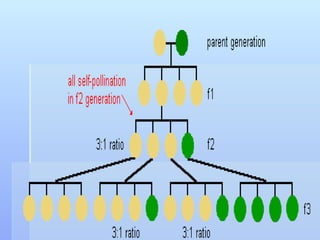
Cross pollinating plants that either produce yellow or green pea seeds First offspring generation (f1) always has yellow seeds F2 generation has 3:1 ratio of yellow to green 3:1 ratio occur in the later generations as well Realized that this was the key to under -standing the basic mechanism of inheritance
 
 
conclusion inheritance of each trait is determined by ‘units’ or ‘factors’ that are passed on to descendents unchanged (genes) An individual inherits one such unit from each parent for each trait Trait may not show up in an individual but can still be passed on to the next generation
Starting parent plants – homozygous (alleles or form) F1 generation – heterozygous (different alleles) Genotype Phenotype
 
the principle of segregation the principle of independent assortment
thank you

Basic Biological Concepts & Basic Genetics

  • 1.
    BASIC BIOLOGICAL CONCEPTS AND BASIC GENETICS BHARTI MPH
  • 2.
  • 3.
    CELL A cellis a smallest unit that is capable of performing life function
  • 4.
    Cell Theory All living things are made up of cell Cells are the smallest working units of all living things. All cells come from preexisting cells through cell division.
  • 5.
  • 6.
    TYPES OF CELLSProkaryotic cell Eukaryotic cell
  • 7.
    CHARACTERSTICS OF PROKARYOTIC CELL 1.Do not have structures surrounded by membranes. 2.Few internal structures. 3. One –celled organism , Bacteria
  • 8.
    CHARACTERSTICS OF EUKARYOTICCELL Contain organelles surrounded by membranes. Most living organisms. IT IS OF TWO TYPES: Animal cell Plant cell
  • 9.
  • 10.
  • 11.
    DIFFERENT ORGANELLES OFANIMAL CELL Ribosome's Endoplasmic Reticulum (ER) Golgi Apparatus Lysosomes Mitochondria Cytoplasm Nucleus Cell Membrane
  • 12.
    BACTERIA Simple structureLacks membrane – bound nucleus Enormous range of metabolic activities Few bacteria causes disease Usually they contain peptidoglycan Gives shape & mechanical strength to the cell
  • 13.
    CLASSIFICATION ON THEBASIS OF STAINING Bacteria can be divided into two groups on the basis of gram staining. Gram positive bacteria Gram negative bacteria
  • 14.
    SHAPES Round shape(cocci) Rod shape (bacilli) Spiral shape (Spring like)
  • 15.
    BACTERIAL DISEASE DiptheriaTuberculosis Whooping cough Tetanus Cholera Typhoid fever Bacterial Dysentry
  • 16.
    VIRUS Sub-microscopic infectiousagent Unable to grow or reproduce outside a host cell Consist of genetic material (DNA,RNA)
  • 17.
    VIRAL DISEASES InfluenzaCommon cold Small pox Mumps Measles German measles Poliovirus Yellow fever
  • 18.
    FUNGI Eukaryotic organismHeterotrophic organisms possessing a chitinous cell wall Some fungal species grow as single cell Examples: yeasts, molds, mushrooms Symptoms: fluffy white patches, reed inflamed skin under patch, severe irritation
  • 19.
    DISEASE CAUSED BYFUNGI Athlete's foot Head ringworm Candidiasis
  • 20.
    PROTOZOA One –celledanimals Smallest of all animals Most of them can only be seen under a microscope They do breathe, move, reproduce like multi celled animals
  • 21.
    Live in waterwhere it is damp Example: paramecium, euglena, amoeba Some are harmful to man ,cause serious diseases Helpful because they eat harmful bacteria and are food for fish and other animal Also called fission
  • 22.
    DISEASE CAUSED BYPROTOZA Malaria Amoebiasis
  • 23.
  • 24.
    MENDEL’S EXPERIMENT Researchwas with plants Basic underline principle of heredity Also applicable to human beings and animals Performed experiment on common pea plant Certain traits show up in the offspring Observed seven traits Apparently occur in one of the two form
  • 25.
    TRAITS Flower coloris purple or white Flower position is axil or terminal Stem length is long or short Seed shape is round or wrinkled Seed color is yellow or green Pod shape is inflated or constricted Pod color is yellow or green
  • 26.
    Mendel’s second experimentPicked common garden pea plant Pea plant have both male and female reproductive organs Can be self pollinated Cross pollinated
  • 27.
    Cross pollinating plantsthat either produce yellow or green pea seeds First offspring generation (f1) always has yellow seeds F2 generation has 3:1 ratio of yellow to green 3:1 ratio occur in the later generations as well Realized that this was the key to under -standing the basic mechanism of inheritance
  • 28.
  • 29.
  • 30.
    conclusion inheritance ofeach trait is determined by ‘units’ or ‘factors’ that are passed on to descendents unchanged (genes) An individual inherits one such unit from each parent for each trait Trait may not show up in an individual but can still be passed on to the next generation
  • 31.
    Starting parent plants– homozygous (alleles or form) F1 generation – heterozygous (different alleles) Genotype Phenotype
  • 32.
  • 33.
    the principle ofsegregation the principle of independent assortment
  • 34.