Journal of Public Health|Vol.31,No.3,pp 389-397 14 May 2009 Does child gender determine household decision for health care in rural Thatta,Pakistan ? R.Nurudine,W.C.Hadden,M.R.Petersen, M.K.Lim Bharti MPH
Introduction Index Journal  Impact factor -1.109 ISSN No. – 1464-360X (online) and 1101-1262 (print) Frequency –After every 3 months Year – 2009 Page  -389-397 , vol. 31,No.3 Funding – IDRC,Canada
Authors R. Nuruddin , Assistant Professor 1,2  W. C. Hadden , Visiting Faculty 1 , M. R. Petersen , Independent Consultant 3  M. K. Lim , Associate Professor 2  Department of Community Health Sciences,  Aga   Khan   University , Stadium Road, PO Box 3500,  Karachi  74800, Pakistan. Department of Community, Occupational and Family Medicine, Yong Loo Lin School of Medicine, National  University  of Singapore, 117597, Singapore. Independent Consultant, Cincinnati, Ohio, USA.    Rozina  Nuruddin , E-mail:  [email_address]
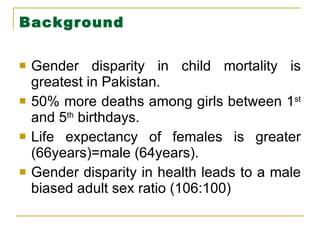
Background  Gender disparity in child mortality is greatest in Pakistan. 50% more deaths among girls between 1 st  and 5 th  birthdays. Life expectancy of females is greater (66years)=male (64years). Gender disparity in health leads to a male biased adult sex ratio (106:100)
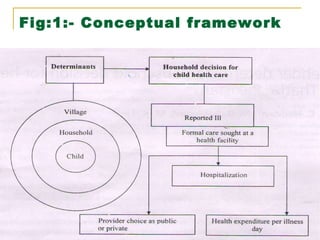
Seeking timely health care. Effective low cost treatments are available. Studies show that boys are favoured in the use of health services . Conceptual framework developed by Pokhrel and Sauerborn provides four decisions for care seeking.
Fig:1:- Conceptual framework
Aim To examine gender as a determinant of health decisions in specific conceptual and analytical framework.
Materials and methods   Data collected  :- Nov 1992 and Feb 1993. Rural district (Thatta) of Sindh province , by Aga Khan University Karachi. Survey  :Provide baseline information on health and nutrition status. More recent Pakistan social and living standard measurement survey (2006-2007) and  demographic health survey (2007), Lack information about determinants of health care.
Infant mortality ratio / 1000 live births of 78 in 1992-93 and 91 in 2003-04. Underweight prevalence - 48% for children under 3 in 1992-93 and 49% for children under 5 in 2003-04.  Literacy level - 32%  Concrete housing - 17% population in  1992-93 and 19% in 2004-05.
Study site Thatta predominantly rural district 60 km from east of Karachi. 1.1million people predominantly Muslim and speak Sindhi. Health care system consist of : Public health care system  BHU- charge nominal fees only 2 (PR) (US$ 0.06) , 1US$ =30 PR-1993) – closed after 14:00 h. Private sector Its routine out- patient service cost 15-50 PR  (US$ 0.30-1.6).
Survey sampling Total  43 rural administrative units of Thatta ,12 were included in the survey. 99 villages within 5km of primary health care selected- using a simple random sampling 250 households per PHC unit. Only 9% households refused to participate. 2276 household were surveyed. All children aged 1-59 months (3740) included.
Data collection Mother was asked about -: Age , Literacy status , No. of live children.  Health status. Children age calculated using a calendar. Five stages in health care seeking: Recent child illness reported by mother during the past year. Formal care sought at a health facility. Provider choice. Hospitalization for at least a day. Health expenditure.
Illness type Pneumonia  Measles Whooping cough  Upper respiratory illness  Ear infection  Others fever : malaria, poliomyelitis, meningitis and diarrhoea.
Three indicators of household socio-economic status (SES): Type of house Land ownership Per capita average monthly household income Subject grouped :Low , middle and upper SES
Village headman provided information : Presence of girl’s school. Transport availability. Village distance . Mortality ratio  calculated according to WHO standards   Mortality Ratio = Gender specific deaths during year /Gender specific live births.
Neonates excluded from further analysis.  To account for unequal selection probabilities and to reduce bias, weights calculated as inverse of sample. Differences in mortality ratio between girls and boys examined.
Statistic used Calculated adjusted prevalence ratio using SAS Proc Genmod with binomial distribution and log- link function. Adopted  COPY method when the log- binomial model did not converge. Clustering at village level was accounted for by the use of cluster identity for village level variables in a repeated statement using Proc Genmod.
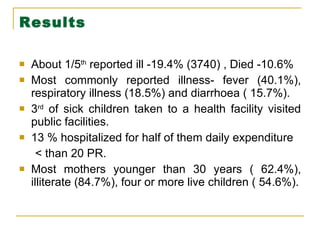
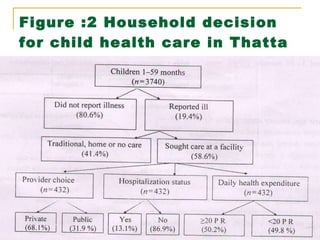
Results  About 1/5 th  reported ill -19.4% (3740) , Died -10.6% Most commonly reported illness- fever (40.1%), respiratory illness (18.5%) and diarrhoea ( 15.7%). 3 rd  of sick children taken to a health facility visited public facilities. 13 % hospitalized for half of them daily expenditure  < than 20 PR. Most mothers younger than 30 years ( 62.4%), illiterate (84.7%), four or more live children ( 54.6%).
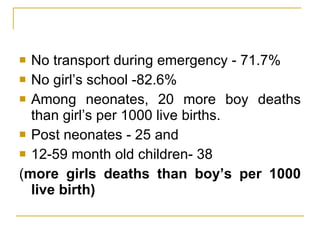
No transport during emergency - 71.7%  No girl’s school -82.6% Among neonates, 20 more boy deaths than girl’s per 1000 live births.  Post neonates - 25 and  12-59 month old children- 38  ( more girls deaths than boy’s per 1000 live birth)
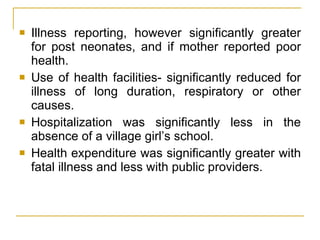
Illness reporting, however significantly greater for post neonates, and if mother reported poor health. Use of health facilities- significantly reduced for illness of long duration, respiratory or other causes. Hospitalization was significantly less in the absence of a village girl’s school. Health expenditure was significantly greater with fatal illness and less with public providers.
Figure :2 Household decision for child health care in Thatta district
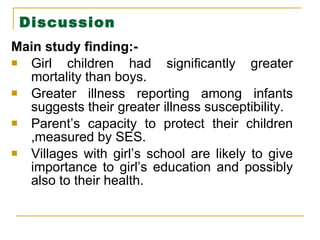
Discussion Main study finding:- Girl children had significantly greater mortality than boys. Greater illness reporting among infants suggests their greater illness susceptibility. Parent’s capacity to protect their children ,measured by SES. Villages with girl’s school are likely to give importance to girl’s education and possibly also to their health.
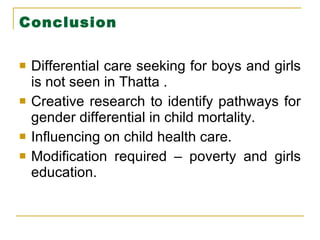
Conclusion Differential care seeking for boys and girls is not seen in Thatta . Creative research to identify pathways for gender differential in child mortality. Influencing on child health care. Modification required – poverty and girls education.
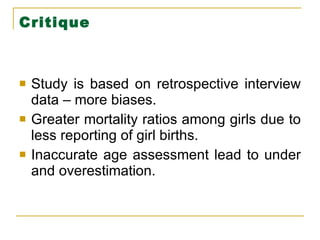
Critique Study is based on retrospective interview data – more biases. Greater mortality ratios among girls due to less reporting of girl births. Inaccurate age assessment lead to under and overestimation.
THANK YOU

journal club

  • 1.
    Journal of PublicHealth|Vol.31,No.3,pp 389-397 14 May 2009 Does child gender determine household decision for health care in rural Thatta,Pakistan ? R.Nurudine,W.C.Hadden,M.R.Petersen, M.K.Lim Bharti MPH
  • 2.
    Introduction Index Journal Impact factor -1.109 ISSN No. – 1464-360X (online) and 1101-1262 (print) Frequency –After every 3 months Year – 2009 Page -389-397 , vol. 31,No.3 Funding – IDRC,Canada
  • 3.
    Authors R. Nuruddin, Assistant Professor 1,2 W. C. Hadden , Visiting Faculty 1 , M. R. Petersen , Independent Consultant 3 M. K. Lim , Associate Professor 2 Department of Community Health Sciences, Aga Khan University , Stadium Road, PO Box 3500, Karachi 74800, Pakistan. Department of Community, Occupational and Family Medicine, Yong Loo Lin School of Medicine, National University of Singapore, 117597, Singapore. Independent Consultant, Cincinnati, Ohio, USA. Rozina Nuruddin , E-mail: [email_address]
  • 4.
    Background Genderdisparity in child mortality is greatest in Pakistan. 50% more deaths among girls between 1 st and 5 th birthdays. Life expectancy of females is greater (66years)=male (64years). Gender disparity in health leads to a male biased adult sex ratio (106:100)
  • 5.
    Seeking timely healthcare. Effective low cost treatments are available. Studies show that boys are favoured in the use of health services . Conceptual framework developed by Pokhrel and Sauerborn provides four decisions for care seeking.
  • 6.
  • 7.
    Aim To examinegender as a determinant of health decisions in specific conceptual and analytical framework.
  • 8.
    Materials and methods Data collected :- Nov 1992 and Feb 1993. Rural district (Thatta) of Sindh province , by Aga Khan University Karachi. Survey :Provide baseline information on health and nutrition status. More recent Pakistan social and living standard measurement survey (2006-2007) and demographic health survey (2007), Lack information about determinants of health care.
  • 9.
    Infant mortality ratio/ 1000 live births of 78 in 1992-93 and 91 in 2003-04. Underweight prevalence - 48% for children under 3 in 1992-93 and 49% for children under 5 in 2003-04. Literacy level - 32% Concrete housing - 17% population in 1992-93 and 19% in 2004-05.
  • 10.
    Study site Thattapredominantly rural district 60 km from east of Karachi. 1.1million people predominantly Muslim and speak Sindhi. Health care system consist of : Public health care system BHU- charge nominal fees only 2 (PR) (US$ 0.06) , 1US$ =30 PR-1993) – closed after 14:00 h. Private sector Its routine out- patient service cost 15-50 PR (US$ 0.30-1.6).
  • 11.
    Survey sampling Total 43 rural administrative units of Thatta ,12 were included in the survey. 99 villages within 5km of primary health care selected- using a simple random sampling 250 households per PHC unit. Only 9% households refused to participate. 2276 household were surveyed. All children aged 1-59 months (3740) included.
  • 12.
    Data collection Motherwas asked about -: Age , Literacy status , No. of live children. Health status. Children age calculated using a calendar. Five stages in health care seeking: Recent child illness reported by mother during the past year. Formal care sought at a health facility. Provider choice. Hospitalization for at least a day. Health expenditure.
  • 13.
    Illness type Pneumonia Measles Whooping cough Upper respiratory illness Ear infection Others fever : malaria, poliomyelitis, meningitis and diarrhoea.
  • 14.
    Three indicators ofhousehold socio-economic status (SES): Type of house Land ownership Per capita average monthly household income Subject grouped :Low , middle and upper SES
  • 15.
    Village headman providedinformation : Presence of girl’s school. Transport availability. Village distance . Mortality ratio calculated according to WHO standards Mortality Ratio = Gender specific deaths during year /Gender specific live births.
  • 16.
    Neonates excluded fromfurther analysis. To account for unequal selection probabilities and to reduce bias, weights calculated as inverse of sample. Differences in mortality ratio between girls and boys examined.
  • 17.
    Statistic used Calculatedadjusted prevalence ratio using SAS Proc Genmod with binomial distribution and log- link function. Adopted COPY method when the log- binomial model did not converge. Clustering at village level was accounted for by the use of cluster identity for village level variables in a repeated statement using Proc Genmod.
  • 18.
    Results About1/5 th reported ill -19.4% (3740) , Died -10.6% Most commonly reported illness- fever (40.1%), respiratory illness (18.5%) and diarrhoea ( 15.7%). 3 rd of sick children taken to a health facility visited public facilities. 13 % hospitalized for half of them daily expenditure < than 20 PR. Most mothers younger than 30 years ( 62.4%), illiterate (84.7%), four or more live children ( 54.6%).
  • 19.
    No transport duringemergency - 71.7% No girl’s school -82.6% Among neonates, 20 more boy deaths than girl’s per 1000 live births. Post neonates - 25 and 12-59 month old children- 38 ( more girls deaths than boy’s per 1000 live birth)
  • 20.
    Illness reporting, howeversignificantly greater for post neonates, and if mother reported poor health. Use of health facilities- significantly reduced for illness of long duration, respiratory or other causes. Hospitalization was significantly less in the absence of a village girl’s school. Health expenditure was significantly greater with fatal illness and less with public providers.
  • 21.
    Figure :2 Householddecision for child health care in Thatta district
  • 22.
    Discussion Main studyfinding:- Girl children had significantly greater mortality than boys. Greater illness reporting among infants suggests their greater illness susceptibility. Parent’s capacity to protect their children ,measured by SES. Villages with girl’s school are likely to give importance to girl’s education and possibly also to their health.
  • 23.
    Conclusion Differential careseeking for boys and girls is not seen in Thatta . Creative research to identify pathways for gender differential in child mortality. Influencing on child health care. Modification required – poverty and girls education.
  • 24.
    Critique Study isbased on retrospective interview data – more biases. Greater mortality ratios among girls due to less reporting of girl births. Inaccurate age assessment lead to under and overestimation.
  • 25.