THE UGANDA INSTITUTE
OF BANKING &
FINANCIAL SERVICES
UIBFS
ISO 9001:2008 CERTIFIED
1
Module 9: Basic Accounting
THE UGANDA INSTITUTE
OF BANKING &
FINANCIAL SERVICES
UIBFS
ISO 9001:2008 CERTIFIED
LEARNING OBJECTIVES
By the end of this module, the students should be able to;
• Define accounting and explain its basic framework.
• Post and process transactions
• Explain the logic of and reasons for year-end adjustments
and provisions in accounting
• Prepare year-end financial statements
• Articulate the nature of published accounts as well the
common Financial Reporting Standards
• Calculate key financial ratios and construct simple financial
projections from relevant information
• Explain the basic principles of taxation in Uganda
2
THE UGANDA INSTITUTE
OF BANKING &
FINANCIAL SERVICES
UIBFS
ISO 9001:2008 CERTIFIED
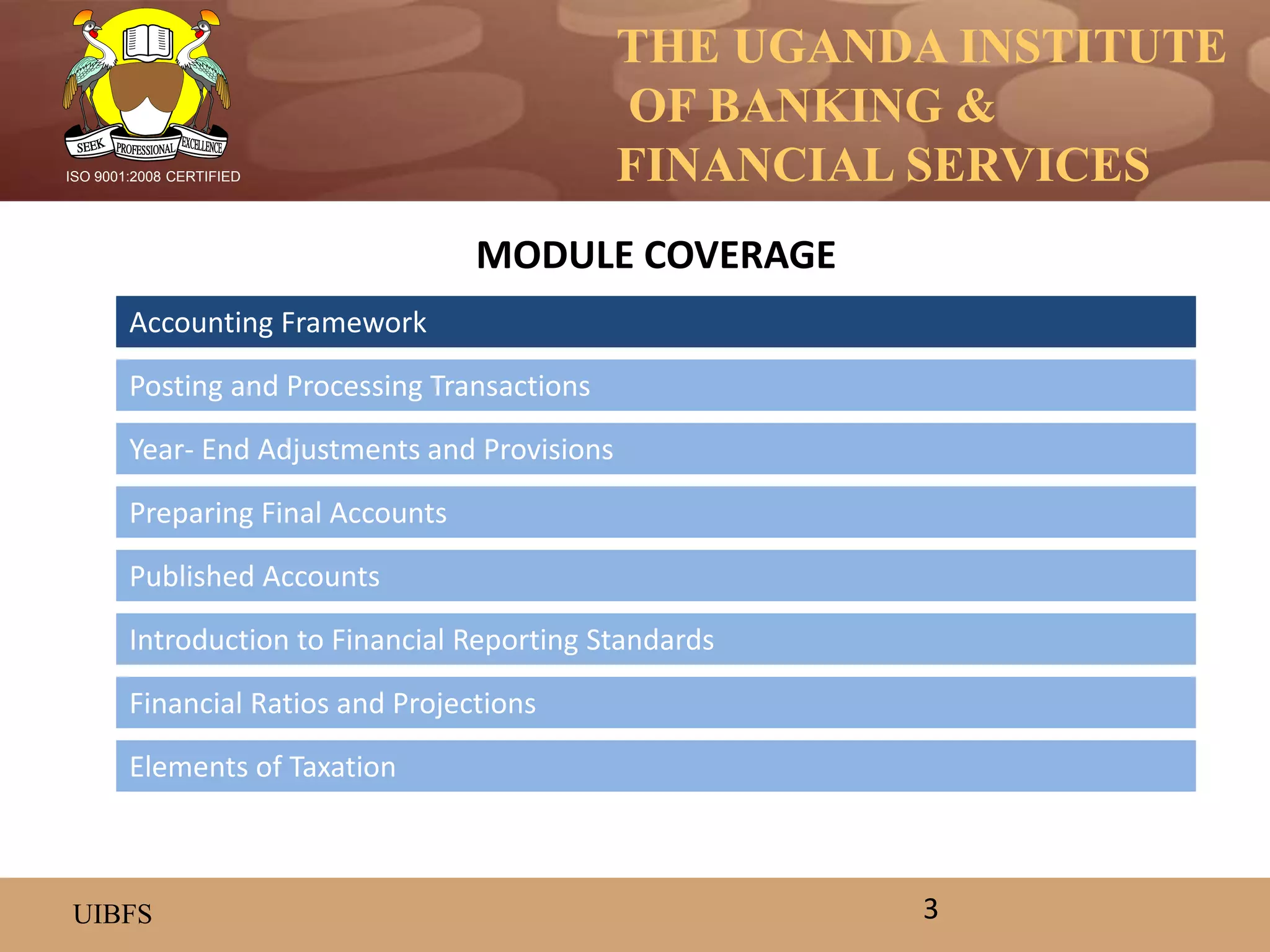
Accounting Framework
Posting and Processing Transactions
Year- End Adjustments and Provisions
Preparing Final Accounts
Introduction to Financial Reporting Standards
Published Accounts
MODULE COVERAGE
3
Financial Ratios and Projections
Elements of Taxation
THE UGANDA INSTITUTE
OF BANKING &
FINANCIAL SERVICES
UIBFS
ISO 9001:2008 CERTIFIED
What is accounting?
• Accounting can be defined as the process of recording, classifying and
summarizing economic transactions in preparation of financial statements that
provide information about the financial position, performance and changes in an
enterprise or economic entity.
• Everyday, banks engage in thousands of business transactions, which result in
money or value changing hands. All these transactions need to be recorded
accurately otherwise the bank can easily lose track of its operations.
• The process of recording these financial transactions in the books of accounts and
summarizing the results is referred to as book keeping.
• Once the transactions have been recorded and summarized, they need to be
interpreted and communicated to the end users.
• Accounting is thus concerned with the interpretation and communication of the
financial information resulting from transactions through the financial reports.
• These financial reports include amongst others the Balance Sheet, Income
Statement and Cash flow Statements. Through these financial statements,
accounting provides most of the necessary financial information.
4
THE UGANDA INSTITUTE
OF BANKING &
FINANCIAL SERVICES
UIBFS
ISO 9001:2008 CERTIFIED
The key objectives of accounting for every bank should be to;
1. Construct accurate records that are the starting point for
measuring performance and reporting progress
2. Provide information to facilitate high quality financial analysis by
various stakeholders
3. Avail factual information to aid clear well informed managerial
decisions
4. Reassure and inspire confidence to shareholders, lenders, the
regulator (Bank of Uganda) and the banking public
5. Users of accounting information
6. Accounting information is collected, processed and produced with
a focus on its users. Accounting is, in this sense, a clear and
standard way of producing financial information and
communicating it to internal and external users.
5
THE UGANDA INSTITUTE
OF BANKING &
FINANCIAL SERVICES
UIBFS
ISO 9001:2008 CERTIFIED
Below are typical users of accounting information and their respective needs
a. Shareholders: As owners of the bank, these are interested in prospects of
receiving dividends, capital growth and the safety of their assets in the
institution. It is in their best interest that the financial statements show that the
bank is run in a profitable, safe and sound way.
b. Board/Directors: The board members would like to interpret/ analyze financial
statements and operational statistics to better perform their key duty of
monitoring management performance and steering the bank towards attaining
its institutional objectives, which usually include profitability for improving
shareholder value and facilitating organic growth.
c. Creditors: The creditors would like to be assured that the bank will be able to
service its debts without difficulty. They are concerned with short term liquidity,
long term solvency and overall the level of indebtedness in relation to equity.
d. Management: Managers of a bank would like to know how they are performing
relative to prior periods and in comparison to targets. They use accounting
information to measure their performance with a view to boosting income and
lowering costs to continually improve.
6
THE UGANDA INSTITUTE
OF BANKING &
FINANCIAL SERVICES
UIBFS
ISO 9001:2008 CERTIFIED
e. Regulators: For banks and other institutions in tier II and III, Bank of Uganda is
their regulator. In this capacity, Bank of Uganda would like to ensure that the
bank complies with all the relevant laws and regulations, is run professionally
and that its financial health remains robust
f. Customers and the general public: The banking public treasures the confidence
that a bank is in sound financial position and that it is running profitably. They
will usually get this information from the published accounts of the bank. This is
one of the reasons that banks are required to publish their audited financial
statements in the press and sometimes in their banking hall.
g. Employees also need these reports in making collective bargaining agreements
(CBA) with the management, in the case of labor unions or for individuals in
discussing their compensation, promotion and rankings.
h. Government entities (tax authorities especially URA) need financial statements
to ascertain the propriety and accuracy of taxes and other duties declared and
paid by the bank.
i. Vendors and Suppliers who extend credit to a business require financial
statements to assess the ability of the bank to pay for supplies more so timely.
7
THE UGANDA INSTITUTE
OF BANKING &
FINANCIAL SERVICES
UIBFS
ISO 9001:2008 CERTIFIED
Attributes of good accounting information
i. Relevant: i.e relating to the transactions in which the bank was a party.
ii. Reliable: i.e. verifiable, accurate/ truthful, neutral and demonstrates
representational faithfulness.
iii. Comparable: information must be measured and reported in a similar manner
for different institutions, especially if there is need to to compare their relative
performance. Banks and other businesses also need to present prior period
accounting information alongside the present period information to facilitate
trend analysis (compare this year’s accounts with prior year accounts).
iv. Consistent: the same accounting methods should be applied from period to
period. This also facilitates comparison of the financial performance of the bank
over a period of time since the same accounting policies would have been used
in the preparation of the accounting information being compared.
v. Comprehensible: The users of the accounting information (though not
accounting professionals, should be able to understand it and as a result make
informed economic decisions based on the information
vi. Timely: The accounting information should be produced on time to be used for
making decisions otherwise its value will not be realized.
vii. Objective: accounting information should not be biased but rather be prepared
on the basis of facts and good practice.
8
THE UGANDA INSTITUTE
OF BANKING &
FINANCIAL SERVICES
UIBFS
ISO 9001:2008 CERTIFIED
International accounting bodies
The accounting profession is regulated internationally by the International Accounting
Standards Board (IASB) which issues accounting standards known as the
International Accounting Standards (IAS) and the International Financial Reporting
Standards (IFRS). There are presently 41 IASs and 8 IFRs (as at Oct 2011).
The objectives of IASB are:
i. To formulate and publish in the public interest accounting standards to be
observed in the presentation of financial statements and to promote their world
wide acceptance and observance.
ii. To work generally for the improvement and harmonization of regulations,
accounting standards and procedures relating to the presentation of financial
statements.
The accounting standards have been adopted by many countries for the preparation
of financial statements by companies in the execution of their regulatory role.
The accounting profession in Uganda is regulated by the Institute of Certified Public
Accountants of Uganda (ICPAU) which is a member of the International Federation
of Accountants (IFAC). ICPAU has also adopted the IASs and IFRSs to be used in
Uganda. We shall therefore be using the IAS and IFRS in this module.
9
THE UGANDA INSTITUTE
OF BANKING &
FINANCIAL SERVICES
UIBFS
ISO 9001:2008 CERTIFIED
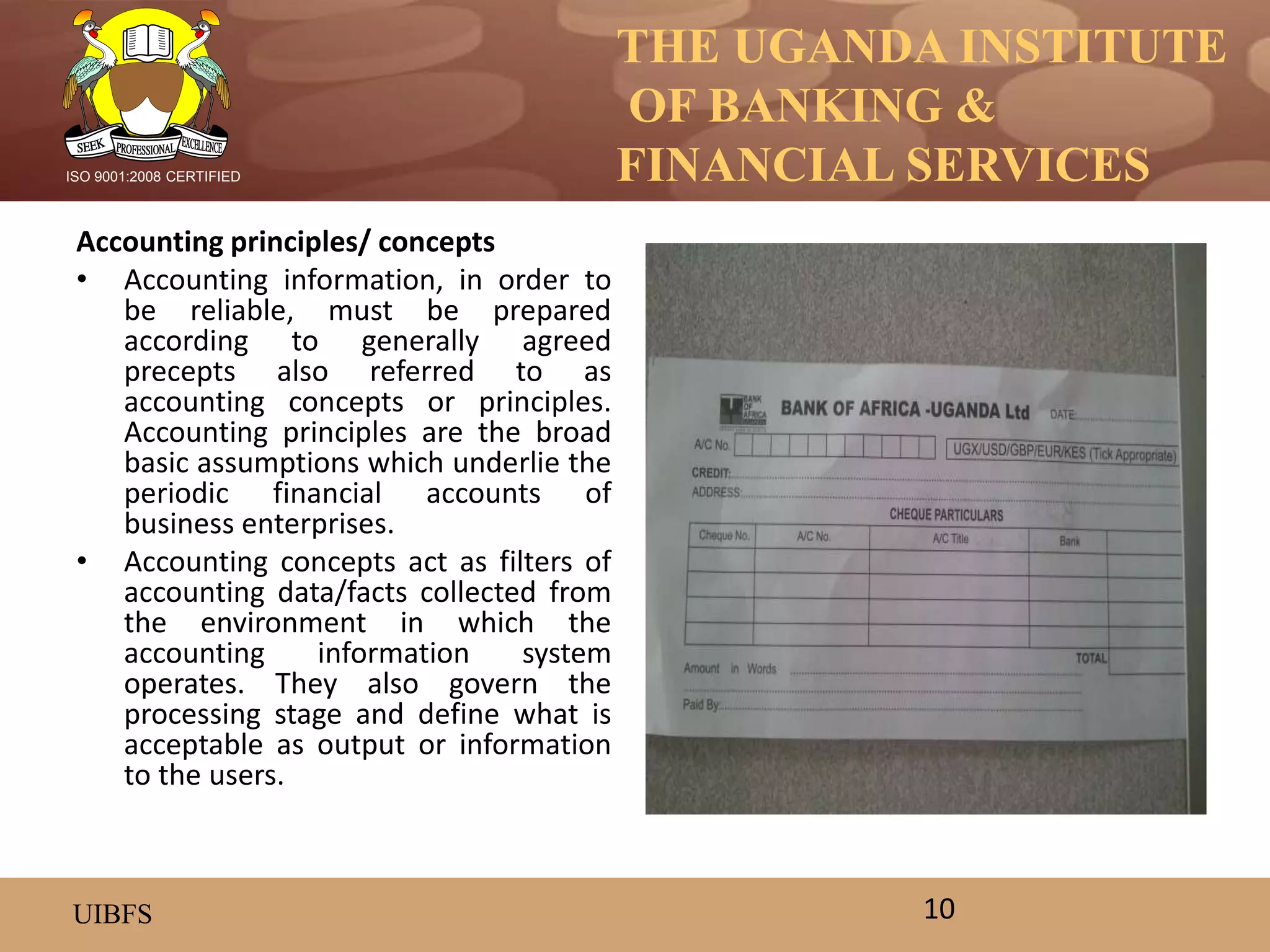
Accounting principles/ concepts
• Accounting information, in order to
be reliable, must be prepared
according to generally agreed
precepts also referred to as
accounting concepts or principles.
Accounting principles are the broad
basic assumptions which underlie the
periodic financial accounts of
business enterprises.
• Accounting concepts act as filters of
accounting data/facts collected from
the environment in which the
accounting information system
operates. They also govern the
processing stage and define what is
acceptable as output or information
to the users.
10
THE UGANDA INSTITUTE
OF BANKING &
FINANCIAL SERVICES
UIBFS
ISO 9001:2008 CERTIFIED
The Accounting profession identifies the following four fundamental principles.
1. Going concern principle:
The institution is viewed as continuing in operation for the foreseeable future and the
accounts should be prepared on the assumption that the organization has neither
the intention nor the necessity of liquidating or of curtailing significantly the scale
of its operations.
2. Accruals’ principle (sometimes called the matching concept).
This requires that costs should be matched against revenues which are produced as a
result of those costs.
The Companies Act 1985 of the Laws of Uganda states that ‘all income and charges
relating to the financial year to which the accounts relate shall be taken into
account, without regard to the date of receipt or payment as long as the business
is entitled to it’.
In other words, if an expense has been paid in one financial period but the related
revenue does not arise until a later one the cost should be carried forward, and if
an expense is incurred in one financial period it should be charged against the
profit of that period, whether or not it has been paid for by the accounting date.
11
THE UGANDA INSTITUTE
OF BANKING &
FINANCIAL SERVICES
UIBFS
ISO 9001:2008 CERTIFIED
3. The Principle of Prudence:
A person is said to be prudent when he gives the most cautious presentation of the
situation. In accounting a knowledgeable user assumes that the preparer has been
cautious to the extent that he has not anticipated any gains (all gains reported
have been realized) and any expenses or losses foreseen with reasonable certainty
have been recognized in the financial statements.
Income should not be anticipated in the accounts but rather only included when the
BANK is legally entitled to it. However, some expenses may not have been paid by
the balance sheet date and yet the services were used like for instance utilities
(water, electricity and telephone bills) in which case these expenses are accrued
(included in the accounts as expenses and the respective service providers
recognized as creditors of the business) at the balance sheet date.
4. Consistency Principle
The accounting treatment of like items should be consistent over successive
accounting periods. When policies are consistently applied, it helps facilitate
comparison of performance over a range of periods. In case the accounting
treatment of any item has changed from one period to another, details of such a
change should be disclosed in the notes to the accounts. The impact of the change
should be quantified and stated.
12
THE UGANDA INSTITUTE
OF BANKING &
FINANCIAL SERVICES
UIBFS
ISO 9001:2008 CERTIFIED
Besides the above four universally agreed fundamental principles or
concepts, there are other principles/ concepts;
Entity concept
This is the assumption that the affairs of an entity are treated as
separate from the other business activities of its owner. The only
time that the personal resources of the proprietor affects the
accounting records of the business is when the proprietor
introduces capital into the business, makes a drawing origin any
other transactions with the business.
Duality concept
Any given transaction will affect a minimum of two accounts within
assets, liabilities, or equity. If the accounting equation (ASSETS =
CAPITAL + LIABILITIES) is to remain in balance, any change in the
assets must be accompanied by an equal change in the liabilities or
equity, or by an equal but opposite change (increase or decrease)
in another asset account.
13
THE UGANDA INSTITUTE
OF BANKING &
FINANCIAL SERVICES
UIBFS
ISO 9001:2008 CERTIFIED
Materiality concept
Under this concept, items are recorded
in financial statements only if they
are material.
Items are material if their omission or
misstatement would affect the
impact of the financial statements.
Materiality as a concept is relative but
some items disclosed in accounts are
particularly sensitive and even a very
small misstatement of such an item
would be seen as a material error for
example where the disclosure of the
absolute amount is a statutory
requirement like for instance the
extent of insider lending (loans to the
shareholders and persons related to
them) in a financial institution.
14
THE UGANDA INSTITUTE
OF BANKING &
FINANCIAL SERVICES
UIBFS
ISO 9001:2008 CERTIFIED
Realization concept
This requires that revenue be recognized in the
accounting period it is earned, rather than
when it is collected in cash. It defines the
point at which revenue is recognized.
“Substance over form” Concept
It stipulates that items in the financial
statements need to be treated more in line
with their economic reality than just their
legal form, as long as this does not result in
violation of materiality. Accordingly, assets,
liabilities, income and expenditure items can
be grouped in some cases and reported as a
single item.
15

Basic accounting unit1

  • 1.
    THE UGANDA INSTITUTE OFBANKING & FINANCIAL SERVICES UIBFS ISO 9001:2008 CERTIFIED 1 Module 9: Basic Accounting
  • 2.
    THE UGANDA INSTITUTE OFBANKING & FINANCIAL SERVICES UIBFS ISO 9001:2008 CERTIFIED LEARNING OBJECTIVES By the end of this module, the students should be able to; • Define accounting and explain its basic framework. • Post and process transactions • Explain the logic of and reasons for year-end adjustments and provisions in accounting • Prepare year-end financial statements • Articulate the nature of published accounts as well the common Financial Reporting Standards • Calculate key financial ratios and construct simple financial projections from relevant information • Explain the basic principles of taxation in Uganda 2
  • 3.
    THE UGANDA INSTITUTE OFBANKING & FINANCIAL SERVICES UIBFS ISO 9001:2008 CERTIFIED Accounting Framework Posting and Processing Transactions Year- End Adjustments and Provisions Preparing Final Accounts Introduction to Financial Reporting Standards Published Accounts MODULE COVERAGE 3 Financial Ratios and Projections Elements of Taxation
  • 4.
    THE UGANDA INSTITUTE OFBANKING & FINANCIAL SERVICES UIBFS ISO 9001:2008 CERTIFIED What is accounting? • Accounting can be defined as the process of recording, classifying and summarizing economic transactions in preparation of financial statements that provide information about the financial position, performance and changes in an enterprise or economic entity. • Everyday, banks engage in thousands of business transactions, which result in money or value changing hands. All these transactions need to be recorded accurately otherwise the bank can easily lose track of its operations. • The process of recording these financial transactions in the books of accounts and summarizing the results is referred to as book keeping. • Once the transactions have been recorded and summarized, they need to be interpreted and communicated to the end users. • Accounting is thus concerned with the interpretation and communication of the financial information resulting from transactions through the financial reports. • These financial reports include amongst others the Balance Sheet, Income Statement and Cash flow Statements. Through these financial statements, accounting provides most of the necessary financial information. 4
  • 5.
    THE UGANDA INSTITUTE OFBANKING & FINANCIAL SERVICES UIBFS ISO 9001:2008 CERTIFIED The key objectives of accounting for every bank should be to; 1. Construct accurate records that are the starting point for measuring performance and reporting progress 2. Provide information to facilitate high quality financial analysis by various stakeholders 3. Avail factual information to aid clear well informed managerial decisions 4. Reassure and inspire confidence to shareholders, lenders, the regulator (Bank of Uganda) and the banking public 5. Users of accounting information 6. Accounting information is collected, processed and produced with a focus on its users. Accounting is, in this sense, a clear and standard way of producing financial information and communicating it to internal and external users. 5
  • 6.
    THE UGANDA INSTITUTE OFBANKING & FINANCIAL SERVICES UIBFS ISO 9001:2008 CERTIFIED Below are typical users of accounting information and their respective needs a. Shareholders: As owners of the bank, these are interested in prospects of receiving dividends, capital growth and the safety of their assets in the institution. It is in their best interest that the financial statements show that the bank is run in a profitable, safe and sound way. b. Board/Directors: The board members would like to interpret/ analyze financial statements and operational statistics to better perform their key duty of monitoring management performance and steering the bank towards attaining its institutional objectives, which usually include profitability for improving shareholder value and facilitating organic growth. c. Creditors: The creditors would like to be assured that the bank will be able to service its debts without difficulty. They are concerned with short term liquidity, long term solvency and overall the level of indebtedness in relation to equity. d. Management: Managers of a bank would like to know how they are performing relative to prior periods and in comparison to targets. They use accounting information to measure their performance with a view to boosting income and lowering costs to continually improve. 6
  • 7.
    THE UGANDA INSTITUTE OFBANKING & FINANCIAL SERVICES UIBFS ISO 9001:2008 CERTIFIED e. Regulators: For banks and other institutions in tier II and III, Bank of Uganda is their regulator. In this capacity, Bank of Uganda would like to ensure that the bank complies with all the relevant laws and regulations, is run professionally and that its financial health remains robust f. Customers and the general public: The banking public treasures the confidence that a bank is in sound financial position and that it is running profitably. They will usually get this information from the published accounts of the bank. This is one of the reasons that banks are required to publish their audited financial statements in the press and sometimes in their banking hall. g. Employees also need these reports in making collective bargaining agreements (CBA) with the management, in the case of labor unions or for individuals in discussing their compensation, promotion and rankings. h. Government entities (tax authorities especially URA) need financial statements to ascertain the propriety and accuracy of taxes and other duties declared and paid by the bank. i. Vendors and Suppliers who extend credit to a business require financial statements to assess the ability of the bank to pay for supplies more so timely. 7
  • 8.
    THE UGANDA INSTITUTE OFBANKING & FINANCIAL SERVICES UIBFS ISO 9001:2008 CERTIFIED Attributes of good accounting information i. Relevant: i.e relating to the transactions in which the bank was a party. ii. Reliable: i.e. verifiable, accurate/ truthful, neutral and demonstrates representational faithfulness. iii. Comparable: information must be measured and reported in a similar manner for different institutions, especially if there is need to to compare their relative performance. Banks and other businesses also need to present prior period accounting information alongside the present period information to facilitate trend analysis (compare this year’s accounts with prior year accounts). iv. Consistent: the same accounting methods should be applied from period to period. This also facilitates comparison of the financial performance of the bank over a period of time since the same accounting policies would have been used in the preparation of the accounting information being compared. v. Comprehensible: The users of the accounting information (though not accounting professionals, should be able to understand it and as a result make informed economic decisions based on the information vi. Timely: The accounting information should be produced on time to be used for making decisions otherwise its value will not be realized. vii. Objective: accounting information should not be biased but rather be prepared on the basis of facts and good practice. 8
  • 9.
    THE UGANDA INSTITUTE OFBANKING & FINANCIAL SERVICES UIBFS ISO 9001:2008 CERTIFIED International accounting bodies The accounting profession is regulated internationally by the International Accounting Standards Board (IASB) which issues accounting standards known as the International Accounting Standards (IAS) and the International Financial Reporting Standards (IFRS). There are presently 41 IASs and 8 IFRs (as at Oct 2011). The objectives of IASB are: i. To formulate and publish in the public interest accounting standards to be observed in the presentation of financial statements and to promote their world wide acceptance and observance. ii. To work generally for the improvement and harmonization of regulations, accounting standards and procedures relating to the presentation of financial statements. The accounting standards have been adopted by many countries for the preparation of financial statements by companies in the execution of their regulatory role. The accounting profession in Uganda is regulated by the Institute of Certified Public Accountants of Uganda (ICPAU) which is a member of the International Federation of Accountants (IFAC). ICPAU has also adopted the IASs and IFRSs to be used in Uganda. We shall therefore be using the IAS and IFRS in this module. 9
  • 10.
    THE UGANDA INSTITUTE OFBANKING & FINANCIAL SERVICES UIBFS ISO 9001:2008 CERTIFIED Accounting principles/ concepts • Accounting information, in order to be reliable, must be prepared according to generally agreed precepts also referred to as accounting concepts or principles. Accounting principles are the broad basic assumptions which underlie the periodic financial accounts of business enterprises. • Accounting concepts act as filters of accounting data/facts collected from the environment in which the accounting information system operates. They also govern the processing stage and define what is acceptable as output or information to the users. 10
  • 11.
    THE UGANDA INSTITUTE OFBANKING & FINANCIAL SERVICES UIBFS ISO 9001:2008 CERTIFIED The Accounting profession identifies the following four fundamental principles. 1. Going concern principle: The institution is viewed as continuing in operation for the foreseeable future and the accounts should be prepared on the assumption that the organization has neither the intention nor the necessity of liquidating or of curtailing significantly the scale of its operations. 2. Accruals’ principle (sometimes called the matching concept). This requires that costs should be matched against revenues which are produced as a result of those costs. The Companies Act 1985 of the Laws of Uganda states that ‘all income and charges relating to the financial year to which the accounts relate shall be taken into account, without regard to the date of receipt or payment as long as the business is entitled to it’. In other words, if an expense has been paid in one financial period but the related revenue does not arise until a later one the cost should be carried forward, and if an expense is incurred in one financial period it should be charged against the profit of that period, whether or not it has been paid for by the accounting date. 11
  • 12.
    THE UGANDA INSTITUTE OFBANKING & FINANCIAL SERVICES UIBFS ISO 9001:2008 CERTIFIED 3. The Principle of Prudence: A person is said to be prudent when he gives the most cautious presentation of the situation. In accounting a knowledgeable user assumes that the preparer has been cautious to the extent that he has not anticipated any gains (all gains reported have been realized) and any expenses or losses foreseen with reasonable certainty have been recognized in the financial statements. Income should not be anticipated in the accounts but rather only included when the BANK is legally entitled to it. However, some expenses may not have been paid by the balance sheet date and yet the services were used like for instance utilities (water, electricity and telephone bills) in which case these expenses are accrued (included in the accounts as expenses and the respective service providers recognized as creditors of the business) at the balance sheet date. 4. Consistency Principle The accounting treatment of like items should be consistent over successive accounting periods. When policies are consistently applied, it helps facilitate comparison of performance over a range of periods. In case the accounting treatment of any item has changed from one period to another, details of such a change should be disclosed in the notes to the accounts. The impact of the change should be quantified and stated. 12
  • 13.
    THE UGANDA INSTITUTE OFBANKING & FINANCIAL SERVICES UIBFS ISO 9001:2008 CERTIFIED Besides the above four universally agreed fundamental principles or concepts, there are other principles/ concepts; Entity concept This is the assumption that the affairs of an entity are treated as separate from the other business activities of its owner. The only time that the personal resources of the proprietor affects the accounting records of the business is when the proprietor introduces capital into the business, makes a drawing origin any other transactions with the business. Duality concept Any given transaction will affect a minimum of two accounts within assets, liabilities, or equity. If the accounting equation (ASSETS = CAPITAL + LIABILITIES) is to remain in balance, any change in the assets must be accompanied by an equal change in the liabilities or equity, or by an equal but opposite change (increase or decrease) in another asset account. 13
  • 14.
    THE UGANDA INSTITUTE OFBANKING & FINANCIAL SERVICES UIBFS ISO 9001:2008 CERTIFIED Materiality concept Under this concept, items are recorded in financial statements only if they are material. Items are material if their omission or misstatement would affect the impact of the financial statements. Materiality as a concept is relative but some items disclosed in accounts are particularly sensitive and even a very small misstatement of such an item would be seen as a material error for example where the disclosure of the absolute amount is a statutory requirement like for instance the extent of insider lending (loans to the shareholders and persons related to them) in a financial institution. 14
  • 15.
    THE UGANDA INSTITUTE OFBANKING & FINANCIAL SERVICES UIBFS ISO 9001:2008 CERTIFIED Realization concept This requires that revenue be recognized in the accounting period it is earned, rather than when it is collected in cash. It defines the point at which revenue is recognized. “Substance over form” Concept It stipulates that items in the financial statements need to be treated more in line with their economic reality than just their legal form, as long as this does not result in violation of materiality. Accordingly, assets, liabilities, income and expenditure items can be grouped in some cases and reported as a single item. 15

Editor's Notes

  • #2 oIntroduction o This module covers the basics of accounting and taxation, with which every banker should be familiar. It presents the basic and fundamental accounting concepts and skills that are necessary for a banker in any role. Coverage of this module should enable course participants to apply sound accounting principles in recording banking transactions, assessing customers and generating reports.   Accounting is the language of finance which anyone working for a bank or other financial institution should be fluent in. A banker with no adequate understanding of accounting would be like a workman without tools. The basics of taxation (which is closely linked to accounting) should also be understood by bankers.
  • #4 At the end of this unit, the students should be able to: Define and explain what accounting is Describe the accounting cycle Identify the main users of accounting information Explain uses and users of accounting information State the key accounting information quality attributes Identify the different accounting bodies and their roles in regulating the accounting profession
  • #5 Prudent financial decisions and good financial analysis is the basis for sound banking operations. The quality of financial analysis depends on the quality of the information from the accounting system.
  • #9 An independent accountant, given the same information used to prepare financial statements, should be able to come out with financial statements that do not significantly differ from those presented.
  • #12 However, the prudence concept must prevail over the accruals concept if any inconsistency between the two arises. For example, where it is doubtful that any revenue will be earned from an expense, then the expense should be written off in the period in which it is paid without the revenue being recognized.
  • #13 Only profits realized by the balance sheet date should be included in the profit and loss account; and All liabilities and losses which have arisen or are likely to arise in respect of the financial year to which the accounts relate (or a previous financial year) must be taken into account. This includes those liabilities which only become apparent between the balance sheet date and the date on which it is signed on behalf of the board of directors.
  • #16 An example of the substance over form concept in this case would be a finance leasing arrangement in which the bank (lessor) has the title to the asset but the client (lease) used the asset. The customer may include the leased assets in their balance sheet even though the title is registered in the names of the bank. The bank is recognized as a creditor in the books of the client. Likewise the bank does not include the asset in its records but rather as a loan to the client.