
MANAGERIAL ACCOUNTING
INTRODUCTION (PART -2)
By: Ishara .S. Saranapala
‘Managerial accounting’ is the process
of….
–identifying,
-measuring.
-analyzing,
-interpreting, and
-communicating
information for the pursuit of an
organization's goals. This is also known as
‘cost accounting.’
WHAT IS MANAGEMENT ACCOUNTING
 Is an accounting system which encompasses various techniques
and processes that are intended to provide financial and non
financial information to people within an organization to make
better decisions and thereby achieve organizational control and
enhance organizational effectiveness.
 Is "the process of identification, measurement, accumulation,
analysis, preparation, interpretation and communication of
information used by management to plan, evaluate and control
within an entity and to assure appropriate use of and
accountability for its resources. (CIMA-UK)
MA assists the management in evolving decisions
that can be categorized into:
 Planning decisions (Strategic)- setting out the goals
of the organization for the future period or periods as
well as set of actions required to be taken to achieve
those goals.
Ex: How much sales to be achieved during the coming
year?, Is the launch of a new product required to
achieve the desired sales and profits?
Operating decisions (Operational)- this involves
taking decisions to operate efficiently. Ex: just in time
operations, Activity based management.
Control decisions (Performance measurement) - In
the implementation of the plans things hardly go along as
planned . Therefore need to monitor implementation of the
plan and compare the actual results with what was
originally planned and afterwards take corrective actions.
Ex: What is the labor variance and who is responsible for
the adverse results, HRM division or Production division
and what action to take (should skilled labor replace with
semiskilled or unskilled?)
FUNCTIONS OF MA
 Allocate costs to the cost of goods sold and stocks
(inventories) for internal and external reporting
purposes.
 Providing routine and non routine reporting for
managerial decision making.
 Provide information for planning, control and
performance measurement.
 Preparation of reports to government agencies
MANAGERIAL ACCOUNTING VS
FINANCIAL ACCOUNTING
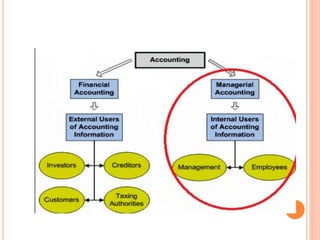
 Produces information that is
used within an organization
 Helps the management to
record, plan and control
activities and aids the
decision making process
 No legal requirement to use
management accounting
 Provides information that
is used by parties external
to the organization
 Provides a record of the
performance at a defined
period and the state of
affairs at the end of that
period
 Limited companies must ,
by law prepare financial
accounts
Management Accounting Financial Accounting
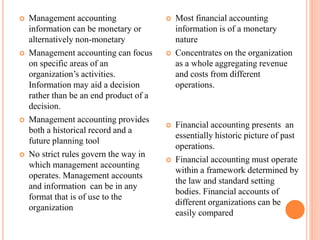
 Management accounting
information can be monetary or
alternatively non-monetary
 Management accounting can focus
on specific areas of an
organization’s activities.
Information may aid a decision
rather than be an end product of a
decision.
 Management accounting provides
both a historical record and a
future planning tool
 No strict rules govern the way in
which management accounting
operates. Management accounts
and information can be in any
format that is of use to the
organization
 Most financial accounting
information is of a monetary
nature
 Concentrates on the organization
as a whole aggregating revenue
and costs from different
operations.
 Financial accounting presents an
essentially historic picture of past
operations.
 Financial accounting must operate
within a framework determined by
the law and standard setting
bodies. Financial accounts of
different organizations can be
easily compared
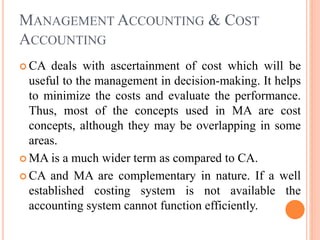
MANAGEMENT ACCOUNTING & COST
ACCOUNTING
 CA deals with ascertainment of cost which will be
useful to the management in decision-making. It helps
to minimize the costs and evaluate the performance.
Thus, most of the concepts used in MA are cost
concepts, although they may be overlapping in some
areas.
 MA is a much wider term as compared to CA.
 CA and MA are complementary in nature. If a well
established costing system is not available the
accounting system cannot function efficiently.
Managerial Accounting

Managerial Accounting

  • 1.
    MANAGERIAL ACCOUNTING INTRODUCTION (PART-2) By: Ishara .S. Saranapala
  • 3.
    ‘Managerial accounting’ isthe process of…. –identifying, -measuring. -analyzing, -interpreting, and -communicating information for the pursuit of an organization's goals. This is also known as ‘cost accounting.’
  • 4.
    WHAT IS MANAGEMENTACCOUNTING  Is an accounting system which encompasses various techniques and processes that are intended to provide financial and non financial information to people within an organization to make better decisions and thereby achieve organizational control and enhance organizational effectiveness.  Is "the process of identification, measurement, accumulation, analysis, preparation, interpretation and communication of information used by management to plan, evaluate and control within an entity and to assure appropriate use of and accountability for its resources. (CIMA-UK)
  • 5.
    MA assists themanagement in evolving decisions that can be categorized into:  Planning decisions (Strategic)- setting out the goals of the organization for the future period or periods as well as set of actions required to be taken to achieve those goals. Ex: How much sales to be achieved during the coming year?, Is the launch of a new product required to achieve the desired sales and profits?
  • 6.
    Operating decisions (Operational)-this involves taking decisions to operate efficiently. Ex: just in time operations, Activity based management. Control decisions (Performance measurement) - In the implementation of the plans things hardly go along as planned . Therefore need to monitor implementation of the plan and compare the actual results with what was originally planned and afterwards take corrective actions. Ex: What is the labor variance and who is responsible for the adverse results, HRM division or Production division and what action to take (should skilled labor replace with semiskilled or unskilled?)
  • 7.
    FUNCTIONS OF MA Allocate costs to the cost of goods sold and stocks (inventories) for internal and external reporting purposes.  Providing routine and non routine reporting for managerial decision making.  Provide information for planning, control and performance measurement.  Preparation of reports to government agencies
  • 8.
    MANAGERIAL ACCOUNTING VS FINANCIALACCOUNTING  Produces information that is used within an organization  Helps the management to record, plan and control activities and aids the decision making process  No legal requirement to use management accounting  Provides information that is used by parties external to the organization  Provides a record of the performance at a defined period and the state of affairs at the end of that period  Limited companies must , by law prepare financial accounts Management Accounting Financial Accounting
  • 9.
     Management accounting informationcan be monetary or alternatively non-monetary  Management accounting can focus on specific areas of an organization’s activities. Information may aid a decision rather than be an end product of a decision.  Management accounting provides both a historical record and a future planning tool  No strict rules govern the way in which management accounting operates. Management accounts and information can be in any format that is of use to the organization  Most financial accounting information is of a monetary nature  Concentrates on the organization as a whole aggregating revenue and costs from different operations.  Financial accounting presents an essentially historic picture of past operations.  Financial accounting must operate within a framework determined by the law and standard setting bodies. Financial accounts of different organizations can be easily compared
  • 10.
    MANAGEMENT ACCOUNTING &COST ACCOUNTING  CA deals with ascertainment of cost which will be useful to the management in decision-making. It helps to minimize the costs and evaluate the performance. Thus, most of the concepts used in MA are cost concepts, although they may be overlapping in some areas.  MA is a much wider term as compared to CA.  CA and MA are complementary in nature. If a well established costing system is not available the accounting system cannot function efficiently.