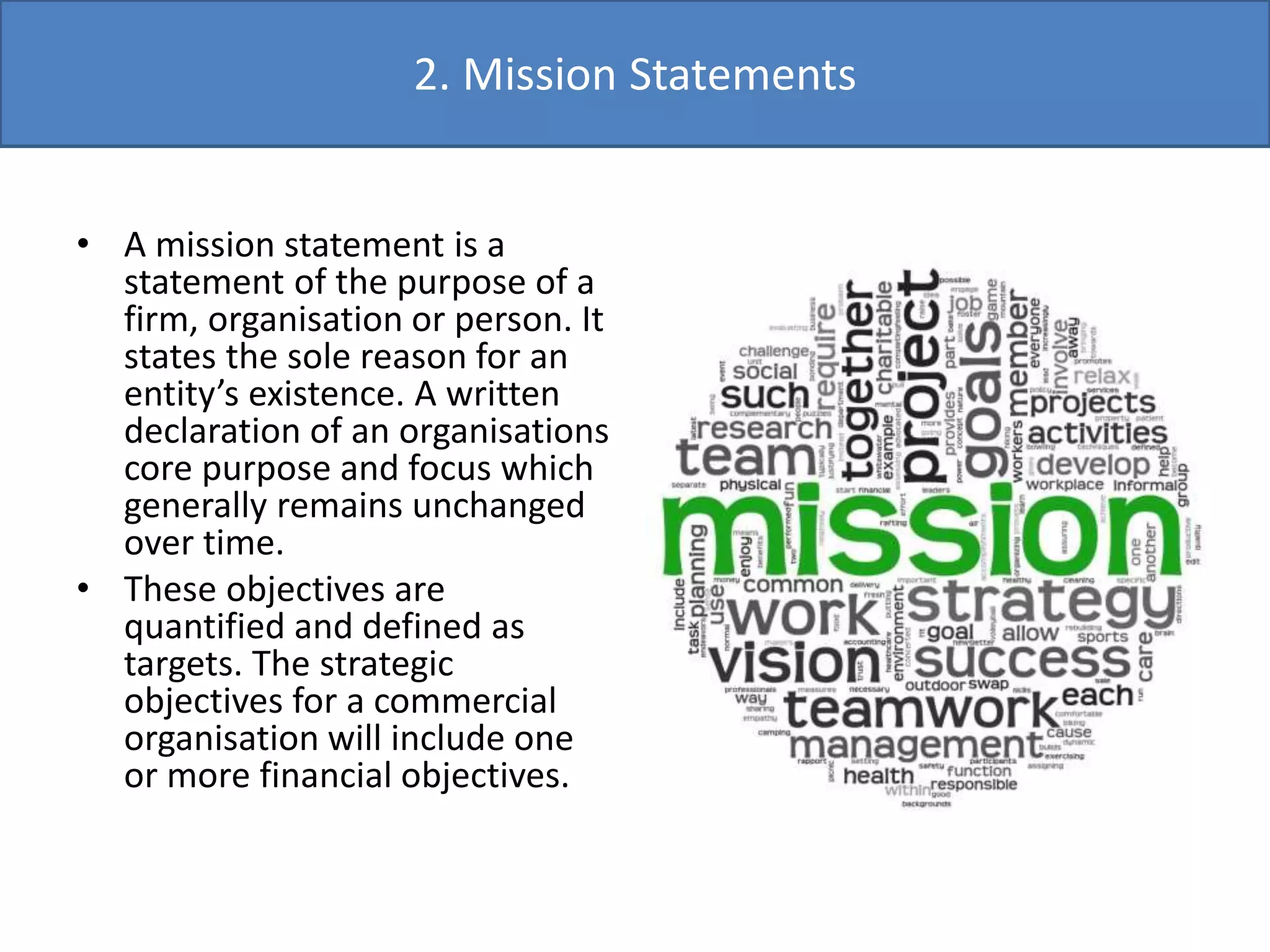
• A mission statement is a
statement of the purpose of a
firm, organisation or person. It
states the sole reason for an
entity’s existence. A written
declaration of an organisations
core purpose and focus which
generally remains unchanged
over time.
• These objectives are
quantified and defined as
targets. The strategic
objectives for a commercial
organisation will include one
or more financial objectives.
2. Mission Statements
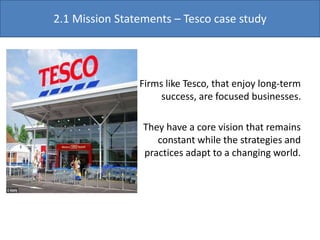
Firms like Tesco, that enjoy long-term
success, are focused businesses.
They have a core vision that remains
constant while the strategies and
practices adapt to a changing world.
2.1 Mission Statements – Tesco case study
Tesco’s vision consists of five elements which
outline the sort of company it aspires to
be:
1. Wanted and needed around the world
2. A growing business, full of opportunities
3. Modern, innovative and full of ideas
4. Winners locally whilst applying skills
globally
5. Inspiring, earning trust and loyalty from
customers, our colleagues and
communities.
The vision, mission statement and goals are
interrelated and state what an
organisation is seeking to achieve whereas
the strategies and tactics show how it will
achieve them.
Tesco case study
There is no standard format, but they should all
possess the following elements:
• Flexibility. - This is to accommodate change in
a dynamic business environment.
• Brevity. – Easy to understand. Straight to the
point.
• Distinctiveness. - To make the firm stand out
2.2 Mission Statements – Structure
Mission statements can play an
important role in the planning
process.
a) Plans should outline the
fulfilment of the organisation’s
mission
b) Evaluation and screening. The
mission acts as a yardstick by
which plans are judged.
c) Implementation of strategy.
Mission affects the
implementation of a planned
strategy in the culture and
business of the firm
2.3 Mission Planning – Structure
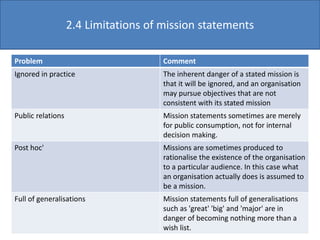
Problem Comment
Ignored in practice The inherent danger of a stated mission is
that it will be ignored, and an organisation
may pursue objectives that are not
consistent with its stated mission
Public relations Mission statements sometimes are merely
for public consumption, not for internal
decision making.
Post hoc' Missions are sometimes produced to
rationalise the existence of the organisation
to a particular audience. In this case what
an organisation actually does is assumed to
be a mission.
Full of generalisations Mission statements full of generalisations
such as 'great' 'big' and 'major' are in
danger of becoming nothing more than a
wish list.
2.4 Limitations of mission statements
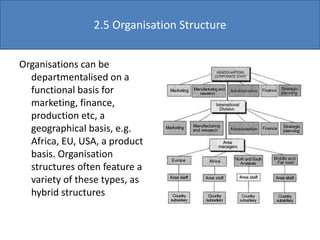
Organisations can be
departmentalised on a
functional basis for
marketing, finance,
production etc, a
geographical basis, e.g.
Africa, EU, USA, a product
basis. Organisation
structures often feature a
variety of these types, as
hybrid structures
2.5 Organisation Structure

Accounting for the non accountant - unit 2

  • 1.
    • A missionstatement is a statement of the purpose of a firm, organisation or person. It states the sole reason for an entity’s existence. A written declaration of an organisations core purpose and focus which generally remains unchanged over time. • These objectives are quantified and defined as targets. The strategic objectives for a commercial organisation will include one or more financial objectives. 2. Mission Statements
  • 2.
    Firms like Tesco,that enjoy long-term success, are focused businesses. They have a core vision that remains constant while the strategies and practices adapt to a changing world. 2.1 Mission Statements – Tesco case study
  • 3.
    Tesco’s vision consistsof five elements which outline the sort of company it aspires to be: 1. Wanted and needed around the world 2. A growing business, full of opportunities 3. Modern, innovative and full of ideas 4. Winners locally whilst applying skills globally 5. Inspiring, earning trust and loyalty from customers, our colleagues and communities. The vision, mission statement and goals are interrelated and state what an organisation is seeking to achieve whereas the strategies and tactics show how it will achieve them. Tesco case study
  • 4.
    There is nostandard format, but they should all possess the following elements: • Flexibility. - This is to accommodate change in a dynamic business environment. • Brevity. – Easy to understand. Straight to the point. • Distinctiveness. - To make the firm stand out 2.2 Mission Statements – Structure
  • 5.
    Mission statements canplay an important role in the planning process. a) Plans should outline the fulfilment of the organisation’s mission b) Evaluation and screening. The mission acts as a yardstick by which plans are judged. c) Implementation of strategy. Mission affects the implementation of a planned strategy in the culture and business of the firm 2.3 Mission Planning – Structure
  • 6.
    Problem Comment Ignored inpractice The inherent danger of a stated mission is that it will be ignored, and an organisation may pursue objectives that are not consistent with its stated mission Public relations Mission statements sometimes are merely for public consumption, not for internal decision making. Post hoc' Missions are sometimes produced to rationalise the existence of the organisation to a particular audience. In this case what an organisation actually does is assumed to be a mission. Full of generalisations Mission statements full of generalisations such as 'great' 'big' and 'major' are in danger of becoming nothing more than a wish list. 2.4 Limitations of mission statements
  • 7.
    Organisations can be departmentalisedon a functional basis for marketing, finance, production etc, a geographical basis, e.g. Africa, EU, USA, a product basis. Organisation structures often feature a variety of these types, as hybrid structures 2.5 Organisation Structure