PONDICHERRY UNIVERSITY
(A Central University)
DIRECTORATE OF DISTANCE EDUCATION
Management Accounting
Paper Code : MBFM 3005
MBA - FINANCE
III Semester
Authors
ӵӵ Prof. S. Kumar
ӵӵ Prof. M. Zaheer Ahmed
ӵӵ Prof. Jonardan Koner
ӵӵ Prof. E. Raja Justics
Edited by
Prof. Malabika Deo,
Professor,
Dept.of Commerce,
Pondicherry University,
Puducherry.
© All Rights Reserved
For Private Circulation Only
TABLE OF CONTENTS
UNIT LESSON TITLE PAGE NO.
I
1.1 Management Accounting Basics 4
1.2 Responsibility Accounting 19
1.3 Transfer Pricing 23
II
2.1 Budgets and Budgetary Control 34
2.2 Standard Costing 58
2.3 Variance Analysis 66
III
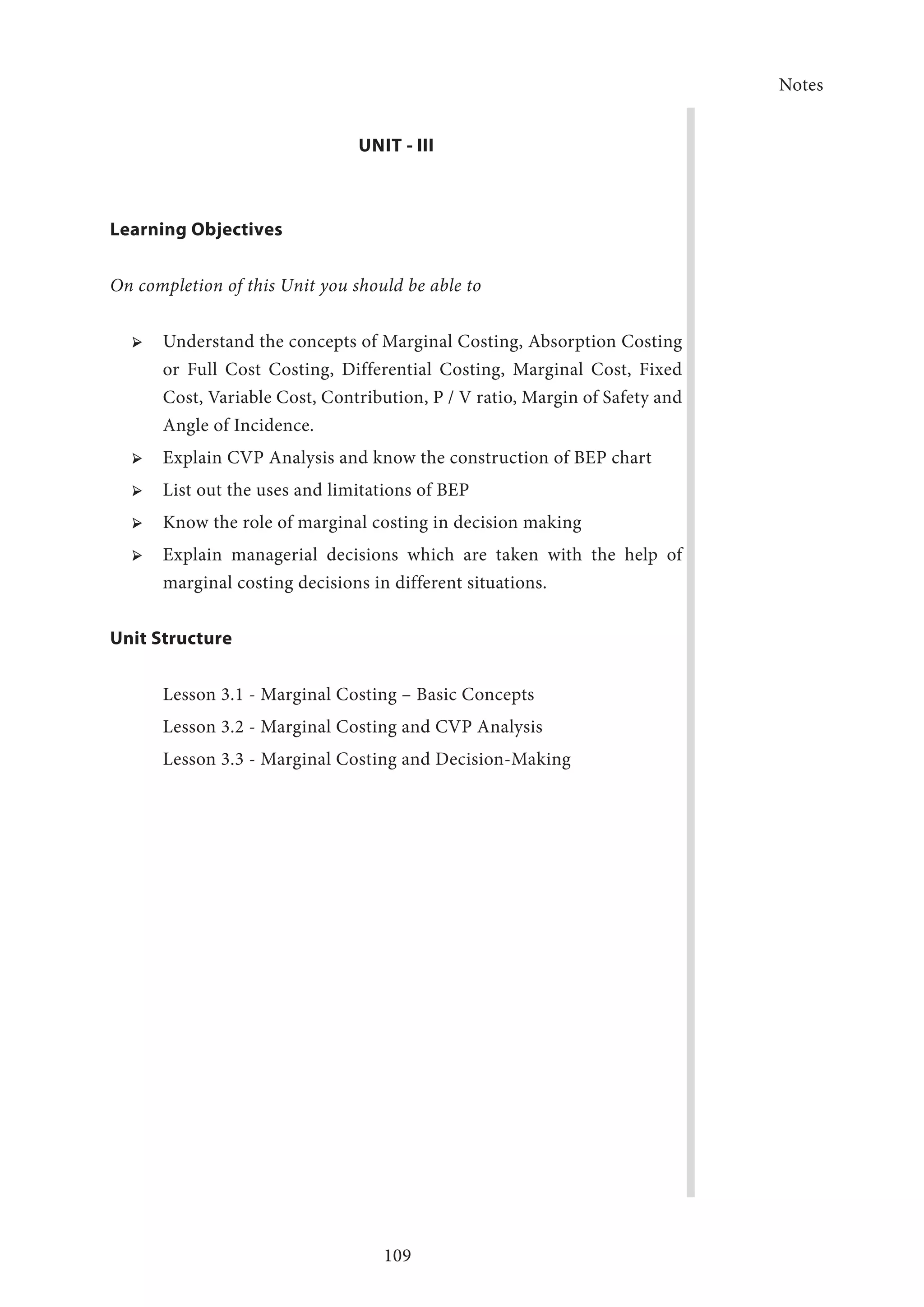
3.1 Marginal Costing – Basic Concepts 110
3.2 Marginal Costing and CVP Analysis 127
3.3 Marginal Costing and Decision-making 148
IV
4.1 DU-Pont Analysis 164
4.2 Funds Flow Analysis 186
4.3 Cash Flow Analysis 211
4.4 Contemporary Issues in Management 226
V
5.1 Social Cost Benefit Analysis 254
5.2 Reporting to Managment 258
Notes
1
MBA (Finance) – III Semester Paper code: MBFM3005
PAPER -XV
Management Accounting
	
Objectives
➢ ➢ To apply various management accounting techniques to all types of
organizations for planning, decision making and control purposes
in practical situations and
➢ ➢ To familiarize Contemporary Issues in Management Accounting.
Unit - I
Management accounting – Objectives, nature, and scope of
Financial Accounting, Cost Accounting, and Management Accounting
– Managerial Decisions – Accounting Plan and Responsibility Centers
– Significance of Responsibility Accounting – Responsibility Centers –
Cost Centre, Profit Centre and Investment Centre – Determinants of
Responsibility Centers – Transfer Pricing – Objectives of transfer pricing
– Methods of transfer pricing (simple problems) – Conflict between a
division and a company - Multi-National Transfer pricing.
Unit – II
Budgeting and Budgetary control – Fixed and flexible budget
– Preparation of functional budget for operating and non-operating
functions, Cash budgets, Capital expenditure budget, Master budget,
Principal budget factors – Zero-base budgeting – Performance budgeting
– Standard Costing and Variance Analysis – Material Variances – labour
Variances, Overhead (Fixed and Variable) Variances – Sales Variances.
Notes
2
Unit – III
Marginal Costing and Break-even Analysis – Cost-Volume-Profit
(CVP) Analysis – Break-Even Analysis – Assumptions and practical
applications of Breakeven-Analysis – Decisions regarding Sales-mix –
Make or Buy Decisions – Limiting Factor Decision – Export Decision –
Plant Merger – Decision of Shutdown or Continuation of a product line.
Unit - IV
DuPont Analysis – Fund Flow Analysis – Cash flow analysis –
Contemporary Issues in Management Accounting – Value chain analysis
– Activity-Based Costing (ABC) – Quality Costing – Target and Life Cycle
Costing – Theory of Constraints accounting (TOC).
Unit – V
Social Cost Benefit Analysis – Decision Tree in Management –
Reporting to Management – Objectives of Reporting – Reporting needs
at different managerial levels – Types of reports – Modes of Reporting,
Reporting at different levels of Management.
[Note: Distribution of Questions between Problems and Theory
of this paper must be 60:40 i.e., Problem Questions: 60 % & Theory
Questions: 40%]
References
Dr Murthy, S Gurusamy, MANAGEMENT ACCOUNTING, McGraw
Hill, Delhi, 2009
Khan. MY, Jain P., MANAGEMENT ACCOUNTING, McGraw Hill, Delhi,
2009
Singhvi. NM, MANAGEMENT ACCOUNTING, PHI, Delhi, 2010
Notes
3
UNIT – I
Learning Objectives
After studying this unit you will be able to
➢ ➢ Understand the management accounting as an area of accounting
➢ ➢ Differentiate the management accounting with the financial
accounting and cost accounting.
➢ ➢ Understand the concept of Responsibility Accounting and various
typesofResponsibilitycentersandhowfaritfixestheresponsibilities
and use of the same as device for the control mechanism under
Management control structure.
➢ ➢ Understand the concept of transfer pricing
➢ ➢ Know the provisions, scope, and objectives of transfer pricing
➢ ➢ Understand different methods of the determination of transfer
pricing
Unit Structure
Lesson 1.1 – Management Accounting Basics
Lesson 1.2 – Responsibility Accounting
Lesson 1.3 – Transfer Pricing
Notes
4
Lesson 1.1 - Management Accounting Basics
Introduction
A business enterprise must keep a systematic record of what happens
from day-to-day events so that it can know its position clearly. Most of
the business enterprises are run by the corporate sector. These business
houses are required by law to prepare periodical statements in proper form
showing the state of financial affairs. The systematic record of the daily
events of a business leading to presentation of a complete financial picture
is known as accounting. Thus, Accounting is the language of business. A
business enterprise speaks through accounting. It reveals the position,
especially the financial position through the language called accounting.
Meaning of Accounting
Accounting is the process of recording, classifying, summarizing,
analyzing and interpreting the financial transactions of the business
for the benefit of management and those parties who are interested in
business such as shareholders, creditors, bankers, customers, employees
and government. Thus, it is concerned with financial reporting and
decision making aspects of the business.
The American Institute of Certified Public Accountants Committee
on Terminology proposed in 1941 that accounting may be defined as, “The
art of recording, classifying and summarizing in a significant manner and
in terms of money, transactions and events which are, in part at least, of a
financial character and interpreting the results thereof”.
Branches of Accounting
Accounting can be classified into three categories:
1.	 Financial Accounting
2.	 Cost Accounting, and
3.	 Management Accounting
Notes
5
Financial Accounting
The term ‘Accounting’ unless otherwise specifically stated always
refers to ‘Financial Accounting’. Financial Accounting is commonly
carried on in the general offices of a business. It is concerned with revenues,
expenses, assets and liabilities of a business house. Financial Accounting
has two-fold objective, viz.
1.	 To ascertain the result of the business, and
2.	 To know the financial position of the concern.
Nature and Scope of Financial Accounting
Financial accounting is a useful tool for management as well as for
external users such as shareholders, potential owners, creditors, customers,
employees and government as it provides information regarding the results
of its operations and the financial status of the business. The following are
the functional aspects of financial accounting:-
1. Dealing with Financial Transactions
Accounting as a process deals only with those transactions which
are measurable in terms of money. Anything which cannot be expressed
in monetary terms does not form part of financial accounting however
significant it may be.
2. Recording of information
Accounting is an art of recording financial transactions of a business
concern. As there is a limitation for human memory, it is not possible to
remember all transactions of the business. Therefore, the information is
recorded in a set of books called Journal and other subsidiary books and it
is useful for management in its decision making process.
3. Classification of Data
The recorded data are arranged in a manner so as to group the
transactions of similar nature at one place so that full information of
these items may be collected under different heads. This is done in the
Notes
6
book called ‘Ledger’. For example, we may have accounts called ‘Salaries’,
‘Rent’, ‘Interest’, Advertisement’, etc. To verify the arithmetical accuracy
of such accounts, trial balance is prepared.
4. Summarizing Group of Information
The classified information of the trial balance is used to prepare
profit and loss account and balance sheet in a manner useful to the users
of accounting information. The final accounts are prepared to find out
operational efficiency and financial strength of the business.
5. Analyzing
It is the process of establishing the relationship between the
items of the profit and loss account and the balance sheet. The purpose
is to identify the financial strength and weakness of the business. It also
provides a basis for interpretation.
6. Interpreting the Financial Information
It is concerned with explaining the meaning and significance of
the relationship established by the analysis. It is useful to the users, as it
enables them to take correct decisions.
7. Communicating the Results
Theprofitabilityandfinancialpositionofthebusinessasinterpreted
above are communicated to the interested parties at regular intervals so as
to assist them to make their own conclusions.
Limitations of Financial Accounting
Financial accounting is concerned with the preparation of final
accounts. The present day business has become so complex that mere
final accounts are not sufficient in meeting financial needs. Financial
accounting is like a post-mortem report. At the most it can reveal what has
happened so far, but it does not have any control over the past happenings.
The limitations of financial accounting are as follows:-
Notes
7
1.	 It records only quantitative information.
2.	 It records only the historical cost. The impact of future uncertainties
has no place in financial accounting.
3.	 It does not take into account price level changes.
4.	 It provides information about the whole concern. Product-wise,
process-wise, department-wise or information of any other line of
activity cannot be obtained separately from the financial accounting.
5.	 Cost figures are not known in advance. Therefore, it is not possible
to fix the price in advance. It does not provide information to
increase or reduce the selling price.
6.	 As there is no technique for comparing the actual performance
with that of the budgeted targets, it is not possible to evaluate
performance of the business.
7.	 It does not tell about the optimum or otherwise of the quantum of
profit made and does not provide the ways and means to increase
the profits.
8.	 In case of loss, whether loss can be reduced or converted into profit
by means of cost control and cost reduction? Financial accounting
does not answer such question.
9.	 It does not reveal which departments are performing well? Which
ones are incurring losses and how much is the loss in each case?
10.	It does not provide the cost of products manufactured
11.	There is no means provided by financial accounting to reduce the
wastage.
12.	Can the expenses be reduced which results in the reduction of
product cost and if so, to what extent and how? There is no answer
to these questions in financial accounting.
13.	It is not helpful to the management in taking strategic decisions
like replacement of assets, introduction of new products,
discontinuation of an existing line, expansion of capacity, etc.
14.	It provides ample scope for manipulation like overvaluation or
undervaluation. This possibility of manipulation reduces the
reliability.
15.	It is technical in nature. A person not conversant with accounting
has little utility of the financial accounts.
Notes
8
Cost Accounting
An accounting system is to make available necessary and accurate
information for all those who are interested in the welfare of the
organization. The requirements of majority of them are satisfied by means
of financial accounting.
However, the management requires far more detailed information
than what the conventional financial accounting can offer. The focus of
the management lies not in the past but on the future.
For a businessman who manufactures goods or renders services,
cost accounting is a useful tool. It was developed on account of limitations
of financial accounting and is the extension of financial accounting. The
advent of factory system gave an impetus to the development of cost
accounting.
It is a method of accounting for cost. The process of recording and
accounting for all the elements of cost is called cost accounting.
The Institute of Cost and Works Accountants, London defines
costing as, “the process of accounting for cost from the point at which
expenditure is incurred or committed to the establishment of its ultimate
relationship with cost centres and cost units. In its wider usage it embraces
the preparation of statistical data, the application of cost control methods
and the ascertainment of the profitability of activities carried out or
planned”.
The Institute of Cost and Works Accountants, India defines cost
accounting as, “the technique and process of ascertainment of costs.
Cost accounting is the process of accounting for costs, which begins with
recording of expenses or the bases on which they are calculated and ends
with preparation of statistical data”.
To put it simply, when the accounting process is applied for the
elements of costs (i.e., Materials, Labour and Other expenses), it becomes
Cost Accounting.
Notes
9
Objectives of Cost Accounting
Cost accounting was born to fulfill the needs of manufacturing
companies. It is a mechanism of accounting through which costs of goods
or services are ascertained and controlled for different purposes. It helps
to ascertain the true cost of every operation, through a close watch, say,
cost analysis and allocation.
The main objectives of cost accounting are as follows:-
1.	 Cost Ascertainment
2.	 Cost Control
3.	 Cost Reduction
4.	 Fixation of Selling Price
5.	 Providing information for framing business policy.
1. Cost Ascertainment
The main objective of cost accounting is to find out the cost of
product, process, job, contract, service or any unit of production. It is
done through various methods and techniques.
2. Cost Control
The very basic function of cost accounting is to control costs.
Comparison of actual cost with standards reveals the discrepancies
(Variances). The variances indicate whether cost is within control or
not. Remedial actions are suggested to control the costs which are within
control.
3. Cost Reduction
Cost reduction refers to the real and permanent reduction in the
unit cost of goods manufactured or services rendered without affecting the
use intended. It can be done with the help of techniques called budgetary
control, standard costing, material control, labour control and overheads
control.
Notes
10
4. Fixation of Selling Price
The price of any product consists of total cost and the margin
required. Cost data are useful in the determination of selling price or
quotations. It provides detailed information regarding various components
of cost. It also provides information in terms of fixed cost and variable
costs, so that the extent of price reduction can be decided.
5. Framing Business Policy
Cost accounting helps management in formulating business policy
and decision making. Break even analysis, cost volume profit relationships,
differential costing, etc are helpful in taking decisions regarding key areas
of the business like-
a.	 Continuation or discontinuation of production
b.	 Utilization of capacity
c.	 The most profitable sales mix
d.	 Key factor
e.	 Export decision
f.	 Make or buy
g.	 Activity planning, etc.
Nature and Scope of Cost Accounting
Cost accounting is concerned with ascertainment and control of
costs. The information provided by cost accounting to the management is
helpful for cost control and cost reduction through functions of planning,
decision making and control. Initially, cost accounting confined itself
to cost ascertainment and presentation of the same, mainly to find out
product cost. With the introduction of large scale production, the scope of
cost accounting got widened and providing information for cost control
and cost reduction assumed equal significance along with finding out cost
of production. To start with cost accounting was applied in manufacturing
activities but now it is applied also in service organizations, government
organizations, local authorities, agricultural farms, extractive industries
and so on.
Notes
11
Cost accounting guides for ascertainment of cost of production.
Cost accounting discloses profitable and unprofitable activities. It
helps management to eliminate the unprofitable activities. It provides
information for estimate and tenders. It discloses the losses occurring in
the form of idle time spoilage or scrap etc. It also provides a perpetual
inventory system. It helps to make effective control over inventory and
for preparation of interim financial statements. It helps in controlling
the cost of production with the help of budgetary control and standard
costing. Cost accounting provides data for future production policies. It
discloses the relative efficiencies of different workers and for fixation of
wages to workers.
Limitations of Cost Accounting
i)	 It is based on estimation: as cost accounting relies heavily on
predetermined data, it is not reliable.
ii)	 No uniform procedure in cost accounting: as there is no uniform
procedure, with the same information different results may be
arrived by different cost accountants.
iii)	 Large number of conventions and estimates: There are number
of conventions and estimates in preparing cost records such as
materials are issued on an average (or) standard price, overheads
are charged on percentage basis, Therefore, the profits arrived
from the cost records are not true.
iv)	 Formalities are more: Many formalities are to be observed to
obtain the benefit of cost accounting. Therefore, it is not applicable
to small and medium firms.
v)	 Expensive: Cost accounting is expensive and requires
reconciliation with financial records.
vi)	 It is unnecessary: Cost accounting is an additional tool not
essential tool and an enterprise can survive even without cost
accounting.
vii)	 Secondary data: Cost accounting depends on financial statements
for a lot of information. The errors or short comings in that
information creep into cost accounts also.
Notes
12
Management Accounting
Management accounting is not a specific system of accounting. It
could be any form of accounting which enables a business to be conducted
more effectively and efficiently. It is largely concerned with providing
economic information to mangers for achieving organizational goals. It
is an extension of the horizon of cost accounting towards newer areas of
management.
Though much of the management accounting information are
financial in nature but are organized in a manner relating directly to the
decision on hand.
Management Accounting is comprised of two words ‘Management’
and ‘Accounting’. It means the study of managerial aspect of accounting.
The emphasis of management accounting is to redesign accounting in
such a way that it is helpful to the management in formation of policy,
control of execution and appreciation of effectiveness.
Management accounting is of recent origin. This was first used
in 1950 by a team of accountants visiting U. S. A under the auspices of
Anglo-American Council on Productivity
Definition
Anglo-American Council on Productivity defines Management
Accounting as, “the presentation of accounting information in such a
way as to assist management to the creation of policy and the day to day
operation of an undertaking”
The American Accounting Association defines Management
Accounting as “the methods and concepts necessary for effective planning
for choosing among alternative business actions and for control through
the evaluation and interpretation of performances”.
TheInstituteofCharteredAccountantsofIndiadefinesManagement
Accounting as follows: “Such of its techniques and procedures by which
accounting mainly seeks to aid the management collectively has come to
be known as management accounting”
Notes
13
From these definitions, it is very clear that financial data are
recorded, analyzed and presented to the management in such a way that it
becomes useful and helpful in planning and running business operations
more systematically.
Objectives of Management Accounting
The fundamental objective of management accounting is to enable
the management to maximize profits or minimize losses. The evolution
of management accounting has given a new approach to the function of
accounting. The main objectives of management accounting are as follows:
1. Planning and Policy Formulation
Planning involves forecasting on the basis of available information,
setting goals; framing polices determining the alternative courses of action
and deciding on the programme of activities. Management accounting can
help greatly in this direction. It facilitates the preparation of statements in
the light of past results and gives estimation for the future.
2. Interpretation process
Management accounting is to present financial information to the
management. Financial information is technical in nature.
Therefore, it must be presented in such a way that it is easily
understood. It presents accounting information with the help of statistical
devices like charts, diagrams, graphs, etc.
3. Assists in Decision-Making Process
With the help of various modern techniques management
accounting makes decision-making process more scientific. Data relating
to cost, price, profit and savings for each of the available alternatives
are collected and analyzed and thus it provides a base for taking sound
decisions.
Notes
14
4. Controlling
Management accounting is a useful tool for managerial control.
Management accounting tools like standard costing and budgetary control
are helpful in controlling performance.
Cost control is affected through the use of standard costing
and departmental control is made possible through the use of budgets.
Performance of each and every individual operation is controlled with the
help of management accounting.
5. Reporting
Management accounting keeps the management fully informed
about the latest position of the concern through reporting. It helps
management to take proper and quick decisions. The performances of
various departments are regularly reported to the top management.
6. Facilitates Organizing
Since management accounting stresses more on Responsibility
Centers with a view to control costs and responsibilities, it also facilitates
decentralization to a greater extent.
Thus, it is helpful in setting up effective and efficient organization
framework.
7. Facilitates Coordination of Operations
Management accounting provides tools for overall control and
coordination of business operations. Budgets are important means of
coordination.
Nature and Scope of Management Accounting
Management accounting involves furnishing of accounting data to
the management for basing its decisions. It helps in improving efficiency
and achieving the organizational goals. The following paragraphs discuss
about the nature of management accounting.
Notes
15
1. Provides accounting information
Management accounting is based on accounting information.
Management accounting is a service function and it provides necessary
information to different levels of management.
Management accounting involves the presentation of information
in a way it suits managerial needs. The accounting data collected by
accounting department is used for reviewing various policy decisions.
2. Cause and Effect Analysis
The role of financial accounting is limited to find out the ultimate
result, i.e., profit and loss, where as management accounting goes a
step further. Management accounting discusses the cause and effect
relationship. The reasons for the loss are probed and the factors directly
influencing the profitability are also analyzed. Profits are compared to
sales, different expenditures, current assets, interest payables, share
capital, etc. to give meaningful interpretation.
3. Use of Special Techniques and Concepts
Management accounting uses special techniques and concepts
according to necessity, to make accounting data more useful. The
techniques usually used include financial planning and analyses, standard
costing, budgetary control, marginal costing, project appraisal etc.
4. Taking Important Decisions
It supplies necessary information to the management which may
be useful for its decisions. The historical data is studied to see its possible
impact on future decisions. The implications of various decisions are also
taken into account.
5. Achieving of Objectives
Management accounting uses the accounting information in
such a way that it helps in formatting plans and setting up objectives.
Comparing actual performance with targeted figures will give an idea to
the management about the performance of various departments. When
Notes
16
there are deviations, corrective measures can be taken at once with the
help of budgetary control and standard costing.
6. No Fixed Norms
No specific rules are followed in management accounting as that
of financial accounting. Though the tools are the same, their use differs
from concern to concern. The deriving of conclusions also depends upon
the intelligence of the management accountant. The presentation will be
in the way which suits the concern most.
7. Increase in Efficiency
The purpose of using accounting information is to increase
efficiency of the concern. The performance appraisal will enable the
management to pin-point efficient and inefficient spots.
Effort is made to take corrective measures so that efficiency is
improved. The constant review will make the staff cost – conscious.
8. Supplies Information and not Decision
Management accountant is only to guide to take decisions. The
data is to be used by the management for taking various decisions. ‘How
is the data to be utilized’ will depend upon the caliber and efficiency of the
management.
9. Concerned with Forecasting
The management accounting is concerned with the future. It helps
the management in planning and forecasting. The historical information
is used to plan future course of action. The information is supplied with
the object to guide management for taking future decisions.
Limitations of Management Accounting
Management Accounting is in the process of development. Hence,
it suffers from all the limitations of a new discipline. Some of these
limitations are:
Notes
17
1. Limitations of Accounting Records
Management accounting derives its information from financial
accounting, cost accounting and other records. It is concerned with the
rearrangement or modification of data.
The correctness or otherwise of the management accounting
depends upon the correctness of these basic records. The limitations of
these records are also the limitations of management accounting.
2. It is only a Tool
Management accounting is not an alternate or substitute for
management. It is a mere tool for management. Ultimate decisions are
being taken by management and not by management accounting.
3. Heavy Cost of Installation
The installation of management accounting system needs a very
elaborate organization. This results in heavy investment which can be
afforded only by big concerns.
4. Personal Bias
The interpretation of financial information depends upon the
capacity of interpreter as one has to make a personal judgment. Personal
prejudices and bias affect the objectivity of decisions.
5. Psychological Resistance
The installation of management accounting involves basic change
in organization set up. New rules and regulations are also required to be
framed which affect a number of personnel and hence there is a possibility
of resistance form some or the other.
6. Evolutionary Stage
Management accounting is only in a developmental stage. Its
concepts and conventions are not as exact and established as that of other
branches of accounting.
Notes
18
Therefore, its results depend to a very great extent upon the
intelligent interpretation of the data of managerial use.
7. Provides only Data
Management accounting provides data and not decisions. It only
informs, not prescribes. This limitation should also be kept in mind while
using the techniques of management accounting.
8. Broad-based Scope
The scope of management accounting is wide and this creates
many difficulties in the implementations process. Management requires
information from both accounting as well as non-accounting sources.
It leads to inexactness and subjectivity in the conclusion obtained
through it.
****
Notes
19
Lesson 1.2 - Responsibility Accounting
Definition of Responsibility Accounting
“Responsibility Accounting collects and reports planned and actual
accounting information about the inputs and outputs of responsibility
centers”.
It is based on information pertaining to inputs and outputs. The
resources utilized in an organization are physical in nature like quantities
of materials consumed, hours of labour, etc., which are called inputs. They
are converted into a common denominator and expressed in monetary
terms called “costs”, for the purpose of managerial control. In a similar
way, outputs are based on cost and revenue data.
Responsibility Accounting must be designed to suit the existing
structure of the organization. Responsibility should be coupled with
authority. An organization structure with clear assignment of authorities
and responsibilities should exist for the successful functioning of the
responsibility accounting system. The performance of each manager is
evaluated in terms of such factors.
Responsibility Centres
Themainfocusofresponsibilityaccountingliesontheresponsibility
centres. A responsibility centre is a sub unit of an organization under the
control of a manager who is held responsible for the activities of that
centre. The responsibility centres are classified as follows:-
1) Cost Centres,
2) Profit Centres and
3) Investment centres.
Notes
20
Cost Centres
When the manager is held accountable only for costs incurred
in a responsibility centre, it is called a cost centre. It is the inputs and
not outputs that are measured in terms of money. A cost centre records
only costs incurred by the centre/unit/division, but the revenues earned
(output) are excluded from its purview. It means that a cost centre is a
segment whose performance is measured in terms of cost without taking
into consideration its attainments in terms of “output”. The costs are the
data for planning and control of cost canters. The performance of the
managers is evaluated by comparing the costs incurred with the budgeted
costs. The management focuses on the cost variances for ensuring proper
control.
A cost centre does not serve the purpose of measuring the
performance of the responsibility centre, since it ignores the output
(revenues) measured in terms of money. For example, common feature
of production department is that there are usually multiple product units.
There must be some common basis to aggregate the dissimilar products
to arrive at the overall output of the responsibility centre. If this is not
done, the efficiency and effectiveness of the responsibility centre cannot
be measure.
Profit Centres
When the manager is held responsible for both Costs (inputs)
and Revenues (output) it is called a profit centre. In a profit centre, both
inputs and outputs are measured in terms of money. The difference
between revenues and costs represents profit. The term “revenue” is used
in a different sense altogether.
According to generally accepted principles of accounting, revenues
are recognized only when sales are made to external customers. For
evaluating the performance of a profit centre, the revenue represents a
monetary measure of output arising from a profit centre during a given
period, irrespective of whether the revenue is realized or not.
The relevant profit to facilitate the evaluation of performance of
a profit centre is the pre–tax profit. The profit of all the departments
Notes
21
so calculated will not necessarily be equivalent to the profit of the
entire organization. The variance will arise because costs which are not
attributable to any single department are excluded from the computation
of the department’s profits and the same are adjusted while determining
the profits of the whole organization.
Profit provides more effective appraisal of the manager’s
performance. The manager of the profit centre is highly motivated in
his decision-making relating to inputs and outputs so that profits can be
maximized. The profit centre approach cannot be uniformly applied to all
responsibility centres. The following are the criteria to be considered for
making a responsibility centre into a profit centre.
A profit centre must maintain additional record keeping to
measure inputs and outputs in monetary terms. When a responsibility
centre renders only services to other departments, e.g., internal audit, it
cannot be made a profit centre.
A profit centre will gain more meaning and significance only
when the divisional managers of responsibility centers have empowered
adequately in their decision making relating to quality and quantity of
outputs and also their relation to costs.
If the output of a division is fairly homogeneous (e.g., cement), a
profit centre will not prove to be more beneficial than a cost centre.
Due to intense competition prevailing among different profit
centers, there will be continuous friction among the centers arresting
the growth and expansion of the whole organization. A profit centre
will generate too much of interest in the short-run profit which may be
detrimental to the long-term results.
Investment Centers
When the manager is held responsible for costs and revenues as
well as for the investment in assets, it is called an Investment Centre. In an
investment centre, the performance is measured not by profits alone, but is
involved with investments effected. The manager of an investment centre
is always interested to earn a satisfactory return. The return on investment
Notes
22
is usually referred to as ROI that serves as a criterion for the performance
evaluation of the manager of an investment centre. Investment centers
may be considered as separate entities where the manager is entrusted
with the overall responsibility of inputs, outputs and investment.
****
Notes
23
Lesson 1.3 - Transfer Pricing
Introduction
In the post economic liberalization, multinational companies
started expanding their business transactions across the border. The
rapid growth of economic activities of multinational groups led to various
complex issues regarding taxation. The multinational groups have more
inter business activities like transfer of goods or services. One group
transfers the goods and services to another group. Such transfers cause
the problem of pricing the goods or services.
Thus it may not comply with necessary rules and regulations
while transferring goods or services. This noncompliance with statutory
provisions may tend to create revenue loss to the exchequer. Hence, there
is a need to provide statutory framework which will lead to compute the
profits and tax in a fair manner.
Provisions Regulating Transfer Pricing in India
The Finance Act, 2001 introduced law of transfer pricing in
India through sections 92A to 92F of the Indian Income Tax Act, 1961
which guides computation of the transfer price and suggests detailed
documentation procedures.
Scope & Applicability
Transfer Pricing Regulations (“TPR”) are applicable to the all
enterprises that enter into an ‘International Transaction’ with an ‘Associated
Enterprise’. Therefore, generally it applies to all cross border transactions
entered into between associated enterprises. It even applies to transactions
involving a mere book entry having no apparent financial impact. The aim
is to arrive at the comparable price as available to any unrelated party in
open market conditions and is known as the Arm’s Length Price (‘ALP’).
Notes
24
Important Definitions
Transfer Pricing
“Transfer price” is a price at which the value of goods or
services being transferred between independently operating units of an
organization. But, the expression “transfer pricing” generally refers to
prices of transactions between associated enterprises may be different
from the prices at which an independent enterprise transfers to another
the same goods or services.
Arm’s Length Price
The term arm’s length price refers to a price which is applied
or proposed to be applied in a transaction between persons other than
associated enterprises, in uncontrolled conditions.
Objectives of Transfer Pricing
	 There are three objectives that should be considered for setting-
out a transfer price.
(a)	 Autonomy of the Division. The prices should seek to maintain
the maximum divisional autonomy so that the benefits, of
decentralization (motivation, better decision making, initiative
etc.) are maintained. The profits of one division should not be
dependent on the actions of other divisions,
(b)	 Goal congruence: The prices should be set so that the divisional
management’s desire to maximize divisional earrings is consistent
with the objectives of the company as a whole. The transfer prices
should not encourage suboptimal decision-making.
(c)	 Performance appraisal: The prices should enable reliable
assessments to be made of divisional performance.
Determination of Arm’s Length Price
The arm’s length price in relation to an international transaction
can be determined by any of the following methods, The most appropriate
Notes
25
method, may be chosen having regard to the nature of transaction or class
of transaction or class of associated persons or functions performed by
such persons or such other relevant factors as the Board may prescribed
namely:—
(a)	 Comparable uncontrolled price method;
(b)	 Resale price method;
(c)	 Cost plus method;
(d)	 Profit split method;
(e)	 Transactional net margin method;
Suppose more than one price is determined by the most appropriate
method, the arm’s length price shall be taken to be the arithmetical mean
of such prices:
In case, the variation between the arm’s length price so determined
and price at which the international transaction has actually been
undertaken does not exceed five per cent of the latter, the price at which
the international transaction has actually been undertaken shall be deemed
to be the arm’s length price.
Computation of Arm’s Length Price
The Institute of Chartered Accountant of India (ICAI) has laid
down certain guidelines which are to be followed when comparable
uncontrollable price is determined. The guidelines are given below.
(a)	 Comparable Uncontrollable Price Method
i)	 Find out the price charged or paid for property transferred or
services provided in a comparable uncontrolled transaction, or a
number of such transactions, is identified,
ii)	 Adjust such price to account for differences, if any, between
the international transaction and the comparable uncontrolled
transaction, or between the enterprises entering into such
transactions, which could materially affect the price in the open
market;
Notes
26
iii)	 the adjusted price arrived at is taken to be an arm’s length price
in respect of the property transferred or services provided in the
international transaction;
iv)	 If there is any variation between price charged (price paid) on the
international transaction and arm’s length price, then an adjustment
has to be made in order to remove the variance.
(b)	 Resale Price Method
(i)	 Find out the international transaction through which property
purchased or services obtained
(ii)	 Identify the price at which the property or services are resold or
provided to a third party
(iii)	Deduct the normal gross profit earned by the enterprise from
the resale price of such property or services. The normal gross
profit can be taken of a profit on a similar transaction made with
unrelated party.
iv)	 The price so arrived at is further reduced by the expenses incurred
by the enterprise in connection with the purchase of property or
obtaining of service; The price so arrived at is adjusted to take into
account the functional and other differences, including differences
in accounting practices, if any, between the international
transaction and the comparable uncontrolled transactions, or
between the enterprises entering into such transactions, which
could materially affect the amount of gross profit margin in the
open market;
v)	 the adjusted price arrived at is taken to be an arm’s length price in
respect of the purchase of the property or obtaining of the services
by the enterprise from the associated enterprise;
(c) Cost Plus Method
i)	 Find the direct and indirect costs of production incurred by the
enterprise in respect of property transferred or services provided
to an associated enterprise
ii)	 Find a comparable uncontrollable transaction or a series of
transaction with a third party for same property or service
Notes
27
iii)	 The amount of a normal gross profit mark-up to such costs
(computed according to the same accounting norms) arising from
the transfer or provision of the same or similar property or services
by the enterprise, or by an unrelated enterprise, in a comparable
uncontrolled transaction, or a number of such transactions, is
determined;
iv)	 The normal gross profit mark-up to account the functional and
other differences, if any, between the international transaction
and the comparable uncontrolled transactions,
v)	 The sum so arrived at, is taken to be an arm’s length price in
relation to the supply of the property or provision of services by
the enterprise;
d) Profit Split Method
	 Which may be applicable mainly in international transactions
involving transfer of unique intangibles or in multiple international
transactions which are so interrelated determining the arm’s length price
of any one transaction, by which,
i)	 The combined net profit of the associated enterprises arising
from the international transaction, in which they are engaged, is
determined;
ii)	 The relative contribution made by each of the associated
enterprises to the earning of such combined net profit, is then
evaluated on the basis of the functions performed, assets employed
or to be employed and risks assumed by each enterprise and on
the basis of reliable external market data which indicates how
such contribution would be evaluated by unrelated enterprise and
on the basis of reliable external market data which indicates how
such contribution would be evaluated by unrelated enterprises
performing comparable functions in similar circumstances;
iii)	 The combined net profit is then split amongst the enterprises in
proportion to their relative contributions,
iv)	 The profit thus apportioned to the assessee is taken into account
to arrive at an arm’s length price in relation to the international
transaction;
Notes
28
e) Transactional Net Margin Method
i)	 The net profit margin realized by the enterprise from an
international transaction entered into with an associated enterprise
is computed in relation to costs incurred or 	 sales effected or
assets employed or to be employed by the enterprise or having
regard to any other relevant base;
ii)	 The net profit margin realised by the enterprise or by an unrelated
enterprise from a comparable uncontrolled transaction or a
number of such transactions is computed having regard to the
same base;
iii)	The net profit margin arising in comparable uncontrolled
transactions is adjusted to take into account of the differences,
if any, between the international transaction and the comparable
uncontrolled transactions, or between the enterprises entering
into such transactions, which could materially affect the amount
of net profit margin in the open market;
iv)	 The net profit margin thus established is then taken into account
to arrive at an arm’s length price in relation to be international
transaction.
Illustration I
X Ltd., an Indian company, sells computer CPU to its 100 per cent
subsidiary Y Ltd. in United States @ $ 50 per piece. X Ltd. also sells its
computer CPU to another company Z Ltd. in United States @ $ 90 per
piece. Total income of X Ltd. for the assessment year 2012-13 is 12,
00,000 which includes sales made for 100 computer CPU @ $ 50 to Y Ltd.
Compute the arm’s length price and taxable income of X Ltd. The rate of
one dollar may be assumed to be equivalent to 47.
Notes
29
Solution
Computation of Arm’s Length Price and Taxable Income of X Ltd.
Arm’s length price:
	 100 x 90 x 47 = 4, 23,000
	
	 Total Income 	 12, 00, 000
	 Add: Arm’s length price	 4, 23,000
	 16, 23,000
	 Less: Price charged 100 x 50 x 47	 2, 35, 000
				Taxable Income	 13, 88, 000
Relevant Points
(1)	 Transfer pricing is the pricing of internal transfers between profit
centres.
(2)	Ideally the transfer prices should, promote goal congruence,
enable effective performance appraisal and maintain divisional
autonomy.
(3)	 Economy theory suggests that the optimum transfer price would
be the marginal cost equal for buying division’s marginal revenue
product. Transfer prices should always be based on the marginal
costs of the supplying division plus the opportunity costs to the
organization as a whole.
(4)	 Because of information deficiencies, transfers pricing in practice
does not always follow theoretical guidelines. Typically prices are
market based, cost based or negotiated.
(5)	Where an appropriate market price exists then this is an
ideal transfer price. However, there may be no market for the
intermediate product, the market may be imperfect, or the price
may be considered unrepresentative.
(6)	 Where cost based systems are used then it is preferable to use
standard costs to avoid transferring inefficiencies.
(7)	 Full cost transfer pricing for full cost plus a markup suffers from a
number of limitations,; it may cause suboptimal decision-making.
Notes
30
The price is only valid at one output level, it makes genuine
performance appraisal difficult.
(8)	 Provided that variable cost equates with economic marginal cost
then transfers at variable cost will avoid gross sub optimality but
performance appraisal becomes meaningless.
(9)	 Negotiated transfer prices will only be appropriate if there is equal
bargaining power and if negotiations are not protracted.
Conclusion
Transfer price policies represent the selection of suitable methods
relating to the computation of transfer prices under various circumstances.
More precisely, transfer pricing should be closely related to management
performance assessment and decision optimization. But the problem
of choosing an appropriate transfer pricing for the two functions of
management-performance measurement and decision optimization –
does not hold any simple solution. There is no single measure of transfer
price that can be adopted under all circumstances.
Activities
1.	Bring out the differences between the Financial Accounting and
Cost Accounting
2.	 Ascertain the differences between the Financial Accounting and
Management Accounting
3.	 Find out the differences between the Cost Accounting and
Management Accounting
4.	 Extract the differences between the Financial Accounting and
Management Accounting.
Self Assessment Questions
1.	What do you understand by ‘Management Accounting’?
2.	 State the objectives of Management Accounting.
3.	 Discuss in detail the nature and scope of management accounting.
4.	 How can financial accounting be made useful for the management
Notes
31
accounting?
5.	 State the limitations of financial accounting and point out how
management accounting helps in overcoming them.
6.	“Accounting provides information various users”. Discuss
accounting as an information system.
7.	 What is Responsibility Accounting? Explain the significance of
Responsibility Accounting.
8.	 What is Transfer Pricing? Discuss the importance of Transfer
Pricing.
9.	 What are the methods under which the arm’s length price, with
regard to an international transaction is determined?
10.	 Write a note on the following:
i.	 Cost Centre
ii.	 Profit Centre
iii.	 Investment Centre
iv.	 Market based transfer pricing
v.	 Cost based transfer pricing
vi.	 Full cost transfer pricing
vii.	 Negotiated transfer pricing
viii.	Variable cost transfer pricing
****
32
Notes
33
UNIT – II
Learning Objectives
After studying this unit you will be able to
➢ ➢ Understand the preparation of various operations and functional
budgets of an organization
➢ ➢ Know the technique of standard costing,
➢ ➢ Differentiate between Standard Costing and Budgeting
➢ ➢ Know different types of variances
➢ ➢ Familiarize various formulas of material, labour, overheads and
sales variances.
Unit Structure
Lesson 2.1 - Budgets and Budgetary Control
Lesson 2.2 - Standard Costing
Lesson 2.3 - Variance Analysis
Notes
34
Lesson 2.1 - Budgets and Budgetary Control
Introduction
To achieve the organizational objectives, an enterprise should be
managed effectively and efficiently. It is facilitated by chalking out the
course of action in advance. Planning, the primary function of management
helps to chalk out the course of actions in advance. But planning has to
be followed by continuous comparison of the actual performance with
the planned performance, i. e., controlling. One systematic approach in
effective follow up process is budgeting. Different budgets are prepared by
the enterprise for different purposes. Thus, budgeting is an integral part
of management.
Definition of Budget
‘A budget is a comprehensive and coordinated plan, expressed
in financial terms, for the operations and resources of an enterprise for
some specific period in the future’. (Fremgen, James M – Accounting for
Managerial Analysis)
‘A budget is a predetermined detailed plan of action developed and
distributed as a guide to current operations and as a partial basis for the
subsequent evaluation of performance’. (Gordon and Shillinglaw)
‘A budget is a financial and/or quantitative statement, prepared
prior to a defined period of time, of the policy to be pursued during the
period for the purpose of attaining a given objective’. (The Chartered
Institute of Management Accountants, London)
Elements of Budget
The basic elements of a budget are as follows:-
1.	 It is a comprehensive and coordinated plan of action.
Notes
35
2.	 It is a plan for the firm’s operations and resources.
3.	 It is based on objectives to be attained.
4.	 It is related to specific future period.
5.	 It is expressed in financial and/or physical units.
Budgeting
Budgeting is the process of preparing and using budgets to achieve
management objectives. It is the systematic approach for accomplishing
the planning, coordination, and control responsibilities of management
by optimally utilizing the given resources.
‘The entire process of preparing the budgets is known as Budgeting’
(J. Batty)
‘Budgeting may be said to be the act of building budgets’ (Rowland
& Harr)
Elements of Budgeting
1.	 A good budgeting should state clearly the firm’s expectations and
facilitate their attainability.
2.	 A good budgeting system should utilize various persons at different
levels while preparing the budgets.
3.	 The authority and responsibility should be properly fixed.
4.	 Realistic targets are to be fixed.
5.	 A good system of accounting is also essential.
6.	 Wholehearted support of the top management is necessary.
7.	 Budgeting education is to be imparted among the employees.
8.	 Proper reporting system should be introduced.
9.	 Availability of working capital is to be ensured.
Definition of Budgetary Control
CIMA, London defines budgetary control as, “the establishment of
the budgets relating to the responsibility of executives to the requirements
of a policy and the continuous comparison of actual with budgeted result
Notes
36
either to secure by individual action the objectives of that policy or to
provide a firm basis for its revision”
	 ‘Budgetary Control is a planning in advance of the various functions
of a business so that the business as a whole is controlled’. (Wheldon)
	 ‘Budgetary Control is a system of controlling costs which includes
the preparation of budgets, coordinating the department and establishing
responsibilities, comprising actual performance with the budgeted and
acting upon results to achieve maximum profitability’. (Brown and
Howard)
Elements of Budgetary Control
1.	 Establishment of budgets for each function and division of the
organization.
2.	 Regular comparison of the actual performance with the budget to
know the variations from budget and placing the responsibility of
executives to achieve the desired result as estimated in the budget.
3.	 Taking necessary remedial action to achieve the desired objectives,
if there is a variation of the actual performance from the budgeted
performance.
4.	 Revision of budgets when the circumstances change.
5.	 Elimination of wastes and increasing the profitability.
Budget, Budgeting and Budgetary Control
A budget is a blue print of a plan expressed in quantitative terms.
Budgeting is a technique for formulating budgets. Budgetary Control refers
to the principles, procedures and practices of achieving given objectives
through budgets.
According to Rowland and William, ‘Budgets are the individual
objectives of a department, whereas Budgeting may be the act of building
budgets. Budgetary control embraces all and in addition includes the
science of planning the budgets to effect an overall management tool for
the business planning and control’.
Notes
37
Objectives of Budgetary Control
Budgetary Control assists the management in the allocation of
responsibilities and is a useful device to estimate and plan the future course
of action. The general objectives of budgetary control are as follows:
1. Planning
(a)	 A budget is an action plan and it is prepared after a careful study
and research.
(b)	 A budget operates as a mechanism through which objectives and
policies are carried out.
(c)	It is a communication channel among various levels of
management.
(d)	 It is helpful in selecting a most profitable alternative.
(e)	 It is a complete formulation of the policy to be pursued for
attaining given objectives.
2. Co-Ordination
	 It coordinates various activities of the business to achieve its com-
mon objectives. It induces the executives to think and operate as a group.
3. Control
Control is necessary to judge that the performance of the
organization confirms to the plans of business. It compares the actual
performance with that of the budgeted performance, ascertains the
deviations, if any, and takes corrective action at once.
Installation of Budgetary Control System
There are certain steps necessary to install a good budgetary control
system in an organization. They are as follows:
1.	 Determination of the Objectives
2.	 Organization for Budgeting
3.	 Budget Centre
Notes
38
4.	 Budget Officer
5.	 Budget Manual
6.	 Budget Committee
7.	 Budget Period
8.	 Determination of Key Factor
1. Determination of Objectives
It is very clear that the installation of a budgetary control system
presupposes the determination of objectives sought to be achieved by the
organization in clear terms.
2. Organization for Budgeting
Having determined the objectives clearly, proper organization is
essential for the successful preparation, maintenance and administration
of budgets. The responsibility of each executive must be clearly defined.
There should be no uncertainty regarding the jurisdiction of executives.
3. Budget Centre
It is that part of the organization for which the budget is prepared.
It may be a department or any other part of the department. It is essential
for the appraisal of performance of different departments so as to make
them responsible for their budgets.
4. Budget Officer
A Budget Officer is a convener of the budget committee. He
coordinates the budgets of various departments. The managers of different
departments are made responsible for their department’s performance.
5. Budget Manual
It is a document which defines the objectives of budgetary control
system. It spells out the duties and responsibilities of budget officers
regarding the preparation and execution of budgets. It also specifies the
relations among various functionaries.
Notes
39
6. Budget Committee
The heads of all important departments are made members of this
committee. It is responsible for preparation and execution of budgets. The
members of this committee may sometimes take collective decisions, if
necessary. In small concerns, the accountant is made responsible for the
same work.
7. Budget Period
It is the period for which a budget is prepared. It depends upon a
number of factors. It may be different for different concerns/functions.
The following are the factors that may be taken into consideration
while determining budget period:
a.	 The type of budget,
b.	 The nature of demand for the products,
c.	 The availability of finance,
d.	 The economic situation of the cycle and
e.	 The length of trade cycle
8. Determination of Key Factor
Generally, the budgets are prepared for all functional areas of the
business. They are inter related and inter dependent. Therefore, a proper
coordination is necessary. There may be many factors that influence the
preparation of a budget.
For example, plant capacity, demand position, availability of raw
materials, etc. Some factors may have an impact on other budgets also. A
factor which influences all other budgets is known as Key factor.
Thekeyfactormaynotremainthesame.Therefore,theorganization
must pay due attention on the key factor in the preparation and execution
of budgets.
Notes
40
Types of Budgeting
Budget can be classified into three categories from different points
of view. They are:
1.	 According to Function
2.	 According to Flexibility
3.	 According to Time
I. According to Function
(a) Sales Budget
The budget which estimates total sales in terms of items, quantity,
value, periods, areas, etc is called Sales Budget.
(b) Production Budget
It estimates quantity of production in terms of items, periods,
areas, etc. It is prepared on the basis of Sales Budget.
(c) Cost of Production Budget
This budget forecasts the cost of production. Separate budgets may
also be prepared for each element of costs such as direct materials budgets,
direct labour budget, factory materials budgets, office overheads budget,
selling and distribution overheads budget, etc.
(d) Purchase Budget
This budget forecasts the quantity and value of purchase required
for production. It gives quantity wise, money wise and period wise
particulars about the materials to be purchased.
(e) Personnel Budget
The budget that anticipates the quantity of personnel required
during a period for production activity is known as Personnel Budget.
Notes
41
(f) Research Budget
This budget relates to the research work to be done for improvement
in quality of the products or research for new products.
(g) Capital Expenditure Budget
This budget provides a guidance regarding the amount of capital
that may be required for procurement of capital assets during the budget
period.
(h) Cash Budget
This budget is a forecast of the cash position by time period for a
specific duration of time. It states the estimated amount of cash receipts
and estimation of cash payments and the likely balance of cash in hand at
the end of different periods.
(i) Master Budget
It is a summary budget incorporating all functional budgets in a
capsule form. It interprets different functional budgets and covers within
its range the preparation of projected income statement and projected
balance sheet.
II. According to Flexibility
On the basis of flexibility, budgets can be divided into two
categories. They are:
1.	 Fixed Budget
2.	 Flexible Budget
1. Fixed Budget
Fixed Budget is one which is prepared on the basis of a standard
or a fixed level of activity. It does not change with the change in the level
of activity.
Notes
42
2. Flexible Budget
A budget prepared to give the budgeted cost of any level of activity
is termed as a flexible budget. According to CIMA, London, a Flexible
Budget is, ‘a budget designed to change in accordance with level of activity
attained’. It is prepared by taking into account the fixed and variable
elements of cost.
III. According to Time
On the basis of time, the budget can be classified as follows:
1.	 Long term budget
2.	 Short term budget
3.	 Current budget
4.	 Rolling budget
1. Long-Term Budget
A budget prepared for considerably long period of time, viz., 5 to
10 years is called Long-term Budget. It is concerned with the planning
of operations of the firm. It is generally prepared in terms of physical
quantities.
2. Short-Term Budget
A budget prepared generally for a period not exceeding 5 years
is called Short-term Budget. It is generally prepared in terms of physical
quantities and in monetary units.
3. Current Budget
It is a budget for a very short period, say, a month or a quarter. It
is adjusted to current conditions. Therefore, it is called current budget.
4. Rolling Budget
It is also known as Progressive Budget. Under this method, a
budget for a year in advance is prepared. A new budget is prepared after
Notes
43
the end of each month/quarter for a full year ahead. The figures for the
month/quarter which has rolled down are dropped and the figures for
the next month/quarter are added. This practice continues whenever a
month/quarter ends and a new month/quarter begins.
Preparation of Budgets
I. Sales Budget
Sales budget is the basis for the preparation of other budgets. It is
the forecast of sales to be achieved in a budget period. The sales manager
is directly responsible for the preparation of this budget. The following
factors are taken into consideration:
a.	 Past sales figures and trend
b.	 Salesmen’s estimates
c.	 Plant capacity
d.	 General trade position
e.	 Orders in hand
f.	 Proposed expansion
g.	 Seasonal fluctuations
h.	 Market demand
i.	 Availability of raw materials and other supplies
j.	 Financial position
k.	 Nature of competition
l.	 Cost of distribution
m.	 Government controls and regulations
n.	 Political situation.
Example
1. The Royal Industries has prepared its annual sales forecast, expecting
to achieve sales of ` 30, 00,000 next year. The Controller is uncertain
about the pattern of sales to be expected by month and asks you to
prepare a monthly budget of sales. The following is the sales data
pertained to the year, which is considered to be representative of a
normal year:
Notes
44
Month Sales (`) Month Sales (`)
January 1,10,000 July 2,60,000
February 1,15,000 August 3,30,000
March 1,00,000 September 3,40,000
April 1,40,000 October 3,50,000
May 1,80,000 November 2,00,000
June 2,25,000 December 1,50,000
Prepare a monthly sales budget for the coming year on the basis of the
above data.
Answer
Sales Budget
Month
Sales
(given)
Sales estimation based on
cash sales ratio given
January 1,10,000 (1,10,000/25,00,000) x 30,00,000 = 1,32,000
February 1,15,000 (1,15,000/25,00,000) x 30,00,000 = 1,38,000
March 1,00,000 (1,00,000/25,00,000) x 30,00,000 = 1,20,000
April 1,40,000 (1,40,000/25,00,000) x 30,00,000 = 1,68,000
May 1,80,000 (1,80,000/25,00,000) x 30,00,000 = 2,16,000
June 2,25,000 (2,25,000/25,00,000) x 30,00,000 = 2,70,000
July 2,60,000 (2,60,000/25,00,000) x 30,00,000 = 3,12,000
August 3,30,000 (3,30,000/25,00,000) x 30,00,000 = 3,96,000
September 3,40,000 (3,40,000/25,00,000) x 30,00,000 = 4,08,000
October 3,50,000 (3,50,000/25,00,000) x 30,00,000 = 4,20,000
November 2,00,000 (2,00,000/25,00,000) x 30,00,000 = 2,40,000
December 1,50,000 (1,50,000/25,00,000) x 30,00,000 = 1,80,000
Total 25,00,000 30,00,000
Note: Sales budget is prepared based on last year’s month-wise sales ratio.
Notes
45
Example
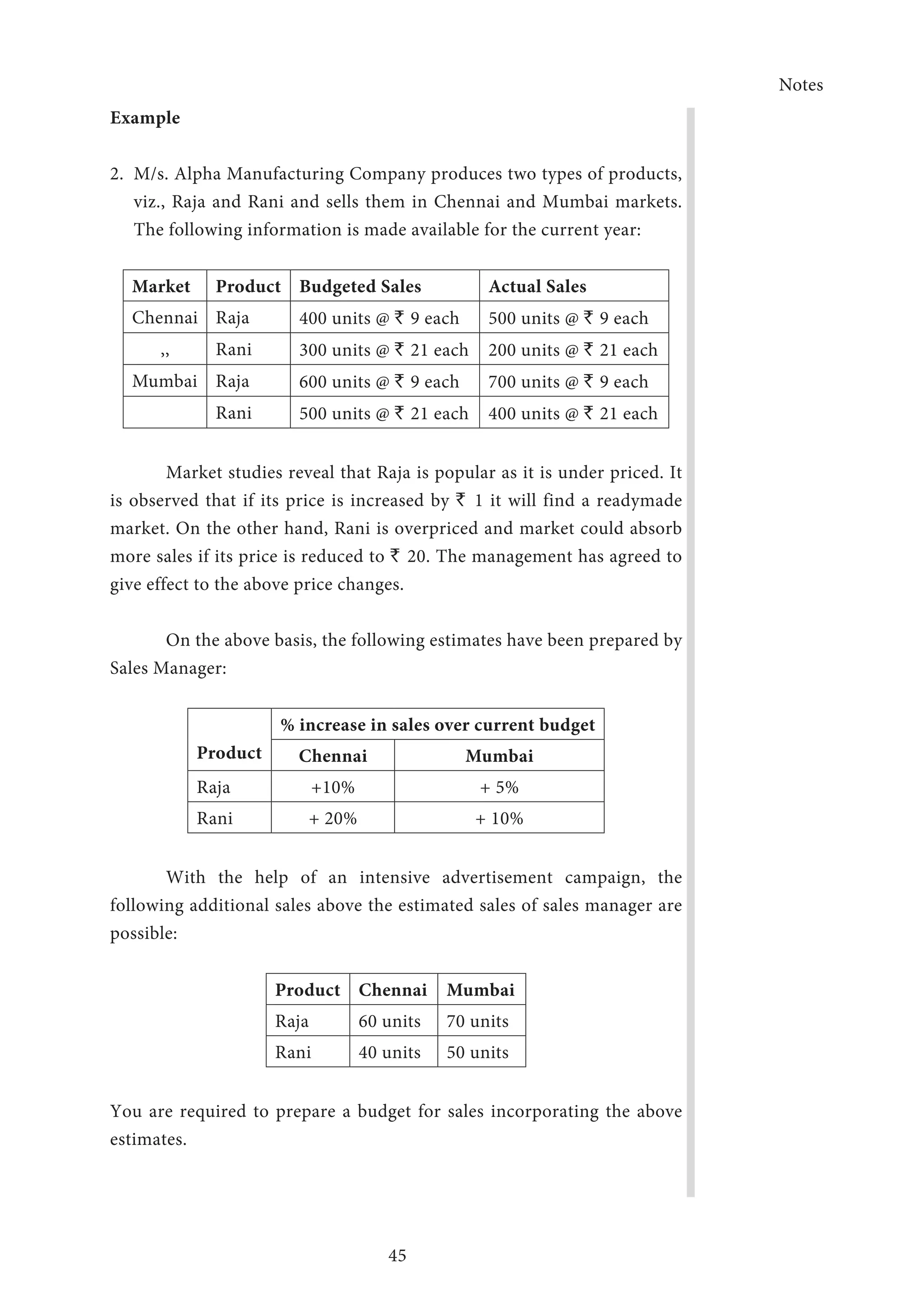
2. M/s. Alpha Manufacturing Company produces two types of products,
viz., Raja and Rani and sells them in Chennai and Mumbai markets.
The following information is made available for the current year:
Market Product Budgeted Sales Actual Sales
Chennai Raja 400 units @ ` 9 each 500 units @ ` 9 each
,, Rani 300 units @ ` 21 each 200 units @ ` 21 each
Mumbai Raja 600 units @ ` 9 each 700 units @ ` 9 each
Rani 500 units @ ` 21 each 400 units @ ` 21 each
Market studies reveal that Raja is popular as it is under priced. It
is observed that if its price is increased by ` 1 it will find a readymade
market. On the other hand, Rani is overpriced and market could absorb
more sales if its price is reduced to ` 20. The management has agreed to
give effect to the above price changes.
	 On the above basis, the following estimates have been prepared by
Sales Manager:
Product
% increase in sales over current budget
Chennai Mumbai
Raja +10% + 5%
Rani + 20% + 10%
	 With the help of an intensive advertisement campaign, the
following additional sales above the estimated sales of sales manager are
possible:
Product Chennai Mumbai
Raja 60 units 70 units
Rani 40 units 50 units
You are required to prepare a budget for sales incorporating the above
estimates.
46
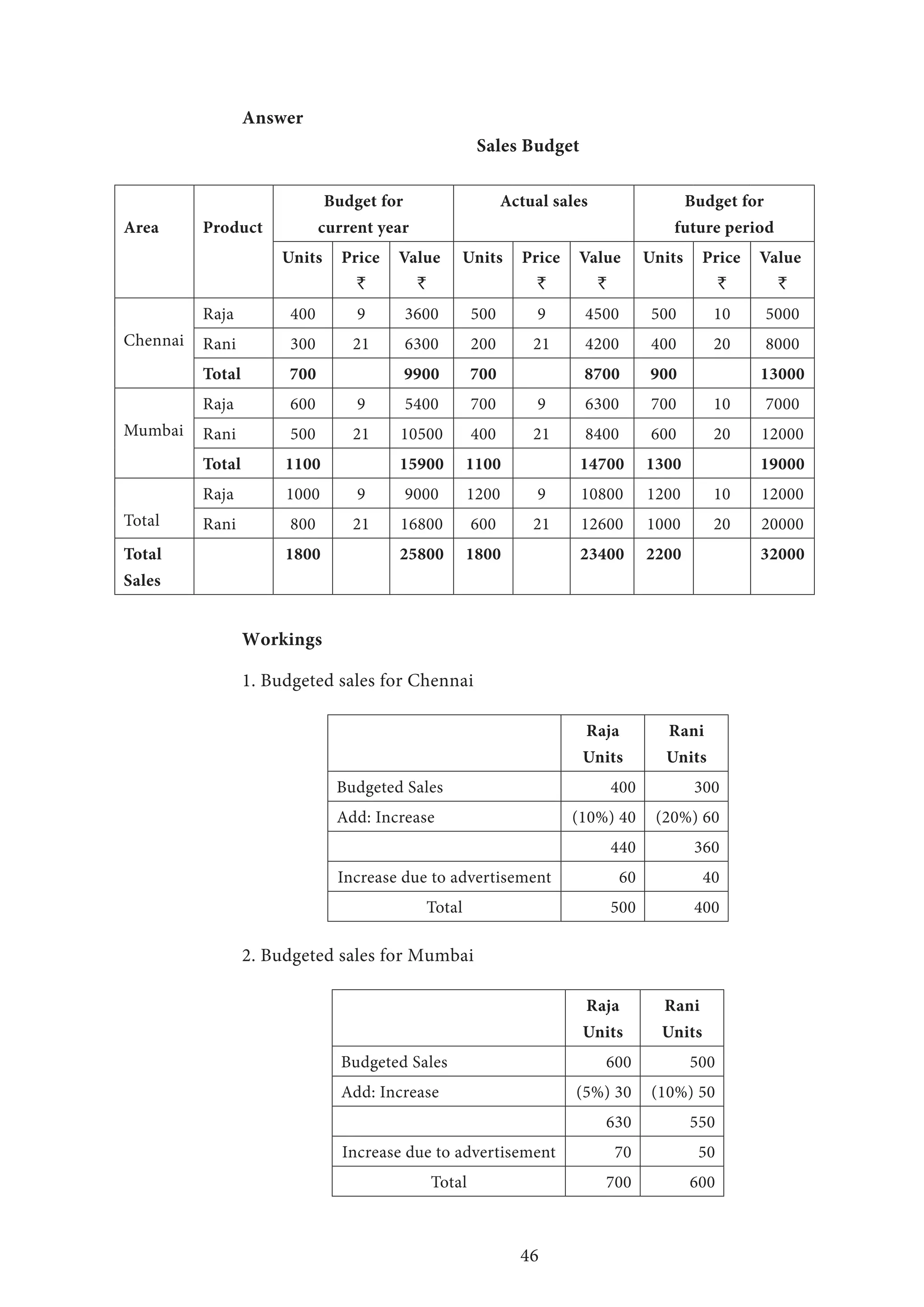
Answer
Sales Budget
Area Product
Budget for
current year
Actual sales Budget for
future period
Units Price
`
Value
`
Units Price
`
Value
`
Units Price
`
Value
`
Chennai
Raja 400 9 3600 500 9 4500 500 10 5000
Rani 300 21 6300 200 21 4200 400 20 8000
Total 700 9900 700 8700 900 13000
Mumbai
Raja 600 9 5400 700 9 6300 700 10 7000
Rani 500 21 10500 400 21 8400 600 20 12000
Total 1100 15900 1100 14700 1300 19000
Total
Raja 1000 9 9000 1200 9 10800 1200 10 12000
Rani 800 21 16800 600 21 12600 1000 20 20000
Total
Sales
1800 25800 1800 23400 2200 32000
Workings
1. Budgeted sales for Chennai
Raja
Units
Rani
Units
Budgeted Sales 400 300
Add: Increase (10%) 40 (20%) 60
440 360
Increase due to advertisement 60 40
Total 500 400
2. Budgeted sales for Mumbai
Raja
Units
Rani
Units
Budgeted Sales 600 500
Add: Increase (5%) 30 (10%) 50
630 550
Increase due to advertisement 70 50
Total 700 600
Notes
47
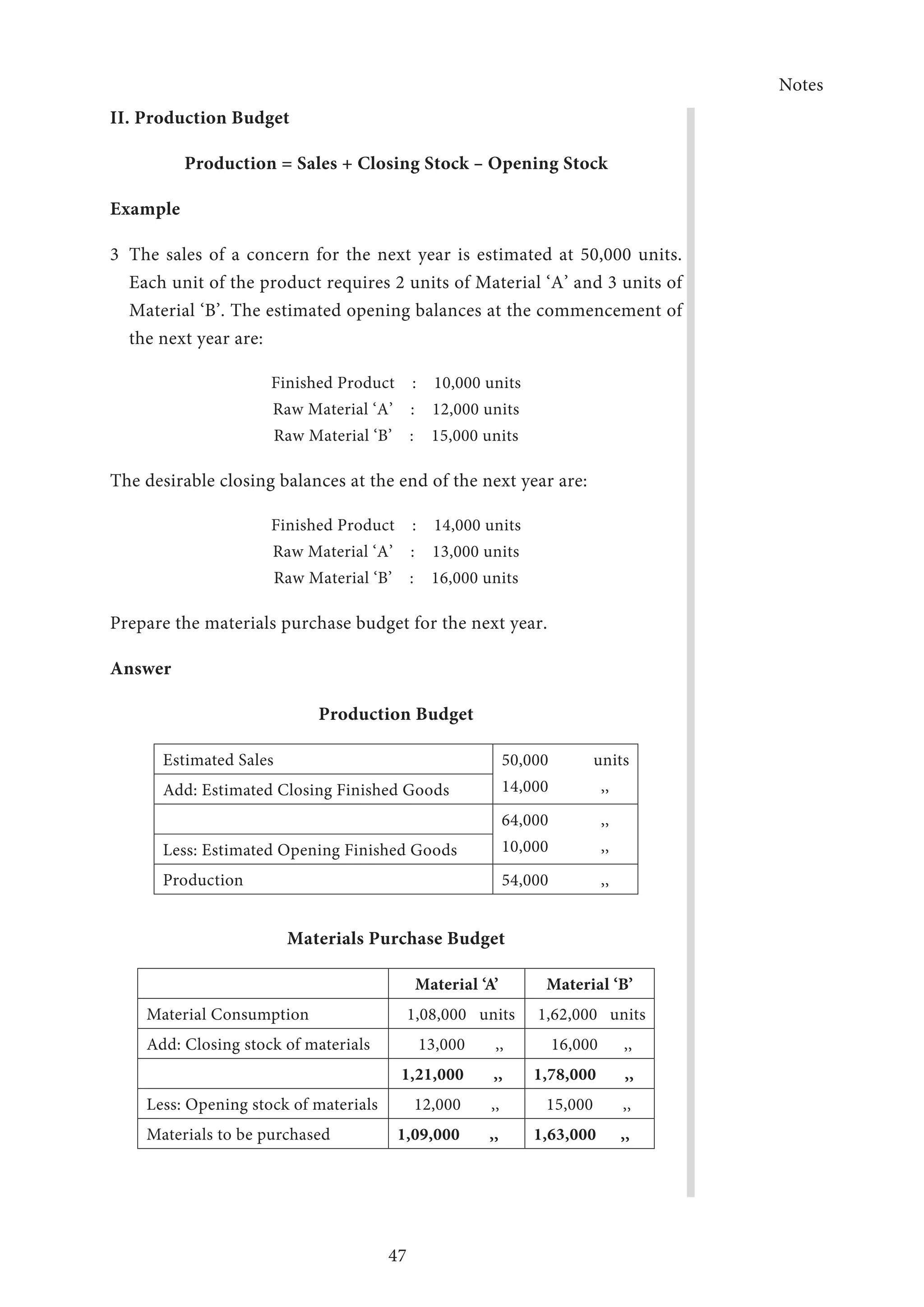
II. Production Budget
Production = Sales + Closing Stock – Opening Stock
Example
3 The sales of a concern for the next year is estimated at 50,000 units.
Each unit of the product requires 2 units of Material ‘A’ and 3 units of
Material ‘B’. The estimated opening balances at the commencement of
the next year are:
Finished Product  :  10,000 units
Raw Material ‘A’  :  12,000 units
Raw Material ‘B’  :  15,000 units
The desirable closing balances at the end of the next year are:
Finished Product  :  14,000 units
Raw Material ‘A’  :  13,000 units
Raw Material ‘B’  :  16,000 units
Prepare the materials purchase budget for the next year.
Answer
Production Budget
Estimated Sales 50,000 units
14,000   ,,Add: Estimated Closing Finished Goods
64,000   ,,
10,000   ,,Less: Estimated Opening Finished Goods
Production 54,000   ,,
Materials Purchase Budget
	 Material ‘A’ Material ‘B’
Material Consumption 1,08,000 units 1,62,000 units
Add: Closing stock of materials 13,000  ,, 16,000   ,,
1,21,000  ,, 1,78,000 ,,
Less: Opening stock of materials 12,000   ,, 15,000 ,,
Materials to be purchased 1,09,000  ,, 1,63,000 ,,
Notes
48
Workings
Materials consumption: Material ‘A’ Material ‘B’
Material required per unit of production 2 units 3 units
For production of 54,000 units 1,08,000 1,62,000
Iii. Cash Budget
It is an estimate of cash receipts and disbursements during a
future period of time. “The Cash Budget is an analysis of flow of cash in
a business over a future, short or long period of time. It is a forecast of
expected cash intake and outlay” (Soleman, Ezra – Handbook of Business
administration).
Procedure for Preparation of Cash Budget
1.	 First take into account the opening cash balance, if any, for the
beginning of the period for which the cash budget is to be prepared.
2.	 Then Cash receipts from various sources are estimated. It may be
from cash sales, cash collections from debtors/bills receivables,
dividends, interest on investments, sale of assets, etc.
3.	 The Cash payments for various disbursements are also estimated.
It may be for cash purchases, payment to creditors/bills payables,
payment to revenue and capital expenditure, creditors for expenses,
etc.
4.	 The estimated cash receipts are added to the opening cash balance,
if any.
5.	 The estimated cash payments are deducted from the above proceeds.
6.	 The balance, if any, is the closing cash balance of the month
concerned.
7.	 The closing cash balance is taken as the opening cash balance of the
following month.
8.	 Then the process is repeatedly performed.
9.	 If the closing balance of any month is negative i.e the estimated
cash payments exceed estimated cash receipts, then overdraft
facility may also be arranged suitably.
Notes
49
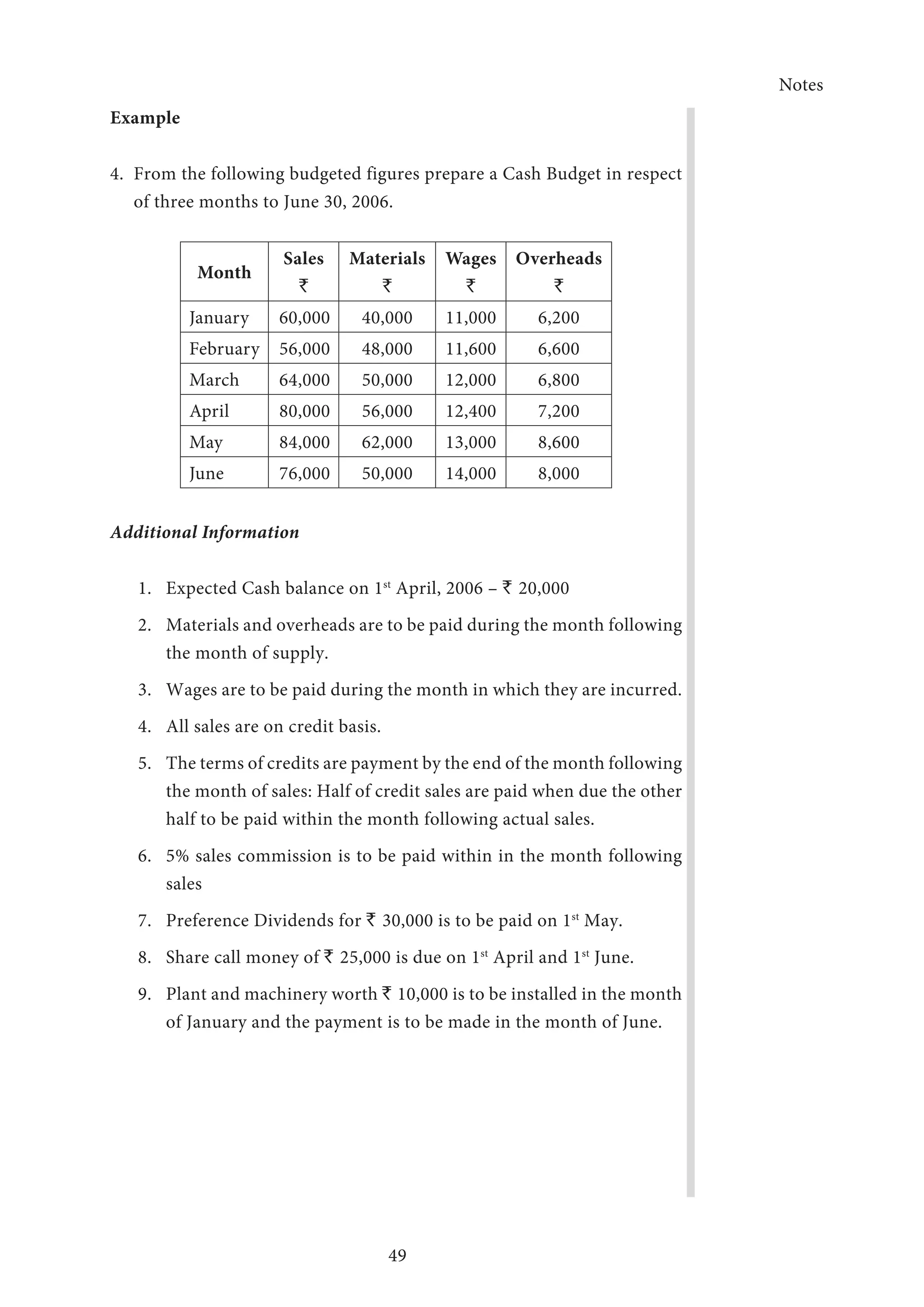
Example
4. From the following budgeted figures prepare a Cash Budget in respect
of three months to June 30, 2006.
Month
Sales
`
Materials
`
Wages
`
Overheads
`
January 60,000 40,000 11,000 6,200
February 56,000 48,000 11,600 6,600
March 64,000 50,000 12,000 6,800
April 80,000 56,000 12,400 7,200
May 84,000 62,000 13,000 8,600
June 76,000 50,000 14,000 8,000
Additional Information
1.	 Expected Cash balance on 1st
April, 2006 – ` 20,000
2.	 Materials and overheads are to be paid during the month following
the month of supply.
3.	 Wages are to be paid during the month in which they are incurred.
4.	 All sales are on credit basis.
5.	 The terms of credits are payment by the end of the month following
the month of sales: Half of credit sales are paid when due the other
half to be paid within the month following actual sales.
6.	 5% sales commission is to be paid within in the month following
sales
7.	 Preference Dividends for ` 30,000 is to be paid on 1st
May.
8.	 Share call money of ` 25,000 is due on 1st
April and 1st
June.
9.	 Plant and machinery worth ` 10,000 is to be installed in the month
of January and the payment is to be made in the month of June.
Notes
50
Answer
Cash Budget for three months from April to June, 2006
Particulars
April
`
May
`
June
`
Opening Cash Balance 20,000 32,000 (-) 5,600
Add: Estimated Cash Receipts:
Sales Collection from debtors
Share call money
Less: Estimated Cash Payments:
Materials
Wages
Overheads
Sales Commission
Preference Dividend
Plant and Machinery
60,000
25,000
72,000 82,000
25,000
1,05,000 1,04,600 1,01,400
50,000
12,400
6,800
3,200
---
---
56,000
13,000
7,200
4,000
30,000
---
62,000
14,000
8,600
4,200
---
10,000
72,400 1,10,200 98,800
Closing Cash Balance 32,600 (-) 5,600 2,600
Workings
1. Sales Collection
Payment is due at the month following the sales. Half is paid on due
and other half is paid during the next month. Therefore, February sales `
50,000 is due at the end of March. Half is given at the end of March and
other half is given in the next month i.e., in the month of April. Hence, the
sales collection for the month of April will be as follows:
For April – Half of February Sales (56,000 x ½)	 = 28,000
	 – Half of March Sales (64,000 x ½)	 = 32,000
Total Collection for April	 = 60,000
	 Similarly, the sales collection for the months of May and June may
be calculated.
Notes
51
2. Materials and Overheads
	 These are paid in the following month. That is March is paid in
April, April is paid in May and May is paid in June.
3. Sales Commission
It is paid in the following month. Therefore,
	 For April – 5% of March Sales (64,000 x 5 /100) = 3,200
	 For May – 5% of March Sales (80,000 x 5 /100) = 4,000
For April – 5% of March Sales (84,000 x 5 /100) = 4,200
Iv. Flexible Budget
A flexible budget consists of a series of budgets for different level of
activity. Therefore, it varies with the level of activity attained. According
to CIMA, London, A Flexible Budget is, ‘a budget designed to change in
accordance with level of activity attained’. It is prepared by taking into
account the fixed and variable elements of cost. This budget is more
suitable when the forecasting of demand is uncertain.
Points to be remembered while preparing a flexible budget
1.	 Cost has to be classified into fixed and variable cost.
2.	 Total fixed cost remains constant at any level of activity.
3.	 Total Variable cost varies in the same proportion at which the level
of activity varies.
4.	 Fixed and variable portion of Semi-variable cost is to be segregated.
Example
5. The following information at 50% capacity is given. Prepare a flexible
budget and forecast the profit or loss at 60%, 70% and 90% capacity.
Fixed expenses: Expenses at 50%
capacity (`)
Salaries 5,000
Rent and taxes 4,000
Notes
52
Depreciation 6,000
Administrative expenses 7,000
Variable expenses:
Materials 20,000
Labour 25,000
Others 4,000
Semi-variable expenses:
Repairs 10,000
Indirect Labour 15,000
Others 9,000
	 It is estimated that fixed expenses will remain constant at all
capacities. Semi-variable expenses will not change between 45% and
60% capacity, will rise by 10% between 60% and 75% capacity, a further
increase of 5% when capacity crosses 75%.
Estimated sales at various levels of capacity are:
Capacity 		 Sales (`)
60%		 1,10,000
70%		 1,30,000
90%		 1,50,000
Answer
Flexible Budget
(Showing Profit  Loss at various capacities)
Particulars
Capacities
50% 60% 70% 90%
` ` ` `
Fixed Expenses:
Salaries 5,000 5,000 5,000 5,000
Rent and taxes 4,000 4,000 4,000 4,000
Depreciation 6,000 6,000 6,000 6,000
Administrative expenses 7,000 7,000 7,000 7,000
Variable expenses:
Notes
53
Materials 20,000 24,000 28,000 36,000
Labour 25,000 30,000 35,000 45,000
Others 4,000 4,800 5,600 7,200
Semi-variable expenses:
Repairs 10,000 10,000 11,000 11,500
Indirect Labour 15,000 15,000 16,500 17,250
Others 9,000 9,000 9,900 10,350
Total Cost 1,05,000 1,14,800 1,28,000 1,49,300
Profit (+) or Loss (-) (-) 4,800 (+) 2,000 (+) 700
Estimated Sales 1,10,000 1,30,000 1,50,000
Example
6. The following information relates to a flexible budget at 60% capacity.
Find out the overhead costs at 50% and 70% capacity and also determine
the overhead rates:
Particulars
Expenses at
60% capacity
Variable overheads: `
  Indirect Labour 10,500
  Indirect Materials 8,400
Semi-variable overheads:
  Repair and Maintenance
  (70% fixed; 30% variable)
7,000
  Electricity
  (50% fixed; 50% variable)
25,200
Fixed overheads:
  Office expenses including salaries 70,000
  Insurance 4,000
  Depreciation 20,000
Estimated direct labour hours 1,20,000 hours
Notes
54
Answer
Flexible Budget
50 %
Capacity
60%
Capacity
70%
Capacity
` ` `
Variable overheads:
Indirect Labour 8,750 10,500 12,250
Indirect Materials 7,000 8,400
Semi-variable overheads:
Repair and Maintenance (1) 6,650 7,000
Electricity (2) 23,100 25,200
Fixed overheads:
Office expenses including salaries 70,000 70,000 70,000
Insurance 4,000 4,000 4,000
Depreciation 20,000 20,000 20,000
Total overheads 1,39,500 1,45,100 1,50,700
Estimated direct labour hours 1,00,000 1,20,000 1,50,000
Overhead rate per hour (`) 1.395 1.21 1.077
Workings
1.	 The amount of Repairs and maintenance at 60% Capacity is `
7,000. Out of this, 70% (i.e ` 4,900) is fixed and remaining 30%
(i.e ` 2,100) is variable. The fixed portion remains constant at all
levels of capacities. Only the variable portion will change according
to change in the level of activity. Therefore, the total amount of
repairs and maintenance for 50% and 70% capacities are calculated
as follows:
Repairs and maintenance 50% 60% 70%
  Fixed (70%)
  Variable (30%)
4,900
1,750
4,900
2,100
4,900
2,450
Total 6,650 7,000 7,350
Notes
55
2.	 Similarly, electricity expenses at different levels of capacity are
calculated as follows:
Electricity 50% 60% 70%
Fixed (50%)
Variable (50%)
12,600
10,500
12,600
12,600
12,600
14,700
Total 23,100 25,200 27,300
Zero Base Budgeting (ZBB)
It is a management technique aimed at cost reduction. It was
introduced by the U. S. Department of Agriculture in 1961. Peter A. Phyrr
popularized it. In 1979, president Jimmy Carte issued a mandate asking
for the use of ZBB by the Government.
ZBB - Definition
“It is a planning and budgeting process which requires each
manager to justify his entire budget request in detail from scratch (Zero
Base) and shifts the burden of proof to each manager to justify why he
should spend money at all.
The approach requires that all activities be analyzed in decision
packages, which are evaluated by systematic analysis and ranked in the
order of importance”. – Peter A. Phyrr.
It implies that-
➢ ➢ Every budget starts with a zero base
➢ ➢ No previous figure is to be taken as a base for adjustments
➢ ➢ Every activity is to be carefully examined afresh
➢ ➢ Each budget allocation is to be justified on the basis of anticipated
circumstances
➢ ➢ Alternatives are to be given due consideration
Notes
56
Advantages of ZBB
1.	 Effective cost control can be achieved
2.	 Facilitates careful planning
3.	 Management by Objectives becomes a reality
4.	 Identifies uneconomical activities	
5.	 Controls inefficiencies
6.	 Scarce resources are used judiciously
7.	 Examines each activity thoroughly
8.	 Controls wasteful expenditure
9.	 Integrates the management functions of planning and control
10.	Reviews activities before allowing funds for them.
Performance Budgeting
It involves evaluation of the performance of the organization in the
context of both specific as well as overall objectives of the organization. It
provides a definite direction to each employee and a control mechanism
to top management.
Definition
Performance Budgeting technique is the process of analyzing,
identifying, simplifying and crystallizing specific performance objectives
of a job to be achieved over a period of the job. The technique is
characterized by its specific direction towards the business objectives of
the organization. – The National Institute of Bank Management.
The responsibility for preparing the performance budget of
each department lies on the respective departmental head. It requires
preparation of performance reports. This report compares budget and
actual data and shows any existing variances. To facilitate the preparation,
the departmental head is supplied with the copy of the master budget
appropriate to his function.
Notes
57
Master Budget
Master budget is a comprehensive plan which is prepared from
and summarizes the functional budgets. The master budget embraces
both operating decisions and financial decisions. When all budgets are
ready, they can finally produce budgeted profit and loss account or income
statement and budgeted balance sheet. Such results can be projected
monthly, quarterly, half-yearly and at year end. When the budgeted profit
falls short of target it may be reviewed and all budgets may be reworked
to reach the target or to achieve a revised target approved by the budget
committee.
****
Notes
58
Lesson 2.2 - Standard Costing
Standard: According to Prof. Erie L. Kolder, “Standard is a desired
attainable objective, a performance, a goal, a model”.
	 Standard Cost: Standard cost is a predetermined estimate of cost
to manufacture a single unit or a number of units during a future period.
The Chartered Institute of Management Accountants, London,
defines “Standard Cost” as, “a pre-determined cost which is calculated
from management’s standards of efficient operation and the relevant
necessary expenditure. It may be used as a basis for price fixing and for
cost control through variance analysis”.
Standard Costing: According to the Chartered Institute of
Management Accountants, London Standard Costing is “the preparation
and use of Standard Cost, their comparison with actual costs, and the
analysis of variances to their causes and points of incidence”.
The study of standard cost comprises of:
1.	 Ascertainment and use of standard costs.
2.	 Comparison of actual costs with standard costs and measuring the
variances.
3.	 Controlling costs by the variance analysis.
4.	 Reporting to management for taking proper action to maximize the
efficiency.
Budgetary Control and Standard Costing
Both standard costing and budgetary control aim at maximum
efficiency and managerial control. Budgetary control and standard
costing have the common objective of controlling business operations by
establishingpre-determinedtargets,measuringtheactualperformanceand
comparing it with the targets, for the purposes of having better efficiency
Notes
59
and of reducing costs. The two systems are said to be interrelated but
they are not inter-dependent. The budgetary control system can function
effectively even without the system of standard costing in operation but
the vice-versa is not possible.
Standard Costing as a Controlling Technique
It is essential for management to have knowledge of costs so that
decision can be effective. Management can control costs on information
being provided to it. The technique of standard costing is used for building
a proper budgeting and feedback system. The uses of standard costing to
management are as follows.
1. Formulation of Price and Production Policies
Standard Costing acts as a valuable guide to management in
the fixation of price and formulation production polices. It also assists
management in the field of inventory pricing, product, product pricing
profit planning and also in reporting to top management.
2. Comparison and Analysis of Data
Standard Costing provides a stable basis for comparison of actual
with standard costs. It brings out the impact of external factors and
internal causes on the cost and performance of the concern. Thus, it helps
to take remedial action.
3. Cost Consciousness
An atmosphere of cost consciousness is created among the
staff. Standard costing also provides incentive to workers for efficient
performance.
4. Better Capacity to Anticipate
An effective budget can be formulated for the future by laving price
knowledge of the deviations of actual costs from standard costs. Data are
available at an early stage and the capacity to anticipate about changing
conditions is developed.
Notes
60
5. Better Economy, Efficiency and Productivity
Men, machines and materials are more effectively utilized and thus
benefits of economies can be reaped in business together with increased
productivity.
6. Delegation of Authority and Responsibility
The net profit is analyzed and responsibility can be placed on
the person in charge for any variations from the standards. It discloses
adverse variations and particular cost centre can be held accountable.
Thus, delegation of authority can be made by management to control the
affairs in different departments.
7. Management by ‘Exception’
The principle of “management by exception’ can be applied in the
business. This helps the management in concentrating its attention on cases
which are off standard, i.e., below or above the standard set. A pattern is
provided for the elimination of undesirable factors causing damage to the
business.
Setting the Standard
	 While setting standard cost for operations, process or products,
the following preliminaries must be gone through:
1.	 Establish Standard Committee comprising Purchase Manager,
Personnel Manager, and Production Manager. The Cost Accountant
coordinates the functions.
2.	 Study the existing costing system, cost records and forms in use.
3.	 A technical survey of the existing methods of production should be
undertaken.
4.	 Determine the type of standard to be used.
5.	 Fix standard for each element of cost.
6.	 Determine standard costs of r each product.
7.	 Fix the responsibility for setting standards.
8.	 Account variances properly.
Notes
61
9.	 Ascertain the deviations by comparing the actual with standards.
10.	Take necessary action to ensure that adverse variances are not
repeated.
Determination of Standard Costs
The following preliminary steps are considered before setting standards:
(a)	Establishment of cost centre
(b)	Classification and codification of accounts
(c)	Types of standards
(d)	Setting the standards.
(a)	 Establishment of cost centre. For fixing responsibility and defining
the lines of authority, cost centre is necessary. “A cost centre is a
location, person or item of equipment (or group of these) for which
costs may be ascertained and used of the purpose of cost control”.
With the help of cost centre, the standards are prepared and the
variances are analyzed.
(b)	 Classification and codification of accounts. Accounts are classified
according to different items of expenses under suitable heading.
Each heading may be given codes and symbols. Coding is useful for
speedy collection and analysis.
(c)	 Types of standards. The different types of standards are given
below:
(i)	 Basic standard. It is fixed and unaltered for an indefinite
period for forward planning. According to I.C.M.A London, it
is “an underlying standard from which a current standard can
be developed”. From this basic standard, changes in current
standard and actual standard can be measured.
(ii)	 Current standard. It is a short-term standard, as it is revised
at regular intervals. I.C.M.A. London refers to it as “a standard
which is established for use over a short period of time and is
related to current conditions”. This standard is realistic and
helpful to business. It is useful for cost control.
Notes
62
(iii)	Normal standard. It is an average standard, and is based on
normal conditions which prevail over a long period of a trade
cycle. I.C.M.A defines it as “the average standard which, it
is anticipated, can be attained over a future period of time,
preferably long enough to cover one trade-cycle”. It is used for
planning and decision making during the period of trade cycle
to which it is related. It is very difficult to apply in practice.
(iv)	Ideal standard. I.C.M.A. defines it as “the standard which can
be attained under the most favorable condition possible”. It is
fixed and needs a high degree of efficiency, best possible con-
ditions of management and performance. Existing conditions
and conditions capable of achievement should be taken into
consideration. It is difficult to attain this ideal standard.
(v)	 Expected standard. It is a practical standard. I.C.M.A defines it
as, “the standard which, it is anticipated, can be attained during
a future specified budget period”. For setting this standard,
due weightage is given for all the expected conditions. It is
more realistic than the ideal standard.
(d)	 Setting the standards. After choosing the standard, the setting of
standard is the work of the standard committee. The cost accountant
has to supply the necessary cost figures and co-ordinate the activity
committee. He must ensure that the setting standards are accurate.
Standards cost is determined for each element of the following costs.
(i)	 Direct Material cost. Standard material cost is equal to the
standard quantity multiplied by the standard price. The setting of
standard costs for direct materials involves
(a)	 Standard Material Quantity. For each product or part or
the process, mechanical calculation or mechanical analysis is
made. The allowance for normal wastage or loss must be fixed
very carefully. Similarly, where different kinds of materials
are used as a mix for a process, a standard material mix is
determined to produce the desire quality product.
(b)	 Standard Material Price. Setting of material standard price is
done by the cost accountant and the purchase manager. The
Notes
63
current standard is the desirable and effective for fixing the
price. Normally one year is the period for fixation of standard
price. If there are more fluctuations in prices, then revision
of standard price is necessary. Before fixing the standard, the
following points must be considered:
➢ ➢ Prices of materials in stock
➢ ➢ Price quoted by suppliers
➢ ➢ Trade and cash discounts received
➢ ➢ Future prices based upon statistical data
➢ ➢ Material price already contracted
(ii)	Setting standard for Direct Labour. The standard labour cost
is equal to the standard time for each operation multiplied by
the standard wage rate. Setting of standard cost of direct labour
involves:
(a)	 Fixation of standard time
(b)	 Fixation of standard rate
(a) Fixation of standard time: Standard time is fixed by time or
motion study or past records or test runs or estimates. Labour
time is fixed by the work study engineer. While fixing standard
time, normal ideal time is allowed for fatigue, normal delays
or other contingencies.
(b) Fixation of standard rate. With the help of the personnel
manager, the accountant determines the standard rate.
Fixation of standard rate is influenced by (i) Union’s policy
(ii) Demand for labour (iii) Policy the be followed. (iv)
Method of wage payment.
(iii)	Setting standard for Overhead. Overheads are divided into fixed,
variable and semi-variable. Standard overhead rate is determined
on the basis of past records and future trend of prices. It is
calculated for a unit or for an hour.
Standard variable overhead rate=
Standard variable overhead for the budge Period
-----------------------------------------------------------
Budgeted production units or budgeted hours for the
budgeted period (or some other base)
Notes
64
Standard fixed overhead rate=
Standard overheads for the budget period
------------------------------------------------------------
Budgeted production units or budgeted hours for the
budgeted period (or some other base)
	
Revision of Standards
Standard cost may be established for an indefinite period. There
are no definite rules for the selection for a particular period. If the
standards are fixed for a short period, it is expensive and frequent revision
of standards will impair the utility and purpose for which standard is set.
At the same, if the standard is set for a longer period, it may not be
useful particularly in the days of high inflation and large fluctuations of
rates in case of materials and labour.
Standards have to be revised from time to time taking into
consideration changing circumstances. The circumstances may change
on account of technical innovations, changed market conditions, increase
or decrease in plant capacity, developing new products or giving up
unprofitable production lines. If variations from actual occur in practice,
they may be due to controllable or uncontrollable causes. Standards
should be revised only on account of those causes which are beyond the
control of the management. Changes in product design, supply of labour
and material, changes in market conditions for a long period, trade or
cyclical variations would impel the management to revise the standards.
The objective, while comparing the actual performance with the standard
performance and revising standards, is to facilitate better control over costs
and improve the overall working and profitability of the organization.
Apart from the above, basic standards are revised in the course of
time under the following circumstances, when:
1.	 There are permanent changes in the method of production –designs
and specifications.
2.	 Plant capacity is changed
3.	 There is a large variation between the standard and the actual.
Notes
65
Budgetary Control and Standard Costing
The systems of budgetary control and standard costing have the
common objective of controlling business operations by establishing pre-
determined targets, measuring the actual performance and comparing it
with the targets, for the purposes of having better efficiency and of reducing
costs. These two systems are said to be interrelated but they are not inter-
dependent. The budgetary control system can function effectively even
without the system of standard costing in operation but the vice-versa is
not true. Usually, the two are used in conjunction with each other to have
most fruitful results. The distinction between the two systems is mainly
on account of the field or scope and technique of operation.
Budgeting Standard costing
1.	 Budgetary control is concerned
with the operation of the
business as a whole and hence
its more extensive
1.	 Standard Costing is related
with the control of the expenses
and hence it is more intensive
2.	 Budget is a projection of
financial accounts
2.	 Standard cost is the projection
of cost accounts
3.	 It does not necessarily involve
standardization of products.
3.	 It requires standardization of
products.
4.	 Budgetary control can be
adopted in part also.
4.	 It is not possible to operate this
system in parts
5.	 Budgeting can be operated
without standard costing.
5.	 Standard costing cannot exist
with out budgeting.
6.	 Budgets determine the ceilings
of expenses above which
actual expenditure should not
normally rise.
6.	 Standards are minimum targets
which are to be attained by
actual performance at specific
efficiency level.
****
Notes
66
Lesson 2.3 - Variance Analysis
It involves the measurement of the deviation of actual performance
formtheintendedperformances.Itisbasedontheprincipleofmanagement
by exception. The attention of management is drawn not only to the
variation in monetary gain but also to the responsibility and causes for
the same.
Favourable and Unfavourable Variances
Variances may be favorable (positive or credit) or unfavorable (or
negative or adverse or debit) depending upon whether the actual cost is
less or more than the standard cost.
Favorable variance: When the actual cost incurred is less than the
standard cost, the deviation is known as favorable variance. The effect of
the favorable variance increases the profit. It is also known as positive or
credit variance.
Unfavorable variance: When the actual cost incurred is more
than the standard cost, the variance is known as unfavorable or adverse
variance. It refers to deviation causing the loss to the business. It is also
known as negative or debit variance.
Controllable and Uncontrollable Variance
Variances may be controllable or uncontrollable, depending upon
the controllability of the factors causing variances.
Controllable variance: It refers to a deviation caused by such
factors which could be influenced by the executive action. For example,
excess usage of materials, excess time taken by a worker, etc. When
compared to the standard cost it is controllable as the responsibility can
be fixed on the in-charge.
Notes
67
Uncontrollable variance: When variance is due to the factors beyond
the control of the concerned person (or department), it is uncontrollable.
For example, the wage rate increased on account of strike, government
restrictions, change in market price etc. Only revision of standards is
required to remove such in future.
Uses
The variance analysis is important tools of cost control and cost
reduction and they generate an atmosphere of cost consciousness in the
organization.
1.	 Comparison of actual with standard cost which reveals the efficiency
or inefficiency of performance. The inefficiency or unfavorable
variance is analyzed and immediate actions are taken.
2.	 It is a tool of cost control and cost reduction
3.	 It helps to apply the principle of management by exception.
4.	 It helps the management to maximize the profits by analyzing the
variances into controllable and uncontrollable; the controllable
variances are further analyzed so as to bring a cost reduction,
indirectly more profit.
5.	 Future planning and programmes are based on the variance
analysis.
6.	 Within the organization, a cost consciousness is created along with
the team spirit.
Computation of Variances
The causes of variance are necessary to find remedial measures; and
therefore a detailed study of variance analysis is essential. Variances can
be found out with respect to all the elements of cost, i.e., direct material,
direct labour and overheads. The following are the common variances,
which are calculated by the management. Sub-divisions of variances in
fact,d give detailed information to the management in order to control
the cost.
Notes
68
1.	 Material variances
2.	 Labour variances
3.	 Overhead variances (a) variable (b) fixed
Material Variance
The following are the variances in the case of materials
a)	 Material Cost Variance (MCV). It is the difference between the stand-
ard cost of direct materials specified for the output achieved and the
actual cost of direct materials used. The standard cost of materials is
computed by multiplying the standard price with the standard quan-
tity for actual output; and the actual cost is computed by multiplying
the actual price with the actual quantity. The formula is:
Material Cost Variance (or) MCV
(Standard cost of materials - Actual cost of materials used)
(or)
(Standard Quantity for actual output x Standard Price) -
(Actual Quantity x Actual Rate)			 (or)
(SO x SP) - (AQ x AP)
b)	 Material Price Variance (MPV). Material price variance is that
portion of the direct materials cost variance which is the difference
between the standard price specified and the actual price paid for the
direct materials used. The formula is:
Material Price Variance
(Actual Quantity consumed x Standard Price) –
(Actual Quantity consumed x Actual Price)		 (or)
Actual Quantity consumed (Standard Price - Actual Price)
(or)
MPV= AQ (SP-AP)
c)	 Material Usage (Quantity) Variance (MUV). It is the deviation caused
by the difference between the standards fixed and actual quantity used
Notes
69
for actual production at standard price. It is calculated by multiplying
the difference between the standard quantity specified and the actual
quantity used by the standard price.
	 Thus material usage variance is “that portion of the direct materials
cost variance which is the difference between the standard quantity
specified for the production achieved, whether completed or not, and the
actual quantity used, both valued at standard prices”.
Material Usage or Quantity Variance
Standard Rate (Standard Quantity - Actual Quantity) (or)
MUV = SR (SQ-AQ)
d)	 Material Mix Variance (MMV). When two or more materials are
used in the manufacture of a product, the difference between the
standard composition and the actual composition of material mix is
the material mix variance. The variance arises due to the change in the
ratio of material and the standard ratio. The formula is:
Material Mix Variance = Standard Rate (Standard Mix – Actual Mix)
Standard is revised due to the shortage of a particular type of material.
The formula is:
MMV = Standard Rate (Revised Standard Quantity - Actual Quantity)
Revised Standard Quantity (RSQ) =
	 Total weight of actual mix
--------------------------------- x Standard Quantity
	 Total weight of standard mix
After finding out this revised standard mix it is multiplied by the
revised standard cost of standard mix and then the standard cost of actual
mix is subtracted form the result.
Notes
70
Example:1
The standard cost of material for manufacturing a unit a particular product
is estimated as 16kg of raw materials @ ` 1 per kg.
On completion of the unit, it was found that 20kg. of raw material costing
` 1.50 per kg. has been consumed. 	Compute Material Variances.
Answer
MCV = (SQ x SP) - (AQ x AP) 	 = (16 x ` 1) - (20 x ` 1.50)
						= ` 16 - ` 30
						= ` 14 (Adverse)
MPV = (SP – AP) x AQ		 = (1 – 1.50) x 20
						= ` 10 (Adverse)
MUV = (SQ – AQ) x SP		 = (16 – 20) x 1
						= ` 4 (Adverse)
Example:2
Calculate the materials mix variance from the following:
Material			Standard			Actual
	 A		 90 units at ` 12 each	 	 100 units at ` 12 each
	 B		 60 units at ` 15 each		 50 units at ` 16 each
Answer:
Material Standard Actual
Qty   Rate   Amount Qty  Rate  Amount
A
B
90   12    1080
60   15   900
100 12 1200
50 16 800
150      1980 150 2000
MMV = SR (SQ-AQ)
Material ‘A’: MMV	= ` 12 (90-100)
			= ` 12 x10
			= ` 120(A)
Notes
71
Material ‘B’: MMV	 = ` 15 (60-50)
			= ` 15 x 10
			= ` 150 (F)
Total MMV	= ` 120(A) + ` 150 (F)
		 = ` 30 (F)
(e)	 Material Yield Variance: It is that portion of the direct material usage
variance which is due to the difference between the standard yield
specified and the actual yield obtained. The variance arises due to
abnormal contingencies like spoilage, chemical reaction etc. Since the
variance is a measure of the waste or loss in the production, it known
as material loss or waste variance.
ICMA, LONDON, has defined it as “the difference between the
standard yield of the actual material input and the actual yield, both valued
at the standard material cost of the produce”. In case actual yield is more
than the standard yield, the material yield variance is favorable and, if the
actual yield is less than the standard yield, the variance is unfavorable or
adverse.
(i)  When actual mix and standard mix are the same, the formula is:
MYV = Standard Yield Rate (Standard Yield - Actual Yield)
or = Standard Revised Rate (Actual Loss - Standard Loss)
Here Standard Yield Rate =
Standard cost of standard mix
---------------------------------------
Net standard output
Net standard output = Gross output – Standard loss
(ii) When the actual mix and the standard mix differ from each other,
the formula is:
Standard Rate =
Standard cost of revised standard mix
-----------------------------------------------------
Net Standard Output
Notes
72
Material Yield Variance = Standard Rate (Actual Standard
Yield – Revised Standard Yield)
Labour Variances
Labour Variances arise because of (I) Difference in Actual Rates
and Standard Rates of Labour and (II) The variation in Actual Time taken
y workers and the Standard Time allotted to them for performing a job.
These are computed on the same pattern as that of Material Variances.
For Labour Variances by simply putting the word “Time” in place of
“Quantity” in the formula meant for Material Variances. The various
Labour Variances can be analysed as follows:
(A)	 Labour Cost Variance
(B)	 Labour Rate Variance
(C)	 Labour Time Or Efficiency Variance
(D)	 Labour Idle Time Variance
(E)	 Labour Mix Variance Or Gang Composition Variance
a) Labour Cost Variance (LCV)
This variance represents the difference between the Standard
Labour Costs and the Actual Labour Costs for the production achieved. If
the Standard Cost is higher, the variation is favourable and vice versa. It
is calculated as follows:
Labour Cost Variance: = (Standard Cost of Labour - Actual Cost of Labour)
	 = (Standard Time x Standard Rate) - (Actual Time
x Actual Rate)
			 = (ST x SR) - (AT x AR)
b) Labour Rate Variance (LRV)
It is the difference between the Standard Rate of pay specified and
the Actual Rate Paid. According to ICMA, London, the variance is “the
difference between the standard and the actual direct Labour Rate per
hour for the total hours worked. If the standard rate is higher, the variance
is Favourable and vice versa.
Notes
73
Labour Rate Variance = Actual Time (Standard Wage Rate x Actual
Wage Rate)
		 	 =AT (SR-AR)
c) Labour Time or Labour Efficiency Variance (LEV)
It is the difference between the Standard Hours for the actual
production achieved and the hours actually worked, valued at the Standard
Labour Rate. When the workers finish the specific job in less than the
Standard Time, the variance is Favourable. If the workers take more time
than the allotted time, the variance is Adverse.
Labour Efficiency Variance (LEV)
=Standard Rate (Standard Time - Actual Time)
=SR (ST-AT)
d) Idle Time Variance
	 It arises because of the time during which the Labour remains idle
due to abnormal reasons, i.e. power failure, strikes, machine breakdown,
shortage of materials, etc. It is always an Adverse variance
Labour Idle Time Variance = Actual Idle Time x Standard Hourly Rate
e) Labour Mix Variance or Gang Compostion Variance (LMV)
It is the difference between the standard composition of workers
and the actual gang of workers. It is a part of labour efficiency variance.
It corresponds to material mix variance. It enables the management to
study the labour cost variance occurred because of the changes in the
composition of labour force.
The rates of pay of the different categories of workers-skilled,
semi-skilled and unskilled are different. Hence, any change made in
composition of the workers will naturally cause variance. How much is
variance due to the change, is indicated by Labour Mix Variance.
Notes
74
(i)	When the total hours i.e. time of the standard composition and
actual composition of workers does not differ the formula is:
	 Labour Mix variance= (StandardCostofStandardMix)-(Standard
cost of Actual Mix)
(ii)	 When the total hours i.e. time of the standard composition and
actual composition of workers differs, the formula is:
Labour Mix Variance
Total Time of Actual mix
………………………..…. x Std cost of Std. mix) - (Std. cost of Actual Mix)
Total Time of Standard Mix
If, on account of short availability of some category of workers, the
standard composition is itself revised, then Labour Mix Variance will be
calculated by taking revised standard mix in place of standard mix.
Labour Yield Variance (LYV)
It is just like Material Yield Variance. It is the difference between
the standard labour output and actual output of yield. It is calculated as
below:
Labour Yield Variance
= Standard cost per unit {Standard production of Actual mix -
Actual Production}
Overhead Variance
Overhead Cost Variance
It is the difference between standard overheads for actual output
i.e. Recovered Overheads and Actual Overheads. It is the total of both
fixed and variable overhead variances. The variable overheads are those
costs which tend to vary directly in proportion to changes in the volume
of production. Fixed overheads consist of costs which are not subject to
Notes
75
change with the change in the volume of production. The variances under
overheads are analysed in two heads, viz Variable Overheads and Fixed
Overheads:
Overheads Cost Variance = Standard Total Overheads-Actual
Total Overheads
The term overhead includes indirect material, indirect labour
and indirect expenses and the variances relate to factory, office or selling
and distribution overheads. Overhead variances are divided into two
broad categories: (i) Variable overhead variances and (ii) Fixed overhead
variances. To compute overhead variances, the following terms must be
understood:
a) Standard overhead rate per unit
Budgeted overheads
= ………..……………
Budgeted output
b) Standard overheads rate per hour
Budgeted overheads
= ………………………
Budgeted hours
c) Standard hours for actual output
			Budgeted hours
…………………. x Actual output
			Budgeted output
d) Standard output for actual time
		 Budgeted output
……………………. x Actual hours
			Budgeted hours
e) Recovered or Absorbed overheads = Standard rate per unit x Actual
output
Notes
76
f) Budgeted overheads = Standard rate per unit x budgeted output
g) Standard overheads = Standard rate per unit x Standard output for
actual time
h) Actual overheads = Actual rate per unit x Actual output
Variable Overhead Variance
	 Variable cost varies in proportion to the level of output, while the
cost is fixed per unit. As such the standard cost per unit of these overheads
remains the same irrespective of the level of output attained. As the
volume does not affect the variable cost per unit or per hour, the only
factors leading to difference is price. It results due to the change in the
expenditure incurred.
(i)  Variable Overhead Expenditure Variance
It is the difference between actual variable overhead expenditure
incurred and the standard variable overheads set in for a particular period.
The formula is:-
{Actual Hours Worked x Standard Variable Overhead Rate per hour}-
Actual Variable overheads
(ii)  Variable Overhead Efficiency Variance
It shows the effect of change in labour efficiency on variable
overheads recovery. The formula is:- Standard Rate (Standard Quantity-
Actual Quantity)
Standard Overhead Rate = (Standard Time for Actual output- Actual
Time)
(iii)  Variable Overhead Variance
It is divided into two: Overhead Expenditure Variance and
Overhead Efficiency Variance. The formula is:-
Variable overhead Expenditure Variance + Variable overhead
Efficiency variance
Notes
77
Fixed Overhead Variance (FOV)
Fixed overhead variance depends on (a) fixed expenses incurred
and (b) the volume of production obtained. The volume of production
depends upon (i) efficiency (ii) the days for which the factory runs in a
week (calendar variance) (iii) capacity of plant for production.
FOV = Actual Output (Fixed Overhead Rate - Actual Fixed Overheads)
(a)	Fixed Overhead Expenditure Variance. (Budgeted or cost
Variance). It is that portion of the fixed overhead which is incurred
during a particular period due to the difference between the
budgeted fixed overheads and the actual fixed overheads.
	 Fixed Overhead expenditure variance = Budgeted fixed overhead-
Actual fixed overhead
(b)	Fixed Overhead Volume Variance. This variance is the difference
between the standard cost of overhead absorbed in actual output
and the standard allowance for that output. This variance measures
the over or under recovery of fixed overheads due to deviation of
actual output forms the budgeted output level.
(i)	 On the Basis of Units of Output
Fixed Overhead Volume Variance = Standard Rate (Budgeted Output-
Actual Output) OR
			 = (Budgeted Cost –Standard Cost)
						OR
			 = (Actual Output x Standard Rate)-
Budgeted fixed overheads
(ii)	On the Basis of Standard Hours
Fixed Overhead Volume Variance
	 = Standard Rate per hour (Budgeted Hours-Standard
Hours)
Standard Hour = Actual Output + Standard Output per hour
Notes
78
Sales Variances
Sales are affected by two factors (i) the selling price and (ii) the
quantity of sales the variations in the standards set and actual for the
purpose may be mainly due to change in market trends. Normally, if the
selling price increases, the volume of sales will be lower than the standard.
It is to be kept in mind that higher price is to be seen as a favorable variance
(higher price paid for material will be an adverse variance) and lower
volume of sales is to be looked as an unfavorable (in case of materials, it
is the other way around, i.e. lower usage of materials than the standard
causes a favorable variance). It is well known that demand and supply
position in the market decide the quantity of sales as well as the selling
price. The variations may be on account of control lab: as well as non-
controllable factors.
	Sales Value Variance
The difference between budgeted sales and actual sales results in
Sales Value variance. 	
The Formula is:
Sales Value Variance = Actual value of sales – Standard value of sales
	Sales Price Variance
	 It is on account of the difference in actual selling 	price and the
standard selling price for actual quantity of sales. The formula is:
Sales price variance = Actual Quantity Sold (Actual price-Standard price)
	Sales Volume Variance
	 Budgeted sales may be different from the standard sales. In other
words, budgeted quantity of sales at standard price may vary from the
actual quantity of sales at standard prices. Thus, the variance is a result of
difference in budgeted and actual quantities of goods sold. The formula is:
Sales volume variance = Standard price (Actual units – Standard units)
Notes
79
Example: 3
A manufacturing concern furnished the following information:
Standard: Material for 70kg, finished products:100kg; Price of
materials: ` 1 per kg
Actual: Output: 2,10,000 kg; Material used: 2,80,000; cost of
material: ` 5,52,000.
Calculate
(a) Material Usage Variance (b) Material Price Variance (c)
Material Cost Variance
Answer
1.	 Standard quantity
For 70kg standard output
Standard quantity of material = 100 kg
2,10,000 kg of finished products
2,10,000 x 100
= ……………….. = 3,00,000 kg
	 70
2.	 Actual Price per kg
2,52,000
= ………… = ` 0.90
2,80,000
(a)	 Material Usage or Quantity Variance
	 =SP (SQ-AQ)
	= ` 1 (3,00,000-2,80,000)
	= ` 1 * 20,000
	= ` 20,000 (Favourable)
(b)	 Material Price Variance
	 = AQ (SP - AP)
	 =2, 80,000 (` 1 – ` 0.90)
	 =2, 80,000 * 0.10 paise
	= ` 28,000 (Favourable)
Notes
80
(c)	Material Cost Variance (MCV)
	 = (SQ x SP)–(AQ x AP)
	 = (3, 00,000 x 1) – (2,80,000 x 0.90)
	= ` 3, 00,000 – ` 2,52,000
	= ` 48,000 (Favorable)	
Example: 4
Standard mix for production of “X’
	 Material A: 60 tonnes @ ` 5 per tonne
	 Material B: 40 tonnes @ ` 10 per tonne
Actual mixture being:
	 Material A: 80 tonnes @ ` 4 per tonne
	 Material B: 70 tonnes @ ` 8 per tonne.
Calculate
(a)	Material Price Variance
(b)	Material sub-usage Variance, and
(c)	Material Mix Variance
Answer
(a) Material Price Variance
	 = AQ (SP - AP)
	Material A= 80 (5-4) = ` 80 (Favourable)
	Material B= 70 (10-8) = ` 140 (Favourable)
	MPV = 80 +140 -= ` 220 (Favourable)
(b) Revised standard Quantity =
	 Total weight of actual mix
--------------------------------- * standard quantity
	 Total weight of standard mix
Notes
81
RSQ for material ‘A’
			   150
= .…... * 60 = 90 tonnes
			  100
RSQ for material ‘B’
			  150
= .…... * 40 = 60 tonnes
			  100
Material sub usage (Revised usage) Variance =
	 Standard Price (Standard. Quantity – Revised Standard Quantity)
	 RUV for material ‘A’= 5(60-90) = 150 (Adverse)
	 RUV for material ‘B’ = 10(40-90) = 200(Adverse)
	 MRV = 150+200= ` 350 (Adverse)
	
	 Material Mix Variance = Standard Rate x (Revised std. Quantity -
Actual qty.)
	 MVV for material ‘A’= 5(90-80) =50 (Adverse)
	 MVV for material ‘B’= 10(60-70) =100 (Adverse)
	MVV=50-100=-50=` 540 (Adverse)
Example: 5
Vinak Ltd. produces an article by blending two basic raw materials. It
operates a standard costing system and the following standards have been
set for new materials.
	 Material	 Standard Mix		 Standard price per kg
A	 	   40%	 		 ` 4.00
B	 	   60%			 ` 3.00
The standard loss in processing is 15%
During April 1994 the company produced 1700 kgs of finished output.
The position of stocks and purchases for the month of April 1994 is as
under:
Notes
82
Material  Stock on  Stock on  Purchased  during April 1994
	 1-4-94	 30-4-94
		 Kgs	 	 Kgs		 Kgs		   Kgs
A		 35		 5		 800		   3400
B		 40		 50		 1200		   3000
Calculate: Material Price Variances, Material Usage Variances, Material
yield variances, Material Mix Variances and Total Material Cost Variances.
Answer
Finished output 1,700 kgs. Standard Loss in processing 15%.
	 Therefore, input is
	100
1,700 x …….. = 2000kgs
85
	 For an input of 2,000 kgs., the standard cost will be as follows
	 A - 40% of 2000 = 800 kgs. at ` 4.00 = ` 3,200
	 B - 60% of 2,000 =1,200 kgs at ` 3.00 = ` 3,600
	 	 ………….			 ………….
	 	 2,000kgs			 ` 6,800
Loss 15%	 300kgs				 -
	 	 ………….			 ………….
	
Finished
	 1,700 kgs			 ` 6,800output
	
6,800
Standard Yield Rate =………= ` 4 per kg
1,700
Actual Costs
A - 35+800-5 = 830kgs. consumed 35 x 4 (assumed) = `	 140.00
			 795 x 4.25 (purchase price) = ` 3,378.75
							 …………….
				 ` 3,518.75
Notes
83
B 40 + 1,200 - 5 0=1190 kgs. consumed 40 x 3 (assumed) = 120.00
	 		 1150 x 2.50(purchase price) = 2,875.00
				……...…..		 ………….
Total 				 2,020		 6,513.75
Less: Loss			 320			 _
				……...…..	 ………….
Finished output		 1,700	 6,513.75
Material Price Variance = AQ (SP-AP)
A = 830 x 4 = 3,320 - 3,518.75 = ` 198.75 (A)
B = 1,190 x 3=3,570 - 2,995 = ` 575.00 (F)
				 ……………..
			 	 ` 376.25 (F)
				
………………
Material Usage Variance = SP(SQ-AQ)
A = 4 (800-830) = 120(A)
B= 3 (1,200-1,190) = 30(F)
			 ……….
			 ` 90(A)
			
……….
Material Yield Variance = SYR* (AY-SY)
					 = 4(1,700 - 1,717) = 68(A)
If SY For 2,000 kgs. input SY = 1,700
Then, For 2,020 kgs. input SY = ?
					  2,020
					 = ………. x 1,700 = 1,717 kgs}
					  2,000	
Material Mix Variance = SP (RSQ-AQ)
Revised standard quantity=
   Total weight of actual mix
---------------------------------- x Standard Quantity
	 Total weight of standard mix
Notes
84
2.020
For ‘A’ = 800 x ……......…….. = 808
2,000
2,020
For ‘B’ = 1,200 x ………….. = 1,212
2,000
	
MMV - For ‘A’ = 4 (808-803) = 88(A)
  For ‘B’ = 3 (1,212-1,190) = 66(F)
			 		..…...….
	 	 			 ` 22(A)
			 		..…...….
Material Cost Variance
= (SC - AC) = (6,800 - 6,513.75) = ` 286.25(F)
Labour Variance
Example: 6
With the help of following information calculate
(a)  Labour Cost Variance
(b)  Labour Rate Variance
(c)  Labour Efficiency Variance
Standard hours: 40 @ ` 3 per hour
Actual hours: 50 @ ` 4 per hour
Answer
(a) Labour Cost Variance = (Standard Time x Standard Rate) -
(Actual Time x Actual Rate)
= (40 x ` 3) – (50 x ` 4)
= (` 120 - 200) = ` 80
= ` 80 (Adverse)
Notes
85
(b) Labour Rate Variance = Actual Time (Standard Rate x Actual
Rate)
= 50 (`3 - `4) = `50
= `50 (Adverse)
(c) Labour Efficiency Variance = Standard Rate (Standard Time-
Actual Time)
= `3 (40 - 50) = ` 30
= `30 (Adverse)
Example; 7
The Labour budget of a company for a week is as follows:
20 skilled men @ 50 paise per hour for 40 hours = 400
40 skilled men @ 30 paise per hour for 40 hours = 480
								…..
								880
								
…..
The actual labour force was used as follows:
30 skilled men @ 50 paise per hour for 40 hours = 600
30 skilled men @ 35 paise per hour for 40 hours = 420
							 ….....
						 	 1,020
	 Analyses labour variances.
Answer
1. Labour Rate Variance	 = AT (SR - AR)
(a) Skilled men	 = 1,200 (` 50 - ` 50) = 0
(b) Unskilled men	 = 1,200 (` 30 - ` 35) = ` 60 (A)
2. Labour Mix variance	 = SR (ST - AT)
(a) Skilled men	 = ` 0.50 (800 -1200) = ` 200 (A)
(b) Unskilled men	 = ` 0.30 (1600 - 1200) = ` 120 (F)
Total Labour Cost Variance	= Standard labour cost - Actual cost
	 = 880 - 1020 = 140 (A)
Notes
86
Example; 8
Standard labour hours and rate for production of Article A are given
below:
Hrs. Rate (`) Total
Skilled worker
Unskilled worker
Semi-skilled worker
5
8
4
1.50 per hour
0.50 per hour
0.75 per hour
7.50
4.00
3.00
Actual data Rate per hour Total
Articles produced 1,000 units
Skilled worker 4,500 hrs
Unskilled worker 10,000 hrs
Semi skilled worker 4,200 hrs
2.00
0.45
0.75
9,000
4,500
3,150
Calculate: Labour Cost Variance, Labour Rate Variance, Labour Efficiency
Variance and Labour Mix Variance
Answer
(a) Labour Cost Variance
=(Standard Time x Standard Rate)-(Actual Time x Actual Rate)
  Standard Time for Actual Production =Actual Units x ST.
  Skilled Worker	 = 1,000 x 5 = 5000 Hrs.
  Unskilled worker	 = 1,000 x 8 = 8,000 Hrs.
  Semi-skilled worker	= 1,000 x 4 = 4,000 Hrs.
Labour Cost Variance
Skilled worker	 = (5000 x ` 1.50) – (4,500 x 2)
	= ` 7,500 – ` 9,000 = ` 1,500 (A)
Unskilled worker	 = ` (8,000 x ` 0.50) – (10,000 x 0.45)
	 = 4,000 - 4,500 = ` 500 (A)
Semi skilled worker	 = (4,000 x ` 0.75) – (4,200 x ` 0.75)
	 = 3,000-3,150) = ` 150 (A)
Total Labour Cost Variance = ` 2150 (A)
Notes
87
(b) Labour Rate Variance = Actual Time (Standard Rate x Actual
Rate)
Skilled worker	 = 4500 (1.50 - 2) = ` 2250 (A)
Unskilled worker	 = ` 4,200 (0.75 – 0.75) = Nil
Semi skilled worker	= 1,000 (0.50 - 0.45) = ` 500 (F)
Total Labour Rate Variance = ` 1,750 (A)
(c) Labour mix variance: = SR (Revised std. Mix of Actual hours
worked) – Actual Mix
Revised std. Mix of Actual hours worked
Std Mix
	 = …………………… x Total Actual Hrs.
		 Total Std. Hours
	   5,000
Skilled worker	 = …………… x 18,700 = 5,500 Hrs
	  17,000
	   8,000
Unskilled worker	 = …………… x 18,700 = 8,800 Hrs.
	  17,000
	   4,000
Semi skilled worker	 = …………… x 18,700 = 4,400 Hrs
	  17,000
Labour Mix Variance
Skilled worker	 = 1.50 (5,500 - 4,500) = ` 1,500 (F)
Unskilled worker	 = 0.50 (8,800 - 10,000) = ` 600 (A)
Semi skilled worker	= 0.75 (4,400 - 4,200) = ` 150 (F)
Total Labour Mix Variance = ` 1050 (F)
Notes
88
(d) Labour Efficiency Variance = SR (ST for Actual output –
Revised Std. Hrs)
Skilled worker	 = 1.50 (5,000 - 5,500) = ` 750 (A)
Unskilled worker	 = 0.50 (8,000 - 8,800) = ` 400 (A)
Semi skilled worker	= 0.75 (4,000 - 4,400) = ` 300 (A)
Total Labour Efficiency Variance = `, 450 (A)
Overhead Variance
Example: 9
S.V. Ltd has furnished you the following data:
					 Budget	Actual July 1994
No. of working days		 25	 	 27
Production in units		 20,000	 22,000
Fixed overheads	 	 ` 30,000	  ` 31,000
Budgeted fixed overhead rate is ` 1 per hour. In July 1994, the actual
hours worked were 31,500.
Calculate the following variance: (i) Efficiency Variance (ii) Capacity
variance (iii) Volume variance (iv) Expenditure variance and (v) Total
overhead variance.
Answer
		 	 Budgeted overhead
Recovered overhead	= …………….……… x Actual output
	 Budgeted output
	 30,000
	 = ……….. x 22,000
	 20,000
	 = 33,000
Notes
89
i. Efficiency Variance	 = Standard Rate per hour (Standard
hours for actual production – Actual
hours)
	 = ` 1 x (33,000 – 31,500)
	 = ` 1,500 (F)
ii. Capacity Variance	 = Standard Rate per hour x (Actual
hours - Budgeted hours)
	 = Standard overheads - Budgeted
overheads = ` 1 x (31,500 – 30,000)
	= ` 1500 (F)
iii. Volume variance	 = Recovered overhead – Budgeted
overheads
	= ` 33,000 – ` 30,000
	= ` 3,000 (F)
iv. Expenditure variance	= Budgeted overheads – Actual
overheads
	= ` 30,000 – ` 31,000
	= ` 1,000 (A)
v. Total overhead variance	= Recovered overhead – Actual
overheads
	= ` 33,000 – ` 31,000
	= ` 2,000 (F)
Example: 10
Vinak Ltd.has furnished you the following for the month of August 1994.
Budget Actual
Output (Units)
Hours
Fixed hours
Variable overhead
Working days
30,000
30,000
`45,000
`60,000
25
32,500
33,000
50,000
68,000
26
Calculate the variances.
Notes
90
Answer
Standard Overhead Rate per Unit
	 Budgeted Overheads
	 = ………….…………..
	 Budgeted Output
	 30,000
	 = …………. = 1 hours
	 30,000
Total standard overhead rate per hour
	 Budgeted overheads
	 = ………….…………..
	 Budgeted hours
	 1,05,000
	 = …………. = ` 3.50 per hour
	 30,000
Standard fixed overhead rate per hour
	 Budgeted fixed overheads
	 = ……………………..……..
	 Budgeted hours
	 45,000
	 = …………. = ` 1.50
	 30,000
Standard variable overhead rate per hour
	 Budgeted variable overheads
	 = ……………………………….
	 Budgeted hours
	 60,000
	 = …………. = ` 2
	 30,000
Notes
91
Overhead cost variance 	= Recovered overheads – Actual overheads
Recovered overhead	 = Actual output x Standard Rate per unit
	 = 32,500 x ` 3.50 = ` 1,13,750
Overhead cost variance = 1,13,750 – 1,18,000
	= ` 4,250 (A)
Variable overhead cost variance 	= Recovered overheads – Actual
overheads
	 = 32,500 hrs x ` 2 – ` 68,000
	= ` 3,000 (A)
Fixed overhead cost variance	= Recovered overheads – Actual
overheads
	 = 32,500 hrs x ` 1.50 – ` 50,000
	 = 48,750 – 50,000
	= ` 1,250 (A)
Expenditure variance	= Budgeted overheads – Actual overheads
	= ` 45,000 – ` 50,000
	= ` 5000 (A)
Volume variance	= Recovered overheads- Budgeted overheads
	 = 32500 hrs x ` 1.50 – 45,000
	 = 48,750 – 45,000
	= ` 3,750 (F)
Efficiency variance = Recovered overheads- standard overheads
	OR
Standard rate	= (Standard hours for actual output – Actual hours)
	 = 1.50 (32,500 – 33,000)
	 = ` 750 (A)
Capacity variance	= standard overheads – Budgeted overheads
	 			 Or
	 = Standard Rate (Actual hours - Budgeted hours)
	 = ` 1.50 (33,000 – 30,000)
	 = ` 4,500 (F)
Notes
92
Calendar variance = Extra / Deficit hours worked x Standard Rate.
One extra day has been worked.
.. The Total number of extra hours worked
				  30,000
= ……….. = 1,200
					25
			 	  = 1,200 x 1.50 = ` 1,800 (F)
Note
1.	 (F) – Favourable; (A) – Adverse (or) Unfavaourable
2.	 When Standard is more than the Actual, it is favourable variance
3.	 When Actual is more than the Standard, it is unfavourable or
adverse variance
4.	 In place of ‘Time’, the term ‘Hours’ may also be used.
Disposal of Variances
Cost variances are disposed of in one of the following ways:
1.	 Transfer to profit and loss account, keeping work-in-progress,
finished goods and cost of sales at standard cost.
2.	 Transfer to cost of sales, thus practically converting the standard
cost of sales into actual cost of sales.
3.	 Prorating to cost of sales and inventories, either on the basis of
units or value, so that both the inventories and cost of goods sold
will be shown at actual costs.
Computation of Sales Variances
Example: 11
	 The budgeted and actual sales for a period in respect of two
products are as follows:
Notes
93
Product Budgeted Actual
Qty
(Units)
Price
(`)
Value
(`)
Qty
(Units)
Price
(`)
Value
(`)
A 500 2 1700 700 3 3100
B 700 3 3100 500 2 1700
Find out sales variance
Solution
(i)	 Sales value variance = Actual sales – Standard sales
		 Total actual value = 3100+1700 = 4800
		 Total standard value = 1700+3100=4800
		 Sales value variance = 4800-4800 = Nil
(ii)	Sales price variance = Actual Quantity Sold (Actual price-
Standard price)
		 Product A 700 (3 - 2) = 700 (F)
		 Product B 500 (2 - 3) = 500 (A)
					 ---------
		  	 		 200 (F)
					 ---------
(iii)	Sales volume variance = Standard price (Actual units –
Standard units)
		 Product A 2 (700 - 500) = 400 (F)
		 Product B 3 (500 - 700) = 600 (A)
					 ---------
	 				  200 (A)
					 ---------
		 F =Favorable	 A= Adverse
From the following data, calculate sales variances with an assumption that
products are homogenous in nature.
Notes
94
Budget Actual
Product Quantity
Units
Selling
Price `
Sales
`
Quantity
Units
Selling
Price `
Sales
`
A 800 11 8800 900 10 9000
B 1200 8 9600 600 9 5400
2000 18400 1500 14400
Solution
Sales Value Variance	 = Actual Sales - Standard Sales
	= ` 14400 -18400
	 = 4000 (A)
Sales Price Variance	 = Actual Quantity sold (Actual Price - Standard
Price)
A	 = 900 x (10 – 11)	= ` 900	(A)
B	 = 600 x (9 – 8)	 = ` 600	(F)
			 -------
	 Total	 ` 300 	 (A)
			 -------
Sales volume variance	= Standard price (Actual units – Standard units)
	 Product A	 11(900-800) = 1100 (F)
	 Product B	 8(600-1200) = 5400 (A)
				 ------
					4300 (A)
			 	 ------
Self Assessment Questions
1. From the following particulars, prepare production cost budget for
June,2006.
Particulars Opening Stock
(1-6-2006)
Closing stock
(30-6-2006)
Finished Goods 1200 units 1600 units
Raw Material ‘A’ 5,000 kgs. 4,800 kgs.
Raw Material ‘B’ 2,000 kgs. 3,100 kgs.
Raw Material
required (per unit)
4 kgs. @ ` 8 per kg. 2 kgs. @ ` 25 per kg.
Budgeted sales for the month – 7,000 units.
Notes
95
(Answer: Raw Material ‘A’ – ` 2,35,200; Raw Material ‘B’ – ` 3,97,500)
2. From the following figures prepare Raw Materials Purchase Budget.
Materials (in Units)
Particulars A B C D
Estimated Opening Stock 16,000 6,000 24,000 2,000
Estimated Closing Stock 20,000 8,000 28,000 4,000
Estimated Consumption 1,20,000 44,000 1,32,000 36,000
Standard Price per unit 0.25 p 0.05 p 0.15 p 0.10 p
	 (Answer: Material ‘A’ – ` 31,000; Material ‘B’ – ` 2,300; Material
‘C’ – ` 20,400 and Material ‘D’ – ` 3,800)
3.	 Parker Ltd. manufactures two brands of pen Hero and Zero. The
sales department of the company has three departments in different
areas of the country.
	 The sales budget for the year ending 31st
December 1999 were:
	 Hero – Department I 3,00,000; Department II 5,62500; Department
III 1,80,000 and Zero – Department I 4,00,000; Department II
6,00,000; Department III 20,000. Sales prices are ` 3 and ` 1.20 in
all departments.
	 It is estimated that by forced sales promotion the sale of Zero in
department I will increase by 1,75,000. It is also expected that by
increasing production and arranging extensive advertisement,
Department III will be enabled to increase the sale of Zero by 50,000.
It is recognized that the estimated sales by department II represent
an unsatisfactory target. It is agreed to increase both estimates by
20%. Prepare a Sales Budget for the year 2000.
	 (Answer: Hero – ` 34,65,000 and Zero – ` 16,38,000)
4.	 Bajaj Co. wishes to arrange overdraft facilities with its bankers dur-
ing the period from April to June 2006 when it will be manufactur-
ing mostly for stock. Prepare a Cash Budget for the above period
from the following data, indicating the extent of the band overdraft
facilities the company will require at the end of each month.
Notes
96
(a)
Month Sales
`
Purchases
`
Wages
`
February 90,000 62,400 6,000
March 96,000 72,000 7,000
April 54,000 1,21,000 5,500
May 87,000 1,23,000 5,000
June 63,000 1,34,000 7,500
(b)	50% of Credit sales are realized in the month following the
sales and the remaining 50% in the second month following.
(c)	Creditors are paid in the month following the month of
purchase.
(d)	 Lag in payment of wages – one month.
(e)	 Cash at bank on 1st
April, 2006 estimated at ` 12,500.
	 Answer: Closing balance for April – ` 26,500; May ` (25,500) and
June ` (83,000)
5.	 Draw up a Cash Budget for January to March 2006 from the
following information:
(a) Cash and bank balance on 1st
January, 2006 – ` 2,00,000.
(b) Actual and budgeted sales:
Actual 2005 ` Budgeted 2006 `
September 6,00,000 January 8,00,000
October 6,50,000 February 8,20,000
November 7,00,000 March 8,90,000
December 7,50,000
(c) Purchases – actual and budgeted:
Actual 2005 ` Budgeted 2006 `
September 3,60,000 January 4,80,000
October 4,00,000 February 4,00,000
November 4,80,000 March 5,00,000
December 4,50,000
97
(d) Wages – actual and budgeted:
Actual 2005
‘’ ‘’
Month Wages
(`)
Expenses
(`)
November 1,50,000 50,000
December 1,50,000 60,000
Budgeted 2006
‘’ ‘’
‘’ ‘’
January 1,80,000 60,000
February 1,80,000 80,000
March 2,00,000 80,000
(e) Special items:
(i) Advance Payment of tax in March 2006 – ` 50,000
(ii) Plant to be acquired and paid in January 2006 – ` 1,00,000
(f) Assume 10 % sales and purchases are on cash basis.
(g) Lag in payment of wages – ½ month
(h) Lag in payment of expenses – ¼ month
(i) Period of credit allowed to debtors – 2 month
(j) Period of credit allowed by creditors – 1 month
	(Answer: January – ` 1,32,000; February – ` 1,62,000 and March –
` 2,41,000)
6.	 From the following forecasts of income and expenditure, prepare a
cash Budget for the month January to April, 2006.
Months
Sales
(Credit)
`
Purchases
(Credit)
`
Wages
`
Manufacturing
expenses
`
Administrative
expenses
`
Selling
expenses
`
2005 Nov. 30,000 15,000 3,000 1,150 1,060 500
Dec. 35,000 20,000 3,200 1,225 1,040 550
2006 Jan. 25,000 15,000 2,500 990 1,100 600
Feb. 30,000 20,000 3,000 1,050 1,150 620
Mar. 35,000 22,500 2,400 1,100 1,220 570
Apr. 40,000 25,000 2,600 1,200 1,180 710
Notes
98
Additional information is as follows
1.	 The customers are allowed a credit period of 2 months.
2.	 A dividend of ` 10,000 is payable in April.
3.	 Capital expenditure to be incurred: Plant purchased on 15th
of
January for ` 5,000;
4.	 A building has been purchased on 1st
March and the payments are
to be made in monthly instalments of ` 2,000 each.
5.	 The creditors are allowing a credit of 2 months.
6.	 Wages are paid on the 1st
of the next month.
7.	 Lag in payment of other expenses is one month.
8.	 Balance of cash in hand on 1st
January, 2006 is ` 15,000
(Answer: Closing balance for January – ` 18,985; February ` 28,795;
March ` 30,975 and April ` 23,685)
7.	 From the following budget date, forecast the cash position at the
end of April, May and June 2006.
Months Sales (`) Purchases (`) Wages (`) Mis. Expenses (`)
February 1,20,000 84,000 10,000 7,000
March 1,30,000 1,00,000 12,000 8,000
April 80,000 1,04,000 8,000 6,000
May 1,16,000 1,06,000 10,000 12,000
June 88,000 80,000 8,000 6,000
Additional information
1.	 Sales: 20% realized in the month of sale; discount allowed 2%.
Balance realized equally in two subsequent months.
2.	 Purchases: These are paid in the month following the month of
supply.
3.	 Wages: 25% paid in arrears following month.
4.	 Miscellaneous expenses: Paid a month in arrears.
5.	 Rent: ` 1,000 per month paid quarterly in advance due in April.
6.	 Income Tax: First instalment of advance tax ` 25,000 due on or
before 15th
June.
Notes
99
7.	 Income from investments: ` 5,000 received quarterly in April, July,
etc.
8.	 Cash in hand: ` 5,000 on 1st
April, 2006.
(Answer: April – ` 5,680; May – ` (-) 7,084 and June – ` (-) 62,936
8.	 The Expenses for the production of 5,000 units in a factory are
given as follows:
Particulars Per unit (`)
Materials
Labour
Variable Overheads
Fixed Overheads (` 50,000)
Administrative Overheads (5% variable)
Selling expenses (20% fixed)
Distribution expenses (10% fixed)
50
20
15
10
10
6
5
Total cost of sales per unit ` 110
	You are required to prepare a budget for the production of 7,000
units.
	(Answer Total cost of sales ` 7,69,000; Total cost of sales per unit
` 109.94)
9.	 Draw up a flexible budget for the overhead expenses on the basis
of the following data and determine the overhead rate at 70%, 80%
and 90% plant capacity.
Particulars At 70 %
capacity
At 80%
capacity
At 90%
capacity
Variable overheads: `
  Indirect Labour - 12,000 -
  Stores including spares - 4,000 -
Semi-variable overheads:
 Power (30% fixed; 70% variable) - 20,000 -
  Repairs (60% fixed; 40% variable) - 2,000 -
Fixed overheads:
Notes
100
  Depreciation - 11,000 -
  Insurance - 3,000 -
  Salaries - 10,000 -
Total Overheads - 62,000 -
Estimated direct labour hours - 124000 hrs -
	(Answer: Overhead rate at 70% - ` 0.536; at 80% - ` 0.50 and at
90% - ` 0.472)
10.	 The cost of an article at a capacity level of 5,000 units is given under
‘A’ below. For a variation of 25% in capacity above or below this
level, the individual expenses as indicated under ‘B’ below:
	 Cost per unit ` 12.55. Find out the cost per unit and total cost
for production levels of 4,000 units and 6,000 units. Also show the
total cost and unit cost for 5,000 units
Particulars ‘A’
`
‘B”
`
Material cost 25,000 (100% varying)
Labour cost 15,000 (100% varying)
Power 1,250 (80% varying)
Repairs and maintenance 2,000 (75% varying)
Stores 1,000 (100% varying)
Inspection 500 (20% varying)
Depreciation 10,000 (100% varying)
Administration overheads 5,000 (25% varying)
Selling overheads 3,000 (25% varying)
Total 62,750
	(Answer: Total Cost at 4,000 units – ` 51,630; at 5,000 units – `
62,750 and at 6,000 units – ` 73,870. Cost per unit is ` 12.908; `
12.55 and ` 12.31 respectively.)
11.	The expenses of budgeted production of 20,000 units in a factory
are furnished below:
Notes
101
Particulars Per unit (`)
Materials 140
Labour 50
Variable overheads 40
Fixed overheads 20
Variable expenses (direct) 10
Selling expenses (10% fixed) 26
Distribution expenses (20% fixed) 14
Administrative expenses 10
Prepare a Flexible Budget for the production of 16,000 units and
12,000 units. Indicate cost per unit at both the levels.
	(Answer: Cost per unit at 16,000 units – ` 318.85; at 12,000 units –
` 333.60)
12.	 Following is the data of a manufacturing concern. Calculate:-
	Material Cost Variance, Material Price Variance and Material
usage variance.
	The standard quantity of materials required for producing one ton
of output is 40 units. The standard price per unit of materials is `
3. During a particular period 90 tons of output was undertaken.
The materials required for actual production were 4,000 units. An
amount of ` 14,000 units. An amount of ` 14, 000 was spent on
purchasing the materials.
	(MCV: ` 3,200(A), MPV: ` 2,000 (A), MUV ` 1,200 (A)
13. The standard materials required for producing 100 units is 120
kgs. A standard price of 0.50 paise per kg is fixed 2,40,000 units
were produced during the period. Actual materials purchased were
3,00,000 kgs. at a cost of ` 1,65,000. Calculate Materials Variance.
( MCV - 21,000)
14. From the data given below, calculate: Material Cost Variance,
Material Price Variance and Material Usage Variance
Notes
102
Products Standard
Quantity (units)
Standard
Price `
Actual Quantity
(units)
Actual
Price
A
B
C
1,050
1,500
2,100
2.00
3.25
3.50
1,100
1,400
2,000
2.25
3.50
3.75
	 (MCV (-) ` 550 (A), MPV: (-) ` 1,125 (A), MUV(-) ` 575 (A)
15.	 From the following information, calculate material mix variance:
Standard Actual
Materials Quantity
(units)
Price per
unit `
Quantity
(units)
Price per
unit `
A
B
40
60
10
5
50
50
12
8
	 (Materials Mix Variance: ` 50 (A)
16.	 Calculate material mix variance form the data given as such:
Standard Actual
Materials Quantity
(units)
Price per
unit `
Quantity
(units)
Price per
unit `
A
B
50
100
2.00
1.20
60
90
2.25
1.75
	Due to the shortage of material A, the use of material ‘A’ was
reduced by 10% and that of ‘B’ increased by 5% Ans: (Material Mix
Variance = -12 (A)
17.	 From the following data calculate various material variances:
Standard Actual
Materials Quantity
(units)
Price per
unit `
Quantity
(units)
Price per
unit `
A
B
80
70
8.00
3.00
90
80
7.50
4.00
(MCV; ` 145 (A), MPV: ` 35 (A), MUV: ` 110 (A), MMV: ` 3.3 (F)
Notes
103
18.	 From the following information, Calculate material yield variance:
Standard Actual
Materials Quantity
(units)
Price per
unit `
Quantity
(units)
Price per
unit `
A
B
80
70
……
150
5
9
60
90
…..
150
4.50
8.00
	There is a standard loss of 10%. Actual yield is 125 units.	(MYV: `
76.3 (A)
19.	 The standard Mix of a product is as under:
A 60 units at 15p per unit	 ` 9
B 80 units at 20 P. per unit	 ` 16	
C 100 units at 25P per unit	 ` 25
	 …….				…...
240 				 ` 25
	Ten units of finished product should be obtained from the above
mentioned mix.
	During the month of January, 1978, ten mixes were completed and
the consumption was as follows:
A 640 units at 15p per unit	 ` 128
B 960 units at 20 P. per unit	` 144	
C 840 units at 25P per unit	 ` 252
	 …….				……..
2,440				` 524
…….				……..
	The actual output was 90 units. Calculate various material
variances.
	(MCV: ` 74 (A), MPV: ` 26 (A), MUV: ` 48 (A), MMV: ` 0.35 (F)
20.	 Vinak Ltd. produces an articles by blending two basic raw materials.
It operates a standard costing system and the following standards
have been set for raw materials.
Notes
104
Material	 Standard Mix		 Standard price per kg.
A		   40%			 ` 4.00
B		   60%			 ` 3.00
	The standard loss in processing is 15%. During April, 1980, the
company produced 1,700 kg of finished output. The position of
stock and purchase for the month of April, 1980 are as under:
Material	 Stock on	 Stock on	 Purchased during
	 1-4-80	 30-4-80	 April, 1980
	 kg		 kg		 kg    Cost `
A	 35		 5		 800	   3,400
B	 40		 50		 1,200	   3,000
Calculate the following variances:
	Material Cost Variance, Material Price Variance, Material Usage
Variance, Material Yield Variance and Material Mix Variance.
	(MCV: ` 286 (F), Material Price Variance: ` 376.75 Favourable,
Material Usage Variance. ` 90 unfavoruable, Material Mix
Variance: ` 22 Adverse)
21.	In a manufacturing concern, the standard time fixed for a month
is 8,000 hours. A standard wage rate of ` 2.25 P. per hour has been
fixed. During one month, 50 workers were employed and average
working days in a month are 25. A worker works for 7 hours in
a day. Total wage bill of the factory for the month amounts to `
21,875. There was a stoppage of work due to power failure (idle
time) for 100 hours. Calculate various labour variances.
	(LCV: ` 3875 (A), Rate of pay variance: ` 2187.50 (A), LEV: `
1462.50 (A)
	 Idle Time Variance: ` 225 Adverse.)
22.	The information regarding the composition and the weekly wage
rates of labour force engaged on a job scheduled to be completed in
30 weeks are as follows:
Notes
105
Standard Actual
Category of
wokers
No. of
workers
Weekly wage
rate per worker
No. of
workers
Weekly wage
rate per worker
Skilled
Semi skilled
Unskilled
75
45
60
`
60
40
20
70
30
80
`
70
50
20
	The work was completed in 32 weeks. Calculate various labour
variances.
23.	 The following data is taken out from the books of a manufacturing
concern.
	 Budgeted labour composition for producing 100 articles
	 20 Men @ ` 1.25 hour for 25 hours
	 30 women @ 1.10 per hour for 30 hours
	 Actual labour composition for Producing 100 articles
	 25 Men @ ` 1.50 per hour for 24 hours
	 25 women @ ` 1.20 per hour for 25 hours
	Calculate: (i) Labour Cost Variance, (ii) Labour Rate Variance,
(iii) Labour Efficency Variance, (iv) Labour Mix Variance.
	Ans:(Labour Cost Variance: ` 35 Adverse, Labour Rate Variacne
` 212.50 Adverse, LEV:` 177.50 Favourable and LMV: ` 24.38
unfavourable)
24.	 Calculate labour variances from the following data:
	 Standard	 Actual
Out put in units	 2,000	 2,500
Number of workers employed 	 50	 60
Number of working days in a month	 20	 22
Average wage per man per month (`)	 280	 330
Ans: LCV ` 2300 (A), LRV ` 1320 (A), LEV ` 980 (A)
Notes
106
25. From the following information compute;
(i)	 Fixed Overhead Variance
(ii)	 Expenditure Variance
(iii)	 Volume Variance
(iv)	 Capacity Variance
(v)	 Efficiency Variance
	 Budget	 Actual
Fixed overheads for November 	 ` 20,000	20,400
Units of production in November	 10,000	 10,400
Standard time for 1 unit	 = 2 hours
Actual Hours Worked	 = 20,100 hours
	Ans: Fixed Overhead Variance: ` 300 (A), Expenditure Variance:
` 400 (A), Volume Variance: ` 100 (F), Capacity Variance: ` 800
(F), Efficiency Variance: ` 700 (A)
26.	From the following information, calculate various overhead
variances:
	 Budget	Actual
Output in units	 12,000	 14,000
Number of working days	 20	 22
Fixed Overheads	 36,000	 49,000
Variable Overheads	 24,000	 35,000
There was an increase of 5% in Capacity.	
(Total Overhead cost Variance: `14,000 (A), Variable Overhead
Variance: ` 7,000 (A), Fixed Overhead Variance: ` 7000 (A),
Expenditure Variance: ` 13,000 (A), Volume Variance: ` 6000 (F),
Capacity Variance: ` 1,800 (F), Calendar Variance: ` 32,780 (F),
Efficiency Variance: ` 420 (F)
27.	 What is sales volume variance?
28.	 Briefly explain sales price variance
Notes
107
29.	The budgeted and actual sales of a concern manufacturing and
marketing a single product are furnished below:
Budgeted sales 10000 units at ` 4 per unit.
Actual sales 5000units at ` 3.5 per unit.
Calculate:
(i)	 Sales price variance
(ii)	 Sales volume variance
****
108
Notes
109
UNIT - III
Learning Objectives
On completion of this Unit you should be able to
➢ ➢ Understand the concepts of Marginal Costing, Absorption Costing
or Full Cost Costing, Differential Costing, Marginal Cost, Fixed
Cost, Variable Cost, Contribution, P / V ratio, Margin of Safety and
Angle of Incidence.
➢ ➢ Explain CVP Analysis and know the construction of BEP chart
➢ ➢ List out the uses and limitations of BEP
➢ ➢ Know the role of marginal costing in decision making
➢ ➢ Explain managerial decisions which are taken with the help of
marginal costing decisions in different situations.
Unit Structure
Lesson 3.1 - Marginal Costing – Basic Concepts
Lesson 3.2 - Marginal Costing and CVP Analysis
Lesson 3.3 - Marginal Costing and Decision-Making
Notes
110
Lesson 3.1 - Marginal Costing – Basic Concepts
Introduction
By analyzing the behavior of costs in relation to changes in volume
of output it becomes evident that there are some items of costs which tend
to vary directly with the volume of output. The cost that vary with volume
of output, are called variable cost and those remain unaffected by change
in volume of output are fixed cost or period costs.
Marginal costing is a study where the effect on profit of changes
in the volume and type of output is analyzed. It is not a method of cost
ascertainment like job costing or contract costing. It is a technique of
costing oriented towards managerial decision making and control.
Marginal costing, being a technique can be used in combination
with other technique such as budgeting and standard costing. It is helpful
in determining the profitability of products, departments, processes, and
cost centers. While analyzing the profitability, marginal costing interprets
the cost on the basis of nature of cost. The emphasis is on behaviour of
costs and their impact on profitability.
Definition
MarginalcostingisdefinedbytheICWA,Indiaas“theascertainment
of marginal costs and of the effect on profit of changes in volume or type of
output by differentiating between fixed costs, and variable costs”
Batty defined Marginal Costing as, “a technique of cost accounting
which pays special attention to the behaviour of costs with changes in the
volume of output”
Kohler’s Dictionary for Accounting defines Marginal Costing “as
the ascertainment of marginal or variable costs to an activity department or
products as compared with absorption costing or direct costing”
Notes
111
The method of charging all the costs to production is called
absorption costing. Kohler’s dictionary for Accountants defines it as “the
process of allocating all or a portion of fixed and variable production
costs to work – in – progress, cost of sales and inventory”. The net profits
ascertained under this system will be different from that under marginal
costing because of
➢ ➢ Difference in stock valuation
➢ ➢ Over and under – absorbed overheads
	 Direct costing is defined as the process of assigning costs as they are
incurred to products and services
Features of Marginal Costing
The following are the special features of Marginal Costing:
➢ ➢ Marginal costing is a technique of working of costing which is used
in conjunction with other methods of costing (Process or job)
➢ ➢ Fixed and variable costs are kept separate at every stage. Semi –
Variable costs are also separated into fixed and variable.
➢ ➢ As fixed costs are period costs, they are excluded from product
cost or cost of production or cost of sales. Only variable costs are
considered as the cost of the product.
➢ ➢ As fixed cost is period cost, they are charged to profit and loss
account during the period in which they incurred. They are not
carried forward to the next year’s income.
➢ ➢ Marginal income or marginal contribution is known as the income
or profit.
➢ ➢ The difference between the contribution and fixed costs is the net
profit or loss.
➢ ➢ Fixed costs remains constant irrespective of the level of activity.
➢ ➢ Sales price and variable cost per unit remains the same.
➢ ➢ Cost volume profit relationship is fully employed to reveal the state
of profitability at various levels of activity.
Notes
112
Assumptions in Marginal Costing
The technique of marginal costing is based on the following assumptions:
1.	 All elements of costs can be divided into fixed and variable.
2.	 The selling price per unit remains unchanged at all levels of activity.
3.	 Variable cost per unit remains constant irrespective of level of output
and fluctuates directly in proportion to changes in the volume of
output.
4.	 Fixed costs remain unchanged or constant for the entire volume of
production.
5.	 Volume of product is the only factor which influences the costs.
Characteristics of Marginal Costing
The essential characteristics and mechanism of marginal costing
technique may be summed up as follows:
1.	 Segregation of cost into fixed and variable elements: In marginal
costing, all costs are segregated into fixed and variable elements.
2.	 Marginal cost as product cost: Only marginal (variable) costs are
charged to products.
3.	 Fixed costs are period costs: Fixed cost are treated as period costs
and are charged to costing profit and loss account of the period in
which they are incurred.
4.	 Valuation of inventory: The work – in – progress and finished
stocks are valued at marginal cost only.
5.	 Contribution is the difference between sales and marginal cost:
The relative profitability of the products or departments is based
on a study of “contribution” made by each of the products or
departments.
Advantages of Marginal Costing
Marginal costing is an important technique of managerial decision
making. It is a tool for cost control and profit planning. The following are
the advantages of marginal costing technique:
Notes
113
1.	Simplicity
The statement propounded under marginal costing can be easily
followed as it breaks up the cost in to variable and fixed.
2.	 Stock Valuation
Stock valuation can be easily done and understood as it includes only the
variable cost.
3.	 Meaningful Reporting
Marginalcostingservesasagoodbasisforreportingtomanagement.
The profits are analyzed from the point of view of sales rather than
production.
4.	 Effect on Fixed Cost
The fixed costs are treated as period costs and are charged to
Profit and Loss Account directly. Thus, they have practically no effect on
decision making.
5. Profit Planning
The Cost – Volume Profit relationship is perfectly analysed to
reveal efficiency of products, processes, and departments. Break – even
Point and Margin of Safety are the two important concepts helpful in
profit planning.
6.	 Cost Control and Cost Reduction
Marginal costing technique is helpful in preparation of flexible
budgets as the costs are classified into fixed and variable. The emphasis is
laid on variable cost for control. The constant focus is on cost and volume
and their effect on profit pave the way for cost reduction.
7.	 Pricing Policy
Marginal costing is immensely helpful in determination of selling
prices under different situations like recession, depression, introduction
Notes
114
of new product, etc. Correct pricing can be developed under the marginal
costs technique with the help of the cost information revealed therein.
8.	 Helpful to Management
Marginal costing is helpful to the management in exercising
decisions regarding make or buy, exporting, key factor and numerous other
aspects of business operations.
Limitations of Marginal Costing
Following are the limitations of marginal costing:
•	 Classification of Cost
Break up of cost into fixed and variable portion is a difficult
problem. More over clear cost division of semi – variable or semi – fixed
cost is complicated and cannot be accurate.
•	 Not Suitable for External Reporting
Since fixed cost is not included in total cost, full cost is not available
to outsiders to judge the efficiency.
•	 Lack of Long – term Perspective
Marginal costing is most suitable for decision making in a short
term. It assumes that costs are classified into fixed and variable. In the long
term all the cost are variable. Therefore it ignores time element and is not
suitable for long term decisions.
•	 Under Valuation of Stock
Under marginal costing only variable costs are considered and the
output as well as stock are undervalued and profit is distorted. When there
is loss of stock the insurance cover will not meet the total cost.
•	 Automation
In these days of automation and technical advancement, huge
investments are made in heavy machinery which results in heavy amount
of fixed costs. Ignoring fixed cost in this context for decision making is
irrational.
Notes
115
•	 Production Aspect is Ignored
Marginal costing lays too much emphasis on selling function and
as such production aspect has been considered to be less significant. But
from the business point of view, both the functions are equally important.
•	 Not Applicable to all Types of Business
In contract type and job order type of businesses, full cost of the job
or the contract is to be charged. Therefore it is difficult to apply marginal
costing in all these types of businesses.
•	 Misleading Picture
Each product is shown at variable cost alone, thus giving a
misleading picture about its cost.
•	 Less Scope for Long – term Policy Decision
Sincecost,volume,andprofitsareinterlinkedinpricedetermination,
which can be changed constantly, development of long term pricing policy
is not possible.
Marginal Costing and Absorption Costing
Absorption costing charges all the costs i.e., both the fixed and
variable fixed to the products, jobs, processes, and operations. Marginal
costing technique charges variable cost. Absorption is not any specific
method of costing. It is common name for all the methods where the total
cost is charged to the output.
Absorption Costing is defined by I.C.M.A, England as “the practice
of charging all costs, both fixed and variable to operations, processes, or
products”
From this definition it is inferred that absorption costing is full
costing.Thefullcostincludesprimecost,factoryoverheads,administration
overheads, selling and distribution overheads.
Notes
116
Distinction between Absorption Costing and Marginal Costing
Absorption Costing Marginal Costing
1. Total cost technique is the prac-
tice of charging all cost, both
variable and fixed to opera-
tions, process or products.
2. It values stock at the cost which
includes fixed cost also.
3. It is guided by profit which is
the excess of sales over the total
costs in solving managerial
problems
4. In total cost technique, there
is a problem of apportionment
of fixed costs which may result
in under or over recovery of
expenses.
1. Marginal costing charges only
variable cost to products, pro-
cess, or operations and excludes
fixed cost entirely.
2. It values stock at total variable
cost only. This results in higher
value of stock under absorption
costing than in marginal
costing.
3. It focuses its attention on
Contribution which is excess
of sales over variable cost.
4. Itexcludesfixedcost.Therefore,
there is no question of arbitrary
apportionment.
The difference between marginal costing and absorption costing is
shown with the help of the following examples.
Illustration No: 1
Cost of Production
(10000 units)
						Per Unit	 Total
						 (` P)	(`)
Variable cost			 	 1.50	 15000
Fixed Cost 				 0.25	 2500
--------
Total cost	 17500
--------
Sales 5000 units at ` 2.50 per unit	 ` 125000
Closing stock 5000 units at ` 1.75	 ` 8750
Notes
117
Solution
Under absorption costing, the profit will be calculated as follows:
`
Sales	12500
Closing stock	 8750
	--------
	21250
Less: Total cost	 17500
	--------
Profit	3750
	--------
Under marginal costing method, the profit will be calculated as follows:
`
Sales	12500
Less: Marginal
Cost of 5000 units (5000 X 1.50)	 7500
	--------
	5000
Less: Fixed cost	 2500
	--------
Profit	2500
	--------
Closing stock will be valued at ` 7500 only at marginal cost.
Illustration No: 2
The monthly cost figures for production in a manufacturing company are
as under:
`
Variable cost	 120000
Fixed cost	 35000
	---------
Total cost	 155000
---------
Normal monthly sales is ` 200000/-. Actual sales figures for the three
separate months are:
118
		 	 Ist Month IInd Month IIIrd Month
		 	 ` 200000	 ` 165000 	 ` 235000
If marginal cost is not used, stocks would be valued as follows:
			 Ist Month 	 IInd Month 	 IIIrd Month
Opening Stock ` 108500 	 ` 108500 	 ` 135625
Closing Stock ` 108500 ` 135625 	 ` 108500
	 Prepare two tabulations side by side to summarize these results for
each of the three months basing one tabulation on marginal costing theory
and the other tabulation alongside on absorption cost theory.
Solution
Marginal Costing
Ist IInd IIIrd
Month Month Month
Absorption Costing
Ist IInd IIIrd
Month Month Month
Opening Stock (`)
Variable Cost (`)
Fixed Cost (`)
84000
120000
-
84000
120000
-
105000
120000
-
108500
120000
35000
108500
120000
35000
135625
120000
35000
Total (`) 204000 204000 225000 263500 263500 290625
Less: Closing Stock (`) 84000 105000 84000 108500 135625 108500
Cost of Sales (A)
Sales (B)
120000
200000
99000
165000
141000
235000
155000
200000
127875
165000
182125
235000
Contribution (B – A)
Less: Fixed Cost (`)
80000
35000
66000
35000
94000
35000
45000
-
37125
-
52875
-
Profit (`) 45000 31000 59000 45000 37125 52875
Note: Stocks at marginal cost is based on variable portion of the monthly
total cost given as follows:
120000
Marginal cost in ` 108500 = 108500 X ------------- = ` 84000
155000
120000
Marginal costs in ` 135625 = 135625 X ------------- = ` 105000
155000
Notes
119
Differential Costing
The concept of differential cost is a relevant cost concept in those
decision situations which involve alternative choices. It is the difference
in the total costs of two alternatives. This helps in decision making. It
can be determined by subtracting the cost of one alternative from the
cost of another alternative. Differential costing is the change in the total
cost which results from the adoption of an alternative course of action.
The alternative may arise on account of sales, volume, price change in
sales mix, etc decisions. Differential cost analysis leads to more correct
decisions than more marginal costing analysis. In this technique the total
costs are considered and not the cost per unit. Differential costs do not
form part of the accounting system while marginal costing can be adapted
to the routine accounting itself. However, when decisions involve huge
amount of money differential cost analysis proves to be useful.
In the illustration given below, differential cost at levels of activity
has been shown:
Alternative I Alternative II Differential cost
Activity level Sales (`) 80% 100%
80000 100000 20000
----------------------------------------------------
Direct materials 40000 50000 10000
Direct labour 16000 20000 4000
Variable overheads 4000 5000 1000
Fixed overheads 3000 3000 -
-----------------------------------------------------
Cost of sales 63000 78000 15000
-----------------------------------------------------
Differential cost is generally confused with marginal cost. Of
course, these two techniques are similar in some aspects but these also
differ in certain other respects.
Similarities
(i)	 Both the differential cost analysis and marginal cost analysis are
based on the classification of cost into fixed and variable. When
Notes
120
fixed costs do not change, both differential and marginal costs are
same.
(ii)	Both are the techniques of cost analysis and presentation and are
used by the management in formulating policies and decision
making.
Dissimilarities
(i)	 Marginal cost may be incorporated in the accounting system
where as differential cost are worked out for reporting to the
management for taking certain decisions.
(ii)	Entire fixed cost are excluded from costing where as some of
the relevant fixed costs may be included in the differential cost
analysis.
(iii)	In marginal costing, contribution and p/v ratio are the main yard-
stick for evaluating performance and decision making. In differ-
ential cost analysis emphasis is made between differential cost and
incremental or decremental revenue for making policy decisions.
(iv)	Differential cost analysis may be used in absorption costing and
marginal costing.
Marginal Cost
Marginal cost is the cost of producing one additional unit of
output. It is the amount by which total cost increases when one extra unit
is produced or the amount of cost which can be avoided by producing one
unit less.
The ICMA, England defines marginal cost as, “the amount of any
given volume of output by which the aggregate cost are charged if the volume
of output is increased or decreased by one unit”.
In practice, this is measured by the total cost attributable to one
unit. In this context, a unit may be single article, a batch of articles, an
order, a stage of production, a process etc., often managerial costs, variable
costs are used to mean the same.
Notes
121
Features of Marginal Cost
➢ ➢ It is usually expressed in terms of one unit.
➢ ➢ It is charged to operation, processes, or products.
➢ ➢ It is the total of prime cost plus variable overheads of one unit.
Marginal Cost Statement
In marginal costing, a statement of marginal cost and contribution
is prepared to ascertain contribution and profit. In this statement,
contribution is separately calculated for each of the product or department.
These contributions are totaled up to arrive at the total contribution.
Fixed cost is deducted from the total contribution to arrive at the profit
figure. No attempt is made to apportion fixed cost to various products or
departments.
Marginal Cost Equation
For convenience the element of cost statement can be written in the
form of an equation as given below:
Sales – Variable Cost = Fixed Cost plus or minus Profit or Loss.
Or Sales – Variable Cost = Fixed Cost plus or minus Profit or Loss
In order to make profit, contribution must be more than fixed cost and to
avoid loss, contribution should be equal to fixed cost.
The above equation can be illustrated in the form of a statement.
Marginal Cost Statement
Sales
Less: Variable Cost
Contribution
Less: Fixed Cost
Profit / Loss
`
xxxxx
(xxxx)
------------
xxxxx
(xxxx)
-------------
Xxxx
------------
Notes
122
Illustration No.3
A company is manufacturing three products X, Y and Z. It supplies you
the following information:
Products
------------------------------------
X Y Z
(`) (`) (`)
Direct Materials 2500 10000 1000
Direct Labour 3000 3000 500
Variable Overheads 2000 5000 2500
Sales 10000 20000 5000
Total fixed overheads ` 3000/-
Prepare a marginal cost statement and determine profit and loss.
Solution
Marginal Cost Statement
Products
-----------------------------------------------
X Y Z Total
(`) (`) (`) (`)
Sales (A) 10000 20000 5000 35000
-----------------------------------------------
Direct materials 2500 10000 1000 13500
Direct Labour 3000 3000 500 6500
Variable Overheads 2000 5000 2500 9500
-----------------------------------------------
Marginal Cost (B) 7500 18000 4000 29500
-----------------------------------------------
Marginal Contribution
(A – B) 2500 2000 1000 5500
Less: Fixed Cost 3000
-------
Net Profit 2500
Notes
123
Contribution
Contribution is the difference between selling price and variable
cost of one unit. The greater contribution from the selling unit indicates
that the variable cost is less compared to selling price. Total contribution is
the number of units multiplied by contribution per unit. Contribution will
be equal to the total fixed costs at break even point where profit is zero.
Illustration No.4
Calculate contribution and profit from the following details:
Sales	 ` 12000
Variable Cost	 ` 7000
Fixed Cost	 ` 4000
Solution:
Contribution	 = Sales – Variable cost
Contribution	= ` 12000 – ` 7000 = ` 5000
Profit	 = Contribution – Fixed Cost
Profit	= ` 5000 – ` 4000 = ` 1000
Profit / Volume Ratio
This is the ratio of contribution to sales. It is an important ratio
analysing the relationship between sales and contribution. A high p/v ratio
indicates high profitability and low p/v ratio indicates low profitability.
This ratio helps in comparison of profitability of various products. Since
high p/v ratio indicates high profits, the objective of every organisation
should be to improve or increase the p/v ratio.
P / V Ratio = Contribution / Sales x 100 or C / S x 100
(Or)
Fixed Cost + Profit
-----------------------
Sales
(Or)
Sales – Variable Cost
-------------------------
Sales
Notes
124
When profits and sales for two consecutive periods are given, the
following formula can be applied:
Change in Profit
--------------------
Change in Sales
P / V ratio is also used in making the following type of calculations:
a)	 Calculation of Break even point.
b)	 Calculation of profit at a given level of sales.
c)	 Calculation of the volume of sales required to earn a given profit.
d)	 Calculation of profit when margin of safety (discussed below) is
given.
e)	 Calculation of the volume of sales required to maintain the present
level of profit if selling price is reduced.
Margin of Safety
The excess of actual or budgeted sales over the break-even sales is
known as the margin of safety.
Margin of safety = actual sales - break-even sales
So this shows the sales volume which gives profit. Larger the
margin of safety greater is the profit.
Budget sales - break-even sales
Margin of safety ratio = -----------------------------------
Budget sales
(Or)
Profit
----------
P/V Ratio
When margin of safety is not satisfactory, the following corrective
steps may be undertaken:
Notes
125
a)	 Increase the volume of sales.
b)	 Increase the selling price.
c)	 Reduce fixed cost.
d)	 Reduce variable cost.
e)	 Improve sales mix by increasing the sale of products with P/V ratio.
	 The effect of a price reduction will always reduce the P / V ratio,
raise the break – even point, shorten the margin of safety.
Angle of Incidence
1.	 This is obtained from the graphical representation of sales and cost.
When sales and output in units are plotted against cost and revenue,
the angle formed between the total sales line and the total cost line
at the break-even point is called the angle of incidence.
Large angle indicates a high rate of profit while a narrow angle
would refer to a relatively low rate of profit.
Profit Goal
To earn a desired amount of profit i.e., a profit goal can be reached
by the formula given below
Fixed cost + Desired profitability
Sales volume to reach profit goal = ------------------------------------------
Contribution ratio
If the profit goal is stated in terms of profit after taxes
 Fixed cost + {(desired after-tax
profit)/1-tax rate}
Sales volume to reach profit goal = ------------------------------------------
Contribution ratio
Operating leverage: An important concept in context of the CVP
analysis is the operating leverage. This refers to the use of the fixed costs
in the operation of a firm, and it accentuates fluctuations in the firm’s
Notes
126
operating profit due to change in sales. Thus the degree of operating
leverage may be defined as the percentage change in operating profit
(earning before interest and tax) on account of a change in sales.
% Change in operating profit
Degree of Leverage DOL= --------------------------------------
% Change in sales
(Or)
Change in EBIT
------------------
EBIT
Degree of Leverage DOL= ------------------
Change in sales
------------
Sales
****
Notes
127
Lesson 3.2 - Marginal Costing and CVP Analysis
Introduction
Break-even analysis is the form of CVP analysis. It indicates the
level of sales at which revenues equal costs. This equilibrium point is
called the breakeven point. It is the level of activity where total revenue
equals total cost. It is alternatively called as CVP analysis also. But it is
said that the study up to the state of equilibrium is called as break even
analysis and beyond that point we term it as CVP analysis.
Cost – Volume Profit analysis helps the management in profit
planning. Profits are affected by several internal and external factors
which influence sales revenues and costs.
The objectives of cost-volume profit analysis are:
i)	 To forecast profits accurately.
ii)	 To help to set up flexible budgets.
iii)	 To help in performance evaluation for purposes of control.
iv)	 To formulate proper pricing policy.
v)	 To know the overheads to be charged to production at various
levels.
Volume or activity can be expressed in any one of the following ways:
1.	Sales capacity expressed as a percentage of maximum sales.
2.	Sales value in terms of money.
3.	Units sold.
4.	Production capacity expressed in percentages.
5.	Value of cost of production.
6.	Direct labour hours.
7.	Direct labour value.
8.	Machine hours.
Notes
128
The factors which are usually involved in this analysis are:
a)		 Selling price
b)		 Sales volume
c)		 Sales mix
d)	 Variable cost per unit
d)	 Total fixed cost
Break Even Chart
The chart depicts the interplay of three elements viz., cost, volume,
and profits. The chart is a graph which at a glance provide information of
fixed costs, variable costs, production / sales achieved profits etc., and also
the trends in each one of them. The conventional graph is as follows:
This is a simple break even chart. The procedure for drawing the
chart is as follows:
1)	 Take X - axis as the volume of sales or capacity or production.
2)	 Take Y – axis as the costs or revenue.
3)	 Having known at ‘0’ level of activity the same fixed cost is incurred,
the fixed cost line drawn parallel to the X – axis.
4)	 At ‘0’ level of activity, the total cost is equal to fixed cost. Therefore
the total cost line starts from the point where the fixed cost line
meets the Y – axis.
Notes
129
5)	 Next plot the sales line starting from ‘0 ’.
6)	 The meeting point of the sales and the total cost line is the Break
Even Point.
It is also called Break Even Point because at this point there is no
profit and loss either.
The costs are just recovery by sales. If a perpendicular line is drawn
to the X- axis from the BEP, the meeting point of the perpendicular and
X- axis will show the break even volume in units. If a perpendicular line
is drawn to meet the Y- axis from the BEP, the meeting point shows the
break even volume in money terms.
Other details shown in the break even charts are:
Angle of Incidence
This is the angle of intersection between the sales line and the total
cost line. The larger the angle the greater is the profit or loss, as the case
may be.
Margin of Safety
This is the difference between the actual sales level and the break
even sales. It represents the “cushion” for the company. The larger the
distance between the break even sales volume and the actual sales volume,
more comfortably the company can afford to allow the fall in sales without
the danger of incurring losses. If the margin of safety is low i.e., if the
distance between the actual sales line and the break even sales line is too
short, even a small fall in the sales volume will drive the company into the
loss area.
The position of breakeven point should be ideally closer to the y –
axis. This will mean that even a small increase in sales will immediately
make the company break even. I t should be noted that beyond the
breakeven point all contribution (Sales – Marginal Cost) will directly add
the profits.
Notes
130
Profit Volume Graph
Profit volume graph is a pictorial representation of the profit
volume relationship. It shows profit and loss account at different volumes
of sales. It is simplified form of break even chart as it clearly represents
the relationship of profit to volume of sales. It is possible to construct a
profit volume graph for any data relating to a business firm where a break
even chart can be drawn. A profit volume graph may be preferred to a
break even chart as profit or losses can be directly read at different levels
of activity.
The construction of profit volume graph involves the following steps:
1.	 Scale of sale is selected on horizontal axis (i.e. ‘X’ axis) and that for
profit or loss are selected on vertical axis (i.e. ‘Y’ axis). The area
below the horizontal axis is the loss area and that above it is the
profit area.
2.	 Points of profits of corresponding sales are plotted and joined. The
resultant line is profit / loss line
Illustration No. 1
Draw up a profit – volume of the following:
Sales	 ` 4 Lakhs
Variable cost	 ` 2 Lakhs
Fixed cost	 ` 1 Lakhs
Profit	 ` 1 Lakhs
Notes
131
Solution
The calculation of BEP is based on some assumptions. They are as
follows:
1.	 The costs are classified as fixed and variable costs.
2.	 The variable costs vary with volume and the fixed costs remain
constant.
3.	 The selling price remains constant in spite of the change in volume.
4.	 The productivity per employee also remains unchanged.
Break-even point can be calculated in terms of units or in terms of rupees.
Fixed Costs
Break-Even Point (in Rupees) = -------------
P/V Ratio
(OR)
Fixed Costs
Break-Even Point (in Rupees) = ---------------------------------------------
Marginal cost per unit/1- Selling price per unit
Fixed Costs
Break-Even Point (in units) = ------------------------
Contribution per unit
Where contribution is sales - variable cost and P/V Ratio is Contribution
divided by sales.
Cost-volume-profit relationship with the help of an example
The relationship between cost volume and profit are well defined
in CVP analysis. With the given example we can elaborately see the
relationship
AB Company is a single product manufacturer whose selling price
is ` 20 per unit and the variable cost is ` 12 per unit. The annual fixed cost
is ` 160000. The number of units produced and sold is 20000. Now if we
analyse the CVP relationship
Notes
132
	 The contribution per unit is	= Selling price -variable cost
					= 20 - 12 = ` 8/-
	 The total contribution for 20000 units is = 8 x 20000 = 160000
Since the profit = total contribution - fixed cost, we get nil profit.
160000-160000=0
This is the break even point where the total cost is equal to the total
revenue and the company has no profit and no loss.
Let us see a few alternatives
If the fixed cost is ` 120000, then the company may earn a profit of
` (160000-120000) = 40000. If the fixed cost is ` 200000, then it may end
in a loss of Rs (200000-160000) = 40000
If the variable cost per unit is increased, say to ` 15 in the
existing condition, then the contribution will come to Rs (20000 x
(20-15) = 100000 and that will result in a loss of ` 160000-100000 =40000.
If the variable cost per unit is decreased say to ` 10 then the contribution
will come to ` 20000x (20-10) = 200000. Then the profit will be 200000-
160000=40000
The above proves that the variation in the costs changes the
profitability of the firm.
If the cost decreases, profit increases and vice versa.
Now we can see how the change in volume alters the profitability.
If the sales volume is 10000 instead of 20000 as above and the all the other
conditions being the same, the result will be (10000x8) - 160000 = 80000
loss. Likewise if the volume is increased to 30000 it will result in a profit
of ` 30000x8 - 160000 = 80000. This shows that the profit increases with
the increase in volume when other conditions are unchanged.
Basic Assumptions of Cost – Volume Profit Analysis
Cost volume profit (C-V-P) analysis, popularly referred to as
breakeven analysis, helps in answering questions like: How do costs behave
Notes
133
in relation to volume? At what sales volume would the firm breakeven?
How sensitive is profit to variations in output? What would be the effect
of a projected sales volume on profit? How much should the firm produce
and sell in order to reach a target profit level?
	 A simple tool for profit planning and analysis, cost-volume-profit
analysis is based on several assumptions. Effective use of this analysis calls
for an understanding of the significance of these assumptions which are
discussed below:
i.	 The behaviour of costs is predictable. The conventional cost-volume-
profit model is based on the assumption that the cost of the firm
is divisible into two components; fixed costs vary variable costs.
Fixed costs remain unchanged for all ranges of output; variable
costs vary proportionately to volume. Hence the behaviour of
costs is predictable. In reality, however, it is not necessary for these
assumptions to be valid over the entire range of volume. If they are
valid over the range of output within which the firm is most likely
to operate – referred to as the relevant range – cost volume profit
analysis is a useful tool.
ii.	 The unit selling price is constant. This implies that the total revenue
of the firm is a linear function of output. For firms which have a
strong market for their products, this assumption is quite valid. For
other firms, however, it may not be so. Price reduction might be
necessary to achieve a higher level of sales. On the whole, however,
this is a reasonable assumption and not unrealistic enough to
impair the validity of the cost-volume- profit model, particularly
in the relevant range of output.
iii.	The firm manufactures a stable product – mix. In the case of a
multi-product firm, the cost volume profit model assumes that the
product – mix of the firm remains stable. Without this premise
it is not possible to define the average variable profit ratio when
different products have different variable profit ratios. While it is
necessary to make this assumption, it must be borne in mind that
the actual mix of products may differ from the planned one. Where
this discrepancy is likely to be significant, cost-volume-profit
model has limited applicability.
Notes
134
iv.	Inventory changes are nil. A final assumption underlying the
conventional cost-volume-profit model is that the volume of sales
is equal to the volume of production during an accounting period.
Put differently, inventory changes are assumed to be nil. This is
required because in cost-volume-profit analysis we match total
costs and total revenues for a particular period.
Uses and Limitations of Break Even Analysis
Uses of BE analysis are as follows:
1.	 It is a simple device and easy to understand.
2.	 It is of utmost use in profit planning.
3.	 It provides the basic information for further profit improvement
studies.
4.	 It is useful in decision making and it helps in considering the risk
implications of alternative actions.
5.	 It helps in finding out the effect of changes in the price, volume, or
cost.
6.	 It helps in make or buys decisions also and helpful in the critical
circumstances to find out the minimum profitability the firm can
maintain.
The Limitations of BE Analysis is
1.	 The basis assumptions are at times base less. For example, we can
say that the fixed costs cannot remain unchanged all the time. And
the constant selling price and unit variable cost concept are also not
acceptable.
2.	 It is difficult to segregate the cost components as fixed and variable
costs.
3.	 It is difficult to apply for multinational companies.
4.	 It is a short-run concept and has a limited use in long range planning.
5.	 It is a static tool since it gives the relationship between cost, volume
and profit at a given point of time and
6.	 It fails to predict future revenues and costs.
Notes
135
	 Despite the limitation it remains an important tool in profit
planning due to the simplicity in calculation.
Illustration No. 2
From the following data calculate
(a) P/V Ratio (b) Variable Cost and (c) Profit
	 `
Sales	 80000
Fixed expenses	 15000
Breakeven point	 50000
Solution
Calculation of P/V Ratio
Breakeven point =Fixed Cost / P/V Ratio
50000 = 15000 / P/V Ratio = 15,000 / 50,000 = 3/10 or 30%
Calculation of variable cost
Contribution = Sales x P/V = 80,000 x 30 / 100 = ` 24000
Variable cost = Sales – Contribution ` 80000 – ` 24000 = ` 56000
Calculation of Profit
Profit = Contribution – Fixed cost = ` 24000 – ` 15000 = ` 9000
Illustration No. 3
From the following data, calculate the break-even point of sales in rupees:
Selling price
Variable cost per unit:
Manufacturing
Selling
Overhead (fixed):
Factory overheads
Selling overheads
`
20
10
5
500000
200000
Notes
136
Solution
Selling price per unit:
Less: Variable Cost per unit:
Manufacturing:
Selling
Contribution per unit
10
5
---
`
20
15
---
5
---
Contribution ratio = ` 5 / ` 20 =25%
Fixed overheads Factory - ` 500000
Selling - ` 200000
------------
` 700000
Break even sales in rupees = Fixed overheads /Contribution ratio
= ` 700000/25% = ` 2800000
Break even sales in units = FC/Contribution per unit
= ` 700000/` 5 = 140000 units
Illustration No. 4
The following data have been obtained from the records of a company
		 I Year	 	 II Year
			 ` 		 `
Sales 		 80000	 	 90000
Profit 		 10000 		 14000
Calculate the break-even point.
Solution
Changes in profit
P/V Ratio = ------------------------------- x 100
Changes in sales
Notes
137
= 14000 – 10000
--------------------- X 100 = 40%
90000- 80000
Contribution = Sales x P/V Ratio = 90000 x 40% = ` 36000
To find the break-even point, we should first find out the fixed cost
because
B.E.P = Fixed cost / P/V Ratio
Fixed cost = Contribution – Profit
= 36000- 14000 = 22000
{This can be cross checked by using the first year’s figures (80000
x 40%) – 10000}
Therefore B.E.P. = Fixed cost / P/V Ratio
= 22000/40% = ` 55000
Illustration No. 5
A.G. Ltd., furnished you the following related to the year 1996.
Sales
Total Cost
First half of the year
(`)
Second half of the year
(`)
45,000
40,000
50,000
43,000
	 Assuming that there is no change in prices and variable cost and
that the fixed expenses are incurred equally in the 2 half year periods,
calculate for the year 1996:
(a)	The profit volume ratio (b) Fixed expenses (c) Break even sales and (d)
% of margin of safety.
Solution
First half (`) Second half (`) Change in sales and profit (`)
Sales 45,000 50,000 5,000
Less Cost 40,000 43,000 3,000
Profit 5000 7000 2000
Notes
138
a)	 P/V ratio=Change in profit / Change in sales x 100
= 2000 / 5000 x 100 = 40%.
Contribution during the first half=Sales x P/V Ratio
= ` 45000 x 40% = ` 18000
b)	 Fixed cost = Contribution – ProfitFor1st
halfyear=18,000 – 5,000 =
` 13,000
	 Fixed cost for the full year =13,000 x 2 = ` 26000
c)	 Break even sales=Fixed cost / P/V Ratio for the year1996=26000 /
40% = ` 65000
d)	 Margin of safety=Sales – Break even sales for the year1996 (MOS)
= 95000 – 65000 = ` 30000
	 Percent of margin of safety = Margin of safety / Sales for the year x
100
	 = 30000 / 95000 x 100
Note: (1) Since fixed expenses are incurred equally in the 2 half
years, ` 13000 is multiplied with 2 to get fixed cost of the full
year.	
(2)	 Sales of both 1st
and 2nd
half years are added and are taken as actual
sales i.e., ` 95000 to calculated margin of safety.
Illustration No.6
From the following information relating to Palani Bros. Ltd., you are
required to find out: (a) P/V Ratio (b) Break even point (c) Profit (d)
Margin of safety (e) Volume of sales to earn profit of ` 6000.
Total Fixed Cost
Total variable cost
Total Sales
`
4500
7500
15000
Notes
139
Solution
Sales
Less: Variablecost
Contribution
Less: Fixed cost
Profit
Amount
(`)
15000
7500
--------
7500
4500
--------
3000
--------
(a)	P/V ratio =Contribution / Sales x 100
= 7500 / 15000 x 100 = 50%
(b)	 Break even sales = Fixed expenses / P/V Ratio
= 4500+ 6000 / 50% = ` 21000
Illustration No. 7
The sales turnover and profit during two years were as follows:
Year Sales
(`)
Profit
(`)
1991
1992
140000
160000
15000
20000
Calculate
(a) P/V Ratio
(b) Break-even point
(c) Sales required to earn a profit of ` 40000
(d) Fixed expenses and
(e) Profit when sales are ` 120000
Notes
140
Solution
	 When sales and profit or sales and cost of two periods are given,
the P/V ratio is obtained by using the ‘Change formula’
Fixed cost can be found by ascertaining the contribution of one of
the periods given by multiplying sales with P/V Ratio. Then, contribution
– Profit can reveal the fixed cost.
Ascertaining P/V ratio using the change formula and finding cost
are the essential requirements in these types of problems.
a)	 P/V ratio
	 = Change in profit / Change in sales x 100
	 Change in profit = 20000 – 15000 = ` 5000
	 Change in sales
	 = 160000 – 140000 = ` 20000
	 P/V Ratio = 5000 / 20000 x 100 = 25%
b)	Break-even point = Fixed expenses / P/V ratio Fixed expenses
= contribution – profit
	 Contribution = Sales x P/V Ratio
	 Using1991sales, contribution = 140000 x 25 / 100 = ` 35000
	 Fixed Expenses = 35,000 – 15,000 = ` 20000
	Note: The same fixed cost can be obtained using 1992 sales also.
	 Break-even point = 20,000 / 25% = ` 80000
c)	 Sales required to earn a profit of ` 40000.
	 Required sales = Required profit + Fixed cost / P/V Ratio
			 = 40,000 + 20,000 / 25% = ` 240000
d)	 Fixed expenses = ` 20000 (as already calculated)
e)	 Profit when sales are ` 120000
	 Contribution = Sales x P/V Ratio
	 = 120000 x 25/100 = ` 30000
	 Profit=Contribution – Fixed Cost
	 = 30,000 – 20,000 = ` 10000.
Notes
141
Illustration No. 8
From the following information, calculate
a.	 Break-even point
b.	 Number of units that must be sold to earn a profit of ` 60000 per
year.
c.	 Number of units that must be sold to earn a net income of 10% on
sales
Sales Price	 ` 20 per unit
Variable cost	 ` 14 per unit
Fixed cost	 ` 79200
Solution
Contribution per unit = Sales price per unit – Variable cost per unit
=20 – 14 = 6.
P/V Ratio = Contribution / Sales x 100 = 6 / 20 x 100 = 30%
(a)	Break even point in units = Fixed expenses/contribution per
unit
	 = 79200 / 6 = 13,200 units.
	 Break even point (in rupees) =Fixed expenses / P/V Ratio 		
	 = 79200 / 30%
	= ` 264000
(b)	Number of units to be sold to make a profit of ` 60,000 per
year:
	Required sales = Fixed expenses + Required Profit / P/V Ratio
	 = 79200 + 60000 / 30%
	= ` 464000
	 Units = 464000 / Selling Price
	 = 464000 / 20 = 23200 units.
(c)	Number of units to be sold to make a net income of 10% on
sales
	 If `x’ is number of units:
Notes
142
	 20x = Fixed Cost + Variable Cost + Profit
	 20x = 79200 + 14x + 2x
	 20x – 16x = 79200
	 x = 79200 / 4 = 19800 units
Proof: Sales = 19800 x 20	 = 396000
less: Variable cost 19800 x 14	 = 277200
	------------
Contribution	 = 118000
Less: Fixed Cost	 = 79200
	 ------------
Profit	 = 39600
	 ------------
	 Profit as a % of sales = 39600 / 396000 x 100 = 10%
Illustration No. 9
You are given the following data for the year 1986 for a factory.
Output: 40000 units
Fixed expenses:		 ` 200000
Variable cost per unit:	 ` 10
Selling price per unit:	 ` 20
How many units must be produced and sold in the year 1987, if
it is anticipated that selling price would be reduced by 10%, variable cost
would be ` 12 per unit, and fixed cost will increase by 10%? The factory
would like to make a profit in 1987 equal to that of the profit in 1986.
Notes
143
Solution
Margin Cost and contribution statement for the year 1986
Particulars `
Sales 40,000 x 20 8,00,000
Less: Variable Cost
40,000 x 10 4,00,000
Contribution 4,00,000
Less: Fixed Cost 2,00,000
Profit 2,00,000
Calculation of units to be produced and sold in 1987 to make the same
profit as in 1986:
New Selling Price=20 – (20 x 10%) = 20 – 2 = ` 18
New variable cost = ` 12 (given New fixed cost=200000 + (200000
x 10%)
		 =200000 + 20000 = 220000
New P/V Ratio=Sales – Variable Cost / Sales x 100
		 =18 – 12 / 18 x 100 = 33 1/3 %
Required sales=Required profit + Fixed expenses / P/V Ratio
		 =200000 + 220000 / 33 1/3 % =` 1260000
Units to be sold=Required Sales / New Selling Price
		 =1260000 / 18 = 70,000 units.
Illustration No. 10
The P/V Ratio of a firm dealing in precision instruments is 50%
and margin of safety is 40%. You are required to work-out break even
point and the net profit if the sales volume is ` 5000000. If 25% of variable
cost is labour cost, what will be the effect on BEP and profit when labour
efficiency decreases by 5%.
Notes
144
Solution
(1) Calculation of Break-Even Point
Margin of safety is 40% of sales = 5000000 x 40 / 100 = ` 2000000
Break-even sales	 = Sales – Margin of safety
	 = 5000,000 – 2000000
	= ` 3000000
Calculation of fixed cost
Break-even Sales	 = Break-even sales x p/v ratio
	 = 3000000 x 50 / 100 = ` 1500000
(2) Calculation of Profit
Contribution = Sales x P/V Ratio = 5000000 x 50 / 100 = ` 2500000
Net Profit =Contribution – Fixed Cost = 2500000 – 1500000 = `
1000000
(3) Effects of decrease in labour efficiency by 5%
Variable cost = Sales – Contribution = 5000000 – 2500000 =
` 2500000
Labour cost = 2500000 x 25 / 100 = ` 625000
New labour cost when labour efficiency decreases by 5%
		 = 625000 x 100 / 95 = ` 657895
		 = 657895 – 625000 = ` 32895 Net Variable Cost =2500000
+ 32,895=` 2532895
Contribution = 5000000 – 2532895 = ` 2467105
Profit = Contribution – Fixed cost
		 = 2467105 – 1500000=` 967105
New P/V=2467105 / 5000000 x 100=49.3421 %
New BEP= Fixed Cost / P/V	 = 1500000 / 49.3421 = ` 3040000
Note: If for 100 units labour cost is ` 100, 5% decrease in efficiency
makes the labour to produce only 95 units in the same time.
Notes
145
Cost of 95 units = ` 100
Cost of 100 units=100 x 100 / 95= 1052635
Original labour cost has to be multiplied with 100 / 95 to get new
labour cost.
Illustration No. 11
From the following find out the break even point
Selling price
Variable cost
Weightage
Fixed cost ` 1480000
P Q R
`
100
50
20%
`
80
40
30%
`
50
20
50%
Solution
	 P 	 Q 	 R
1. Selling price ` 	 100 	 80	 50
2. Variable cost ` 	 50 	 40 	 20
3. Weightage 	 20% 	 30% 	 50%
4. Contribution (1-2) 	 50 	 40 	 30
5. P/V Ratio (4/1) 	 50% 	 50% 	 60%
6. Fixed cost (14.8lacx3) 	 2.96 	 4.44	 7.4
7. BEP (6/5) 	 5.92 lac 	 8.88 lac 	 12.33 lac
Combined p/v ratio =	 50% x 20% + 50% x 30% + 60% x 50%
	 10% +	 15% +	 30% = 55%
Combined BEP will be = Fixed cost / 55%
= 1480000 /55% = ` 2690909
Notes
146
Illustration No. 12
Raviraj Ltd. Manufactures and sells four types of products under the
brand names of A, B, C and D. The sales mix in value comprises 33 1/3%,
41 2/3%, 16 2/3% and 8 1/3% of products A, B, C and D respectively. The
total budgeted sales (100%) are ` 60,000 per month.
Operating costs are
Variable cost:
Product	 A 60% of selling price
			 B 68% of selling price
			 C 80% of selling price
			 D 40% of selling price
Fixed cost: ` 14,700 per month
Calculate the breakeven point for the products on an overall basis and also
the B.E. Sales of individual products. Show the proof for your answer.
Solution
P/V Ratio for individual products = 100-% of variable cost to sales
A = 40 %( 100-60)
B = 32 %( 100-68)
C = 20 %( 100-80)
D = 60 %( 100-40)
Calculation of Composite P/V Ratio
(1)
Products
(2)
Sales
(3)
% to total
sales
(4)
P/v Ratio
(Col 3 x Col 4)
Composite
P/V Ratio
A
B
C
D
20000
25000
10000
5000
60000
33 1/3%
41 2/3%
16 2/3%
8 1/3%
40%
32%
20%
60%
(After adjusting
fractions)
13.33%
13.33%
3.33%
5.00%
35%
Notes
147
					 Total Fixed cost
Composite BEP in ` = ----------------------------
			 Composite P / V Ratio
				` 14,700
= ------------- = ` 42,000
				 35%
Proof of validity of composite B.E.P
Break even sales of:
A ` 42000 x 33 1/3 % = ` 14000 14000 x 40% = 5600
B ` 42000 x 41 2/3 % = ` 17500 17500 x 32% = 5600
C ` 42000 x 16 2/3 % = ` 7000 7000 x 20% = 1400
D ` 42000 x 8 1/3 % = ` 3500 3500 x 60% = 2100
Total contribution 14700
Total fixed cost 14700
Profit/Loss Nil
****
Notes
148
Lesson 3.3 - Marginal Costing and Decision-Making
Introduction
During normal circumstances, Price is based on full cost and a
certain desired margin, or profit. But in certain special circumstances,
products are to be sold at a price below total cost based on absorption
costing.
In such circumstances, the price should be fixed on the basis of
marginal cost so as to cover the marginal cost and contribute something
towards fixed cost. Sometimes it becomes necessary to reduce the selling
price to the level of marginal cost.
The most useful contribution of marginal costing is that it helps
management in vital decision making. Decision making essentially
involves a choice between various alternatives and marginal costing
assists in choosing the best alternative by furnishing all possible facts.
The information supplied by marginal costing technique is of special
importance, where information obtained from total absorption costing
method is incomplete.
The following are some of the managerial decisions which are
taken with the help of marginal costing decisions:
➢ ➢ Fixation of selling price.
➢ ➢ Make or buy decision
➢ ➢ Selection of a suitable product mix or sales mix.
➢ ➢ Key factor:
➢ ➢ Alternative methods of production.
➢ ➢ Profit planning
➢ ➢ Suspending activities i.e., closing down
Notes
149
Fixation of Selling Price
One of the main purposes of cost accounting is the ascertainment
of cost for fixation of selling price. Price fixation is one of the fundamental
problems which the management has to face. Although prices are
determined by market conditions and other factors, marginal costing
technique assists the management in the fixation of selling prices under
various circumstances which is as follows.
a)	 Pricing under normal conditions.
b)	 Pricing during stiff competition.
c)	 Pricing during trade depression.
d)	 Accepting special bulk orders.
e)	 Accepting additional orders to utilize idle capacity.
f)	 Accepting orders and exporting new materials.
Decision to Make or Buy
It is a common type of business decision for a company to determine
whether to make to buy materials or component parts. Manufacturing or
making often requires a capital investment so that a decision to make must
always be made whenever the expected cost savings provide a higher return
on the required capital investment that can be obtained by employing
these funds in an alternative investment bearing the same risk. In practice,
difficulties are encountered in identifying and estimating relevant costs
and in calculating non-cost considerations.
In case a firm decides to get a product manufactured from outside,
besides savings in cost, it must also take into account the following factors:
1.	 Whether the outside supplier would be in a position to maintain
the quality of the product?
2.	 Whether the supplier would be regular in his supplies?
3.	 Whether the supplier is reliable? In other words is the financially
and technically sound?
Notes
150
Selection of a Suitable Product Mix or Sales Mix
When a concern manufactures a number of products a problem
often raises as to which product mix or sales mix will give the maximum
profit. In other words, what should be the best combination of varying
quantities of the different products/? Which would be selected from
amongst the various alternative combinations available? Such a problem
can be solved with the help of marginal contribution cost analysis: the
product mix which gives the best optimum mix. Eg, let us consider the
following analysis made in respect of three products manufactured in a
company:
Product I (`) Product II (`) Product III (`)
Per unit sales price
Materials
Labour
Variable Overheads
Marginal cost
Marginal
contribution
25
6
5
4
15
10
30
8
4
3
15
15
18
2
6
5
13
5
Out of the three products, product II gives the highest contribution
per unit. Therefore, if no other factors no others factors intervene, the
production capacity will be utilized to the maximum possible extent for
the manufacture of that product. Product I ranks second and so, after
meeting the requirement of Product II, the capacity will be utilized for
product I. What ever capacity is available thereafter may be utilized for
Product III.
Key Factor
Firms would try to produce commodities which fetch a higher
contribution or the highest contribution. This assumption is based on
the possibility of selling out the product at the maximum. Sometimes
it may happen that the firm may not be able to push out all products
manufactured. And, sometimes the firm may not be able to sell all the
products it manufactured or production may be limited due to shortage
of materials, labour, plant, capacity, capital, demand, etc.
Notes
151
A key factor is also called as a limiting factor or principal budget
factor or scarce factor. It is a factor of production which is scarce and
because of want of which the production may stop. Generally sales volume,
plant capacity, material, labour etc may be limiting factors. When there is
a key factor profit is calculated by using the formula
Contribution
Profitability = -------------------------------------------------
Key factor (Materials, Labour, or Capital)
	 When there is no limiting factor, the production can be on the
basis of the highest P / V ratio. When two or more limiting factors are in
operation, they will be seriously considered to determine the profitability.
Alternative Methods of Production
Sometimes management has to choose from among alternative
methods of production, i.e., mechanical or manual. In such circumstances,
the technique of marginal costing can be applied and the method which
gives the highest contribution can be adopted.
Profit Planning
Profit planning is the planning of the future operations to attain
maximum profit or to maintain level of profit. Whenever there is a change
in sale price, variable costs and product mix, the required volume of sales
for maintaining or attaining a desired amount of profit may be ascertained
with the help of P / V ratio.
Fixed Cost + Profit
Expected Sales = -------------------------
P / V Ratio
Suspending Activities i.e., closing down
	 When a firm is operating for loss sometime, the management has
to decide upon its shut down.
Notes
152
i)	 Complete shut down:
ii)	 When the selling price does not even cover the variable cost: or
iii)	 The demand for the output is very low and the future prospects are
bleak.
Complete shutdown saves the management from the fixed of
running the factory or division or firm.
b) Partial or temporary shutdown: Here the intention is to close down
for some time and reopen the firm when circumstances favour it.
Some fixed cost will continue in the form of irreducible minimum,
like Skelton staff to maintain the factory, some managerial
remuneration, salaries, irreplaceable technical experts, etc. The
saving from the partial shutdown should be compared with the
position if the firm continues. If there is substantial savings, shut
down may be preferable. Minor savings in expenditure does not
warrantshutdownbecauserevivingafirmisacumbersomeprocess.
Decision to Make or Buy
Illustration No. 1
An automobile manufacturing company finds that the cost of making Part
No. 208 in its own workshop is ` 6. The same part is available in the
market at ` 5.60 with an assurance of continuous supply. The cost data to
make the part are:
Material	 ` 2.00
Direct labour	 ` 2.50
Other variable cost 	 ` 0.50
Fixed cost allocated 	 ` 1.00
	 -------
	 ` 6.00
	 -------
Should be part be made or brought?
Will your answer be different if the market price is ` 4.60? Show your
calculations clearly.
Notes
153
Solution
To take a decision on whether to ‘make or buy’ the part, fixed cost being
irrelevant is to be ignored. The additional costs being variable costs are to
be considered.
Materials 	 ` 2.00
Direct labour 	 ` 2.50
Other variable cost 	 ` 0.50
	 -------
Total variable cost 	 ` 5.00
	 -------
The company should continue ‘to Make’ the part if its market price is `
5.60 ‘Making’ results in saving of ` 0.60 (5.60 – 5.00) per unit.
(b) The company should ‘Buy’ the part from the market and stop its
production facilities which become ‘Idle’ if the production of the
part is discontinued cannot be used to derive some income.
Note: The above conclusion is on the assumption that the production
facilities which become ‘Idle’ if the production of the part is
discontinued cannot be used to derive some income.
	 However, if the ‘Idle facilities’ can be leased out or can be used to
produce some other product or part which can result in some amount of
‘contribution’, that should also be considered while taking the ‘Make or
buy decision’.
Key Factor
Illustration No. 2
Two businesses S.V.P. Ltd., and T.R.R. Ltd., sell the same type of product
in the same type of market. Their budgeted Profit and Loss Accounts for
the coming year are as follows:
Notes
154
	 S.V.P. Ltd.	 T.R.R. Ltd.
	 `	 `
Sales	 150000	150000
Less: Variable cost	 120000	 100000
Fixed cost	 15000	 35000
	 --------	--------
Budgeted Net Profit	 15000	 15000
	 --------	--------
You are required to:
Calculate break-even point of each business
Calculate the sales volume at which each business will earn ` 5000/-
profit.
State which business is likely to earn greater profit in conditions of:
Heavy demand for the product
Low demand for the product
Briefly give your reasons.
Solution
Marginal Cost and Contribution Statement
Particulars SVP Ltd. ` TRR Ltd. `
Sales 150000 150000
Less: Variable Cost 120000 100000
Contribution 30000 50000
Less: Fixed Cost 15000 35000
Profit 15000 15000
(a) Calculation of break-
even point
P/V Ratio = Contribution
/ Sales x 100
30000 / 150000 x
100
50000 / 150000 x 100
= 20% = 33 1/3 %
Breakeven point = Fixed
cost / PV Ratio
15000 / 20 x 100 35000 / 33 1/3 x 100
= ` 75,000 = ` 1,05,000
Notes
155
(b) Sales required to earn
profit of
` 5,000
Required Sales = Required Profit + Fixed cost / P/V Ratio
5000 + 15000 / 20
x 100
5000 + 35000 / 33 1/3
x 100
= ` 1,00,000 = ` 1,20,000
(c) (1) In condition of heavy demand, a concern with higher P/V Ratio
can earn greater profits because of higher contribution. Thus
TRR Ltd., is likely to earn greater profit.
	 (2) In conditions of low demand, a concern with lower break even
point is likely to earn more profits because it will start making
profits at lower level of sales. Therefore in case of low demand
SVP Ltd., will make profits when its sales reach ` 75000,
whereas TRR Ltd., will start making profits only when its sales
reach the level of ` 105000.
Illustration No. 3
Cola Ltd., produces two different types of soft drinks, the limiting factor
is the availability of labor. From the following information, show which
product is more profitable:
Particulars
Product A
Cost per unit
`
Product B
Cost per unit
`
Materials
Labor: 6 Hours @` 0.50
3Hours @ ` 0.50
Overheads:Fixed-50% of labor
Variable
Total cost
Selling price
Profit
Total production for the month
10.00
3.00
-
1.50
1.50
16.00
19.00
3.00
500
10.00
-
1.50
0.75
1.150
13.75
16.00
2.25
600
Notes
156
Maximum capacity per month is 4800 hours. Give proof in support
of you answer. Marginal costing and Break- Even Analysis (Cost-Volume-
Profit Analysis and Decision Making
Solution
Product A
(per unit) `
Product B
(Per unit) `
Selling price
Less: Variable Cost:
Materials
Labor
Variable Overheads
Contributing per unit
Labor Hours required per unit
Contribution per hour
Hence, product B is more
profitable (because of more
contributing per hour
A
10.00
3.00
1.50
B
10.00
1.50
1.50
19.00
14.50
4.50
6 hours
4.50
6
=0.75
16.00
13.00
3.00
3hours
3.00
3
=1.00
Illustration No. 4
S  Co. Ltd., has three divisions, each of which makes a different product.
The budgeted data for the next year is as follows:
Divisions A (`) B (`) C (`)
Sales 1,12,000 56,000 84,000
Costs:
Direct Material 14,000 7,000 14,000
Direct Labour 5,600 7,000 22,400
Variable overhead 14,000 7,000 28,000
Fixed Costs 28,000 14,000 28,000
Total Costs 61,600 35,000 92,400
The management is considering closing down Division C. There is no
possibility of reducing variables costs. Advise whether or not division C
should be closed down.
Notes
157
Solution
Divisions A (`) B (`) C (`)
Sales 112000 56000 84000
Less: Variable Costs:
Direct Material 14000 7000 14000
Direct Labour 5600 7000 22400
Variable overhead 14000 7000 28000
33600 21000 64000
78400 35000 20000
Less: Fixed Costs 28000 14000 28000
Loss 50400 21000 8000
Since Division C is giving a positive contribution of ` 20000/- it should
not be discharged.
Export Decision
	 Export decision may arise when large scale purchasers demand
products at a price which is less than the market price. A decision has
to be taken now whether to accept the order to reject it. By reducing the
normal price, the volume of output and the sales can be increased. If the
price is below the total cost, rejection of the order is aimed at.
Illustration No. 5
Due to industrial depression, a plant is running at present, at 50% of its
capacity. The following details are available.
Cost of Production per Unit
Direct materials 	 ` 3
Direct labour	 ` 1
Variable overhead	 ` 2
Fixed overhead	 ` 2
	 ` 8
Notes
158
Production per Month	 20,000 units
Total Cost of Production 	 ` 1,60,000
Sales Price	 ` 1,50,000
Loss:	 ` 10,000
	
	 An exporter offers to buy 5,000 units per month at the rate of
` 6.50 per unit and the company hesitates to accept the offer for fear
of increasing its already operating losses. Advise whether the company
should accept or decline this offer.
Solution
Existing (20,000
units) `
Offer (5,000
units) `
Total `
Sales
Variable Cost:
Materials
Labour
Variable Overhead
Total Variable Overhead
Contribution
Less: Fixed Cost
Profit/Loss
1, 50, 000
60, 000
20, 000
40, 000
32, 500
15, 000
5, 000
10, 000
1, 82, 500
85,000
55,000
90,000
1, 20, 000 30,000 1, 50, 000
30, 000
40, 000
2, 500
-
32, 500
40,000
- 10, 000 2,500 - 7, 500
The firm must accept the offer, because the amount of loss stands reduced
from ` 10,000 to ` 7, 500.
Self Assessment Questions
1.	 What is marginal costing? What are its main features?
2.	 Define marginal cost?
3.	 What is absorption costing?
4.	 State the differences between absorption costing and marginal
costing.
5.	 State the limitations of marginal costing.
6.	 What is contribution? What are the uses of contribution to
Management?
Notes
159
7.	 What is margin of safety? How is it calculated?
8.	 What is angle of incidence? What does it indicate?
9.	 What are the advantages and disadvantages of marginal costing?
10.	 The selling price of a particular product is ` 100 and the marginal
cost is ` 65. During the month of April, 800 units produced of
which 500 were sold. There was no opening at the commencement
of the month. Fixed costs amounted to ` 18000. Provide a statement
using a) Marginal costing and b) Absorption costing, showing the
closing stock valuation and the profit earned under each principle.
11.	From the following information, calculate the amount of
contribution and profit.
			 `
Sales		 1000000
Variable cost	 600000
Fixed cost	 150000
12. Determine the amount of fixed cost from the following.
			 `
Sales		 300000
Variable cost	 200000
Profit		 50000
13. Determine the amount of variable cost from the following.
			 `
Sales		 500000
Fixed cost	 100000
Profit		 100000
14. Discuss the role of marginal costing in taking managerial decisions.
15. What is key factor? What is it importance?
16. Explain the different factors to be considered while taking a make
or buy decision.
17. When is selling below cost is permissible or necessary?
18. How do you decide upon the optimal sales mix?
160
19. Present the following information to management:
	 The managerial product cost and the contribution per unit and
	 ii. The total contribution and profits resulting from each of the
sales mixes:
	 Product 	 per unit
	 		 `
Direct materials 	 A 	 10
Direct materials	 B 	 9
Direct wages 	 A 	 3
Direct wages 	 B 	 2
Fixed expenses - ` 800
(Variable expenses are allotted to products 100% of direct wages)
	 Sales Price - A ` 20
	 Sales Price - B ` 15
Sales mix:
	 100 units of product A and 200 of B
	 150 units of product B and 150 of B
	 200 unit of product A and 100 of B
Recommend which of the sales mixes should be adopted.
20. Pondicherry Trading Corporation is running its plant at 50%
capacity. The management has supplied you the following details:
	 Cost of Production
	 Per Unit (`)
Direct materials 	 4
Direct labour 	 2
Variable overheads 6
Fixed overheads (Fully absorbed) 	 4
16
Production per month 40000 units
Total cost of production
40000 X ` 16 	 640000
Sales price 40000 X ` 14 	 560000
` 80000
Notes
161
	 An exporter offers to purchase 10000 units per month at ` 13 per
unit and the company is hesitating in accepting the offer due to the
fear that it will increase its already large operating losses.
	 Advise whether the company should accept or decline this offer.
21.	 What is break even point? How do you calculate it?
22.	 What do you understand by cost volume profit analysis? What is its
significance?
23.	 What is composite break even point?
24.	 What is a break even chart? How isit useful?
25.	 Mention the assumptions underlying a break even chart?
26.	 Calculate BEP in units and value for the following:
	 Total cost		 ` 50000
	 Total variable cost	 ` 30000
	 Sales (5000 units)	 ` 50000
27.	A Ltd. has two factories X and Y producing same article whose
selling price is ` 150 per unit. Other details are:
						 X		 Y
	 Capacity in units		 10000	 15000
	 Variable cost per unit (`)	 100		 120
	 Fixed expenses (`)		300000	210000
	 Determine the BEP for the two factories assuming constant sales
mix also composite BEP.
28.	 From the following data calculate
	 a. Break even point (Units)
	 b. If sales are 10% and 15% above the break even sales volume
determine the net profit.
	  Selling price per unit		 - ` 10
	  Direct material per unit		 - ` 3
	 Fixed overheads			- ` 10000
	  Variable overheads per unit	 – ` 2
	  Direct labour cost per unit	 - ` 2
****
162
Notes
163
UNIT - IV
Learning Objectives
After reading this Unit you will be able to
➢ ➢ Understand the concept of DuPont analysis and some important
ratios
➢ ➢ Know the concept, meaning of funds and familiarize with various
technical terms, meaning, and concepts of funds flow statement
➢ ➢ Understand the steps to prepare funds flow statement
➢ ➢ Prepare cash flow statement
➢ ➢ Develop the power of understanding the important issues in the
area of Management Accounting
➢ ➢ Decide the use of costing in Management Accounting
Unit Structure
Lesson 4.1 - DU-Pont Analysis
Lesson 4.2 - Funds Flow Analysis
Lesson 4.3 - Cash Flow Analysis
Lesson 4.4 - Contemporary Issues in Management
Notes
164
Lesson - 4.1 - DU-Pont Analysis
Introduction
The Du Pont Company of USA introduced this analysis in 1920s.
This analysis acquired wider acceptance at the industry level. The Du Pont
analysis is an extension of return on investment ratio. This analysis is
considered to be an important tool to evaluate the managerial performance
by relating the net profit and assets turnover.
The Du Pont chart is mainly based on two components i.e., net profit
and capital employed. Net profit is related to operating expenses. If the
expenses are within the control then this cost control will definitely reflect
in profit margin. Capital employed, on the other hand, consists of current
assets and net fixed assets. This analysis is a useful one in segregation and
identification of factors that affect the overall performance of the company.
Important Ratios and their Application
Current Ratio
Current ratio establishes the relationship between current assets
and current liabilities. It is important component to know the short term
solvency of the firm. Generally firms have a lot of short term financial
obligations. In order to meet out these obligations, the firm shall have to
have adequate short term financial liquidity. This liquidity is indicated
by current assets available in the company. Suppose a firm’s current ratio
is high, it means the firm is capable of meeting its current obligations
without any difficulty. There is rule of thumb on current assets and current
liabilities level. According to that the rule of thumb is 2:1 that means if a
firm has current asset of ` 2, it can have current liabilities of ` 1. The
current ratio is calculated as follows.
Current ratio =
165
DU-PONT CHART
Return on Investment
Profit Investment
Turnover
Operating
Profit
Sales
Sales - Operating Expenses
Sales Investment
Cost of Goods Sold Office and
Administrative
Expenses
Selling 
Distribution
Expenses
Fixed Assets Working Capital
Current Assets Current Liabilities
Important Ratios and their Application
Ratio Analysis
Ratio Analysis is a very important tool of financial analysis. It is
the process of establishing a significant relationship between the items
of financial statements to provide a meaningful understanding of the
performance and financial position of a firm.
Notes
166
Meaning of Ratio
Since, we are using the term ‘ratio’ in relation to financial statement
analysis; it may properly mean ‘An Accounting Ratio’ or ‘Financial Ratio’.
It may be defined as the mathematical expression of the relationship
between two accounting figures. But these figures must be related to each
other (i.e., these figures must have a mutual cause and effect relationship)
to produce a meaningful and useful ratio. For example, the figure of
turnover cannot be said to be significantly related to the figure of share
premium. It indicates a quantitative relationship which the analyst may
use to make a qualitative judgment about the various aspects of the
financial position and performance of a concern. It may be expressed as a
percentage or as a rate (i.e., in ‘x’ number of times) or as a pure ratio, e.g.,
if gross profit on sales of ` 1,00,000 is ` 20,000, the ratio of gross profit to
sales is 20%. i.e
` 20,000
` 1,00,000
X 100
In another example of Capital Turnover Ratio, if Sales with a
Capital Employed of ` 20,000 is ` 1, 00,000, the Capital Turnover Ratio
may be expressed as 5 times i.e., ` 1, 00,000 / ` 20,000. In the case of a
Current Ratio, if current assets are ` 1,00,000 and current liabilities are `
50,000, Current Ratio may be expressed as 2: 1 i.e., ` 1,00,000: ` 50,000.
In view of the requirements of various users (e.g., Short-term
Creditors, Long-term Creditors, Management, Investors) of the ratios, one
may classify the ratios into the following four groups, such as Liquidity
Ratios, Solvency Ratios, Activity Ratios and Profitability Ratios.
Liquidity Ratios
These ratios measure the concern’s ability to meet short-term
obligations as and when they become due. These ratios show the short-
term financial solvency of the concern. Usually the following two ratios
are calculated for this purpose:
1.	 Current Ratio and 2. Quick Ratio
Notes
167
1. Current Ratio
(a)	Meaning: This ratio establishes a relationship between current
assets and current liabilities.
(b)	Objective: The objective for computing this ratio is to measure the
ability of the firm to meet its short-term obligations and to reflect
the short-term financial strength / solvency of a firm. In other
words, the objective is to measure the safety margin available for
short-term creditors.
(c)	Components: There are two components of this ratio which are as
under:
(i) 	 Current Assets which mean the assets which are held for their
conversion into cash within a year and include the following:
Cash Balance Bank Balances
Marketable Securities Debtors (less Provision)
Bills Receivable (less Provi-
sions)
Stock of all types, viz., Raw-
Materials, Work-in-prog-
ress, Finished GoodsPrepaid Expenses
Incomes accrued but not
due	
Short-term Loans and Ad-
vances
Advance Payment of tax	 (Debit Balances)
Tax reduced at source (Debit
Balance)
Incomes due but not re-
ceived
(ii)	Current Liabilities which mean the liabilities which are
expected to be matured within a year and include the following:
Creditors for Goods	 Creditors for Expenses
Bills Payable	 Bank Overdraft
Short-term Loans and Advances	Income received-in-ad-
vance
Provision for Tax	 Unclaimed dividend
(d)	Computation: This ratio is computed by dividing the current assets
by the current liabilities. This ratio is usually expressed as a pure
ratio e.g. 2: I. In the form of a formula, this ratio may be expressed
as under:
Notes
168
Current Assets
Current Ratio = ---------------------------
Current Liabilities
(e)	Interpretation: It indicates rupees of current assets available for
each rupee of current liability, Higher the ratio, greater the margin
of safety for short-term creditors and vice-versa. However, too
high / too low ratio calls for further investigation since the too
high ratio may indicate the presence of idle funds with the firm
or the absence of investment opportunities with the firm and too
low ratio may indicate the over trading/under capitalization if the
capital turnover ratio is high.
Traditionally, a current ratio of 2: 1 is considered to be a satisfactory
ratio. On the basis of this traditional rule, if the current ratio is 2
or more, it means the firm is adequately liquid and has the ability
to meet its current obligations but if the current ratio is less than
2, it means the firm may have difficulty in meeting its current
obligations. The logic behind this rule is that even if the value of
current assets becomes half, the firm can still meet its short-term
obligations.
However, the traditional standard of 2: I should not be used
blindly since there may be firms having current ratio of less than
2, and may be working efficiently and meeting their short-term
obligations as and when they become due while the other firms
having current ratio of more than 2, may not be able to meet their
current obligations in time. This is so because the current ratio
measures the quantity of current assets and not their quality.
Current assets may consist of doubtful and slow paying debtors
and slow moving and obsolete stock of goods. That is why, it can
be said that current ratio is no doubt a quick measurement of a
firm’s liquidity but it is crude as well.
(f)	Precaution: While computing and using the current ratio, it must
be ensured that (a) the quality of both receivables (debtors and bills
receivable) and inventory have been carefully assessed and (b) that
all current assets and current liabilities have been properly valued.
169
Example (iv): The Balance Sheet of Tulsian Ltd. as at 31 st March 19X1 is
as under:
Liabilities ` Assets `
Equity Share Capital 1,00,000 Land  Building 6,00,000
18% Pref. Share
capital
1,00,000 Plant  Machinery 5,00,000
Reserves 60,000 Furniture  Fixtures 1.00,000
Profit  Loss A/c 2,40,000 12,00,000
15% Debentures 8,00,000 Less: Depreciation 2 00 000
Trade Creditors 40,000 10,00,000
Bills Payable 30,000 Trade Investments (long-term) 1,00,000
Outstanding Expenses 20,000 Stock 95,000
Bank overdraft 10,000 Debtors 3,40,000
Provision for Tax 2,40,000 Less: Provision 30,000 3,10,000
Marketable Securities 10,000
Cash 10,000
Bills receivables 10,000
Prepaid Expenses 5,000
Preliminary Expenses 60,000
Underwriting
Commission
40,000
16,40,000 16,40,000
Net Sales for the year 19XI-19X2 amounted to ` 20.00.000. Calculate Current Ratio.
Solution
Current Assets = Stock + Debtors - Provision on Debtors +Marketable
Securities
	 + Cash + B/R + Prepaid Expenses
		 = ` 95,000 + ` 3,40,000 - ` 30,000 + ` 10,000 + ` 10,000 +
` 10,000 + ` 5,000 = ` 4,40,000
Current Liabilities = Trade Creditors + B/P + O/s Exp + Bank O/D +
Provision for Tax = ` 40,000 + ` 30,000 + ` 20,000 +
` 10,000 + ` 2,40,000
		 = ` 3,40,000
Notes
170
		 	 Current Assets		 ` 4,40,000
Current Ratio = --------------------------- = ------------------------- = 22:17
		 Current Liabilities		 ` 3,40, 000
2. Quick Ratio
(a)	Meaning: This ratio establishes a: relationship between quick
assets and current liabilities.
(b)	Objective: The objective of computing this ratio is to measure the
ability of the firm to meet its short-term obligations as and when
due without relying upon the realization of stock.
(c)	Components There are two components of this ratio which are as
under:
(i)	 Quick assets: Mean those current assets which can be
converted into cash immediately or at a short notice without
a loss of value and include the following:
Cash Balances		 Bank Balances
Marketable Securities	 Debtors
Bills Receivable		 Short-term Loans and Advances
(ii) 	Current liabilities: (as explained earlier in Current Ratio)
(d)	Computation This ratio is computed by dividing the quick assets
by the current liabilities. This ratio is usually expressed as a pure
ratio e.g., 1: 1. In the form of a formula, this ratio may be expressed
as under:
		 Quick Assts
Quick Ratio =
Current Liabilities
(e)	Interpretation: It indicates rupees of quick assets available for
each rupee of cur­rent liability. Traditionally, a quick ratio of 1:1
is considered to be a satisfactory ratio. However, this traditional
rule should not be used blindly since a firm having a quick ratio
of more than 1, may not able to meet its short-term obligations
in time if its current assets consist of doubtful and slow paying
debtors while a firm having a quick ratio of less than 1, may be
meeting its short-term obligations in time because of its very
efficient inventory management.
Notes
171
(f)	Precaution: While computing and using the quick ratio, it must
be ensured, (a) that the quality of the receivables (debtors and bills
receivable) has been carefully assessed and (b) that all quick assets
and current liabilities have been properly valued.
	Example (v): Current Assets ` 2,00,000, Inventory ` 40,000,
Working Capital ` 1, 20 000. Calculate the Quick Ratio.
	Solution: Current Liabilities = Current Assets - Working Capital
		 = ` 2,00,000 - ` 1,20,000 = ` 80,000
	 Quick Assets = Current Assets - Inventory
= ` 2,00,000 - ` 40,000 = ` 1,60,000
				 Quick Assets	 ` l,60,000
	 Quick Ratio	 = ---------------------	 ---------------------	= 2:1
Current Liabilities	 ` 80000
Solvency Ratios
These ratios show the long-term financial solvency and measure the
enterprise’s ability to pay the interest regularly and to repay the principal
(i.e. capital amount) on maturity or in pre-determined installments at due
dates. Usually, the following ratios are calculated to judge the long-term
financial solvency of the concern.
Debt-Equity Ratio
(a)	 Meaning: This ratio establishes a relationship between long-term
debts and share-holders’ funds.
(b)	 Objective: The objective of computing this ratio is to measure the
relative proportion of debt and equity in financing the assets of a
firm.
(c)	 Components: There are two components of this ratio, which are
as under:
(i)	 Long-term Debts, which mean long-term loans (whether
secured or unsecured (e.g., Debentures, bonds, loans from
financial institutions).
Notes
172
(ii)	 Shareholders’ Funds which mean equity share capital plus
preference share capital plus reserves and surplus minus
fictitious assets (e.g., preliminary expenses).
(d)	 Computation: This ratio is computed by dividing the long-term
debts by the share­holders’ funds. This ratio is usually expressed as
a pure ratio e.g., 2: 1. In the form of a formula, this ratio may be
expressed as under:
.. Long - term Debts
Debt-Equity Ratio = --------------------------
Shareholders ‘Funds
(e)	 Interpretation: It indicates the margin of safety to long-term
creditors. A low debt equities ratio implies the use of more equity
than debt which means a larger safety margin for creditors since
owner’s equity is treated as a margin of safety by creditors and
vice versa.
	Example (vi): Capital Employed ` 24,00,000, Long-term Debt `
16,00,000 Calculate the Debt-Equity Ratio.
	Solution: Shareholders’ ‘Funds = Capital Employed - Long-ter
	= ` 24,00,000 - ` 16,00,000 = ` 8,00,000
				 Long-term Debts 	 ` 16,00,000
	 Debt-Equity Ratio = ------------------------- = ---------------- = 2:1
	 			 Shareholders ‘Funds 		 ` 8,00,00
	Example (vii): Capital Employed ` 8,00,000, Shareholders’ Funds
` 2,00,000 Calculate the Debt Equity Ratio.
	 Solution: Long-term Debt	 = Capital Employed - Shareholders’
Funds
	= ` 8, 00,000 - ` 2, 00,000 = ` 6, 00,000
		 Long-term Debts	 - ` 6, 00,000
	 Debt equity Ratio ------------------------- = ---------------- = 3:1
			 Shareholders Funds	 = ` 2, 00,000
Notes
173
Debt Total Funds Ratio
This ratio is a variation of the debt-equity ratio and gives the
similar indications as the debt-equity ratio. In this ratio, the outside long-
term liabilities are related to the total capitalization of the firm and not
merely to the shareholders’ funds. This ratio is computed by dividing the
long-term debt by the capital employed. In the form of a formula, this
ratio may be expressed as under:
Long-term Debt
Debt-Total Funds Ratio = ---------------------------
Capital Employed
	 Where, the Capital Employed comprises the long-term debt and
the shareholders’ funds.
Interest Coverage Ratio (or Time-interest Earned Ratio or Debt-Service
Ratio)
(a)	 Meaning: This ratio establishes a relationship between net profits
before interest and taxes and interest on long-term debt.
(b)	 Objective: The objective of computing this ratio is to measure the
debt-servicing capacity of a firm so far as fixed interest on long-
term debt is concerned.
(c)	 Components: There are two components of this ratio which are as
under:
(i) 	 Net profits before interest and taxes;
(ii) 	Interest on long-term debts.
(d)	 Computation: This ratio is computed by dividing the net profits
before interest and taxes by interest on long-term debt. This
ratio is usually expressed as ‘x’ number of times. In the form of a
formula, this ratio may be expressed as under:
Net Profit before interest and taxes
Interest Coverage Ratio = -----------------------------------------
	 		 Interest on Long-term debt
Notes
174
(e)	 Interpretation: Interest coverage ratio shows the number of
times the interest charges are covered by the profits out of which
they will be paid. It indicates the limit beyond which the ability
of the firm to service its debt would be adversely affected. For
instance, an interest coverage of five times would imply that even
if the firm’s net profits before interest and tax were to decline to
20% of the present level, the firm will still be able to pay interest
out of profits. Higher the ratio, greater the firm’s ability to pay
interest but very high ratio may imply lesser use of debt and/or
very efficient operations.
	Example (viii): Net Profit before Interest and Tax ` 3,20,000,
Interest on long term debt ` 40,000. Calculate Interest Coverage
Ratio.
	Solution
Net Profit before Interest and Taxes
	 Interest Coverage Ratio = --------------------------------------------
Interest on Long-term Debt
` 3, 20,000
= ------------------ = 8 Times
` 40, 000
Activity Ratios
These ratios measure the effectiveness with which a firm uses its
available resources. These ratios are also called ‘Turnover Ratios’ since
they indicate the speed with which the resourc­es are being turned (or
converted) into sales. Usually the following turnover ratios are calculated:
I. 	 Capital Turnover Ratio
II.	 Fixed Assets Turnover Ratio,
III. 	Net Working Capital Turnover Ratio	
IV. Stock Turnover Ratio
V.	 Debtors Turnover Ratio.
VI. Creditors Turnover Ratio.
Notes
175
Capital Turnover Ratio
(a)	Meaning: This ratio establishes a relationship between net sales
and capital em­ployed.
(b)	Objective: The objective of computing this ratio is to determine
the efficiency with which the capital employed is utilized.
(c)	Components: There are two components of this ratio which are
as under:
(i)	 Net Sales which mean gross sales minus sales returns; and
(ii)	Capital Employed which means Long-term Debt plus
Shareholders’ Funds.
(d)	Computation: This ratio is computed by dividing the net sales by
the capital employed. This ratio is usually expressed as ‘x’ number
of times. In the form of a formula this ratio may be expressed as
under:
Net Sales
Capital Turnover Ratio = ------------------------
Capital Employed
(e)	Interpretation: It indicates the firm’s ability to generate sales per
rupee of capital employed. In general, the higher the ratio the more
efficient the management and utilization of capital employed. A
too high ratio may indicate the situation of an over-trading (or
under. capitalization) if current ratio is lower than that required
reasonably and vice versa.
Fixed Assets Turnover Ratio
(a)	 Meaning: This ratio establishes a relationship between net sales
and fixed assets.
(b)	 Objective: The objective of computing this ratio is to determine
the efficiency with which the fixed assets are utilized.
(c)	 Components: There are two components of this ratio, they are:
(i)	 Net Sales which means gross sales minus sales returns;
(ii)	 Net Fixed (operating) Assets which mean gross fixed assets
minus depreciation thereon.
Notes
176
(d)	 Computation This ratio is computed by dividing the net sales by
the net fixed assets. This ratio is usually expressed as ‘x’ number
of times. In the form of a formula, this ratio may be expressed as
under:
Net Sales
Fixed Assets Turnover Ratio = ------------------------
Net Fixed Assets
(e)	 Interpretation: It indicates the firm’s ability to generate sales per
rupee of invest­ment in fixed assets. In general, higher the ratio,
the more efficient the management and utilization of fixed assets,
and vice versa. It may be noted that there is no direct relationship
between sales and fixed assets since the sales are influenced by
other factors as well (e.g., quality of product, delivery terms, credit
terms, after sales service, advertisement and publicities.)
	Example (ix): Fixed Assets (at cost) ` 7,00,000, Accumulated
Depreciation till date ` 1,00,000, Credit Sales ` 17,00,000, Cash
Sales ` , 1,50,000, Sales Returns ` 50,000. Calculate Fixed Assets
Turnover Ratio.
	Solution: Net Sales	 = Cash Sales + Credit Sales - Sales Returns
	= ` 1, 50,000 + ` 17, 00,000 - ` 50,000 = ` 18, 00, 000
		 Net Fixed Assets = Fixed Assets (at cost) - Depreciation
	= ` 7, 00,000 - ` 1, 00,000 = ` 6, 00,000
		 Net Sales	 ` 18, 00,000	 .
Fixed Assets Turnover Ratio = --------------------= -------------- = 3 Times
		 Net Fixed Assets	 ` 600000
	Example (x): Capital Employed ` 2,00,000, Working Capital `
40,000, Cost of goods sold ` 6,40,000, Gross Profit ` 1,60,000.
Calculate Fixed Assets Turnover Ratio.
	 Solution: Net Sales = Cost of Goods Sold + Gross Profit
	 	 = ` 6,40,000 + ` 1,60,000 = ` 8,00,000
		 Net fixed Assets = Capital Employed - Working Capital
		 = ` 2, 00,000 - ` 40,000 = ` 1,60,000
Notes
177
				Net Sales	` 8,00,000	.
Fixed Assets Turnover Ratio = -------------------=----------------= 5 Times
Net fixed Asset	 ` 1,60,000
Working Capital Turnover Ratio
(a)	Meaning:	 This ratio establishes a relationship between net
sales and working capital.
(b)	Objective: The objective of computing this ratio is to determine
the efficiency with which the working capital is utilized.
(c)	Components: There are two components of this ratio which are
as under:
(i)	 Net Sales which mean gross sales minus sales returns; and
(ii)	 Working Capital which means current assets minus current
liabilities.
(d)	Computation: This ratio is computed by dividing the net sales by
the working i capital. This ratio is usually expressed as ‘x’ number
of times. In the form of a formula, this ratio may be expressed as
under:
Net Sales
Working Capital Turnover Ratio = ------------------------
Working Capital
(e)	Interpretation: It indicates the firm’s ability to generate sales per
rupee of working capital. In general, higher the ratio, the more
efficient the management and utilization of, working capital and
vice versa.	
	Example (xi): Current Assets ` 6,00,000, Current Liabilities `
1,20,000, Credit Sales ` 12,00,000, Cash Sales ` 2,60,000, Sales
Returns ` 20,000. Calculate Working Cap­ital Turnover Ratio.	
	Solution Net Sales = Cash Sales + Credit Sales - Sales Returns
		 = ` 2,60,000 + ` 12,00,000 - ` 20,000 	 = ` 14,40,000
		 Working Capital 	 = Current Assets - Current Liabilities
		 = ` 6,00,000 - ` 1,20,000 = ` , 4,80,000
Notes
178
	 Net Sales	 ` 14,40,000
Working Capital Turnover Ratio = ---------------- = ------------- =3 Times
Working Capital 	 ` 4,80,000
Stock Turnover Ratio
(a)	Meaning: This ratio establishes a relationship between costs of
goods sold and aver­age inventory.
(b)	Objective: The objective of computing this ratio is to determine
the efficiency with which the inventory is utilized.
(c)	Components: There are two components of this ratio which are
as under:
(i)	 Cost of Goods Sold, this is calculated as under.
Cost of Goods Sold = Opening Inventory + Net Purchases +
Direct	 Expenses - Closing Inventory = Net Sales - Gross
Profit
(ii)	 Average Inventory which is calculated as under:
Average Inventory = (Opening Inventory + Closing
Inventory)/2
(d)	Computation: This ratio is computed by dividing the cost of goods
sold by the average inventory. This ratio is usually expressed as
‘x’ number of times. In the form of a formula, this ratio may be
expressed as under:-
Cost of Goods Sold
Stock Turnover Ratio = -------------------------
Average Inventory
(e)	Interpretation: It indicates the speed with which the inventory
is converted into sales. In general, a high ratio indicates efficient
performance since an improvement in the ratio shows that either
the same volume of sales have been maintained with a lower
invest­ment in stocks, or the volume of sales has increased without
any increase in the amount of stocks. However, too high ratio
and too low ratio calls for further investigation. A too high ratio
may be the result of a very low inventory levels which may result
in frequent stock-outs and thus the firm may incur high stock-
Notes
179
out costs. On the other hand, a too low ratio may be the result of
excessive inventory levels, slow-moving or obsolete inventory and
thus, the firm may incur high carrying costs. Thus, a firm should
have neither a very high nor a very low stock turnover ratio; it
should have a satisfactory level. To judge whether the ratio is
satisfactory or not, it should be compared with its own past ratios
or with the ratio of similar firms in the same industry or with
industry average.
(f)	 Stock Velocity- This velocity indicates the period for which sales
can be generated with the help of an average stock maintained
and is usually expressed in days. This velocity may be calculated
as follows:
Average stock
Stock Velocity = ____________________________ Or
	 Average Daily cost of Goods Sold
12 months /52 weeks /365 days
__________________________
Stock Turnover Ratio
Additional Exercise Problems with solutions are given below:
Problem 1
The following is the Balance Sheet of a firm
	
Liabilities ` Assets `
Share Capital 30, 000 Fixed Assets 16, 500
Creditors 8, 000 Cash 1, 000
Bills Payable 2, 000 Book Debts 6, 000
Bills Receivables 2, 000
Provision for Tax 3, 500 Stock 17, 500
Prepaid Expenses 500
43, 500 43, 500
	
Comment upon the liquidity of the firm.
Notes
180
Solution
1.	 Current Ratio	= = ` = 2: 1
2.	 Liquid Ratio	 = = = 0.67: 1
Current Assets
	 Cash 	 ` 1, 000
	 Book Debts	 6, 000
	 B/R	 2, 000
	 Stock 	 17, 500
	 Prepaid Expenses	 500
	 27,000
Current Liabilities
	Creditors	 ` 8, 000
	 Bills Payable	 2, 000
	 Provision for Tax	 3, 500
	 13, 500
Comments
	 Current ratio is 2: 1 which is considered satisfactory. But quick ratio
is below the optimum ratio of 1: 1, indicating that the liquidity position of
the firm is not satisfactory. The firm can meet its current obligations only
to the extent of 67%.
Problem 2
From the following Balance Sheet of XYZ Ltd., calculate return on capital
employed.
Liabilities ` Assets `
Share Capital (100 each)
Reserves and surplus
10% Debentures
Sundry creditors
10,00,000
1,50,000
4,00,000
1,60,000
Fixed assets
Current assets
11,00,000
6,10,000
17,10,000 17,10,000
Notes
181
Additional Information
Net operating profit before tax is ` 3, 40,000. Assume tax rate is 40%.
Solution
	 = = 24.51%
Problem 3
From the information given below, calculate operating profit ratio
Cost of Goods Sold 	 = ` 4, 50, 000
Administrative  Office Expenses 	= ` 45, 000
Selling  Distributive Expenses 	 = ` 55, 000
Net Sales	 = ` 7, 35, 000
Solution
Operating Profit Ratio = x 100
Operating Profit = Sales – (Cost of goods sold + Administrative Office
expenses + Selling  Distributive Expenses)
		 = ` 7, 35, 000 – (` 4, 50,000 + ` 45, 000 + ` 55, 000) = `
1, 85, 000
Operating Profit Ratio = x 100 = 25.17%
Alternatively,
Operating Profit Ratio = 100 – Operating Ratio
Operating Ratio	 = x 100 = x 100 = 74.83%
Operating Profit Ratio	 = 100 – 74.83 = 25.17%
Notes
182
Problem 4
Following is the Profit and Loss Account to X Ltd. for the year ended 31st
December, 2012
Dr. Cr.
` `
To Opening Stock 1, 00, 000 By Sales 5, 60, 000
To Purchases 3, 50, 000 By Closing Stock 1, 00, 000
To wages 9, 000
To Gross Profit c/d 2, 01, 000
6, 60, 000 6, 60, 000
To Administrative expenses 20, 000 By Gross Profit b/d 2, 01, 000
To Selling and Distribution
Expenses
89, 000 By Interest on Investment
(Outside business)
10, 000
To Non-operating expenses 30, 000 By Profit on sale of
Investments
8, 000
To Net Profit 80,000
2, 19, 000 2, 19, 000
You are required to calculate:
1.	 Gross Profit Ratio
2.	 Net Profit Ratio
3.	 Operating Ratio
4.	 Operating Profit Ratio
5.	 Administrative Expenses Ratio
Solution
1.	 Gross Profit Ratio = x 100 = x 100 = 35.9%
2.	 Net Profit Ratio = x 100 = x 100 = 14.3%
	 Alternatively, Net Profit Ratio	 = x 100
	= x 100 = x 100 = 16.4%
3.	 Operating Ratio = x 100
Notes
183
	 Costs of Goods Sold = Openingstock+Purchases+wages–Closing
stock
	 = 1, 00, 000 + 3, 50, 000 + 9, 000 – 1, 00, 000 = ` 3, 59, 000
	 Operating Expenses = Administrative + Selling  Distribution
expenses
	= ` 20, 000 + 89, 000 = ` 1, 09, 000
	 Operating Ratio = x 100 = x 10 = 83.6%
4.	 Operating Profit Ratio	 = 100 – Operating Ratio = 100 – 83.6%
= 16.4%
5.	 Administrative Expense Ratio = x 100
	 = x 100	 = 0.035
Problem 5
The following are the summarized Profit and Loss Account of ABC
Ltd., for the year ending 31st
December, 2012 and the Balance Sheet as on
the same date.
Profit and Loss Account
` `
To Opening stock
To Purchases
To Incidental expenses
To Gross Profit c/d
To Selling and distribution
expenses
To Administration expenses
To Finance expenses
To Loss on sale of asset
Net profit
9,950
54,525
1,425
34,000
By Sales
By Closing stock
By Gross profit b/d
By Interest on income
(Non operating in nature)
By Profit on sale of shares
(Non operating in nature)
85,000
14,900
99,900 99,900
3,000
15,000
1,500
400
15,000
34,000
300
600
34,900 34,900
Notes
184
Balance Sheet
Liabilities ` Assets `
2000 Equity shares of ` 10
each
Reserves
Current liabilities
Profit and loss a/c
20,000
9,000
13,000
6,000
Land  Building
Plant  Machinery
Stock in trade
Sundry debtors
Cash  Bank balance
15,000
8,000
14,900
7,100
3,000
48,000 48,000
Calculate
(i)	 Current ratio
(ii)	 Quick ratio
(iii)	 Operating ratio
(iv)	 Stock turnover ratio
(v)	 Fixed assets turnover ratio
Solution
a)	 Current ratio =
	 =	 = 	 1.92
b)	 Quick/Liquid/Acid Test Ratio =
	 Quick assets/Liquid assets = Current assets – (Stock and Prepaid
expenses)
	 25,000 – 14,900 = 10,100 = = 0.77
c) Operating ratio = x 100
	= x 100 = 83%
Notes
185
1.	 Stock turnover ratio = = = 4.1
2.	 Fixed Assets Turnover Ratio =
	 Fixed assets = Land  Building + Plant  Machinery
	 15,000 + 8,000 = 23,000 = = 3.69
****
Notes
186
Lesson 4.2 - Funds Flow Analysis
Meaning of Funds
The term ‘funds’ has several meanings. In a narrow sense, ‘funds’
means cash and a funds flow statement is prepared based upon this premise
only. In a broader sense, ‘funds’ is considered to be equivalent to money.
In a popular sense, a fund means working capital. The term working
capital is defined as the excess of current assets over current liabilities.
Concepts of Working Capital
There are also two concepts of working capital—gross working
capital and net working capital. Gross working capital refers to the total
amount a firm invested in current assets while the term net working capital
means excess of current assets over current liabilities
Meaning of Current Assets and Current Liabilities
Current assets refer to those assets which can be easily converted
in to cash normally within a period of one year. While current liabilities
are those liabilities which have to be paid in the ordinary course of time
i.e. normally liabilities have to be settled within a period of one accounting
year.
Notes
187
List of Current Assets and Current Liabilities
Current assets Current liabilities
Cash in hand
Cash at bank
Bills receivables
Sundry debtors/Accounts
receivables
Short term advances
Sundry creditors
Bills payable/Accounts payable
Bank overdraft
Short term loan
Outstanding expenses
Short term investments
Stocks (raw materials, work-in-
progress, stores and spares, and
finished goods)
Prepaid expenses
Accrued income
Provision for doubtful debts
Income received in advance
Meaning and Definitions of Funds Flow Statement
The term funds flow statement is concerned with the changes
occurring in financial position of a business enterprise between beginning
and ending financial statements dates. It also reveals the sources and uses
of funds for a period of time.
I.C.W.A in Glossary of Management Accounting terms defines
funds flow statement as “a statement prospective or retrospective, setting
out the sources and applications of the funds of an enterprise. The purpose
of the statement is to indicate clearly the requirement of funds and how
they are proposed to be raised and the efficient utilization and application
of the same.”
Non-current assets. All assets other than current assets come
within the category of non-current assets. Such assets include goodwill,
land, building, machinery, furniture, long-term investments, patent rights,
trade marks, debit balance of the profit and Loss Account, discount on 	
issue of shares and debentures, preliminary expenses, etc
Non-current liabilities. All liabilities other than current liabilities
come within the category of non-current liabilities. Such liabilities include
Notes
188
Equity share capital Preference share capital, Debentures, Long-term
loans, Share forfeited, Profit and Loss Account (profit), Capital reserve,
and Capital redemption reserve
List of Non-Current Assets and Non-Current Liabilities
Non-current assets or
fixed assets
Non-current liabilities or
long-term liabilities
Goodwill
Land
Equity share capital
Preference share capital
Building
Plant and Machinery
Furniture and Fittings
Trademark
Patent
Long-term investments
Discount on issue of shares and
debentures
Other deferred expenses
Debentures
Long-term loans
Share forfeited
Profit and Loss Account (profit)
Capital reserve
Capital redemption reserve
Difference Between Funds Flow Statement and Income Statement
Funds flow statement is not a substitute of income statement (Profit
and Loss Account). Income statement is a document which indicates
the operational results by showing profits earned on loss incurred by
a business undertaking. It reports the results of business activities and
indicates the reasons for the profitability or otherwise. It does not either
highlight the changes in the financial position of a business or reveal the
inflows and outflows of funds in business during a particular period. It is a
shortcoming of an income statement compared to a funds flow statement.
	 Funds flow statement is not competitive but complementary to
financial statements. It provides additional information regarding changes
in working capital, derived from financial statements at two points of time.
It is a tool for management to do financial analysis which is important for
decision making.
Notes
189
Difference between Funds Flow Statement and Income Statement are
as follows:
1.	 Funds flow statement highlights the changes in the financial
position of a business and indicates the various means by which
funds were obtained during particular period and the ways by
which these funds were employed whereas income statement does
not reveal the inflows and outflows of funds but depicts the items
of expenses and income arrived at the figure of profit or loss.
2.	 Funds flow statement is complementary to income statement. It
helps preparation of funds flow statement. Income statement is not
prepared from funds flow statement.
3.	 While preparing funds flow statement, both capital and revenue
items are considered, but for the preparation of income statement,
only revenue items are taken into account.
4.	 There is no prescribed format for preparing a funds flow statement.
But income statement is prepared in a prescribed format.
Difference Between Funds Flow Statement and Balance Sheet
A Balance sheet is a statement which reveals the financial position
or status of a business on a given date. It is prepared at the end of the
accounting period. Balance sheet contains various assets and liabilities of
an undertaking. Funds flow statement tells us many financial facts which
a Balance sheet fails to do so. Balance Sheet fails to disclose the causes
for changes in the assets and liabilities between two different points of
time. Again, while Balance Sheet is the end result of all the accounting
operations for a period of time, funds flow statement is essentially a
post Balance Sheet exercise. Funds statements are prepared to show the
various sources from which the funds came into business and the various
applications where they have been used.
The main difference between funds flow statement and balance
Sheet are as follows:
1.	 Funds flow statement is a statement of changes in financial position
and, hence, is dynamic in nature. But Balance Sheet is a statement
of financial position on a particular date hence is static in nature.
Notes
190
2.	 Funds flow statement shows the sources and the uses of funds in a
particular period of time, whereas Balance Sheet depicts the assets
and liabilities at a particular point of time.
3.	 Funds flow statement is a tool of management for financial analysis,
which helps making decisions, but income statement is not of much
help to management in decision-making
4.	 Usually, a schedule of changes in working capital has to be prepared
before preparing funds flow statement. But no such schedule
of changes is required for the preparation of Balance Sheet.
Preparation of balance sheet is preceded by preparation; Profit and
Loss Account.
Uses and Importance of Funds Flow Statement
Funds flow statement helps a business enterprise in following ways.
1.	 In the Analysis of Financial Operations
	 The funds flow statement explains causes for changes and also the
effect of such changes on the liquidity position of the company. Suppose a
company may be having operating profit but still its cash position may be
bad. The funds flow statement gives clear answers to this situation.
2.	 It Helps to the Formation of a Good Dividend Policy
Sometimes a firm may not be able to distribute the dividends to
its equity shareholders for wanting of liquid cash despite the fact that the
firm has made sufficient profits. The funds flow statement helps the firm
in such a circumstance.
3.	 It Helps in the Proper Allocation of Resources
A projected funds flow statement helps the firm for the best
deployment of the resources available with the firm.
Notes
191
4.	 It Acts as a Future Guide
A projected funds flow statement helps the company to identify
the future needs of the funds and thereby the company can take necessary
initiatives to arrange the funds.
5.	 It Helps in Determining Working Capital
A funds flow statement helps in explaining how efficiently the
management has used its working capital and also suggests ways to
improve the working capital position of the firm.
Limitations of Funds Flow Statement
1.	 Funds flow statement is not a substitute for financial statements; it
provides some information regarding changes in working capital
2.	 It is historical in nature, so, its value is limited from the viewpoint
of future operations.
3.	 This statement lacks originality, as it is only a rearrangement of
data operating in the financial statements.
4.	 When a transaction affects either both current items or non-current
items they are not recorded in the financial statement.
5.	 It is not generally considered as a sophisticated item for financial
analysis.
Procedures for Preparing Funds Flow Statement
Funds flow statement is a method by which we study changes in the
financial position of a business enterprise between beginning and ending
financial statement dates.
Hence, the funds flow statement is prepared by comparing two
Balance sheets and, with the help of such, other information derived from
the accounts, as may be needed. The preparation of a funds flow statement
consists of three steps
1.	 Schedule of changes in working capital which shows whether there
is increase in working capital or decrease in working capital.
Notes
192
2.	 Funds from operation or adjusted profit and loss account which
exhibits funds from operation
3.	 Funds flow statement reveals the sources and uses of funds
	 The preparation of Statement of Schedule of Changes in Working
Capital is as follows.
The statement of schedule of changes in working capital deals with
the current assets and current liabilities alone, as they are shown in the
Balance Sheets of the current and the previous years. All non-current
assets and non-current liabilities, and profits and losses ignore additional
information available. Each current asset and current liability in the
period’s Balance sheet is compared with that shown in the previous period’s
Balance Sheet. Increase or decrease in each of the assets and liabilities is
noted. The effect of such increase or decrease during the period in each
item is recorded individually on the working capital. Finally, the overall
change in the working capital is calculated. It is possible that working
capital might have increase or decrease as the final result.
The following interpretations have to be taken into consideration
when schedule of changes in working capital is prepared.
1.	 An increase in current assets and decrease in current liabilities will
result in increase in working capital.
2.	 A decrease in current assets and increase in current liabilities will
result in decrease in working capital.
Preparation of Schedule of changes in working capital
Current Assets 20xx 20xx Increase Decrease
Cash in hand xxx xxx xxx -
Cash at bank xxx xxx xxx -
Bills receivable xxx xxx - xxx
Debtors. xxx xxx - xxx
Stock. investment xxx xxx xxx -
Prepaid expense xxx xxx xxx -
Other current assets xxx xxx
Notes
193
Current Liabilities
Creditors xxx xxx - xxx
Bill payable xxx xxx xxx -
Bank overdraft xxx xxx - xxx
Outstanding expenses xxx xxx xxx -
Provision for Doubtful debts xxx xxx xxx -
Increase in/ Decrease in working
capital
xxx xxx
Total xxx xxx
Note
The amounts which are put in the increase and decrease columns
are hypothetical. The value of current assets and current liabilities may
increase or decrease compared to previous year. It is not necessary that
items shown in the increase and decrease columns should always give
same effect.
Illustration 1
From the following details, prepare a schedule of changes in working
capital
Liabilities 2010 2011 Assets 2010 2011
Share capital 1,50,000 1,50,000 Goodwill 12,000 12,000
General reserve 14,000 18,000 Building 40,000 36,000
Profit  Loss
Account
16,000 13,000 Plant 37,000 36,000
Sunday Creditors 8,000 5,400 Investment 60,000 61,000
Bills Payable 1,200 800 Stock 30,000 23,400
Prevision for
taxation
16,000 18,000 Bills
receivable
2,000 3,200
Provision for
doubtful debts
400 600 Debtors 18,000 19,000
Cash at bank 6,600 15,200
2,05,600 2,05,800 2,05,600 2,05,800
Notes
194
Schedule of Changes in Working Capital
Current assets 2010 2011 Increase Decrease
Stock 30,000 23,400 - 6,600
BIR 2,000 3,200 1,200 -
Drs 18,000 19,000 1,000 -
Cash at bank 6.600 15.200 8,600 -
Current liabilities
Creditors 8,000 5,400 2,600 -
Bills payable 1,200 800 400 -
Provision for doubtful debts 400 600 - 200
Net Increase in working capital 7,000
13,800 13,800
Funds from Operations- Adjusted PL Account
To General reserve (Increase) xxx By Balance b/d xxx
Good will written off (Decrease) xxx Profit on sale of fixed asset xxx
Preliminary expenses written off xxx Refund of double taxation xxx
Patents written off xxx Dividend on investment xxx
Miscellaneous Expenses written off xxx Discount on redemption of
debenture
xxx
Provision for depreciation xxx
Depreciation xxx
Loss on sale of Fixed asset xxx
Provision for tax (Note) xxx
Proposed dividend (Closing balance) xxx
Interim dividend (Adjustment) xxx
Premium on redemption of debenture xxx
Discount on issue of shares xxx
Balance c/d xxx
xxx xxx
Notes
195
Funds from operation can also be prepared using vertical statement
method. The format for vertical method is given below.
Calculation of Funds From Operation
Net profit for the current year			 xxx
Add: Non-operating expenses
General reserve			 xxx
Goodwill written off			 xxx
Preliminary expenses written off				 xxx
Patents written off				 xxx
Miscellaneous expenses			 xxx
Provision for depreciation				 xxx
Depreciation			 xxx
Loss on sale of fixed asset 				 xxx
Provision for tax			 xxx
Proposed dividend				 xxx
Interim dividend			 xxx
Premium on redemption of debenture			 xxx
Discount on issue of shares			 xxx
			----
			xxx
			----
Less: Non-operating income
Profit on sale of fixed assets	 xxx
Refund of double taxation	 xxx
Dividend on investment		 xxx
Discount on redemption of debenture	 xxx
	 -----	xxx
			----
Funds from operation			 xxx
			----
Important Adjustments
Treatment of Provision for Taxation
1.	 Where provision for taxation is given in the adjustment (below
balance sheet) as tax paid during the year, the following treatment
should be made:
Notes
196
Balance sheet (Partial) for the years 2011-12
Liabilities
2011 2012
Provision for taxation ` 25000 ` 30000
Adjustment
During the year income tax paid is ` 8000
Solution
Provision for taxation Account
To Cash (To be shown in the uses
side of funds flow statement)
8000 By Balance b/d 25000
To Balance c/d 30000 By Adjusted PL A/c
(Balancing figure)
13000
Total 38000 38000
2.	 Where provision for taxation is given in the adjustment as tax
created or made, or provided, the following treatment should be
given.
Balance sheet (Partial) for the years 2010-11
Liabilities
2010 2011
Provision for taxation ` 20000 ` 12000
Adjustment
Provision for taxation was made during the year 2010-2011 ` 10, 000
Solution
Provision for taxation Account
To cash(Balancing figure) (To be
shown in the uses side of funds
flow statement)
18,000 By Balance b/d 20,000
To Balance c/d 12.000 By Adjusted PL A/c 10,000
30,000 30,000
Notes
197
Treatment of Depreciation
Fixed Asset Account
To Balance b/d xxx By Adjusted PL A/c
(Depreciation)
xxx
To Adjusted PL A/c (Profit on
sale of fixed asset)
xxx By Adjusted PL A/c (Loss on
sale of fixed asset)
To Cash (Purchase)
( Balancing figure)
xxx By Cash (Sales)(Balancing
figure)
xxx
By Balance c/d xxx
Total xxx xxx
Treatment No.1
Balance Sheet (Partial) for the years 2009-10
Assets side 2009 2010
Land  Building ` 2,00,000 ` 1,70,000
Adjustment
Depreciation of ` 20000 has been changed on land and Building in 2010
Solution
Land and Building Account
To Balance b/d 2,00,000 ByAdjustedPLA/c(Depreciation) 20,000
Cash (Sales)(Balancing figure) 10,000
By Balance c/d 1,70,000
Total 2,00,000 2,00,000
Treatment No.2
Balance Sheet (Partial) for the years 2010-11
Asset side 2010 2011
Plant  Machinery ` 60,000 ` 1,00,000
Adjustment: Plant costing ` 20.000/. (Accumulated depreciation of `
12000) was sold for ` 6000/-
Notes
198
Solution
Plant and machinery Account
To Balance b/d 60,000 By Adjusted PL A/c (Depreciation) 12,000
By Adjusted PL A/c (Loss on sale
of Plant Machinery
2,000
To Cash (Purchase)
( Balancing figure)
60,000 By Cash (Sales)(Balancing figure) 6,000
By Balance c/d 1,00,000
1,20,000 1.20,000
Calculation of profit loss on sale of plant and machinery
Cost 20,000
Less: Depreciation 12,000
WDV (Written Down Value) 8,000
Less: Sale Value 6000
Loss 2000
Treatment No.3
Where provision for depreciation of opening and closing Balances
are given in the adjustments, two ledgers are to be prepared namely
concerned asset a/c and provision for depreciation a/c.
Balance Sheet (Partial) for the years 2010-11
Asset side 2010 2011
Plant ` 80,000 ` 55,000
Adjustment: During the year plant costing ` 10, 000 accumulated
depreciation ` 3000/. was sold for ` 5000/. Provision for depreciation
against plant as on 2010 was ` 25, 000 and on 2011 is ` 40, 000/.
Notes
199
Solution
Plant Account
To Balance b/d 80,000 +
25,000
1,05,000 By Depreciation 3,000
By Adjusted PL A/c (Loss
on sale of Plant A/c
2,000
By Cash (Sales) 5,000
By Balance c/d 55,000+40,000 95,000
1,05,000 1,05,000
Calculation of profit or loss on sale of plant
cost 10,000
(-) Depreciation 3,000
WDV 7,000
(-)sales Value 5,000
Loss on sale of plant 2,000
Provision for Depreciation Account
To Plant 3000 By Balance c/d 25,000
To Balance c/d 40,000 By Adjusted PL A/c 18,000
Total 43,000 43,000
Treatment No.4
Balance sheet (Partial) for the years 2010-11
liabilities 2010 2011 Asset 2010 2011
Provision for
Depreciation on Plant
 Machinery
`40,000 `62,000 Plant 
Machinery
`2,40,000 `3,00,000
Adjustment: Plant costing ` 15000/. (Depreciation ` 8000/.) was sold for
` 5000
Notes
200
Solution
Plant  Machinery Account
To Balance b/d 2,40,000 By Depreciation 8,000
By Adjusted PL A/c (Loss on
sale of Plant  Machinery A/c
2,000
To Cash (purchase)
(Balancing Figure)
75,000 By Cash (Sales) 5000
By Balance c/d 3,00,000
3,15.000 315000
Calculation of profit or loss on sale of plant and machinery
Cost 15,000
(-) Depreciation 8000
WDV 7,000
(-) Sales Value 5,000
Loss 2,000
Provision for Depreciation Account
To Machinery 8,000 By Balance B/D 40,000
To Balance C/D 62,000 By Adjusted PL A/c
(Balancing figure)
30,000
Total 70,000 70.000
From the following particulars, calculate funds from operations.
Profit Loss Account
To Salaries ` 5,000 By Gross profit ` 50,000
To Rent 3,000 By Profit on sale of Building
Book value ` 10000 Sold for
` 15000 5,000
To Depreciation on plant 5,000
To Printing  stationery 3,000
To Preliminary express
written off
2,000
To Goodwill written off 3,000
To provision for tax 4,000
Notes
201
To Proposed dividends 6,000
To Net profit taken to
Balance sheet
24,000
Total 55,000 55,000
Calculation of funds from operation under vertical method.
Net profit 	 ` 24, 000
Add: Non-operating expenses
Depreciation on Plant	 5,000
Preliminary expenses	 2,000
Goodwill written off	 3,000	
Provision for tax	 4,000
Proposed dividend	 6,000
	______
	44,000
Less: Non-operating expenses	
Profit on sale of Building 	 5,000
	______
Funds from operation	 39,000
	______
Calculation of funds from operation under T form method
Funds from operation
-Adjusted Profit  Loss Account
To Depreciation on Plant 5,000 By Balance b/d -
To Preliminary expenses 2,000 By Profit on sale of Building 5,000
To Goodwill written off 3,000
To Provision for tax 4,000 By Funds from operation
(Balancing figure)
39,000
Proposed dividend 6,000
To Balance c/d 24,000 44,000
Notes
202
Format of Funds Flow Statement
Sources				Application
Issue of share capital	 xxx	 Redemption of share capital	 xxx
Issue of debentures	 xxx	 Redemption of debentures	 xxx
Borrowing from Bank	 xxx	 Repayment of Bank loan	 xxx
Issue of share Premium	 xxx	 Purchase of fixed asset	 xxx
Sale of Investment	 xxx	 Purchase of Investment	 xxx
Sale of Fixed Asset	 xxx	 Increase in working capital	 xxx
Decrease in Working Capital	 xxx	 Provision for Taxation	 xxx
Funds from operation	 xxx	 Proposed dividend 	 xxx
		(opening Balance)
Dividend on investment	 xxx	 interim dividen(adjustment)	 xxx
Drawings (Note)	 xxx
	-----		 ----
	xxx		 xxx
	-----		 -----
Comprehensive Funds Flow Statments
1.	 From the following balance sheets of X Ltd. On 31st December,
2011 and 2012, you are required to prepare.
a)	 A schedule of changes in working capital.
b)	 A Funds flow Statement.
Liabilities
2011
`
2012
`
Assets
2011
`
2012
`
Share Capital
General Reserve
Profit  Loss A/c
Sundry Creditors
Bills Payable
Provision for Taxation
ProvisionforDoubtful
Debts
1,10,000
14,000
16,000
8,000
1,200
16,000
400
1,10,000
18,000
13,000
5,400
800
18,000
600
Goodwill
Building
Plant
Investment
Stocks
Bills
Receivable
Debtors
Cash at Bank
22,000
40,000
37,000
10,000
30,000
2,000
18,000
6,600
22,000
36,000
36,000
11,000
23,400
3,200
19,000
15,200
1,65,600 1,65,800 1,65,600 1,65,800
Notes
203
The following additional information has also been given:
1)	 Depreciation charged on Plant was ` 4,000 and on Building ` 4,000
2)	 Provision for taxation of ` 19,000 was made during the year 2012.
3)	 Interim Dividend of ` 18, 000 was paid during the year 2012.
Solution
Schedule of Changes in Working Capital
Particulars
2011
`
2012
`
Increase
`
Decrease
`
Current Assets:
Cas at Bank
Debtors
Bills Receivable
Stock
Current Liabilities:
Provision for Doubtful Debts
Bills Payable
Sundry Creditors
Net Increase in Working Capital
6,600
18,000
2,000
30,000
400
1,200
8,000
15,200
19,000
3,200
23,400
600
800
5,400
Total
8,600
1,000
1,200
400
2,600
13,800
6,600
200
-
7,000
13,800
Plant Account
To Balance b/d 37,000 By Adjusted PL A/c 4,000
To Cash (purchase) (B/F) 3,000 By balance c/d 36,000
40,000 40,000
Building Account
To Balance b/d 40,000 By Adjusted PL A/c 4,000
By Balance c/d 36,000
40,000 40,000
Notes
204
Provision for Taxation Account
To Cash (B/F) 17,000 By balance b/d 16,000
To Balance c/d 18,000 By Adjusted PL A/c 19,000
35,000 35,000
Funds from Operations
Adjusted PL Account
To General Reserve 4,000 By Balance b/d 16,000
To Depreciation. On
Plant 4000
Building 4000 8,000
By Funds from operation
(Balancing figure)
46,000
To Provision for Tax 19,000
To Interim Dividend 18,000
To Balance c/d 13,000
Total 62,000 62,000
Funds flow statement for the year ended 31.12.2012
Sources Applications
Funds from operation 46,000 Purchase of Plant 3000
Increase in Working capital 7000
Tax paid 17000
Interim Dividend 18,000
Purchase of investment 1,000
Total 46,000 46,000
Balance Sheets of M/s Black and White as on 1-1-2012 and 31-12-2012
205
Balance Sheet
Liabilities
1-1-12
`
31-12-12
`
Assets
1-1-2012
`
31-12-12
`
Creditors
Mr. White’s Loan
Loan from P.N.
Bank
Capital
40,000
25,000
40,000
1,25,000
44,000
-
50,000
1,53,000
Cash
Debtors
Stock
Machinery
Land
Building
10,000
30,000
35,000
80,000
40,000
35,000
7,000
50,000
25,000
55,000
50,000
60,000
2,30,000 2,47,000 2,30,000 2,47,000
During the year machine costing ` 10, 000 (accumulated depreciation
` 3, 000) was sold for ` 5, 000. The provision for Depreciation against
machinery as on 1-1-2012 was ` 25, 000 and on 31-12-2012 ` 40, 000.
Net Profit for the year 2012 amounted to ` 45, 000. You are required to
prepare Funds (Working capital) Flow Statement.
Note
Where net profit/drawing is given in the adjustment like above, a separate
capital account shall be prepared to find out hidden information i.e.
drawing/net profit.
Capital Account
To Drawings (B/F) xxx By Balance b/d xxx
To Balance c/d xxx By Net Profit (Balancing figure) xxx
Total xxx xxx
Notes
206
Schedule of changes in Working Capital
1.1.2012 31.12.2012 Increase Decrease
Current assets
Cash 10,000 7000 - 3000
Debtors 30,000 50,000 20,000 -
Stock 35,000 25,000 - 10,000
Current liabilities
Creditors 40,000 44,000 4000
Net Increase in
Working Capital
3000
20,000 20,000
Machinery Account
To balance b/d
(80000+25000)
1,05,000 By Depreciation 3000
By cash (Sales) 5000
By Adjusted PL A/c 2000
By balance c/d (55000 +
40000)
95,000
1,05,000 1,05,000
Provision for Depreciation Account
To Machinery A/c 3,000 By balance b/d 25,000
By Adjusted PL A/c
(Balancing figure)
18,000
To balance c/d 40,000
43,000 43,000
Notes
207
Capital Account
ToDrawing(Balancing
figure)
17,000 By balance b/d 1, 25,000
To balance c/d 1,53,000 By Net profit 45,000
1, 70,000 1,70,000
Funds from Operations
Adjusted P L Account
To Provision for
depreciation A/c
18,000 By Funds From Operation
(Balancing figure)
65,000
To Machinery (loss
on sales)
2,000
To balance c/d 45,000
65,000 65,000
Funds flow statement for the year ended 31.12.2012
Sources ` Application `
Funds from Operation 65000 Purchase of Land 10000
Sale of Fixed Asset
(machinery)
5000 Purchase of Building 25000
Borrowing from Bank 10000 Purchase of Mrs.A’s
loan
25000
Increase in working
capital
3000
Drawings 17000
80,000 80,000
The following are the summarized Balance sheets of ABC Ltd., as on 31st
December, 2011 and 2012:
Notes
208
Liabilities 2011
`
2012
`
Assets 2011
`
2012
`
Share Capital 2,00,000 2,50,000 Land 
Buildings
2,00,000 1,90,000
General Reserve 50,000 60,000 Plant 1,50,000 1,74,000
Profit  Loss Account 30,500 30,600 Stock 1,00,000 74,000
Bank Loan (short
term)
70,000 - Debtors 80,000 64,000
Creditors 1,50,000 1,35,000 Cash 500 600
Provision for Taxation 30,000 35,000 Bank - 8,000
5,30,500 5,10,600 5,30,500 5,10,600
Additional Information
a)	 Depreciation was written off plant ` 14, 000 in 2012.
b)	 Dividend of ` 20,000 was paid during 2012.
c)	 Income tax provision made during the year was ` 25, 000.
d)	 A piece of land has been sold during the year at cost.
You are required to prepare a statement showing sources and application
of funds for the year 2012 and a schedule of changes in working capital.
Solution:
Schedule of changes in Working Capital
2011
`
2012
`
Increase
`
Decrease
`
Current Assets:
Stock 1,00,000 74,000 26,000
Debtors 80,000 64,200 15,800
Cash 500 600 100
Bank - 8,000 8,000
Current Liabilities
Bank Loan 70,000 - 70,000
Creditors 1,50,000 1,35,200 14,800
Net increase in working capital 51,100
Total 92,900 92,900
Notes
209
Plant Account
Sources ` Applications `
To Balance b/d
To Cash-Purchases (balancing
figure)
1,50,000
38,000
By Depreciation
By Balance c/d
14,000
1,74,000
1,88,000 1,88,000
Provision for Taxation Account
Sources ` Applications `
To Cash (Tax paid)
(Balancing figure)
To Balance c/d
20,000
35,000
By Balance b/d
By Adjusted P/L A/c
30,000
25,000
55,000 55,000
Funds from operation
Adjusted Profit Loss Account
Sources ` Applications `
To Transfer to General Reserve
To Depreciation
To Provision for Taxation
To Dividend
To Balance c/d
10,000
14,000
25,000
20,000
30,600
By Balance b/d
By Funds from
Operations
30,500
69,100
99,600 99,600
Notes
210
Funds flow statement
For the year ended 31st
December, 2012
Sources ` Applications `
Issue of Capital
Sales of Land 
Buildings
Funds from Operations
50,000
10,000
69,100
Purchase of Plant
Dividend paid
Income Tax paid during
2004
Net increase in working
capital
38,000
20,000
20,000
51,100
1,29,100 1,29,100
****
Notes
211
Lesson 4.3 - Cash Flow Analysis
Introduction
Cash flow analysis is another important technique of financial
analysis. It involves preparation of Cash Flow Statement for identifying
sources and applications of cash; Cash flow statement may be prepared on
the basis of actual or estimated data.
In the latter case, it is termed as ‘Projected Cash Flow Statement’,
which is synonymous with the term ‘Cash Budget’. In the following pages
we shall explain in detail in preparation of cash flow statement, utility and
limitations of cash flow analysis etc.
Meaning of Cash Flow Statement
A Cash Flow Statement is a statement depicting change in cash
position from one period to another. For example, if the cash balance of a
business is shown by its Balance Sheet on 31st December, 1998 at ` 20,000
while the cash balance as per its Balance Sheet on 31st December, 1999 is
` 30,000, there has been an inflow of cash of ` 10,000 in the year 1999.
The cash flow statement explains the reasons for such inflows or outflows
of cash, as the case may be. It also helps management in making plans for
the immediate future.
A Projected Cash Flow Statement or a Cash Budget will help the
management in ascertaining how much cash will be available to meet
obligations to trade creditors, to pay bank loans and to pay dividend to
the shareholders. A proper planning of the cash resources will enable the
management to have cash available whenever needed and put it to some
profitable or productive use in case there is surplus cash available.
The term “Cash” here stands for cash and bank balances. In a
narrower sense, funds are also used to denote cash. In such a case, the
term “Funds” will exclude from its purview all other current assets and
Notes
212
current liabilities and the terms “Funds Flow Statement” and “Cash Flow
Statement” will have synonymous meanings.
However, for the purpose of this study we are calling this part of
study Cash Flow Analysis and not Funds Flow analysis.
Preparation of Cash Flow Statement
Cash Flow Statement can be prepared on the same pattern on which
a Funds Flow Statement is prepared. The change in the cash position from
one period to another is computed by taking into account “Sources” and”
Applications” of cash.
Sources of Cash
Sources of cash can be both internal as well as external:
Internal Sources- Cash from operations is the main internal
source. The Net Profit shown by the Profit and Loss Account will have
to be adjusted for non-cash items for finding out cash from operations.
Some of these items are as follows:
i)	Depreciation. Depreciation does not result in outflow of cash
and, therefore, net profit will have to be increased by the amount
of depreciation or development rebate charged, in order to find
out the real cash generated from operations.
(ii)	 Amortization of Intangible Assets. Goodwill, preliminary
expenses, etc., when written off against profits, reduce the net
profits without affecting the cash balance. The amounts written
off should, therefore, be added back to profits to find out the cash
from operations.
iii)	 Loss on Sale of Fixed Assets. It does not result in outflow of cash
and, therefore, should be added back to profits.
iv)	 Gains from Sale of Fixed Assets. Since sale of fixed assets is taken
as a separate source of cash, it should be deducted from net profits.
v)	 Creation of Reserves. If profit for the year has been arrived at after
charging transfers to reserves, such transfers should be added back
Notes
213
to profits. In case operations show a net loss, such net loss after
making adjustments for non-cash items will have be shown as an
application of cash.
Thus, cash from operations is computed on the pattern of
computation of ‘Funds’ from operations, as explained in an earlier chapter.
However, to find out real cash from operations, adjustments will have to
be made for ‘changes’ in current assets and current liabilities arising on
account of operations, viz., trade debtors, trade creditors, bills receivable,
bills payable, etc.
For the sake of convenience computation of cash from operations
can be studied by taking two different situations:
	 (1) 	 When all transactions are cash transactions, and
	 (2) 	 When all transactions are not cash transactions.
When all Transactions are Cash Transactions:
The computation of cash from operations will be very simple in
this case. The net profit as shown by the Profit and Loss Account will be
taken as the amount of cash from operations as shown in the following
example:
Example (xii)
Profit and Loss Account (for the year ended 31st Dec.1998)
			 Dr.	 	 Cr.
` `
To Purchases
To Wages
To Rent
To Stationery
To Net Profit
15,000
10,000
500
2,500
22,000
By Sales 50,000
50,000 50,000
Notes
214
In the example given above, if all transactions are cash transactions,
i.e., all purchases’ and expenses have been paid for in cash and all sales
have been realized in cash, the cash from operations will be ` 22,000.
i.e., the net profit shown in the Profit and Loss Account. Thus, in case of
all transactions being cash transactions, the equation for computing cash
from operations can be made out as follows:
Cash for Operations = Net Profit
When all Transactions are not Cash Transactions	
In the example given above, we have computed cash from
operations on the basis that all transactions are cash transactions. Because
the business sells goods on credit, it purchases goods on credit.
Certain expenses are always outstanding and some of the incomes
are not immediately realized. Under such circumstances, the net
profit made by a firm cannot generate equivalent amount of cash. The
computation of cash from operations in such a situation can be done
conveniently if it is done in two stages:
(i)	 Computation of funds (i.e., working capital) from operations.
(ii)	 Adjustments in the funds so calculated for changes in the current
assets (excluding cash) and current liabilities.
An illustration for computing ‘Funds’ from operations is given
below. However, since there are no credit transactions, hence the amount
of ‘Funds’ from operations is as a matter of fact, cash from operations as
shown below:
Notes
215
Trading and Profit and Loss Account
For the year ending 31st March, 1998
Dr.	Cr.
` ` `
To Purchases 20,000 By Sales 30,000
To Wages 5,000
To Gross Profit c/d 5,000
30,000 30,000
To Salaries 1,000 ByGross Profit/b/d 5,000
To Rent 1,000 By Profit on sale out
building
To Depreciation on Plant 1,000   Book Value 10,000
To Loss on sale of furniture 500   Sold for 15,000 5,000
To Goodwill written off 1,000
To Net Profit 5,500
10,000 10,000
Calculate the cash from operations.
Solution
Cash From Operations
Add
` `
Net Profit as per P  L Account 5,500
Non-cash items (items which do not result in
outflow of cash):
Depreciation 1,000
Loss on sale of furniture 500
Goodwill written off 1,000 2,500
Less: Non-cash items (items which do not result In
Inflow of cash):
8,000
Profit on sale of building
(` 15,000 will be taken as a separate source of
cash)
5,000
Cash from operations 3,000
Notes
216
Adjustments for Changes in Current Assets and Current Liabilities
In the illustration given above, the cash from operations has
been computed on the same pattern on which funds from operations are
computed. As a matter of fact, the fund from operations is equivalent to
cash from operations in. this case. This is because of the presumption that
all are cash transactions and all goods have been sold. However, there may
be credit purchases, credit sales, outstanding and prepaid expenses, etc. In
such a case, adjustments have to be made for each of these items in order
to find out cash from operations.
This has been explained in the following pages:
(i)	 Effect of Credit Sales. In business, there are both cash sales and
credit sales. In case, the total sales are ` 30,000 out of which the
credit sales are ` 10,000, it means sales have contributed only
to the extent of ` 20,000 in providing cash from operations.
Thus, while computing cash from operations, it is necessary that
suitable adjustments for outstanding debtors are also made.
(ii)	 Effect of Credit Purchases. Whatever has been stated regarding
credit sales is also applicable to credit purchases. The only
difference will be that decrease in creditors from one period to
another will result in decrease of cash from operations because
it means more cash payments have been made to the creditors
which will result in outflow of cash. On the other hand, increase
in creditors from one period to another will result in increase of
cash from operations because less payment has been made to the
creditors for goods supplied which will result in increase of cash
balance at the disposal of the business.
(iii)	 Effect of Opening and Closing Stocks. The amount of opening
stock is charged to the debit side of the Profit  Loss Account.
It thus reduces the net profit without reducing the cash from
operations. Similarly, the amount of closing stock is put on the
credit side of the Profit and Loss Account. It thus increases the
amount of net profit without increasing the cash from operations.
(iv)	 Effect of Outstanding Expenses, Incomes received in Advance,
etc. The effect of these items on cash from operations is similar to
Notes
217
the effect of creditors. This means any increase in these items will
resultinincreaseincashfromoperationswhileanydecreasemeans
decrease in cash from operations. This is because net profit from
operations is computed after charging to it all expenses whether
paid or outstanding. In case certain expenses have not been paid,
this will result in decrease of net profit without a corresponding
decrease in cash from operations. Similarly, income received in
advance is not taken into account while calculating profit from
operations, since it relates to the next year. It, therefore, means
cash from operations will be higher than the actual net profit as
shown by the Profit and Loss Account. Consider the following
example:
Example (xiii)
Net Profit for the year 1998		 10,000
Expenses outstanding as on 1.1.1998		 2,000
Expenses outstanding as on 31.12.1998		 3,000
Interest received in advance 1.1.1998		 1,000
Interest received in advance 31.12.1998		 2,000
The Cash from Operations will be computed as follows:
Net Profit for the year		 10,000
Add:	 Expenses outstanding on 31.12.1998		 3,000
	 Income received in advance on 31.12.1998		 2,000
	 15,000
Less:	 Expenses outstanding on 1.1.1998	 2,000	
		Interest received in advance on 1.1.1998	 1,000	 3,000
Cash from Operations		12,000
	 Alternatively, Cash from Operations can be computed as follows:
	 Net profit for the year		10,000
Add:	 Increase in Outstanding Expenses 		1,000
Add:	 Increase in Interest received in Advance 		1,000
	 Cash from Operations		12,000
Thus, the effect of income received in advance and outstanding
expenses on cash from operations can be shown as follows:
Notes
218
				 + Increase in outstanding expenses
				 + Increase in income received in advanceCash from Operations
	 - Decrease in outstanding expenses= Net Profit
		 - Decrease in income received in advance
(v)	 Effect of Prepaid Expenses and Outstanding Incomes. The
effect’ of prepaid expenses and outstanding income on cash from
operations is similar to the effect of debtors. While computing
net profit from operations, the expenses only for the accounting
year are charged to the Profit and Loss Account. Expenses paid
in advance are not charged to the Profit and Loss Account. Thus,
pre-payment of expenses does not decrease net profit for the year
but it decreases cash from operations. Similarly, income earned
during a year is credited to the Profit arid Loss Account whether
it has been received or not. Thus, income, which has not been
received, but which has become due, increases the net profit for
the year without increasing cash from operations. This will be
clear with the help of the following example:
Example (xiv)
	 `
Gross Profit	 30,000
Expenses paid	 10,000
Interest received	 2,000
The expenses paid include ` 1,000 paid for the next year. While interest of
` 500 has become due during the year, but it has not been received so far.
The net profit for the year will be computed as follows:
Profit and Loss Account
` ` ` `
To Expenses paid 10,000 By Gross Profit 30,000
Less:
 Prepaid expenses 1,000 9,000
To Net Profit 23,500 By Interest received 2,000
Add: Interest accrued 500 2,500
32,500 32,500
Notes
219
Now, the cash from operations will be computed as follows:
							 `
	 Net Profit for the year			23,500
Less: 	 Prepaid Expenses	 1,000
	 Outstanding Interest	 500	 	 1,500
	 Cash from operations		 22,000
External Sources
The external sources of cash are:
(i)	 Issue of New Shares. In case shares have been issued for cash, the
net cash received (i.e., after deducting expenses on issue of shares
or discount on issue of shares) will be taken as a source of cash.
(ii) 		Raising Long-term Loans. Long-term loans such as issue of
debentures, loans from Industrial Finance Corporation, State
Financial Corporations, I.D.B.I., etc., are sources of cash. They
should be shown separately.
(iii)		 Purchase of Plant and Machinery on Deferred Payments. In case
plant and machinery has been purchased on a deferred payment
system, it should be shown as a separate source of cash to the extent
of deferred credit. However, the cost of machinery purchased will
be shown as an application of cash.
(iv)		Short-term Borrowings-Cash Credit from Banks. Short-term
borrowings, etc., from banks increase cash available and they
have to be shown separately under this head.
(v)		 Sale of Fixed Assets, Investment, etc. It results in generation of
cash and therefore, is a source of cash.
Decrease in various current assets and increase in various current
liabilities may be taken as external sources of cash, if they are not adjusted
while computing cash from operations.
Notes
220
Applications of Cash
Applications of cash may take any of the following forms:
(i)	 Purchase of Fixed Assets. Cash may be utilized for additional fixed
assets or renewals or replacement of existing fixed assets.
(ii)	 Payment of Long-term Loans. The payment of long-term loans
such as loans from financial institutions or debentures results in
decrease in cash. It is, therefore, an application of cash.
(iii)	 Decrease in Deferred Payment Liabilities. Payments for plant and
machinery 	 purchased on deferred payment basis have to be
made as per the agreement. It is, therefore, an application of cash.
(iv)	 Loss on Account of Operations. Loss suffered on account of
business operations will result in outflow of cash.
(v)	 Payment of Tax. Payment of tax will result in decrease of cash and
hence it is an application of cash.
(vi)	 Payment of Dividend. This decreases the cash available for
business and hence it is an application of cash.
(vii)	 Decrease in Unsecured Loans, Deposits, etc. The decrease in these
liabilities denotes that they have been paid off to that extent. It
results, therefore outflow of cash.
Increase in various current assets or decrease in various current
liabilities may be shown as applications of cash, if changes in these items
have not been adjusted while finding out cash from operations.
Notes
221
Format of a Cash Flow Statement
A cash flow statement can be prepared in the following form.
Cash Flow Statement	 for the year ending on……………..
Balance as on 1.1.19..
	 Cash Balance
	Balance
Add: 	 Sources of Cash:
	 Issue of Shares
	 Raising of Long-term Loans
	 Sale of Fixed Assets
	 Short-term Borrowings
	 Cash from operations:
	 Profit as per Profit and Loss Account
Add:	 Less: Adjustment for Non-cash Items
Add:	 Increase in Current Liabilities
		 Decrease in Current Assets
Less: 	 Increase in Current Assets
		 Decrease in Current Liabilities
Total Cash available (1)
	Less:	 Applications of Cash:
	 Redemption of Redeemable Preference Shares
	 Redemption of Long-term Loans
	 Purchase of Fixed Assets
	 Decrease in Deferred Payment Liabilities
	 Cash Outflow on account of Operations
	 Tax paid
	 Dividend paid
	 Decrease in Unsecured loans, Deposits, etc.,
Total Applications (2)
Closing Balances*
	 Cash balance
	 Bank balance
……….
……….
___
……….
……….
……….
……….
--
……….
--
……….
……….
……….
……….
……….
--
……….
--
……….
……….
……….
……….
……….
……….
……….
……….
……….
……….
* These totals should tally with the balance as shown by (1) - (2).
Notes
222
Difference Between Cash Flow Analysis and Funds Flow Analysis
Following are the points of difference between a Cash Flow Analysis
and a Funds Flow Analysis:
(1)	 A Cash Flow Statement is concerned only with the change in cash
position while a Funds Flow statement is concerned with change
in working capital position between two balance sheet dates. Cash
is only one of the constituents of working capital besides several
other constituents such, as inventories, accounts receivable,
prepaid expenses.
(2) 	 A Cash Flow Statement is merely a record of cash receipts, and
‘disbursements. Of course, it is valuable in its own way but it
fails to bring to light many important changes involving the
disposition of resources. While studying the short-term solvency
of a business one is interested not only in cash balance but also in
the assets which are easily convertible into cash.
(3) 	 Cash flow analysis is more useful to the management as a tool
of financial analysis in short period as compared to funds flow
analysis. It has rightly been said that shorter the period covered
by the analysis, greater is the importance of cash flow analysis.
For example, if it is to be found out whether the business can
meet its obligations maturing after 10 years from now? A good
estimate can be made about firm’s capacity to meet its long-term
obligations? If changes in working capital position on account of
operations are observed? However, if the firm’s capacity to meet
a liability maturing after one month is to be seen, the realistic
approach would be to consider the projected change in the cash
position rather than an expected change in the working capital
position.
(4) 	 Cash is a part of working capital and, therefore, an improvement
in cash position results in improvement in the funds position but
the reverse is not true. In other words, “inflow of cash” results
in “inflow of funds” but “inflow of funds” may not necessarily
result in “inflow of cash”. Thus sound funds position does not
necessarily mean a sound cash position but a sound cash position
generally means a sound funds position.
Notes
223
(5) 	 Another distinction between a cash flow analysis and a funds
flow analysis can be made on the basis of the techniques of their
preparation. An increase in a current liability or decrease in a
current asset results in decrease in working capital and vice versa.
While an increase in a current liability or decrease in current asset
(other than cash) will result in increase in cash and vice versa,
Some people, as stated earlier, use term ‘Funds’ in a very narrow
sense of cash only. In such an event the two terms ‘Funds’ and ‘Cash’ will
have synonymous in meanings.
Utility of Cash Flow Analysis
A Cash Flow Statement is useful for short-term planning. A business
enterprise needs sufficient cash to meet its various obligations in the near
future such as payment for purchase of fixed assets, payment of debts
maturing in the near future, expenses of the business, etc. A historical
analysis of the different sources and applications of cash will enable the
management to make reliable cash flow projections for the immediate
future. It may then plan out for investment of surplus or meeting the
deficit, if any. Thus, a cash flow analysis is an important financial tool for
the management. Its chief advantages are as follows:
1. Helps in Efficient Cash Management
Cash flow analysis helps in evaluating financial policies and cash
position. Cash is the basis for all operations and hence a projected cash
flow statement will enable the management to plan and co-ordinate the
financial operations properly. The management can know how much
cash is needed, from which source it will be derived, how much can be
generated internally and how much could be obtained from outside.
2. Helps in Internal Financial Management
Cash flow analysis provides information about cash which will be
available from operations. This will help the management in determining
policies regarding internal financial management, e.g., possibility of
repayment of long-term debt, dividend policies, planning replacement of
plant and machinery, etc.
Notes
224
3. Discloses the Movements of Cash
Cash flow statement discloses the complete story of cash
movement. The increase in or decrease of, cash and the reason therefore
can be known. It discloses the reasons for low cash balance in spite of
heavy operating profits or for heavy cash balance in spite of low profits.
However, comparison of original forecast with the actual results highlights
the trends of movement of cash which may otherwise go undetected.
4. Discloses Success or Failure of Cash Planning
The extent of success or failure of cash planning can be known by
comparing the projected cash flow statement with the actual cash flow
statement and necessary remedial measures can be taken.
Limitations of Cash Flow Analysis
Cash flow analysis is a useful tool of financial analysis. However, it
has its own limitations. These limitations are as under:
(1) 	 Cash flow statement cannot be equated with the Income
Statement. An Income Statement takes into account both cash
as well as non-cash items and, therefore, net cash flow does not
necessarily mean net income of the business.
(2) 	 The cash balance as disclosed by the cash flow statement may not
represent the real liquid position of the business since it can be
easily influenced by postponing purchases and other payments.
(3)	 Cash flow statement cannot replace the Income Statement or the
Funds Flow Statement. Each of them has a separate function to
perform.
In spite of these limitations, it can be said that cash flow statement
is a useful supplementary instrument. It discloses the volume as well as
the speed at which the cash flows in the different segments of the business.
This helps the management in knowing the amount of capital tied up in
a particular segment of the business. The technique of cash flow analysis,
when used in conjunction with ratio analysis, serves as a barometer in
measuring the profitability and financial position of the business.
Notes
225
The concept and technique of preparing a Cash Flow Statement
will be clear with the help of the following illustration.
Cash from Operations
From the following balances, you are required to calculate cash from
operations:	
						 December 31
1997
`
1998
`
Debtors 50,000 47,000
Bills Receivable 10,000 12,500
Creditors 20,000 25,000
Bills Payable 8,000 6,000
Outstanding Expenses 1,000 1,200
Prepaid Expenses 800 700
Accrued Income 600 750
Income received in Advance 300 250
Profit made during the year - 1,30,000
Solutions
						 December 31st
1997
`
1998
`
Profit made during the year 1,30,000
Add:
  Decrease in Debtors 3,000
  Increase in Creditors 5,000
  Increase in Outstanding Expenses 200
  Decreases in prepaid expenses 100 8,300
Less:
1,38,300
  Increase in Bills Receivable 2,500
  Decrease in Bills payable 2,000
  Increases in Accrued Income 150
  Decrease in Income received in advance 50 4,700
  Cash from Operations 1,33,600
****
Notes
226
Lesson 4.4 - Contemporary Issues in Management Accounting
Value Chain Analysis; Activity-Based Costing; Quality costing;
Target and Life-Cycle Costing and Theory of Constraints Accounting
(TOC)
Value Chain Analysis
Value chain is the linked set of value-creating activities from the
basic raw material sources for suppliers to the ultimate end-use product
delivered into the final customers’ hands. No individual firm is likely to
span the entire value chain. Each firm must be understood in the context
of the overall value chain of value-creating activities. Note that the value
chain requires an external focus, unlike conventional management
accounting in which the focus is internal to the firm. According to Michael
Porter, a business unit can develop a sustainable competitive advantage
based on cost or on differentiation or on both.
The primary focus of the low-cost strategy is to achieve low cost
relative to competitors. Cost leadership can be achieved through, for
example, economies of scale of production, learning curve effects, tight cost
control, cost minimization in RD, service sales force, or administration.
Examples of companies following the low-cost strategy are Nirma in
detergents, Shiva in computers, and Times in wrist watches.
The differentiation strategy consists in differentiating the product
by creating something perceived as unique. Product differentiation can
be achieved through brand loyalty, superior customer service, dealer
network, and product design and features. Examples of companies
following the differentiation route are Hindustan Lever in detergents,
WIPRO in computers and Titan in wrist watches.
Whether or not a firm can develop and sustain differentiation or
cost advantage or differentiation with cost advantage depends on how
well the firm manages its value chain relative to the value chain of its
Notes
227
competitors. Value chain analysis is essential to determine exactly where
in the chain customer value can be enhanced or costs lowered.
It should be noted that no single firm, spans the entire value chain
in which it operates. Typically, a firm is only a part of the larger set of
activities in the value delivery system. The value chain concept highlights
four profit improvement areas:
l.	 Linkages with suppliers
2.	 Linkages with customers
3. 	 Process linkages within the value chain of a business unit
4.	 Linkages across business unit value chain within.
Activity-Based Costing
Applying overhead costs to each product or service based on
the extent to which that product or service causes overhead cost to be
incurred, is the primary objective of accounting for overhead costs. In
many production processes, when overhead is applied to products is used
a single pre-determined overhead rate based on a single activity measure.
With Activity-Based Costing (ABC), multiple activities are identified in
the production processes that are associated with costs. The events within
these activities that cause work (costs) are called cost drivers. Examples of
overhead cost drivers are machine setups, material-handling operations,
and the number of steps in a manufacturing process. Examples of costs
drivers in non-manufacturing organizations are hospital beds occupied,
the number of take-offs and lending for an airline, and the number of
rooms occupied in a hotel. The cost drivers are used to apply overhead to
products and services when using ABC.
The following five steps are used to apply costs to products under
an ABC system:
1.	 Choose appropriate activities
2. 	 Trace costs to activities
3.	 Determine cost drivers for each activity
4. 	 Estimate the application rate for each cost driver
5.	 Apply costs to products.
Notes
228
These steps are discussed in more detail above.
Choose Appropriate Activities
Involve producing a product or providing a service. The various
activities within an organization. The first step of ABC is to choose the
activities that will be the intermediate cost objectives of overhead costs.
These activities do not necessarily coincide with existing departments
but rather represent a group of transactions that support the production
process. Typical activities used in ABC are designing, ordering, scheduling,
moving materials, controlling inventory, and controlling quality.
Each of these activities is composed ‘of transactions that result in
costs. More than one cost pool can be established for each activity. A cost
pool is an account to record the costs of an activity with a specific cost
driver.
Trace Costs to Activities
Once the activities have been chosen, costs must be traced to the
cost pools for different activities. To facilitate this tracing, cost drivers
are chosen to act as vehicles for distributing costs. These cost drivers are
often called resource drivers. A pre-determined rate is estimated for each
resource driver. Consumption of the resource driver in combination with
the pre-determined rate determines the distribution of the resource costs
to the activities.
Determine Cost Drivers for Activities
Cost drivers for activities are sometimes called activity drivers.
Activity drivers represent the event that causes costs within an activity. For
example, activity drivers for the purchasing activity include negotiations
with vendors, ordering materials, scheduling’ their arrival, and perhaps
inspection. Each of these activity drivers represents costly procedures that
are performed in the purchasing activity. An activity driver is chosen for
each cost pool. If two cost pools use the same cost driver, then the cost
pools could be combined for product-costing purposes.
Notes
229
Cooper has developed several criteria for choosing activity drivers.
First, the data on the cost driver must be easy to obtain. Second, the
consumption of the activity implied by the activity driver should be highly
correlated with the actual consumption of the activity. The third criterion
to consider is the behavioral effects induced by the choice of the activity
driver. Activity drivers determine the application of costs, which in turn
can affect individual performance measures.
The judicious use of more activity drivers increases the accuracy
of product costs. Ostrenga concludes that there is a preferred sequence
for accurate product costs. Direct costs are the most accurate in applying
costs to products. The application of overhead costs through cost drivers
is the next most accurate process. Any remaining overhead costs must be
allocated in a somewhat arbitrary manner, which is less accurate.
Estimate Application Rates for each Activity Driver
An application rate must be estimated for each activity driver.
A pre-determined rate is estimated by dividing the cost pool by the
estimated level of activity of the activity driver. Alternatively, an actual
rate is determined by dividing the actual costs of the cost pool by the
actual level of activity of the activity driver. Standard costs, could also be
used to calculate a pre-determined rate.
Applying Costs to Products
The application of costs to products is calculated by multiplying
the application rate times the usage of the activity driver in manufacturing
a product or providing a service.
Examples of Activity-Based Costing
Modison Motors Inc. produces electric motors. The company
makes a standard electric-starter motor for a major auto manufacturer
and also produces electric motors that are specially ordered. The company
has four essential activities: design, ordering, machinery, and marketing.
Modison Motors incurs the following costs during the month of, January:
Notes
230
Standard Motors Special Order Motors
Direct Labor ` 10,00,000 ` 2,00,000
Direct materials ` 30,00,000 ` 10,00,000
Overhead:
Indirect labour ` 3,50,000
Depreciation of building ` 2,00,000
Depreciation of
equipment
` 10,00,000
Maintenance ` 3,00,000
Utilities ` 10,00,000
` 60,00,000
Traditional cost accounting would apply the overhead costs based
on a single measure of activity. If direct ­labor dollars were used, then the
overhead rate would be ` 60, 00,000 / (` 10, 00,000 + ` 2, 00,000), or ` 5,
per direct-labor dollar. Hence: Overhead to standard motors
= (` 5/Direct-labor dollar)(` 10,00,000 of direct labor)
= ` 50,00,000
Overhead to special-order motors
= (` 5/Direct-labor dollar)(` 2,00,000 of direct labor) = ` 10,00,000
With ABC, activities are chosen and the overhead costs are
distributed to cost pools within these activities through resource drivers.
The costs of activities are then applied to products through activity drivers.
Suppose that Modison Motors uses the following activities: designing,
ordering, machining, and marketing. Each activity has one cost pool. The
overhead costs are distributed to the cost pools of the activities using the
following resource drivers:
OverheadAccount Resource Driver
Indirect labor Labor dollars
Depreciation of building Square feet of building
Depreciation of equipment Machine time
Maintenance Square feet of building
Utilities Amps used
Notes
231
The usages of the resource drivers by activity are:
Designing Ordering Machining Marketing Totals
Labor Dollars 10,00,000 20,000 1,00,000 1,30,000 3,50,000
Sq.ft of building 50,000 30,000 1,00,000 20,000 2,00,000
Machine time 0 0 10,00,000 0 10,00,000
Amps 2,00,000 1,00,000 16,00,000 1,00,000 20,00,000
	 The resource driver application rates are calculated by dividing
overhead costs by total resource driver usage:
Overhead
Account
Resource Driver
Cost of
Overhead
Total Driver
Usage
Application
Rate
Indirect labor Labor dollars ` 35,00,000 ` 3,50,000
`,10/ Labor
dollar
Depreciation
of building
Square feet of
building
2,00,000 2,00,000 Sqft ` 1/sq.ft.
Depreciation
of machinery
Machine time 10,00,000 50.000 hrs. ` 20/hr.
Maintenance Sq. ft. of building 3,00,000 2,00,000 sqft. ` 1.50/sq.ft.
Utilities Amps used 10.00.000 20,00,000 amps 0.50/amp
By multiplying the application rate times the resource usage of
each activity, overhead costs can be allocated to the different activities. For
example, the cost of the indirect labor allocated to the designing activity is
` 10/labor dollar times ` 10,000 in labor, or ` 100,000.
Designing Ordering Machining Marketing Total
` ` ` ` `
Indirect labor 10,00,000 2,00,000 10,00,000 13,00,000 35,00,000
Depreciation
of building
50,000 30,000 1,00.000 20,000 2,00,000
Depreciation
of equipment
10,00,000 10,00,000
Maintenance 75,000 45,000 1,50,000 30.000 3,00,000
Utilities 1,00,000 50,000 8,00,000 50,000 10,00,000
Total 12,25.000 3,25,000 30,50,000 14,00,000 60,00,000
Once the overhead costs have been distributed to the activity cost
pools, activity drivers must be chosen to apply the costs to the.products.
Suppose the following activity drivers are chosen:
Notes
232
Activity Activity Driver
Designing Design changes
Ordering Number of orders
Matching Machine time
Marketing Number of contract with customer
Modison Motors uses actual costs and activity levels to determine
the application rates shown below:
Activity Driver
Costs of
Activity
TotalDriver
Usage
ApplicationRate
Design changes ` 12,25,000 12,250 changes ` 1 00 /change
Number 0f orders 3.25,000 6,500 orders ` 50 /order
Machine time 30,50.000 152.5 hours ` 2000 / hour
Number of
contracts
14.00,000 7,000 contracts ` 200 /contract
	 The application rates are then multiplied by the cost driver usage
for each product to determine the costs applied to each product.
Product Activity Application Rate Driver Usage Cost
Standard Designing ` 100/change 225 changes ` 22,500
Ordering ` 50/order 150 orders 7,500
Machining ` 2000/hour 100 hours 200,000
Marketing ` 200/contract 200 contracts 40,000
Total overhead costs applied to the standard electric motors ` 270,000
Special- Designing ` 100/change 1000 changes ` 100,000
ordered Ordering ` 50/order 500 orders 25,000
Machining ` 2000 / hour 52.5 hours 105,000
Marketing ` 200 /contract 500 contract 100,000
Total overhead costs applied to the special-order motors ` 330,000
The ABC method applied a much higher amount of the overhead
cost to the special-order electric motors than when all overhead was
applied by direct-labor dollar (` 330, 000 versus ` 100, 000). The reason
for the greater overhead application to the special-order electric motors
is the greater usage of the activities that enhanced the manufacturing of
Notes
233
the electric motors during their production. Use of direct-labor dollars to
allocate overhead does not recognize the extra overhead requirements of
the special-order electric motors. Misapplication of overhead could lead
to inappropriate product line decisions.
The greater the diversity of requirements of products on overhead-
related services and other overhead costs, the greater the need for an ABC
system.
Other Benefits of Activity-Based Costing
ABC is valuable for planning, because the establishment of an
ABC system requires a careful study of the total manufacturing or service
process of an organization. ABC highlights the causes of costs. An analysis
of these causes can identify activities that do not add to the value of the
product. These activities include moving materials and accounting for
transactions. Although these activities cannot be completely eliminated,
they may be reduced. Recognition of how various activities affect costs
can lead to modifications in the planning of factory layouts and increased
efforts in the design process stage to reduce future manufacturing costs.
An analysis of activities can also lead to better performance
measurement. Workers on the line often understand activities better than
costs and can be evaluated accordingly. At higher management levels,
the activities can be aggregated to coincide with responsibility centers.
Managers would be responsible for the costs of the activities associated
with their responsibility centers.
Weaknesses of Activity-Based Costing
First, ABC is based on historical costs. For planning decisions,
future costs are generally the relevant costs. Second, ABC does not divide
variable and fixed costs. For many short run decisions, it is important
to identify variable costs. Third, ABC is only as accurate as the quality
of the cost drivers. The distribution and application of costs becomes an
arbitrary allocation process when the cost drivers are not associated with
the factors that are causing costs. And finally, ABC tends to be more costly
than the more traditional methods of applying costs to products.
Notes
234
Quality Costing
The benefits from increased product quality come in lower costs for
reworking discovered defective units and from more satisfied customers
who find fewer defective units. The cost of lowering the tolerance for
defective units results from the increased costs of using a better production
technology. These costs could be due to using more highly skilled and
experienced workers, from using a better grade of materials, or from
acquiring updated production equipment.
A quality-costing system monitors and accumulates the costs
incurred by a firm in maintaining or improving product quality.
Measuring Quality Costs
The quality costs discussed here deal with costs associated with
quality of conformance as opposed to costs associated with quality of
design. Quality of design refers to variations in products that have the
same functional use.
Quality of Conformance refers to the degree with which the final
product meets its specifications. In other words, quality of conformance
refers to the product’s fitness for use. If products are sold and they do not
meet the consumers’ expectations, the company will incur costs because
the consumer is unhappy with the product’s performance. These costs are
one kind of quality costs that will be reduced if higher-quality products are
produced. Thus higher quality may mean lower total costs when quality of
conformance is considered.
The costs associated with quality of conformance generally can be
classified into four types: prevention costs, appraisal costs, internal failure
costs, and external failure costs. The prevention and appraisal costs occur
because a lack of quality of conformance can exist. The internal and exter-
nal failure costs occur because a lack of quality of conformance does exist.
Prevention Costs are the costs incurred to reduce the number
of defective units produced or the incidence of poor-quality service.
Prevention costs begin with the designing and engineering of the product
or service. Designers and engineers should work together to develop a
product that is easy to assemble with a minimal number of mistakes.
Notes
235
Appraisal Costs are the costs incurred to ensure that materials,
products, and services meet quality standards. Appraisal costs begin with
the inspection of raw materials and part from vendors. Further inspection
costs are incurred throughout the production process. Quality audits
and reliability tests are performed on products and services to determine
if they meet quality standards. Appraisal costs also occur through field
inspections at the customer site before the final release of the product.
Internal Failure Costs are the costs associated with materials and
products that fail to meet quality standards and result in manufacturing
losses. These defects are identified before they are shipped to customers.
Scrap and the costs of spoiled units that cannot be salvaged are internal
failure costs. The cost of analyzing, investigating and reworking defects
is also internal failure costs. Defects create additional costs because they
lead to down time in the production process.
External Failure Costs are the costs incurred when inferior-
quality products or services are sold to customers. These costs begin with
customer complaints and usually lead to warranty repairs, replacement,
or product recall.
The problem management faces is choosing the desired level of
product quality. If all the costs can be measured accurately, then the
desired level of product quality occurs when the sum of prevention,
appraisal, and failure costs is minimized. Quality costs are minimized at a
specific percentage of planned defects.
The magnitude of quality costs has prompted many companies to
install quality-costing systems to monitor and help reduce the costs of
achieving high-quality production. Several examples follow.
➢ ➢ Quality at Bavarian Motor Works (BMW)
➢ ➢ Quality Costs in Banking
➢ ➢ Reducing Quality Costs at TRW
➢ ➢ Cost of a faulty electrical component at Hewlett-Packard
Although the concepts of quality costing are easy to understand,
the cost measurement of many quality efforts is difficult. Many of the costs
are not isolated in a traditional cost accounting system, and some costs are
opportunity costs that are not part of a historical cost accounting system.
Notes
236
Quality cost reports provide management with only a partial
picture of the costs of quality. Management would also like to know the
potential trade-off among the different types of quality costs relating to new
technologies. Cost trade-offs are not part of a historical cost accounting
system, and estimates of these cost trade-offs must be made.
Typical Quality Cost Report
					 Current Percentage
					 months cost of Total
Prevention costs:
Quality training ` 2,000 1.3%
Reliability engineering 10.000 6.5
Pilot studies 5,000 3.3
Systems development 8,000 5.2
Total prevention ` 25,000 16.3%
Appraisal costs:
Materials inspection ` 6,000 .3.9%
Supplies inspection 3,000 2.0
Reliability testing 5,000 3.3
Laboratory 25,000 16.3
Total appraisal ` 39,000 25.5%
Internal failure costs:
Scrap ` 15,000 9.8%
Repair 18,000 11.8
Rework 12,000 7.8
Down time 6.000 3.9
Total internal failure ` 51.000 33.3%
External failure costs:
Warranty costs ` 14.000 9.2%
Out-of-warranty repairs and
replacement
6.000 3.9
Customer complaints 3.000 2.0
Product liability 10.000 6.5
Transportation losses 5,000 3.3
Total external failure ` 38.000 24.9%
Total quality costs ` 153,000 100.0%
Notes
237
Total Quality Control
Total quality control (TQC) is a management process based on
the belief that quality costs are minimized with zero defects. The phrase
quality is free is commonly advocated by proponents of TQC, who argue
that the reduction of failure costs due to improved quality outweigh
additional prevention and appraisal costs.
It is not surprising, then, that U.S. Auto Manufacturers have
recently become leaders in advocating TQC.
TQC begins with the design and engineering of the product.
Designing a product to be resistant to workmanship defects may not
be incrementally more costly than the present design process, but the
reduction in other quality costs can be substantial.
TQC is often associated with just-in-time (JIT) manufacturing.
Under JIT each worker is trained to be a quality inspector. Therefore teams
specializing in quality inspection become unnecessary. With suppliers
delivering high-quality parts and materials, a company can substantially
reduce, if not eliminate appraisal costs.
Total quality control is sometimes referred to as total quality
management (TQM) because a completely new orientation must be taken
by management to make TQC successful. New performance measures that
reinforce quality improvements must be initiated. Standard cost variance
such as the materials price variance and labor efficiency variance tend to
emphasize price and quantity rather than quality and should not be used
to reward employees. The productivity measures described in the next
section are more useful in motivating workers to achieve both quality and
productivity.
Target Costing
Introduction
Target costing has recently received considerable attention.
Computer Aided Manufacturing-International defines target cost as
“a market-based cost that is calculated using a sales price necessary to
capture a predetermined market share.” In competitive industries a unit
Notes
238
sales price would be established independent of the initial product cost. If
the target cost is below the initial forecast of product cost, the company
drives the unit cost down over a designed period to compete.
Target cost = Sales price (for the target market share) - Desired profit
Japanese cost management is known to be guided by the concept
of target cost. Management decides, before the product is designed, what
a product should cost, based on marketing (rather than manufacturing)
factors. The following write-up on target costing for the Sony Walkman
describes the target costing approach.
The Walkman: Setting the price before the Cost
Sony’s Walkman was a classic example of how a company uses the
“PROFITS = SALES - COSTS” equation to full advantage: First set the
price at which the customer will buy, then bring down your costs so you
can make profits. “I dictated the selling price (of the Walkman) to suit
a young person’s pocketbook, even before we made the first machine,”
wrote Sony Corp. Chairman Akio Morita in his book Made In Japan. “I
said I wanted the first models... to retail for no more than Yen 30,000.
The accountants protested but I persisted. I told them I was confident we
would be making our new product in very large numbers and our cost
would come down as volume climbed.”
The target costing philosophy leads to a market-driven approach
to accounting. Target costs are conceptually different from standard costs.
Standard costs are predetermined costs built up from an internal analysis
by industrial engineers. Target costs are based on external analysis of
markets and competitors. Several Japanese firms are known to compute
two separate variances, one comparing actual costs with target costs and
other comparing actual costs with standard costs.
While introducing a new product, a company might test the
market to determine the price it can charge in order to be competitive
with products already on the market of similar function and quality. A
target cost is the maximum manufactured cost for a product. It is arrived
at by subtracting its expected market price from the required margin on
sales.
Notes
239
Target costing is a market-driven design methodology. It estimates
the cost for a product and then designs the product to meet that cost.
It is used to encourage the various departments involved in design and
production to find less expensive ways of achieving similar or better
product features and quality.
It is a cost management tool which reduces a product’s costs over
its entire life cycle. Target costing includes actions the management needs
to take i.e. establish reasonable target costs, develop methods for achieving
those targets, and develop means by which to test the cost effectiveness of
different cost-cutting scenarios.
There are several phases to the methodology.
Conception (Planning) Phase
Based upon its strategic business plans, a company must first
establish what type of product it wishes to manufacture. ­
Traditionally (before target costing), once the type of product
was determined, its development was assigned to the product design
department. Then the produced product was sent to the costing
department, which assessed the cost of the design and frequently found it
more expensive to produce than the market would tolerate.
The design was then returned to the design department with
instructions to reduce its costs, usually by promising its quality. The
product design was sent back and forth between the two departments until
consensus was reached. The product was then sent to the manufacturing
department, which often concluded that it was impossible to manufacture
it in its proposed cost. It was then sent back to the design department, so
on. Much time, money and effort were spent before the product reached
the production stage. As a result, profit suffered.
Under target costing, a product’s design begins at the opposite
end. It first establishes a price at which the product can be competitive
and then assigns a team to develop cost scenarios and search for ways to
design the product to meet those cost constraints. Several steps must be
taken in order to establish a reasonable target cost.
Notes
240
i)	 Market research should be done to determine several factors. First,
the products of competitors’ should be analyzed with regard to
price, quality, service and support, delivery, and technology. After a
preliminary test of competitor’s product, it is necessary to establish
the features that consumers’ value in this type of product, and the
important features that are lacking.
ii)	 After preliminary testing, a company should be able to pinpoint a
market niche it believes is undersupplied, and in which it believes it
might have some competitive advantage. Only then can a company
set a target cost close to competitors’ products of similar functions
and value. The target cost is bound to change in the development
and design stages. However, the new target costs should only be
allowed to decrease, unless the company can provide added features
that add value to the product.
Development Phase
The company must find ways to attain the target cost. is involves a
number of steps.
1.	 First, an in-depth study of the most competitive product on the
market must be conducted. This study will show what materials
were used and what features are provided, and it will give an
indication of the manufacturing process needed to complete the
product.
Once a better understanding of the design has been achieved,
the organization can target the costs against this “best” design. But
its competition will probably be engaged in similar analysis and will
further improve its product toward this “best” design. It is necessary
when performing comparative cost analysis, and trying to establish the
competitor’s cost structure, adequate attention be paid to the competitive
advantages of the competitor, such as technology, location, and vertical
integration.
2.	 After trying to identify the cost structure of the competitor, the
company should develop estimates for the internal cost structure
of its own products. This is most effectively done by analyzing
Notes
241
internal costs’ of similar products already being produced by the
company and should take into account the different needs of the
new product in assessing these costs.
3.	 After preliminary analysis of the cost structures of both the
competition and itself, the company should further define these
cost structures in terms of cost drivers. Focusing on cost drivers
can help reduce waste, improve quality, minimize non-value-
added activities, and identify ineffective product design. The use
of multiple drivers’ leads both to a better understanding of the
inputs and resources required to produce products, and a better
cost analysis through more detailed cost information.
Whenenoughcostinformationisavailable,theproductdevelopment
team is able to generate cost estimates under different scenarios. After
this, the designers, manufacturers, marketers, and engineers on the team
should conduct a session of brainstorming to generate ideas on how to
substantially reduce costs (by smoothing the process, using different
materials, and so on) or add a number of different features to the product
without increasing target costs. In these brainstorming sessions, no idea
is rejected, and the best ideas are integrated into the development of the
product.
Production Phase
In these stages, target costing becomes a tool for reducing costs of
existing products. It is highly unlikely that the design, manufacturing, and
engineering groups will develop the optimal, cost-effective process at the
beginning of production. The search for better, less expensive products
should continue in the framework of continuous improvement.
1.	 The ABC technique can be useful as a tool for target costing of
existing products. ABC assists in identifying non value-added
activities and can be used to develop scenarios on how to minimize
them. Target costing at the activity level makes opportunities for
cost reduction highly visible.
2. 	 Target costing is also strongly linked to consumer requirement, and
tries to identify the features such as performance specifications,
services, warranties, and delivery consumers want products to
Notes
242
provide. These consumers may also be questioned about which
features they prefer in products, and how much they are worth to
them. The surveys on preferable features and value of these features
help management do cost-benefit analysis on different features of a
product, and then try to reduce costs on features that are not ranked
highly.
3.	 Target costing also provides incentives to move toward less expensive
means of production, as well as production techniques that provide
a more even flow of goods. JIT provides an environment where
there is better monitoring of costs and product quality as well as
access to ideas for continuous improvement and better production
strategies.
Benefits of Target Costing
1.	 The process of target costing provides detailed information on the
costs involved in producing a new product, as well as a better way
of testing different cost scenarios through the use of ABC.
2.	 Target costing reduces the development cycle of a product. Costs can
be targeted at the same time the product is being designed, bringing
in the resources of the manufacturing and finance departments to
ensure that all avenues of cost reduction are being explored and
that the product is designed for manufacturability at an early stage
of development.
3.	 The internal costing model, using ABC, can provide an excellent
understanding of the dynamics of production costs and can
detail ways to eliminate waste, reduce non-value-added activities,
improve quality, simplify the process, and attack the root causes of
costs (cost drivers). It can also be used for measuring different cost
scenarios to ensure that the best ideas available are incorporated
from the outset into the production design.
4.	 The profitability of new products is increased by target costing
through promoting reduction in costs while maintaining or
improving quality. It also helps in promoting the requirements of
consumers, which leads to products that better reflect consumer
needs and find better acceptance than existing products.
Notes
243
5.	 Target costing is also used to forecast future ­costs and to provide
motivation to meet future cost goals.
6.	 Target costing is very attractive because it is used to control costs
before the company even incurs any production costs, which saves
a great deal of time and money.
7.	 Drawback of target costing: - There is one major drawback to target
costing. It is difficult to use with complex products that require
many subassemblies, such as automobiles. This is because tracking
costs becomes too complicated and tedious, and cost analysis must
be performed at so many levels.
Life Cycle Costing
CAM-l defines life-cycle costing as “the accumulation of costs for
activities that occur over the entire life cycle of a product, from inception
to abandonment by the manufacturer and the customer,” Life-cycle
analysis provides a framework for managing the cost and performance of
a product over the duration of its life.
The life-cycle commences with the initial identification of
a consumer need and extends through planning, research, design,
development, production, and evaluation, and use, logistics support in
operation, retirement, and disposal. Life-cycle is important to cost control
because of the interdependencies of activities in different time periods.
For example, the output of the design activity has a significant impact on
the cost and performance of subsequent activities.
Cost systems have focused primarily on the cost of physical
production, without accumulating costs over the entire design,
manufacture, market, and support cycle of a product. Resources committed
to the development of products and the manufacturing process represents
a sizeable investment of capital. The benefits accrue over many years,
and under conventional accounting, are not directly identified with the
product being developed. They are treated instead as a period expense and
allocated to all products. Even companies which use life-cycle models for
planning and budgeting new products do not integrate these models into
cost systems. It is important to provide feedback on planning effectiveness
and the impact of design decisions on operational and support costs.
Notes
244
Period reporting hinders management’s understanding of product-line
profitability and the potential cost impact of long-term decisions such
as engineering design changes. Life-cycle costing and reporting provide
management with a better picture of product profitability and help
managers to gauge their planning activities.
Product Life Cycle Costing
The cycle begins with the identification of new consumer need and
the invention of a new product and is often followed by patent protection
and further development to make it saleable.
This is usually followed by a rapid expansion in its sales as the
product gains market acceptance. Then competitors enter the field with
imitation and rival products and the distinctiveness of the new product
starts diminishing. The speed of degeneration differs from product to
product. The innovation of a new product and its degeneration into a
common product is termed as the ‘life cycle of a product’.
Characteristics
The major characteristics of product life-cycle concept are as follows:
➢ ➢ The products have finite lives and pass through the cycle of
development, introduction, growth, maturity, decline and deletion
at varying speeds.
➢ ➢ Product cost, revenue and profit patterns tend to follow predictable
courses through the product life cycle. Profits first appear during
the growth phase and after stabilizing during the maturity phase,
decline thereafter to the point of deletion.
➢ ➢ Profit per unit varies as products move through their life cycles.
➢ ➢ Each phase of the product life-cycle poses different threats and
opportunities that give rise 	 to different strategic actions.
➢ ➢ Products require different functional emphasis in each phase - such
as an RD emphasis in the development phase and a cost control
emphasis in the decline stage.
Notes
245
Activities in Product Life Cycle
Typically the life cycle of a manufactured product will consist of
the following activities:
1.	 Market research
2.	 Specification
3.	 Design
4.	 Prototype manufacture
5. Development of the product Tooling
6. Manufacturing
7. Selling
8.	Distribution
9. Product support through after sales service
10.	Decommissioning or Replacement.
Phases in Product Life-Cycle
There are five distinct phases in the life cycle of a product as shown.
Introduction phase: The Research and engineering skills lead to
product development and when the product is put on the market and its
awareness and acceptance are minimal. Promotional costs will be high,
sales, revenue low and profits probably negative. The skill that is exhibited
in testing and launching the product’ will rank high in this phase as
critical factor in securing success and initial market acceptance. Sales of
new products usually rise slowly at first.
Despite little competition profits are negative or low. This owns to
high unit costs resulting from low output rates, and heavy promotional
investments incurred to stimulate growth. The introductory stage may
last from a few months to a year for consumer goods and generally longer
for industrial products.
Growth phase: In the growth phase product penetrates into the
market and sales increases because of the cumulative effects of introductory
promotion, distribution. Since costs will be lower than in the earlier
phase, the product will start to make a profit contribution. Following the
Notes
246
consumer acceptance in the launch phase it now becomes vital to secure
wholesaler/retailer support. But to sustain growth, consumer satisfaction
must be ensured at this stage. If the product is successful, growth usually
accelerates at some point, often catching the innovator by surprise.
Profit margins peak during this stage as ‘experience curve’ affects
lower unit costs and promotion costs are spread over a larger volume.
Maturity phase: This stage begins after sales cease to rise
exponentially. The causes of the declining percentage growth rate the
market saturation ­eventually may be because most potential customers
have tried the product and sales settle at a rate governed by population
growth and the replacement rate of satisfied buyers. In addition there are
no new distribution channels to fill. This is usually the longest stage in the
cycle, and most existing products are in this stage. The period over which
sales are maintained depends upon the firm’s ability to stretch, the cycle
by means of market segmentation and finding new uses for it.
Profits decline in this stage because for the following reasons.
➢ ➢ The increasing number of competitive products.
➢ ➢ The innovators find market leadership under growing pressure.
➢ ➢ Potential cost economies are used up.
➢ ➢ Prices begin to soften as smaller competitors struggle to obtain
market share in an increasingly saturated market.
Sales growth continues but at a diminishing rate because of the
diminishing number of potential customers. It may happen certain
unsuccessful competing brands would have withdrawing from the market.
For this reason sales are likely to continue to rise while the customers
for the withdrawn brands are mopped up by the survivors. In this phase
there will be stable prices and profits and the emergence of competitors.
There is no improvement in the product but changes in selling effort are
common, profit margin slip despite rising sales.
Saturation phase: As the market becomes saturated, pressure is
exerted for a new product as profit begins to fall. Intensified marketing
effort may prolong the period of maturity, but only by increasing costs
disproportionately.
Notes
247
Decline phase: Eventually most products and brands enter a period
of declining sales. This may be caused by the following factors:
➢ ➢ Technical advances leading to product substitution.
➢ ➢ Fashion and changing tastes.
➢ ➢ The average length of the product life cycle is tending to shorten as
a result of economic, technological and social change.
Turning Point Indices in Product Life Cycle
The following checklist indicates some of the detailed information
necessary to identify turning points in the product life cycle:
Market Saturation
➢ ➢ Is the growth rate of sales volume declining?
➢ ➢ What is the current level of ownership compared to potential?
➢ ➢ Are first time buyers a declining proportion of total sales?
Nature of Competition
➢ ➢ How many competitors have entered or plan to enter?
➢ ➢ Is long-term over capacity emerging?
➢ ➢ Are prices and profit margins being cut?
➢ ➢ Are advertising and promotional elasticity declining and price
elasticity increasing?
Alternative Products and Technologies
➢ ➢ Are new products being created in this industry by others which
may meet consumer needs more effectively?
➢ ➢ Is significant technical progress taking place which threatens
existing products?
Project Life Cycle Costing
The term ‘project life cycle cost’ has been defined as follows: ‘It
includes the costs associated with acquiring, using, caring for and disposing
Notes
248
of physical assets, including the feasibility studies, research, design,
development, production, maintenance, replacement and disposal, as well
as support, training an operating costs generated by the acquisition, use,
maintenance and replacement of permanent physical assets’.
Project Life Cycle Costs
Product life cycle costs are incurred for products and services from
their design stage through development to market launch, production and
sales, and their eventual withdrawal from the market. In contrast project
life cycle costs are incurred for fixed assets, i.e. for capital equipment and
so on. The component elements of a project’s cost over its life cycle could
include the following:
➢ ➢ Acquisition cost, i.e. costs of research, design, testing, production,
construction, or purchase of capital equipment.
➢ ➢ Transportation and handling costs of capital equipment
➢ ➢ Maintenance costs of capital equipment
➢ ➢ Operations costs, i.e. the costs incurred in operations, such as
energy costs, and various facility and other utility costs.
➢ ➢ Training costs i.e. operator and maintenance training.
➢ ➢ Inventory costs i.e. cost of holding spare parts, warehousing etc.
➢ ➢ Technical data costs, i.e. costs of purchasing any technical data.
➢ ➢ Retirement and disposal costs at the end of life or the capital
equipment life.
Management Accountants’ Role in Project Life Cycle Costing
Project life-cycle costing is a new concept which places new
demands upon the Management Accountant. The development of realistic
project life cycle costing models will require the accountant to develop
an effective working relationship with the operational researcher and the
systems analyst, as well as with those involved in the terro technological
system, particularly engineers. Engineers require a greater contribution
from accountants in terms of effort and interest throughout the life of a
physical asset. A key question for many accountants will be whether the
costs of developing realistic life cycle costs will outweigh the benefits to
Notes
249
be derived from their availability. Lifecycle costing in the management
of Physical Assets, much value can be obtained by thinking in life-cycle
costing concepts whenever a decision affecting the design and operation
of a physical asset is to be made.
The concept project life cycle costing has become more widely
accepted in recent years. The philosophy of it is quite simple. It involves
accounting for all costs over the life of the decision which is influenced
directly by the decision.
Terro technology is concerned with pursuit of economic life cycle
costs. This simply means trying to ensure that the assets produce the
highest possible benefit at least cost. To do this, it is necessary to record the
cost of designing, buying, installing, operating, and maintaining the asset,
together with a record of the benefits produced. Most organizations keep
a record of the initial capital costs, only for asset accounting purposes.
Uses of Project Life Cycle Costing
The project life cycle costing is especially useful in the following areas:-
➢ ➢ Projects operate in capital intensive industries
➢ ➢ Projects have a sizable, on-going constructing program
➢ ➢ Projects dependent on expensive or numerous items of plant with
consequent substantial replacement programs
➢ ➢ Projects considering major expansion
➢ ➢ Projects contemplating the purchase/design/ 	 development of
expensive new technology
➢ ➢ Projects sensitive to disruption due to down-time.
Theory of Constraints (TOC)
The theory of constraints (TOC) is an overall management
philosophy introduced by Eliyahu M. Goldratt in his 1984. The theory
of constraints is a process of continuous improvement to clear the
throughput chain of all constraints. The profits are expanded by increasing
the throughput of the plant. What prevents the throughput being higher
is constraint. The theory of constraints describes methods to maximize
Notes
250
operating income when faced with some bottleneck and some non-
bottleneck operations. It is now necessary to deal in detail with the terms
‘throughput’ and ‘constraints’.
Five steps in TOC. The Toc as management tool can be explained by
considering five steps;
1.	 Identify the system’s constraint.
2.	 Decide how to exploit the system’s constraint.
3.	 Subordinate everything to constraint.
4.	 Elevate the system’s constraint.
5.	 Repeat the process, if the constraint is broken.
Application of TOC
➢ ➢ Operations
➢ ➢ Supply chain / logistics
➢ ➢ Finance and accounting
➢ ➢ Project management
➢ ➢ Marketing and sales
Self Assessment Questions (SAQs)
1.	 What do you understand by the term funds?
2.	 What is working capital?
3.	 Define funds flow statement
4.	 Distinguish funds flow statement from income statement
5.	 Distinguish funds flow statement from balance sheet
Notes
251
6.	 From the following Balance sheets of T. Ltd., prepare a Fund flow
statement for 2009:
		 2010 	 2011 		 2010 	 2011
		 ` 	 ` 		 ` 	 `
Share capital 	 4, 00,000 	 5,25,000 	 Land  	 4,00,000 	 4,95,000
				 Buildings
General Reserve 	 25,000 	 30,000 	 Plant 	 75,000 	 84,500
Plant  Loss a/c 	 15,250 	 15,300 	 Stock 	 50,000 	 37,000
Bank Loan 	 35,000 	 --- 	 Debtors 	 40,000 	 32,000
Creditors 	 75,000 	 67,500 	 Cash 	 250 300
Provision for 	
taxation	 15,000 	 17,500 	 Bank 	 --- 	 6,500
		 ---------	---------		 ---------	---------
		 5,65,250 	 6,55,300 		 5,65,250 	 6,55,300
	 Additional information:
(i)	 Dividend of ` 45,000 was paid during 2011.
(ii)	 Depreciation on plant written off in the year 2011 ` 30,000.
(iii)	Provision for income tax ` 41,000 was made during the year
7.	 What significant inferences are brought out by the statement of
cash flow?
8.	 What are the limitations of cash flow statements?
9.	 What are the categories under which the various ratios are grouped?
10.	 What does Debt-equity Ratio indicate?
11.	 What is an activity cost pool?
12.	 Describe the benefits of Target Costing.
13.	 Describe the major characteristics of product life cycle concept.
****
252
Notes
253
UNIT - V
Reporting to Management
Learning Objectives
After studying this unit you will be able to
➢ ➢ Understand the concept of social cost benefit analysis
➢ ➢ Know the objectives and techniques of social cost benefit analysis
➢ ➢ Analyze the difficulties of social cost benefit analysis
➢ ➢ The general format of report and Reporting
➢ ➢ Importance of Reporting in the Finance field.
Unit Structure
Lesson 5.1 - Social Cost Benefit Analysis
Lesson 5.2 - Reporting to Management
Notes
254
Lesson 5.1 - Social Cost Benefit Analysis
Concept of Social Cost Benefit Analysis
	 The first objective of financial management i.e. profit maximization
has become out of context due to its technical flaws. Social cost-benefit
analysis(SCBA)canbedefinedas“asystematicandquantitativeappraisalto
determine whether estimated social benefits of a project justify the estimated
social costs”. The objectives of a business enterprise are not only making
profit but also to take into account of the interests of the stakeholders
such as employees, customers, suppliers, government, general public etc.
The business should help in overcoming social problems. It should try to
help society even at the cost of reducing its profits. This is carried out by
corporate through their participation in social responsibility. Generally,
cost benefit analysis is necessary in order to allocate the scarce resources
among different sectors within the economy and among different projects
within each sector of the economy. To determine the rationality of
investment in any project undertaken for social betterment as whole, cost
benefit analysis is necessary.
Objectives of Social Cost Benefit Analysis
(i)	 To evaluate the potential future economic and social benefits that
may be fetched by the projects that are to be started.
(ii)	 To estimate the potential future economic and social costs that
may be incurred to get the benefits.
(iii)	 To calculate the net benefits as a result of the above appraisal.
(iv)	 To ascertain the net benefits that may be received from each of
the alternative projects being considered.
(v)	 To identify projects those will yield the maximum benefits in
relation to set economic standard and social goals for the national
economy.
Notes
255
Techniques of Social Cost Benefit Analysis
The following are the techniques used in social cost benefit analysis
A.	 INIDO Methodology
United Nations Industrial Development Organization (UNIDO) has five
stages
➢ ➢ Calculation of financial profitability measured at market prices
➢ ➢ Obtaining the net benefit of the project measured in terms of
economic (efficiency) prices
➢ ➢ Adjustment for the impact of the project on savings and investment
➢ ➢ Adjustment for the impact of the project on income distribution
➢ ➢ Adjustment for the impact of the project on merit goods and
demerit goods
B. Little and Mirrlee’s Approach (LM Approach)
➢ ➢ LM approach uses uncommitted social income basis.
➢ ➢ LM approach focuses on an integrated analysis of the consideration
such as efficiency, saving and redistribution.
➢ ➢ Outputs and inputs of a project are classified by the LM approach
into three categories, namely, traded goods /services, non traded
goods/services and labor.
Difficulties in Social Cost Benefit Analysis
1.	 Difficulty of measuring benefits
➢ ➢ It is very difficult to measure the benefits of social programme
➢ ➢ It is hard to recognize the ancillary benefits of social programme
2.	 Difficulty of scale problems
	 Determining the scale of operation is another important problem
faced when social cost analysis is done
Notes
256
3.	 Difficulty in estimating social costs
	 In estimating social cost of future programmes, two elements of
uncertainties need close consideration. These are referred to as
cost estimating uncertainty and programme uncertainty. Cost
estimating uncertainty happens due to the inability to estimate the
cost of certain items. While programme uncertainty refers to the
lack of information relating to programme need.
4.	 Difficulty in determining total cost system
	 This problem is aroused where inter-relationship of various
programme components is missing. In order to estimate social
cost, it is important to consider a programme as a total system, but
not as a single component.
Decision Tree
A decision tree is a decision support tool that uses a tree-like graph
or model of decisions and their possible consequences, including chance
event outcomes, resource costs, and utility. It is one way to display an
algorithm.
Decision tree is a useful analytical tool for clarifying the range of
alternative courses of action and their possible outcomes.
It is a diagram showing several possible courses of action and
possible events (i.e.., state of nature) and the potential outcomes for each
course of action. It is a graphic representation of the sequence of action-
event combinations available to the decision-maker.
A decision tree consists of 3 types of nodes:
1.	 Decision nodes - commonly represented by squares
2.	 Chance nodes - represented by circles
3.	 End nodes - represented by triangles
Decision trees are commonly used in operations research,
specifically in decision analysis, to help identify a strategy most likely
to reach a goal. If in practice decisions have to be taken online with no
Notes
257
recall under incomplete knowledge, a decision tree should be paralleled
by a probability model as a best choice model or online selection model
algorithm.
Another use of decision trees is as a descriptive means for
calculating conditional probabilities. Decision trees, influence diagrams,
utility functions, and other decisions.
****
Notes
258
Lesson 5.2 - Reporting to Management
Introduction
The term ‘reporting’ conveys different meanings on different
circumstances. In a narrow sense it means: supplying facts and figures.
On the other hand, when a committee is appointed to study a problem,
a report is taken to mean: review of certain matter with its pros and cons
and offering suggestions.
In case of dealing with routine matters, a report refers to supplying
the information at regular intervals in standardized forms. A report is
a means of communication which is in written form and is meant for
use of management for the purpose of planning decision-making and
controlling.
Simply stated it is a communication of result by a subordinate
to superior. It serves as a feedback to the management. The contents of
report, the details of the data reported and the method of presentation
depend upon the size and type of the business enterprise, extent of
power delegated to subordinates and the existence of various levels of
management for whom information is meant.
Objectives of Reporting
Traditionally, reporting was aimed at showing compliance with
the budget. While this function is met in countries with a parliamentary
tradition and adequate audit capacity, in other countries, improving
compliance remains the priority challenge. Nevertheless, transparency
and accountability call for wider scope of reporting. A budget reporting
system should provide a means of assessing how well the government is
doing. Ideally, therefore it should answer following questions.
1.	 Budgetary integrity. Have resources been used in conformity with
legal authorizations and mandatory requirements? What is the
Notes
259
status of resources and expenditures (uncommitted balances and
undisbursed commitments)?
2.	 Operating performance. How much do programs cost? How were
they financed? What was achieved? What are the liabilities arising
from their execution? How has the government managed its assets?
3.	 Stewardship. Did the government’s financial condition improve or
deteriorate?
4.	 What provision has been made for the future?
5.	 Systemsandcontrol.Aretheresystemstoensureeffectivecompliance,
proper management of assets and adequate performance?
Reports are an important instrument for planning and policy
formulation. For this purpose, they should provide information on
ongoing programs and the main objectives of government departments.
Reports can also be used for public relations and be a source of facts and
figures. They give an organization the opportunity to present a statement
of its achievements, and to provide information for a wide variety of
purposes.
Reporting must take into account the needs of different groups of users
including:
(i	)	 The Cabinet, core ministries, line ministries, agencies, and
program managers;
(ii)	 The legislature; and
(iii)	Outside the government, individual citizens, the media,
corporations,
Universities, interest groups, investors, and creditors.
According to surveys carried out in several developed countries,
the need for reporting arises because users need comprehensive and timely
information on the budget. The executive branch of government needs
periodic information about the status of budgetary resources to ensure
efficient budget implementation and to assess the comparative the costs of
different programs.
Notes
260
Citizens and the legislature need information on costs and
performance of programs that affect them or concern their constituency.
Financial markets need cash based information, etc.
Principles of Reporting
Reports prepared by the government for internal and external use
are governed by the following principles:
➢ ➢ Completeness. The report, in the aggregate, should cover all aspects
of the reporting entity’s mission.
➢ ➢ Legitimacy. Reports should be appropriate for the intended users
and consistent in form and content with accepted standards.
➢ ➢ User friendliness. Reports should be understandable to reasonably
informed and interested users, and should permit information to
be captured quickly and communicated easily. They should include
explanations and interpretations for legislators and citizens who
are not familiar with budgetary jargon and methodological issues.
Financial statements can be difficult for non accountants; thus
where ever possible, charts and illustrations should be used to
improve readability. Of course, reports should not exclude essential
information merely because it is difficult to understand or because
some report users choose not to use it.
➢ ➢ Reliability. The information presented in the reports should be
verifiable and free of bias and faithfully represent what it purports
to represent. Reliability does not imply precision or certainty.
For certain items, a properly explained estimate provides more
meaningful information than no estimate at all (for example, tax
expenditures, contingencies, or superannuation liabilities).
➢ ➢ Relevance. Information is provided in response to an explicitly
recognized need. The traditional function of year-end reports is
to allow the legislature to verify budget execution. The broader
objectives of financial reporting require that reports take into
account the different needs of various users. A frequent criticism
of government financial reports is that they are overloaded and
useless.
Notes
261
➢ ➢ Consistency. Consistency is required not only internally, but also
over time, that is, once an accounting or reporting method is
adopted, it should be used for all similar transactions unless there is
good cause to change it. If methods or the coverage of reports have
changed or if the financial reporting entity has changed, the effect
of the change should be shown in the reports.
➢ ➢ Timeliness. The passage of time usually diminishes the usefulness
of information. A timely estimate may then be more useful than
precise information that takes longer to produce. However, the value
of timeliness should not preclude compilation and data checking
even after the preliminary reports have been published.
➢ ➢ Comparability. Financial reporting should help report users make
relevant comparisons among similar reporting units, such as
comparisons of the costs of specific functions or activities that can
be under taken.
➢ ➢ Usefulness. Agency reports, to be useful both inside and outside
the agency, reports should contribute to an understanding of the
current and future activities of the agency, its sources and uses of
funds, and the diligence shown in the use of funds.
Importance
In cost accounting, there are three important divisions, viz., cost
ascertainment, cost presentation, and cost control. Cost presentation
serves as a link between cost ascertainment and cost control. The
management of every organisation is interested in maximisation of profit
through minimisation of wastages, losses, and ultimately cost.
So management will have to be furnished with frequent reports
on all functional areas of business to achieve these objectives.One of
the important functions of cost accounting is to provide the required
information to all levels of management at the appropriate time.
The various aspects of reporting such as: nature of reports
to be prepared, the details of information to be included and mode of
presentation are all decided at the time of installation of cost accounting
system. In fact, cost ascertainment and cost control are designed in such a
Notes
262
way that they suit the scheme of information to be presented so that they
serve all levels of management but not the other way round.
Efficient reporting is critical to an enterprise for many reasons,
including:
1.	Performance Measurement. Reporting enables company
performance to be evaluated on many levels, including:
2.	 Enterprise Performance. Consolidated executive reporting enables
executives to determine the success of their corporate vision and
resulting initiatives.
3.	Divisional Performance. Management reporting provides
managers with a team performance report that can be used to
manage and evaluate the results against forecasts.
4.	 AssetPerformance.Detailedreportingrovidesindividualpersonnel
and their managers with either an individual or asset performance
report to manage and evaluate the results against forecasts.
5.	 Capital Utilization Optimization. Reporting enables management
to compare and prioritize assets to optimize capital utilization.
6.	 Informed Decision Making. Reporting provides a basis for forecast
development, goal setting, result evaluation and management,
and informed decision-making. These decisions can range from
corporate-wide initiatives and divisional budgeting considerations
to the hiring and firing of individual personnel.
7.	 Through reporting, management can steer the enterprise towards
optimal profitability. In order for profitability to be optimal, it is
critical that enterprise reporting is informative, timely, accurate
and available with simplified access to the required detail. This
allows management to take an active role to ensure continuous
fiscal improvement and cost efficacy.
Qualities of a Good Report
The draft of the report should be reviewed for an appropriate
number of times so that the errors are completely avoided. While reviewing
the draft, certain guidelines are to be followed, as indicated below:
Notes
263
1.	 The text of the report should be free from ambiguity.
2.	 The text should convey the intended message.
3.	 Because the readers are with different profiles, the style and presen-
tation of the text of the report should suit the profile of the targeted
group of readers; otherwise, the purpose of the report will be lost.
4.	 The content of the report should fully reveal the scope of the
research in logical sequence without omitting any item and at the
same time it should be crisp and clear.
5.	 The report should be organized in hierarchical form with chapters,
main sections, subsections within main sections, etc.,
6.	 There should be continuity between chapters and also between
sections as well subsections.
7.	 The abstract at the beginning should reveal the essence of the entire
report which gives the overview of the report.
8.	 The chapter on conclusions and suggestion is again enlarged version
of the abstract with more detailed elaboration on the inferences and
suggestions.
9.	 A reading of abstract and conclusion of a report should give the
clear picture of the report content to the readers.
10.	 Lengthy sentences should be avoided in a report unless warranted.
11.	Each and every table as well as figure should be numbered and it
must be referred in the main text.
12.	 The presentation of the text should be lucid so that every reader is
able to understand and comprehend the report content without any
difficulty.
13.	The report should have reasonable length. The research report
can be from 300 to 400 pages, but the technical reports should be
restricted to 50 to 75 pages.
A good report should satisfy the following requisites in order to
enable the receiver of report to understand and get interested in the report.
Notes
264
(a)	 Title: This should indicate the subject-matter of the report.
It should be brief but not vague. Where a lengthy report is to
be prepared the subject-matter is to be presented in various
paragraphs under different sub-titles.
(b)	Period: It should mention the duration covered by the report.
(c)	 Units of measurement: In case of quantitative information is to
be reported, the units in which quantities are expressed should
be clear. For example, production in tonnes, sales in lakh rupees,
idle time in hours.
(d)	 Date: The date on which the report is presented is to be mentioned.
This helps receiver of the report to know what changes must have
occurred during the time lag of period covered under the report
and date of presentation of report.
(e)	 Name: The report must contain the name of the person by whom
a report is prepared, the name of person to whom it is meant and
the names of those for whom copies are sent.
(f)	 Standard: The reports prepared must meet the standard expected
by its receiver. Use of highly technical words may be avoided as it
may not be readily understood by lower level management.
(g)	 Use of diagrams: Wherever possible the reports must be
illustrated by diagrams and charts in addition to description of
the report. This facilitates ready understanding.
(h)	Recommendations: Recommendations are to be offered to
facilitate the reader as to what course of action is to be taken to
set right the defects.
(i)	Promptness: The reports should be prepared periodically and
submitted to all levels of management promptly. It is said that
report delayed is report denied. If the time lag between the period
of preparation and period of submission is more it may give rise
to wrong decisions.
(j)	Accuracy: The information furnished in the report must be
accurate. It is important to avoid furnishing unnecessary details
in the report.
(k)	 Comparison: A comparative study must be incorporated in the
Notes
265
report so as to facilitate the receiver of the report to know the
progress and prospects of the performance. Comparison can be
based on past performance or predetermined performance.
(I)	 Economy: The expenses incurred in maintaining reporting
system must be less than the benefits derived there from or loss
sustained by not reporting.
(m)	 Simplicity: The report should be brief, clear and simple to
understand. The form of report should be designed to suit
different levels of management. Where it is inevitable to prepare
a lengthy report, a brief synopsis should precede the report.
(n)	 Controllability: Where variances are incorporated it is essential
to stress on controllable aspects and to drop out uncontrollable
element. But this depends upon the circumstance under which
the report is prepared.
(o)		 Source of information: The source of information must be
included in the report.
Types of Reports
Reports are classified into different types according to different
bases. This is shown in the following chart:
Types of Report
On the basis of On the basis of 	 On the basis of function
purpose	 period of submission
External Internal Routine Special Operating Financial
Report Report Report 	 Report Report Report
Notes
266
I. On the Basis of Purpose
On the basis of purpose, reports can be classified into two types,
viz., (a) External report, and (b) Internal report.
(a)	 External report: External report is prepared for meeting the
requirementsofpersonsoutsidethebusiness,suchasshareholders,
creditors, bankers, government, stock exchange and so on. An
example of external report is the published accounts, viz., profit
and loss account and balance sheet. External report is brief in size
as compared to internal report and they are prepared as per the
statutory requirements.
(b)	 Internal report: Internal report is meant for different levels
of management. This can again be classified into three types:
(a) Report meant for top level management, (b) Report meant
for middle level management, and (c) Report meant for lower
level management. Report to top level management should be
in summary form giving an overall view of the performance of
the business. Whereas external reports are prepared annually,
internal reports are prepared frequently to serve the needs of
management. Internal report need not conform to any standard
as it is not statutorily required to be prepared.
II. On the Basis of Period of Submission
According to this basis, reports can be classified into two types,
viz., (I) Routine reports, and (2) Special reports.
(a)	 Routine reports: They are prepared periodically to cover normal
activities of the business. They are submitted to different levels
of management according to a fixed time schedule. While some
reports are prepared and submitted at very short intervals, some
are prepared and submitted at a long interval of time. Some
examples of routine reports relate to monthly profit and loss
ccount, monthly balance sheets, monthly production, purchases,
sales, etc.
(b)	 Special reports: Special reports are prepared to cover specific
or special matters concerning the business. Most of the special
Notes
267
reports are prepared after investigation or survey. There is no
standard form used for submitting this report. Some of the matters
which are covered by special reports are: causes for production
delays, labour disputes, effects of machine breakdown, problems
involved in capital expenditure, make or buy problems, purchase
or hire of fixed assets, price fixation problems, closing down or
continuation of certain departments, cost reduction schemes, etc.
III. On the Basis of Function
According to the purpose served by the reports, it can be classified
into two types, viz., -(a) operating report, and (b) financial report.
(a)	 Operating report: These reports are prepared to reveal the
various functional results. These reports can again be classified
into three types, viz., (a) Control reports, which are prepared
to exercise control over various operation of the business, (b)
Information report, which are prepared for facilitating planning
and policy formulation in a business, (c) Venture measurement
report which is prepared to show the result of a specific venture
undertaken as for example a new product line introduced.
(b)	 Financial report: Such reports provide information about
financial position of the undertaking. These reports may be
prepared annually to show the financial position for the year as in
the case of balance sheet or periodically to show the cash position
for a given period as in the case of fund flow analysis and cash
flow analysis.
The following list briefly defines several other types of reports.
1. Physical Description Report
Physical description reports describe the physical characteristics
of a machine, a device, or some other type of object. They also explain the
relationship of one part of the object to other parts so that the reader can
visualize the object as a unit. Physical description reports are many times
combined with process, analysis, or investigation reports.
Notes
268
2. Process Report
Process reports explain how products are produced, tests are
completed, or devices operate by describing the details of procedures
used to perform a series of operations. Process reports may be general
or detailed. General process reports are addressed to persons not directly
involved in performing the process. Detailed process reports are designed
to give the readers all the necessary information needed to complete the
process.
3. Analytical Report
Analytical reports critically examine one or more items, activities,
or options. They are structured around an analysis of component parts or
other common basis for comparison between options. This type of report
usually results in conclusions and recommendations.
4. Examination Report
Examination reports are used to report or record data obtained
from an examination of an item or conditions. Examination reports
differ from one another in subject matter and length. Some are similar
to analytical reports but are less complicated because the information is
obtained from personal observations.
Examination reports are logically organized records investigating
topics such as accidents or disasters. They are usually prepared for people
knowledgeable about the subject and not for the general reader.
5. Laboratory Report
Laboratory reports record and communicate the procedures and
results of laboratory activities. Equipment, procedures, findings, and
conclusions are clearly presented at a level appropriate for readers with
some expertise in the subject. They are sometimes presented in laboratory
notebooks using neatly handwritten text and charts.
Notes
269
6. Literature Review
Literaturereviewsarelogicallyorganizedsummariesoftheliterature
on a given subject. It is important that they are correctly documented and
accurately represent the scope and balance of the available literature.
Conclusions drawn reflect the collection as a whole and should
appropriately reflect various points of view. Overuse of direct quotations
should be avoided.
7. Design Portfolio
Design portfolios are organized presentations of preliminary and
final designs of items such as mechanisms, products, and works of art.
When part of an educational activity, they may also include an analysis of
the problem, review of related designs, evaluation, and other information.
The presentation may be in the form of notes, sketches, and presentation
illustrations.
8. Detail Report
Detail Report: Prints a text report outlining each audit question
as well as the scoring criteria and responses entered for each question.
Compliance level is calculated as a percentage at the end of the report.
9. Graphical Report (points)
Compares your possible score (in compliance points) to your
actual score in a bar graph format. Then calculates your compliance score
as a percentage and sorted by audit section number.
10. Graphical Report (%)
Compares your possible score (percentage) to your actual score in
a bar graph format.
11. Non-Compliance Report
Prints a listing of the audit questions on which you failed to reach
Notes
270
compliance. Includes the audit section number for each question and the
actual score vs. possible score.
12. Non-Compliance Graphical Report
Prints a bar graph report of those audit questions on which you
failed to reach compliance.
13. Summary Report
A report allowing users to summarize responses based on the
selection from four fields.
14. Trend Report
A report allowing users to view trends over a defined time frame.
Management Reporting
A research report can be classified into decision-oriented
(technical) report and research - oriented report. Further, the research-
oriented report can be classified into survey-based research report and
algorithmic research report.
1 Decision-Oriented (Technical) Report
The steps of preparing decision-oriented report are presented below:
i.	 Identification of the problem
ii.	 Establishment objectives
iii.	 Generation of decision alternatives
iv.	 Evaluation of decision alternatives
v.	 Selection of the best decision alternative
vi.	 Development of action plan
vii.	Provision for correction plan after implementation of the decision.
Notes
271
2. Survey-Based Research Report
	 The main body of the report for the survey-based research contains
the following:
i.	 Problem definition
ii.	 Objectives of the research
iii.	 Research methodology
iv.	 Data analysis
v.	 Interpretation of results and suggestion
vi.	Conclusions.
3. Algorithmic Research Report
There are problems, viz., production scheduling, JIT, supply
chain management, line balancing, layout design, portfolio management,
etc., exist in reality. The solution for each of the above problems can
be obtained through algorithms. So, the researchers should come out
with newer algorithms or improved algorithms for such problems. For
a combinatorial problem, the researcher should attempt to develop an
efficient heuristic. The algorithmic research report can be classified into
the following categories:
1.	 Algorithmic research report for combinatorial problem
2.	 Exact algorithmic research report for polynomial problem.
Algorithmic research report with modeling for combinatorial problem
The main body of this type of research report will contain the following:
i.	 Problem identification
ii.	 Literature review
iii.	 Objectives of the research
iv.	 Development of mathematical model
v.	 Design of algorithm (heuristic)
vi.	 Experimentation and comparison of the algorithm with the model
Notes
272
in terms of solution accuracy
vii.	Experimentation and comparison of the algorithm with the best
existing algorithm (heuristic) in terms of solution accuracy
viii.	Case study
ix.	 Conclusions.
In this type of research, the results of the algorithm will be
compared with the optimal results of the mathematical model as well as
with the results of the best existing algorithm to check its solution accuracy
through a carefully designed experiment
Note: In a research related to combinatorial problems in new and
complex area, development of a mathematical model to obtain the optimal
solution may not be easy.
Under such situation, the results of the algorithm (heuristic)
should be compared with that of the best w existing heuristic alone for
checking its solution accuracy through a carefully designed experiment
Exact algorithmic research report for polynomial problem
The main body of this type of research report will contain the following:
i.	 Problem identification
ii.	 Literature review
iii.	 Objectives of the research
iv.	 Design of exact algorithm
v.	 Experimentation arid comparison of the exact algorithm with the
best existing exact algorithm in terms of computational time
vi.	 Case study
vii.	Conclusions.
In a research related to polynomial problem, the researcher will
have to develop an efficient exact algorithm in terms of computational
time and compare it with the best existing exact algorithm for that problem
through a carefully designed experiment. The comparison in terms of
solution accuracy does not apply here because all exact algorithms will
give optimal solution.
Notes
273
Forms of Report
Reporting of information management takes different forms. They
are explained below:
1. Oral Report
An oral report is not very popular as it does not serve any evidence
and cannot be referred to in future. Oral report may take the form of a
meeting with individuals or a conference.
2. Descriptive Reports
These are written in narrative style. They are frequently supported
by tables and charts to illustrate certain points covered in the report. One
important point that must be considered in drafting this form of report
is the language. The language used must be simple, easy to understand
and lucid. Where the report is very long, it must be suitably divided into
paragraphs with headings. They must cover all the principles of.good
report discussed earlier.
3. Comparative Statement
This form of report is used for preparing the routine report. Under
this method the particulars of information are shown in a comparative
form, i.e., the actual results an compared with planned results and the
deviations between the two arc indicated. The various tools used to
prepare this form of report arc comparative financial statements, ratio
analysis, fund flow analysis and so on.
4. Diagrammatic and Graphic Representation
This is more popular form of preparing reports. They occupy lesser
space and give at a glance the whole picture about a particular aspect of
study. They also facilitate in comparative study and show the trend over
a period of time. This form of report can be used where a report contains
presentation of statistical numbers and other facts and figures it overcomes
the language barrier and is very easily understood by everyone.
Notes
274
Of course when large numbers are involved, it is to be reduced
by selecting a convenient scale Diagrammatic representation involves the
following forms:
(a)	 Bar diagram: it was horizontal and vertical axes to show the
magnitude of values, quantity and period. Bar diagrams are of the
following types.
(i)	 Simple bar diagram: These are most popularly used in
preparing reports. The consider only length but not the width
to indicate the change. In formation relating to volume of
production, cost of production sales, etc. for different years
can be shown under this form.
(ii)	 Multiple bar diagram: This type of diagram is used to report
related matters such as production and sales, sales and profit,
advertisement and sales and so on.
(iii)	Sub-divided bar diagram: This form of diagram is used to
report matters which involved different component parts as
for example, the components of total cost of production such
as prime cost, factory cost, office cost, cost,of sales.
(iv)	Percentage bar diagrams: These diagrams depict the
information on a percentage basis.
(b)	 Pie-diagram: They take the form of circles instead of bars. They
facilitate comparison besides depicting the actual information
under review.
5. Break-Even Chart
	 This type of chart is prepared to show the relationship between
variable and fixed cost and sales. It shows the point of no-profit and no-
loss or where total cost equals to total revenue received.
6. Gantt Chart
This chart was first introduced by Heny L. Gantt. It is a special type
of bar diagram under which bars are drawn horizontally. This chart shows
Notes
275
the bars of planned schedule and attained performance. They are largely
used to denote utilization of machine capacity.
Reports Submitted to Various Levels of Management
1. Top Level Management
The top level management comprises of board of directors,
managing director, and other executives who are concerned with
determination of objectives and formulation of policies. Top management
is to be furnished with reports at regular intervals in order to enable them
to exercise control over the activities of the business. The following are
some of the reports submitted to board of directors.
a)	 Master budget which covers all functional budgets for taking
remedial actions where there are significant deviations from
budgeted figures.
b)	 Various functional budgets prepared by various departmental
managers for holding departmental managers for any shortfall in
their performance.
c)	 Capital expenditure budget and cash budget to know the extent of
variances for taking remedial measures.
d)	 Reports relating to production and sales, which shows the trend of
the performance of business.
e)	 Report covering important ratios such as stock turnover ratio, fixed
assets turnover ratio, liquidity ratio, solvency ratio, profitability
ratios, etc. to know the improvement in business.
f)	 Appraisal of various projects undertaken by the organization.
2. Middle Level Management
It comprises of different departmental managers such as
production manager, purchase manager, sales manager, chief accountant,
etc. These managers require reports to improve the efficiency of their
respective departments. The following are some of the matters reported
to production manager:
Notes
276
(a)	 Report relating to actual capacity utilized as compared to budgeted
capacity.
(b)	 Report relating to actual output as against standard output.
(c)	 Labour and machine capacity utilized.
(d)	Idle time lost.
(e)	 Report on scraps, wastages and losses in production.
(/)	 Report relating to stock of raw materials, work-in-progress and
finished goods.
(g)	Report relating to cost of production, operation of different
departments.
The following are some of the matters reported to sales manager:
(a)	 Report relating to number of orders executed, orders received and
orders on hand.
(b)	 Reports relating to actual sales and budgeted sales and actual selling
and distribution expenses and budgeted selling and distribution
expenses.
(c)	 Summary of selling expenses incurred in different territories and
their corresponding sales.
(d)	 Gross profit earned on different products and in different areas.
(e)	 Market survey reports.
(/)	 Report relating to present and potential demand.
The following are some of the matters reported to financial manager:
(a)	 Report relating to cash position.
(b)	 Summary of receipts and payments.
(c)	 Report relating to outstanding debts on credit sales.
(d)	 Report on debts due on credit purchases.
(e)	 Monthly profit and loss account.
(f)	 Quarterly report on capital expenditure.
Notes
277
3. Lower Level Management
The lower level management includes supervisors, foremen and
inspectors who are concerned with the operations of the factory. They are
interested in increasing the efficiency of the production departments. The
reports that are to be sent to them are variances relating to planned and
actual performance. The report must also emphasize cost control aspects.
Management Reporting Requirements
(a) General
This document prescribes management reports required if the offer
requests progress payments and a progress payments clause is included in
the subcontract. They are in addition to technical reports required under
the subcontract, but must be consistent with data furnished under those
requirements. Preferred formats for the Billing Plan/Management Report
and the Milestone Schedule and Status Report are attached.
(b) Description of Reports
(1) Billing Plan/Management Report, Form
This report shows the planned rate of progress payment billings
and billings for accepted supplies under each major task for the remainder
of the subcontract performance period. For each task, the planned billings
are to be projected in monthly increments for each of the twelve months
of the current or succeeding fiscal year, and in fiscal year increments
thereafter for the remainder of the subcontract. (Projected billings should
be directly related to the activities scheduled to be performed during each
billing period, as reflected on the Milestone Schedule and Status Report.)
or schedule. Each time it is necessary to alter the plan, a new plan and
narrative explanation for the change will be provided to the Company.
	 (B) As a monthly report, this document provides a comparison of
the planned billings with the actual billings for work performed as of the
cut-off period for the report. Variances from the plan are computed, and
explanations for variances exceeding + 10% will be provided by the Seller
in the Narrative Highlights Report.
Notes
278
	 In addition, upon the occurrence of a variance exceeding + 10%,
the Seller must reevaluate the estimated billings for the balance of the
current fiscal year and to the completion of the subcontract. Narrative
explanations must be provided for significant changes to these estimated
billings.
(2) Milestone Schedule and Status Report
This is used both as a baseline plan and status report.
As a baseline plan, it establishes the Seller’s schedule for
accomplishing the planned events and milestones of each reporting
category identified in the subcontract.
As a status report, it measures status or progress against the
baseline plan. It will reflect planned and accomplished events, milestones,
slippages, and changes in schedule.
(3) Narrative Highlights Report
The Narrative Highlights Report permits management presentation
of the technical aspects of subcontract performance along with an overview
of significant project highlights, accomplishments, and problems. The
report will continue discussions of items identified in the previous report
through completion of an activity or resolution of a problem. Typical
reporting elements to be covered by brief statements are:
(A)	 Major accomplishments and significant highlights.
(B)	 Major subcontract awards, including award date, subcontract
amount, and scheduled completion date.
(C)	 Developments affecting estimates and schedules. This will
specifically include explanations of deviations from the Billing
Plan which exceed + 10% and deviations from Milestone Schedule
Plan which exceed 30 days.
(D)	 Revised estimates or schedules.
(E)	 Technical problems encountered and resolution actions proposed.
(F)	 Planned major accomplishments during the next 60 days.
Notes
279
General Format of a Report
The mechanical format of a report consists of three parts: the
preliminaries, the text, and the reference materials. The length of any of
these three parts is conditional on the extent of the study.
1. The Preliminaries
(a)	 Title page
(b)	 Preface, including acknowledgments (if desired or necessary)
(c)	 Table of contents
(d)	 List of tables
(e)	 List of Figures or illustrations
2. The Text
(a)	 Introduction (introductory chapter or chapters)
(b)	 Main body of the report (usually divided into chapters! and
sections)
(c)	Conclusion
3. The Reference Material
(a)	 Bibliography
The order of these may be
(b)	 Appendix (or Appendixes)
(c)	 Index (if any)
reversed
Notes
280
The Preliminaries
1. Title Page
Generally, the following information is required:
Written Report
(a)	 Title of the report
(b)	 Name/s of the writer/s
2. Preface
The preface (often used synonymously with foreword) may
include: the purpose in conducting the study, a brief background, scope,
purpose, general nature of the activity/research upon which the report is
being based and acknowledgments.
3. Table of Contents
The table of contents includes the major divisions of the report: the
introduction, the chapters with their subsections, and the bibliography
and appendix. Page numbers for each of these divisions are given. Care
should be exercised that titles of chapters and captions of subdivisions
within chapters correspond exactly with those included in the body of the
report.
In some cases, sub-headings within chapters are not included in the
table of contents. It is optional whether the title page, acknowledgments,
list of tables and list of Figures are entered in the table of contents. The
purpose of a table of contents is to provide an analytical overview of the
material included in the study or report together with the sequence of
presentation.
To this end, the relationship between major divisions and minor
subdivisions needs to be shown by an appropriate use of capitalisation
and indentation or by the use of a numeric system.A table of contents
is necessary only in those papers where the text has been divided into
chapters or several subheadings.
Notes
281
The basic criterion for the inclusion of subheadings under major
chapter division is whether the procedure facilitates the reading of a report
and especially the location of specific sections within a report.
4. List of Tables
After the table of contents, the writer needs to prepare a list of
tables. The heading LIST OF TABLES, should be centered on a separate
page by itself.
5. List of Figures (or Illustrations)
The list of Figures appears in the same form as the list of tables.
The page is headed LIST OF FIGURES, without terminal punctuation,
and the numbers of the Figures are listed at the left of the page under the
heading Figure.
6. Introduction
An introduction should be written with considerable care: with
two major aims in view: introducing the problem in a suitable context,
and arousing and stimulating the reader’s interest. If introductions are
dull, aimless, confused, rambling, and lacking in precision, direction and
specificity; there is little incentive for the reader to continue reading. The
length of an introduction varies according to the nature of the matter
reported.
7. Main Body of the Report
There are certain general principles which should be followed:
(a)	 Organize the presentation of the argument or findings in a logical
and orderly way, developing the aims stated or implied in the
introduction.
(b)	 Substantiate arguments or findings.
(c)	 Be accurate in documentation.
Notes
282
8. Conclusion
The conclusion serves ‘the important function of tying together the
whole gamut of the report or assignment. In summary includes, important
findings discussed and conclusions drawn from the whole study. In
addition, the list unanswered questions that have occurred in the course
of the reporting and which require further enquiry beyond the limits of
the project being reported. The conclusion should leave the reader with
the impression of completeness and of positive gain.
9. Bibliography
The bibliography follows the main body of the text and is a separate
but integral part of a thesis, preceded by a division sheet or introduced by
a centered capitalized heading BIBLOGRAPHY. Pagination is continuous
and follows the page numbers in the text. In a written assignment, the word
bibliography may be a little pretentious and the heading REFERENCES
may be an adequate alternative.
10. Appendix
It is usual to include in an appendix such matters as original data,
tables that present supporting evidence, tests that have been constructed
by the research student, parts of documents or any supportive evidence
that would detract from the major line of argument and would make the
body of the text unduly large and poorly structured. Each appendix should
be clearly separated from the next and listed in the table of contents.
11. Index
If an index is included, it follows the bibliography and the appendix.
An index is not required for a written assignment or for an unpublished
thesis. If a thesis is subsequently published as a book, monograph or
bulletin, an index is necessary for any or of complexity.
Notes
283
12. The Abstract
An abstract consists of the following parts
1.	 A short statement of the problem.
2.	 A brief description of the methods and procedures used in collecting
the data.
3. A condensed summary of the findings of the study.
The length of the abstract may be specified, for example, 200 words.
Usually an abstract is short.
13. The Final Report
From the outset, the aim is, at the production of a piece of work
of high quality. The text should be free of errors and untidy corrections.
Paper of standard size (usually quarto) and good quality should be used
for preparation of the report.
Self Assessment Questions
1.	 What is social cost benefit analyzed?
2.	 Define social cost accounting
3.	 What are the advantages of social cost benefit analyze
4.	 Explain Decision Tree in Management
5.	 What are the different types of report? Explain them in brief.
6.	 Discuss the guidelines for reviewing the draft of a report.
7.	 What are the qualities of a research report? Explain them in brief.
8.	 Give a sample cover page of a research report.
9.	 Discuss the items of the introductory pages in detail.
10.	 Give sample table of-contents of a survey based research report.
11.	 Give a sample table of contents of an algorithmic research report.
12.	What are the items under the text of a research report? Explain
them in brief.
13.	 Discuss the guidelines for preparing bibliography.
Notes
284
14.	 Give a brief account of typing/printing instructions while preparing
a research report.
15.	 Discuss the guidelines for oral presentation of a research report
16.	Assume a research topic of your choice and give the complete
format of its research report
17.	 What do you understand by the term “reporting to management”?.
Discuss briefly the matters that you would deal with while reporting
to the board of directors.
18.	Discuss the general principles to be observed while preparing
reports.
19.	 Describe the various forms of reporting to management.
20.	Distinguish between routine and special reports. State the various
matters which are sent to management under routine and special
reports
21.	 Explain different types of reports submitted to the management of
an organisation.
22.	 Explaintheinformationsubmittedtodifferentlevelsofmanagement.
Notes
285
REFERENCES
1.	 Anthony, Robert, MANAGEMENT ACCOUNTING, Tarapore-
wala, Mumbai.
2.	 Barfield, Jessie, Celly A. Raiborn and Michael R. Kenney, COST
ACCOUTING; TRADITIONS AND INNOVATIONS, South -
Western College Publishing, Cincinnati, Ohio.
3.	Decoster, Don T. and Elden L. Schater, MANAGEMENT
ACCOUNTING, A Decision Emphasis, John Wiley and Sons Inc.,
New York.
4.	 Dr.S. Ganeson and Tmt. S. R. Kalavathi, MANAGEMENT
ACCOUNTING, Thirumalai Publications, Nagercoil.
5.	Garrison, Ray H. and Eric W. Noreen, MANAGEMENT
ACCOUNTING, Richard D. Irwin, Chicago.
6.	 Hansen, Don R. and Maryanne M. Moreen, MANAGEMENT
ACCOUNTING.
7.	 N. Vinayakam and I.B. Sinha, MANAGEMENT ACCOUNTING
– TOOLS AND TECHNIQUES, Himalaya Publishing House,
Mumbai.
8.	T.S. Reddy and Y. Hari Prasad Reddy, MANAGEMENT
ACCOUNTING, Margam Publications, Chennai.
****

Accounting management230813

  • 1.
    PONDICHERRY UNIVERSITY (A CentralUniversity) DIRECTORATE OF DISTANCE EDUCATION Management Accounting Paper Code : MBFM 3005 MBA - FINANCE III Semester
  • 2.
    Authors ӵӵ Prof. S.Kumar ӵӵ Prof. M. Zaheer Ahmed ӵӵ Prof. Jonardan Koner ӵӵ Prof. E. Raja Justics Edited by Prof. Malabika Deo, Professor, Dept.of Commerce, Pondicherry University, Puducherry. © All Rights Reserved For Private Circulation Only
  • 3.
    TABLE OF CONTENTS UNITLESSON TITLE PAGE NO. I 1.1 Management Accounting Basics 4 1.2 Responsibility Accounting 19 1.3 Transfer Pricing 23 II 2.1 Budgets and Budgetary Control 34 2.2 Standard Costing 58 2.3 Variance Analysis 66 III 3.1 Marginal Costing – Basic Concepts 110 3.2 Marginal Costing and CVP Analysis 127 3.3 Marginal Costing and Decision-making 148 IV 4.1 DU-Pont Analysis 164 4.2 Funds Flow Analysis 186 4.3 Cash Flow Analysis 211 4.4 Contemporary Issues in Management 226 V 5.1 Social Cost Benefit Analysis 254 5.2 Reporting to Managment 258
  • 5.
    Notes 1 MBA (Finance) –III Semester Paper code: MBFM3005 PAPER -XV Management Accounting Objectives ➢ ➢ To apply various management accounting techniques to all types of organizations for planning, decision making and control purposes in practical situations and ➢ ➢ To familiarize Contemporary Issues in Management Accounting. Unit - I Management accounting – Objectives, nature, and scope of Financial Accounting, Cost Accounting, and Management Accounting – Managerial Decisions – Accounting Plan and Responsibility Centers – Significance of Responsibility Accounting – Responsibility Centers – Cost Centre, Profit Centre and Investment Centre – Determinants of Responsibility Centers – Transfer Pricing – Objectives of transfer pricing – Methods of transfer pricing (simple problems) – Conflict between a division and a company - Multi-National Transfer pricing. Unit – II Budgeting and Budgetary control – Fixed and flexible budget – Preparation of functional budget for operating and non-operating functions, Cash budgets, Capital expenditure budget, Master budget, Principal budget factors – Zero-base budgeting – Performance budgeting – Standard Costing and Variance Analysis – Material Variances – labour Variances, Overhead (Fixed and Variable) Variances – Sales Variances.
  • 6.
    Notes 2 Unit – III MarginalCosting and Break-even Analysis – Cost-Volume-Profit (CVP) Analysis – Break-Even Analysis – Assumptions and practical applications of Breakeven-Analysis – Decisions regarding Sales-mix – Make or Buy Decisions – Limiting Factor Decision – Export Decision – Plant Merger – Decision of Shutdown or Continuation of a product line. Unit - IV DuPont Analysis – Fund Flow Analysis – Cash flow analysis – Contemporary Issues in Management Accounting – Value chain analysis – Activity-Based Costing (ABC) – Quality Costing – Target and Life Cycle Costing – Theory of Constraints accounting (TOC). Unit – V Social Cost Benefit Analysis – Decision Tree in Management – Reporting to Management – Objectives of Reporting – Reporting needs at different managerial levels – Types of reports – Modes of Reporting, Reporting at different levels of Management. [Note: Distribution of Questions between Problems and Theory of this paper must be 60:40 i.e., Problem Questions: 60 % & Theory Questions: 40%] References Dr Murthy, S Gurusamy, MANAGEMENT ACCOUNTING, McGraw Hill, Delhi, 2009 Khan. MY, Jain P., MANAGEMENT ACCOUNTING, McGraw Hill, Delhi, 2009 Singhvi. NM, MANAGEMENT ACCOUNTING, PHI, Delhi, 2010
  • 7.
    Notes 3 UNIT – I LearningObjectives After studying this unit you will be able to ➢ ➢ Understand the management accounting as an area of accounting ➢ ➢ Differentiate the management accounting with the financial accounting and cost accounting. ➢ ➢ Understand the concept of Responsibility Accounting and various typesofResponsibilitycentersandhowfaritfixestheresponsibilities and use of the same as device for the control mechanism under Management control structure. ➢ ➢ Understand the concept of transfer pricing ➢ ➢ Know the provisions, scope, and objectives of transfer pricing ➢ ➢ Understand different methods of the determination of transfer pricing Unit Structure Lesson 1.1 – Management Accounting Basics Lesson 1.2 – Responsibility Accounting Lesson 1.3 – Transfer Pricing
  • 8.
    Notes 4 Lesson 1.1 -Management Accounting Basics Introduction A business enterprise must keep a systematic record of what happens from day-to-day events so that it can know its position clearly. Most of the business enterprises are run by the corporate sector. These business houses are required by law to prepare periodical statements in proper form showing the state of financial affairs. The systematic record of the daily events of a business leading to presentation of a complete financial picture is known as accounting. Thus, Accounting is the language of business. A business enterprise speaks through accounting. It reveals the position, especially the financial position through the language called accounting. Meaning of Accounting Accounting is the process of recording, classifying, summarizing, analyzing and interpreting the financial transactions of the business for the benefit of management and those parties who are interested in business such as shareholders, creditors, bankers, customers, employees and government. Thus, it is concerned with financial reporting and decision making aspects of the business. The American Institute of Certified Public Accountants Committee on Terminology proposed in 1941 that accounting may be defined as, “The art of recording, classifying and summarizing in a significant manner and in terms of money, transactions and events which are, in part at least, of a financial character and interpreting the results thereof”. Branches of Accounting Accounting can be classified into three categories: 1. Financial Accounting 2. Cost Accounting, and 3. Management Accounting
  • 9.
    Notes 5 Financial Accounting The term‘Accounting’ unless otherwise specifically stated always refers to ‘Financial Accounting’. Financial Accounting is commonly carried on in the general offices of a business. It is concerned with revenues, expenses, assets and liabilities of a business house. Financial Accounting has two-fold objective, viz. 1. To ascertain the result of the business, and 2. To know the financial position of the concern. Nature and Scope of Financial Accounting Financial accounting is a useful tool for management as well as for external users such as shareholders, potential owners, creditors, customers, employees and government as it provides information regarding the results of its operations and the financial status of the business. The following are the functional aspects of financial accounting:- 1. Dealing with Financial Transactions Accounting as a process deals only with those transactions which are measurable in terms of money. Anything which cannot be expressed in monetary terms does not form part of financial accounting however significant it may be. 2. Recording of information Accounting is an art of recording financial transactions of a business concern. As there is a limitation for human memory, it is not possible to remember all transactions of the business. Therefore, the information is recorded in a set of books called Journal and other subsidiary books and it is useful for management in its decision making process. 3. Classification of Data The recorded data are arranged in a manner so as to group the transactions of similar nature at one place so that full information of these items may be collected under different heads. This is done in the
  • 10.
    Notes 6 book called ‘Ledger’.For example, we may have accounts called ‘Salaries’, ‘Rent’, ‘Interest’, Advertisement’, etc. To verify the arithmetical accuracy of such accounts, trial balance is prepared. 4. Summarizing Group of Information The classified information of the trial balance is used to prepare profit and loss account and balance sheet in a manner useful to the users of accounting information. The final accounts are prepared to find out operational efficiency and financial strength of the business. 5. Analyzing It is the process of establishing the relationship between the items of the profit and loss account and the balance sheet. The purpose is to identify the financial strength and weakness of the business. It also provides a basis for interpretation. 6. Interpreting the Financial Information It is concerned with explaining the meaning and significance of the relationship established by the analysis. It is useful to the users, as it enables them to take correct decisions. 7. Communicating the Results Theprofitabilityandfinancialpositionofthebusinessasinterpreted above are communicated to the interested parties at regular intervals so as to assist them to make their own conclusions. Limitations of Financial Accounting Financial accounting is concerned with the preparation of final accounts. The present day business has become so complex that mere final accounts are not sufficient in meeting financial needs. Financial accounting is like a post-mortem report. At the most it can reveal what has happened so far, but it does not have any control over the past happenings. The limitations of financial accounting are as follows:-
  • 11.
    Notes 7 1. It recordsonly quantitative information. 2. It records only the historical cost. The impact of future uncertainties has no place in financial accounting. 3. It does not take into account price level changes. 4. It provides information about the whole concern. Product-wise, process-wise, department-wise or information of any other line of activity cannot be obtained separately from the financial accounting. 5. Cost figures are not known in advance. Therefore, it is not possible to fix the price in advance. It does not provide information to increase or reduce the selling price. 6. As there is no technique for comparing the actual performance with that of the budgeted targets, it is not possible to evaluate performance of the business. 7. It does not tell about the optimum or otherwise of the quantum of profit made and does not provide the ways and means to increase the profits. 8. In case of loss, whether loss can be reduced or converted into profit by means of cost control and cost reduction? Financial accounting does not answer such question. 9. It does not reveal which departments are performing well? Which ones are incurring losses and how much is the loss in each case? 10. It does not provide the cost of products manufactured 11. There is no means provided by financial accounting to reduce the wastage. 12. Can the expenses be reduced which results in the reduction of product cost and if so, to what extent and how? There is no answer to these questions in financial accounting. 13. It is not helpful to the management in taking strategic decisions like replacement of assets, introduction of new products, discontinuation of an existing line, expansion of capacity, etc. 14. It provides ample scope for manipulation like overvaluation or undervaluation. This possibility of manipulation reduces the reliability. 15. It is technical in nature. A person not conversant with accounting has little utility of the financial accounts.
  • 12.
    Notes 8 Cost Accounting An accountingsystem is to make available necessary and accurate information for all those who are interested in the welfare of the organization. The requirements of majority of them are satisfied by means of financial accounting. However, the management requires far more detailed information than what the conventional financial accounting can offer. The focus of the management lies not in the past but on the future. For a businessman who manufactures goods or renders services, cost accounting is a useful tool. It was developed on account of limitations of financial accounting and is the extension of financial accounting. The advent of factory system gave an impetus to the development of cost accounting. It is a method of accounting for cost. The process of recording and accounting for all the elements of cost is called cost accounting. The Institute of Cost and Works Accountants, London defines costing as, “the process of accounting for cost from the point at which expenditure is incurred or committed to the establishment of its ultimate relationship with cost centres and cost units. In its wider usage it embraces the preparation of statistical data, the application of cost control methods and the ascertainment of the profitability of activities carried out or planned”. The Institute of Cost and Works Accountants, India defines cost accounting as, “the technique and process of ascertainment of costs. Cost accounting is the process of accounting for costs, which begins with recording of expenses or the bases on which they are calculated and ends with preparation of statistical data”. To put it simply, when the accounting process is applied for the elements of costs (i.e., Materials, Labour and Other expenses), it becomes Cost Accounting.
  • 13.
    Notes 9 Objectives of CostAccounting Cost accounting was born to fulfill the needs of manufacturing companies. It is a mechanism of accounting through which costs of goods or services are ascertained and controlled for different purposes. It helps to ascertain the true cost of every operation, through a close watch, say, cost analysis and allocation. The main objectives of cost accounting are as follows:- 1. Cost Ascertainment 2. Cost Control 3. Cost Reduction 4. Fixation of Selling Price 5. Providing information for framing business policy. 1. Cost Ascertainment The main objective of cost accounting is to find out the cost of product, process, job, contract, service or any unit of production. It is done through various methods and techniques. 2. Cost Control The very basic function of cost accounting is to control costs. Comparison of actual cost with standards reveals the discrepancies (Variances). The variances indicate whether cost is within control or not. Remedial actions are suggested to control the costs which are within control. 3. Cost Reduction Cost reduction refers to the real and permanent reduction in the unit cost of goods manufactured or services rendered without affecting the use intended. It can be done with the help of techniques called budgetary control, standard costing, material control, labour control and overheads control.
  • 14.
    Notes 10 4. Fixation ofSelling Price The price of any product consists of total cost and the margin required. Cost data are useful in the determination of selling price or quotations. It provides detailed information regarding various components of cost. It also provides information in terms of fixed cost and variable costs, so that the extent of price reduction can be decided. 5. Framing Business Policy Cost accounting helps management in formulating business policy and decision making. Break even analysis, cost volume profit relationships, differential costing, etc are helpful in taking decisions regarding key areas of the business like- a. Continuation or discontinuation of production b. Utilization of capacity c. The most profitable sales mix d. Key factor e. Export decision f. Make or buy g. Activity planning, etc. Nature and Scope of Cost Accounting Cost accounting is concerned with ascertainment and control of costs. The information provided by cost accounting to the management is helpful for cost control and cost reduction through functions of planning, decision making and control. Initially, cost accounting confined itself to cost ascertainment and presentation of the same, mainly to find out product cost. With the introduction of large scale production, the scope of cost accounting got widened and providing information for cost control and cost reduction assumed equal significance along with finding out cost of production. To start with cost accounting was applied in manufacturing activities but now it is applied also in service organizations, government organizations, local authorities, agricultural farms, extractive industries and so on.
  • 15.
    Notes 11 Cost accounting guidesfor ascertainment of cost of production. Cost accounting discloses profitable and unprofitable activities. It helps management to eliminate the unprofitable activities. It provides information for estimate and tenders. It discloses the losses occurring in the form of idle time spoilage or scrap etc. It also provides a perpetual inventory system. It helps to make effective control over inventory and for preparation of interim financial statements. It helps in controlling the cost of production with the help of budgetary control and standard costing. Cost accounting provides data for future production policies. It discloses the relative efficiencies of different workers and for fixation of wages to workers. Limitations of Cost Accounting i) It is based on estimation: as cost accounting relies heavily on predetermined data, it is not reliable. ii) No uniform procedure in cost accounting: as there is no uniform procedure, with the same information different results may be arrived by different cost accountants. iii) Large number of conventions and estimates: There are number of conventions and estimates in preparing cost records such as materials are issued on an average (or) standard price, overheads are charged on percentage basis, Therefore, the profits arrived from the cost records are not true. iv) Formalities are more: Many formalities are to be observed to obtain the benefit of cost accounting. Therefore, it is not applicable to small and medium firms. v) Expensive: Cost accounting is expensive and requires reconciliation with financial records. vi) It is unnecessary: Cost accounting is an additional tool not essential tool and an enterprise can survive even without cost accounting. vii) Secondary data: Cost accounting depends on financial statements for a lot of information. The errors or short comings in that information creep into cost accounts also.
  • 16.
    Notes 12 Management Accounting Management accountingis not a specific system of accounting. It could be any form of accounting which enables a business to be conducted more effectively and efficiently. It is largely concerned with providing economic information to mangers for achieving organizational goals. It is an extension of the horizon of cost accounting towards newer areas of management. Though much of the management accounting information are financial in nature but are organized in a manner relating directly to the decision on hand. Management Accounting is comprised of two words ‘Management’ and ‘Accounting’. It means the study of managerial aspect of accounting. The emphasis of management accounting is to redesign accounting in such a way that it is helpful to the management in formation of policy, control of execution and appreciation of effectiveness. Management accounting is of recent origin. This was first used in 1950 by a team of accountants visiting U. S. A under the auspices of Anglo-American Council on Productivity Definition Anglo-American Council on Productivity defines Management Accounting as, “the presentation of accounting information in such a way as to assist management to the creation of policy and the day to day operation of an undertaking” The American Accounting Association defines Management Accounting as “the methods and concepts necessary for effective planning for choosing among alternative business actions and for control through the evaluation and interpretation of performances”. TheInstituteofCharteredAccountantsofIndiadefinesManagement Accounting as follows: “Such of its techniques and procedures by which accounting mainly seeks to aid the management collectively has come to be known as management accounting”
  • 17.
    Notes 13 From these definitions,it is very clear that financial data are recorded, analyzed and presented to the management in such a way that it becomes useful and helpful in planning and running business operations more systematically. Objectives of Management Accounting The fundamental objective of management accounting is to enable the management to maximize profits or minimize losses. The evolution of management accounting has given a new approach to the function of accounting. The main objectives of management accounting are as follows: 1. Planning and Policy Formulation Planning involves forecasting on the basis of available information, setting goals; framing polices determining the alternative courses of action and deciding on the programme of activities. Management accounting can help greatly in this direction. It facilitates the preparation of statements in the light of past results and gives estimation for the future. 2. Interpretation process Management accounting is to present financial information to the management. Financial information is technical in nature. Therefore, it must be presented in such a way that it is easily understood. It presents accounting information with the help of statistical devices like charts, diagrams, graphs, etc. 3. Assists in Decision-Making Process With the help of various modern techniques management accounting makes decision-making process more scientific. Data relating to cost, price, profit and savings for each of the available alternatives are collected and analyzed and thus it provides a base for taking sound decisions.
  • 18.
    Notes 14 4. Controlling Management accountingis a useful tool for managerial control. Management accounting tools like standard costing and budgetary control are helpful in controlling performance. Cost control is affected through the use of standard costing and departmental control is made possible through the use of budgets. Performance of each and every individual operation is controlled with the help of management accounting. 5. Reporting Management accounting keeps the management fully informed about the latest position of the concern through reporting. It helps management to take proper and quick decisions. The performances of various departments are regularly reported to the top management. 6. Facilitates Organizing Since management accounting stresses more on Responsibility Centers with a view to control costs and responsibilities, it also facilitates decentralization to a greater extent. Thus, it is helpful in setting up effective and efficient organization framework. 7. Facilitates Coordination of Operations Management accounting provides tools for overall control and coordination of business operations. Budgets are important means of coordination. Nature and Scope of Management Accounting Management accounting involves furnishing of accounting data to the management for basing its decisions. It helps in improving efficiency and achieving the organizational goals. The following paragraphs discuss about the nature of management accounting.
  • 19.
    Notes 15 1. Provides accountinginformation Management accounting is based on accounting information. Management accounting is a service function and it provides necessary information to different levels of management. Management accounting involves the presentation of information in a way it suits managerial needs. The accounting data collected by accounting department is used for reviewing various policy decisions. 2. Cause and Effect Analysis The role of financial accounting is limited to find out the ultimate result, i.e., profit and loss, where as management accounting goes a step further. Management accounting discusses the cause and effect relationship. The reasons for the loss are probed and the factors directly influencing the profitability are also analyzed. Profits are compared to sales, different expenditures, current assets, interest payables, share capital, etc. to give meaningful interpretation. 3. Use of Special Techniques and Concepts Management accounting uses special techniques and concepts according to necessity, to make accounting data more useful. The techniques usually used include financial planning and analyses, standard costing, budgetary control, marginal costing, project appraisal etc. 4. Taking Important Decisions It supplies necessary information to the management which may be useful for its decisions. The historical data is studied to see its possible impact on future decisions. The implications of various decisions are also taken into account. 5. Achieving of Objectives Management accounting uses the accounting information in such a way that it helps in formatting plans and setting up objectives. Comparing actual performance with targeted figures will give an idea to the management about the performance of various departments. When
  • 20.
    Notes 16 there are deviations,corrective measures can be taken at once with the help of budgetary control and standard costing. 6. No Fixed Norms No specific rules are followed in management accounting as that of financial accounting. Though the tools are the same, their use differs from concern to concern. The deriving of conclusions also depends upon the intelligence of the management accountant. The presentation will be in the way which suits the concern most. 7. Increase in Efficiency The purpose of using accounting information is to increase efficiency of the concern. The performance appraisal will enable the management to pin-point efficient and inefficient spots. Effort is made to take corrective measures so that efficiency is improved. The constant review will make the staff cost – conscious. 8. Supplies Information and not Decision Management accountant is only to guide to take decisions. The data is to be used by the management for taking various decisions. ‘How is the data to be utilized’ will depend upon the caliber and efficiency of the management. 9. Concerned with Forecasting The management accounting is concerned with the future. It helps the management in planning and forecasting. The historical information is used to plan future course of action. The information is supplied with the object to guide management for taking future decisions. Limitations of Management Accounting Management Accounting is in the process of development. Hence, it suffers from all the limitations of a new discipline. Some of these limitations are:
  • 21.
    Notes 17 1. Limitations ofAccounting Records Management accounting derives its information from financial accounting, cost accounting and other records. It is concerned with the rearrangement or modification of data. The correctness or otherwise of the management accounting depends upon the correctness of these basic records. The limitations of these records are also the limitations of management accounting. 2. It is only a Tool Management accounting is not an alternate or substitute for management. It is a mere tool for management. Ultimate decisions are being taken by management and not by management accounting. 3. Heavy Cost of Installation The installation of management accounting system needs a very elaborate organization. This results in heavy investment which can be afforded only by big concerns. 4. Personal Bias The interpretation of financial information depends upon the capacity of interpreter as one has to make a personal judgment. Personal prejudices and bias affect the objectivity of decisions. 5. Psychological Resistance The installation of management accounting involves basic change in organization set up. New rules and regulations are also required to be framed which affect a number of personnel and hence there is a possibility of resistance form some or the other. 6. Evolutionary Stage Management accounting is only in a developmental stage. Its concepts and conventions are not as exact and established as that of other branches of accounting.
  • 22.
    Notes 18 Therefore, its resultsdepend to a very great extent upon the intelligent interpretation of the data of managerial use. 7. Provides only Data Management accounting provides data and not decisions. It only informs, not prescribes. This limitation should also be kept in mind while using the techniques of management accounting. 8. Broad-based Scope The scope of management accounting is wide and this creates many difficulties in the implementations process. Management requires information from both accounting as well as non-accounting sources. It leads to inexactness and subjectivity in the conclusion obtained through it. ****
  • 23.
    Notes 19 Lesson 1.2 -Responsibility Accounting Definition of Responsibility Accounting “Responsibility Accounting collects and reports planned and actual accounting information about the inputs and outputs of responsibility centers”. It is based on information pertaining to inputs and outputs. The resources utilized in an organization are physical in nature like quantities of materials consumed, hours of labour, etc., which are called inputs. They are converted into a common denominator and expressed in monetary terms called “costs”, for the purpose of managerial control. In a similar way, outputs are based on cost and revenue data. Responsibility Accounting must be designed to suit the existing structure of the organization. Responsibility should be coupled with authority. An organization structure with clear assignment of authorities and responsibilities should exist for the successful functioning of the responsibility accounting system. The performance of each manager is evaluated in terms of such factors. Responsibility Centres Themainfocusofresponsibilityaccountingliesontheresponsibility centres. A responsibility centre is a sub unit of an organization under the control of a manager who is held responsible for the activities of that centre. The responsibility centres are classified as follows:- 1) Cost Centres, 2) Profit Centres and 3) Investment centres.
  • 24.
    Notes 20 Cost Centres When themanager is held accountable only for costs incurred in a responsibility centre, it is called a cost centre. It is the inputs and not outputs that are measured in terms of money. A cost centre records only costs incurred by the centre/unit/division, but the revenues earned (output) are excluded from its purview. It means that a cost centre is a segment whose performance is measured in terms of cost without taking into consideration its attainments in terms of “output”. The costs are the data for planning and control of cost canters. The performance of the managers is evaluated by comparing the costs incurred with the budgeted costs. The management focuses on the cost variances for ensuring proper control. A cost centre does not serve the purpose of measuring the performance of the responsibility centre, since it ignores the output (revenues) measured in terms of money. For example, common feature of production department is that there are usually multiple product units. There must be some common basis to aggregate the dissimilar products to arrive at the overall output of the responsibility centre. If this is not done, the efficiency and effectiveness of the responsibility centre cannot be measure. Profit Centres When the manager is held responsible for both Costs (inputs) and Revenues (output) it is called a profit centre. In a profit centre, both inputs and outputs are measured in terms of money. The difference between revenues and costs represents profit. The term “revenue” is used in a different sense altogether. According to generally accepted principles of accounting, revenues are recognized only when sales are made to external customers. For evaluating the performance of a profit centre, the revenue represents a monetary measure of output arising from a profit centre during a given period, irrespective of whether the revenue is realized or not. The relevant profit to facilitate the evaluation of performance of a profit centre is the pre–tax profit. The profit of all the departments
  • 25.
    Notes 21 so calculated willnot necessarily be equivalent to the profit of the entire organization. The variance will arise because costs which are not attributable to any single department are excluded from the computation of the department’s profits and the same are adjusted while determining the profits of the whole organization. Profit provides more effective appraisal of the manager’s performance. The manager of the profit centre is highly motivated in his decision-making relating to inputs and outputs so that profits can be maximized. The profit centre approach cannot be uniformly applied to all responsibility centres. The following are the criteria to be considered for making a responsibility centre into a profit centre. A profit centre must maintain additional record keeping to measure inputs and outputs in monetary terms. When a responsibility centre renders only services to other departments, e.g., internal audit, it cannot be made a profit centre. A profit centre will gain more meaning and significance only when the divisional managers of responsibility centers have empowered adequately in their decision making relating to quality and quantity of outputs and also their relation to costs. If the output of a division is fairly homogeneous (e.g., cement), a profit centre will not prove to be more beneficial than a cost centre. Due to intense competition prevailing among different profit centers, there will be continuous friction among the centers arresting the growth and expansion of the whole organization. A profit centre will generate too much of interest in the short-run profit which may be detrimental to the long-term results. Investment Centers When the manager is held responsible for costs and revenues as well as for the investment in assets, it is called an Investment Centre. In an investment centre, the performance is measured not by profits alone, but is involved with investments effected. The manager of an investment centre is always interested to earn a satisfactory return. The return on investment
  • 26.
    Notes 22 is usually referredto as ROI that serves as a criterion for the performance evaluation of the manager of an investment centre. Investment centers may be considered as separate entities where the manager is entrusted with the overall responsibility of inputs, outputs and investment. ****
  • 27.
    Notes 23 Lesson 1.3 -Transfer Pricing Introduction In the post economic liberalization, multinational companies started expanding their business transactions across the border. The rapid growth of economic activities of multinational groups led to various complex issues regarding taxation. The multinational groups have more inter business activities like transfer of goods or services. One group transfers the goods and services to another group. Such transfers cause the problem of pricing the goods or services. Thus it may not comply with necessary rules and regulations while transferring goods or services. This noncompliance with statutory provisions may tend to create revenue loss to the exchequer. Hence, there is a need to provide statutory framework which will lead to compute the profits and tax in a fair manner. Provisions Regulating Transfer Pricing in India The Finance Act, 2001 introduced law of transfer pricing in India through sections 92A to 92F of the Indian Income Tax Act, 1961 which guides computation of the transfer price and suggests detailed documentation procedures. Scope & Applicability Transfer Pricing Regulations (“TPR”) are applicable to the all enterprises that enter into an ‘International Transaction’ with an ‘Associated Enterprise’. Therefore, generally it applies to all cross border transactions entered into between associated enterprises. It even applies to transactions involving a mere book entry having no apparent financial impact. The aim is to arrive at the comparable price as available to any unrelated party in open market conditions and is known as the Arm’s Length Price (‘ALP’).
  • 28.
    Notes 24 Important Definitions Transfer Pricing “Transferprice” is a price at which the value of goods or services being transferred between independently operating units of an organization. But, the expression “transfer pricing” generally refers to prices of transactions between associated enterprises may be different from the prices at which an independent enterprise transfers to another the same goods or services. Arm’s Length Price The term arm’s length price refers to a price which is applied or proposed to be applied in a transaction between persons other than associated enterprises, in uncontrolled conditions. Objectives of Transfer Pricing There are three objectives that should be considered for setting- out a transfer price. (a) Autonomy of the Division. The prices should seek to maintain the maximum divisional autonomy so that the benefits, of decentralization (motivation, better decision making, initiative etc.) are maintained. The profits of one division should not be dependent on the actions of other divisions, (b) Goal congruence: The prices should be set so that the divisional management’s desire to maximize divisional earrings is consistent with the objectives of the company as a whole. The transfer prices should not encourage suboptimal decision-making. (c) Performance appraisal: The prices should enable reliable assessments to be made of divisional performance. Determination of Arm’s Length Price The arm’s length price in relation to an international transaction can be determined by any of the following methods, The most appropriate
  • 29.
    Notes 25 method, may bechosen having regard to the nature of transaction or class of transaction or class of associated persons or functions performed by such persons or such other relevant factors as the Board may prescribed namely:— (a) Comparable uncontrolled price method; (b) Resale price method; (c) Cost plus method; (d) Profit split method; (e) Transactional net margin method; Suppose more than one price is determined by the most appropriate method, the arm’s length price shall be taken to be the arithmetical mean of such prices: In case, the variation between the arm’s length price so determined and price at which the international transaction has actually been undertaken does not exceed five per cent of the latter, the price at which the international transaction has actually been undertaken shall be deemed to be the arm’s length price. Computation of Arm’s Length Price The Institute of Chartered Accountant of India (ICAI) has laid down certain guidelines which are to be followed when comparable uncontrollable price is determined. The guidelines are given below. (a) Comparable Uncontrollable Price Method i) Find out the price charged or paid for property transferred or services provided in a comparable uncontrolled transaction, or a number of such transactions, is identified, ii) Adjust such price to account for differences, if any, between the international transaction and the comparable uncontrolled transaction, or between the enterprises entering into such transactions, which could materially affect the price in the open market;
  • 30.
    Notes 26 iii) the adjustedprice arrived at is taken to be an arm’s length price in respect of the property transferred or services provided in the international transaction; iv) If there is any variation between price charged (price paid) on the international transaction and arm’s length price, then an adjustment has to be made in order to remove the variance. (b) Resale Price Method (i) Find out the international transaction through which property purchased or services obtained (ii) Identify the price at which the property or services are resold or provided to a third party (iii) Deduct the normal gross profit earned by the enterprise from the resale price of such property or services. The normal gross profit can be taken of a profit on a similar transaction made with unrelated party. iv) The price so arrived at is further reduced by the expenses incurred by the enterprise in connection with the purchase of property or obtaining of service; The price so arrived at is adjusted to take into account the functional and other differences, including differences in accounting practices, if any, between the international transaction and the comparable uncontrolled transactions, or between the enterprises entering into such transactions, which could materially affect the amount of gross profit margin in the open market; v) the adjusted price arrived at is taken to be an arm’s length price in respect of the purchase of the property or obtaining of the services by the enterprise from the associated enterprise; (c) Cost Plus Method i) Find the direct and indirect costs of production incurred by the enterprise in respect of property transferred or services provided to an associated enterprise ii) Find a comparable uncontrollable transaction or a series of transaction with a third party for same property or service
  • 31.
    Notes 27 iii) The amountof a normal gross profit mark-up to such costs (computed according to the same accounting norms) arising from the transfer or provision of the same or similar property or services by the enterprise, or by an unrelated enterprise, in a comparable uncontrolled transaction, or a number of such transactions, is determined; iv) The normal gross profit mark-up to account the functional and other differences, if any, between the international transaction and the comparable uncontrolled transactions, v) The sum so arrived at, is taken to be an arm’s length price in relation to the supply of the property or provision of services by the enterprise; d) Profit Split Method Which may be applicable mainly in international transactions involving transfer of unique intangibles or in multiple international transactions which are so interrelated determining the arm’s length price of any one transaction, by which, i) The combined net profit of the associated enterprises arising from the international transaction, in which they are engaged, is determined; ii) The relative contribution made by each of the associated enterprises to the earning of such combined net profit, is then evaluated on the basis of the functions performed, assets employed or to be employed and risks assumed by each enterprise and on the basis of reliable external market data which indicates how such contribution would be evaluated by unrelated enterprise and on the basis of reliable external market data which indicates how such contribution would be evaluated by unrelated enterprises performing comparable functions in similar circumstances; iii) The combined net profit is then split amongst the enterprises in proportion to their relative contributions, iv) The profit thus apportioned to the assessee is taken into account to arrive at an arm’s length price in relation to the international transaction;
  • 32.
    Notes 28 e) Transactional NetMargin Method i) The net profit margin realized by the enterprise from an international transaction entered into with an associated enterprise is computed in relation to costs incurred or sales effected or assets employed or to be employed by the enterprise or having regard to any other relevant base; ii) The net profit margin realised by the enterprise or by an unrelated enterprise from a comparable uncontrolled transaction or a number of such transactions is computed having regard to the same base; iii) The net profit margin arising in comparable uncontrolled transactions is adjusted to take into account of the differences, if any, between the international transaction and the comparable uncontrolled transactions, or between the enterprises entering into such transactions, which could materially affect the amount of net profit margin in the open market; iv) The net profit margin thus established is then taken into account to arrive at an arm’s length price in relation to be international transaction. Illustration I X Ltd., an Indian company, sells computer CPU to its 100 per cent subsidiary Y Ltd. in United States @ $ 50 per piece. X Ltd. also sells its computer CPU to another company Z Ltd. in United States @ $ 90 per piece. Total income of X Ltd. for the assessment year 2012-13 is 12, 00,000 which includes sales made for 100 computer CPU @ $ 50 to Y Ltd. Compute the arm’s length price and taxable income of X Ltd. The rate of one dollar may be assumed to be equivalent to 47.
  • 33.
    Notes 29 Solution Computation of Arm’sLength Price and Taxable Income of X Ltd. Arm’s length price: 100 x 90 x 47 = 4, 23,000 Total Income 12, 00, 000 Add: Arm’s length price 4, 23,000 16, 23,000 Less: Price charged 100 x 50 x 47 2, 35, 000 Taxable Income 13, 88, 000 Relevant Points (1) Transfer pricing is the pricing of internal transfers between profit centres. (2) Ideally the transfer prices should, promote goal congruence, enable effective performance appraisal and maintain divisional autonomy. (3) Economy theory suggests that the optimum transfer price would be the marginal cost equal for buying division’s marginal revenue product. Transfer prices should always be based on the marginal costs of the supplying division plus the opportunity costs to the organization as a whole. (4) Because of information deficiencies, transfers pricing in practice does not always follow theoretical guidelines. Typically prices are market based, cost based or negotiated. (5) Where an appropriate market price exists then this is an ideal transfer price. However, there may be no market for the intermediate product, the market may be imperfect, or the price may be considered unrepresentative. (6) Where cost based systems are used then it is preferable to use standard costs to avoid transferring inefficiencies. (7) Full cost transfer pricing for full cost plus a markup suffers from a number of limitations,; it may cause suboptimal decision-making.
  • 34.
    Notes 30 The price isonly valid at one output level, it makes genuine performance appraisal difficult. (8) Provided that variable cost equates with economic marginal cost then transfers at variable cost will avoid gross sub optimality but performance appraisal becomes meaningless. (9) Negotiated transfer prices will only be appropriate if there is equal bargaining power and if negotiations are not protracted. Conclusion Transfer price policies represent the selection of suitable methods relating to the computation of transfer prices under various circumstances. More precisely, transfer pricing should be closely related to management performance assessment and decision optimization. But the problem of choosing an appropriate transfer pricing for the two functions of management-performance measurement and decision optimization – does not hold any simple solution. There is no single measure of transfer price that can be adopted under all circumstances. Activities 1. Bring out the differences between the Financial Accounting and Cost Accounting 2. Ascertain the differences between the Financial Accounting and Management Accounting 3. Find out the differences between the Cost Accounting and Management Accounting 4. Extract the differences between the Financial Accounting and Management Accounting. Self Assessment Questions 1. What do you understand by ‘Management Accounting’? 2. State the objectives of Management Accounting. 3. Discuss in detail the nature and scope of management accounting. 4. How can financial accounting be made useful for the management
  • 35.
    Notes 31 accounting? 5. State thelimitations of financial accounting and point out how management accounting helps in overcoming them. 6. “Accounting provides information various users”. Discuss accounting as an information system. 7. What is Responsibility Accounting? Explain the significance of Responsibility Accounting. 8. What is Transfer Pricing? Discuss the importance of Transfer Pricing. 9. What are the methods under which the arm’s length price, with regard to an international transaction is determined? 10. Write a note on the following: i. Cost Centre ii. Profit Centre iii. Investment Centre iv. Market based transfer pricing v. Cost based transfer pricing vi. Full cost transfer pricing vii. Negotiated transfer pricing viii. Variable cost transfer pricing ****
  • 36.
  • 37.
    Notes 33 UNIT – II LearningObjectives After studying this unit you will be able to ➢ ➢ Understand the preparation of various operations and functional budgets of an organization ➢ ➢ Know the technique of standard costing, ➢ ➢ Differentiate between Standard Costing and Budgeting ➢ ➢ Know different types of variances ➢ ➢ Familiarize various formulas of material, labour, overheads and sales variances. Unit Structure Lesson 2.1 - Budgets and Budgetary Control Lesson 2.2 - Standard Costing Lesson 2.3 - Variance Analysis
  • 38.
    Notes 34 Lesson 2.1 -Budgets and Budgetary Control Introduction To achieve the organizational objectives, an enterprise should be managed effectively and efficiently. It is facilitated by chalking out the course of action in advance. Planning, the primary function of management helps to chalk out the course of actions in advance. But planning has to be followed by continuous comparison of the actual performance with the planned performance, i. e., controlling. One systematic approach in effective follow up process is budgeting. Different budgets are prepared by the enterprise for different purposes. Thus, budgeting is an integral part of management. Definition of Budget ‘A budget is a comprehensive and coordinated plan, expressed in financial terms, for the operations and resources of an enterprise for some specific period in the future’. (Fremgen, James M – Accounting for Managerial Analysis) ‘A budget is a predetermined detailed plan of action developed and distributed as a guide to current operations and as a partial basis for the subsequent evaluation of performance’. (Gordon and Shillinglaw) ‘A budget is a financial and/or quantitative statement, prepared prior to a defined period of time, of the policy to be pursued during the period for the purpose of attaining a given objective’. (The Chartered Institute of Management Accountants, London) Elements of Budget The basic elements of a budget are as follows:- 1. It is a comprehensive and coordinated plan of action.
  • 39.
    Notes 35 2. It isa plan for the firm’s operations and resources. 3. It is based on objectives to be attained. 4. It is related to specific future period. 5. It is expressed in financial and/or physical units. Budgeting Budgeting is the process of preparing and using budgets to achieve management objectives. It is the systematic approach for accomplishing the planning, coordination, and control responsibilities of management by optimally utilizing the given resources. ‘The entire process of preparing the budgets is known as Budgeting’ (J. Batty) ‘Budgeting may be said to be the act of building budgets’ (Rowland & Harr) Elements of Budgeting 1. A good budgeting should state clearly the firm’s expectations and facilitate their attainability. 2. A good budgeting system should utilize various persons at different levels while preparing the budgets. 3. The authority and responsibility should be properly fixed. 4. Realistic targets are to be fixed. 5. A good system of accounting is also essential. 6. Wholehearted support of the top management is necessary. 7. Budgeting education is to be imparted among the employees. 8. Proper reporting system should be introduced. 9. Availability of working capital is to be ensured. Definition of Budgetary Control CIMA, London defines budgetary control as, “the establishment of the budgets relating to the responsibility of executives to the requirements of a policy and the continuous comparison of actual with budgeted result
  • 40.
    Notes 36 either to secureby individual action the objectives of that policy or to provide a firm basis for its revision” ‘Budgetary Control is a planning in advance of the various functions of a business so that the business as a whole is controlled’. (Wheldon) ‘Budgetary Control is a system of controlling costs which includes the preparation of budgets, coordinating the department and establishing responsibilities, comprising actual performance with the budgeted and acting upon results to achieve maximum profitability’. (Brown and Howard) Elements of Budgetary Control 1. Establishment of budgets for each function and division of the organization. 2. Regular comparison of the actual performance with the budget to know the variations from budget and placing the responsibility of executives to achieve the desired result as estimated in the budget. 3. Taking necessary remedial action to achieve the desired objectives, if there is a variation of the actual performance from the budgeted performance. 4. Revision of budgets when the circumstances change. 5. Elimination of wastes and increasing the profitability. Budget, Budgeting and Budgetary Control A budget is a blue print of a plan expressed in quantitative terms. Budgeting is a technique for formulating budgets. Budgetary Control refers to the principles, procedures and practices of achieving given objectives through budgets. According to Rowland and William, ‘Budgets are the individual objectives of a department, whereas Budgeting may be the act of building budgets. Budgetary control embraces all and in addition includes the science of planning the budgets to effect an overall management tool for the business planning and control’.
  • 41.
    Notes 37 Objectives of BudgetaryControl Budgetary Control assists the management in the allocation of responsibilities and is a useful device to estimate and plan the future course of action. The general objectives of budgetary control are as follows: 1. Planning (a) A budget is an action plan and it is prepared after a careful study and research. (b) A budget operates as a mechanism through which objectives and policies are carried out. (c) It is a communication channel among various levels of management. (d) It is helpful in selecting a most profitable alternative. (e) It is a complete formulation of the policy to be pursued for attaining given objectives. 2. Co-Ordination It coordinates various activities of the business to achieve its com- mon objectives. It induces the executives to think and operate as a group. 3. Control Control is necessary to judge that the performance of the organization confirms to the plans of business. It compares the actual performance with that of the budgeted performance, ascertains the deviations, if any, and takes corrective action at once. Installation of Budgetary Control System There are certain steps necessary to install a good budgetary control system in an organization. They are as follows: 1. Determination of the Objectives 2. Organization for Budgeting 3. Budget Centre
  • 42.
    Notes 38 4. Budget Officer 5. Budget Manual 6. Budget Committee 7. Budget Period 8. Determination of Key Factor 1. Determination of Objectives It is very clear that the installation of a budgetary control system presupposes the determination of objectives sought to be achieved by the organization in clear terms. 2. Organization for Budgeting Having determined the objectives clearly, proper organization is essential for the successful preparation, maintenance and administration of budgets. The responsibility of each executive must be clearly defined. There should be no uncertainty regarding the jurisdiction of executives. 3. Budget Centre It is that part of the organization for which the budget is prepared. It may be a department or any other part of the department. It is essential for the appraisal of performance of different departments so as to make them responsible for their budgets. 4. Budget Officer A Budget Officer is a convener of the budget committee. He coordinates the budgets of various departments. The managers of different departments are made responsible for their department’s performance. 5. Budget Manual It is a document which defines the objectives of budgetary control system. It spells out the duties and responsibilities of budget officers regarding the preparation and execution of budgets. It also specifies the relations among various functionaries.
  • 43.
    Notes 39 6. Budget Committee Theheads of all important departments are made members of this committee. It is responsible for preparation and execution of budgets. The members of this committee may sometimes take collective decisions, if necessary. In small concerns, the accountant is made responsible for the same work. 7. Budget Period It is the period for which a budget is prepared. It depends upon a number of factors. It may be different for different concerns/functions. The following are the factors that may be taken into consideration while determining budget period: a. The type of budget, b. The nature of demand for the products, c. The availability of finance, d. The economic situation of the cycle and e. The length of trade cycle 8. Determination of Key Factor Generally, the budgets are prepared for all functional areas of the business. They are inter related and inter dependent. Therefore, a proper coordination is necessary. There may be many factors that influence the preparation of a budget. For example, plant capacity, demand position, availability of raw materials, etc. Some factors may have an impact on other budgets also. A factor which influences all other budgets is known as Key factor. Thekeyfactormaynotremainthesame.Therefore,theorganization must pay due attention on the key factor in the preparation and execution of budgets.
  • 44.
    Notes 40 Types of Budgeting Budgetcan be classified into three categories from different points of view. They are: 1. According to Function 2. According to Flexibility 3. According to Time I. According to Function (a) Sales Budget The budget which estimates total sales in terms of items, quantity, value, periods, areas, etc is called Sales Budget. (b) Production Budget It estimates quantity of production in terms of items, periods, areas, etc. It is prepared on the basis of Sales Budget. (c) Cost of Production Budget This budget forecasts the cost of production. Separate budgets may also be prepared for each element of costs such as direct materials budgets, direct labour budget, factory materials budgets, office overheads budget, selling and distribution overheads budget, etc. (d) Purchase Budget This budget forecasts the quantity and value of purchase required for production. It gives quantity wise, money wise and period wise particulars about the materials to be purchased. (e) Personnel Budget The budget that anticipates the quantity of personnel required during a period for production activity is known as Personnel Budget.
  • 45.
    Notes 41 (f) Research Budget Thisbudget relates to the research work to be done for improvement in quality of the products or research for new products. (g) Capital Expenditure Budget This budget provides a guidance regarding the amount of capital that may be required for procurement of capital assets during the budget period. (h) Cash Budget This budget is a forecast of the cash position by time period for a specific duration of time. It states the estimated amount of cash receipts and estimation of cash payments and the likely balance of cash in hand at the end of different periods. (i) Master Budget It is a summary budget incorporating all functional budgets in a capsule form. It interprets different functional budgets and covers within its range the preparation of projected income statement and projected balance sheet. II. According to Flexibility On the basis of flexibility, budgets can be divided into two categories. They are: 1. Fixed Budget 2. Flexible Budget 1. Fixed Budget Fixed Budget is one which is prepared on the basis of a standard or a fixed level of activity. It does not change with the change in the level of activity.
  • 46.
    Notes 42 2. Flexible Budget Abudget prepared to give the budgeted cost of any level of activity is termed as a flexible budget. According to CIMA, London, a Flexible Budget is, ‘a budget designed to change in accordance with level of activity attained’. It is prepared by taking into account the fixed and variable elements of cost. III. According to Time On the basis of time, the budget can be classified as follows: 1. Long term budget 2. Short term budget 3. Current budget 4. Rolling budget 1. Long-Term Budget A budget prepared for considerably long period of time, viz., 5 to 10 years is called Long-term Budget. It is concerned with the planning of operations of the firm. It is generally prepared in terms of physical quantities. 2. Short-Term Budget A budget prepared generally for a period not exceeding 5 years is called Short-term Budget. It is generally prepared in terms of physical quantities and in monetary units. 3. Current Budget It is a budget for a very short period, say, a month or a quarter. It is adjusted to current conditions. Therefore, it is called current budget. 4. Rolling Budget It is also known as Progressive Budget. Under this method, a budget for a year in advance is prepared. A new budget is prepared after
  • 47.
    Notes 43 the end ofeach month/quarter for a full year ahead. The figures for the month/quarter which has rolled down are dropped and the figures for the next month/quarter are added. This practice continues whenever a month/quarter ends and a new month/quarter begins. Preparation of Budgets I. Sales Budget Sales budget is the basis for the preparation of other budgets. It is the forecast of sales to be achieved in a budget period. The sales manager is directly responsible for the preparation of this budget. The following factors are taken into consideration: a. Past sales figures and trend b. Salesmen’s estimates c. Plant capacity d. General trade position e. Orders in hand f. Proposed expansion g. Seasonal fluctuations h. Market demand i. Availability of raw materials and other supplies j. Financial position k. Nature of competition l. Cost of distribution m. Government controls and regulations n. Political situation. Example 1. The Royal Industries has prepared its annual sales forecast, expecting to achieve sales of ` 30, 00,000 next year. The Controller is uncertain about the pattern of sales to be expected by month and asks you to prepare a monthly budget of sales. The following is the sales data pertained to the year, which is considered to be representative of a normal year:
  • 48.
    Notes 44 Month Sales (`)Month Sales (`) January 1,10,000 July 2,60,000 February 1,15,000 August 3,30,000 March 1,00,000 September 3,40,000 April 1,40,000 October 3,50,000 May 1,80,000 November 2,00,000 June 2,25,000 December 1,50,000 Prepare a monthly sales budget for the coming year on the basis of the above data. Answer Sales Budget Month Sales (given) Sales estimation based on cash sales ratio given January 1,10,000 (1,10,000/25,00,000) x 30,00,000 = 1,32,000 February 1,15,000 (1,15,000/25,00,000) x 30,00,000 = 1,38,000 March 1,00,000 (1,00,000/25,00,000) x 30,00,000 = 1,20,000 April 1,40,000 (1,40,000/25,00,000) x 30,00,000 = 1,68,000 May 1,80,000 (1,80,000/25,00,000) x 30,00,000 = 2,16,000 June 2,25,000 (2,25,000/25,00,000) x 30,00,000 = 2,70,000 July 2,60,000 (2,60,000/25,00,000) x 30,00,000 = 3,12,000 August 3,30,000 (3,30,000/25,00,000) x 30,00,000 = 3,96,000 September 3,40,000 (3,40,000/25,00,000) x 30,00,000 = 4,08,000 October 3,50,000 (3,50,000/25,00,000) x 30,00,000 = 4,20,000 November 2,00,000 (2,00,000/25,00,000) x 30,00,000 = 2,40,000 December 1,50,000 (1,50,000/25,00,000) x 30,00,000 = 1,80,000 Total 25,00,000 30,00,000 Note: Sales budget is prepared based on last year’s month-wise sales ratio.
  • 49.
    Notes 45 Example 2. M/s. Alpha ManufacturingCompany produces two types of products, viz., Raja and Rani and sells them in Chennai and Mumbai markets. The following information is made available for the current year: Market Product Budgeted Sales Actual Sales Chennai Raja 400 units @ ` 9 each 500 units @ ` 9 each ,, Rani 300 units @ ` 21 each 200 units @ ` 21 each Mumbai Raja 600 units @ ` 9 each 700 units @ ` 9 each Rani 500 units @ ` 21 each 400 units @ ` 21 each Market studies reveal that Raja is popular as it is under priced. It is observed that if its price is increased by ` 1 it will find a readymade market. On the other hand, Rani is overpriced and market could absorb more sales if its price is reduced to ` 20. The management has agreed to give effect to the above price changes. On the above basis, the following estimates have been prepared by Sales Manager: Product % increase in sales over current budget Chennai Mumbai Raja +10% + 5% Rani + 20% + 10% With the help of an intensive advertisement campaign, the following additional sales above the estimated sales of sales manager are possible: Product Chennai Mumbai Raja 60 units 70 units Rani 40 units 50 units You are required to prepare a budget for sales incorporating the above estimates.
  • 50.
    46 Answer Sales Budget Area Product Budgetfor current year Actual sales Budget for future period Units Price ` Value ` Units Price ` Value ` Units Price ` Value ` Chennai Raja 400 9 3600 500 9 4500 500 10 5000 Rani 300 21 6300 200 21 4200 400 20 8000 Total 700 9900 700 8700 900 13000 Mumbai Raja 600 9 5400 700 9 6300 700 10 7000 Rani 500 21 10500 400 21 8400 600 20 12000 Total 1100 15900 1100 14700 1300 19000 Total Raja 1000 9 9000 1200 9 10800 1200 10 12000 Rani 800 21 16800 600 21 12600 1000 20 20000 Total Sales 1800 25800 1800 23400 2200 32000 Workings 1. Budgeted sales for Chennai Raja Units Rani Units Budgeted Sales 400 300 Add: Increase (10%) 40 (20%) 60 440 360 Increase due to advertisement 60 40 Total 500 400 2. Budgeted sales for Mumbai Raja Units Rani Units Budgeted Sales 600 500 Add: Increase (5%) 30 (10%) 50 630 550 Increase due to advertisement 70 50 Total 700 600
  • 51.
    Notes 47 II. Production Budget Production= Sales + Closing Stock – Opening Stock Example 3 The sales of a concern for the next year is estimated at 50,000 units. Each unit of the product requires 2 units of Material ‘A’ and 3 units of Material ‘B’. The estimated opening balances at the commencement of the next year are: Finished Product  :  10,000 units Raw Material ‘A’  :  12,000 units Raw Material ‘B’  :  15,000 units The desirable closing balances at the end of the next year are: Finished Product  :  14,000 units Raw Material ‘A’  :  13,000 units Raw Material ‘B’  :  16,000 units Prepare the materials purchase budget for the next year. Answer Production Budget Estimated Sales 50,000 units 14,000   ,,Add: Estimated Closing Finished Goods 64,000   ,, 10,000   ,,Less: Estimated Opening Finished Goods Production 54,000   ,, Materials Purchase Budget Material ‘A’ Material ‘B’ Material Consumption 1,08,000 units 1,62,000 units Add: Closing stock of materials 13,000  ,, 16,000   ,, 1,21,000  ,, 1,78,000 ,, Less: Opening stock of materials 12,000   ,, 15,000 ,, Materials to be purchased 1,09,000  ,, 1,63,000 ,,
  • 52.
    Notes 48 Workings Materials consumption: Material‘A’ Material ‘B’ Material required per unit of production 2 units 3 units For production of 54,000 units 1,08,000 1,62,000 Iii. Cash Budget It is an estimate of cash receipts and disbursements during a future period of time. “The Cash Budget is an analysis of flow of cash in a business over a future, short or long period of time. It is a forecast of expected cash intake and outlay” (Soleman, Ezra – Handbook of Business administration). Procedure for Preparation of Cash Budget 1. First take into account the opening cash balance, if any, for the beginning of the period for which the cash budget is to be prepared. 2. Then Cash receipts from various sources are estimated. It may be from cash sales, cash collections from debtors/bills receivables, dividends, interest on investments, sale of assets, etc. 3. The Cash payments for various disbursements are also estimated. It may be for cash purchases, payment to creditors/bills payables, payment to revenue and capital expenditure, creditors for expenses, etc. 4. The estimated cash receipts are added to the opening cash balance, if any. 5. The estimated cash payments are deducted from the above proceeds. 6. The balance, if any, is the closing cash balance of the month concerned. 7. The closing cash balance is taken as the opening cash balance of the following month. 8. Then the process is repeatedly performed. 9. If the closing balance of any month is negative i.e the estimated cash payments exceed estimated cash receipts, then overdraft facility may also be arranged suitably.
  • 53.
    Notes 49 Example 4. From the followingbudgeted figures prepare a Cash Budget in respect of three months to June 30, 2006. Month Sales ` Materials ` Wages ` Overheads ` January 60,000 40,000 11,000 6,200 February 56,000 48,000 11,600 6,600 March 64,000 50,000 12,000 6,800 April 80,000 56,000 12,400 7,200 May 84,000 62,000 13,000 8,600 June 76,000 50,000 14,000 8,000 Additional Information 1. Expected Cash balance on 1st April, 2006 – ` 20,000 2. Materials and overheads are to be paid during the month following the month of supply. 3. Wages are to be paid during the month in which they are incurred. 4. All sales are on credit basis. 5. The terms of credits are payment by the end of the month following the month of sales: Half of credit sales are paid when due the other half to be paid within the month following actual sales. 6. 5% sales commission is to be paid within in the month following sales 7. Preference Dividends for ` 30,000 is to be paid on 1st May. 8. Share call money of ` 25,000 is due on 1st April and 1st June. 9. Plant and machinery worth ` 10,000 is to be installed in the month of January and the payment is to be made in the month of June.
  • 54.
    Notes 50 Answer Cash Budget forthree months from April to June, 2006 Particulars April ` May ` June ` Opening Cash Balance 20,000 32,000 (-) 5,600 Add: Estimated Cash Receipts: Sales Collection from debtors Share call money Less: Estimated Cash Payments: Materials Wages Overheads Sales Commission Preference Dividend Plant and Machinery 60,000 25,000 72,000 82,000 25,000 1,05,000 1,04,600 1,01,400 50,000 12,400 6,800 3,200 --- --- 56,000 13,000 7,200 4,000 30,000 --- 62,000 14,000 8,600 4,200 --- 10,000 72,400 1,10,200 98,800 Closing Cash Balance 32,600 (-) 5,600 2,600 Workings 1. Sales Collection Payment is due at the month following the sales. Half is paid on due and other half is paid during the next month. Therefore, February sales ` 50,000 is due at the end of March. Half is given at the end of March and other half is given in the next month i.e., in the month of April. Hence, the sales collection for the month of April will be as follows: For April – Half of February Sales (56,000 x ½) = 28,000 – Half of March Sales (64,000 x ½) = 32,000 Total Collection for April = 60,000 Similarly, the sales collection for the months of May and June may be calculated.
  • 55.
    Notes 51 2. Materials andOverheads These are paid in the following month. That is March is paid in April, April is paid in May and May is paid in June. 3. Sales Commission It is paid in the following month. Therefore, For April – 5% of March Sales (64,000 x 5 /100) = 3,200 For May – 5% of March Sales (80,000 x 5 /100) = 4,000 For April – 5% of March Sales (84,000 x 5 /100) = 4,200 Iv. Flexible Budget A flexible budget consists of a series of budgets for different level of activity. Therefore, it varies with the level of activity attained. According to CIMA, London, A Flexible Budget is, ‘a budget designed to change in accordance with level of activity attained’. It is prepared by taking into account the fixed and variable elements of cost. This budget is more suitable when the forecasting of demand is uncertain. Points to be remembered while preparing a flexible budget 1. Cost has to be classified into fixed and variable cost. 2. Total fixed cost remains constant at any level of activity. 3. Total Variable cost varies in the same proportion at which the level of activity varies. 4. Fixed and variable portion of Semi-variable cost is to be segregated. Example 5. The following information at 50% capacity is given. Prepare a flexible budget and forecast the profit or loss at 60%, 70% and 90% capacity. Fixed expenses: Expenses at 50% capacity (`) Salaries 5,000 Rent and taxes 4,000
  • 56.
    Notes 52 Depreciation 6,000 Administrative expenses7,000 Variable expenses: Materials 20,000 Labour 25,000 Others 4,000 Semi-variable expenses: Repairs 10,000 Indirect Labour 15,000 Others 9,000 It is estimated that fixed expenses will remain constant at all capacities. Semi-variable expenses will not change between 45% and 60% capacity, will rise by 10% between 60% and 75% capacity, a further increase of 5% when capacity crosses 75%. Estimated sales at various levels of capacity are: Capacity Sales (`) 60% 1,10,000 70% 1,30,000 90% 1,50,000 Answer Flexible Budget (Showing Profit Loss at various capacities) Particulars Capacities 50% 60% 70% 90% ` ` ` ` Fixed Expenses: Salaries 5,000 5,000 5,000 5,000 Rent and taxes 4,000 4,000 4,000 4,000 Depreciation 6,000 6,000 6,000 6,000 Administrative expenses 7,000 7,000 7,000 7,000 Variable expenses:
  • 57.
    Notes 53 Materials 20,000 24,00028,000 36,000 Labour 25,000 30,000 35,000 45,000 Others 4,000 4,800 5,600 7,200 Semi-variable expenses: Repairs 10,000 10,000 11,000 11,500 Indirect Labour 15,000 15,000 16,500 17,250 Others 9,000 9,000 9,900 10,350 Total Cost 1,05,000 1,14,800 1,28,000 1,49,300 Profit (+) or Loss (-) (-) 4,800 (+) 2,000 (+) 700 Estimated Sales 1,10,000 1,30,000 1,50,000 Example 6. The following information relates to a flexible budget at 60% capacity. Find out the overhead costs at 50% and 70% capacity and also determine the overhead rates: Particulars Expenses at 60% capacity Variable overheads: `   Indirect Labour 10,500   Indirect Materials 8,400 Semi-variable overheads:   Repair and Maintenance   (70% fixed; 30% variable) 7,000   Electricity   (50% fixed; 50% variable) 25,200 Fixed overheads:   Office expenses including salaries 70,000   Insurance 4,000   Depreciation 20,000 Estimated direct labour hours 1,20,000 hours
  • 58.
    Notes 54 Answer Flexible Budget 50 % Capacity 60% Capacity 70% Capacity `` ` Variable overheads: Indirect Labour 8,750 10,500 12,250 Indirect Materials 7,000 8,400 Semi-variable overheads: Repair and Maintenance (1) 6,650 7,000 Electricity (2) 23,100 25,200 Fixed overheads: Office expenses including salaries 70,000 70,000 70,000 Insurance 4,000 4,000 4,000 Depreciation 20,000 20,000 20,000 Total overheads 1,39,500 1,45,100 1,50,700 Estimated direct labour hours 1,00,000 1,20,000 1,50,000 Overhead rate per hour (`) 1.395 1.21 1.077 Workings 1. The amount of Repairs and maintenance at 60% Capacity is ` 7,000. Out of this, 70% (i.e ` 4,900) is fixed and remaining 30% (i.e ` 2,100) is variable. The fixed portion remains constant at all levels of capacities. Only the variable portion will change according to change in the level of activity. Therefore, the total amount of repairs and maintenance for 50% and 70% capacities are calculated as follows: Repairs and maintenance 50% 60% 70%   Fixed (70%)   Variable (30%) 4,900 1,750 4,900 2,100 4,900 2,450 Total 6,650 7,000 7,350
  • 59.
    Notes 55 2. Similarly, electricityexpenses at different levels of capacity are calculated as follows: Electricity 50% 60% 70% Fixed (50%) Variable (50%) 12,600 10,500 12,600 12,600 12,600 14,700 Total 23,100 25,200 27,300 Zero Base Budgeting (ZBB) It is a management technique aimed at cost reduction. It was introduced by the U. S. Department of Agriculture in 1961. Peter A. Phyrr popularized it. In 1979, president Jimmy Carte issued a mandate asking for the use of ZBB by the Government. ZBB - Definition “It is a planning and budgeting process which requires each manager to justify his entire budget request in detail from scratch (Zero Base) and shifts the burden of proof to each manager to justify why he should spend money at all. The approach requires that all activities be analyzed in decision packages, which are evaluated by systematic analysis and ranked in the order of importance”. – Peter A. Phyrr. It implies that- ➢ ➢ Every budget starts with a zero base ➢ ➢ No previous figure is to be taken as a base for adjustments ➢ ➢ Every activity is to be carefully examined afresh ➢ ➢ Each budget allocation is to be justified on the basis of anticipated circumstances ➢ ➢ Alternatives are to be given due consideration
  • 60.
    Notes 56 Advantages of ZBB 1. Effective cost control can be achieved 2. Facilitates careful planning 3. Management by Objectives becomes a reality 4. Identifies uneconomical activities 5. Controls inefficiencies 6. Scarce resources are used judiciously 7. Examines each activity thoroughly 8. Controls wasteful expenditure 9. Integrates the management functions of planning and control 10. Reviews activities before allowing funds for them. Performance Budgeting It involves evaluation of the performance of the organization in the context of both specific as well as overall objectives of the organization. It provides a definite direction to each employee and a control mechanism to top management. Definition Performance Budgeting technique is the process of analyzing, identifying, simplifying and crystallizing specific performance objectives of a job to be achieved over a period of the job. The technique is characterized by its specific direction towards the business objectives of the organization. – The National Institute of Bank Management. The responsibility for preparing the performance budget of each department lies on the respective departmental head. It requires preparation of performance reports. This report compares budget and actual data and shows any existing variances. To facilitate the preparation, the departmental head is supplied with the copy of the master budget appropriate to his function.
  • 61.
    Notes 57 Master Budget Master budgetis a comprehensive plan which is prepared from and summarizes the functional budgets. The master budget embraces both operating decisions and financial decisions. When all budgets are ready, they can finally produce budgeted profit and loss account or income statement and budgeted balance sheet. Such results can be projected monthly, quarterly, half-yearly and at year end. When the budgeted profit falls short of target it may be reviewed and all budgets may be reworked to reach the target or to achieve a revised target approved by the budget committee. ****
  • 62.
    Notes 58 Lesson 2.2 -Standard Costing Standard: According to Prof. Erie L. Kolder, “Standard is a desired attainable objective, a performance, a goal, a model”. Standard Cost: Standard cost is a predetermined estimate of cost to manufacture a single unit or a number of units during a future period. The Chartered Institute of Management Accountants, London, defines “Standard Cost” as, “a pre-determined cost which is calculated from management’s standards of efficient operation and the relevant necessary expenditure. It may be used as a basis for price fixing and for cost control through variance analysis”. Standard Costing: According to the Chartered Institute of Management Accountants, London Standard Costing is “the preparation and use of Standard Cost, their comparison with actual costs, and the analysis of variances to their causes and points of incidence”. The study of standard cost comprises of: 1. Ascertainment and use of standard costs. 2. Comparison of actual costs with standard costs and measuring the variances. 3. Controlling costs by the variance analysis. 4. Reporting to management for taking proper action to maximize the efficiency. Budgetary Control and Standard Costing Both standard costing and budgetary control aim at maximum efficiency and managerial control. Budgetary control and standard costing have the common objective of controlling business operations by establishingpre-determinedtargets,measuringtheactualperformanceand comparing it with the targets, for the purposes of having better efficiency
  • 63.
    Notes 59 and of reducingcosts. The two systems are said to be interrelated but they are not inter-dependent. The budgetary control system can function effectively even without the system of standard costing in operation but the vice-versa is not possible. Standard Costing as a Controlling Technique It is essential for management to have knowledge of costs so that decision can be effective. Management can control costs on information being provided to it. The technique of standard costing is used for building a proper budgeting and feedback system. The uses of standard costing to management are as follows. 1. Formulation of Price and Production Policies Standard Costing acts as a valuable guide to management in the fixation of price and formulation production polices. It also assists management in the field of inventory pricing, product, product pricing profit planning and also in reporting to top management. 2. Comparison and Analysis of Data Standard Costing provides a stable basis for comparison of actual with standard costs. It brings out the impact of external factors and internal causes on the cost and performance of the concern. Thus, it helps to take remedial action. 3. Cost Consciousness An atmosphere of cost consciousness is created among the staff. Standard costing also provides incentive to workers for efficient performance. 4. Better Capacity to Anticipate An effective budget can be formulated for the future by laving price knowledge of the deviations of actual costs from standard costs. Data are available at an early stage and the capacity to anticipate about changing conditions is developed.
  • 64.
    Notes 60 5. Better Economy,Efficiency and Productivity Men, machines and materials are more effectively utilized and thus benefits of economies can be reaped in business together with increased productivity. 6. Delegation of Authority and Responsibility The net profit is analyzed and responsibility can be placed on the person in charge for any variations from the standards. It discloses adverse variations and particular cost centre can be held accountable. Thus, delegation of authority can be made by management to control the affairs in different departments. 7. Management by ‘Exception’ The principle of “management by exception’ can be applied in the business. This helps the management in concentrating its attention on cases which are off standard, i.e., below or above the standard set. A pattern is provided for the elimination of undesirable factors causing damage to the business. Setting the Standard While setting standard cost for operations, process or products, the following preliminaries must be gone through: 1. Establish Standard Committee comprising Purchase Manager, Personnel Manager, and Production Manager. The Cost Accountant coordinates the functions. 2. Study the existing costing system, cost records and forms in use. 3. A technical survey of the existing methods of production should be undertaken. 4. Determine the type of standard to be used. 5. Fix standard for each element of cost. 6. Determine standard costs of r each product. 7. Fix the responsibility for setting standards. 8. Account variances properly.
  • 65.
    Notes 61 9. Ascertain thedeviations by comparing the actual with standards. 10. Take necessary action to ensure that adverse variances are not repeated. Determination of Standard Costs The following preliminary steps are considered before setting standards: (a) Establishment of cost centre (b) Classification and codification of accounts (c) Types of standards (d) Setting the standards. (a) Establishment of cost centre. For fixing responsibility and defining the lines of authority, cost centre is necessary. “A cost centre is a location, person or item of equipment (or group of these) for which costs may be ascertained and used of the purpose of cost control”. With the help of cost centre, the standards are prepared and the variances are analyzed. (b) Classification and codification of accounts. Accounts are classified according to different items of expenses under suitable heading. Each heading may be given codes and symbols. Coding is useful for speedy collection and analysis. (c) Types of standards. The different types of standards are given below: (i) Basic standard. It is fixed and unaltered for an indefinite period for forward planning. According to I.C.M.A London, it is “an underlying standard from which a current standard can be developed”. From this basic standard, changes in current standard and actual standard can be measured. (ii) Current standard. It is a short-term standard, as it is revised at regular intervals. I.C.M.A. London refers to it as “a standard which is established for use over a short period of time and is related to current conditions”. This standard is realistic and helpful to business. It is useful for cost control.
  • 66.
    Notes 62 (iii) Normal standard. Itis an average standard, and is based on normal conditions which prevail over a long period of a trade cycle. I.C.M.A defines it as “the average standard which, it is anticipated, can be attained over a future period of time, preferably long enough to cover one trade-cycle”. It is used for planning and decision making during the period of trade cycle to which it is related. It is very difficult to apply in practice. (iv) Ideal standard. I.C.M.A. defines it as “the standard which can be attained under the most favorable condition possible”. It is fixed and needs a high degree of efficiency, best possible con- ditions of management and performance. Existing conditions and conditions capable of achievement should be taken into consideration. It is difficult to attain this ideal standard. (v) Expected standard. It is a practical standard. I.C.M.A defines it as, “the standard which, it is anticipated, can be attained during a future specified budget period”. For setting this standard, due weightage is given for all the expected conditions. It is more realistic than the ideal standard. (d) Setting the standards. After choosing the standard, the setting of standard is the work of the standard committee. The cost accountant has to supply the necessary cost figures and co-ordinate the activity committee. He must ensure that the setting standards are accurate. Standards cost is determined for each element of the following costs. (i) Direct Material cost. Standard material cost is equal to the standard quantity multiplied by the standard price. The setting of standard costs for direct materials involves (a) Standard Material Quantity. For each product or part or the process, mechanical calculation or mechanical analysis is made. The allowance for normal wastage or loss must be fixed very carefully. Similarly, where different kinds of materials are used as a mix for a process, a standard material mix is determined to produce the desire quality product. (b) Standard Material Price. Setting of material standard price is done by the cost accountant and the purchase manager. The
  • 67.
    Notes 63 current standard isthe desirable and effective for fixing the price. Normally one year is the period for fixation of standard price. If there are more fluctuations in prices, then revision of standard price is necessary. Before fixing the standard, the following points must be considered: ➢ ➢ Prices of materials in stock ➢ ➢ Price quoted by suppliers ➢ ➢ Trade and cash discounts received ➢ ➢ Future prices based upon statistical data ➢ ➢ Material price already contracted (ii) Setting standard for Direct Labour. The standard labour cost is equal to the standard time for each operation multiplied by the standard wage rate. Setting of standard cost of direct labour involves: (a) Fixation of standard time (b) Fixation of standard rate (a) Fixation of standard time: Standard time is fixed by time or motion study or past records or test runs or estimates. Labour time is fixed by the work study engineer. While fixing standard time, normal ideal time is allowed for fatigue, normal delays or other contingencies. (b) Fixation of standard rate. With the help of the personnel manager, the accountant determines the standard rate. Fixation of standard rate is influenced by (i) Union’s policy (ii) Demand for labour (iii) Policy the be followed. (iv) Method of wage payment. (iii) Setting standard for Overhead. Overheads are divided into fixed, variable and semi-variable. Standard overhead rate is determined on the basis of past records and future trend of prices. It is calculated for a unit or for an hour. Standard variable overhead rate= Standard variable overhead for the budge Period ----------------------------------------------------------- Budgeted production units or budgeted hours for the budgeted period (or some other base)
  • 68.
    Notes 64 Standard fixed overheadrate= Standard overheads for the budget period ------------------------------------------------------------ Budgeted production units or budgeted hours for the budgeted period (or some other base) Revision of Standards Standard cost may be established for an indefinite period. There are no definite rules for the selection for a particular period. If the standards are fixed for a short period, it is expensive and frequent revision of standards will impair the utility and purpose for which standard is set. At the same, if the standard is set for a longer period, it may not be useful particularly in the days of high inflation and large fluctuations of rates in case of materials and labour. Standards have to be revised from time to time taking into consideration changing circumstances. The circumstances may change on account of technical innovations, changed market conditions, increase or decrease in plant capacity, developing new products or giving up unprofitable production lines. If variations from actual occur in practice, they may be due to controllable or uncontrollable causes. Standards should be revised only on account of those causes which are beyond the control of the management. Changes in product design, supply of labour and material, changes in market conditions for a long period, trade or cyclical variations would impel the management to revise the standards. The objective, while comparing the actual performance with the standard performance and revising standards, is to facilitate better control over costs and improve the overall working and profitability of the organization. Apart from the above, basic standards are revised in the course of time under the following circumstances, when: 1. There are permanent changes in the method of production –designs and specifications. 2. Plant capacity is changed 3. There is a large variation between the standard and the actual.
  • 69.
    Notes 65 Budgetary Control andStandard Costing The systems of budgetary control and standard costing have the common objective of controlling business operations by establishing pre- determined targets, measuring the actual performance and comparing it with the targets, for the purposes of having better efficiency and of reducing costs. These two systems are said to be interrelated but they are not inter- dependent. The budgetary control system can function effectively even without the system of standard costing in operation but the vice-versa is not true. Usually, the two are used in conjunction with each other to have most fruitful results. The distinction between the two systems is mainly on account of the field or scope and technique of operation. Budgeting Standard costing 1. Budgetary control is concerned with the operation of the business as a whole and hence its more extensive 1. Standard Costing is related with the control of the expenses and hence it is more intensive 2. Budget is a projection of financial accounts 2. Standard cost is the projection of cost accounts 3. It does not necessarily involve standardization of products. 3. It requires standardization of products. 4. Budgetary control can be adopted in part also. 4. It is not possible to operate this system in parts 5. Budgeting can be operated without standard costing. 5. Standard costing cannot exist with out budgeting. 6. Budgets determine the ceilings of expenses above which actual expenditure should not normally rise. 6. Standards are minimum targets which are to be attained by actual performance at specific efficiency level. ****
  • 70.
    Notes 66 Lesson 2.3 -Variance Analysis It involves the measurement of the deviation of actual performance formtheintendedperformances.Itisbasedontheprincipleofmanagement by exception. The attention of management is drawn not only to the variation in monetary gain but also to the responsibility and causes for the same. Favourable and Unfavourable Variances Variances may be favorable (positive or credit) or unfavorable (or negative or adverse or debit) depending upon whether the actual cost is less or more than the standard cost. Favorable variance: When the actual cost incurred is less than the standard cost, the deviation is known as favorable variance. The effect of the favorable variance increases the profit. It is also known as positive or credit variance. Unfavorable variance: When the actual cost incurred is more than the standard cost, the variance is known as unfavorable or adverse variance. It refers to deviation causing the loss to the business. It is also known as negative or debit variance. Controllable and Uncontrollable Variance Variances may be controllable or uncontrollable, depending upon the controllability of the factors causing variances. Controllable variance: It refers to a deviation caused by such factors which could be influenced by the executive action. For example, excess usage of materials, excess time taken by a worker, etc. When compared to the standard cost it is controllable as the responsibility can be fixed on the in-charge.
  • 71.
    Notes 67 Uncontrollable variance: Whenvariance is due to the factors beyond the control of the concerned person (or department), it is uncontrollable. For example, the wage rate increased on account of strike, government restrictions, change in market price etc. Only revision of standards is required to remove such in future. Uses The variance analysis is important tools of cost control and cost reduction and they generate an atmosphere of cost consciousness in the organization. 1. Comparison of actual with standard cost which reveals the efficiency or inefficiency of performance. The inefficiency or unfavorable variance is analyzed and immediate actions are taken. 2. It is a tool of cost control and cost reduction 3. It helps to apply the principle of management by exception. 4. It helps the management to maximize the profits by analyzing the variances into controllable and uncontrollable; the controllable variances are further analyzed so as to bring a cost reduction, indirectly more profit. 5. Future planning and programmes are based on the variance analysis. 6. Within the organization, a cost consciousness is created along with the team spirit. Computation of Variances The causes of variance are necessary to find remedial measures; and therefore a detailed study of variance analysis is essential. Variances can be found out with respect to all the elements of cost, i.e., direct material, direct labour and overheads. The following are the common variances, which are calculated by the management. Sub-divisions of variances in fact,d give detailed information to the management in order to control the cost.
  • 72.
    Notes 68 1. Material variances 2. Labour variances 3. Overhead variances (a) variable (b) fixed Material Variance The following are the variances in the case of materials a) Material Cost Variance (MCV). It is the difference between the stand- ard cost of direct materials specified for the output achieved and the actual cost of direct materials used. The standard cost of materials is computed by multiplying the standard price with the standard quan- tity for actual output; and the actual cost is computed by multiplying the actual price with the actual quantity. The formula is: Material Cost Variance (or) MCV (Standard cost of materials - Actual cost of materials used) (or) (Standard Quantity for actual output x Standard Price) - (Actual Quantity x Actual Rate) (or) (SO x SP) - (AQ x AP) b) Material Price Variance (MPV). Material price variance is that portion of the direct materials cost variance which is the difference between the standard price specified and the actual price paid for the direct materials used. The formula is: Material Price Variance (Actual Quantity consumed x Standard Price) – (Actual Quantity consumed x Actual Price) (or) Actual Quantity consumed (Standard Price - Actual Price) (or) MPV= AQ (SP-AP) c) Material Usage (Quantity) Variance (MUV). It is the deviation caused by the difference between the standards fixed and actual quantity used
  • 73.
    Notes 69 for actual productionat standard price. It is calculated by multiplying the difference between the standard quantity specified and the actual quantity used by the standard price. Thus material usage variance is “that portion of the direct materials cost variance which is the difference between the standard quantity specified for the production achieved, whether completed or not, and the actual quantity used, both valued at standard prices”. Material Usage or Quantity Variance Standard Rate (Standard Quantity - Actual Quantity) (or) MUV = SR (SQ-AQ) d) Material Mix Variance (MMV). When two or more materials are used in the manufacture of a product, the difference between the standard composition and the actual composition of material mix is the material mix variance. The variance arises due to the change in the ratio of material and the standard ratio. The formula is: Material Mix Variance = Standard Rate (Standard Mix – Actual Mix) Standard is revised due to the shortage of a particular type of material. The formula is: MMV = Standard Rate (Revised Standard Quantity - Actual Quantity) Revised Standard Quantity (RSQ) = Total weight of actual mix --------------------------------- x Standard Quantity Total weight of standard mix After finding out this revised standard mix it is multiplied by the revised standard cost of standard mix and then the standard cost of actual mix is subtracted form the result.
  • 74.
    Notes 70 Example:1 The standard costof material for manufacturing a unit a particular product is estimated as 16kg of raw materials @ ` 1 per kg. On completion of the unit, it was found that 20kg. of raw material costing ` 1.50 per kg. has been consumed. Compute Material Variances. Answer MCV = (SQ x SP) - (AQ x AP) = (16 x ` 1) - (20 x ` 1.50) = ` 16 - ` 30 = ` 14 (Adverse) MPV = (SP – AP) x AQ = (1 – 1.50) x 20 = ` 10 (Adverse) MUV = (SQ – AQ) x SP = (16 – 20) x 1 = ` 4 (Adverse) Example:2 Calculate the materials mix variance from the following: Material Standard Actual A 90 units at ` 12 each 100 units at ` 12 each B 60 units at ` 15 each 50 units at ` 16 each Answer: Material Standard Actual Qty   Rate   Amount Qty  Rate  Amount A B 90   12    1080 60   15   900 100 12 1200 50 16 800 150      1980 150 2000 MMV = SR (SQ-AQ) Material ‘A’: MMV = ` 12 (90-100) = ` 12 x10 = ` 120(A)
  • 75.
    Notes 71 Material ‘B’: MMV = ` 15 (60-50) = ` 15 x 10 = ` 150 (F) Total MMV = ` 120(A) + ` 150 (F) = ` 30 (F) (e) Material Yield Variance: It is that portion of the direct material usage variance which is due to the difference between the standard yield specified and the actual yield obtained. The variance arises due to abnormal contingencies like spoilage, chemical reaction etc. Since the variance is a measure of the waste or loss in the production, it known as material loss or waste variance. ICMA, LONDON, has defined it as “the difference between the standard yield of the actual material input and the actual yield, both valued at the standard material cost of the produce”. In case actual yield is more than the standard yield, the material yield variance is favorable and, if the actual yield is less than the standard yield, the variance is unfavorable or adverse. (i)  When actual mix and standard mix are the same, the formula is: MYV = Standard Yield Rate (Standard Yield - Actual Yield) or = Standard Revised Rate (Actual Loss - Standard Loss) Here Standard Yield Rate = Standard cost of standard mix --------------------------------------- Net standard output Net standard output = Gross output – Standard loss (ii) When the actual mix and the standard mix differ from each other, the formula is: Standard Rate = Standard cost of revised standard mix ----------------------------------------------------- Net Standard Output
  • 76.
    Notes 72 Material Yield Variance= Standard Rate (Actual Standard Yield – Revised Standard Yield) Labour Variances Labour Variances arise because of (I) Difference in Actual Rates and Standard Rates of Labour and (II) The variation in Actual Time taken y workers and the Standard Time allotted to them for performing a job. These are computed on the same pattern as that of Material Variances. For Labour Variances by simply putting the word “Time” in place of “Quantity” in the formula meant for Material Variances. The various Labour Variances can be analysed as follows: (A) Labour Cost Variance (B) Labour Rate Variance (C) Labour Time Or Efficiency Variance (D) Labour Idle Time Variance (E) Labour Mix Variance Or Gang Composition Variance a) Labour Cost Variance (LCV) This variance represents the difference between the Standard Labour Costs and the Actual Labour Costs for the production achieved. If the Standard Cost is higher, the variation is favourable and vice versa. It is calculated as follows: Labour Cost Variance: = (Standard Cost of Labour - Actual Cost of Labour) = (Standard Time x Standard Rate) - (Actual Time x Actual Rate) = (ST x SR) - (AT x AR) b) Labour Rate Variance (LRV) It is the difference between the Standard Rate of pay specified and the Actual Rate Paid. According to ICMA, London, the variance is “the difference between the standard and the actual direct Labour Rate per hour for the total hours worked. If the standard rate is higher, the variance is Favourable and vice versa.
  • 77.
    Notes 73 Labour Rate Variance= Actual Time (Standard Wage Rate x Actual Wage Rate) =AT (SR-AR) c) Labour Time or Labour Efficiency Variance (LEV) It is the difference between the Standard Hours for the actual production achieved and the hours actually worked, valued at the Standard Labour Rate. When the workers finish the specific job in less than the Standard Time, the variance is Favourable. If the workers take more time than the allotted time, the variance is Adverse. Labour Efficiency Variance (LEV) =Standard Rate (Standard Time - Actual Time) =SR (ST-AT) d) Idle Time Variance It arises because of the time during which the Labour remains idle due to abnormal reasons, i.e. power failure, strikes, machine breakdown, shortage of materials, etc. It is always an Adverse variance Labour Idle Time Variance = Actual Idle Time x Standard Hourly Rate e) Labour Mix Variance or Gang Compostion Variance (LMV) It is the difference between the standard composition of workers and the actual gang of workers. It is a part of labour efficiency variance. It corresponds to material mix variance. It enables the management to study the labour cost variance occurred because of the changes in the composition of labour force. The rates of pay of the different categories of workers-skilled, semi-skilled and unskilled are different. Hence, any change made in composition of the workers will naturally cause variance. How much is variance due to the change, is indicated by Labour Mix Variance.
  • 78.
    Notes 74 (i) When the totalhours i.e. time of the standard composition and actual composition of workers does not differ the formula is: Labour Mix variance= (StandardCostofStandardMix)-(Standard cost of Actual Mix) (ii) When the total hours i.e. time of the standard composition and actual composition of workers differs, the formula is: Labour Mix Variance Total Time of Actual mix ………………………..…. x Std cost of Std. mix) - (Std. cost of Actual Mix) Total Time of Standard Mix If, on account of short availability of some category of workers, the standard composition is itself revised, then Labour Mix Variance will be calculated by taking revised standard mix in place of standard mix. Labour Yield Variance (LYV) It is just like Material Yield Variance. It is the difference between the standard labour output and actual output of yield. It is calculated as below: Labour Yield Variance = Standard cost per unit {Standard production of Actual mix - Actual Production} Overhead Variance Overhead Cost Variance It is the difference between standard overheads for actual output i.e. Recovered Overheads and Actual Overheads. It is the total of both fixed and variable overhead variances. The variable overheads are those costs which tend to vary directly in proportion to changes in the volume of production. Fixed overheads consist of costs which are not subject to
  • 79.
    Notes 75 change with thechange in the volume of production. The variances under overheads are analysed in two heads, viz Variable Overheads and Fixed Overheads: Overheads Cost Variance = Standard Total Overheads-Actual Total Overheads The term overhead includes indirect material, indirect labour and indirect expenses and the variances relate to factory, office or selling and distribution overheads. Overhead variances are divided into two broad categories: (i) Variable overhead variances and (ii) Fixed overhead variances. To compute overhead variances, the following terms must be understood: a) Standard overhead rate per unit Budgeted overheads = ………..…………… Budgeted output b) Standard overheads rate per hour Budgeted overheads = ……………………… Budgeted hours c) Standard hours for actual output Budgeted hours …………………. x Actual output Budgeted output d) Standard output for actual time Budgeted output ……………………. x Actual hours Budgeted hours e) Recovered or Absorbed overheads = Standard rate per unit x Actual output
  • 80.
    Notes 76 f) Budgeted overheads= Standard rate per unit x budgeted output g) Standard overheads = Standard rate per unit x Standard output for actual time h) Actual overheads = Actual rate per unit x Actual output Variable Overhead Variance Variable cost varies in proportion to the level of output, while the cost is fixed per unit. As such the standard cost per unit of these overheads remains the same irrespective of the level of output attained. As the volume does not affect the variable cost per unit or per hour, the only factors leading to difference is price. It results due to the change in the expenditure incurred. (i)  Variable Overhead Expenditure Variance It is the difference between actual variable overhead expenditure incurred and the standard variable overheads set in for a particular period. The formula is:- {Actual Hours Worked x Standard Variable Overhead Rate per hour}- Actual Variable overheads (ii)  Variable Overhead Efficiency Variance It shows the effect of change in labour efficiency on variable overheads recovery. The formula is:- Standard Rate (Standard Quantity- Actual Quantity) Standard Overhead Rate = (Standard Time for Actual output- Actual Time) (iii)  Variable Overhead Variance It is divided into two: Overhead Expenditure Variance and Overhead Efficiency Variance. The formula is:- Variable overhead Expenditure Variance + Variable overhead Efficiency variance
  • 81.
    Notes 77 Fixed Overhead Variance(FOV) Fixed overhead variance depends on (a) fixed expenses incurred and (b) the volume of production obtained. The volume of production depends upon (i) efficiency (ii) the days for which the factory runs in a week (calendar variance) (iii) capacity of plant for production. FOV = Actual Output (Fixed Overhead Rate - Actual Fixed Overheads) (a) Fixed Overhead Expenditure Variance. (Budgeted or cost Variance). It is that portion of the fixed overhead which is incurred during a particular period due to the difference between the budgeted fixed overheads and the actual fixed overheads. Fixed Overhead expenditure variance = Budgeted fixed overhead- Actual fixed overhead (b) Fixed Overhead Volume Variance. This variance is the difference between the standard cost of overhead absorbed in actual output and the standard allowance for that output. This variance measures the over or under recovery of fixed overheads due to deviation of actual output forms the budgeted output level. (i) On the Basis of Units of Output Fixed Overhead Volume Variance = Standard Rate (Budgeted Output- Actual Output) OR = (Budgeted Cost –Standard Cost) OR = (Actual Output x Standard Rate)- Budgeted fixed overheads (ii) On the Basis of Standard Hours Fixed Overhead Volume Variance = Standard Rate per hour (Budgeted Hours-Standard Hours) Standard Hour = Actual Output + Standard Output per hour
  • 82.
    Notes 78 Sales Variances Sales areaffected by two factors (i) the selling price and (ii) the quantity of sales the variations in the standards set and actual for the purpose may be mainly due to change in market trends. Normally, if the selling price increases, the volume of sales will be lower than the standard. It is to be kept in mind that higher price is to be seen as a favorable variance (higher price paid for material will be an adverse variance) and lower volume of sales is to be looked as an unfavorable (in case of materials, it is the other way around, i.e. lower usage of materials than the standard causes a favorable variance). It is well known that demand and supply position in the market decide the quantity of sales as well as the selling price. The variations may be on account of control lab: as well as non- controllable factors.  Sales Value Variance The difference between budgeted sales and actual sales results in Sales Value variance. The Formula is: Sales Value Variance = Actual value of sales – Standard value of sales  Sales Price Variance It is on account of the difference in actual selling price and the standard selling price for actual quantity of sales. The formula is: Sales price variance = Actual Quantity Sold (Actual price-Standard price)  Sales Volume Variance Budgeted sales may be different from the standard sales. In other words, budgeted quantity of sales at standard price may vary from the actual quantity of sales at standard prices. Thus, the variance is a result of difference in budgeted and actual quantities of goods sold. The formula is: Sales volume variance = Standard price (Actual units – Standard units)
  • 83.
    Notes 79 Example: 3 A manufacturingconcern furnished the following information: Standard: Material for 70kg, finished products:100kg; Price of materials: ` 1 per kg Actual: Output: 2,10,000 kg; Material used: 2,80,000; cost of material: ` 5,52,000. Calculate (a) Material Usage Variance (b) Material Price Variance (c) Material Cost Variance Answer 1. Standard quantity For 70kg standard output Standard quantity of material = 100 kg 2,10,000 kg of finished products 2,10,000 x 100 = ……………….. = 3,00,000 kg 70 2. Actual Price per kg 2,52,000 = ………… = ` 0.90 2,80,000 (a) Material Usage or Quantity Variance =SP (SQ-AQ) = ` 1 (3,00,000-2,80,000) = ` 1 * 20,000 = ` 20,000 (Favourable) (b) Material Price Variance = AQ (SP - AP) =2, 80,000 (` 1 – ` 0.90) =2, 80,000 * 0.10 paise = ` 28,000 (Favourable)
  • 84.
    Notes 80 (c) Material Cost Variance(MCV) = (SQ x SP)–(AQ x AP) = (3, 00,000 x 1) – (2,80,000 x 0.90) = ` 3, 00,000 – ` 2,52,000 = ` 48,000 (Favorable) Example: 4 Standard mix for production of “X’ Material A: 60 tonnes @ ` 5 per tonne Material B: 40 tonnes @ ` 10 per tonne Actual mixture being: Material A: 80 tonnes @ ` 4 per tonne Material B: 70 tonnes @ ` 8 per tonne. Calculate (a) Material Price Variance (b) Material sub-usage Variance, and (c) Material Mix Variance Answer (a) Material Price Variance = AQ (SP - AP) Material A= 80 (5-4) = ` 80 (Favourable) Material B= 70 (10-8) = ` 140 (Favourable) MPV = 80 +140 -= ` 220 (Favourable) (b) Revised standard Quantity = Total weight of actual mix --------------------------------- * standard quantity Total weight of standard mix
  • 85.
    Notes 81 RSQ for material‘A’    150 = .…... * 60 = 90 tonnes   100 RSQ for material ‘B’   150 = .…... * 40 = 60 tonnes   100 Material sub usage (Revised usage) Variance = Standard Price (Standard. Quantity – Revised Standard Quantity) RUV for material ‘A’= 5(60-90) = 150 (Adverse) RUV for material ‘B’ = 10(40-90) = 200(Adverse) MRV = 150+200= ` 350 (Adverse) Material Mix Variance = Standard Rate x (Revised std. Quantity - Actual qty.) MVV for material ‘A’= 5(90-80) =50 (Adverse) MVV for material ‘B’= 10(60-70) =100 (Adverse) MVV=50-100=-50=` 540 (Adverse) Example: 5 Vinak Ltd. produces an article by blending two basic raw materials. It operates a standard costing system and the following standards have been set for new materials. Material Standard Mix Standard price per kg A    40% ` 4.00 B    60% ` 3.00 The standard loss in processing is 15% During April 1994 the company produced 1700 kgs of finished output. The position of stocks and purchases for the month of April 1994 is as under:
  • 86.
    Notes 82 Material  Stock on  Stock on  Purchased  duringApril 1994 1-4-94 30-4-94 Kgs Kgs Kgs    Kgs A 35 5 800    3400 B 40 50 1200    3000 Calculate: Material Price Variances, Material Usage Variances, Material yield variances, Material Mix Variances and Total Material Cost Variances. Answer Finished output 1,700 kgs. Standard Loss in processing 15%. Therefore, input is 100 1,700 x …….. = 2000kgs 85 For an input of 2,000 kgs., the standard cost will be as follows A - 40% of 2000 = 800 kgs. at ` 4.00 = ` 3,200 B - 60% of 2,000 =1,200 kgs at ` 3.00 = ` 3,600 …………. …………. 2,000kgs ` 6,800 Loss 15% 300kgs - …………. …………. Finished 1,700 kgs ` 6,800output 6,800 Standard Yield Rate =………= ` 4 per kg 1,700 Actual Costs A - 35+800-5 = 830kgs. consumed 35 x 4 (assumed) = ` 140.00 795 x 4.25 (purchase price) = ` 3,378.75 ……………. ` 3,518.75
  • 87.
    Notes 83 B 40 +1,200 - 5 0=1190 kgs. consumed 40 x 3 (assumed) = 120.00 1150 x 2.50(purchase price) = 2,875.00 ……...….. …………. Total 2,020 6,513.75 Less: Loss 320 _ ……...….. …………. Finished output 1,700 6,513.75 Material Price Variance = AQ (SP-AP) A = 830 x 4 = 3,320 - 3,518.75 = ` 198.75 (A) B = 1,190 x 3=3,570 - 2,995 = ` 575.00 (F) …………….. ` 376.25 (F) ……………… Material Usage Variance = SP(SQ-AQ) A = 4 (800-830) = 120(A) B= 3 (1,200-1,190) = 30(F) ………. ` 90(A) ………. Material Yield Variance = SYR* (AY-SY) = 4(1,700 - 1,717) = 68(A) If SY For 2,000 kgs. input SY = 1,700 Then, For 2,020 kgs. input SY = ?   2,020 = ………. x 1,700 = 1,717 kgs}   2,000 Material Mix Variance = SP (RSQ-AQ) Revised standard quantity=    Total weight of actual mix ---------------------------------- x Standard Quantity Total weight of standard mix
  • 88.
    Notes 84 2.020 For ‘A’ =800 x ……......…….. = 808 2,000 2,020 For ‘B’ = 1,200 x ………….. = 1,212 2,000 MMV - For ‘A’ = 4 (808-803) = 88(A)   For ‘B’ = 3 (1,212-1,190) = 66(F) ..…...…. ` 22(A) ..…...…. Material Cost Variance = (SC - AC) = (6,800 - 6,513.75) = ` 286.25(F) Labour Variance Example: 6 With the help of following information calculate (a)  Labour Cost Variance (b)  Labour Rate Variance (c)  Labour Efficiency Variance Standard hours: 40 @ ` 3 per hour Actual hours: 50 @ ` 4 per hour Answer (a) Labour Cost Variance = (Standard Time x Standard Rate) - (Actual Time x Actual Rate) = (40 x ` 3) – (50 x ` 4) = (` 120 - 200) = ` 80 = ` 80 (Adverse)
  • 89.
    Notes 85 (b) Labour Rate Variance= Actual Time (Standard Rate x Actual Rate) = 50 (`3 - `4) = `50 = `50 (Adverse) (c) Labour Efficiency Variance = Standard Rate (Standard Time- Actual Time) = `3 (40 - 50) = ` 30 = `30 (Adverse) Example; 7 The Labour budget of a company for a week is as follows: 20 skilled men @ 50 paise per hour for 40 hours = 400 40 skilled men @ 30 paise per hour for 40 hours = 480 ….. 880 ….. The actual labour force was used as follows: 30 skilled men @ 50 paise per hour for 40 hours = 600 30 skilled men @ 35 paise per hour for 40 hours = 420 …..... 1,020 Analyses labour variances. Answer 1. Labour Rate Variance = AT (SR - AR) (a) Skilled men = 1,200 (` 50 - ` 50) = 0 (b) Unskilled men = 1,200 (` 30 - ` 35) = ` 60 (A) 2. Labour Mix variance = SR (ST - AT) (a) Skilled men = ` 0.50 (800 -1200) = ` 200 (A) (b) Unskilled men = ` 0.30 (1600 - 1200) = ` 120 (F) Total Labour Cost Variance = Standard labour cost - Actual cost = 880 - 1020 = 140 (A)
  • 90.
    Notes 86 Example; 8 Standard labourhours and rate for production of Article A are given below: Hrs. Rate (`) Total Skilled worker Unskilled worker Semi-skilled worker 5 8 4 1.50 per hour 0.50 per hour 0.75 per hour 7.50 4.00 3.00 Actual data Rate per hour Total Articles produced 1,000 units Skilled worker 4,500 hrs Unskilled worker 10,000 hrs Semi skilled worker 4,200 hrs 2.00 0.45 0.75 9,000 4,500 3,150 Calculate: Labour Cost Variance, Labour Rate Variance, Labour Efficiency Variance and Labour Mix Variance Answer (a) Labour Cost Variance =(Standard Time x Standard Rate)-(Actual Time x Actual Rate)   Standard Time for Actual Production =Actual Units x ST.   Skilled Worker = 1,000 x 5 = 5000 Hrs.   Unskilled worker = 1,000 x 8 = 8,000 Hrs.   Semi-skilled worker = 1,000 x 4 = 4,000 Hrs. Labour Cost Variance Skilled worker = (5000 x ` 1.50) – (4,500 x 2) = ` 7,500 – ` 9,000 = ` 1,500 (A) Unskilled worker = ` (8,000 x ` 0.50) – (10,000 x 0.45) = 4,000 - 4,500 = ` 500 (A) Semi skilled worker = (4,000 x ` 0.75) – (4,200 x ` 0.75) = 3,000-3,150) = ` 150 (A) Total Labour Cost Variance = ` 2150 (A)
  • 91.
    Notes 87 (b) Labour Rate Variance= Actual Time (Standard Rate x Actual Rate) Skilled worker = 4500 (1.50 - 2) = ` 2250 (A) Unskilled worker = ` 4,200 (0.75 – 0.75) = Nil Semi skilled worker = 1,000 (0.50 - 0.45) = ` 500 (F) Total Labour Rate Variance = ` 1,750 (A) (c) Labour mix variance: = SR (Revised std. Mix of Actual hours worked) – Actual Mix Revised std. Mix of Actual hours worked Std Mix = …………………… x Total Actual Hrs. Total Std. Hours    5,000 Skilled worker = …………… x 18,700 = 5,500 Hrs   17,000    8,000 Unskilled worker = …………… x 18,700 = 8,800 Hrs.   17,000    4,000 Semi skilled worker = …………… x 18,700 = 4,400 Hrs   17,000 Labour Mix Variance Skilled worker = 1.50 (5,500 - 4,500) = ` 1,500 (F) Unskilled worker = 0.50 (8,800 - 10,000) = ` 600 (A) Semi skilled worker = 0.75 (4,400 - 4,200) = ` 150 (F) Total Labour Mix Variance = ` 1050 (F)
  • 92.
    Notes 88 (d) Labour Efficiency Variance= SR (ST for Actual output – Revised Std. Hrs) Skilled worker = 1.50 (5,000 - 5,500) = ` 750 (A) Unskilled worker = 0.50 (8,000 - 8,800) = ` 400 (A) Semi skilled worker = 0.75 (4,000 - 4,400) = ` 300 (A) Total Labour Efficiency Variance = `, 450 (A) Overhead Variance Example: 9 S.V. Ltd has furnished you the following data: Budget Actual July 1994 No. of working days 25 27 Production in units 20,000 22,000 Fixed overheads ` 30,000   ` 31,000 Budgeted fixed overhead rate is ` 1 per hour. In July 1994, the actual hours worked were 31,500. Calculate the following variance: (i) Efficiency Variance (ii) Capacity variance (iii) Volume variance (iv) Expenditure variance and (v) Total overhead variance. Answer Budgeted overhead Recovered overhead = …………….……… x Actual output Budgeted output 30,000 = ……….. x 22,000 20,000 = 33,000
  • 93.
    Notes 89 i. Efficiency Variance =Standard Rate per hour (Standard hours for actual production – Actual hours) = ` 1 x (33,000 – 31,500) = ` 1,500 (F) ii. Capacity Variance = Standard Rate per hour x (Actual hours - Budgeted hours) = Standard overheads - Budgeted overheads = ` 1 x (31,500 – 30,000) = ` 1500 (F) iii. Volume variance = Recovered overhead – Budgeted overheads = ` 33,000 – ` 30,000 = ` 3,000 (F) iv. Expenditure variance = Budgeted overheads – Actual overheads = ` 30,000 – ` 31,000 = ` 1,000 (A) v. Total overhead variance = Recovered overhead – Actual overheads = ` 33,000 – ` 31,000 = ` 2,000 (F) Example: 10 Vinak Ltd.has furnished you the following for the month of August 1994. Budget Actual Output (Units) Hours Fixed hours Variable overhead Working days 30,000 30,000 `45,000 `60,000 25 32,500 33,000 50,000 68,000 26 Calculate the variances.
  • 94.
    Notes 90 Answer Standard Overhead Rateper Unit Budgeted Overheads = ………….………….. Budgeted Output 30,000 = …………. = 1 hours 30,000 Total standard overhead rate per hour Budgeted overheads = ………….………….. Budgeted hours 1,05,000 = …………. = ` 3.50 per hour 30,000 Standard fixed overhead rate per hour Budgeted fixed overheads = ……………………..…….. Budgeted hours 45,000 = …………. = ` 1.50 30,000 Standard variable overhead rate per hour Budgeted variable overheads = ………………………………. Budgeted hours 60,000 = …………. = ` 2 30,000
  • 95.
    Notes 91 Overhead cost variance = Recovered overheads – Actual overheads Recovered overhead = Actual output x Standard Rate per unit = 32,500 x ` 3.50 = ` 1,13,750 Overhead cost variance = 1,13,750 – 1,18,000 = ` 4,250 (A) Variable overhead cost variance = Recovered overheads – Actual overheads = 32,500 hrs x ` 2 – ` 68,000 = ` 3,000 (A) Fixed overhead cost variance = Recovered overheads – Actual overheads = 32,500 hrs x ` 1.50 – ` 50,000 = 48,750 – 50,000 = ` 1,250 (A) Expenditure variance = Budgeted overheads – Actual overheads = ` 45,000 – ` 50,000 = ` 5000 (A) Volume variance = Recovered overheads- Budgeted overheads = 32500 hrs x ` 1.50 – 45,000 = 48,750 – 45,000 = ` 3,750 (F) Efficiency variance = Recovered overheads- standard overheads OR Standard rate = (Standard hours for actual output – Actual hours) = 1.50 (32,500 – 33,000) = ` 750 (A) Capacity variance = standard overheads – Budgeted overheads Or = Standard Rate (Actual hours - Budgeted hours) = ` 1.50 (33,000 – 30,000) = ` 4,500 (F)
  • 96.
    Notes 92 Calendar variance =Extra / Deficit hours worked x Standard Rate. One extra day has been worked. .. The Total number of extra hours worked   30,000 = ……….. = 1,200 25     = 1,200 x 1.50 = ` 1,800 (F) Note 1. (F) – Favourable; (A) – Adverse (or) Unfavaourable 2. When Standard is more than the Actual, it is favourable variance 3. When Actual is more than the Standard, it is unfavourable or adverse variance 4. In place of ‘Time’, the term ‘Hours’ may also be used. Disposal of Variances Cost variances are disposed of in one of the following ways: 1. Transfer to profit and loss account, keeping work-in-progress, finished goods and cost of sales at standard cost. 2. Transfer to cost of sales, thus practically converting the standard cost of sales into actual cost of sales. 3. Prorating to cost of sales and inventories, either on the basis of units or value, so that both the inventories and cost of goods sold will be shown at actual costs. Computation of Sales Variances Example: 11 The budgeted and actual sales for a period in respect of two products are as follows:
  • 97.
    Notes 93 Product Budgeted Actual Qty (Units) Price (`) Value (`) Qty (Units) Price (`) Value (`) A500 2 1700 700 3 3100 B 700 3 3100 500 2 1700 Find out sales variance Solution (i) Sales value variance = Actual sales – Standard sales Total actual value = 3100+1700 = 4800 Total standard value = 1700+3100=4800 Sales value variance = 4800-4800 = Nil (ii) Sales price variance = Actual Quantity Sold (Actual price- Standard price) Product A 700 (3 - 2) = 700 (F) Product B 500 (2 - 3) = 500 (A) ---------     200 (F) --------- (iii) Sales volume variance = Standard price (Actual units – Standard units) Product A 2 (700 - 500) = 400 (F) Product B 3 (500 - 700) = 600 (A) ---------   200 (A) --------- F =Favorable A= Adverse From the following data, calculate sales variances with an assumption that products are homogenous in nature.
  • 98.
    Notes 94 Budget Actual Product Quantity Units Selling Price` Sales ` Quantity Units Selling Price ` Sales ` A 800 11 8800 900 10 9000 B 1200 8 9600 600 9 5400 2000 18400 1500 14400 Solution Sales Value Variance = Actual Sales - Standard Sales = ` 14400 -18400 = 4000 (A) Sales Price Variance = Actual Quantity sold (Actual Price - Standard Price) A = 900 x (10 – 11) = ` 900 (A) B = 600 x (9 – 8) = ` 600 (F) ------- Total ` 300 (A) ------- Sales volume variance = Standard price (Actual units – Standard units) Product A 11(900-800) = 1100 (F) Product B 8(600-1200) = 5400 (A) ------ 4300 (A) ------ Self Assessment Questions 1. From the following particulars, prepare production cost budget for June,2006. Particulars Opening Stock (1-6-2006) Closing stock (30-6-2006) Finished Goods 1200 units 1600 units Raw Material ‘A’ 5,000 kgs. 4,800 kgs. Raw Material ‘B’ 2,000 kgs. 3,100 kgs. Raw Material required (per unit) 4 kgs. @ ` 8 per kg. 2 kgs. @ ` 25 per kg. Budgeted sales for the month – 7,000 units.
  • 99.
    Notes 95 (Answer: Raw Material‘A’ – ` 2,35,200; Raw Material ‘B’ – ` 3,97,500) 2. From the following figures prepare Raw Materials Purchase Budget. Materials (in Units) Particulars A B C D Estimated Opening Stock 16,000 6,000 24,000 2,000 Estimated Closing Stock 20,000 8,000 28,000 4,000 Estimated Consumption 1,20,000 44,000 1,32,000 36,000 Standard Price per unit 0.25 p 0.05 p 0.15 p 0.10 p (Answer: Material ‘A’ – ` 31,000; Material ‘B’ – ` 2,300; Material ‘C’ – ` 20,400 and Material ‘D’ – ` 3,800) 3. Parker Ltd. manufactures two brands of pen Hero and Zero. The sales department of the company has three departments in different areas of the country. The sales budget for the year ending 31st December 1999 were: Hero – Department I 3,00,000; Department II 5,62500; Department III 1,80,000 and Zero – Department I 4,00,000; Department II 6,00,000; Department III 20,000. Sales prices are ` 3 and ` 1.20 in all departments. It is estimated that by forced sales promotion the sale of Zero in department I will increase by 1,75,000. It is also expected that by increasing production and arranging extensive advertisement, Department III will be enabled to increase the sale of Zero by 50,000. It is recognized that the estimated sales by department II represent an unsatisfactory target. It is agreed to increase both estimates by 20%. Prepare a Sales Budget for the year 2000. (Answer: Hero – ` 34,65,000 and Zero – ` 16,38,000) 4. Bajaj Co. wishes to arrange overdraft facilities with its bankers dur- ing the period from April to June 2006 when it will be manufactur- ing mostly for stock. Prepare a Cash Budget for the above period from the following data, indicating the extent of the band overdraft facilities the company will require at the end of each month.
  • 100.
    Notes 96 (a) Month Sales ` Purchases ` Wages ` February 90,00062,400 6,000 March 96,000 72,000 7,000 April 54,000 1,21,000 5,500 May 87,000 1,23,000 5,000 June 63,000 1,34,000 7,500 (b) 50% of Credit sales are realized in the month following the sales and the remaining 50% in the second month following. (c) Creditors are paid in the month following the month of purchase. (d) Lag in payment of wages – one month. (e) Cash at bank on 1st April, 2006 estimated at ` 12,500. Answer: Closing balance for April – ` 26,500; May ` (25,500) and June ` (83,000) 5. Draw up a Cash Budget for January to March 2006 from the following information: (a) Cash and bank balance on 1st January, 2006 – ` 2,00,000. (b) Actual and budgeted sales: Actual 2005 ` Budgeted 2006 ` September 6,00,000 January 8,00,000 October 6,50,000 February 8,20,000 November 7,00,000 March 8,90,000 December 7,50,000 (c) Purchases – actual and budgeted: Actual 2005 ` Budgeted 2006 ` September 3,60,000 January 4,80,000 October 4,00,000 February 4,00,000 November 4,80,000 March 5,00,000 December 4,50,000
  • 101.
    97 (d) Wages –actual and budgeted: Actual 2005 ‘’ ‘’ Month Wages (`) Expenses (`) November 1,50,000 50,000 December 1,50,000 60,000 Budgeted 2006 ‘’ ‘’ ‘’ ‘’ January 1,80,000 60,000 February 1,80,000 80,000 March 2,00,000 80,000 (e) Special items: (i) Advance Payment of tax in March 2006 – ` 50,000 (ii) Plant to be acquired and paid in January 2006 – ` 1,00,000 (f) Assume 10 % sales and purchases are on cash basis. (g) Lag in payment of wages – ½ month (h) Lag in payment of expenses – ¼ month (i) Period of credit allowed to debtors – 2 month (j) Period of credit allowed by creditors – 1 month (Answer: January – ` 1,32,000; February – ` 1,62,000 and March – ` 2,41,000) 6. From the following forecasts of income and expenditure, prepare a cash Budget for the month January to April, 2006. Months Sales (Credit) ` Purchases (Credit) ` Wages ` Manufacturing expenses ` Administrative expenses ` Selling expenses ` 2005 Nov. 30,000 15,000 3,000 1,150 1,060 500 Dec. 35,000 20,000 3,200 1,225 1,040 550 2006 Jan. 25,000 15,000 2,500 990 1,100 600 Feb. 30,000 20,000 3,000 1,050 1,150 620 Mar. 35,000 22,500 2,400 1,100 1,220 570 Apr. 40,000 25,000 2,600 1,200 1,180 710
  • 102.
    Notes 98 Additional information isas follows 1. The customers are allowed a credit period of 2 months. 2. A dividend of ` 10,000 is payable in April. 3. Capital expenditure to be incurred: Plant purchased on 15th of January for ` 5,000; 4. A building has been purchased on 1st March and the payments are to be made in monthly instalments of ` 2,000 each. 5. The creditors are allowing a credit of 2 months. 6. Wages are paid on the 1st of the next month. 7. Lag in payment of other expenses is one month. 8. Balance of cash in hand on 1st January, 2006 is ` 15,000 (Answer: Closing balance for January – ` 18,985; February ` 28,795; March ` 30,975 and April ` 23,685) 7. From the following budget date, forecast the cash position at the end of April, May and June 2006. Months Sales (`) Purchases (`) Wages (`) Mis. Expenses (`) February 1,20,000 84,000 10,000 7,000 March 1,30,000 1,00,000 12,000 8,000 April 80,000 1,04,000 8,000 6,000 May 1,16,000 1,06,000 10,000 12,000 June 88,000 80,000 8,000 6,000 Additional information 1. Sales: 20% realized in the month of sale; discount allowed 2%. Balance realized equally in two subsequent months. 2. Purchases: These are paid in the month following the month of supply. 3. Wages: 25% paid in arrears following month. 4. Miscellaneous expenses: Paid a month in arrears. 5. Rent: ` 1,000 per month paid quarterly in advance due in April. 6. Income Tax: First instalment of advance tax ` 25,000 due on or before 15th June.
  • 103.
    Notes 99 7. Income frominvestments: ` 5,000 received quarterly in April, July, etc. 8. Cash in hand: ` 5,000 on 1st April, 2006. (Answer: April – ` 5,680; May – ` (-) 7,084 and June – ` (-) 62,936 8. The Expenses for the production of 5,000 units in a factory are given as follows: Particulars Per unit (`) Materials Labour Variable Overheads Fixed Overheads (` 50,000) Administrative Overheads (5% variable) Selling expenses (20% fixed) Distribution expenses (10% fixed) 50 20 15 10 10 6 5 Total cost of sales per unit ` 110 You are required to prepare a budget for the production of 7,000 units. (Answer Total cost of sales ` 7,69,000; Total cost of sales per unit ` 109.94) 9. Draw up a flexible budget for the overhead expenses on the basis of the following data and determine the overhead rate at 70%, 80% and 90% plant capacity. Particulars At 70 % capacity At 80% capacity At 90% capacity Variable overheads: `   Indirect Labour - 12,000 -   Stores including spares - 4,000 - Semi-variable overheads:  Power (30% fixed; 70% variable) - 20,000 -   Repairs (60% fixed; 40% variable) - 2,000 - Fixed overheads:
  • 104.
    Notes 100   Depreciation -11,000 -   Insurance - 3,000 -   Salaries - 10,000 - Total Overheads - 62,000 - Estimated direct labour hours - 124000 hrs - (Answer: Overhead rate at 70% - ` 0.536; at 80% - ` 0.50 and at 90% - ` 0.472) 10. The cost of an article at a capacity level of 5,000 units is given under ‘A’ below. For a variation of 25% in capacity above or below this level, the individual expenses as indicated under ‘B’ below: Cost per unit ` 12.55. Find out the cost per unit and total cost for production levels of 4,000 units and 6,000 units. Also show the total cost and unit cost for 5,000 units Particulars ‘A’ ` ‘B” ` Material cost 25,000 (100% varying) Labour cost 15,000 (100% varying) Power 1,250 (80% varying) Repairs and maintenance 2,000 (75% varying) Stores 1,000 (100% varying) Inspection 500 (20% varying) Depreciation 10,000 (100% varying) Administration overheads 5,000 (25% varying) Selling overheads 3,000 (25% varying) Total 62,750 (Answer: Total Cost at 4,000 units – ` 51,630; at 5,000 units – ` 62,750 and at 6,000 units – ` 73,870. Cost per unit is ` 12.908; ` 12.55 and ` 12.31 respectively.) 11. The expenses of budgeted production of 20,000 units in a factory are furnished below:
  • 105.
    Notes 101 Particulars Per unit(`) Materials 140 Labour 50 Variable overheads 40 Fixed overheads 20 Variable expenses (direct) 10 Selling expenses (10% fixed) 26 Distribution expenses (20% fixed) 14 Administrative expenses 10 Prepare a Flexible Budget for the production of 16,000 units and 12,000 units. Indicate cost per unit at both the levels. (Answer: Cost per unit at 16,000 units – ` 318.85; at 12,000 units – ` 333.60) 12. Following is the data of a manufacturing concern. Calculate:- Material Cost Variance, Material Price Variance and Material usage variance. The standard quantity of materials required for producing one ton of output is 40 units. The standard price per unit of materials is ` 3. During a particular period 90 tons of output was undertaken. The materials required for actual production were 4,000 units. An amount of ` 14,000 units. An amount of ` 14, 000 was spent on purchasing the materials. (MCV: ` 3,200(A), MPV: ` 2,000 (A), MUV ` 1,200 (A) 13. The standard materials required for producing 100 units is 120 kgs. A standard price of 0.50 paise per kg is fixed 2,40,000 units were produced during the period. Actual materials purchased were 3,00,000 kgs. at a cost of ` 1,65,000. Calculate Materials Variance. ( MCV - 21,000) 14. From the data given below, calculate: Material Cost Variance, Material Price Variance and Material Usage Variance
  • 106.
    Notes 102 Products Standard Quantity (units) Standard Price` Actual Quantity (units) Actual Price A B C 1,050 1,500 2,100 2.00 3.25 3.50 1,100 1,400 2,000 2.25 3.50 3.75 (MCV (-) ` 550 (A), MPV: (-) ` 1,125 (A), MUV(-) ` 575 (A) 15. From the following information, calculate material mix variance: Standard Actual Materials Quantity (units) Price per unit ` Quantity (units) Price per unit ` A B 40 60 10 5 50 50 12 8 (Materials Mix Variance: ` 50 (A) 16. Calculate material mix variance form the data given as such: Standard Actual Materials Quantity (units) Price per unit ` Quantity (units) Price per unit ` A B 50 100 2.00 1.20 60 90 2.25 1.75 Due to the shortage of material A, the use of material ‘A’ was reduced by 10% and that of ‘B’ increased by 5% Ans: (Material Mix Variance = -12 (A) 17. From the following data calculate various material variances: Standard Actual Materials Quantity (units) Price per unit ` Quantity (units) Price per unit ` A B 80 70 8.00 3.00 90 80 7.50 4.00 (MCV; ` 145 (A), MPV: ` 35 (A), MUV: ` 110 (A), MMV: ` 3.3 (F)
  • 107.
    Notes 103 18. From thefollowing information, Calculate material yield variance: Standard Actual Materials Quantity (units) Price per unit ` Quantity (units) Price per unit ` A B 80 70 …… 150 5 9 60 90 ….. 150 4.50 8.00 There is a standard loss of 10%. Actual yield is 125 units. (MYV: ` 76.3 (A) 19. The standard Mix of a product is as under: A 60 units at 15p per unit ` 9 B 80 units at 20 P. per unit ` 16 C 100 units at 25P per unit ` 25 ……. …... 240 ` 25 Ten units of finished product should be obtained from the above mentioned mix. During the month of January, 1978, ten mixes were completed and the consumption was as follows: A 640 units at 15p per unit ` 128 B 960 units at 20 P. per unit ` 144 C 840 units at 25P per unit ` 252 ……. …….. 2,440 ` 524 ……. …….. The actual output was 90 units. Calculate various material variances. (MCV: ` 74 (A), MPV: ` 26 (A), MUV: ` 48 (A), MMV: ` 0.35 (F) 20. Vinak Ltd. produces an articles by blending two basic raw materials. It operates a standard costing system and the following standards have been set for raw materials.
  • 108.
    Notes 104 Material Standard Mix Standard price per kg. A    40% ` 4.00 B    60% ` 3.00 The standard loss in processing is 15%. During April, 1980, the company produced 1,700 kg of finished output. The position of stock and purchase for the month of April, 1980 are as under: Material Stock on Stock on Purchased during 1-4-80 30-4-80 April, 1980 kg kg kg    Cost ` A 35 5 800    3,400 B 40 50 1,200    3,000 Calculate the following variances: Material Cost Variance, Material Price Variance, Material Usage Variance, Material Yield Variance and Material Mix Variance. (MCV: ` 286 (F), Material Price Variance: ` 376.75 Favourable, Material Usage Variance. ` 90 unfavoruable, Material Mix Variance: ` 22 Adverse) 21. In a manufacturing concern, the standard time fixed for a month is 8,000 hours. A standard wage rate of ` 2.25 P. per hour has been fixed. During one month, 50 workers were employed and average working days in a month are 25. A worker works for 7 hours in a day. Total wage bill of the factory for the month amounts to ` 21,875. There was a stoppage of work due to power failure (idle time) for 100 hours. Calculate various labour variances. (LCV: ` 3875 (A), Rate of pay variance: ` 2187.50 (A), LEV: ` 1462.50 (A) Idle Time Variance: ` 225 Adverse.) 22. The information regarding the composition and the weekly wage rates of labour force engaged on a job scheduled to be completed in 30 weeks are as follows:
  • 109.
    Notes 105 Standard Actual Category of wokers No.of workers Weekly wage rate per worker No. of workers Weekly wage rate per worker Skilled Semi skilled Unskilled 75 45 60 ` 60 40 20 70 30 80 ` 70 50 20 The work was completed in 32 weeks. Calculate various labour variances. 23. The following data is taken out from the books of a manufacturing concern. Budgeted labour composition for producing 100 articles 20 Men @ ` 1.25 hour for 25 hours 30 women @ 1.10 per hour for 30 hours Actual labour composition for Producing 100 articles 25 Men @ ` 1.50 per hour for 24 hours 25 women @ ` 1.20 per hour for 25 hours Calculate: (i) Labour Cost Variance, (ii) Labour Rate Variance, (iii) Labour Efficency Variance, (iv) Labour Mix Variance. Ans:(Labour Cost Variance: ` 35 Adverse, Labour Rate Variacne ` 212.50 Adverse, LEV:` 177.50 Favourable and LMV: ` 24.38 unfavourable) 24. Calculate labour variances from the following data: Standard Actual Out put in units 2,000 2,500 Number of workers employed 50 60 Number of working days in a month 20 22 Average wage per man per month (`) 280 330 Ans: LCV ` 2300 (A), LRV ` 1320 (A), LEV ` 980 (A)
  • 110.
    Notes 106 25. From thefollowing information compute; (i) Fixed Overhead Variance (ii) Expenditure Variance (iii) Volume Variance (iv) Capacity Variance (v) Efficiency Variance Budget Actual Fixed overheads for November ` 20,000 20,400 Units of production in November 10,000 10,400 Standard time for 1 unit = 2 hours Actual Hours Worked = 20,100 hours Ans: Fixed Overhead Variance: ` 300 (A), Expenditure Variance: ` 400 (A), Volume Variance: ` 100 (F), Capacity Variance: ` 800 (F), Efficiency Variance: ` 700 (A) 26. From the following information, calculate various overhead variances: Budget Actual Output in units 12,000 14,000 Number of working days 20 22 Fixed Overheads 36,000 49,000 Variable Overheads 24,000 35,000 There was an increase of 5% in Capacity. (Total Overhead cost Variance: `14,000 (A), Variable Overhead Variance: ` 7,000 (A), Fixed Overhead Variance: ` 7000 (A), Expenditure Variance: ` 13,000 (A), Volume Variance: ` 6000 (F), Capacity Variance: ` 1,800 (F), Calendar Variance: ` 32,780 (F), Efficiency Variance: ` 420 (F) 27. What is sales volume variance? 28. Briefly explain sales price variance
  • 111.
    Notes 107 29. The budgeted andactual sales of a concern manufacturing and marketing a single product are furnished below: Budgeted sales 10000 units at ` 4 per unit. Actual sales 5000units at ` 3.5 per unit. Calculate: (i) Sales price variance (ii) Sales volume variance ****
  • 112.
  • 113.
    Notes 109 UNIT - III LearningObjectives On completion of this Unit you should be able to ➢ ➢ Understand the concepts of Marginal Costing, Absorption Costing or Full Cost Costing, Differential Costing, Marginal Cost, Fixed Cost, Variable Cost, Contribution, P / V ratio, Margin of Safety and Angle of Incidence. ➢ ➢ Explain CVP Analysis and know the construction of BEP chart ➢ ➢ List out the uses and limitations of BEP ➢ ➢ Know the role of marginal costing in decision making ➢ ➢ Explain managerial decisions which are taken with the help of marginal costing decisions in different situations. Unit Structure Lesson 3.1 - Marginal Costing – Basic Concepts Lesson 3.2 - Marginal Costing and CVP Analysis Lesson 3.3 - Marginal Costing and Decision-Making
  • 114.
    Notes 110 Lesson 3.1 -Marginal Costing – Basic Concepts Introduction By analyzing the behavior of costs in relation to changes in volume of output it becomes evident that there are some items of costs which tend to vary directly with the volume of output. The cost that vary with volume of output, are called variable cost and those remain unaffected by change in volume of output are fixed cost or period costs. Marginal costing is a study where the effect on profit of changes in the volume and type of output is analyzed. It is not a method of cost ascertainment like job costing or contract costing. It is a technique of costing oriented towards managerial decision making and control. Marginal costing, being a technique can be used in combination with other technique such as budgeting and standard costing. It is helpful in determining the profitability of products, departments, processes, and cost centers. While analyzing the profitability, marginal costing interprets the cost on the basis of nature of cost. The emphasis is on behaviour of costs and their impact on profitability. Definition MarginalcostingisdefinedbytheICWA,Indiaas“theascertainment of marginal costs and of the effect on profit of changes in volume or type of output by differentiating between fixed costs, and variable costs” Batty defined Marginal Costing as, “a technique of cost accounting which pays special attention to the behaviour of costs with changes in the volume of output” Kohler’s Dictionary for Accounting defines Marginal Costing “as the ascertainment of marginal or variable costs to an activity department or products as compared with absorption costing or direct costing”
  • 115.
    Notes 111 The method ofcharging all the costs to production is called absorption costing. Kohler’s dictionary for Accountants defines it as “the process of allocating all or a portion of fixed and variable production costs to work – in – progress, cost of sales and inventory”. The net profits ascertained under this system will be different from that under marginal costing because of ➢ ➢ Difference in stock valuation ➢ ➢ Over and under – absorbed overheads Direct costing is defined as the process of assigning costs as they are incurred to products and services Features of Marginal Costing The following are the special features of Marginal Costing: ➢ ➢ Marginal costing is a technique of working of costing which is used in conjunction with other methods of costing (Process or job) ➢ ➢ Fixed and variable costs are kept separate at every stage. Semi – Variable costs are also separated into fixed and variable. ➢ ➢ As fixed costs are period costs, they are excluded from product cost or cost of production or cost of sales. Only variable costs are considered as the cost of the product. ➢ ➢ As fixed cost is period cost, they are charged to profit and loss account during the period in which they incurred. They are not carried forward to the next year’s income. ➢ ➢ Marginal income or marginal contribution is known as the income or profit. ➢ ➢ The difference between the contribution and fixed costs is the net profit or loss. ➢ ➢ Fixed costs remains constant irrespective of the level of activity. ➢ ➢ Sales price and variable cost per unit remains the same. ➢ ➢ Cost volume profit relationship is fully employed to reveal the state of profitability at various levels of activity.
  • 116.
    Notes 112 Assumptions in MarginalCosting The technique of marginal costing is based on the following assumptions: 1. All elements of costs can be divided into fixed and variable. 2. The selling price per unit remains unchanged at all levels of activity. 3. Variable cost per unit remains constant irrespective of level of output and fluctuates directly in proportion to changes in the volume of output. 4. Fixed costs remain unchanged or constant for the entire volume of production. 5. Volume of product is the only factor which influences the costs. Characteristics of Marginal Costing The essential characteristics and mechanism of marginal costing technique may be summed up as follows: 1. Segregation of cost into fixed and variable elements: In marginal costing, all costs are segregated into fixed and variable elements. 2. Marginal cost as product cost: Only marginal (variable) costs are charged to products. 3. Fixed costs are period costs: Fixed cost are treated as period costs and are charged to costing profit and loss account of the period in which they are incurred. 4. Valuation of inventory: The work – in – progress and finished stocks are valued at marginal cost only. 5. Contribution is the difference between sales and marginal cost: The relative profitability of the products or departments is based on a study of “contribution” made by each of the products or departments. Advantages of Marginal Costing Marginal costing is an important technique of managerial decision making. It is a tool for cost control and profit planning. The following are the advantages of marginal costing technique:
  • 117.
    Notes 113 1. Simplicity The statement propoundedunder marginal costing can be easily followed as it breaks up the cost in to variable and fixed. 2. Stock Valuation Stock valuation can be easily done and understood as it includes only the variable cost. 3. Meaningful Reporting Marginalcostingservesasagoodbasisforreportingtomanagement. The profits are analyzed from the point of view of sales rather than production. 4. Effect on Fixed Cost The fixed costs are treated as period costs and are charged to Profit and Loss Account directly. Thus, they have practically no effect on decision making. 5. Profit Planning The Cost – Volume Profit relationship is perfectly analysed to reveal efficiency of products, processes, and departments. Break – even Point and Margin of Safety are the two important concepts helpful in profit planning. 6. Cost Control and Cost Reduction Marginal costing technique is helpful in preparation of flexible budgets as the costs are classified into fixed and variable. The emphasis is laid on variable cost for control. The constant focus is on cost and volume and their effect on profit pave the way for cost reduction. 7. Pricing Policy Marginal costing is immensely helpful in determination of selling prices under different situations like recession, depression, introduction
  • 118.
    Notes 114 of new product,etc. Correct pricing can be developed under the marginal costs technique with the help of the cost information revealed therein. 8. Helpful to Management Marginal costing is helpful to the management in exercising decisions regarding make or buy, exporting, key factor and numerous other aspects of business operations. Limitations of Marginal Costing Following are the limitations of marginal costing: • Classification of Cost Break up of cost into fixed and variable portion is a difficult problem. More over clear cost division of semi – variable or semi – fixed cost is complicated and cannot be accurate. • Not Suitable for External Reporting Since fixed cost is not included in total cost, full cost is not available to outsiders to judge the efficiency. • Lack of Long – term Perspective Marginal costing is most suitable for decision making in a short term. It assumes that costs are classified into fixed and variable. In the long term all the cost are variable. Therefore it ignores time element and is not suitable for long term decisions. • Under Valuation of Stock Under marginal costing only variable costs are considered and the output as well as stock are undervalued and profit is distorted. When there is loss of stock the insurance cover will not meet the total cost. • Automation In these days of automation and technical advancement, huge investments are made in heavy machinery which results in heavy amount of fixed costs. Ignoring fixed cost in this context for decision making is irrational.
  • 119.
    Notes 115 • Production Aspectis Ignored Marginal costing lays too much emphasis on selling function and as such production aspect has been considered to be less significant. But from the business point of view, both the functions are equally important. • Not Applicable to all Types of Business In contract type and job order type of businesses, full cost of the job or the contract is to be charged. Therefore it is difficult to apply marginal costing in all these types of businesses. • Misleading Picture Each product is shown at variable cost alone, thus giving a misleading picture about its cost. • Less Scope for Long – term Policy Decision Sincecost,volume,andprofitsareinterlinkedinpricedetermination, which can be changed constantly, development of long term pricing policy is not possible. Marginal Costing and Absorption Costing Absorption costing charges all the costs i.e., both the fixed and variable fixed to the products, jobs, processes, and operations. Marginal costing technique charges variable cost. Absorption is not any specific method of costing. It is common name for all the methods where the total cost is charged to the output. Absorption Costing is defined by I.C.M.A, England as “the practice of charging all costs, both fixed and variable to operations, processes, or products” From this definition it is inferred that absorption costing is full costing.Thefullcostincludesprimecost,factoryoverheads,administration overheads, selling and distribution overheads.
  • 120.
    Notes 116 Distinction between AbsorptionCosting and Marginal Costing Absorption Costing Marginal Costing 1. Total cost technique is the prac- tice of charging all cost, both variable and fixed to opera- tions, process or products. 2. It values stock at the cost which includes fixed cost also. 3. It is guided by profit which is the excess of sales over the total costs in solving managerial problems 4. In total cost technique, there is a problem of apportionment of fixed costs which may result in under or over recovery of expenses. 1. Marginal costing charges only variable cost to products, pro- cess, or operations and excludes fixed cost entirely. 2. It values stock at total variable cost only. This results in higher value of stock under absorption costing than in marginal costing. 3. It focuses its attention on Contribution which is excess of sales over variable cost. 4. Itexcludesfixedcost.Therefore, there is no question of arbitrary apportionment. The difference between marginal costing and absorption costing is shown with the help of the following examples. Illustration No: 1 Cost of Production (10000 units) Per Unit Total (` P) (`) Variable cost 1.50 15000 Fixed Cost 0.25 2500 -------- Total cost 17500 -------- Sales 5000 units at ` 2.50 per unit ` 125000 Closing stock 5000 units at ` 1.75 ` 8750
  • 121.
    Notes 117 Solution Under absorption costing,the profit will be calculated as follows: ` Sales 12500 Closing stock 8750 -------- 21250 Less: Total cost 17500 -------- Profit 3750 -------- Under marginal costing method, the profit will be calculated as follows: ` Sales 12500 Less: Marginal Cost of 5000 units (5000 X 1.50) 7500 -------- 5000 Less: Fixed cost 2500 -------- Profit 2500 -------- Closing stock will be valued at ` 7500 only at marginal cost. Illustration No: 2 The monthly cost figures for production in a manufacturing company are as under: ` Variable cost 120000 Fixed cost 35000 --------- Total cost 155000 --------- Normal monthly sales is ` 200000/-. Actual sales figures for the three separate months are:
  • 122.
    118 IstMonth IInd Month IIIrd Month ` 200000 ` 165000 ` 235000 If marginal cost is not used, stocks would be valued as follows: Ist Month IInd Month IIIrd Month Opening Stock ` 108500 ` 108500 ` 135625 Closing Stock ` 108500 ` 135625 ` 108500 Prepare two tabulations side by side to summarize these results for each of the three months basing one tabulation on marginal costing theory and the other tabulation alongside on absorption cost theory. Solution Marginal Costing Ist IInd IIIrd Month Month Month Absorption Costing Ist IInd IIIrd Month Month Month Opening Stock (`) Variable Cost (`) Fixed Cost (`) 84000 120000 - 84000 120000 - 105000 120000 - 108500 120000 35000 108500 120000 35000 135625 120000 35000 Total (`) 204000 204000 225000 263500 263500 290625 Less: Closing Stock (`) 84000 105000 84000 108500 135625 108500 Cost of Sales (A) Sales (B) 120000 200000 99000 165000 141000 235000 155000 200000 127875 165000 182125 235000 Contribution (B – A) Less: Fixed Cost (`) 80000 35000 66000 35000 94000 35000 45000 - 37125 - 52875 - Profit (`) 45000 31000 59000 45000 37125 52875 Note: Stocks at marginal cost is based on variable portion of the monthly total cost given as follows: 120000 Marginal cost in ` 108500 = 108500 X ------------- = ` 84000 155000 120000 Marginal costs in ` 135625 = 135625 X ------------- = ` 105000 155000
  • 123.
    Notes 119 Differential Costing The conceptof differential cost is a relevant cost concept in those decision situations which involve alternative choices. It is the difference in the total costs of two alternatives. This helps in decision making. It can be determined by subtracting the cost of one alternative from the cost of another alternative. Differential costing is the change in the total cost which results from the adoption of an alternative course of action. The alternative may arise on account of sales, volume, price change in sales mix, etc decisions. Differential cost analysis leads to more correct decisions than more marginal costing analysis. In this technique the total costs are considered and not the cost per unit. Differential costs do not form part of the accounting system while marginal costing can be adapted to the routine accounting itself. However, when decisions involve huge amount of money differential cost analysis proves to be useful. In the illustration given below, differential cost at levels of activity has been shown: Alternative I Alternative II Differential cost Activity level Sales (`) 80% 100% 80000 100000 20000 ---------------------------------------------------- Direct materials 40000 50000 10000 Direct labour 16000 20000 4000 Variable overheads 4000 5000 1000 Fixed overheads 3000 3000 - ----------------------------------------------------- Cost of sales 63000 78000 15000 ----------------------------------------------------- Differential cost is generally confused with marginal cost. Of course, these two techniques are similar in some aspects but these also differ in certain other respects. Similarities (i) Both the differential cost analysis and marginal cost analysis are based on the classification of cost into fixed and variable. When
  • 124.
    Notes 120 fixed costs donot change, both differential and marginal costs are same. (ii) Both are the techniques of cost analysis and presentation and are used by the management in formulating policies and decision making. Dissimilarities (i) Marginal cost may be incorporated in the accounting system where as differential cost are worked out for reporting to the management for taking certain decisions. (ii) Entire fixed cost are excluded from costing where as some of the relevant fixed costs may be included in the differential cost analysis. (iii) In marginal costing, contribution and p/v ratio are the main yard- stick for evaluating performance and decision making. In differ- ential cost analysis emphasis is made between differential cost and incremental or decremental revenue for making policy decisions. (iv) Differential cost analysis may be used in absorption costing and marginal costing. Marginal Cost Marginal cost is the cost of producing one additional unit of output. It is the amount by which total cost increases when one extra unit is produced or the amount of cost which can be avoided by producing one unit less. The ICMA, England defines marginal cost as, “the amount of any given volume of output by which the aggregate cost are charged if the volume of output is increased or decreased by one unit”. In practice, this is measured by the total cost attributable to one unit. In this context, a unit may be single article, a batch of articles, an order, a stage of production, a process etc., often managerial costs, variable costs are used to mean the same.
  • 125.
    Notes 121 Features of MarginalCost ➢ ➢ It is usually expressed in terms of one unit. ➢ ➢ It is charged to operation, processes, or products. ➢ ➢ It is the total of prime cost plus variable overheads of one unit. Marginal Cost Statement In marginal costing, a statement of marginal cost and contribution is prepared to ascertain contribution and profit. In this statement, contribution is separately calculated for each of the product or department. These contributions are totaled up to arrive at the total contribution. Fixed cost is deducted from the total contribution to arrive at the profit figure. No attempt is made to apportion fixed cost to various products or departments. Marginal Cost Equation For convenience the element of cost statement can be written in the form of an equation as given below: Sales – Variable Cost = Fixed Cost plus or minus Profit or Loss. Or Sales – Variable Cost = Fixed Cost plus or minus Profit or Loss In order to make profit, contribution must be more than fixed cost and to avoid loss, contribution should be equal to fixed cost. The above equation can be illustrated in the form of a statement. Marginal Cost Statement Sales Less: Variable Cost Contribution Less: Fixed Cost Profit / Loss ` xxxxx (xxxx) ------------ xxxxx (xxxx) ------------- Xxxx ------------
  • 126.
    Notes 122 Illustration No.3 A companyis manufacturing three products X, Y and Z. It supplies you the following information: Products ------------------------------------ X Y Z (`) (`) (`) Direct Materials 2500 10000 1000 Direct Labour 3000 3000 500 Variable Overheads 2000 5000 2500 Sales 10000 20000 5000 Total fixed overheads ` 3000/- Prepare a marginal cost statement and determine profit and loss. Solution Marginal Cost Statement Products ----------------------------------------------- X Y Z Total (`) (`) (`) (`) Sales (A) 10000 20000 5000 35000 ----------------------------------------------- Direct materials 2500 10000 1000 13500 Direct Labour 3000 3000 500 6500 Variable Overheads 2000 5000 2500 9500 ----------------------------------------------- Marginal Cost (B) 7500 18000 4000 29500 ----------------------------------------------- Marginal Contribution (A – B) 2500 2000 1000 5500 Less: Fixed Cost 3000 ------- Net Profit 2500
  • 127.
    Notes 123 Contribution Contribution is thedifference between selling price and variable cost of one unit. The greater contribution from the selling unit indicates that the variable cost is less compared to selling price. Total contribution is the number of units multiplied by contribution per unit. Contribution will be equal to the total fixed costs at break even point where profit is zero. Illustration No.4 Calculate contribution and profit from the following details: Sales ` 12000 Variable Cost ` 7000 Fixed Cost ` 4000 Solution: Contribution = Sales – Variable cost Contribution = ` 12000 – ` 7000 = ` 5000 Profit = Contribution – Fixed Cost Profit = ` 5000 – ` 4000 = ` 1000 Profit / Volume Ratio This is the ratio of contribution to sales. It is an important ratio analysing the relationship between sales and contribution. A high p/v ratio indicates high profitability and low p/v ratio indicates low profitability. This ratio helps in comparison of profitability of various products. Since high p/v ratio indicates high profits, the objective of every organisation should be to improve or increase the p/v ratio. P / V Ratio = Contribution / Sales x 100 or C / S x 100 (Or) Fixed Cost + Profit ----------------------- Sales (Or) Sales – Variable Cost ------------------------- Sales
  • 128.
    Notes 124 When profits andsales for two consecutive periods are given, the following formula can be applied: Change in Profit -------------------- Change in Sales P / V ratio is also used in making the following type of calculations: a) Calculation of Break even point. b) Calculation of profit at a given level of sales. c) Calculation of the volume of sales required to earn a given profit. d) Calculation of profit when margin of safety (discussed below) is given. e) Calculation of the volume of sales required to maintain the present level of profit if selling price is reduced. Margin of Safety The excess of actual or budgeted sales over the break-even sales is known as the margin of safety. Margin of safety = actual sales - break-even sales So this shows the sales volume which gives profit. Larger the margin of safety greater is the profit. Budget sales - break-even sales Margin of safety ratio = ----------------------------------- Budget sales (Or) Profit ---------- P/V Ratio When margin of safety is not satisfactory, the following corrective steps may be undertaken:
  • 129.
    Notes 125 a) Increase thevolume of sales. b) Increase the selling price. c) Reduce fixed cost. d) Reduce variable cost. e) Improve sales mix by increasing the sale of products with P/V ratio. The effect of a price reduction will always reduce the P / V ratio, raise the break – even point, shorten the margin of safety. Angle of Incidence 1. This is obtained from the graphical representation of sales and cost. When sales and output in units are plotted against cost and revenue, the angle formed between the total sales line and the total cost line at the break-even point is called the angle of incidence. Large angle indicates a high rate of profit while a narrow angle would refer to a relatively low rate of profit. Profit Goal To earn a desired amount of profit i.e., a profit goal can be reached by the formula given below Fixed cost + Desired profitability Sales volume to reach profit goal = ------------------------------------------ Contribution ratio If the profit goal is stated in terms of profit after taxes Fixed cost + {(desired after-tax profit)/1-tax rate} Sales volume to reach profit goal = ------------------------------------------ Contribution ratio Operating leverage: An important concept in context of the CVP analysis is the operating leverage. This refers to the use of the fixed costs in the operation of a firm, and it accentuates fluctuations in the firm’s
  • 130.
    Notes 126 operating profit dueto change in sales. Thus the degree of operating leverage may be defined as the percentage change in operating profit (earning before interest and tax) on account of a change in sales. % Change in operating profit Degree of Leverage DOL= -------------------------------------- % Change in sales (Or) Change in EBIT ------------------ EBIT Degree of Leverage DOL= ------------------ Change in sales ------------ Sales ****
  • 131.
    Notes 127 Lesson 3.2 -Marginal Costing and CVP Analysis Introduction Break-even analysis is the form of CVP analysis. It indicates the level of sales at which revenues equal costs. This equilibrium point is called the breakeven point. It is the level of activity where total revenue equals total cost. It is alternatively called as CVP analysis also. But it is said that the study up to the state of equilibrium is called as break even analysis and beyond that point we term it as CVP analysis. Cost – Volume Profit analysis helps the management in profit planning. Profits are affected by several internal and external factors which influence sales revenues and costs. The objectives of cost-volume profit analysis are: i) To forecast profits accurately. ii) To help to set up flexible budgets. iii) To help in performance evaluation for purposes of control. iv) To formulate proper pricing policy. v) To know the overheads to be charged to production at various levels. Volume or activity can be expressed in any one of the following ways: 1. Sales capacity expressed as a percentage of maximum sales. 2. Sales value in terms of money. 3. Units sold. 4. Production capacity expressed in percentages. 5. Value of cost of production. 6. Direct labour hours. 7. Direct labour value. 8. Machine hours.
  • 132.
    Notes 128 The factors whichare usually involved in this analysis are: a) Selling price b) Sales volume c) Sales mix d) Variable cost per unit d) Total fixed cost Break Even Chart The chart depicts the interplay of three elements viz., cost, volume, and profits. The chart is a graph which at a glance provide information of fixed costs, variable costs, production / sales achieved profits etc., and also the trends in each one of them. The conventional graph is as follows: This is a simple break even chart. The procedure for drawing the chart is as follows: 1) Take X - axis as the volume of sales or capacity or production. 2) Take Y – axis as the costs or revenue. 3) Having known at ‘0’ level of activity the same fixed cost is incurred, the fixed cost line drawn parallel to the X – axis. 4) At ‘0’ level of activity, the total cost is equal to fixed cost. Therefore the total cost line starts from the point where the fixed cost line meets the Y – axis.
  • 133.
    Notes 129 5) Next plotthe sales line starting from ‘0 ’. 6) The meeting point of the sales and the total cost line is the Break Even Point. It is also called Break Even Point because at this point there is no profit and loss either. The costs are just recovery by sales. If a perpendicular line is drawn to the X- axis from the BEP, the meeting point of the perpendicular and X- axis will show the break even volume in units. If a perpendicular line is drawn to meet the Y- axis from the BEP, the meeting point shows the break even volume in money terms. Other details shown in the break even charts are: Angle of Incidence This is the angle of intersection between the sales line and the total cost line. The larger the angle the greater is the profit or loss, as the case may be. Margin of Safety This is the difference between the actual sales level and the break even sales. It represents the “cushion” for the company. The larger the distance between the break even sales volume and the actual sales volume, more comfortably the company can afford to allow the fall in sales without the danger of incurring losses. If the margin of safety is low i.e., if the distance between the actual sales line and the break even sales line is too short, even a small fall in the sales volume will drive the company into the loss area. The position of breakeven point should be ideally closer to the y – axis. This will mean that even a small increase in sales will immediately make the company break even. I t should be noted that beyond the breakeven point all contribution (Sales – Marginal Cost) will directly add the profits.
  • 134.
    Notes 130 Profit Volume Graph Profitvolume graph is a pictorial representation of the profit volume relationship. It shows profit and loss account at different volumes of sales. It is simplified form of break even chart as it clearly represents the relationship of profit to volume of sales. It is possible to construct a profit volume graph for any data relating to a business firm where a break even chart can be drawn. A profit volume graph may be preferred to a break even chart as profit or losses can be directly read at different levels of activity. The construction of profit volume graph involves the following steps: 1. Scale of sale is selected on horizontal axis (i.e. ‘X’ axis) and that for profit or loss are selected on vertical axis (i.e. ‘Y’ axis). The area below the horizontal axis is the loss area and that above it is the profit area. 2. Points of profits of corresponding sales are plotted and joined. The resultant line is profit / loss line Illustration No. 1 Draw up a profit – volume of the following: Sales ` 4 Lakhs Variable cost ` 2 Lakhs Fixed cost ` 1 Lakhs Profit ` 1 Lakhs
  • 135.
    Notes 131 Solution The calculation ofBEP is based on some assumptions. They are as follows: 1. The costs are classified as fixed and variable costs. 2. The variable costs vary with volume and the fixed costs remain constant. 3. The selling price remains constant in spite of the change in volume. 4. The productivity per employee also remains unchanged. Break-even point can be calculated in terms of units or in terms of rupees. Fixed Costs Break-Even Point (in Rupees) = ------------- P/V Ratio (OR) Fixed Costs Break-Even Point (in Rupees) = --------------------------------------------- Marginal cost per unit/1- Selling price per unit Fixed Costs Break-Even Point (in units) = ------------------------ Contribution per unit Where contribution is sales - variable cost and P/V Ratio is Contribution divided by sales. Cost-volume-profit relationship with the help of an example The relationship between cost volume and profit are well defined in CVP analysis. With the given example we can elaborately see the relationship AB Company is a single product manufacturer whose selling price is ` 20 per unit and the variable cost is ` 12 per unit. The annual fixed cost is ` 160000. The number of units produced and sold is 20000. Now if we analyse the CVP relationship
  • 136.
    Notes 132 The contributionper unit is = Selling price -variable cost = 20 - 12 = ` 8/- The total contribution for 20000 units is = 8 x 20000 = 160000 Since the profit = total contribution - fixed cost, we get nil profit. 160000-160000=0 This is the break even point where the total cost is equal to the total revenue and the company has no profit and no loss. Let us see a few alternatives If the fixed cost is ` 120000, then the company may earn a profit of ` (160000-120000) = 40000. If the fixed cost is ` 200000, then it may end in a loss of Rs (200000-160000) = 40000 If the variable cost per unit is increased, say to ` 15 in the existing condition, then the contribution will come to Rs (20000 x (20-15) = 100000 and that will result in a loss of ` 160000-100000 =40000. If the variable cost per unit is decreased say to ` 10 then the contribution will come to ` 20000x (20-10) = 200000. Then the profit will be 200000- 160000=40000 The above proves that the variation in the costs changes the profitability of the firm. If the cost decreases, profit increases and vice versa. Now we can see how the change in volume alters the profitability. If the sales volume is 10000 instead of 20000 as above and the all the other conditions being the same, the result will be (10000x8) - 160000 = 80000 loss. Likewise if the volume is increased to 30000 it will result in a profit of ` 30000x8 - 160000 = 80000. This shows that the profit increases with the increase in volume when other conditions are unchanged. Basic Assumptions of Cost – Volume Profit Analysis Cost volume profit (C-V-P) analysis, popularly referred to as breakeven analysis, helps in answering questions like: How do costs behave
  • 137.
    Notes 133 in relation tovolume? At what sales volume would the firm breakeven? How sensitive is profit to variations in output? What would be the effect of a projected sales volume on profit? How much should the firm produce and sell in order to reach a target profit level? A simple tool for profit planning and analysis, cost-volume-profit analysis is based on several assumptions. Effective use of this analysis calls for an understanding of the significance of these assumptions which are discussed below: i. The behaviour of costs is predictable. The conventional cost-volume- profit model is based on the assumption that the cost of the firm is divisible into two components; fixed costs vary variable costs. Fixed costs remain unchanged for all ranges of output; variable costs vary proportionately to volume. Hence the behaviour of costs is predictable. In reality, however, it is not necessary for these assumptions to be valid over the entire range of volume. If they are valid over the range of output within which the firm is most likely to operate – referred to as the relevant range – cost volume profit analysis is a useful tool. ii. The unit selling price is constant. This implies that the total revenue of the firm is a linear function of output. For firms which have a strong market for their products, this assumption is quite valid. For other firms, however, it may not be so. Price reduction might be necessary to achieve a higher level of sales. On the whole, however, this is a reasonable assumption and not unrealistic enough to impair the validity of the cost-volume- profit model, particularly in the relevant range of output. iii. The firm manufactures a stable product – mix. In the case of a multi-product firm, the cost volume profit model assumes that the product – mix of the firm remains stable. Without this premise it is not possible to define the average variable profit ratio when different products have different variable profit ratios. While it is necessary to make this assumption, it must be borne in mind that the actual mix of products may differ from the planned one. Where this discrepancy is likely to be significant, cost-volume-profit model has limited applicability.
  • 138.
    Notes 134 iv. Inventory changes arenil. A final assumption underlying the conventional cost-volume-profit model is that the volume of sales is equal to the volume of production during an accounting period. Put differently, inventory changes are assumed to be nil. This is required because in cost-volume-profit analysis we match total costs and total revenues for a particular period. Uses and Limitations of Break Even Analysis Uses of BE analysis are as follows: 1. It is a simple device and easy to understand. 2. It is of utmost use in profit planning. 3. It provides the basic information for further profit improvement studies. 4. It is useful in decision making and it helps in considering the risk implications of alternative actions. 5. It helps in finding out the effect of changes in the price, volume, or cost. 6. It helps in make or buys decisions also and helpful in the critical circumstances to find out the minimum profitability the firm can maintain. The Limitations of BE Analysis is 1. The basis assumptions are at times base less. For example, we can say that the fixed costs cannot remain unchanged all the time. And the constant selling price and unit variable cost concept are also not acceptable. 2. It is difficult to segregate the cost components as fixed and variable costs. 3. It is difficult to apply for multinational companies. 4. It is a short-run concept and has a limited use in long range planning. 5. It is a static tool since it gives the relationship between cost, volume and profit at a given point of time and 6. It fails to predict future revenues and costs.
  • 139.
    Notes 135 Despite thelimitation it remains an important tool in profit planning due to the simplicity in calculation. Illustration No. 2 From the following data calculate (a) P/V Ratio (b) Variable Cost and (c) Profit ` Sales 80000 Fixed expenses 15000 Breakeven point 50000 Solution Calculation of P/V Ratio Breakeven point =Fixed Cost / P/V Ratio 50000 = 15000 / P/V Ratio = 15,000 / 50,000 = 3/10 or 30% Calculation of variable cost Contribution = Sales x P/V = 80,000 x 30 / 100 = ` 24000 Variable cost = Sales – Contribution ` 80000 – ` 24000 = ` 56000 Calculation of Profit Profit = Contribution – Fixed cost = ` 24000 – ` 15000 = ` 9000 Illustration No. 3 From the following data, calculate the break-even point of sales in rupees: Selling price Variable cost per unit: Manufacturing Selling Overhead (fixed): Factory overheads Selling overheads ` 20 10 5 500000 200000
  • 140.
    Notes 136 Solution Selling price perunit: Less: Variable Cost per unit: Manufacturing: Selling Contribution per unit 10 5 --- ` 20 15 --- 5 --- Contribution ratio = ` 5 / ` 20 =25% Fixed overheads Factory - ` 500000 Selling - ` 200000 ------------ ` 700000 Break even sales in rupees = Fixed overheads /Contribution ratio = ` 700000/25% = ` 2800000 Break even sales in units = FC/Contribution per unit = ` 700000/` 5 = 140000 units Illustration No. 4 The following data have been obtained from the records of a company I Year II Year ` ` Sales 80000 90000 Profit 10000 14000 Calculate the break-even point. Solution Changes in profit P/V Ratio = ------------------------------- x 100 Changes in sales
  • 141.
    Notes 137 = 14000 –10000 --------------------- X 100 = 40% 90000- 80000 Contribution = Sales x P/V Ratio = 90000 x 40% = ` 36000 To find the break-even point, we should first find out the fixed cost because B.E.P = Fixed cost / P/V Ratio Fixed cost = Contribution – Profit = 36000- 14000 = 22000 {This can be cross checked by using the first year’s figures (80000 x 40%) – 10000} Therefore B.E.P. = Fixed cost / P/V Ratio = 22000/40% = ` 55000 Illustration No. 5 A.G. Ltd., furnished you the following related to the year 1996. Sales Total Cost First half of the year (`) Second half of the year (`) 45,000 40,000 50,000 43,000 Assuming that there is no change in prices and variable cost and that the fixed expenses are incurred equally in the 2 half year periods, calculate for the year 1996: (a) The profit volume ratio (b) Fixed expenses (c) Break even sales and (d) % of margin of safety. Solution First half (`) Second half (`) Change in sales and profit (`) Sales 45,000 50,000 5,000 Less Cost 40,000 43,000 3,000 Profit 5000 7000 2000
  • 142.
    Notes 138 a) P/V ratio=Changein profit / Change in sales x 100 = 2000 / 5000 x 100 = 40%. Contribution during the first half=Sales x P/V Ratio = ` 45000 x 40% = ` 18000 b) Fixed cost = Contribution – ProfitFor1st halfyear=18,000 – 5,000 = ` 13,000 Fixed cost for the full year =13,000 x 2 = ` 26000 c) Break even sales=Fixed cost / P/V Ratio for the year1996=26000 / 40% = ` 65000 d) Margin of safety=Sales – Break even sales for the year1996 (MOS) = 95000 – 65000 = ` 30000 Percent of margin of safety = Margin of safety / Sales for the year x 100 = 30000 / 95000 x 100 Note: (1) Since fixed expenses are incurred equally in the 2 half years, ` 13000 is multiplied with 2 to get fixed cost of the full year. (2) Sales of both 1st and 2nd half years are added and are taken as actual sales i.e., ` 95000 to calculated margin of safety. Illustration No.6 From the following information relating to Palani Bros. Ltd., you are required to find out: (a) P/V Ratio (b) Break even point (c) Profit (d) Margin of safety (e) Volume of sales to earn profit of ` 6000. Total Fixed Cost Total variable cost Total Sales ` 4500 7500 15000
  • 143.
    Notes 139 Solution Sales Less: Variablecost Contribution Less: Fixedcost Profit Amount (`) 15000 7500 -------- 7500 4500 -------- 3000 -------- (a) P/V ratio =Contribution / Sales x 100 = 7500 / 15000 x 100 = 50% (b) Break even sales = Fixed expenses / P/V Ratio = 4500+ 6000 / 50% = ` 21000 Illustration No. 7 The sales turnover and profit during two years were as follows: Year Sales (`) Profit (`) 1991 1992 140000 160000 15000 20000 Calculate (a) P/V Ratio (b) Break-even point (c) Sales required to earn a profit of ` 40000 (d) Fixed expenses and (e) Profit when sales are ` 120000
  • 144.
    Notes 140 Solution When salesand profit or sales and cost of two periods are given, the P/V ratio is obtained by using the ‘Change formula’ Fixed cost can be found by ascertaining the contribution of one of the periods given by multiplying sales with P/V Ratio. Then, contribution – Profit can reveal the fixed cost. Ascertaining P/V ratio using the change formula and finding cost are the essential requirements in these types of problems. a) P/V ratio = Change in profit / Change in sales x 100 Change in profit = 20000 – 15000 = ` 5000 Change in sales = 160000 – 140000 = ` 20000 P/V Ratio = 5000 / 20000 x 100 = 25% b) Break-even point = Fixed expenses / P/V ratio Fixed expenses = contribution – profit Contribution = Sales x P/V Ratio Using1991sales, contribution = 140000 x 25 / 100 = ` 35000 Fixed Expenses = 35,000 – 15,000 = ` 20000 Note: The same fixed cost can be obtained using 1992 sales also. Break-even point = 20,000 / 25% = ` 80000 c) Sales required to earn a profit of ` 40000. Required sales = Required profit + Fixed cost / P/V Ratio = 40,000 + 20,000 / 25% = ` 240000 d) Fixed expenses = ` 20000 (as already calculated) e) Profit when sales are ` 120000 Contribution = Sales x P/V Ratio = 120000 x 25/100 = ` 30000 Profit=Contribution – Fixed Cost = 30,000 – 20,000 = ` 10000.
  • 145.
    Notes 141 Illustration No. 8 Fromthe following information, calculate a. Break-even point b. Number of units that must be sold to earn a profit of ` 60000 per year. c. Number of units that must be sold to earn a net income of 10% on sales Sales Price ` 20 per unit Variable cost ` 14 per unit Fixed cost ` 79200 Solution Contribution per unit = Sales price per unit – Variable cost per unit =20 – 14 = 6. P/V Ratio = Contribution / Sales x 100 = 6 / 20 x 100 = 30% (a) Break even point in units = Fixed expenses/contribution per unit = 79200 / 6 = 13,200 units. Break even point (in rupees) =Fixed expenses / P/V Ratio = 79200 / 30% = ` 264000 (b) Number of units to be sold to make a profit of ` 60,000 per year: Required sales = Fixed expenses + Required Profit / P/V Ratio = 79200 + 60000 / 30% = ` 464000 Units = 464000 / Selling Price = 464000 / 20 = 23200 units. (c) Number of units to be sold to make a net income of 10% on sales If `x’ is number of units:
  • 146.
    Notes 142 20x =Fixed Cost + Variable Cost + Profit 20x = 79200 + 14x + 2x 20x – 16x = 79200 x = 79200 / 4 = 19800 units Proof: Sales = 19800 x 20 = 396000 less: Variable cost 19800 x 14 = 277200 ------------ Contribution = 118000 Less: Fixed Cost = 79200 ------------ Profit = 39600 ------------ Profit as a % of sales = 39600 / 396000 x 100 = 10% Illustration No. 9 You are given the following data for the year 1986 for a factory. Output: 40000 units Fixed expenses: ` 200000 Variable cost per unit: ` 10 Selling price per unit: ` 20 How many units must be produced and sold in the year 1987, if it is anticipated that selling price would be reduced by 10%, variable cost would be ` 12 per unit, and fixed cost will increase by 10%? The factory would like to make a profit in 1987 equal to that of the profit in 1986.
  • 147.
    Notes 143 Solution Margin Cost andcontribution statement for the year 1986 Particulars ` Sales 40,000 x 20 8,00,000 Less: Variable Cost 40,000 x 10 4,00,000 Contribution 4,00,000 Less: Fixed Cost 2,00,000 Profit 2,00,000 Calculation of units to be produced and sold in 1987 to make the same profit as in 1986: New Selling Price=20 – (20 x 10%) = 20 – 2 = ` 18 New variable cost = ` 12 (given New fixed cost=200000 + (200000 x 10%) =200000 + 20000 = 220000 New P/V Ratio=Sales – Variable Cost / Sales x 100 =18 – 12 / 18 x 100 = 33 1/3 % Required sales=Required profit + Fixed expenses / P/V Ratio =200000 + 220000 / 33 1/3 % =` 1260000 Units to be sold=Required Sales / New Selling Price =1260000 / 18 = 70,000 units. Illustration No. 10 The P/V Ratio of a firm dealing in precision instruments is 50% and margin of safety is 40%. You are required to work-out break even point and the net profit if the sales volume is ` 5000000. If 25% of variable cost is labour cost, what will be the effect on BEP and profit when labour efficiency decreases by 5%.
  • 148.
    Notes 144 Solution (1) Calculation ofBreak-Even Point Margin of safety is 40% of sales = 5000000 x 40 / 100 = ` 2000000 Break-even sales = Sales – Margin of safety = 5000,000 – 2000000 = ` 3000000 Calculation of fixed cost Break-even Sales = Break-even sales x p/v ratio = 3000000 x 50 / 100 = ` 1500000 (2) Calculation of Profit Contribution = Sales x P/V Ratio = 5000000 x 50 / 100 = ` 2500000 Net Profit =Contribution – Fixed Cost = 2500000 – 1500000 = ` 1000000 (3) Effects of decrease in labour efficiency by 5% Variable cost = Sales – Contribution = 5000000 – 2500000 = ` 2500000 Labour cost = 2500000 x 25 / 100 = ` 625000 New labour cost when labour efficiency decreases by 5% = 625000 x 100 / 95 = ` 657895 = 657895 – 625000 = ` 32895 Net Variable Cost =2500000 + 32,895=` 2532895 Contribution = 5000000 – 2532895 = ` 2467105 Profit = Contribution – Fixed cost = 2467105 – 1500000=` 967105 New P/V=2467105 / 5000000 x 100=49.3421 % New BEP= Fixed Cost / P/V = 1500000 / 49.3421 = ` 3040000 Note: If for 100 units labour cost is ` 100, 5% decrease in efficiency makes the labour to produce only 95 units in the same time.
  • 149.
    Notes 145 Cost of 95units = ` 100 Cost of 100 units=100 x 100 / 95= 1052635 Original labour cost has to be multiplied with 100 / 95 to get new labour cost. Illustration No. 11 From the following find out the break even point Selling price Variable cost Weightage Fixed cost ` 1480000 P Q R ` 100 50 20% ` 80 40 30% ` 50 20 50% Solution P Q R 1. Selling price ` 100 80 50 2. Variable cost ` 50 40 20 3. Weightage 20% 30% 50% 4. Contribution (1-2) 50 40 30 5. P/V Ratio (4/1) 50% 50% 60% 6. Fixed cost (14.8lacx3) 2.96 4.44 7.4 7. BEP (6/5) 5.92 lac 8.88 lac 12.33 lac Combined p/v ratio = 50% x 20% + 50% x 30% + 60% x 50% 10% + 15% + 30% = 55% Combined BEP will be = Fixed cost / 55% = 1480000 /55% = ` 2690909
  • 150.
    Notes 146 Illustration No. 12 RavirajLtd. Manufactures and sells four types of products under the brand names of A, B, C and D. The sales mix in value comprises 33 1/3%, 41 2/3%, 16 2/3% and 8 1/3% of products A, B, C and D respectively. The total budgeted sales (100%) are ` 60,000 per month. Operating costs are Variable cost: Product A 60% of selling price B 68% of selling price C 80% of selling price D 40% of selling price Fixed cost: ` 14,700 per month Calculate the breakeven point for the products on an overall basis and also the B.E. Sales of individual products. Show the proof for your answer. Solution P/V Ratio for individual products = 100-% of variable cost to sales A = 40 %( 100-60) B = 32 %( 100-68) C = 20 %( 100-80) D = 60 %( 100-40) Calculation of Composite P/V Ratio (1) Products (2) Sales (3) % to total sales (4) P/v Ratio (Col 3 x Col 4) Composite P/V Ratio A B C D 20000 25000 10000 5000 60000 33 1/3% 41 2/3% 16 2/3% 8 1/3% 40% 32% 20% 60% (After adjusting fractions) 13.33% 13.33% 3.33% 5.00% 35%
  • 151.
    Notes 147 Total Fixedcost Composite BEP in ` = ---------------------------- Composite P / V Ratio ` 14,700 = ------------- = ` 42,000 35% Proof of validity of composite B.E.P Break even sales of: A ` 42000 x 33 1/3 % = ` 14000 14000 x 40% = 5600 B ` 42000 x 41 2/3 % = ` 17500 17500 x 32% = 5600 C ` 42000 x 16 2/3 % = ` 7000 7000 x 20% = 1400 D ` 42000 x 8 1/3 % = ` 3500 3500 x 60% = 2100 Total contribution 14700 Total fixed cost 14700 Profit/Loss Nil ****
  • 152.
    Notes 148 Lesson 3.3 -Marginal Costing and Decision-Making Introduction During normal circumstances, Price is based on full cost and a certain desired margin, or profit. But in certain special circumstances, products are to be sold at a price below total cost based on absorption costing. In such circumstances, the price should be fixed on the basis of marginal cost so as to cover the marginal cost and contribute something towards fixed cost. Sometimes it becomes necessary to reduce the selling price to the level of marginal cost. The most useful contribution of marginal costing is that it helps management in vital decision making. Decision making essentially involves a choice between various alternatives and marginal costing assists in choosing the best alternative by furnishing all possible facts. The information supplied by marginal costing technique is of special importance, where information obtained from total absorption costing method is incomplete. The following are some of the managerial decisions which are taken with the help of marginal costing decisions: ➢ ➢ Fixation of selling price. ➢ ➢ Make or buy decision ➢ ➢ Selection of a suitable product mix or sales mix. ➢ ➢ Key factor: ➢ ➢ Alternative methods of production. ➢ ➢ Profit planning ➢ ➢ Suspending activities i.e., closing down
  • 153.
    Notes 149 Fixation of SellingPrice One of the main purposes of cost accounting is the ascertainment of cost for fixation of selling price. Price fixation is one of the fundamental problems which the management has to face. Although prices are determined by market conditions and other factors, marginal costing technique assists the management in the fixation of selling prices under various circumstances which is as follows. a) Pricing under normal conditions. b) Pricing during stiff competition. c) Pricing during trade depression. d) Accepting special bulk orders. e) Accepting additional orders to utilize idle capacity. f) Accepting orders and exporting new materials. Decision to Make or Buy It is a common type of business decision for a company to determine whether to make to buy materials or component parts. Manufacturing or making often requires a capital investment so that a decision to make must always be made whenever the expected cost savings provide a higher return on the required capital investment that can be obtained by employing these funds in an alternative investment bearing the same risk. In practice, difficulties are encountered in identifying and estimating relevant costs and in calculating non-cost considerations. In case a firm decides to get a product manufactured from outside, besides savings in cost, it must also take into account the following factors: 1. Whether the outside supplier would be in a position to maintain the quality of the product? 2. Whether the supplier would be regular in his supplies? 3. Whether the supplier is reliable? In other words is the financially and technically sound?
  • 154.
    Notes 150 Selection of aSuitable Product Mix or Sales Mix When a concern manufactures a number of products a problem often raises as to which product mix or sales mix will give the maximum profit. In other words, what should be the best combination of varying quantities of the different products/? Which would be selected from amongst the various alternative combinations available? Such a problem can be solved with the help of marginal contribution cost analysis: the product mix which gives the best optimum mix. Eg, let us consider the following analysis made in respect of three products manufactured in a company: Product I (`) Product II (`) Product III (`) Per unit sales price Materials Labour Variable Overheads Marginal cost Marginal contribution 25 6 5 4 15 10 30 8 4 3 15 15 18 2 6 5 13 5 Out of the three products, product II gives the highest contribution per unit. Therefore, if no other factors no others factors intervene, the production capacity will be utilized to the maximum possible extent for the manufacture of that product. Product I ranks second and so, after meeting the requirement of Product II, the capacity will be utilized for product I. What ever capacity is available thereafter may be utilized for Product III. Key Factor Firms would try to produce commodities which fetch a higher contribution or the highest contribution. This assumption is based on the possibility of selling out the product at the maximum. Sometimes it may happen that the firm may not be able to push out all products manufactured. And, sometimes the firm may not be able to sell all the products it manufactured or production may be limited due to shortage of materials, labour, plant, capacity, capital, demand, etc.
  • 155.
    Notes 151 A key factoris also called as a limiting factor or principal budget factor or scarce factor. It is a factor of production which is scarce and because of want of which the production may stop. Generally sales volume, plant capacity, material, labour etc may be limiting factors. When there is a key factor profit is calculated by using the formula Contribution Profitability = ------------------------------------------------- Key factor (Materials, Labour, or Capital) When there is no limiting factor, the production can be on the basis of the highest P / V ratio. When two or more limiting factors are in operation, they will be seriously considered to determine the profitability. Alternative Methods of Production Sometimes management has to choose from among alternative methods of production, i.e., mechanical or manual. In such circumstances, the technique of marginal costing can be applied and the method which gives the highest contribution can be adopted. Profit Planning Profit planning is the planning of the future operations to attain maximum profit or to maintain level of profit. Whenever there is a change in sale price, variable costs and product mix, the required volume of sales for maintaining or attaining a desired amount of profit may be ascertained with the help of P / V ratio. Fixed Cost + Profit Expected Sales = ------------------------- P / V Ratio Suspending Activities i.e., closing down When a firm is operating for loss sometime, the management has to decide upon its shut down.
  • 156.
    Notes 152 i) Complete shutdown: ii) When the selling price does not even cover the variable cost: or iii) The demand for the output is very low and the future prospects are bleak. Complete shutdown saves the management from the fixed of running the factory or division or firm. b) Partial or temporary shutdown: Here the intention is to close down for some time and reopen the firm when circumstances favour it. Some fixed cost will continue in the form of irreducible minimum, like Skelton staff to maintain the factory, some managerial remuneration, salaries, irreplaceable technical experts, etc. The saving from the partial shutdown should be compared with the position if the firm continues. If there is substantial savings, shut down may be preferable. Minor savings in expenditure does not warrantshutdownbecauserevivingafirmisacumbersomeprocess. Decision to Make or Buy Illustration No. 1 An automobile manufacturing company finds that the cost of making Part No. 208 in its own workshop is ` 6. The same part is available in the market at ` 5.60 with an assurance of continuous supply. The cost data to make the part are: Material ` 2.00 Direct labour ` 2.50 Other variable cost ` 0.50 Fixed cost allocated ` 1.00 ------- ` 6.00 ------- Should be part be made or brought? Will your answer be different if the market price is ` 4.60? Show your calculations clearly.
  • 157.
    Notes 153 Solution To take adecision on whether to ‘make or buy’ the part, fixed cost being irrelevant is to be ignored. The additional costs being variable costs are to be considered. Materials ` 2.00 Direct labour ` 2.50 Other variable cost ` 0.50 ------- Total variable cost ` 5.00 ------- The company should continue ‘to Make’ the part if its market price is ` 5.60 ‘Making’ results in saving of ` 0.60 (5.60 – 5.00) per unit. (b) The company should ‘Buy’ the part from the market and stop its production facilities which become ‘Idle’ if the production of the part is discontinued cannot be used to derive some income. Note: The above conclusion is on the assumption that the production facilities which become ‘Idle’ if the production of the part is discontinued cannot be used to derive some income. However, if the ‘Idle facilities’ can be leased out or can be used to produce some other product or part which can result in some amount of ‘contribution’, that should also be considered while taking the ‘Make or buy decision’. Key Factor Illustration No. 2 Two businesses S.V.P. Ltd., and T.R.R. Ltd., sell the same type of product in the same type of market. Their budgeted Profit and Loss Accounts for the coming year are as follows:
  • 158.
    Notes 154 S.V.P. Ltd. T.R.R. Ltd. ` ` Sales 150000 150000 Less: Variable cost 120000 100000 Fixed cost 15000 35000 -------- -------- Budgeted Net Profit 15000 15000 -------- -------- You are required to: Calculate break-even point of each business Calculate the sales volume at which each business will earn ` 5000/- profit. State which business is likely to earn greater profit in conditions of: Heavy demand for the product Low demand for the product Briefly give your reasons. Solution Marginal Cost and Contribution Statement Particulars SVP Ltd. ` TRR Ltd. ` Sales 150000 150000 Less: Variable Cost 120000 100000 Contribution 30000 50000 Less: Fixed Cost 15000 35000 Profit 15000 15000 (a) Calculation of break- even point P/V Ratio = Contribution / Sales x 100 30000 / 150000 x 100 50000 / 150000 x 100 = 20% = 33 1/3 % Breakeven point = Fixed cost / PV Ratio 15000 / 20 x 100 35000 / 33 1/3 x 100 = ` 75,000 = ` 1,05,000
  • 159.
    Notes 155 (b) Sales requiredto earn profit of ` 5,000 Required Sales = Required Profit + Fixed cost / P/V Ratio 5000 + 15000 / 20 x 100 5000 + 35000 / 33 1/3 x 100 = ` 1,00,000 = ` 1,20,000 (c) (1) In condition of heavy demand, a concern with higher P/V Ratio can earn greater profits because of higher contribution. Thus TRR Ltd., is likely to earn greater profit. (2) In conditions of low demand, a concern with lower break even point is likely to earn more profits because it will start making profits at lower level of sales. Therefore in case of low demand SVP Ltd., will make profits when its sales reach ` 75000, whereas TRR Ltd., will start making profits only when its sales reach the level of ` 105000. Illustration No. 3 Cola Ltd., produces two different types of soft drinks, the limiting factor is the availability of labor. From the following information, show which product is more profitable: Particulars Product A Cost per unit ` Product B Cost per unit ` Materials Labor: 6 Hours @` 0.50 3Hours @ ` 0.50 Overheads:Fixed-50% of labor Variable Total cost Selling price Profit Total production for the month 10.00 3.00 - 1.50 1.50 16.00 19.00 3.00 500 10.00 - 1.50 0.75 1.150 13.75 16.00 2.25 600
  • 160.
    Notes 156 Maximum capacity permonth is 4800 hours. Give proof in support of you answer. Marginal costing and Break- Even Analysis (Cost-Volume- Profit Analysis and Decision Making Solution Product A (per unit) ` Product B (Per unit) ` Selling price Less: Variable Cost: Materials Labor Variable Overheads Contributing per unit Labor Hours required per unit Contribution per hour Hence, product B is more profitable (because of more contributing per hour A 10.00 3.00 1.50 B 10.00 1.50 1.50 19.00 14.50 4.50 6 hours 4.50 6 =0.75 16.00 13.00 3.00 3hours 3.00 3 =1.00 Illustration No. 4 S Co. Ltd., has three divisions, each of which makes a different product. The budgeted data for the next year is as follows: Divisions A (`) B (`) C (`) Sales 1,12,000 56,000 84,000 Costs: Direct Material 14,000 7,000 14,000 Direct Labour 5,600 7,000 22,400 Variable overhead 14,000 7,000 28,000 Fixed Costs 28,000 14,000 28,000 Total Costs 61,600 35,000 92,400 The management is considering closing down Division C. There is no possibility of reducing variables costs. Advise whether or not division C should be closed down.
  • 161.
    Notes 157 Solution Divisions A (`)B (`) C (`) Sales 112000 56000 84000 Less: Variable Costs: Direct Material 14000 7000 14000 Direct Labour 5600 7000 22400 Variable overhead 14000 7000 28000 33600 21000 64000 78400 35000 20000 Less: Fixed Costs 28000 14000 28000 Loss 50400 21000 8000 Since Division C is giving a positive contribution of ` 20000/- it should not be discharged. Export Decision Export decision may arise when large scale purchasers demand products at a price which is less than the market price. A decision has to be taken now whether to accept the order to reject it. By reducing the normal price, the volume of output and the sales can be increased. If the price is below the total cost, rejection of the order is aimed at. Illustration No. 5 Due to industrial depression, a plant is running at present, at 50% of its capacity. The following details are available. Cost of Production per Unit Direct materials ` 3 Direct labour ` 1 Variable overhead ` 2 Fixed overhead ` 2 ` 8
  • 162.
    Notes 158 Production per Month 20,000 units Total Cost of Production ` 1,60,000 Sales Price ` 1,50,000 Loss: ` 10,000 An exporter offers to buy 5,000 units per month at the rate of ` 6.50 per unit and the company hesitates to accept the offer for fear of increasing its already operating losses. Advise whether the company should accept or decline this offer. Solution Existing (20,000 units) ` Offer (5,000 units) ` Total ` Sales Variable Cost: Materials Labour Variable Overhead Total Variable Overhead Contribution Less: Fixed Cost Profit/Loss 1, 50, 000 60, 000 20, 000 40, 000 32, 500 15, 000 5, 000 10, 000 1, 82, 500 85,000 55,000 90,000 1, 20, 000 30,000 1, 50, 000 30, 000 40, 000 2, 500 - 32, 500 40,000 - 10, 000 2,500 - 7, 500 The firm must accept the offer, because the amount of loss stands reduced from ` 10,000 to ` 7, 500. Self Assessment Questions 1. What is marginal costing? What are its main features? 2. Define marginal cost? 3. What is absorption costing? 4. State the differences between absorption costing and marginal costing. 5. State the limitations of marginal costing. 6. What is contribution? What are the uses of contribution to Management?
  • 163.
    Notes 159 7. What ismargin of safety? How is it calculated? 8. What is angle of incidence? What does it indicate? 9. What are the advantages and disadvantages of marginal costing? 10. The selling price of a particular product is ` 100 and the marginal cost is ` 65. During the month of April, 800 units produced of which 500 were sold. There was no opening at the commencement of the month. Fixed costs amounted to ` 18000. Provide a statement using a) Marginal costing and b) Absorption costing, showing the closing stock valuation and the profit earned under each principle. 11. From the following information, calculate the amount of contribution and profit. ` Sales 1000000 Variable cost 600000 Fixed cost 150000 12. Determine the amount of fixed cost from the following. ` Sales 300000 Variable cost 200000 Profit 50000 13. Determine the amount of variable cost from the following. ` Sales 500000 Fixed cost 100000 Profit 100000 14. Discuss the role of marginal costing in taking managerial decisions. 15. What is key factor? What is it importance? 16. Explain the different factors to be considered while taking a make or buy decision. 17. When is selling below cost is permissible or necessary? 18. How do you decide upon the optimal sales mix?
  • 164.
    160 19. Present thefollowing information to management: The managerial product cost and the contribution per unit and ii. The total contribution and profits resulting from each of the sales mixes: Product per unit ` Direct materials A 10 Direct materials B 9 Direct wages A 3 Direct wages B 2 Fixed expenses - ` 800 (Variable expenses are allotted to products 100% of direct wages) Sales Price - A ` 20 Sales Price - B ` 15 Sales mix: 100 units of product A and 200 of B 150 units of product B and 150 of B 200 unit of product A and 100 of B Recommend which of the sales mixes should be adopted. 20. Pondicherry Trading Corporation is running its plant at 50% capacity. The management has supplied you the following details: Cost of Production Per Unit (`) Direct materials 4 Direct labour 2 Variable overheads 6 Fixed overheads (Fully absorbed) 4 16 Production per month 40000 units Total cost of production 40000 X ` 16 640000 Sales price 40000 X ` 14 560000 ` 80000
  • 165.
    Notes 161 An exporteroffers to purchase 10000 units per month at ` 13 per unit and the company is hesitating in accepting the offer due to the fear that it will increase its already large operating losses. Advise whether the company should accept or decline this offer. 21. What is break even point? How do you calculate it? 22. What do you understand by cost volume profit analysis? What is its significance? 23. What is composite break even point? 24. What is a break even chart? How isit useful? 25. Mention the assumptions underlying a break even chart? 26. Calculate BEP in units and value for the following: Total cost ` 50000 Total variable cost ` 30000 Sales (5000 units) ` 50000 27. A Ltd. has two factories X and Y producing same article whose selling price is ` 150 per unit. Other details are: X Y Capacity in units 10000 15000 Variable cost per unit (`) 100 120 Fixed expenses (`) 300000 210000 Determine the BEP for the two factories assuming constant sales mix also composite BEP. 28. From the following data calculate a. Break even point (Units) b. If sales are 10% and 15% above the break even sales volume determine the net profit.   Selling price per unit - ` 10   Direct material per unit - ` 3  Fixed overheads - ` 10000   Variable overheads per unit – ` 2   Direct labour cost per unit - ` 2 ****
  • 166.
  • 167.
    Notes 163 UNIT - IV LearningObjectives After reading this Unit you will be able to ➢ ➢ Understand the concept of DuPont analysis and some important ratios ➢ ➢ Know the concept, meaning of funds and familiarize with various technical terms, meaning, and concepts of funds flow statement ➢ ➢ Understand the steps to prepare funds flow statement ➢ ➢ Prepare cash flow statement ➢ ➢ Develop the power of understanding the important issues in the area of Management Accounting ➢ ➢ Decide the use of costing in Management Accounting Unit Structure Lesson 4.1 - DU-Pont Analysis Lesson 4.2 - Funds Flow Analysis Lesson 4.3 - Cash Flow Analysis Lesson 4.4 - Contemporary Issues in Management
  • 168.
    Notes 164 Lesson - 4.1- DU-Pont Analysis Introduction The Du Pont Company of USA introduced this analysis in 1920s. This analysis acquired wider acceptance at the industry level. The Du Pont analysis is an extension of return on investment ratio. This analysis is considered to be an important tool to evaluate the managerial performance by relating the net profit and assets turnover. The Du Pont chart is mainly based on two components i.e., net profit and capital employed. Net profit is related to operating expenses. If the expenses are within the control then this cost control will definitely reflect in profit margin. Capital employed, on the other hand, consists of current assets and net fixed assets. This analysis is a useful one in segregation and identification of factors that affect the overall performance of the company. Important Ratios and their Application Current Ratio Current ratio establishes the relationship between current assets and current liabilities. It is important component to know the short term solvency of the firm. Generally firms have a lot of short term financial obligations. In order to meet out these obligations, the firm shall have to have adequate short term financial liquidity. This liquidity is indicated by current assets available in the company. Suppose a firm’s current ratio is high, it means the firm is capable of meeting its current obligations without any difficulty. There is rule of thumb on current assets and current liabilities level. According to that the rule of thumb is 2:1 that means if a firm has current asset of ` 2, it can have current liabilities of ` 1. The current ratio is calculated as follows. Current ratio =
  • 169.
    165 DU-PONT CHART Return onInvestment Profit Investment Turnover Operating Profit Sales Sales - Operating Expenses Sales Investment Cost of Goods Sold Office and Administrative Expenses Selling Distribution Expenses Fixed Assets Working Capital Current Assets Current Liabilities Important Ratios and their Application Ratio Analysis Ratio Analysis is a very important tool of financial analysis. It is the process of establishing a significant relationship between the items of financial statements to provide a meaningful understanding of the performance and financial position of a firm.
  • 170.
    Notes 166 Meaning of Ratio Since,we are using the term ‘ratio’ in relation to financial statement analysis; it may properly mean ‘An Accounting Ratio’ or ‘Financial Ratio’. It may be defined as the mathematical expression of the relationship between two accounting figures. But these figures must be related to each other (i.e., these figures must have a mutual cause and effect relationship) to produce a meaningful and useful ratio. For example, the figure of turnover cannot be said to be significantly related to the figure of share premium. It indicates a quantitative relationship which the analyst may use to make a qualitative judgment about the various aspects of the financial position and performance of a concern. It may be expressed as a percentage or as a rate (i.e., in ‘x’ number of times) or as a pure ratio, e.g., if gross profit on sales of ` 1,00,000 is ` 20,000, the ratio of gross profit to sales is 20%. i.e ` 20,000 ` 1,00,000 X 100 In another example of Capital Turnover Ratio, if Sales with a Capital Employed of ` 20,000 is ` 1, 00,000, the Capital Turnover Ratio may be expressed as 5 times i.e., ` 1, 00,000 / ` 20,000. In the case of a Current Ratio, if current assets are ` 1,00,000 and current liabilities are ` 50,000, Current Ratio may be expressed as 2: 1 i.e., ` 1,00,000: ` 50,000. In view of the requirements of various users (e.g., Short-term Creditors, Long-term Creditors, Management, Investors) of the ratios, one may classify the ratios into the following four groups, such as Liquidity Ratios, Solvency Ratios, Activity Ratios and Profitability Ratios. Liquidity Ratios These ratios measure the concern’s ability to meet short-term obligations as and when they become due. These ratios show the short- term financial solvency of the concern. Usually the following two ratios are calculated for this purpose: 1. Current Ratio and 2. Quick Ratio
  • 171.
    Notes 167 1. Current Ratio (a) Meaning:This ratio establishes a relationship between current assets and current liabilities. (b) Objective: The objective for computing this ratio is to measure the ability of the firm to meet its short-term obligations and to reflect the short-term financial strength / solvency of a firm. In other words, the objective is to measure the safety margin available for short-term creditors. (c) Components: There are two components of this ratio which are as under: (i) Current Assets which mean the assets which are held for their conversion into cash within a year and include the following: Cash Balance Bank Balances Marketable Securities Debtors (less Provision) Bills Receivable (less Provi- sions) Stock of all types, viz., Raw- Materials, Work-in-prog- ress, Finished GoodsPrepaid Expenses Incomes accrued but not due Short-term Loans and Ad- vances Advance Payment of tax (Debit Balances) Tax reduced at source (Debit Balance) Incomes due but not re- ceived (ii) Current Liabilities which mean the liabilities which are expected to be matured within a year and include the following: Creditors for Goods Creditors for Expenses Bills Payable Bank Overdraft Short-term Loans and Advances Income received-in-ad- vance Provision for Tax Unclaimed dividend (d) Computation: This ratio is computed by dividing the current assets by the current liabilities. This ratio is usually expressed as a pure ratio e.g. 2: I. In the form of a formula, this ratio may be expressed as under:
  • 172.
    Notes 168 Current Assets Current Ratio= --------------------------- Current Liabilities (e) Interpretation: It indicates rupees of current assets available for each rupee of current liability, Higher the ratio, greater the margin of safety for short-term creditors and vice-versa. However, too high / too low ratio calls for further investigation since the too high ratio may indicate the presence of idle funds with the firm or the absence of investment opportunities with the firm and too low ratio may indicate the over trading/under capitalization if the capital turnover ratio is high. Traditionally, a current ratio of 2: 1 is considered to be a satisfactory ratio. On the basis of this traditional rule, if the current ratio is 2 or more, it means the firm is adequately liquid and has the ability to meet its current obligations but if the current ratio is less than 2, it means the firm may have difficulty in meeting its current obligations. The logic behind this rule is that even if the value of current assets becomes half, the firm can still meet its short-term obligations. However, the traditional standard of 2: I should not be used blindly since there may be firms having current ratio of less than 2, and may be working efficiently and meeting their short-term obligations as and when they become due while the other firms having current ratio of more than 2, may not be able to meet their current obligations in time. This is so because the current ratio measures the quantity of current assets and not their quality. Current assets may consist of doubtful and slow paying debtors and slow moving and obsolete stock of goods. That is why, it can be said that current ratio is no doubt a quick measurement of a firm’s liquidity but it is crude as well. (f) Precaution: While computing and using the current ratio, it must be ensured that (a) the quality of both receivables (debtors and bills receivable) and inventory have been carefully assessed and (b) that all current assets and current liabilities have been properly valued.
  • 173.
    169 Example (iv): TheBalance Sheet of Tulsian Ltd. as at 31 st March 19X1 is as under: Liabilities ` Assets ` Equity Share Capital 1,00,000 Land Building 6,00,000 18% Pref. Share capital 1,00,000 Plant Machinery 5,00,000 Reserves 60,000 Furniture Fixtures 1.00,000 Profit Loss A/c 2,40,000 12,00,000 15% Debentures 8,00,000 Less: Depreciation 2 00 000 Trade Creditors 40,000 10,00,000 Bills Payable 30,000 Trade Investments (long-term) 1,00,000 Outstanding Expenses 20,000 Stock 95,000 Bank overdraft 10,000 Debtors 3,40,000 Provision for Tax 2,40,000 Less: Provision 30,000 3,10,000 Marketable Securities 10,000 Cash 10,000 Bills receivables 10,000 Prepaid Expenses 5,000 Preliminary Expenses 60,000 Underwriting Commission 40,000 16,40,000 16,40,000 Net Sales for the year 19XI-19X2 amounted to ` 20.00.000. Calculate Current Ratio. Solution Current Assets = Stock + Debtors - Provision on Debtors +Marketable Securities + Cash + B/R + Prepaid Expenses = ` 95,000 + ` 3,40,000 - ` 30,000 + ` 10,000 + ` 10,000 + ` 10,000 + ` 5,000 = ` 4,40,000 Current Liabilities = Trade Creditors + B/P + O/s Exp + Bank O/D + Provision for Tax = ` 40,000 + ` 30,000 + ` 20,000 + ` 10,000 + ` 2,40,000 = ` 3,40,000
  • 174.
    Notes 170 CurrentAssets ` 4,40,000 Current Ratio = --------------------------- = ------------------------- = 22:17 Current Liabilities ` 3,40, 000 2. Quick Ratio (a) Meaning: This ratio establishes a: relationship between quick assets and current liabilities. (b) Objective: The objective of computing this ratio is to measure the ability of the firm to meet its short-term obligations as and when due without relying upon the realization of stock. (c) Components There are two components of this ratio which are as under: (i) Quick assets: Mean those current assets which can be converted into cash immediately or at a short notice without a loss of value and include the following: Cash Balances Bank Balances Marketable Securities Debtors Bills Receivable Short-term Loans and Advances (ii) Current liabilities: (as explained earlier in Current Ratio) (d) Computation This ratio is computed by dividing the quick assets by the current liabilities. This ratio is usually expressed as a pure ratio e.g., 1: 1. In the form of a formula, this ratio may be expressed as under: Quick Assts Quick Ratio = Current Liabilities (e) Interpretation: It indicates rupees of quick assets available for each rupee of cur­rent liability. Traditionally, a quick ratio of 1:1 is considered to be a satisfactory ratio. However, this traditional rule should not be used blindly since a firm having a quick ratio of more than 1, may not able to meet its short-term obligations in time if its current assets consist of doubtful and slow paying debtors while a firm having a quick ratio of less than 1, may be meeting its short-term obligations in time because of its very efficient inventory management.
  • 175.
    Notes 171 (f) Precaution: While computingand using the quick ratio, it must be ensured, (a) that the quality of the receivables (debtors and bills receivable) has been carefully assessed and (b) that all quick assets and current liabilities have been properly valued. Example (v): Current Assets ` 2,00,000, Inventory ` 40,000, Working Capital ` 1, 20 000. Calculate the Quick Ratio. Solution: Current Liabilities = Current Assets - Working Capital = ` 2,00,000 - ` 1,20,000 = ` 80,000 Quick Assets = Current Assets - Inventory = ` 2,00,000 - ` 40,000 = ` 1,60,000 Quick Assets ` l,60,000 Quick Ratio = --------------------- --------------------- = 2:1 Current Liabilities ` 80000 Solvency Ratios These ratios show the long-term financial solvency and measure the enterprise’s ability to pay the interest regularly and to repay the principal (i.e. capital amount) on maturity or in pre-determined installments at due dates. Usually, the following ratios are calculated to judge the long-term financial solvency of the concern. Debt-Equity Ratio (a) Meaning: This ratio establishes a relationship between long-term debts and share-holders’ funds. (b) Objective: The objective of computing this ratio is to measure the relative proportion of debt and equity in financing the assets of a firm. (c) Components: There are two components of this ratio, which are as under: (i) Long-term Debts, which mean long-term loans (whether secured or unsecured (e.g., Debentures, bonds, loans from financial institutions).
  • 176.
    Notes 172 (ii) Shareholders’ Fundswhich mean equity share capital plus preference share capital plus reserves and surplus minus fictitious assets (e.g., preliminary expenses). (d) Computation: This ratio is computed by dividing the long-term debts by the share­holders’ funds. This ratio is usually expressed as a pure ratio e.g., 2: 1. In the form of a formula, this ratio may be expressed as under: .. Long - term Debts Debt-Equity Ratio = -------------------------- Shareholders ‘Funds (e) Interpretation: It indicates the margin of safety to long-term creditors. A low debt equities ratio implies the use of more equity than debt which means a larger safety margin for creditors since owner’s equity is treated as a margin of safety by creditors and vice versa. Example (vi): Capital Employed ` 24,00,000, Long-term Debt ` 16,00,000 Calculate the Debt-Equity Ratio. Solution: Shareholders’ ‘Funds = Capital Employed - Long-ter = ` 24,00,000 - ` 16,00,000 = ` 8,00,000 Long-term Debts ` 16,00,000 Debt-Equity Ratio = ------------------------- = ---------------- = 2:1 Shareholders ‘Funds ` 8,00,00 Example (vii): Capital Employed ` 8,00,000, Shareholders’ Funds ` 2,00,000 Calculate the Debt Equity Ratio. Solution: Long-term Debt = Capital Employed - Shareholders’ Funds = ` 8, 00,000 - ` 2, 00,000 = ` 6, 00,000 Long-term Debts - ` 6, 00,000 Debt equity Ratio ------------------------- = ---------------- = 3:1 Shareholders Funds = ` 2, 00,000
  • 177.
    Notes 173 Debt Total FundsRatio This ratio is a variation of the debt-equity ratio and gives the similar indications as the debt-equity ratio. In this ratio, the outside long- term liabilities are related to the total capitalization of the firm and not merely to the shareholders’ funds. This ratio is computed by dividing the long-term debt by the capital employed. In the form of a formula, this ratio may be expressed as under: Long-term Debt Debt-Total Funds Ratio = --------------------------- Capital Employed Where, the Capital Employed comprises the long-term debt and the shareholders’ funds. Interest Coverage Ratio (or Time-interest Earned Ratio or Debt-Service Ratio) (a) Meaning: This ratio establishes a relationship between net profits before interest and taxes and interest on long-term debt. (b) Objective: The objective of computing this ratio is to measure the debt-servicing capacity of a firm so far as fixed interest on long- term debt is concerned. (c) Components: There are two components of this ratio which are as under: (i) Net profits before interest and taxes; (ii) Interest on long-term debts. (d) Computation: This ratio is computed by dividing the net profits before interest and taxes by interest on long-term debt. This ratio is usually expressed as ‘x’ number of times. In the form of a formula, this ratio may be expressed as under: Net Profit before interest and taxes Interest Coverage Ratio = ----------------------------------------- Interest on Long-term debt
  • 178.
    Notes 174 (e) Interpretation: Interestcoverage ratio shows the number of times the interest charges are covered by the profits out of which they will be paid. It indicates the limit beyond which the ability of the firm to service its debt would be adversely affected. For instance, an interest coverage of five times would imply that even if the firm’s net profits before interest and tax were to decline to 20% of the present level, the firm will still be able to pay interest out of profits. Higher the ratio, greater the firm’s ability to pay interest but very high ratio may imply lesser use of debt and/or very efficient operations. Example (viii): Net Profit before Interest and Tax ` 3,20,000, Interest on long term debt ` 40,000. Calculate Interest Coverage Ratio. Solution Net Profit before Interest and Taxes Interest Coverage Ratio = -------------------------------------------- Interest on Long-term Debt ` 3, 20,000 = ------------------ = 8 Times ` 40, 000 Activity Ratios These ratios measure the effectiveness with which a firm uses its available resources. These ratios are also called ‘Turnover Ratios’ since they indicate the speed with which the resourc­es are being turned (or converted) into sales. Usually the following turnover ratios are calculated: I. Capital Turnover Ratio II. Fixed Assets Turnover Ratio, III. Net Working Capital Turnover Ratio IV. Stock Turnover Ratio V. Debtors Turnover Ratio. VI. Creditors Turnover Ratio.
  • 179.
    Notes 175 Capital Turnover Ratio (a) Meaning:This ratio establishes a relationship between net sales and capital em­ployed. (b) Objective: The objective of computing this ratio is to determine the efficiency with which the capital employed is utilized. (c) Components: There are two components of this ratio which are as under: (i) Net Sales which mean gross sales minus sales returns; and (ii) Capital Employed which means Long-term Debt plus Shareholders’ Funds. (d) Computation: This ratio is computed by dividing the net sales by the capital employed. This ratio is usually expressed as ‘x’ number of times. In the form of a formula this ratio may be expressed as under: Net Sales Capital Turnover Ratio = ------------------------ Capital Employed (e) Interpretation: It indicates the firm’s ability to generate sales per rupee of capital employed. In general, the higher the ratio the more efficient the management and utilization of capital employed. A too high ratio may indicate the situation of an over-trading (or under. capitalization) if current ratio is lower than that required reasonably and vice versa. Fixed Assets Turnover Ratio (a) Meaning: This ratio establishes a relationship between net sales and fixed assets. (b) Objective: The objective of computing this ratio is to determine the efficiency with which the fixed assets are utilized. (c) Components: There are two components of this ratio, they are: (i) Net Sales which means gross sales minus sales returns; (ii) Net Fixed (operating) Assets which mean gross fixed assets minus depreciation thereon.
  • 180.
    Notes 176 (d) Computation Thisratio is computed by dividing the net sales by the net fixed assets. This ratio is usually expressed as ‘x’ number of times. In the form of a formula, this ratio may be expressed as under: Net Sales Fixed Assets Turnover Ratio = ------------------------ Net Fixed Assets (e) Interpretation: It indicates the firm’s ability to generate sales per rupee of invest­ment in fixed assets. In general, higher the ratio, the more efficient the management and utilization of fixed assets, and vice versa. It may be noted that there is no direct relationship between sales and fixed assets since the sales are influenced by other factors as well (e.g., quality of product, delivery terms, credit terms, after sales service, advertisement and publicities.) Example (ix): Fixed Assets (at cost) ` 7,00,000, Accumulated Depreciation till date ` 1,00,000, Credit Sales ` 17,00,000, Cash Sales ` , 1,50,000, Sales Returns ` 50,000. Calculate Fixed Assets Turnover Ratio. Solution: Net Sales = Cash Sales + Credit Sales - Sales Returns = ` 1, 50,000 + ` 17, 00,000 - ` 50,000 = ` 18, 00, 000 Net Fixed Assets = Fixed Assets (at cost) - Depreciation = ` 7, 00,000 - ` 1, 00,000 = ` 6, 00,000 Net Sales ` 18, 00,000 . Fixed Assets Turnover Ratio = --------------------= -------------- = 3 Times Net Fixed Assets ` 600000 Example (x): Capital Employed ` 2,00,000, Working Capital ` 40,000, Cost of goods sold ` 6,40,000, Gross Profit ` 1,60,000. Calculate Fixed Assets Turnover Ratio. Solution: Net Sales = Cost of Goods Sold + Gross Profit = ` 6,40,000 + ` 1,60,000 = ` 8,00,000 Net fixed Assets = Capital Employed - Working Capital = ` 2, 00,000 - ` 40,000 = ` 1,60,000
  • 181.
    Notes 177 Net Sales ` 8,00,000 . FixedAssets Turnover Ratio = -------------------=----------------= 5 Times Net fixed Asset ` 1,60,000 Working Capital Turnover Ratio (a) Meaning: This ratio establishes a relationship between net sales and working capital. (b) Objective: The objective of computing this ratio is to determine the efficiency with which the working capital is utilized. (c) Components: There are two components of this ratio which are as under: (i) Net Sales which mean gross sales minus sales returns; and (ii) Working Capital which means current assets minus current liabilities. (d) Computation: This ratio is computed by dividing the net sales by the working i capital. This ratio is usually expressed as ‘x’ number of times. In the form of a formula, this ratio may be expressed as under: Net Sales Working Capital Turnover Ratio = ------------------------ Working Capital (e) Interpretation: It indicates the firm’s ability to generate sales per rupee of working capital. In general, higher the ratio, the more efficient the management and utilization of, working capital and vice versa. Example (xi): Current Assets ` 6,00,000, Current Liabilities ` 1,20,000, Credit Sales ` 12,00,000, Cash Sales ` 2,60,000, Sales Returns ` 20,000. Calculate Working Cap­ital Turnover Ratio. Solution Net Sales = Cash Sales + Credit Sales - Sales Returns = ` 2,60,000 + ` 12,00,000 - ` 20,000 = ` 14,40,000 Working Capital = Current Assets - Current Liabilities = ` 6,00,000 - ` 1,20,000 = ` , 4,80,000
  • 182.
    Notes 178 Net Sales ` 14,40,000 Working Capital Turnover Ratio = ---------------- = ------------- =3 Times Working Capital ` 4,80,000 Stock Turnover Ratio (a) Meaning: This ratio establishes a relationship between costs of goods sold and aver­age inventory. (b) Objective: The objective of computing this ratio is to determine the efficiency with which the inventory is utilized. (c) Components: There are two components of this ratio which are as under: (i) Cost of Goods Sold, this is calculated as under. Cost of Goods Sold = Opening Inventory + Net Purchases + Direct Expenses - Closing Inventory = Net Sales - Gross Profit (ii) Average Inventory which is calculated as under: Average Inventory = (Opening Inventory + Closing Inventory)/2 (d) Computation: This ratio is computed by dividing the cost of goods sold by the average inventory. This ratio is usually expressed as ‘x’ number of times. In the form of a formula, this ratio may be expressed as under:- Cost of Goods Sold Stock Turnover Ratio = ------------------------- Average Inventory (e) Interpretation: It indicates the speed with which the inventory is converted into sales. In general, a high ratio indicates efficient performance since an improvement in the ratio shows that either the same volume of sales have been maintained with a lower invest­ment in stocks, or the volume of sales has increased without any increase in the amount of stocks. However, too high ratio and too low ratio calls for further investigation. A too high ratio may be the result of a very low inventory levels which may result in frequent stock-outs and thus the firm may incur high stock-
  • 183.
    Notes 179 out costs. Onthe other hand, a too low ratio may be the result of excessive inventory levels, slow-moving or obsolete inventory and thus, the firm may incur high carrying costs. Thus, a firm should have neither a very high nor a very low stock turnover ratio; it should have a satisfactory level. To judge whether the ratio is satisfactory or not, it should be compared with its own past ratios or with the ratio of similar firms in the same industry or with industry average. (f) Stock Velocity- This velocity indicates the period for which sales can be generated with the help of an average stock maintained and is usually expressed in days. This velocity may be calculated as follows: Average stock Stock Velocity = ____________________________ Or Average Daily cost of Goods Sold 12 months /52 weeks /365 days __________________________ Stock Turnover Ratio Additional Exercise Problems with solutions are given below: Problem 1 The following is the Balance Sheet of a firm Liabilities ` Assets ` Share Capital 30, 000 Fixed Assets 16, 500 Creditors 8, 000 Cash 1, 000 Bills Payable 2, 000 Book Debts 6, 000 Bills Receivables 2, 000 Provision for Tax 3, 500 Stock 17, 500 Prepaid Expenses 500 43, 500 43, 500 Comment upon the liquidity of the firm.
  • 184.
    Notes 180 Solution 1. Current Ratio == ` = 2: 1 2. Liquid Ratio = = = 0.67: 1 Current Assets Cash ` 1, 000 Book Debts 6, 000 B/R 2, 000 Stock 17, 500 Prepaid Expenses 500 27,000 Current Liabilities Creditors ` 8, 000 Bills Payable 2, 000 Provision for Tax 3, 500 13, 500 Comments Current ratio is 2: 1 which is considered satisfactory. But quick ratio is below the optimum ratio of 1: 1, indicating that the liquidity position of the firm is not satisfactory. The firm can meet its current obligations only to the extent of 67%. Problem 2 From the following Balance Sheet of XYZ Ltd., calculate return on capital employed. Liabilities ` Assets ` Share Capital (100 each) Reserves and surplus 10% Debentures Sundry creditors 10,00,000 1,50,000 4,00,000 1,60,000 Fixed assets Current assets 11,00,000 6,10,000 17,10,000 17,10,000
  • 185.
    Notes 181 Additional Information Net operatingprofit before tax is ` 3, 40,000. Assume tax rate is 40%. Solution = = 24.51% Problem 3 From the information given below, calculate operating profit ratio Cost of Goods Sold = ` 4, 50, 000 Administrative Office Expenses = ` 45, 000 Selling Distributive Expenses = ` 55, 000 Net Sales = ` 7, 35, 000 Solution Operating Profit Ratio = x 100 Operating Profit = Sales – (Cost of goods sold + Administrative Office expenses + Selling Distributive Expenses) = ` 7, 35, 000 – (` 4, 50,000 + ` 45, 000 + ` 55, 000) = ` 1, 85, 000 Operating Profit Ratio = x 100 = 25.17% Alternatively, Operating Profit Ratio = 100 – Operating Ratio Operating Ratio = x 100 = x 100 = 74.83% Operating Profit Ratio = 100 – 74.83 = 25.17%
  • 186.
    Notes 182 Problem 4 Following isthe Profit and Loss Account to X Ltd. for the year ended 31st December, 2012 Dr. Cr. ` ` To Opening Stock 1, 00, 000 By Sales 5, 60, 000 To Purchases 3, 50, 000 By Closing Stock 1, 00, 000 To wages 9, 000 To Gross Profit c/d 2, 01, 000 6, 60, 000 6, 60, 000 To Administrative expenses 20, 000 By Gross Profit b/d 2, 01, 000 To Selling and Distribution Expenses 89, 000 By Interest on Investment (Outside business) 10, 000 To Non-operating expenses 30, 000 By Profit on sale of Investments 8, 000 To Net Profit 80,000 2, 19, 000 2, 19, 000 You are required to calculate: 1. Gross Profit Ratio 2. Net Profit Ratio 3. Operating Ratio 4. Operating Profit Ratio 5. Administrative Expenses Ratio Solution 1. Gross Profit Ratio = x 100 = x 100 = 35.9% 2. Net Profit Ratio = x 100 = x 100 = 14.3% Alternatively, Net Profit Ratio = x 100 = x 100 = x 100 = 16.4% 3. Operating Ratio = x 100
  • 187.
    Notes 183 Costs ofGoods Sold = Openingstock+Purchases+wages–Closing stock = 1, 00, 000 + 3, 50, 000 + 9, 000 – 1, 00, 000 = ` 3, 59, 000 Operating Expenses = Administrative + Selling Distribution expenses = ` 20, 000 + 89, 000 = ` 1, 09, 000 Operating Ratio = x 100 = x 10 = 83.6% 4. Operating Profit Ratio = 100 – Operating Ratio = 100 – 83.6% = 16.4% 5. Administrative Expense Ratio = x 100 = x 100 = 0.035 Problem 5 The following are the summarized Profit and Loss Account of ABC Ltd., for the year ending 31st December, 2012 and the Balance Sheet as on the same date. Profit and Loss Account ` ` To Opening stock To Purchases To Incidental expenses To Gross Profit c/d To Selling and distribution expenses To Administration expenses To Finance expenses To Loss on sale of asset Net profit 9,950 54,525 1,425 34,000 By Sales By Closing stock By Gross profit b/d By Interest on income (Non operating in nature) By Profit on sale of shares (Non operating in nature) 85,000 14,900 99,900 99,900 3,000 15,000 1,500 400 15,000 34,000 300 600 34,900 34,900
  • 188.
    Notes 184 Balance Sheet Liabilities `Assets ` 2000 Equity shares of ` 10 each Reserves Current liabilities Profit and loss a/c 20,000 9,000 13,000 6,000 Land Building Plant Machinery Stock in trade Sundry debtors Cash Bank balance 15,000 8,000 14,900 7,100 3,000 48,000 48,000 Calculate (i) Current ratio (ii) Quick ratio (iii) Operating ratio (iv) Stock turnover ratio (v) Fixed assets turnover ratio Solution a) Current ratio = = = 1.92 b) Quick/Liquid/Acid Test Ratio = Quick assets/Liquid assets = Current assets – (Stock and Prepaid expenses) 25,000 – 14,900 = 10,100 = = 0.77 c) Operating ratio = x 100 = x 100 = 83%
  • 189.
    Notes 185 1. Stock turnoverratio = = = 4.1 2. Fixed Assets Turnover Ratio = Fixed assets = Land Building + Plant Machinery 15,000 + 8,000 = 23,000 = = 3.69 ****
  • 190.
    Notes 186 Lesson 4.2 -Funds Flow Analysis Meaning of Funds The term ‘funds’ has several meanings. In a narrow sense, ‘funds’ means cash and a funds flow statement is prepared based upon this premise only. In a broader sense, ‘funds’ is considered to be equivalent to money. In a popular sense, a fund means working capital. The term working capital is defined as the excess of current assets over current liabilities. Concepts of Working Capital There are also two concepts of working capital—gross working capital and net working capital. Gross working capital refers to the total amount a firm invested in current assets while the term net working capital means excess of current assets over current liabilities Meaning of Current Assets and Current Liabilities Current assets refer to those assets which can be easily converted in to cash normally within a period of one year. While current liabilities are those liabilities which have to be paid in the ordinary course of time i.e. normally liabilities have to be settled within a period of one accounting year.
  • 191.
    Notes 187 List of CurrentAssets and Current Liabilities Current assets Current liabilities Cash in hand Cash at bank Bills receivables Sundry debtors/Accounts receivables Short term advances Sundry creditors Bills payable/Accounts payable Bank overdraft Short term loan Outstanding expenses Short term investments Stocks (raw materials, work-in- progress, stores and spares, and finished goods) Prepaid expenses Accrued income Provision for doubtful debts Income received in advance Meaning and Definitions of Funds Flow Statement The term funds flow statement is concerned with the changes occurring in financial position of a business enterprise between beginning and ending financial statements dates. It also reveals the sources and uses of funds for a period of time. I.C.W.A in Glossary of Management Accounting terms defines funds flow statement as “a statement prospective or retrospective, setting out the sources and applications of the funds of an enterprise. The purpose of the statement is to indicate clearly the requirement of funds and how they are proposed to be raised and the efficient utilization and application of the same.” Non-current assets. All assets other than current assets come within the category of non-current assets. Such assets include goodwill, land, building, machinery, furniture, long-term investments, patent rights, trade marks, debit balance of the profit and Loss Account, discount on issue of shares and debentures, preliminary expenses, etc Non-current liabilities. All liabilities other than current liabilities come within the category of non-current liabilities. Such liabilities include
  • 192.
    Notes 188 Equity share capitalPreference share capital, Debentures, Long-term loans, Share forfeited, Profit and Loss Account (profit), Capital reserve, and Capital redemption reserve List of Non-Current Assets and Non-Current Liabilities Non-current assets or fixed assets Non-current liabilities or long-term liabilities Goodwill Land Equity share capital Preference share capital Building Plant and Machinery Furniture and Fittings Trademark Patent Long-term investments Discount on issue of shares and debentures Other deferred expenses Debentures Long-term loans Share forfeited Profit and Loss Account (profit) Capital reserve Capital redemption reserve Difference Between Funds Flow Statement and Income Statement Funds flow statement is not a substitute of income statement (Profit and Loss Account). Income statement is a document which indicates the operational results by showing profits earned on loss incurred by a business undertaking. It reports the results of business activities and indicates the reasons for the profitability or otherwise. It does not either highlight the changes in the financial position of a business or reveal the inflows and outflows of funds in business during a particular period. It is a shortcoming of an income statement compared to a funds flow statement. Funds flow statement is not competitive but complementary to financial statements. It provides additional information regarding changes in working capital, derived from financial statements at two points of time. It is a tool for management to do financial analysis which is important for decision making.
  • 193.
    Notes 189 Difference between FundsFlow Statement and Income Statement are as follows: 1. Funds flow statement highlights the changes in the financial position of a business and indicates the various means by which funds were obtained during particular period and the ways by which these funds were employed whereas income statement does not reveal the inflows and outflows of funds but depicts the items of expenses and income arrived at the figure of profit or loss. 2. Funds flow statement is complementary to income statement. It helps preparation of funds flow statement. Income statement is not prepared from funds flow statement. 3. While preparing funds flow statement, both capital and revenue items are considered, but for the preparation of income statement, only revenue items are taken into account. 4. There is no prescribed format for preparing a funds flow statement. But income statement is prepared in a prescribed format. Difference Between Funds Flow Statement and Balance Sheet A Balance sheet is a statement which reveals the financial position or status of a business on a given date. It is prepared at the end of the accounting period. Balance sheet contains various assets and liabilities of an undertaking. Funds flow statement tells us many financial facts which a Balance sheet fails to do so. Balance Sheet fails to disclose the causes for changes in the assets and liabilities between two different points of time. Again, while Balance Sheet is the end result of all the accounting operations for a period of time, funds flow statement is essentially a post Balance Sheet exercise. Funds statements are prepared to show the various sources from which the funds came into business and the various applications where they have been used. The main difference between funds flow statement and balance Sheet are as follows: 1. Funds flow statement is a statement of changes in financial position and, hence, is dynamic in nature. But Balance Sheet is a statement of financial position on a particular date hence is static in nature.
  • 194.
    Notes 190 2. Funds flowstatement shows the sources and the uses of funds in a particular period of time, whereas Balance Sheet depicts the assets and liabilities at a particular point of time. 3. Funds flow statement is a tool of management for financial analysis, which helps making decisions, but income statement is not of much help to management in decision-making 4. Usually, a schedule of changes in working capital has to be prepared before preparing funds flow statement. But no such schedule of changes is required for the preparation of Balance Sheet. Preparation of balance sheet is preceded by preparation; Profit and Loss Account. Uses and Importance of Funds Flow Statement Funds flow statement helps a business enterprise in following ways. 1. In the Analysis of Financial Operations The funds flow statement explains causes for changes and also the effect of such changes on the liquidity position of the company. Suppose a company may be having operating profit but still its cash position may be bad. The funds flow statement gives clear answers to this situation. 2. It Helps to the Formation of a Good Dividend Policy Sometimes a firm may not be able to distribute the dividends to its equity shareholders for wanting of liquid cash despite the fact that the firm has made sufficient profits. The funds flow statement helps the firm in such a circumstance. 3. It Helps in the Proper Allocation of Resources A projected funds flow statement helps the firm for the best deployment of the resources available with the firm.
  • 195.
    Notes 191 4. It Actsas a Future Guide A projected funds flow statement helps the company to identify the future needs of the funds and thereby the company can take necessary initiatives to arrange the funds. 5. It Helps in Determining Working Capital A funds flow statement helps in explaining how efficiently the management has used its working capital and also suggests ways to improve the working capital position of the firm. Limitations of Funds Flow Statement 1. Funds flow statement is not a substitute for financial statements; it provides some information regarding changes in working capital 2. It is historical in nature, so, its value is limited from the viewpoint of future operations. 3. This statement lacks originality, as it is only a rearrangement of data operating in the financial statements. 4. When a transaction affects either both current items or non-current items they are not recorded in the financial statement. 5. It is not generally considered as a sophisticated item for financial analysis. Procedures for Preparing Funds Flow Statement Funds flow statement is a method by which we study changes in the financial position of a business enterprise between beginning and ending financial statement dates. Hence, the funds flow statement is prepared by comparing two Balance sheets and, with the help of such, other information derived from the accounts, as may be needed. The preparation of a funds flow statement consists of three steps 1. Schedule of changes in working capital which shows whether there is increase in working capital or decrease in working capital.
  • 196.
    Notes 192 2. Funds fromoperation or adjusted profit and loss account which exhibits funds from operation 3. Funds flow statement reveals the sources and uses of funds The preparation of Statement of Schedule of Changes in Working Capital is as follows. The statement of schedule of changes in working capital deals with the current assets and current liabilities alone, as they are shown in the Balance Sheets of the current and the previous years. All non-current assets and non-current liabilities, and profits and losses ignore additional information available. Each current asset and current liability in the period’s Balance sheet is compared with that shown in the previous period’s Balance Sheet. Increase or decrease in each of the assets and liabilities is noted. The effect of such increase or decrease during the period in each item is recorded individually on the working capital. Finally, the overall change in the working capital is calculated. It is possible that working capital might have increase or decrease as the final result. The following interpretations have to be taken into consideration when schedule of changes in working capital is prepared. 1. An increase in current assets and decrease in current liabilities will result in increase in working capital. 2. A decrease in current assets and increase in current liabilities will result in decrease in working capital. Preparation of Schedule of changes in working capital Current Assets 20xx 20xx Increase Decrease Cash in hand xxx xxx xxx - Cash at bank xxx xxx xxx - Bills receivable xxx xxx - xxx Debtors. xxx xxx - xxx Stock. investment xxx xxx xxx - Prepaid expense xxx xxx xxx - Other current assets xxx xxx
  • 197.
    Notes 193 Current Liabilities Creditors xxxxxx - xxx Bill payable xxx xxx xxx - Bank overdraft xxx xxx - xxx Outstanding expenses xxx xxx xxx - Provision for Doubtful debts xxx xxx xxx - Increase in/ Decrease in working capital xxx xxx Total xxx xxx Note The amounts which are put in the increase and decrease columns are hypothetical. The value of current assets and current liabilities may increase or decrease compared to previous year. It is not necessary that items shown in the increase and decrease columns should always give same effect. Illustration 1 From the following details, prepare a schedule of changes in working capital Liabilities 2010 2011 Assets 2010 2011 Share capital 1,50,000 1,50,000 Goodwill 12,000 12,000 General reserve 14,000 18,000 Building 40,000 36,000 Profit Loss Account 16,000 13,000 Plant 37,000 36,000 Sunday Creditors 8,000 5,400 Investment 60,000 61,000 Bills Payable 1,200 800 Stock 30,000 23,400 Prevision for taxation 16,000 18,000 Bills receivable 2,000 3,200 Provision for doubtful debts 400 600 Debtors 18,000 19,000 Cash at bank 6,600 15,200 2,05,600 2,05,800 2,05,600 2,05,800
  • 198.
    Notes 194 Schedule of Changesin Working Capital Current assets 2010 2011 Increase Decrease Stock 30,000 23,400 - 6,600 BIR 2,000 3,200 1,200 - Drs 18,000 19,000 1,000 - Cash at bank 6.600 15.200 8,600 - Current liabilities Creditors 8,000 5,400 2,600 - Bills payable 1,200 800 400 - Provision for doubtful debts 400 600 - 200 Net Increase in working capital 7,000 13,800 13,800 Funds from Operations- Adjusted PL Account To General reserve (Increase) xxx By Balance b/d xxx Good will written off (Decrease) xxx Profit on sale of fixed asset xxx Preliminary expenses written off xxx Refund of double taxation xxx Patents written off xxx Dividend on investment xxx Miscellaneous Expenses written off xxx Discount on redemption of debenture xxx Provision for depreciation xxx Depreciation xxx Loss on sale of Fixed asset xxx Provision for tax (Note) xxx Proposed dividend (Closing balance) xxx Interim dividend (Adjustment) xxx Premium on redemption of debenture xxx Discount on issue of shares xxx Balance c/d xxx xxx xxx
  • 199.
    Notes 195 Funds from operationcan also be prepared using vertical statement method. The format for vertical method is given below. Calculation of Funds From Operation Net profit for the current year xxx Add: Non-operating expenses General reserve xxx Goodwill written off xxx Preliminary expenses written off xxx Patents written off xxx Miscellaneous expenses xxx Provision for depreciation xxx Depreciation xxx Loss on sale of fixed asset xxx Provision for tax xxx Proposed dividend xxx Interim dividend xxx Premium on redemption of debenture xxx Discount on issue of shares xxx ---- xxx ---- Less: Non-operating income Profit on sale of fixed assets xxx Refund of double taxation xxx Dividend on investment xxx Discount on redemption of debenture xxx ----- xxx ---- Funds from operation xxx ---- Important Adjustments Treatment of Provision for Taxation 1. Where provision for taxation is given in the adjustment (below balance sheet) as tax paid during the year, the following treatment should be made:
  • 200.
    Notes 196 Balance sheet (Partial)for the years 2011-12 Liabilities 2011 2012 Provision for taxation ` 25000 ` 30000 Adjustment During the year income tax paid is ` 8000 Solution Provision for taxation Account To Cash (To be shown in the uses side of funds flow statement) 8000 By Balance b/d 25000 To Balance c/d 30000 By Adjusted PL A/c (Balancing figure) 13000 Total 38000 38000 2. Where provision for taxation is given in the adjustment as tax created or made, or provided, the following treatment should be given. Balance sheet (Partial) for the years 2010-11 Liabilities 2010 2011 Provision for taxation ` 20000 ` 12000 Adjustment Provision for taxation was made during the year 2010-2011 ` 10, 000 Solution Provision for taxation Account To cash(Balancing figure) (To be shown in the uses side of funds flow statement) 18,000 By Balance b/d 20,000 To Balance c/d 12.000 By Adjusted PL A/c 10,000 30,000 30,000
  • 201.
    Notes 197 Treatment of Depreciation FixedAsset Account To Balance b/d xxx By Adjusted PL A/c (Depreciation) xxx To Adjusted PL A/c (Profit on sale of fixed asset) xxx By Adjusted PL A/c (Loss on sale of fixed asset) To Cash (Purchase) ( Balancing figure) xxx By Cash (Sales)(Balancing figure) xxx By Balance c/d xxx Total xxx xxx Treatment No.1 Balance Sheet (Partial) for the years 2009-10 Assets side 2009 2010 Land Building ` 2,00,000 ` 1,70,000 Adjustment Depreciation of ` 20000 has been changed on land and Building in 2010 Solution Land and Building Account To Balance b/d 2,00,000 ByAdjustedPLA/c(Depreciation) 20,000 Cash (Sales)(Balancing figure) 10,000 By Balance c/d 1,70,000 Total 2,00,000 2,00,000 Treatment No.2 Balance Sheet (Partial) for the years 2010-11 Asset side 2010 2011 Plant Machinery ` 60,000 ` 1,00,000 Adjustment: Plant costing ` 20.000/. (Accumulated depreciation of ` 12000) was sold for ` 6000/-
  • 202.
    Notes 198 Solution Plant and machineryAccount To Balance b/d 60,000 By Adjusted PL A/c (Depreciation) 12,000 By Adjusted PL A/c (Loss on sale of Plant Machinery 2,000 To Cash (Purchase) ( Balancing figure) 60,000 By Cash (Sales)(Balancing figure) 6,000 By Balance c/d 1,00,000 1,20,000 1.20,000 Calculation of profit loss on sale of plant and machinery Cost 20,000 Less: Depreciation 12,000 WDV (Written Down Value) 8,000 Less: Sale Value 6000 Loss 2000 Treatment No.3 Where provision for depreciation of opening and closing Balances are given in the adjustments, two ledgers are to be prepared namely concerned asset a/c and provision for depreciation a/c. Balance Sheet (Partial) for the years 2010-11 Asset side 2010 2011 Plant ` 80,000 ` 55,000 Adjustment: During the year plant costing ` 10, 000 accumulated depreciation ` 3000/. was sold for ` 5000/. Provision for depreciation against plant as on 2010 was ` 25, 000 and on 2011 is ` 40, 000/.
  • 203.
    Notes 199 Solution Plant Account To Balanceb/d 80,000 + 25,000 1,05,000 By Depreciation 3,000 By Adjusted PL A/c (Loss on sale of Plant A/c 2,000 By Cash (Sales) 5,000 By Balance c/d 55,000+40,000 95,000 1,05,000 1,05,000 Calculation of profit or loss on sale of plant cost 10,000 (-) Depreciation 3,000 WDV 7,000 (-)sales Value 5,000 Loss on sale of plant 2,000 Provision for Depreciation Account To Plant 3000 By Balance c/d 25,000 To Balance c/d 40,000 By Adjusted PL A/c 18,000 Total 43,000 43,000 Treatment No.4 Balance sheet (Partial) for the years 2010-11 liabilities 2010 2011 Asset 2010 2011 Provision for Depreciation on Plant Machinery `40,000 `62,000 Plant Machinery `2,40,000 `3,00,000 Adjustment: Plant costing ` 15000/. (Depreciation ` 8000/.) was sold for ` 5000
  • 204.
    Notes 200 Solution Plant MachineryAccount To Balance b/d 2,40,000 By Depreciation 8,000 By Adjusted PL A/c (Loss on sale of Plant Machinery A/c 2,000 To Cash (purchase) (Balancing Figure) 75,000 By Cash (Sales) 5000 By Balance c/d 3,00,000 3,15.000 315000 Calculation of profit or loss on sale of plant and machinery Cost 15,000 (-) Depreciation 8000 WDV 7,000 (-) Sales Value 5,000 Loss 2,000 Provision for Depreciation Account To Machinery 8,000 By Balance B/D 40,000 To Balance C/D 62,000 By Adjusted PL A/c (Balancing figure) 30,000 Total 70,000 70.000 From the following particulars, calculate funds from operations. Profit Loss Account To Salaries ` 5,000 By Gross profit ` 50,000 To Rent 3,000 By Profit on sale of Building Book value ` 10000 Sold for ` 15000 5,000 To Depreciation on plant 5,000 To Printing stationery 3,000 To Preliminary express written off 2,000 To Goodwill written off 3,000 To provision for tax 4,000
  • 205.
    Notes 201 To Proposed dividends6,000 To Net profit taken to Balance sheet 24,000 Total 55,000 55,000 Calculation of funds from operation under vertical method. Net profit ` 24, 000 Add: Non-operating expenses Depreciation on Plant 5,000 Preliminary expenses 2,000 Goodwill written off 3,000 Provision for tax 4,000 Proposed dividend 6,000 ______ 44,000 Less: Non-operating expenses Profit on sale of Building 5,000 ______ Funds from operation 39,000 ______ Calculation of funds from operation under T form method Funds from operation -Adjusted Profit Loss Account To Depreciation on Plant 5,000 By Balance b/d - To Preliminary expenses 2,000 By Profit on sale of Building 5,000 To Goodwill written off 3,000 To Provision for tax 4,000 By Funds from operation (Balancing figure) 39,000 Proposed dividend 6,000 To Balance c/d 24,000 44,000
  • 206.
    Notes 202 Format of FundsFlow Statement Sources Application Issue of share capital xxx Redemption of share capital xxx Issue of debentures xxx Redemption of debentures xxx Borrowing from Bank xxx Repayment of Bank loan xxx Issue of share Premium xxx Purchase of fixed asset xxx Sale of Investment xxx Purchase of Investment xxx Sale of Fixed Asset xxx Increase in working capital xxx Decrease in Working Capital xxx Provision for Taxation xxx Funds from operation xxx Proposed dividend xxx (opening Balance) Dividend on investment xxx interim dividen(adjustment) xxx Drawings (Note) xxx ----- ---- xxx xxx ----- ----- Comprehensive Funds Flow Statments 1. From the following balance sheets of X Ltd. On 31st December, 2011 and 2012, you are required to prepare. a) A schedule of changes in working capital. b) A Funds flow Statement. Liabilities 2011 ` 2012 ` Assets 2011 ` 2012 ` Share Capital General Reserve Profit Loss A/c Sundry Creditors Bills Payable Provision for Taxation ProvisionforDoubtful Debts 1,10,000 14,000 16,000 8,000 1,200 16,000 400 1,10,000 18,000 13,000 5,400 800 18,000 600 Goodwill Building Plant Investment Stocks Bills Receivable Debtors Cash at Bank 22,000 40,000 37,000 10,000 30,000 2,000 18,000 6,600 22,000 36,000 36,000 11,000 23,400 3,200 19,000 15,200 1,65,600 1,65,800 1,65,600 1,65,800
  • 207.
    Notes 203 The following additionalinformation has also been given: 1) Depreciation charged on Plant was ` 4,000 and on Building ` 4,000 2) Provision for taxation of ` 19,000 was made during the year 2012. 3) Interim Dividend of ` 18, 000 was paid during the year 2012. Solution Schedule of Changes in Working Capital Particulars 2011 ` 2012 ` Increase ` Decrease ` Current Assets: Cas at Bank Debtors Bills Receivable Stock Current Liabilities: Provision for Doubtful Debts Bills Payable Sundry Creditors Net Increase in Working Capital 6,600 18,000 2,000 30,000 400 1,200 8,000 15,200 19,000 3,200 23,400 600 800 5,400 Total 8,600 1,000 1,200 400 2,600 13,800 6,600 200 - 7,000 13,800 Plant Account To Balance b/d 37,000 By Adjusted PL A/c 4,000 To Cash (purchase) (B/F) 3,000 By balance c/d 36,000 40,000 40,000 Building Account To Balance b/d 40,000 By Adjusted PL A/c 4,000 By Balance c/d 36,000 40,000 40,000
  • 208.
    Notes 204 Provision for TaxationAccount To Cash (B/F) 17,000 By balance b/d 16,000 To Balance c/d 18,000 By Adjusted PL A/c 19,000 35,000 35,000 Funds from Operations Adjusted PL Account To General Reserve 4,000 By Balance b/d 16,000 To Depreciation. On Plant 4000 Building 4000 8,000 By Funds from operation (Balancing figure) 46,000 To Provision for Tax 19,000 To Interim Dividend 18,000 To Balance c/d 13,000 Total 62,000 62,000 Funds flow statement for the year ended 31.12.2012 Sources Applications Funds from operation 46,000 Purchase of Plant 3000 Increase in Working capital 7000 Tax paid 17000 Interim Dividend 18,000 Purchase of investment 1,000 Total 46,000 46,000 Balance Sheets of M/s Black and White as on 1-1-2012 and 31-12-2012
  • 209.
    205 Balance Sheet Liabilities 1-1-12 ` 31-12-12 ` Assets 1-1-2012 ` 31-12-12 ` Creditors Mr. White’sLoan Loan from P.N. Bank Capital 40,000 25,000 40,000 1,25,000 44,000 - 50,000 1,53,000 Cash Debtors Stock Machinery Land Building 10,000 30,000 35,000 80,000 40,000 35,000 7,000 50,000 25,000 55,000 50,000 60,000 2,30,000 2,47,000 2,30,000 2,47,000 During the year machine costing ` 10, 000 (accumulated depreciation ` 3, 000) was sold for ` 5, 000. The provision for Depreciation against machinery as on 1-1-2012 was ` 25, 000 and on 31-12-2012 ` 40, 000. Net Profit for the year 2012 amounted to ` 45, 000. You are required to prepare Funds (Working capital) Flow Statement. Note Where net profit/drawing is given in the adjustment like above, a separate capital account shall be prepared to find out hidden information i.e. drawing/net profit. Capital Account To Drawings (B/F) xxx By Balance b/d xxx To Balance c/d xxx By Net Profit (Balancing figure) xxx Total xxx xxx
  • 210.
    Notes 206 Schedule of changesin Working Capital 1.1.2012 31.12.2012 Increase Decrease Current assets Cash 10,000 7000 - 3000 Debtors 30,000 50,000 20,000 - Stock 35,000 25,000 - 10,000 Current liabilities Creditors 40,000 44,000 4000 Net Increase in Working Capital 3000 20,000 20,000 Machinery Account To balance b/d (80000+25000) 1,05,000 By Depreciation 3000 By cash (Sales) 5000 By Adjusted PL A/c 2000 By balance c/d (55000 + 40000) 95,000 1,05,000 1,05,000 Provision for Depreciation Account To Machinery A/c 3,000 By balance b/d 25,000 By Adjusted PL A/c (Balancing figure) 18,000 To balance c/d 40,000 43,000 43,000
  • 211.
    Notes 207 Capital Account ToDrawing(Balancing figure) 17,000 Bybalance b/d 1, 25,000 To balance c/d 1,53,000 By Net profit 45,000 1, 70,000 1,70,000 Funds from Operations Adjusted P L Account To Provision for depreciation A/c 18,000 By Funds From Operation (Balancing figure) 65,000 To Machinery (loss on sales) 2,000 To balance c/d 45,000 65,000 65,000 Funds flow statement for the year ended 31.12.2012 Sources ` Application ` Funds from Operation 65000 Purchase of Land 10000 Sale of Fixed Asset (machinery) 5000 Purchase of Building 25000 Borrowing from Bank 10000 Purchase of Mrs.A’s loan 25000 Increase in working capital 3000 Drawings 17000 80,000 80,000 The following are the summarized Balance sheets of ABC Ltd., as on 31st December, 2011 and 2012:
  • 212.
    Notes 208 Liabilities 2011 ` 2012 ` Assets 2011 ` 2012 ` ShareCapital 2,00,000 2,50,000 Land Buildings 2,00,000 1,90,000 General Reserve 50,000 60,000 Plant 1,50,000 1,74,000 Profit Loss Account 30,500 30,600 Stock 1,00,000 74,000 Bank Loan (short term) 70,000 - Debtors 80,000 64,000 Creditors 1,50,000 1,35,000 Cash 500 600 Provision for Taxation 30,000 35,000 Bank - 8,000 5,30,500 5,10,600 5,30,500 5,10,600 Additional Information a) Depreciation was written off plant ` 14, 000 in 2012. b) Dividend of ` 20,000 was paid during 2012. c) Income tax provision made during the year was ` 25, 000. d) A piece of land has been sold during the year at cost. You are required to prepare a statement showing sources and application of funds for the year 2012 and a schedule of changes in working capital. Solution: Schedule of changes in Working Capital 2011 ` 2012 ` Increase ` Decrease ` Current Assets: Stock 1,00,000 74,000 26,000 Debtors 80,000 64,200 15,800 Cash 500 600 100 Bank - 8,000 8,000 Current Liabilities Bank Loan 70,000 - 70,000 Creditors 1,50,000 1,35,200 14,800 Net increase in working capital 51,100 Total 92,900 92,900
  • 213.
    Notes 209 Plant Account Sources `Applications ` To Balance b/d To Cash-Purchases (balancing figure) 1,50,000 38,000 By Depreciation By Balance c/d 14,000 1,74,000 1,88,000 1,88,000 Provision for Taxation Account Sources ` Applications ` To Cash (Tax paid) (Balancing figure) To Balance c/d 20,000 35,000 By Balance b/d By Adjusted P/L A/c 30,000 25,000 55,000 55,000 Funds from operation Adjusted Profit Loss Account Sources ` Applications ` To Transfer to General Reserve To Depreciation To Provision for Taxation To Dividend To Balance c/d 10,000 14,000 25,000 20,000 30,600 By Balance b/d By Funds from Operations 30,500 69,100 99,600 99,600
  • 214.
    Notes 210 Funds flow statement Forthe year ended 31st December, 2012 Sources ` Applications ` Issue of Capital Sales of Land Buildings Funds from Operations 50,000 10,000 69,100 Purchase of Plant Dividend paid Income Tax paid during 2004 Net increase in working capital 38,000 20,000 20,000 51,100 1,29,100 1,29,100 ****
  • 215.
    Notes 211 Lesson 4.3 -Cash Flow Analysis Introduction Cash flow analysis is another important technique of financial analysis. It involves preparation of Cash Flow Statement for identifying sources and applications of cash; Cash flow statement may be prepared on the basis of actual or estimated data. In the latter case, it is termed as ‘Projected Cash Flow Statement’, which is synonymous with the term ‘Cash Budget’. In the following pages we shall explain in detail in preparation of cash flow statement, utility and limitations of cash flow analysis etc. Meaning of Cash Flow Statement A Cash Flow Statement is a statement depicting change in cash position from one period to another. For example, if the cash balance of a business is shown by its Balance Sheet on 31st December, 1998 at ` 20,000 while the cash balance as per its Balance Sheet on 31st December, 1999 is ` 30,000, there has been an inflow of cash of ` 10,000 in the year 1999. The cash flow statement explains the reasons for such inflows or outflows of cash, as the case may be. It also helps management in making plans for the immediate future. A Projected Cash Flow Statement or a Cash Budget will help the management in ascertaining how much cash will be available to meet obligations to trade creditors, to pay bank loans and to pay dividend to the shareholders. A proper planning of the cash resources will enable the management to have cash available whenever needed and put it to some profitable or productive use in case there is surplus cash available. The term “Cash” here stands for cash and bank balances. In a narrower sense, funds are also used to denote cash. In such a case, the term “Funds” will exclude from its purview all other current assets and
  • 216.
    Notes 212 current liabilities andthe terms “Funds Flow Statement” and “Cash Flow Statement” will have synonymous meanings. However, for the purpose of this study we are calling this part of study Cash Flow Analysis and not Funds Flow analysis. Preparation of Cash Flow Statement Cash Flow Statement can be prepared on the same pattern on which a Funds Flow Statement is prepared. The change in the cash position from one period to another is computed by taking into account “Sources” and” Applications” of cash. Sources of Cash Sources of cash can be both internal as well as external: Internal Sources- Cash from operations is the main internal source. The Net Profit shown by the Profit and Loss Account will have to be adjusted for non-cash items for finding out cash from operations. Some of these items are as follows: i) Depreciation. Depreciation does not result in outflow of cash and, therefore, net profit will have to be increased by the amount of depreciation or development rebate charged, in order to find out the real cash generated from operations. (ii) Amortization of Intangible Assets. Goodwill, preliminary expenses, etc., when written off against profits, reduce the net profits without affecting the cash balance. The amounts written off should, therefore, be added back to profits to find out the cash from operations. iii) Loss on Sale of Fixed Assets. It does not result in outflow of cash and, therefore, should be added back to profits. iv) Gains from Sale of Fixed Assets. Since sale of fixed assets is taken as a separate source of cash, it should be deducted from net profits. v) Creation of Reserves. If profit for the year has been arrived at after charging transfers to reserves, such transfers should be added back
  • 217.
    Notes 213 to profits. Incase operations show a net loss, such net loss after making adjustments for non-cash items will have be shown as an application of cash. Thus, cash from operations is computed on the pattern of computation of ‘Funds’ from operations, as explained in an earlier chapter. However, to find out real cash from operations, adjustments will have to be made for ‘changes’ in current assets and current liabilities arising on account of operations, viz., trade debtors, trade creditors, bills receivable, bills payable, etc. For the sake of convenience computation of cash from operations can be studied by taking two different situations: (1) When all transactions are cash transactions, and (2) When all transactions are not cash transactions. When all Transactions are Cash Transactions: The computation of cash from operations will be very simple in this case. The net profit as shown by the Profit and Loss Account will be taken as the amount of cash from operations as shown in the following example: Example (xii) Profit and Loss Account (for the year ended 31st Dec.1998) Dr. Cr. ` ` To Purchases To Wages To Rent To Stationery To Net Profit 15,000 10,000 500 2,500 22,000 By Sales 50,000 50,000 50,000
  • 218.
    Notes 214 In the examplegiven above, if all transactions are cash transactions, i.e., all purchases’ and expenses have been paid for in cash and all sales have been realized in cash, the cash from operations will be ` 22,000. i.e., the net profit shown in the Profit and Loss Account. Thus, in case of all transactions being cash transactions, the equation for computing cash from operations can be made out as follows: Cash for Operations = Net Profit When all Transactions are not Cash Transactions In the example given above, we have computed cash from operations on the basis that all transactions are cash transactions. Because the business sells goods on credit, it purchases goods on credit. Certain expenses are always outstanding and some of the incomes are not immediately realized. Under such circumstances, the net profit made by a firm cannot generate equivalent amount of cash. The computation of cash from operations in such a situation can be done conveniently if it is done in two stages: (i) Computation of funds (i.e., working capital) from operations. (ii) Adjustments in the funds so calculated for changes in the current assets (excluding cash) and current liabilities. An illustration for computing ‘Funds’ from operations is given below. However, since there are no credit transactions, hence the amount of ‘Funds’ from operations is as a matter of fact, cash from operations as shown below:
  • 219.
    Notes 215 Trading and Profitand Loss Account For the year ending 31st March, 1998 Dr. Cr. ` ` ` To Purchases 20,000 By Sales 30,000 To Wages 5,000 To Gross Profit c/d 5,000 30,000 30,000 To Salaries 1,000 ByGross Profit/b/d 5,000 To Rent 1,000 By Profit on sale out building To Depreciation on Plant 1,000   Book Value 10,000 To Loss on sale of furniture 500   Sold for 15,000 5,000 To Goodwill written off 1,000 To Net Profit 5,500 10,000 10,000 Calculate the cash from operations. Solution Cash From Operations Add ` ` Net Profit as per P L Account 5,500 Non-cash items (items which do not result in outflow of cash): Depreciation 1,000 Loss on sale of furniture 500 Goodwill written off 1,000 2,500 Less: Non-cash items (items which do not result In Inflow of cash): 8,000 Profit on sale of building (` 15,000 will be taken as a separate source of cash) 5,000 Cash from operations 3,000
  • 220.
    Notes 216 Adjustments for Changesin Current Assets and Current Liabilities In the illustration given above, the cash from operations has been computed on the same pattern on which funds from operations are computed. As a matter of fact, the fund from operations is equivalent to cash from operations in. this case. This is because of the presumption that all are cash transactions and all goods have been sold. However, there may be credit purchases, credit sales, outstanding and prepaid expenses, etc. In such a case, adjustments have to be made for each of these items in order to find out cash from operations. This has been explained in the following pages: (i) Effect of Credit Sales. In business, there are both cash sales and credit sales. In case, the total sales are ` 30,000 out of which the credit sales are ` 10,000, it means sales have contributed only to the extent of ` 20,000 in providing cash from operations. Thus, while computing cash from operations, it is necessary that suitable adjustments for outstanding debtors are also made. (ii) Effect of Credit Purchases. Whatever has been stated regarding credit sales is also applicable to credit purchases. The only difference will be that decrease in creditors from one period to another will result in decrease of cash from operations because it means more cash payments have been made to the creditors which will result in outflow of cash. On the other hand, increase in creditors from one period to another will result in increase of cash from operations because less payment has been made to the creditors for goods supplied which will result in increase of cash balance at the disposal of the business. (iii) Effect of Opening and Closing Stocks. The amount of opening stock is charged to the debit side of the Profit Loss Account. It thus reduces the net profit without reducing the cash from operations. Similarly, the amount of closing stock is put on the credit side of the Profit and Loss Account. It thus increases the amount of net profit without increasing the cash from operations. (iv) Effect of Outstanding Expenses, Incomes received in Advance, etc. The effect of these items on cash from operations is similar to
  • 221.
    Notes 217 the effect ofcreditors. This means any increase in these items will resultinincreaseincashfromoperationswhileanydecreasemeans decrease in cash from operations. This is because net profit from operations is computed after charging to it all expenses whether paid or outstanding. In case certain expenses have not been paid, this will result in decrease of net profit without a corresponding decrease in cash from operations. Similarly, income received in advance is not taken into account while calculating profit from operations, since it relates to the next year. It, therefore, means cash from operations will be higher than the actual net profit as shown by the Profit and Loss Account. Consider the following example: Example (xiii) Net Profit for the year 1998 10,000 Expenses outstanding as on 1.1.1998 2,000 Expenses outstanding as on 31.12.1998 3,000 Interest received in advance 1.1.1998 1,000 Interest received in advance 31.12.1998 2,000 The Cash from Operations will be computed as follows: Net Profit for the year 10,000 Add: Expenses outstanding on 31.12.1998 3,000 Income received in advance on 31.12.1998 2,000 15,000 Less: Expenses outstanding on 1.1.1998 2,000 Interest received in advance on 1.1.1998 1,000 3,000 Cash from Operations 12,000 Alternatively, Cash from Operations can be computed as follows: Net profit for the year 10,000 Add: Increase in Outstanding Expenses 1,000 Add: Increase in Interest received in Advance 1,000 Cash from Operations 12,000 Thus, the effect of income received in advance and outstanding expenses on cash from operations can be shown as follows:
  • 222.
    Notes 218 + Increasein outstanding expenses + Increase in income received in advanceCash from Operations - Decrease in outstanding expenses= Net Profit - Decrease in income received in advance (v) Effect of Prepaid Expenses and Outstanding Incomes. The effect’ of prepaid expenses and outstanding income on cash from operations is similar to the effect of debtors. While computing net profit from operations, the expenses only for the accounting year are charged to the Profit and Loss Account. Expenses paid in advance are not charged to the Profit and Loss Account. Thus, pre-payment of expenses does not decrease net profit for the year but it decreases cash from operations. Similarly, income earned during a year is credited to the Profit arid Loss Account whether it has been received or not. Thus, income, which has not been received, but which has become due, increases the net profit for the year without increasing cash from operations. This will be clear with the help of the following example: Example (xiv) ` Gross Profit 30,000 Expenses paid 10,000 Interest received 2,000 The expenses paid include ` 1,000 paid for the next year. While interest of ` 500 has become due during the year, but it has not been received so far. The net profit for the year will be computed as follows: Profit and Loss Account ` ` ` ` To Expenses paid 10,000 By Gross Profit 30,000 Less:  Prepaid expenses 1,000 9,000 To Net Profit 23,500 By Interest received 2,000 Add: Interest accrued 500 2,500 32,500 32,500
  • 223.
    Notes 219 Now, the cashfrom operations will be computed as follows: ` Net Profit for the year 23,500 Less: Prepaid Expenses 1,000 Outstanding Interest 500 1,500 Cash from operations 22,000 External Sources The external sources of cash are: (i) Issue of New Shares. In case shares have been issued for cash, the net cash received (i.e., after deducting expenses on issue of shares or discount on issue of shares) will be taken as a source of cash. (ii) Raising Long-term Loans. Long-term loans such as issue of debentures, loans from Industrial Finance Corporation, State Financial Corporations, I.D.B.I., etc., are sources of cash. They should be shown separately. (iii) Purchase of Plant and Machinery on Deferred Payments. In case plant and machinery has been purchased on a deferred payment system, it should be shown as a separate source of cash to the extent of deferred credit. However, the cost of machinery purchased will be shown as an application of cash. (iv) Short-term Borrowings-Cash Credit from Banks. Short-term borrowings, etc., from banks increase cash available and they have to be shown separately under this head. (v) Sale of Fixed Assets, Investment, etc. It results in generation of cash and therefore, is a source of cash. Decrease in various current assets and increase in various current liabilities may be taken as external sources of cash, if they are not adjusted while computing cash from operations.
  • 224.
    Notes 220 Applications of Cash Applicationsof cash may take any of the following forms: (i) Purchase of Fixed Assets. Cash may be utilized for additional fixed assets or renewals or replacement of existing fixed assets. (ii) Payment of Long-term Loans. The payment of long-term loans such as loans from financial institutions or debentures results in decrease in cash. It is, therefore, an application of cash. (iii) Decrease in Deferred Payment Liabilities. Payments for plant and machinery purchased on deferred payment basis have to be made as per the agreement. It is, therefore, an application of cash. (iv) Loss on Account of Operations. Loss suffered on account of business operations will result in outflow of cash. (v) Payment of Tax. Payment of tax will result in decrease of cash and hence it is an application of cash. (vi) Payment of Dividend. This decreases the cash available for business and hence it is an application of cash. (vii) Decrease in Unsecured Loans, Deposits, etc. The decrease in these liabilities denotes that they have been paid off to that extent. It results, therefore outflow of cash. Increase in various current assets or decrease in various current liabilities may be shown as applications of cash, if changes in these items have not been adjusted while finding out cash from operations.
  • 225.
    Notes 221 Format of aCash Flow Statement A cash flow statement can be prepared in the following form. Cash Flow Statement for the year ending on…………….. Balance as on 1.1.19.. Cash Balance Balance Add: Sources of Cash: Issue of Shares Raising of Long-term Loans Sale of Fixed Assets Short-term Borrowings Cash from operations: Profit as per Profit and Loss Account Add: Less: Adjustment for Non-cash Items Add: Increase in Current Liabilities Decrease in Current Assets Less: Increase in Current Assets Decrease in Current Liabilities Total Cash available (1) Less: Applications of Cash: Redemption of Redeemable Preference Shares Redemption of Long-term Loans Purchase of Fixed Assets Decrease in Deferred Payment Liabilities Cash Outflow on account of Operations Tax paid Dividend paid Decrease in Unsecured loans, Deposits, etc., Total Applications (2) Closing Balances* Cash balance Bank balance ………. ………. ___ ………. ………. ………. ………. -- ………. -- ………. ………. ………. ………. ………. -- ………. -- ………. ………. ………. ………. ………. ………. ………. ………. ………. ………. * These totals should tally with the balance as shown by (1) - (2).
  • 226.
    Notes 222 Difference Between CashFlow Analysis and Funds Flow Analysis Following are the points of difference between a Cash Flow Analysis and a Funds Flow Analysis: (1) A Cash Flow Statement is concerned only with the change in cash position while a Funds Flow statement is concerned with change in working capital position between two balance sheet dates. Cash is only one of the constituents of working capital besides several other constituents such, as inventories, accounts receivable, prepaid expenses. (2) A Cash Flow Statement is merely a record of cash receipts, and ‘disbursements. Of course, it is valuable in its own way but it fails to bring to light many important changes involving the disposition of resources. While studying the short-term solvency of a business one is interested not only in cash balance but also in the assets which are easily convertible into cash. (3) Cash flow analysis is more useful to the management as a tool of financial analysis in short period as compared to funds flow analysis. It has rightly been said that shorter the period covered by the analysis, greater is the importance of cash flow analysis. For example, if it is to be found out whether the business can meet its obligations maturing after 10 years from now? A good estimate can be made about firm’s capacity to meet its long-term obligations? If changes in working capital position on account of operations are observed? However, if the firm’s capacity to meet a liability maturing after one month is to be seen, the realistic approach would be to consider the projected change in the cash position rather than an expected change in the working capital position. (4) Cash is a part of working capital and, therefore, an improvement in cash position results in improvement in the funds position but the reverse is not true. In other words, “inflow of cash” results in “inflow of funds” but “inflow of funds” may not necessarily result in “inflow of cash”. Thus sound funds position does not necessarily mean a sound cash position but a sound cash position generally means a sound funds position.
  • 227.
    Notes 223 (5) Anotherdistinction between a cash flow analysis and a funds flow analysis can be made on the basis of the techniques of their preparation. An increase in a current liability or decrease in a current asset results in decrease in working capital and vice versa. While an increase in a current liability or decrease in current asset (other than cash) will result in increase in cash and vice versa, Some people, as stated earlier, use term ‘Funds’ in a very narrow sense of cash only. In such an event the two terms ‘Funds’ and ‘Cash’ will have synonymous in meanings. Utility of Cash Flow Analysis A Cash Flow Statement is useful for short-term planning. A business enterprise needs sufficient cash to meet its various obligations in the near future such as payment for purchase of fixed assets, payment of debts maturing in the near future, expenses of the business, etc. A historical analysis of the different sources and applications of cash will enable the management to make reliable cash flow projections for the immediate future. It may then plan out for investment of surplus or meeting the deficit, if any. Thus, a cash flow analysis is an important financial tool for the management. Its chief advantages are as follows: 1. Helps in Efficient Cash Management Cash flow analysis helps in evaluating financial policies and cash position. Cash is the basis for all operations and hence a projected cash flow statement will enable the management to plan and co-ordinate the financial operations properly. The management can know how much cash is needed, from which source it will be derived, how much can be generated internally and how much could be obtained from outside. 2. Helps in Internal Financial Management Cash flow analysis provides information about cash which will be available from operations. This will help the management in determining policies regarding internal financial management, e.g., possibility of repayment of long-term debt, dividend policies, planning replacement of plant and machinery, etc.
  • 228.
    Notes 224 3. Discloses theMovements of Cash Cash flow statement discloses the complete story of cash movement. The increase in or decrease of, cash and the reason therefore can be known. It discloses the reasons for low cash balance in spite of heavy operating profits or for heavy cash balance in spite of low profits. However, comparison of original forecast with the actual results highlights the trends of movement of cash which may otherwise go undetected. 4. Discloses Success or Failure of Cash Planning The extent of success or failure of cash planning can be known by comparing the projected cash flow statement with the actual cash flow statement and necessary remedial measures can be taken. Limitations of Cash Flow Analysis Cash flow analysis is a useful tool of financial analysis. However, it has its own limitations. These limitations are as under: (1) Cash flow statement cannot be equated with the Income Statement. An Income Statement takes into account both cash as well as non-cash items and, therefore, net cash flow does not necessarily mean net income of the business. (2) The cash balance as disclosed by the cash flow statement may not represent the real liquid position of the business since it can be easily influenced by postponing purchases and other payments. (3) Cash flow statement cannot replace the Income Statement or the Funds Flow Statement. Each of them has a separate function to perform. In spite of these limitations, it can be said that cash flow statement is a useful supplementary instrument. It discloses the volume as well as the speed at which the cash flows in the different segments of the business. This helps the management in knowing the amount of capital tied up in a particular segment of the business. The technique of cash flow analysis, when used in conjunction with ratio analysis, serves as a barometer in measuring the profitability and financial position of the business.
  • 229.
    Notes 225 The concept andtechnique of preparing a Cash Flow Statement will be clear with the help of the following illustration. Cash from Operations From the following balances, you are required to calculate cash from operations: December 31 1997 ` 1998 ` Debtors 50,000 47,000 Bills Receivable 10,000 12,500 Creditors 20,000 25,000 Bills Payable 8,000 6,000 Outstanding Expenses 1,000 1,200 Prepaid Expenses 800 700 Accrued Income 600 750 Income received in Advance 300 250 Profit made during the year - 1,30,000 Solutions December 31st 1997 ` 1998 ` Profit made during the year 1,30,000 Add:   Decrease in Debtors 3,000   Increase in Creditors 5,000   Increase in Outstanding Expenses 200   Decreases in prepaid expenses 100 8,300 Less: 1,38,300   Increase in Bills Receivable 2,500   Decrease in Bills payable 2,000   Increases in Accrued Income 150   Decrease in Income received in advance 50 4,700   Cash from Operations 1,33,600 ****
  • 230.
    Notes 226 Lesson 4.4 -Contemporary Issues in Management Accounting Value Chain Analysis; Activity-Based Costing; Quality costing; Target and Life-Cycle Costing and Theory of Constraints Accounting (TOC) Value Chain Analysis Value chain is the linked set of value-creating activities from the basic raw material sources for suppliers to the ultimate end-use product delivered into the final customers’ hands. No individual firm is likely to span the entire value chain. Each firm must be understood in the context of the overall value chain of value-creating activities. Note that the value chain requires an external focus, unlike conventional management accounting in which the focus is internal to the firm. According to Michael Porter, a business unit can develop a sustainable competitive advantage based on cost or on differentiation or on both. The primary focus of the low-cost strategy is to achieve low cost relative to competitors. Cost leadership can be achieved through, for example, economies of scale of production, learning curve effects, tight cost control, cost minimization in RD, service sales force, or administration. Examples of companies following the low-cost strategy are Nirma in detergents, Shiva in computers, and Times in wrist watches. The differentiation strategy consists in differentiating the product by creating something perceived as unique. Product differentiation can be achieved through brand loyalty, superior customer service, dealer network, and product design and features. Examples of companies following the differentiation route are Hindustan Lever in detergents, WIPRO in computers and Titan in wrist watches. Whether or not a firm can develop and sustain differentiation or cost advantage or differentiation with cost advantage depends on how well the firm manages its value chain relative to the value chain of its
  • 231.
    Notes 227 competitors. Value chainanalysis is essential to determine exactly where in the chain customer value can be enhanced or costs lowered. It should be noted that no single firm, spans the entire value chain in which it operates. Typically, a firm is only a part of the larger set of activities in the value delivery system. The value chain concept highlights four profit improvement areas: l. Linkages with suppliers 2. Linkages with customers 3. Process linkages within the value chain of a business unit 4. Linkages across business unit value chain within. Activity-Based Costing Applying overhead costs to each product or service based on the extent to which that product or service causes overhead cost to be incurred, is the primary objective of accounting for overhead costs. In many production processes, when overhead is applied to products is used a single pre-determined overhead rate based on a single activity measure. With Activity-Based Costing (ABC), multiple activities are identified in the production processes that are associated with costs. The events within these activities that cause work (costs) are called cost drivers. Examples of overhead cost drivers are machine setups, material-handling operations, and the number of steps in a manufacturing process. Examples of costs drivers in non-manufacturing organizations are hospital beds occupied, the number of take-offs and lending for an airline, and the number of rooms occupied in a hotel. The cost drivers are used to apply overhead to products and services when using ABC. The following five steps are used to apply costs to products under an ABC system: 1. Choose appropriate activities 2. Trace costs to activities 3. Determine cost drivers for each activity 4. Estimate the application rate for each cost driver 5. Apply costs to products.
  • 232.
    Notes 228 These steps arediscussed in more detail above. Choose Appropriate Activities Involve producing a product or providing a service. The various activities within an organization. The first step of ABC is to choose the activities that will be the intermediate cost objectives of overhead costs. These activities do not necessarily coincide with existing departments but rather represent a group of transactions that support the production process. Typical activities used in ABC are designing, ordering, scheduling, moving materials, controlling inventory, and controlling quality. Each of these activities is composed ‘of transactions that result in costs. More than one cost pool can be established for each activity. A cost pool is an account to record the costs of an activity with a specific cost driver. Trace Costs to Activities Once the activities have been chosen, costs must be traced to the cost pools for different activities. To facilitate this tracing, cost drivers are chosen to act as vehicles for distributing costs. These cost drivers are often called resource drivers. A pre-determined rate is estimated for each resource driver. Consumption of the resource driver in combination with the pre-determined rate determines the distribution of the resource costs to the activities. Determine Cost Drivers for Activities Cost drivers for activities are sometimes called activity drivers. Activity drivers represent the event that causes costs within an activity. For example, activity drivers for the purchasing activity include negotiations with vendors, ordering materials, scheduling’ their arrival, and perhaps inspection. Each of these activity drivers represents costly procedures that are performed in the purchasing activity. An activity driver is chosen for each cost pool. If two cost pools use the same cost driver, then the cost pools could be combined for product-costing purposes.
  • 233.
    Notes 229 Cooper has developedseveral criteria for choosing activity drivers. First, the data on the cost driver must be easy to obtain. Second, the consumption of the activity implied by the activity driver should be highly correlated with the actual consumption of the activity. The third criterion to consider is the behavioral effects induced by the choice of the activity driver. Activity drivers determine the application of costs, which in turn can affect individual performance measures. The judicious use of more activity drivers increases the accuracy of product costs. Ostrenga concludes that there is a preferred sequence for accurate product costs. Direct costs are the most accurate in applying costs to products. The application of overhead costs through cost drivers is the next most accurate process. Any remaining overhead costs must be allocated in a somewhat arbitrary manner, which is less accurate. Estimate Application Rates for each Activity Driver An application rate must be estimated for each activity driver. A pre-determined rate is estimated by dividing the cost pool by the estimated level of activity of the activity driver. Alternatively, an actual rate is determined by dividing the actual costs of the cost pool by the actual level of activity of the activity driver. Standard costs, could also be used to calculate a pre-determined rate. Applying Costs to Products The application of costs to products is calculated by multiplying the application rate times the usage of the activity driver in manufacturing a product or providing a service. Examples of Activity-Based Costing Modison Motors Inc. produces electric motors. The company makes a standard electric-starter motor for a major auto manufacturer and also produces electric motors that are specially ordered. The company has four essential activities: design, ordering, machinery, and marketing. Modison Motors incurs the following costs during the month of, January:
  • 234.
    Notes 230 Standard Motors SpecialOrder Motors Direct Labor ` 10,00,000 ` 2,00,000 Direct materials ` 30,00,000 ` 10,00,000 Overhead: Indirect labour ` 3,50,000 Depreciation of building ` 2,00,000 Depreciation of equipment ` 10,00,000 Maintenance ` 3,00,000 Utilities ` 10,00,000 ` 60,00,000 Traditional cost accounting would apply the overhead costs based on a single measure of activity. If direct ­labor dollars were used, then the overhead rate would be ` 60, 00,000 / (` 10, 00,000 + ` 2, 00,000), or ` 5, per direct-labor dollar. Hence: Overhead to standard motors = (` 5/Direct-labor dollar)(` 10,00,000 of direct labor) = ` 50,00,000 Overhead to special-order motors = (` 5/Direct-labor dollar)(` 2,00,000 of direct labor) = ` 10,00,000 With ABC, activities are chosen and the overhead costs are distributed to cost pools within these activities through resource drivers. The costs of activities are then applied to products through activity drivers. Suppose that Modison Motors uses the following activities: designing, ordering, machining, and marketing. Each activity has one cost pool. The overhead costs are distributed to the cost pools of the activities using the following resource drivers: OverheadAccount Resource Driver Indirect labor Labor dollars Depreciation of building Square feet of building Depreciation of equipment Machine time Maintenance Square feet of building Utilities Amps used
  • 235.
    Notes 231 The usages ofthe resource drivers by activity are: Designing Ordering Machining Marketing Totals Labor Dollars 10,00,000 20,000 1,00,000 1,30,000 3,50,000 Sq.ft of building 50,000 30,000 1,00,000 20,000 2,00,000 Machine time 0 0 10,00,000 0 10,00,000 Amps 2,00,000 1,00,000 16,00,000 1,00,000 20,00,000 The resource driver application rates are calculated by dividing overhead costs by total resource driver usage: Overhead Account Resource Driver Cost of Overhead Total Driver Usage Application Rate Indirect labor Labor dollars ` 35,00,000 ` 3,50,000 `,10/ Labor dollar Depreciation of building Square feet of building 2,00,000 2,00,000 Sqft ` 1/sq.ft. Depreciation of machinery Machine time 10,00,000 50.000 hrs. ` 20/hr. Maintenance Sq. ft. of building 3,00,000 2,00,000 sqft. ` 1.50/sq.ft. Utilities Amps used 10.00.000 20,00,000 amps 0.50/amp By multiplying the application rate times the resource usage of each activity, overhead costs can be allocated to the different activities. For example, the cost of the indirect labor allocated to the designing activity is ` 10/labor dollar times ` 10,000 in labor, or ` 100,000. Designing Ordering Machining Marketing Total ` ` ` ` ` Indirect labor 10,00,000 2,00,000 10,00,000 13,00,000 35,00,000 Depreciation of building 50,000 30,000 1,00.000 20,000 2,00,000 Depreciation of equipment 10,00,000 10,00,000 Maintenance 75,000 45,000 1,50,000 30.000 3,00,000 Utilities 1,00,000 50,000 8,00,000 50,000 10,00,000 Total 12,25.000 3,25,000 30,50,000 14,00,000 60,00,000 Once the overhead costs have been distributed to the activity cost pools, activity drivers must be chosen to apply the costs to the.products. Suppose the following activity drivers are chosen:
  • 236.
    Notes 232 Activity Activity Driver DesigningDesign changes Ordering Number of orders Matching Machine time Marketing Number of contract with customer Modison Motors uses actual costs and activity levels to determine the application rates shown below: Activity Driver Costs of Activity TotalDriver Usage ApplicationRate Design changes ` 12,25,000 12,250 changes ` 1 00 /change Number 0f orders 3.25,000 6,500 orders ` 50 /order Machine time 30,50.000 152.5 hours ` 2000 / hour Number of contracts 14.00,000 7,000 contracts ` 200 /contract The application rates are then multiplied by the cost driver usage for each product to determine the costs applied to each product. Product Activity Application Rate Driver Usage Cost Standard Designing ` 100/change 225 changes ` 22,500 Ordering ` 50/order 150 orders 7,500 Machining ` 2000/hour 100 hours 200,000 Marketing ` 200/contract 200 contracts 40,000 Total overhead costs applied to the standard electric motors ` 270,000 Special- Designing ` 100/change 1000 changes ` 100,000 ordered Ordering ` 50/order 500 orders 25,000 Machining ` 2000 / hour 52.5 hours 105,000 Marketing ` 200 /contract 500 contract 100,000 Total overhead costs applied to the special-order motors ` 330,000 The ABC method applied a much higher amount of the overhead cost to the special-order electric motors than when all overhead was applied by direct-labor dollar (` 330, 000 versus ` 100, 000). The reason for the greater overhead application to the special-order electric motors is the greater usage of the activities that enhanced the manufacturing of
  • 237.
    Notes 233 the electric motorsduring their production. Use of direct-labor dollars to allocate overhead does not recognize the extra overhead requirements of the special-order electric motors. Misapplication of overhead could lead to inappropriate product line decisions. The greater the diversity of requirements of products on overhead- related services and other overhead costs, the greater the need for an ABC system. Other Benefits of Activity-Based Costing ABC is valuable for planning, because the establishment of an ABC system requires a careful study of the total manufacturing or service process of an organization. ABC highlights the causes of costs. An analysis of these causes can identify activities that do not add to the value of the product. These activities include moving materials and accounting for transactions. Although these activities cannot be completely eliminated, they may be reduced. Recognition of how various activities affect costs can lead to modifications in the planning of factory layouts and increased efforts in the design process stage to reduce future manufacturing costs. An analysis of activities can also lead to better performance measurement. Workers on the line often understand activities better than costs and can be evaluated accordingly. At higher management levels, the activities can be aggregated to coincide with responsibility centers. Managers would be responsible for the costs of the activities associated with their responsibility centers. Weaknesses of Activity-Based Costing First, ABC is based on historical costs. For planning decisions, future costs are generally the relevant costs. Second, ABC does not divide variable and fixed costs. For many short run decisions, it is important to identify variable costs. Third, ABC is only as accurate as the quality of the cost drivers. The distribution and application of costs becomes an arbitrary allocation process when the cost drivers are not associated with the factors that are causing costs. And finally, ABC tends to be more costly than the more traditional methods of applying costs to products.
  • 238.
    Notes 234 Quality Costing The benefitsfrom increased product quality come in lower costs for reworking discovered defective units and from more satisfied customers who find fewer defective units. The cost of lowering the tolerance for defective units results from the increased costs of using a better production technology. These costs could be due to using more highly skilled and experienced workers, from using a better grade of materials, or from acquiring updated production equipment. A quality-costing system monitors and accumulates the costs incurred by a firm in maintaining or improving product quality. Measuring Quality Costs The quality costs discussed here deal with costs associated with quality of conformance as opposed to costs associated with quality of design. Quality of design refers to variations in products that have the same functional use. Quality of Conformance refers to the degree with which the final product meets its specifications. In other words, quality of conformance refers to the product’s fitness for use. If products are sold and they do not meet the consumers’ expectations, the company will incur costs because the consumer is unhappy with the product’s performance. These costs are one kind of quality costs that will be reduced if higher-quality products are produced. Thus higher quality may mean lower total costs when quality of conformance is considered. The costs associated with quality of conformance generally can be classified into four types: prevention costs, appraisal costs, internal failure costs, and external failure costs. The prevention and appraisal costs occur because a lack of quality of conformance can exist. The internal and exter- nal failure costs occur because a lack of quality of conformance does exist. Prevention Costs are the costs incurred to reduce the number of defective units produced or the incidence of poor-quality service. Prevention costs begin with the designing and engineering of the product or service. Designers and engineers should work together to develop a product that is easy to assemble with a minimal number of mistakes.
  • 239.
    Notes 235 Appraisal Costs arethe costs incurred to ensure that materials, products, and services meet quality standards. Appraisal costs begin with the inspection of raw materials and part from vendors. Further inspection costs are incurred throughout the production process. Quality audits and reliability tests are performed on products and services to determine if they meet quality standards. Appraisal costs also occur through field inspections at the customer site before the final release of the product. Internal Failure Costs are the costs associated with materials and products that fail to meet quality standards and result in manufacturing losses. These defects are identified before they are shipped to customers. Scrap and the costs of spoiled units that cannot be salvaged are internal failure costs. The cost of analyzing, investigating and reworking defects is also internal failure costs. Defects create additional costs because they lead to down time in the production process. External Failure Costs are the costs incurred when inferior- quality products or services are sold to customers. These costs begin with customer complaints and usually lead to warranty repairs, replacement, or product recall. The problem management faces is choosing the desired level of product quality. If all the costs can be measured accurately, then the desired level of product quality occurs when the sum of prevention, appraisal, and failure costs is minimized. Quality costs are minimized at a specific percentage of planned defects. The magnitude of quality costs has prompted many companies to install quality-costing systems to monitor and help reduce the costs of achieving high-quality production. Several examples follow. ➢ ➢ Quality at Bavarian Motor Works (BMW) ➢ ➢ Quality Costs in Banking ➢ ➢ Reducing Quality Costs at TRW ➢ ➢ Cost of a faulty electrical component at Hewlett-Packard Although the concepts of quality costing are easy to understand, the cost measurement of many quality efforts is difficult. Many of the costs are not isolated in a traditional cost accounting system, and some costs are opportunity costs that are not part of a historical cost accounting system.
  • 240.
    Notes 236 Quality cost reportsprovide management with only a partial picture of the costs of quality. Management would also like to know the potential trade-off among the different types of quality costs relating to new technologies. Cost trade-offs are not part of a historical cost accounting system, and estimates of these cost trade-offs must be made. Typical Quality Cost Report Current Percentage months cost of Total Prevention costs: Quality training ` 2,000 1.3% Reliability engineering 10.000 6.5 Pilot studies 5,000 3.3 Systems development 8,000 5.2 Total prevention ` 25,000 16.3% Appraisal costs: Materials inspection ` 6,000 .3.9% Supplies inspection 3,000 2.0 Reliability testing 5,000 3.3 Laboratory 25,000 16.3 Total appraisal ` 39,000 25.5% Internal failure costs: Scrap ` 15,000 9.8% Repair 18,000 11.8 Rework 12,000 7.8 Down time 6.000 3.9 Total internal failure ` 51.000 33.3% External failure costs: Warranty costs ` 14.000 9.2% Out-of-warranty repairs and replacement 6.000 3.9 Customer complaints 3.000 2.0 Product liability 10.000 6.5 Transportation losses 5,000 3.3 Total external failure ` 38.000 24.9% Total quality costs ` 153,000 100.0%
  • 241.
    Notes 237 Total Quality Control Totalquality control (TQC) is a management process based on the belief that quality costs are minimized with zero defects. The phrase quality is free is commonly advocated by proponents of TQC, who argue that the reduction of failure costs due to improved quality outweigh additional prevention and appraisal costs. It is not surprising, then, that U.S. Auto Manufacturers have recently become leaders in advocating TQC. TQC begins with the design and engineering of the product. Designing a product to be resistant to workmanship defects may not be incrementally more costly than the present design process, but the reduction in other quality costs can be substantial. TQC is often associated with just-in-time (JIT) manufacturing. Under JIT each worker is trained to be a quality inspector. Therefore teams specializing in quality inspection become unnecessary. With suppliers delivering high-quality parts and materials, a company can substantially reduce, if not eliminate appraisal costs. Total quality control is sometimes referred to as total quality management (TQM) because a completely new orientation must be taken by management to make TQC successful. New performance measures that reinforce quality improvements must be initiated. Standard cost variance such as the materials price variance and labor efficiency variance tend to emphasize price and quantity rather than quality and should not be used to reward employees. The productivity measures described in the next section are more useful in motivating workers to achieve both quality and productivity. Target Costing Introduction Target costing has recently received considerable attention. Computer Aided Manufacturing-International defines target cost as “a market-based cost that is calculated using a sales price necessary to capture a predetermined market share.” In competitive industries a unit
  • 242.
    Notes 238 sales price wouldbe established independent of the initial product cost. If the target cost is below the initial forecast of product cost, the company drives the unit cost down over a designed period to compete. Target cost = Sales price (for the target market share) - Desired profit Japanese cost management is known to be guided by the concept of target cost. Management decides, before the product is designed, what a product should cost, based on marketing (rather than manufacturing) factors. The following write-up on target costing for the Sony Walkman describes the target costing approach. The Walkman: Setting the price before the Cost Sony’s Walkman was a classic example of how a company uses the “PROFITS = SALES - COSTS” equation to full advantage: First set the price at which the customer will buy, then bring down your costs so you can make profits. “I dictated the selling price (of the Walkman) to suit a young person’s pocketbook, even before we made the first machine,” wrote Sony Corp. Chairman Akio Morita in his book Made In Japan. “I said I wanted the first models... to retail for no more than Yen 30,000. The accountants protested but I persisted. I told them I was confident we would be making our new product in very large numbers and our cost would come down as volume climbed.” The target costing philosophy leads to a market-driven approach to accounting. Target costs are conceptually different from standard costs. Standard costs are predetermined costs built up from an internal analysis by industrial engineers. Target costs are based on external analysis of markets and competitors. Several Japanese firms are known to compute two separate variances, one comparing actual costs with target costs and other comparing actual costs with standard costs. While introducing a new product, a company might test the market to determine the price it can charge in order to be competitive with products already on the market of similar function and quality. A target cost is the maximum manufactured cost for a product. It is arrived at by subtracting its expected market price from the required margin on sales.
  • 243.
    Notes 239 Target costing isa market-driven design methodology. It estimates the cost for a product and then designs the product to meet that cost. It is used to encourage the various departments involved in design and production to find less expensive ways of achieving similar or better product features and quality. It is a cost management tool which reduces a product’s costs over its entire life cycle. Target costing includes actions the management needs to take i.e. establish reasonable target costs, develop methods for achieving those targets, and develop means by which to test the cost effectiveness of different cost-cutting scenarios. There are several phases to the methodology. Conception (Planning) Phase Based upon its strategic business plans, a company must first establish what type of product it wishes to manufacture. ­ Traditionally (before target costing), once the type of product was determined, its development was assigned to the product design department. Then the produced product was sent to the costing department, which assessed the cost of the design and frequently found it more expensive to produce than the market would tolerate. The design was then returned to the design department with instructions to reduce its costs, usually by promising its quality. The product design was sent back and forth between the two departments until consensus was reached. The product was then sent to the manufacturing department, which often concluded that it was impossible to manufacture it in its proposed cost. It was then sent back to the design department, so on. Much time, money and effort were spent before the product reached the production stage. As a result, profit suffered. Under target costing, a product’s design begins at the opposite end. It first establishes a price at which the product can be competitive and then assigns a team to develop cost scenarios and search for ways to design the product to meet those cost constraints. Several steps must be taken in order to establish a reasonable target cost.
  • 244.
    Notes 240 i) Market researchshould be done to determine several factors. First, the products of competitors’ should be analyzed with regard to price, quality, service and support, delivery, and technology. After a preliminary test of competitor’s product, it is necessary to establish the features that consumers’ value in this type of product, and the important features that are lacking. ii) After preliminary testing, a company should be able to pinpoint a market niche it believes is undersupplied, and in which it believes it might have some competitive advantage. Only then can a company set a target cost close to competitors’ products of similar functions and value. The target cost is bound to change in the development and design stages. However, the new target costs should only be allowed to decrease, unless the company can provide added features that add value to the product. Development Phase The company must find ways to attain the target cost. is involves a number of steps. 1. First, an in-depth study of the most competitive product on the market must be conducted. This study will show what materials were used and what features are provided, and it will give an indication of the manufacturing process needed to complete the product. Once a better understanding of the design has been achieved, the organization can target the costs against this “best” design. But its competition will probably be engaged in similar analysis and will further improve its product toward this “best” design. It is necessary when performing comparative cost analysis, and trying to establish the competitor’s cost structure, adequate attention be paid to the competitive advantages of the competitor, such as technology, location, and vertical integration. 2. After trying to identify the cost structure of the competitor, the company should develop estimates for the internal cost structure of its own products. This is most effectively done by analyzing
  • 245.
    Notes 241 internal costs’ ofsimilar products already being produced by the company and should take into account the different needs of the new product in assessing these costs. 3. After preliminary analysis of the cost structures of both the competition and itself, the company should further define these cost structures in terms of cost drivers. Focusing on cost drivers can help reduce waste, improve quality, minimize non-value- added activities, and identify ineffective product design. The use of multiple drivers’ leads both to a better understanding of the inputs and resources required to produce products, and a better cost analysis through more detailed cost information. Whenenoughcostinformationisavailable,theproductdevelopment team is able to generate cost estimates under different scenarios. After this, the designers, manufacturers, marketers, and engineers on the team should conduct a session of brainstorming to generate ideas on how to substantially reduce costs (by smoothing the process, using different materials, and so on) or add a number of different features to the product without increasing target costs. In these brainstorming sessions, no idea is rejected, and the best ideas are integrated into the development of the product. Production Phase In these stages, target costing becomes a tool for reducing costs of existing products. It is highly unlikely that the design, manufacturing, and engineering groups will develop the optimal, cost-effective process at the beginning of production. The search for better, less expensive products should continue in the framework of continuous improvement. 1. The ABC technique can be useful as a tool for target costing of existing products. ABC assists in identifying non value-added activities and can be used to develop scenarios on how to minimize them. Target costing at the activity level makes opportunities for cost reduction highly visible. 2. Target costing is also strongly linked to consumer requirement, and tries to identify the features such as performance specifications, services, warranties, and delivery consumers want products to
  • 246.
    Notes 242 provide. These consumersmay also be questioned about which features they prefer in products, and how much they are worth to them. The surveys on preferable features and value of these features help management do cost-benefit analysis on different features of a product, and then try to reduce costs on features that are not ranked highly. 3. Target costing also provides incentives to move toward less expensive means of production, as well as production techniques that provide a more even flow of goods. JIT provides an environment where there is better monitoring of costs and product quality as well as access to ideas for continuous improvement and better production strategies. Benefits of Target Costing 1. The process of target costing provides detailed information on the costs involved in producing a new product, as well as a better way of testing different cost scenarios through the use of ABC. 2. Target costing reduces the development cycle of a product. Costs can be targeted at the same time the product is being designed, bringing in the resources of the manufacturing and finance departments to ensure that all avenues of cost reduction are being explored and that the product is designed for manufacturability at an early stage of development. 3. The internal costing model, using ABC, can provide an excellent understanding of the dynamics of production costs and can detail ways to eliminate waste, reduce non-value-added activities, improve quality, simplify the process, and attack the root causes of costs (cost drivers). It can also be used for measuring different cost scenarios to ensure that the best ideas available are incorporated from the outset into the production design. 4. The profitability of new products is increased by target costing through promoting reduction in costs while maintaining or improving quality. It also helps in promoting the requirements of consumers, which leads to products that better reflect consumer needs and find better acceptance than existing products.
  • 247.
    Notes 243 5. Target costingis also used to forecast future ­costs and to provide motivation to meet future cost goals. 6. Target costing is very attractive because it is used to control costs before the company even incurs any production costs, which saves a great deal of time and money. 7. Drawback of target costing: - There is one major drawback to target costing. It is difficult to use with complex products that require many subassemblies, such as automobiles. This is because tracking costs becomes too complicated and tedious, and cost analysis must be performed at so many levels. Life Cycle Costing CAM-l defines life-cycle costing as “the accumulation of costs for activities that occur over the entire life cycle of a product, from inception to abandonment by the manufacturer and the customer,” Life-cycle analysis provides a framework for managing the cost and performance of a product over the duration of its life. The life-cycle commences with the initial identification of a consumer need and extends through planning, research, design, development, production, and evaluation, and use, logistics support in operation, retirement, and disposal. Life-cycle is important to cost control because of the interdependencies of activities in different time periods. For example, the output of the design activity has a significant impact on the cost and performance of subsequent activities. Cost systems have focused primarily on the cost of physical production, without accumulating costs over the entire design, manufacture, market, and support cycle of a product. Resources committed to the development of products and the manufacturing process represents a sizeable investment of capital. The benefits accrue over many years, and under conventional accounting, are not directly identified with the product being developed. They are treated instead as a period expense and allocated to all products. Even companies which use life-cycle models for planning and budgeting new products do not integrate these models into cost systems. It is important to provide feedback on planning effectiveness and the impact of design decisions on operational and support costs.
  • 248.
    Notes 244 Period reporting hindersmanagement’s understanding of product-line profitability and the potential cost impact of long-term decisions such as engineering design changes. Life-cycle costing and reporting provide management with a better picture of product profitability and help managers to gauge their planning activities. Product Life Cycle Costing The cycle begins with the identification of new consumer need and the invention of a new product and is often followed by patent protection and further development to make it saleable. This is usually followed by a rapid expansion in its sales as the product gains market acceptance. Then competitors enter the field with imitation and rival products and the distinctiveness of the new product starts diminishing. The speed of degeneration differs from product to product. The innovation of a new product and its degeneration into a common product is termed as the ‘life cycle of a product’. Characteristics The major characteristics of product life-cycle concept are as follows: ➢ ➢ The products have finite lives and pass through the cycle of development, introduction, growth, maturity, decline and deletion at varying speeds. ➢ ➢ Product cost, revenue and profit patterns tend to follow predictable courses through the product life cycle. Profits first appear during the growth phase and after stabilizing during the maturity phase, decline thereafter to the point of deletion. ➢ ➢ Profit per unit varies as products move through their life cycles. ➢ ➢ Each phase of the product life-cycle poses different threats and opportunities that give rise to different strategic actions. ➢ ➢ Products require different functional emphasis in each phase - such as an RD emphasis in the development phase and a cost control emphasis in the decline stage.
  • 249.
    Notes 245 Activities in ProductLife Cycle Typically the life cycle of a manufactured product will consist of the following activities: 1. Market research 2. Specification 3. Design 4. Prototype manufacture 5. Development of the product Tooling 6. Manufacturing 7. Selling 8. Distribution 9. Product support through after sales service 10. Decommissioning or Replacement. Phases in Product Life-Cycle There are five distinct phases in the life cycle of a product as shown. Introduction phase: The Research and engineering skills lead to product development and when the product is put on the market and its awareness and acceptance are minimal. Promotional costs will be high, sales, revenue low and profits probably negative. The skill that is exhibited in testing and launching the product’ will rank high in this phase as critical factor in securing success and initial market acceptance. Sales of new products usually rise slowly at first. Despite little competition profits are negative or low. This owns to high unit costs resulting from low output rates, and heavy promotional investments incurred to stimulate growth. The introductory stage may last from a few months to a year for consumer goods and generally longer for industrial products. Growth phase: In the growth phase product penetrates into the market and sales increases because of the cumulative effects of introductory promotion, distribution. Since costs will be lower than in the earlier phase, the product will start to make a profit contribution. Following the
  • 250.
    Notes 246 consumer acceptance inthe launch phase it now becomes vital to secure wholesaler/retailer support. But to sustain growth, consumer satisfaction must be ensured at this stage. If the product is successful, growth usually accelerates at some point, often catching the innovator by surprise. Profit margins peak during this stage as ‘experience curve’ affects lower unit costs and promotion costs are spread over a larger volume. Maturity phase: This stage begins after sales cease to rise exponentially. The causes of the declining percentage growth rate the market saturation ­eventually may be because most potential customers have tried the product and sales settle at a rate governed by population growth and the replacement rate of satisfied buyers. In addition there are no new distribution channels to fill. This is usually the longest stage in the cycle, and most existing products are in this stage. The period over which sales are maintained depends upon the firm’s ability to stretch, the cycle by means of market segmentation and finding new uses for it. Profits decline in this stage because for the following reasons. ➢ ➢ The increasing number of competitive products. ➢ ➢ The innovators find market leadership under growing pressure. ➢ ➢ Potential cost economies are used up. ➢ ➢ Prices begin to soften as smaller competitors struggle to obtain market share in an increasingly saturated market. Sales growth continues but at a diminishing rate because of the diminishing number of potential customers. It may happen certain unsuccessful competing brands would have withdrawing from the market. For this reason sales are likely to continue to rise while the customers for the withdrawn brands are mopped up by the survivors. In this phase there will be stable prices and profits and the emergence of competitors. There is no improvement in the product but changes in selling effort are common, profit margin slip despite rising sales. Saturation phase: As the market becomes saturated, pressure is exerted for a new product as profit begins to fall. Intensified marketing effort may prolong the period of maturity, but only by increasing costs disproportionately.
  • 251.
    Notes 247 Decline phase: Eventuallymost products and brands enter a period of declining sales. This may be caused by the following factors: ➢ ➢ Technical advances leading to product substitution. ➢ ➢ Fashion and changing tastes. ➢ ➢ The average length of the product life cycle is tending to shorten as a result of economic, technological and social change. Turning Point Indices in Product Life Cycle The following checklist indicates some of the detailed information necessary to identify turning points in the product life cycle: Market Saturation ➢ ➢ Is the growth rate of sales volume declining? ➢ ➢ What is the current level of ownership compared to potential? ➢ ➢ Are first time buyers a declining proportion of total sales? Nature of Competition ➢ ➢ How many competitors have entered or plan to enter? ➢ ➢ Is long-term over capacity emerging? ➢ ➢ Are prices and profit margins being cut? ➢ ➢ Are advertising and promotional elasticity declining and price elasticity increasing? Alternative Products and Technologies ➢ ➢ Are new products being created in this industry by others which may meet consumer needs more effectively? ➢ ➢ Is significant technical progress taking place which threatens existing products? Project Life Cycle Costing The term ‘project life cycle cost’ has been defined as follows: ‘It includes the costs associated with acquiring, using, caring for and disposing
  • 252.
    Notes 248 of physical assets,including the feasibility studies, research, design, development, production, maintenance, replacement and disposal, as well as support, training an operating costs generated by the acquisition, use, maintenance and replacement of permanent physical assets’. Project Life Cycle Costs Product life cycle costs are incurred for products and services from their design stage through development to market launch, production and sales, and their eventual withdrawal from the market. In contrast project life cycle costs are incurred for fixed assets, i.e. for capital equipment and so on. The component elements of a project’s cost over its life cycle could include the following: ➢ ➢ Acquisition cost, i.e. costs of research, design, testing, production, construction, or purchase of capital equipment. ➢ ➢ Transportation and handling costs of capital equipment ➢ ➢ Maintenance costs of capital equipment ➢ ➢ Operations costs, i.e. the costs incurred in operations, such as energy costs, and various facility and other utility costs. ➢ ➢ Training costs i.e. operator and maintenance training. ➢ ➢ Inventory costs i.e. cost of holding spare parts, warehousing etc. ➢ ➢ Technical data costs, i.e. costs of purchasing any technical data. ➢ ➢ Retirement and disposal costs at the end of life or the capital equipment life. Management Accountants’ Role in Project Life Cycle Costing Project life-cycle costing is a new concept which places new demands upon the Management Accountant. The development of realistic project life cycle costing models will require the accountant to develop an effective working relationship with the operational researcher and the systems analyst, as well as with those involved in the terro technological system, particularly engineers. Engineers require a greater contribution from accountants in terms of effort and interest throughout the life of a physical asset. A key question for many accountants will be whether the costs of developing realistic life cycle costs will outweigh the benefits to
  • 253.
    Notes 249 be derived fromtheir availability. Lifecycle costing in the management of Physical Assets, much value can be obtained by thinking in life-cycle costing concepts whenever a decision affecting the design and operation of a physical asset is to be made. The concept project life cycle costing has become more widely accepted in recent years. The philosophy of it is quite simple. It involves accounting for all costs over the life of the decision which is influenced directly by the decision. Terro technology is concerned with pursuit of economic life cycle costs. This simply means trying to ensure that the assets produce the highest possible benefit at least cost. To do this, it is necessary to record the cost of designing, buying, installing, operating, and maintaining the asset, together with a record of the benefits produced. Most organizations keep a record of the initial capital costs, only for asset accounting purposes. Uses of Project Life Cycle Costing The project life cycle costing is especially useful in the following areas:- ➢ ➢ Projects operate in capital intensive industries ➢ ➢ Projects have a sizable, on-going constructing program ➢ ➢ Projects dependent on expensive or numerous items of plant with consequent substantial replacement programs ➢ ➢ Projects considering major expansion ➢ ➢ Projects contemplating the purchase/design/ development of expensive new technology ➢ ➢ Projects sensitive to disruption due to down-time. Theory of Constraints (TOC) The theory of constraints (TOC) is an overall management philosophy introduced by Eliyahu M. Goldratt in his 1984. The theory of constraints is a process of continuous improvement to clear the throughput chain of all constraints. The profits are expanded by increasing the throughput of the plant. What prevents the throughput being higher is constraint. The theory of constraints describes methods to maximize
  • 254.
    Notes 250 operating income whenfaced with some bottleneck and some non- bottleneck operations. It is now necessary to deal in detail with the terms ‘throughput’ and ‘constraints’. Five steps in TOC. The Toc as management tool can be explained by considering five steps; 1. Identify the system’s constraint. 2. Decide how to exploit the system’s constraint. 3. Subordinate everything to constraint. 4. Elevate the system’s constraint. 5. Repeat the process, if the constraint is broken. Application of TOC ➢ ➢ Operations ➢ ➢ Supply chain / logistics ➢ ➢ Finance and accounting ➢ ➢ Project management ➢ ➢ Marketing and sales Self Assessment Questions (SAQs) 1. What do you understand by the term funds? 2. What is working capital? 3. Define funds flow statement 4. Distinguish funds flow statement from income statement 5. Distinguish funds flow statement from balance sheet
  • 255.
    Notes 251 6. From thefollowing Balance sheets of T. Ltd., prepare a Fund flow statement for 2009: 2010 2011 2010 2011 ` ` ` ` Share capital 4, 00,000 5,25,000 Land 4,00,000 4,95,000 Buildings General Reserve 25,000 30,000 Plant 75,000 84,500 Plant Loss a/c 15,250 15,300 Stock 50,000 37,000 Bank Loan 35,000 --- Debtors 40,000 32,000 Creditors 75,000 67,500 Cash 250 300 Provision for taxation 15,000 17,500 Bank --- 6,500 --------- --------- --------- --------- 5,65,250 6,55,300 5,65,250 6,55,300 Additional information: (i) Dividend of ` 45,000 was paid during 2011. (ii) Depreciation on plant written off in the year 2011 ` 30,000. (iii) Provision for income tax ` 41,000 was made during the year 7. What significant inferences are brought out by the statement of cash flow? 8. What are the limitations of cash flow statements? 9. What are the categories under which the various ratios are grouped? 10. What does Debt-equity Ratio indicate? 11. What is an activity cost pool? 12. Describe the benefits of Target Costing. 13. Describe the major characteristics of product life cycle concept. ****
  • 256.
  • 257.
    Notes 253 UNIT - V Reportingto Management Learning Objectives After studying this unit you will be able to ➢ ➢ Understand the concept of social cost benefit analysis ➢ ➢ Know the objectives and techniques of social cost benefit analysis ➢ ➢ Analyze the difficulties of social cost benefit analysis ➢ ➢ The general format of report and Reporting ➢ ➢ Importance of Reporting in the Finance field. Unit Structure Lesson 5.1 - Social Cost Benefit Analysis Lesson 5.2 - Reporting to Management
  • 258.
    Notes 254 Lesson 5.1 -Social Cost Benefit Analysis Concept of Social Cost Benefit Analysis The first objective of financial management i.e. profit maximization has become out of context due to its technical flaws. Social cost-benefit analysis(SCBA)canbedefinedas“asystematicandquantitativeappraisalto determine whether estimated social benefits of a project justify the estimated social costs”. The objectives of a business enterprise are not only making profit but also to take into account of the interests of the stakeholders such as employees, customers, suppliers, government, general public etc. The business should help in overcoming social problems. It should try to help society even at the cost of reducing its profits. This is carried out by corporate through their participation in social responsibility. Generally, cost benefit analysis is necessary in order to allocate the scarce resources among different sectors within the economy and among different projects within each sector of the economy. To determine the rationality of investment in any project undertaken for social betterment as whole, cost benefit analysis is necessary. Objectives of Social Cost Benefit Analysis (i) To evaluate the potential future economic and social benefits that may be fetched by the projects that are to be started. (ii) To estimate the potential future economic and social costs that may be incurred to get the benefits. (iii) To calculate the net benefits as a result of the above appraisal. (iv) To ascertain the net benefits that may be received from each of the alternative projects being considered. (v) To identify projects those will yield the maximum benefits in relation to set economic standard and social goals for the national economy.
  • 259.
    Notes 255 Techniques of SocialCost Benefit Analysis The following are the techniques used in social cost benefit analysis A. INIDO Methodology United Nations Industrial Development Organization (UNIDO) has five stages ➢ ➢ Calculation of financial profitability measured at market prices ➢ ➢ Obtaining the net benefit of the project measured in terms of economic (efficiency) prices ➢ ➢ Adjustment for the impact of the project on savings and investment ➢ ➢ Adjustment for the impact of the project on income distribution ➢ ➢ Adjustment for the impact of the project on merit goods and demerit goods B. Little and Mirrlee’s Approach (LM Approach) ➢ ➢ LM approach uses uncommitted social income basis. ➢ ➢ LM approach focuses on an integrated analysis of the consideration such as efficiency, saving and redistribution. ➢ ➢ Outputs and inputs of a project are classified by the LM approach into three categories, namely, traded goods /services, non traded goods/services and labor. Difficulties in Social Cost Benefit Analysis 1. Difficulty of measuring benefits ➢ ➢ It is very difficult to measure the benefits of social programme ➢ ➢ It is hard to recognize the ancillary benefits of social programme 2. Difficulty of scale problems Determining the scale of operation is another important problem faced when social cost analysis is done
  • 260.
    Notes 256 3. Difficulty inestimating social costs In estimating social cost of future programmes, two elements of uncertainties need close consideration. These are referred to as cost estimating uncertainty and programme uncertainty. Cost estimating uncertainty happens due to the inability to estimate the cost of certain items. While programme uncertainty refers to the lack of information relating to programme need. 4. Difficulty in determining total cost system This problem is aroused where inter-relationship of various programme components is missing. In order to estimate social cost, it is important to consider a programme as a total system, but not as a single component. Decision Tree A decision tree is a decision support tool that uses a tree-like graph or model of decisions and their possible consequences, including chance event outcomes, resource costs, and utility. It is one way to display an algorithm. Decision tree is a useful analytical tool for clarifying the range of alternative courses of action and their possible outcomes. It is a diagram showing several possible courses of action and possible events (i.e.., state of nature) and the potential outcomes for each course of action. It is a graphic representation of the sequence of action- event combinations available to the decision-maker. A decision tree consists of 3 types of nodes: 1. Decision nodes - commonly represented by squares 2. Chance nodes - represented by circles 3. End nodes - represented by triangles Decision trees are commonly used in operations research, specifically in decision analysis, to help identify a strategy most likely to reach a goal. If in practice decisions have to be taken online with no
  • 261.
    Notes 257 recall under incompleteknowledge, a decision tree should be paralleled by a probability model as a best choice model or online selection model algorithm. Another use of decision trees is as a descriptive means for calculating conditional probabilities. Decision trees, influence diagrams, utility functions, and other decisions. ****
  • 262.
    Notes 258 Lesson 5.2 -Reporting to Management Introduction The term ‘reporting’ conveys different meanings on different circumstances. In a narrow sense it means: supplying facts and figures. On the other hand, when a committee is appointed to study a problem, a report is taken to mean: review of certain matter with its pros and cons and offering suggestions. In case of dealing with routine matters, a report refers to supplying the information at regular intervals in standardized forms. A report is a means of communication which is in written form and is meant for use of management for the purpose of planning decision-making and controlling. Simply stated it is a communication of result by a subordinate to superior. It serves as a feedback to the management. The contents of report, the details of the data reported and the method of presentation depend upon the size and type of the business enterprise, extent of power delegated to subordinates and the existence of various levels of management for whom information is meant. Objectives of Reporting Traditionally, reporting was aimed at showing compliance with the budget. While this function is met in countries with a parliamentary tradition and adequate audit capacity, in other countries, improving compliance remains the priority challenge. Nevertheless, transparency and accountability call for wider scope of reporting. A budget reporting system should provide a means of assessing how well the government is doing. Ideally, therefore it should answer following questions. 1. Budgetary integrity. Have resources been used in conformity with legal authorizations and mandatory requirements? What is the
  • 263.
    Notes 259 status of resourcesand expenditures (uncommitted balances and undisbursed commitments)? 2. Operating performance. How much do programs cost? How were they financed? What was achieved? What are the liabilities arising from their execution? How has the government managed its assets? 3. Stewardship. Did the government’s financial condition improve or deteriorate? 4. What provision has been made for the future? 5. Systemsandcontrol.Aretheresystemstoensureeffectivecompliance, proper management of assets and adequate performance? Reports are an important instrument for planning and policy formulation. For this purpose, they should provide information on ongoing programs and the main objectives of government departments. Reports can also be used for public relations and be a source of facts and figures. They give an organization the opportunity to present a statement of its achievements, and to provide information for a wide variety of purposes. Reporting must take into account the needs of different groups of users including: (i ) The Cabinet, core ministries, line ministries, agencies, and program managers; (ii) The legislature; and (iii) Outside the government, individual citizens, the media, corporations, Universities, interest groups, investors, and creditors. According to surveys carried out in several developed countries, the need for reporting arises because users need comprehensive and timely information on the budget. The executive branch of government needs periodic information about the status of budgetary resources to ensure efficient budget implementation and to assess the comparative the costs of different programs.
  • 264.
    Notes 260 Citizens and thelegislature need information on costs and performance of programs that affect them or concern their constituency. Financial markets need cash based information, etc. Principles of Reporting Reports prepared by the government for internal and external use are governed by the following principles: ➢ ➢ Completeness. The report, in the aggregate, should cover all aspects of the reporting entity’s mission. ➢ ➢ Legitimacy. Reports should be appropriate for the intended users and consistent in form and content with accepted standards. ➢ ➢ User friendliness. Reports should be understandable to reasonably informed and interested users, and should permit information to be captured quickly and communicated easily. They should include explanations and interpretations for legislators and citizens who are not familiar with budgetary jargon and methodological issues. Financial statements can be difficult for non accountants; thus where ever possible, charts and illustrations should be used to improve readability. Of course, reports should not exclude essential information merely because it is difficult to understand or because some report users choose not to use it. ➢ ➢ Reliability. The information presented in the reports should be verifiable and free of bias and faithfully represent what it purports to represent. Reliability does not imply precision or certainty. For certain items, a properly explained estimate provides more meaningful information than no estimate at all (for example, tax expenditures, contingencies, or superannuation liabilities). ➢ ➢ Relevance. Information is provided in response to an explicitly recognized need. The traditional function of year-end reports is to allow the legislature to verify budget execution. The broader objectives of financial reporting require that reports take into account the different needs of various users. A frequent criticism of government financial reports is that they are overloaded and useless.
  • 265.
    Notes 261 ➢ ➢ Consistency. Consistencyis required not only internally, but also over time, that is, once an accounting or reporting method is adopted, it should be used for all similar transactions unless there is good cause to change it. If methods or the coverage of reports have changed or if the financial reporting entity has changed, the effect of the change should be shown in the reports. ➢ ➢ Timeliness. The passage of time usually diminishes the usefulness of information. A timely estimate may then be more useful than precise information that takes longer to produce. However, the value of timeliness should not preclude compilation and data checking even after the preliminary reports have been published. ➢ ➢ Comparability. Financial reporting should help report users make relevant comparisons among similar reporting units, such as comparisons of the costs of specific functions or activities that can be under taken. ➢ ➢ Usefulness. Agency reports, to be useful both inside and outside the agency, reports should contribute to an understanding of the current and future activities of the agency, its sources and uses of funds, and the diligence shown in the use of funds. Importance In cost accounting, there are three important divisions, viz., cost ascertainment, cost presentation, and cost control. Cost presentation serves as a link between cost ascertainment and cost control. The management of every organisation is interested in maximisation of profit through minimisation of wastages, losses, and ultimately cost. So management will have to be furnished with frequent reports on all functional areas of business to achieve these objectives.One of the important functions of cost accounting is to provide the required information to all levels of management at the appropriate time. The various aspects of reporting such as: nature of reports to be prepared, the details of information to be included and mode of presentation are all decided at the time of installation of cost accounting system. In fact, cost ascertainment and cost control are designed in such a
  • 266.
    Notes 262 way that theysuit the scheme of information to be presented so that they serve all levels of management but not the other way round. Efficient reporting is critical to an enterprise for many reasons, including: 1. Performance Measurement. Reporting enables company performance to be evaluated on many levels, including: 2. Enterprise Performance. Consolidated executive reporting enables executives to determine the success of their corporate vision and resulting initiatives. 3. Divisional Performance. Management reporting provides managers with a team performance report that can be used to manage and evaluate the results against forecasts. 4. AssetPerformance.Detailedreportingrovidesindividualpersonnel and their managers with either an individual or asset performance report to manage and evaluate the results against forecasts. 5. Capital Utilization Optimization. Reporting enables management to compare and prioritize assets to optimize capital utilization. 6. Informed Decision Making. Reporting provides a basis for forecast development, goal setting, result evaluation and management, and informed decision-making. These decisions can range from corporate-wide initiatives and divisional budgeting considerations to the hiring and firing of individual personnel. 7. Through reporting, management can steer the enterprise towards optimal profitability. In order for profitability to be optimal, it is critical that enterprise reporting is informative, timely, accurate and available with simplified access to the required detail. This allows management to take an active role to ensure continuous fiscal improvement and cost efficacy. Qualities of a Good Report The draft of the report should be reviewed for an appropriate number of times so that the errors are completely avoided. While reviewing the draft, certain guidelines are to be followed, as indicated below:
  • 267.
    Notes 263 1. The textof the report should be free from ambiguity. 2. The text should convey the intended message. 3. Because the readers are with different profiles, the style and presen- tation of the text of the report should suit the profile of the targeted group of readers; otherwise, the purpose of the report will be lost. 4. The content of the report should fully reveal the scope of the research in logical sequence without omitting any item and at the same time it should be crisp and clear. 5. The report should be organized in hierarchical form with chapters, main sections, subsections within main sections, etc., 6. There should be continuity between chapters and also between sections as well subsections. 7. The abstract at the beginning should reveal the essence of the entire report which gives the overview of the report. 8. The chapter on conclusions and suggestion is again enlarged version of the abstract with more detailed elaboration on the inferences and suggestions. 9. A reading of abstract and conclusion of a report should give the clear picture of the report content to the readers. 10. Lengthy sentences should be avoided in a report unless warranted. 11. Each and every table as well as figure should be numbered and it must be referred in the main text. 12. The presentation of the text should be lucid so that every reader is able to understand and comprehend the report content without any difficulty. 13. The report should have reasonable length. The research report can be from 300 to 400 pages, but the technical reports should be restricted to 50 to 75 pages. A good report should satisfy the following requisites in order to enable the receiver of report to understand and get interested in the report.
  • 268.
    Notes 264 (a) Title: Thisshould indicate the subject-matter of the report. It should be brief but not vague. Where a lengthy report is to be prepared the subject-matter is to be presented in various paragraphs under different sub-titles. (b) Period: It should mention the duration covered by the report. (c) Units of measurement: In case of quantitative information is to be reported, the units in which quantities are expressed should be clear. For example, production in tonnes, sales in lakh rupees, idle time in hours. (d) Date: The date on which the report is presented is to be mentioned. This helps receiver of the report to know what changes must have occurred during the time lag of period covered under the report and date of presentation of report. (e) Name: The report must contain the name of the person by whom a report is prepared, the name of person to whom it is meant and the names of those for whom copies are sent. (f) Standard: The reports prepared must meet the standard expected by its receiver. Use of highly technical words may be avoided as it may not be readily understood by lower level management. (g) Use of diagrams: Wherever possible the reports must be illustrated by diagrams and charts in addition to description of the report. This facilitates ready understanding. (h) Recommendations: Recommendations are to be offered to facilitate the reader as to what course of action is to be taken to set right the defects. (i) Promptness: The reports should be prepared periodically and submitted to all levels of management promptly. It is said that report delayed is report denied. If the time lag between the period of preparation and period of submission is more it may give rise to wrong decisions. (j) Accuracy: The information furnished in the report must be accurate. It is important to avoid furnishing unnecessary details in the report. (k) Comparison: A comparative study must be incorporated in the
  • 269.
    Notes 265 report so asto facilitate the receiver of the report to know the progress and prospects of the performance. Comparison can be based on past performance or predetermined performance. (I) Economy: The expenses incurred in maintaining reporting system must be less than the benefits derived there from or loss sustained by not reporting. (m) Simplicity: The report should be brief, clear and simple to understand. The form of report should be designed to suit different levels of management. Where it is inevitable to prepare a lengthy report, a brief synopsis should precede the report. (n) Controllability: Where variances are incorporated it is essential to stress on controllable aspects and to drop out uncontrollable element. But this depends upon the circumstance under which the report is prepared. (o) Source of information: The source of information must be included in the report. Types of Reports Reports are classified into different types according to different bases. This is shown in the following chart: Types of Report On the basis of On the basis of On the basis of function purpose period of submission External Internal Routine Special Operating Financial Report Report Report Report Report Report
  • 270.
    Notes 266 I. On theBasis of Purpose On the basis of purpose, reports can be classified into two types, viz., (a) External report, and (b) Internal report. (a) External report: External report is prepared for meeting the requirementsofpersonsoutsidethebusiness,suchasshareholders, creditors, bankers, government, stock exchange and so on. An example of external report is the published accounts, viz., profit and loss account and balance sheet. External report is brief in size as compared to internal report and they are prepared as per the statutory requirements. (b) Internal report: Internal report is meant for different levels of management. This can again be classified into three types: (a) Report meant for top level management, (b) Report meant for middle level management, and (c) Report meant for lower level management. Report to top level management should be in summary form giving an overall view of the performance of the business. Whereas external reports are prepared annually, internal reports are prepared frequently to serve the needs of management. Internal report need not conform to any standard as it is not statutorily required to be prepared. II. On the Basis of Period of Submission According to this basis, reports can be classified into two types, viz., (I) Routine reports, and (2) Special reports. (a) Routine reports: They are prepared periodically to cover normal activities of the business. They are submitted to different levels of management according to a fixed time schedule. While some reports are prepared and submitted at very short intervals, some are prepared and submitted at a long interval of time. Some examples of routine reports relate to monthly profit and loss ccount, monthly balance sheets, monthly production, purchases, sales, etc. (b) Special reports: Special reports are prepared to cover specific or special matters concerning the business. Most of the special
  • 271.
    Notes 267 reports are preparedafter investigation or survey. There is no standard form used for submitting this report. Some of the matters which are covered by special reports are: causes for production delays, labour disputes, effects of machine breakdown, problems involved in capital expenditure, make or buy problems, purchase or hire of fixed assets, price fixation problems, closing down or continuation of certain departments, cost reduction schemes, etc. III. On the Basis of Function According to the purpose served by the reports, it can be classified into two types, viz., -(a) operating report, and (b) financial report. (a) Operating report: These reports are prepared to reveal the various functional results. These reports can again be classified into three types, viz., (a) Control reports, which are prepared to exercise control over various operation of the business, (b) Information report, which are prepared for facilitating planning and policy formulation in a business, (c) Venture measurement report which is prepared to show the result of a specific venture undertaken as for example a new product line introduced. (b) Financial report: Such reports provide information about financial position of the undertaking. These reports may be prepared annually to show the financial position for the year as in the case of balance sheet or periodically to show the cash position for a given period as in the case of fund flow analysis and cash flow analysis. The following list briefly defines several other types of reports. 1. Physical Description Report Physical description reports describe the physical characteristics of a machine, a device, or some other type of object. They also explain the relationship of one part of the object to other parts so that the reader can visualize the object as a unit. Physical description reports are many times combined with process, analysis, or investigation reports.
  • 272.
    Notes 268 2. Process Report Processreports explain how products are produced, tests are completed, or devices operate by describing the details of procedures used to perform a series of operations. Process reports may be general or detailed. General process reports are addressed to persons not directly involved in performing the process. Detailed process reports are designed to give the readers all the necessary information needed to complete the process. 3. Analytical Report Analytical reports critically examine one or more items, activities, or options. They are structured around an analysis of component parts or other common basis for comparison between options. This type of report usually results in conclusions and recommendations. 4. Examination Report Examination reports are used to report or record data obtained from an examination of an item or conditions. Examination reports differ from one another in subject matter and length. Some are similar to analytical reports but are less complicated because the information is obtained from personal observations. Examination reports are logically organized records investigating topics such as accidents or disasters. They are usually prepared for people knowledgeable about the subject and not for the general reader. 5. Laboratory Report Laboratory reports record and communicate the procedures and results of laboratory activities. Equipment, procedures, findings, and conclusions are clearly presented at a level appropriate for readers with some expertise in the subject. They are sometimes presented in laboratory notebooks using neatly handwritten text and charts.
  • 273.
    Notes 269 6. Literature Review Literaturereviewsarelogicallyorganizedsummariesoftheliterature ona given subject. It is important that they are correctly documented and accurately represent the scope and balance of the available literature. Conclusions drawn reflect the collection as a whole and should appropriately reflect various points of view. Overuse of direct quotations should be avoided. 7. Design Portfolio Design portfolios are organized presentations of preliminary and final designs of items such as mechanisms, products, and works of art. When part of an educational activity, they may also include an analysis of the problem, review of related designs, evaluation, and other information. The presentation may be in the form of notes, sketches, and presentation illustrations. 8. Detail Report Detail Report: Prints a text report outlining each audit question as well as the scoring criteria and responses entered for each question. Compliance level is calculated as a percentage at the end of the report. 9. Graphical Report (points) Compares your possible score (in compliance points) to your actual score in a bar graph format. Then calculates your compliance score as a percentage and sorted by audit section number. 10. Graphical Report (%) Compares your possible score (percentage) to your actual score in a bar graph format. 11. Non-Compliance Report Prints a listing of the audit questions on which you failed to reach
  • 274.
    Notes 270 compliance. Includes theaudit section number for each question and the actual score vs. possible score. 12. Non-Compliance Graphical Report Prints a bar graph report of those audit questions on which you failed to reach compliance. 13. Summary Report A report allowing users to summarize responses based on the selection from four fields. 14. Trend Report A report allowing users to view trends over a defined time frame. Management Reporting A research report can be classified into decision-oriented (technical) report and research - oriented report. Further, the research- oriented report can be classified into survey-based research report and algorithmic research report. 1 Decision-Oriented (Technical) Report The steps of preparing decision-oriented report are presented below: i. Identification of the problem ii. Establishment objectives iii. Generation of decision alternatives iv. Evaluation of decision alternatives v. Selection of the best decision alternative vi. Development of action plan vii. Provision for correction plan after implementation of the decision.
  • 275.
    Notes 271 2. Survey-Based ResearchReport The main body of the report for the survey-based research contains the following: i. Problem definition ii. Objectives of the research iii. Research methodology iv. Data analysis v. Interpretation of results and suggestion vi. Conclusions. 3. Algorithmic Research Report There are problems, viz., production scheduling, JIT, supply chain management, line balancing, layout design, portfolio management, etc., exist in reality. The solution for each of the above problems can be obtained through algorithms. So, the researchers should come out with newer algorithms or improved algorithms for such problems. For a combinatorial problem, the researcher should attempt to develop an efficient heuristic. The algorithmic research report can be classified into the following categories: 1. Algorithmic research report for combinatorial problem 2. Exact algorithmic research report for polynomial problem. Algorithmic research report with modeling for combinatorial problem The main body of this type of research report will contain the following: i. Problem identification ii. Literature review iii. Objectives of the research iv. Development of mathematical model v. Design of algorithm (heuristic) vi. Experimentation and comparison of the algorithm with the model
  • 276.
    Notes 272 in terms ofsolution accuracy vii. Experimentation and comparison of the algorithm with the best existing algorithm (heuristic) in terms of solution accuracy viii. Case study ix. Conclusions. In this type of research, the results of the algorithm will be compared with the optimal results of the mathematical model as well as with the results of the best existing algorithm to check its solution accuracy through a carefully designed experiment Note: In a research related to combinatorial problems in new and complex area, development of a mathematical model to obtain the optimal solution may not be easy. Under such situation, the results of the algorithm (heuristic) should be compared with that of the best w existing heuristic alone for checking its solution accuracy through a carefully designed experiment Exact algorithmic research report for polynomial problem The main body of this type of research report will contain the following: i. Problem identification ii. Literature review iii. Objectives of the research iv. Design of exact algorithm v. Experimentation arid comparison of the exact algorithm with the best existing exact algorithm in terms of computational time vi. Case study vii. Conclusions. In a research related to polynomial problem, the researcher will have to develop an efficient exact algorithm in terms of computational time and compare it with the best existing exact algorithm for that problem through a carefully designed experiment. The comparison in terms of solution accuracy does not apply here because all exact algorithms will give optimal solution.
  • 277.
    Notes 273 Forms of Report Reportingof information management takes different forms. They are explained below: 1. Oral Report An oral report is not very popular as it does not serve any evidence and cannot be referred to in future. Oral report may take the form of a meeting with individuals or a conference. 2. Descriptive Reports These are written in narrative style. They are frequently supported by tables and charts to illustrate certain points covered in the report. One important point that must be considered in drafting this form of report is the language. The language used must be simple, easy to understand and lucid. Where the report is very long, it must be suitably divided into paragraphs with headings. They must cover all the principles of.good report discussed earlier. 3. Comparative Statement This form of report is used for preparing the routine report. Under this method the particulars of information are shown in a comparative form, i.e., the actual results an compared with planned results and the deviations between the two arc indicated. The various tools used to prepare this form of report arc comparative financial statements, ratio analysis, fund flow analysis and so on. 4. Diagrammatic and Graphic Representation This is more popular form of preparing reports. They occupy lesser space and give at a glance the whole picture about a particular aspect of study. They also facilitate in comparative study and show the trend over a period of time. This form of report can be used where a report contains presentation of statistical numbers and other facts and figures it overcomes the language barrier and is very easily understood by everyone.
  • 278.
    Notes 274 Of course whenlarge numbers are involved, it is to be reduced by selecting a convenient scale Diagrammatic representation involves the following forms: (a) Bar diagram: it was horizontal and vertical axes to show the magnitude of values, quantity and period. Bar diagrams are of the following types. (i) Simple bar diagram: These are most popularly used in preparing reports. The consider only length but not the width to indicate the change. In formation relating to volume of production, cost of production sales, etc. for different years can be shown under this form. (ii) Multiple bar diagram: This type of diagram is used to report related matters such as production and sales, sales and profit, advertisement and sales and so on. (iii) Sub-divided bar diagram: This form of diagram is used to report matters which involved different component parts as for example, the components of total cost of production such as prime cost, factory cost, office cost, cost,of sales. (iv) Percentage bar diagrams: These diagrams depict the information on a percentage basis. (b) Pie-diagram: They take the form of circles instead of bars. They facilitate comparison besides depicting the actual information under review. 5. Break-Even Chart This type of chart is prepared to show the relationship between variable and fixed cost and sales. It shows the point of no-profit and no- loss or where total cost equals to total revenue received. 6. Gantt Chart This chart was first introduced by Heny L. Gantt. It is a special type of bar diagram under which bars are drawn horizontally. This chart shows
  • 279.
    Notes 275 the bars ofplanned schedule and attained performance. They are largely used to denote utilization of machine capacity. Reports Submitted to Various Levels of Management 1. Top Level Management The top level management comprises of board of directors, managing director, and other executives who are concerned with determination of objectives and formulation of policies. Top management is to be furnished with reports at regular intervals in order to enable them to exercise control over the activities of the business. The following are some of the reports submitted to board of directors. a) Master budget which covers all functional budgets for taking remedial actions where there are significant deviations from budgeted figures. b) Various functional budgets prepared by various departmental managers for holding departmental managers for any shortfall in their performance. c) Capital expenditure budget and cash budget to know the extent of variances for taking remedial measures. d) Reports relating to production and sales, which shows the trend of the performance of business. e) Report covering important ratios such as stock turnover ratio, fixed assets turnover ratio, liquidity ratio, solvency ratio, profitability ratios, etc. to know the improvement in business. f) Appraisal of various projects undertaken by the organization. 2. Middle Level Management It comprises of different departmental managers such as production manager, purchase manager, sales manager, chief accountant, etc. These managers require reports to improve the efficiency of their respective departments. The following are some of the matters reported to production manager:
  • 280.
    Notes 276 (a) Report relatingto actual capacity utilized as compared to budgeted capacity. (b) Report relating to actual output as against standard output. (c) Labour and machine capacity utilized. (d) Idle time lost. (e) Report on scraps, wastages and losses in production. (/) Report relating to stock of raw materials, work-in-progress and finished goods. (g) Report relating to cost of production, operation of different departments. The following are some of the matters reported to sales manager: (a) Report relating to number of orders executed, orders received and orders on hand. (b) Reports relating to actual sales and budgeted sales and actual selling and distribution expenses and budgeted selling and distribution expenses. (c) Summary of selling expenses incurred in different territories and their corresponding sales. (d) Gross profit earned on different products and in different areas. (e) Market survey reports. (/) Report relating to present and potential demand. The following are some of the matters reported to financial manager: (a) Report relating to cash position. (b) Summary of receipts and payments. (c) Report relating to outstanding debts on credit sales. (d) Report on debts due on credit purchases. (e) Monthly profit and loss account. (f) Quarterly report on capital expenditure.
  • 281.
    Notes 277 3. Lower LevelManagement The lower level management includes supervisors, foremen and inspectors who are concerned with the operations of the factory. They are interested in increasing the efficiency of the production departments. The reports that are to be sent to them are variances relating to planned and actual performance. The report must also emphasize cost control aspects. Management Reporting Requirements (a) General This document prescribes management reports required if the offer requests progress payments and a progress payments clause is included in the subcontract. They are in addition to technical reports required under the subcontract, but must be consistent with data furnished under those requirements. Preferred formats for the Billing Plan/Management Report and the Milestone Schedule and Status Report are attached. (b) Description of Reports (1) Billing Plan/Management Report, Form This report shows the planned rate of progress payment billings and billings for accepted supplies under each major task for the remainder of the subcontract performance period. For each task, the planned billings are to be projected in monthly increments for each of the twelve months of the current or succeeding fiscal year, and in fiscal year increments thereafter for the remainder of the subcontract. (Projected billings should be directly related to the activities scheduled to be performed during each billing period, as reflected on the Milestone Schedule and Status Report.) or schedule. Each time it is necessary to alter the plan, a new plan and narrative explanation for the change will be provided to the Company. (B) As a monthly report, this document provides a comparison of the planned billings with the actual billings for work performed as of the cut-off period for the report. Variances from the plan are computed, and explanations for variances exceeding + 10% will be provided by the Seller in the Narrative Highlights Report.
  • 282.
    Notes 278 In addition,upon the occurrence of a variance exceeding + 10%, the Seller must reevaluate the estimated billings for the balance of the current fiscal year and to the completion of the subcontract. Narrative explanations must be provided for significant changes to these estimated billings. (2) Milestone Schedule and Status Report This is used both as a baseline plan and status report. As a baseline plan, it establishes the Seller’s schedule for accomplishing the planned events and milestones of each reporting category identified in the subcontract. As a status report, it measures status or progress against the baseline plan. It will reflect planned and accomplished events, milestones, slippages, and changes in schedule. (3) Narrative Highlights Report The Narrative Highlights Report permits management presentation of the technical aspects of subcontract performance along with an overview of significant project highlights, accomplishments, and problems. The report will continue discussions of items identified in the previous report through completion of an activity or resolution of a problem. Typical reporting elements to be covered by brief statements are: (A) Major accomplishments and significant highlights. (B) Major subcontract awards, including award date, subcontract amount, and scheduled completion date. (C) Developments affecting estimates and schedules. This will specifically include explanations of deviations from the Billing Plan which exceed + 10% and deviations from Milestone Schedule Plan which exceed 30 days. (D) Revised estimates or schedules. (E) Technical problems encountered and resolution actions proposed. (F) Planned major accomplishments during the next 60 days.
  • 283.
    Notes 279 General Format ofa Report The mechanical format of a report consists of three parts: the preliminaries, the text, and the reference materials. The length of any of these three parts is conditional on the extent of the study. 1. The Preliminaries (a) Title page (b) Preface, including acknowledgments (if desired or necessary) (c) Table of contents (d) List of tables (e) List of Figures or illustrations 2. The Text (a) Introduction (introductory chapter or chapters) (b) Main body of the report (usually divided into chapters! and sections) (c) Conclusion 3. The Reference Material (a) Bibliography The order of these may be (b) Appendix (or Appendixes) (c) Index (if any) reversed
  • 284.
    Notes 280 The Preliminaries 1. TitlePage Generally, the following information is required: Written Report (a) Title of the report (b) Name/s of the writer/s 2. Preface The preface (often used synonymously with foreword) may include: the purpose in conducting the study, a brief background, scope, purpose, general nature of the activity/research upon which the report is being based and acknowledgments. 3. Table of Contents The table of contents includes the major divisions of the report: the introduction, the chapters with their subsections, and the bibliography and appendix. Page numbers for each of these divisions are given. Care should be exercised that titles of chapters and captions of subdivisions within chapters correspond exactly with those included in the body of the report. In some cases, sub-headings within chapters are not included in the table of contents. It is optional whether the title page, acknowledgments, list of tables and list of Figures are entered in the table of contents. The purpose of a table of contents is to provide an analytical overview of the material included in the study or report together with the sequence of presentation. To this end, the relationship between major divisions and minor subdivisions needs to be shown by an appropriate use of capitalisation and indentation or by the use of a numeric system.A table of contents is necessary only in those papers where the text has been divided into chapters or several subheadings.
  • 285.
    Notes 281 The basic criterionfor the inclusion of subheadings under major chapter division is whether the procedure facilitates the reading of a report and especially the location of specific sections within a report. 4. List of Tables After the table of contents, the writer needs to prepare a list of tables. The heading LIST OF TABLES, should be centered on a separate page by itself. 5. List of Figures (or Illustrations) The list of Figures appears in the same form as the list of tables. The page is headed LIST OF FIGURES, without terminal punctuation, and the numbers of the Figures are listed at the left of the page under the heading Figure. 6. Introduction An introduction should be written with considerable care: with two major aims in view: introducing the problem in a suitable context, and arousing and stimulating the reader’s interest. If introductions are dull, aimless, confused, rambling, and lacking in precision, direction and specificity; there is little incentive for the reader to continue reading. The length of an introduction varies according to the nature of the matter reported. 7. Main Body of the Report There are certain general principles which should be followed: (a) Organize the presentation of the argument or findings in a logical and orderly way, developing the aims stated or implied in the introduction. (b) Substantiate arguments or findings. (c) Be accurate in documentation.
  • 286.
    Notes 282 8. Conclusion The conclusionserves ‘the important function of tying together the whole gamut of the report or assignment. In summary includes, important findings discussed and conclusions drawn from the whole study. In addition, the list unanswered questions that have occurred in the course of the reporting and which require further enquiry beyond the limits of the project being reported. The conclusion should leave the reader with the impression of completeness and of positive gain. 9. Bibliography The bibliography follows the main body of the text and is a separate but integral part of a thesis, preceded by a division sheet or introduced by a centered capitalized heading BIBLOGRAPHY. Pagination is continuous and follows the page numbers in the text. In a written assignment, the word bibliography may be a little pretentious and the heading REFERENCES may be an adequate alternative. 10. Appendix It is usual to include in an appendix such matters as original data, tables that present supporting evidence, tests that have been constructed by the research student, parts of documents or any supportive evidence that would detract from the major line of argument and would make the body of the text unduly large and poorly structured. Each appendix should be clearly separated from the next and listed in the table of contents. 11. Index If an index is included, it follows the bibliography and the appendix. An index is not required for a written assignment or for an unpublished thesis. If a thesis is subsequently published as a book, monograph or bulletin, an index is necessary for any or of complexity.
  • 287.
    Notes 283 12. The Abstract Anabstract consists of the following parts 1. A short statement of the problem. 2. A brief description of the methods and procedures used in collecting the data. 3. A condensed summary of the findings of the study. The length of the abstract may be specified, for example, 200 words. Usually an abstract is short. 13. The Final Report From the outset, the aim is, at the production of a piece of work of high quality. The text should be free of errors and untidy corrections. Paper of standard size (usually quarto) and good quality should be used for preparation of the report. Self Assessment Questions 1. What is social cost benefit analyzed? 2. Define social cost accounting 3. What are the advantages of social cost benefit analyze 4. Explain Decision Tree in Management 5. What are the different types of report? Explain them in brief. 6. Discuss the guidelines for reviewing the draft of a report. 7. What are the qualities of a research report? Explain them in brief. 8. Give a sample cover page of a research report. 9. Discuss the items of the introductory pages in detail. 10. Give sample table of-contents of a survey based research report. 11. Give a sample table of contents of an algorithmic research report. 12. What are the items under the text of a research report? Explain them in brief. 13. Discuss the guidelines for preparing bibliography.
  • 288.
    Notes 284 14. Give abrief account of typing/printing instructions while preparing a research report. 15. Discuss the guidelines for oral presentation of a research report 16. Assume a research topic of your choice and give the complete format of its research report 17. What do you understand by the term “reporting to management”?. Discuss briefly the matters that you would deal with while reporting to the board of directors. 18. Discuss the general principles to be observed while preparing reports. 19. Describe the various forms of reporting to management. 20. Distinguish between routine and special reports. State the various matters which are sent to management under routine and special reports 21. Explain different types of reports submitted to the management of an organisation. 22. Explaintheinformationsubmittedtodifferentlevelsofmanagement.
  • 289.
    Notes 285 REFERENCES 1. Anthony, Robert,MANAGEMENT ACCOUNTING, Tarapore- wala, Mumbai. 2. Barfield, Jessie, Celly A. Raiborn and Michael R. Kenney, COST ACCOUTING; TRADITIONS AND INNOVATIONS, South - Western College Publishing, Cincinnati, Ohio. 3. Decoster, Don T. and Elden L. Schater, MANAGEMENT ACCOUNTING, A Decision Emphasis, John Wiley and Sons Inc., New York. 4. Dr.S. Ganeson and Tmt. S. R. Kalavathi, MANAGEMENT ACCOUNTING, Thirumalai Publications, Nagercoil. 5. Garrison, Ray H. and Eric W. Noreen, MANAGEMENT ACCOUNTING, Richard D. Irwin, Chicago. 6. Hansen, Don R. and Maryanne M. Moreen, MANAGEMENT ACCOUNTING. 7. N. Vinayakam and I.B. Sinha, MANAGEMENT ACCOUNTING – TOOLS AND TECHNIQUES, Himalaya Publishing House, Mumbai. 8. T.S. Reddy and Y. Hari Prasad Reddy, MANAGEMENT ACCOUNTING, Margam Publications, Chennai. ****