THE UGANDA INSTITUTE
OF BANKING &
FINANCIAL SERVICES
UIBFS
ISO 9001:2008 CERTIFIED
Introduction to law
Contract law and Banking
Banking and its relationship with legislation
MODULE COVERAGE
1
Banker-Customer Contract
Negotiable Instruments
THE UGANDA INSTITUTE
OF BANKING &
FINANCIAL SERVICES
UIBFS
ISO 9001:2008 CERTIFIED
What is a ‘contract?’
A contract is a legally enforceable agreement between two or more parties who can
be either individuals and/or corporate organizations.
The underlying theory is that a contract is the outcome of ‘consenting minds’, each
party being free to accept or reject the terms of the other. The parties are judged
by what they have said, written, or done, not by what is in their minds. This is the
standard objective.
The Need for Contract law
• If you already have a bank account, then you are already in contract with your
bankers, and hopefully, you entered into this sort of contract voluntarily!
• Contract law is central to all aspects of banking. Besides the basic banking contract
with a customer covering the operation of a new account, there are many other
contracts that bank enters into with its customers; for example application and
grant of loans.
• The bank also enters into contracts with its suppliers of goods, say stationery.
Indeed, any business organisation pursues its objectives by entering into voluntary
agreements (or contracts) with other organisations and individuals.
• Deals are done through the purchase and supply of goods and services by making
agreements complying with a set of rules which must have the force of law to
ensure realisation of the activity. These rules constitute the law of contract.
2
THE UGANDA INSTITUTE
OF BANKING &
FINANCIAL SERVICES
UIBFS
ISO 9001:2008 CERTIFIED
3
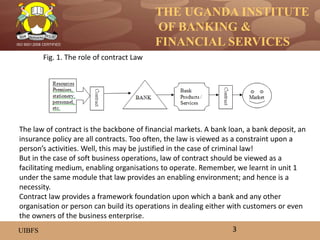
Fig. 1. The role of contract Law
The law of contract is the backbone of financial markets. A bank loan, a bank deposit, an
insurance policy are all contracts. Too often, the law is viewed as a constraint upon a
person’s activities. Well, this may be justified in the case of criminal law!
But in the case of soft business operations, law of contract should be viewed as a
facilitating medium, enabling organisations to operate. Remember, we learnt in unit 1
under the same module that law provides an enabling environment; and hence is a
necessity.
Contract law provides a framework foundation upon which a bank and any other
organisation or person can build its operations in dealing either with customers or even
the owners of the business enterprise.
THE UGANDA INSTITUTE
OF BANKING &
FINANCIAL SERVICES
UIBFS
ISO 9001:2008 CERTIFIED
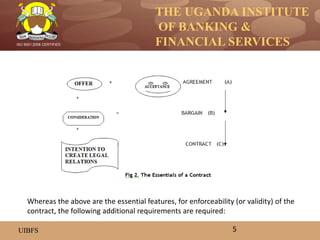
The essentials of a valid contact
A valid contract has three essential features.
1) The agreement; consisting of one party making an offer which is accepted by the
other.
2) The bargain; there must be an element of exchange, the law requiring, referred to
as consideration. Consideration is something of value that a party to a contract
gives or forgoes in fulfilment of the contract.
3) The intention to create legal relations. If, for example, my brother offers me a lift
to Kampala, and I say I’ll contribute to the cost of the petrol and then don’t, there
isn’t necessarily a binding contract that he can sue me under. If the arrangement is
an informal, social one, then my offer to pay for petrol probably wasn’t made with
the intention of being legally bound.
4
THE UGANDA INSTITUTE
OF BANKING &
FINANCIAL SERVICES
UIBFS
ISO 9001:2008 CERTIFIED
5
Whereas the above are the essential features, for enforceability (or validity) of the
contract, the following additional requirements are required:
THE UGANDA INSTITUTE
OF BANKING &
FINANCIAL SERVICES
UIBFS
ISO 9001:2008 CERTIFIED
• …legality, i.e. the object of the contract must be within public policy. For example,
if the subject matter of a contract is illegal, you cannot enforce the contract. A
contract for the sale of illegal drugs, for example, violates public policy and is not
enforceable.
• …legal capacity to make contract. A person must be old and sane enough to enter
a contract. In case of a company or other corporate personality, they must be
recognized organizations with an identity separate from those of the people who
constitute it in order to enter into a contract.
• …genuineness of consent , and the
• …required form, e.g in writing
• Agreements which fail on one of the above additional requirements are either
void, voidable or as often said, unenforceable. It would be interesting to analyse
further these terms.
6
THE UGANDA INSTITUTE
OF BANKING &
FINANCIAL SERVICES
UIBFS
ISO 9001:2008 CERTIFIED
• A void contract is a contradiction ‘in terms’ since it has never been a contract and
hence is without legal effect. The agreement has no effect. A voidable contract can
be rejected by the ‘innocent’ party but it is perfectly valid until it is rejected.
• For example, if your consent was as a result of being influenced, you have the right
to set aside the contract when you realise this! Note, however, that the contract
remains valid until avoided.
• Since these arguments can go on and on, for our purposes it suffices to understand
just the concept, i.e. a voidable contract. And finally, an unenforceable contract is,
again, perfectly valid and value given or transferred under it cannot be recovered.
• This is because the necessary evidence of it is missing. The simplest example in
banking operations would be where a guarantee (a promise to answer for the debt
of another) is offered but is not evidenced in writing. A bank guarantee requires
written evidence of its terms to be enforceable.
• The ‘banker-customer agreement’ is of particular significance to the banker, and
indeed the customer. This relationship is will be discussed in unit 5, but before we
discuss ‘breach of contract’ below, let us relate the model of the contract seen
above to the banker – customer contract.
7
THE UGANDA INSTITUTE
OF BANKING &
FINANCIAL SERVICES
UIBFS
ISO 9001:2008 CERTIFIED
• We should easily agree that the would-be customer to the bank makes the OFFER
to the bank when heshe completes the account opening form. The bank,
presumably, ACCEPTS the application, and if satisfied, OPENS the account, i.e.
enters into CONTRACT.
• Although the contract might not be legally enforceable at this stage because of
conditionality (as we shall see in unit 5 when considering who a bank ‘customer’
is), it marks the commencement of rights and duties, on both sides, i.e. between
the bank and would - be customer.
• We mentioned when discussing the need for contract law under 10.24 that it is
just a few of the many contracts entered into that are not performed according to
their terms. Then what happens when a contract is breached (or broken)?
• We also learnt in unit 1 that breach of the law gives rise to strict liability. We saw
what remedies are available to the injured party, i.e. sue for damages.
• The amount of damages is the financial loss incurred. Say, for example, in the
event that a bank wrongly pays a cheque (a payment instrument described in unit
4), the customer’s loss would be the financial consequences that were a
predictable (foreseeable) result of the bank’s breach of contract or mandate.
•
8

The legal environment unit2

  • 1.
    THE UGANDA INSTITUTE OFBANKING & FINANCIAL SERVICES UIBFS ISO 9001:2008 CERTIFIED Introduction to law Contract law and Banking Banking and its relationship with legislation MODULE COVERAGE 1 Banker-Customer Contract Negotiable Instruments
  • 2.
    THE UGANDA INSTITUTE OFBANKING & FINANCIAL SERVICES UIBFS ISO 9001:2008 CERTIFIED What is a ‘contract?’ A contract is a legally enforceable agreement between two or more parties who can be either individuals and/or corporate organizations. The underlying theory is that a contract is the outcome of ‘consenting minds’, each party being free to accept or reject the terms of the other. The parties are judged by what they have said, written, or done, not by what is in their minds. This is the standard objective. The Need for Contract law • If you already have a bank account, then you are already in contract with your bankers, and hopefully, you entered into this sort of contract voluntarily! • Contract law is central to all aspects of banking. Besides the basic banking contract with a customer covering the operation of a new account, there are many other contracts that bank enters into with its customers; for example application and grant of loans. • The bank also enters into contracts with its suppliers of goods, say stationery. Indeed, any business organisation pursues its objectives by entering into voluntary agreements (or contracts) with other organisations and individuals. • Deals are done through the purchase and supply of goods and services by making agreements complying with a set of rules which must have the force of law to ensure realisation of the activity. These rules constitute the law of contract. 2
  • 3.
    THE UGANDA INSTITUTE OFBANKING & FINANCIAL SERVICES UIBFS ISO 9001:2008 CERTIFIED 3 Fig. 1. The role of contract Law The law of contract is the backbone of financial markets. A bank loan, a bank deposit, an insurance policy are all contracts. Too often, the law is viewed as a constraint upon a person’s activities. Well, this may be justified in the case of criminal law! But in the case of soft business operations, law of contract should be viewed as a facilitating medium, enabling organisations to operate. Remember, we learnt in unit 1 under the same module that law provides an enabling environment; and hence is a necessity. Contract law provides a framework foundation upon which a bank and any other organisation or person can build its operations in dealing either with customers or even the owners of the business enterprise.
  • 4.
    THE UGANDA INSTITUTE OFBANKING & FINANCIAL SERVICES UIBFS ISO 9001:2008 CERTIFIED The essentials of a valid contact A valid contract has three essential features. 1) The agreement; consisting of one party making an offer which is accepted by the other. 2) The bargain; there must be an element of exchange, the law requiring, referred to as consideration. Consideration is something of value that a party to a contract gives or forgoes in fulfilment of the contract. 3) The intention to create legal relations. If, for example, my brother offers me a lift to Kampala, and I say I’ll contribute to the cost of the petrol and then don’t, there isn’t necessarily a binding contract that he can sue me under. If the arrangement is an informal, social one, then my offer to pay for petrol probably wasn’t made with the intention of being legally bound. 4
  • 5.
    THE UGANDA INSTITUTE OFBANKING & FINANCIAL SERVICES UIBFS ISO 9001:2008 CERTIFIED 5 Whereas the above are the essential features, for enforceability (or validity) of the contract, the following additional requirements are required:
  • 6.
    THE UGANDA INSTITUTE OFBANKING & FINANCIAL SERVICES UIBFS ISO 9001:2008 CERTIFIED • …legality, i.e. the object of the contract must be within public policy. For example, if the subject matter of a contract is illegal, you cannot enforce the contract. A contract for the sale of illegal drugs, for example, violates public policy and is not enforceable. • …legal capacity to make contract. A person must be old and sane enough to enter a contract. In case of a company or other corporate personality, they must be recognized organizations with an identity separate from those of the people who constitute it in order to enter into a contract. • …genuineness of consent , and the • …required form, e.g in writing • Agreements which fail on one of the above additional requirements are either void, voidable or as often said, unenforceable. It would be interesting to analyse further these terms. 6
  • 7.
    THE UGANDA INSTITUTE OFBANKING & FINANCIAL SERVICES UIBFS ISO 9001:2008 CERTIFIED • A void contract is a contradiction ‘in terms’ since it has never been a contract and hence is without legal effect. The agreement has no effect. A voidable contract can be rejected by the ‘innocent’ party but it is perfectly valid until it is rejected. • For example, if your consent was as a result of being influenced, you have the right to set aside the contract when you realise this! Note, however, that the contract remains valid until avoided. • Since these arguments can go on and on, for our purposes it suffices to understand just the concept, i.e. a voidable contract. And finally, an unenforceable contract is, again, perfectly valid and value given or transferred under it cannot be recovered. • This is because the necessary evidence of it is missing. The simplest example in banking operations would be where a guarantee (a promise to answer for the debt of another) is offered but is not evidenced in writing. A bank guarantee requires written evidence of its terms to be enforceable. • The ‘banker-customer agreement’ is of particular significance to the banker, and indeed the customer. This relationship is will be discussed in unit 5, but before we discuss ‘breach of contract’ below, let us relate the model of the contract seen above to the banker – customer contract. 7
  • 8.
    THE UGANDA INSTITUTE OFBANKING & FINANCIAL SERVICES UIBFS ISO 9001:2008 CERTIFIED • We should easily agree that the would-be customer to the bank makes the OFFER to the bank when heshe completes the account opening form. The bank, presumably, ACCEPTS the application, and if satisfied, OPENS the account, i.e. enters into CONTRACT. • Although the contract might not be legally enforceable at this stage because of conditionality (as we shall see in unit 5 when considering who a bank ‘customer’ is), it marks the commencement of rights and duties, on both sides, i.e. between the bank and would - be customer. • We mentioned when discussing the need for contract law under 10.24 that it is just a few of the many contracts entered into that are not performed according to their terms. Then what happens when a contract is breached (or broken)? • We also learnt in unit 1 that breach of the law gives rise to strict liability. We saw what remedies are available to the injured party, i.e. sue for damages. • The amount of damages is the financial loss incurred. Say, for example, in the event that a bank wrongly pays a cheque (a payment instrument described in unit 4), the customer’s loss would be the financial consequences that were a predictable (foreseeable) result of the bank’s breach of contract or mandate. • 8