BARRIER CONCEPTS
BARRIER CONCEPTS
•Barrier defines limit of motion
•Concept of doing joint mobilization & manipulation
•Describes motion in a joint or in tissue in one plane
•Types of barriers :
* Physiological barrier
* Anatomical barrier
* Restrictive barrier
1. PHYSIOLOGICAL BARRIER
• The point at which voluntary range of motion in an articulation is limited by soft tissue tendon.
• A normal joint moves through a certain range of active motion and the limit of this motion is
physiological barrier.
• Thus active movement is also called physiological movement. Contractile tissues, nervous
tissues and inert tissues are involved or moved during active movement.
• The first barrier felt during active movement due to tension of soft tissues.
2. ANATOMICAL BARRIER
• The point at which passive ROM is limited by bone contour or soft tissues (especially ligaments)
or both.
• This serves as the final limit to motion in a articulation.
• Movement beyond this cause disruption of tissue, subluxation / fracture.
• The limit of PROM is anatomical barrier. No more further range is achieved.
• An obstruction , a factor that tends to restrict from movement – Elastic barrier. It is the normal
limit to joint motion that occurs when the joint and surrounding tissues are fully tensed.
Cont.
• A neutral point exists along with barriers.
• Midrange of the joint where there is least amount of support from non-muscular tissues and
ligaments.
•It minimizes stress on joint.
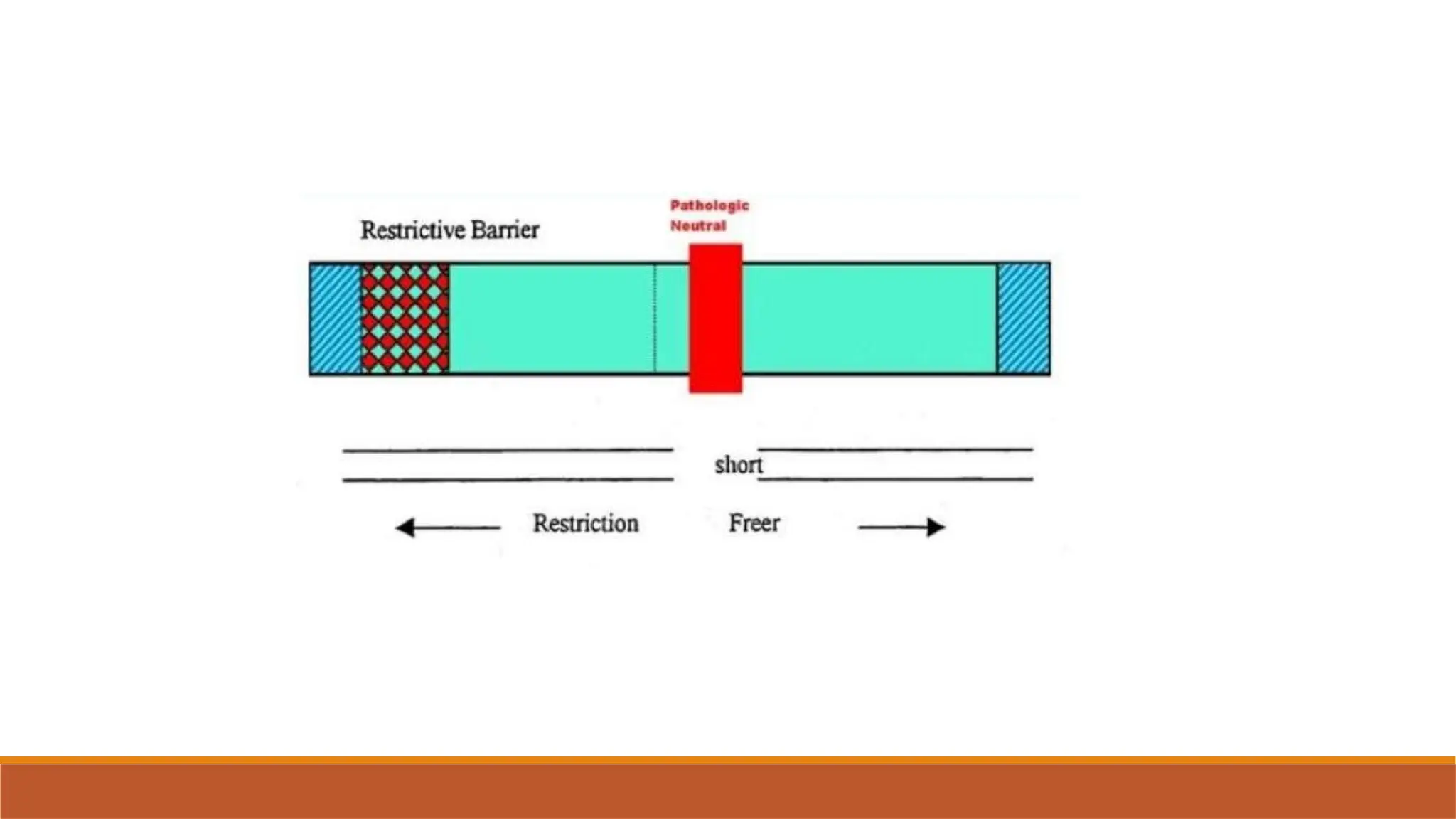
3. RESTRICTIVE BARRIER
• An impediment or obstacle to movement within physiologic limits of an articulation that
reduces active range of motion.
• They may occur secondary to changes in the following tissues : skin, fascia, muscles, ligaments,
joint capsule and joint surfaces.
• The presence of somatic dysfunction will alter normal barriers and produce a pathologic
neutral
point. It is the resting position that shifts away from midline due to restrictive barrier. It usually
occurs at the midpoint of the available range of motion.
In our joint, the space has been provided for following events :
1. Joint play : (accessory movement) initial motion between joint surfaces. In addition to active
ROM, there is a small ROM that can be obtained only passively by examiner.
2.AROM : exercises are done in joint play and AROM phase.
3. PROM : force is applied by therapist for movement which a patient cannot move actively.
4. Physiological barrier : first barrier felt during active movement due to tension of soft tissue.
Cont.
5. Anatomical barrier : barrier felt at the last range of passive movement as bony ends come in
contact.
6. Paraphysiological space : space between physiological and anatomic barrier where passive
ligamentous stretch occurs before tissue disruption.
7. Mobilization : done in PROM & paraphysiological space.
8. Manipulation : only done in paraphysiological space.
THANK YOU ..

BARRIER CONCEPTS IN MANUAL THERAPY..pptx

  • 1.
  • 2.
    BARRIER CONCEPTS •Barrier defineslimit of motion •Concept of doing joint mobilization & manipulation •Describes motion in a joint or in tissue in one plane •Types of barriers : * Physiological barrier * Anatomical barrier * Restrictive barrier
  • 3.
    1. PHYSIOLOGICAL BARRIER •The point at which voluntary range of motion in an articulation is limited by soft tissue tendon. • A normal joint moves through a certain range of active motion and the limit of this motion is physiological barrier. • Thus active movement is also called physiological movement. Contractile tissues, nervous tissues and inert tissues are involved or moved during active movement. • The first barrier felt during active movement due to tension of soft tissues.
  • 4.
    2. ANATOMICAL BARRIER •The point at which passive ROM is limited by bone contour or soft tissues (especially ligaments) or both. • This serves as the final limit to motion in a articulation. • Movement beyond this cause disruption of tissue, subluxation / fracture. • The limit of PROM is anatomical barrier. No more further range is achieved. • An obstruction , a factor that tends to restrict from movement – Elastic barrier. It is the normal limit to joint motion that occurs when the joint and surrounding tissues are fully tensed.
  • 6.
    Cont. • A neutralpoint exists along with barriers. • Midrange of the joint where there is least amount of support from non-muscular tissues and ligaments. •It minimizes stress on joint.
  • 7.
    3. RESTRICTIVE BARRIER •An impediment or obstacle to movement within physiologic limits of an articulation that reduces active range of motion. • They may occur secondary to changes in the following tissues : skin, fascia, muscles, ligaments, joint capsule and joint surfaces. • The presence of somatic dysfunction will alter normal barriers and produce a pathologic neutral point. It is the resting position that shifts away from midline due to restrictive barrier. It usually occurs at the midpoint of the available range of motion.
  • 9.
    In our joint,the space has been provided for following events : 1. Joint play : (accessory movement) initial motion between joint surfaces. In addition to active ROM, there is a small ROM that can be obtained only passively by examiner. 2.AROM : exercises are done in joint play and AROM phase. 3. PROM : force is applied by therapist for movement which a patient cannot move actively. 4. Physiological barrier : first barrier felt during active movement due to tension of soft tissue.
  • 10.
    Cont. 5. Anatomical barrier: barrier felt at the last range of passive movement as bony ends come in contact. 6. Paraphysiological space : space between physiological and anatomic barrier where passive ligamentous stretch occurs before tissue disruption. 7. Mobilization : done in PROM & paraphysiological space. 8. Manipulation : only done in paraphysiological space.
  • 11.