Barrett’s Taxonomy
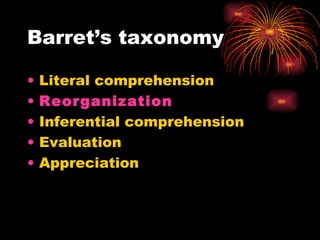
Barret’s taxonomy Literal comprehension Reorganization Inferential comprehension Evaluation Appreciation
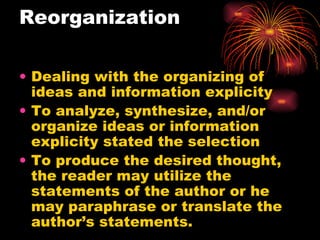
Reorganization Dealing with the organizing of ideas and information explicity To analyze, synthesize, and/or organize ideas or information explicity stated the selection To produce the desired thought, the reader may utilize the statements of the author or he may paraphrase or translate the author’s statements.
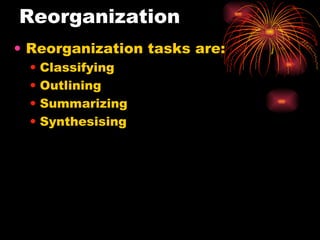
Reorganization Reorganization tasks are: Classifying Outlining Summarizing Synthesising
Reorganization - Classifying In this instance the student is required to place people, things, places and/ or events into categories When pupils are asked to recognize or recall certain kinds of details, relationships, or traits, they are in effect classifying, but at a lower level of the taxonomy The key to this level is that things must be sorted into a category or a class.
Reorganization - Classifying EXAMPLES AND PATTERNS : Read each phrase below. Does it tell you “who,” “what,” “when,” “how,” or  “where?” 1.“Sank here.” (A phrase taken from a selection) 2. Which of the following are _____ ? 3. Place the following under the proper heading. 4. Classify the following according to _____ . 5. Which of the following _____ does not belong. (Where based upon the selection and not merely a matter of word meaning. Care also has to be exercised in such cases to make sure the inferring of a comparison, level 3.4 is not necessitated.)
Reorganization- Outlining The students is requested to organize the selection in outline form using direct statements or paraphrased statements from the selection EXAMPLES AND PATTERNS : 1. Organize the facts into main heads and subheads to form an outline. 2. Complete the following outline. 3. Divide the story into _____ parts.
Reorganization - Summarizing The student is asked to condense the selection using direct or paraphrased statements from the selection. ( This level is interpreted as also being applicable when less than the entire selection is condensed.) EXAMPLES AND PATTERNS : 1. What has happened up to this point? 2. Tell the story in your own words.
Reorganization - Synthesizing In this instance, the student is requested to consolidate explicit ideas or information from more than one source. The pupil is required to put together information from more than one place. More is required than just a collecting of information for this information must become fused so that information from more than one source provides a single answer to a question.
Reorganization - Synthesizing EXAMPLES AND PATTERNS : 1. How long did the entire _____ last ? 2. Fill in your time line. 3. What was the speed of the _____ ? 4. Did _____ have enough _____ ? 5. Compute _____ . 6.How many times did _____ take place ? 7. On what day did _____ happen ? 8. Figure out _____
Lets answer the Qs Put each word under the proper heading: Pedro dress friends Tina City downstairs window Carla House wheelchair People Places Things

Barrett’s taxonomy

  • 1.
  • 2.
    Barret’s taxonomy Literalcomprehension Reorganization Inferential comprehension Evaluation Appreciation
  • 3.
    Reorganization Dealing withthe organizing of ideas and information explicity To analyze, synthesize, and/or organize ideas or information explicity stated the selection To produce the desired thought, the reader may utilize the statements of the author or he may paraphrase or translate the author’s statements.
  • 4.
    Reorganization Reorganization tasksare: Classifying Outlining Summarizing Synthesising
  • 5.
    Reorganization - ClassifyingIn this instance the student is required to place people, things, places and/ or events into categories When pupils are asked to recognize or recall certain kinds of details, relationships, or traits, they are in effect classifying, but at a lower level of the taxonomy The key to this level is that things must be sorted into a category or a class.
  • 6.
    Reorganization - ClassifyingEXAMPLES AND PATTERNS : Read each phrase below. Does it tell you “who,” “what,” “when,” “how,” or “where?” 1.“Sank here.” (A phrase taken from a selection) 2. Which of the following are _____ ? 3. Place the following under the proper heading. 4. Classify the following according to _____ . 5. Which of the following _____ does not belong. (Where based upon the selection and not merely a matter of word meaning. Care also has to be exercised in such cases to make sure the inferring of a comparison, level 3.4 is not necessitated.)
  • 7.
    Reorganization- Outlining Thestudents is requested to organize the selection in outline form using direct statements or paraphrased statements from the selection EXAMPLES AND PATTERNS : 1. Organize the facts into main heads and subheads to form an outline. 2. Complete the following outline. 3. Divide the story into _____ parts.
  • 8.
    Reorganization - SummarizingThe student is asked to condense the selection using direct or paraphrased statements from the selection. ( This level is interpreted as also being applicable when less than the entire selection is condensed.) EXAMPLES AND PATTERNS : 1. What has happened up to this point? 2. Tell the story in your own words.
  • 9.
    Reorganization - SynthesizingIn this instance, the student is requested to consolidate explicit ideas or information from more than one source. The pupil is required to put together information from more than one place. More is required than just a collecting of information for this information must become fused so that information from more than one source provides a single answer to a question.
  • 10.
    Reorganization - SynthesizingEXAMPLES AND PATTERNS : 1. How long did the entire _____ last ? 2. Fill in your time line. 3. What was the speed of the _____ ? 4. Did _____ have enough _____ ? 5. Compute _____ . 6.How many times did _____ take place ? 7. On what day did _____ happen ? 8. Figure out _____
  • 11.
    Lets answer theQs Put each word under the proper heading: Pedro dress friends Tina City downstairs window Carla House wheelchair People Places Things