Expanded Definition
English 10
Learning Objectives: At the end of the
session, we are expected to:
 Describe the purpose of expanded
definition of words,
Use a variety of techniques in expanding
definitions.
Determine the different techniques of
expanded definition,
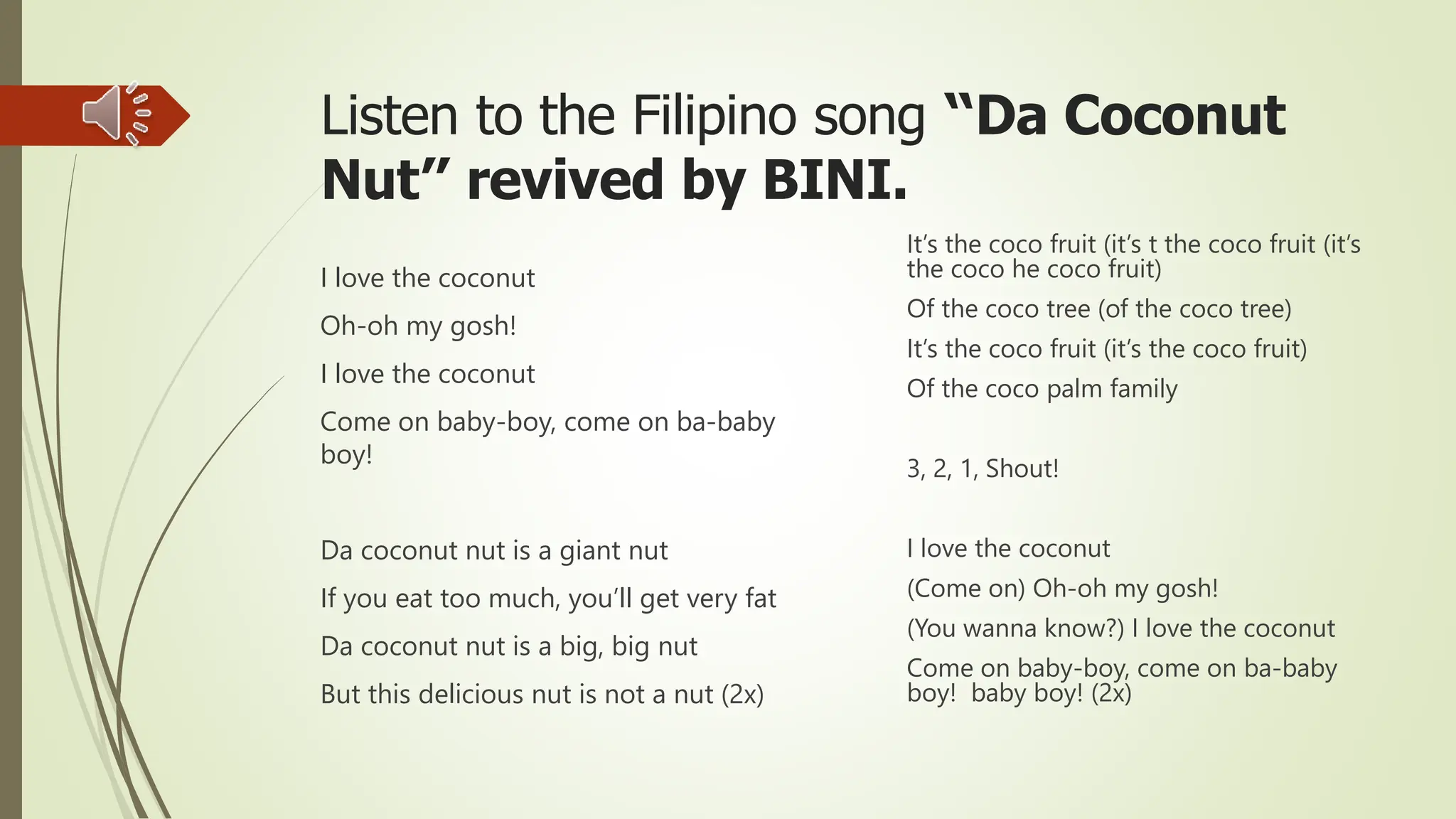
Listen to the Filipino song “Da Coconut
Nut” revived by BINI.
I love the coconut
Oh-oh my gosh!
I love the coconut
Come on baby-boy, come on ba-baby
boy!
Da coconut nut is a giant nut
If you eat too much, you’ll get very fat
Da coconut nut is a big, big nut
But this delicious nut is not a nut (2x)
It’s the coco fruit (it’s t the coco fruit (it’s
the coco he coco fruit)
Of the coco tree (of the coco tree)
It’s the coco fruit (it’s the coco fruit)
Of the coco palm family
3, 2, 1, Shout!
I love the coconut
(Come on) Oh-oh my gosh!
(You wanna know?) I love the coconut
Come on baby-boy, come on ba-baby
boy! baby boy! (2x)
Answer the following questions:
1. Based on the song, what is a coconut?
2. How is coconut described?
3. How many times is coconut defined in the
song?
4. Based on our activity, do you think one
definition is enough for you to know what a
coconut is? Why?
Expanded Definition of Words
• It is an explanation of the meaning of a
certain word or phrase.
• It is distinguishing the characteristics
of a certain word, providing extra facts
or information about it, giving
examples, and saying what cannot be
included to describe it.
Techniques of Extended Definition
1.Etymology – explains the origin
of the word itself.
Ex: Arbitration comes from the
Latin judicium which means
judgment.
Techniques of Extended Definition
2.History/Background – discusses the
history of the term, its use, and
controversies associated with it.
Ex: The use of arbitration as
arbitration as third-party mediation
dates from the 1630s.
Techniques of Extended Definition
3.Description - to explain the color,
size, and shape.
Ex: Arbitration is the process of an
argument between peoplesolving by
helping them to agree to an
acceptable solution.
Techniques of Extended Definition
4.Principle of Operation – discussing
how topic in question functions,
question functions, including any
special materials or conditions
required.
Ex: Arbitration is conducted by a
trained arbiter who sets down the
rules that the parties must abide by.
Techniques of Extended Definition
5.Cause and Effect - to explain the
causes and effects of the term.
Ex: An arbitration clause is ambiguous
when the parties do not express clearly,
that in case of conflict, the method to use
to settle the disagreements will be
arbitration.
Techniques of Extended Definition
6.Classification - to show how the
topic fits into a larger category
Ex: Arbitration is one of the
alternatives to going into a formal
court to formal court to settle
disputes.
Techniques of Extended Definition
7.Comparison/ Contrast - to show
how the topic is similar or different
from others in the class.
Ex: The main difference between arbitration
and litigation law is that the court is involved
in the case of litigation, as it is litigation, as it is
a lawsuit, whereas, in arbitration, a settlement
between the parties is done outside of court.
Techniques of Extended Definition
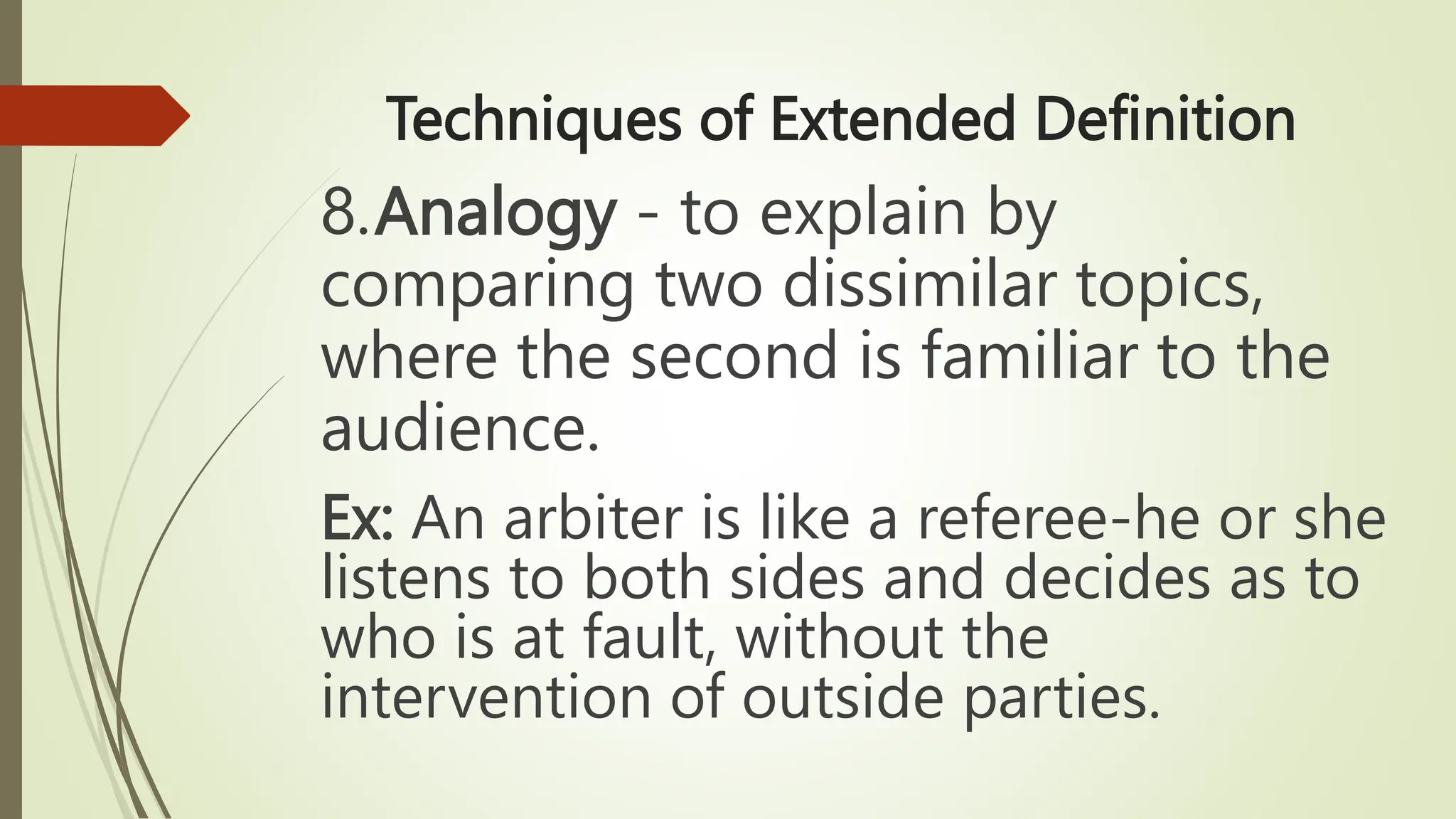
8.Analogy - to explain by
comparing two dissimilar topics,
where the second is familiar to the
audience.
Ex: An arbiter is like a referee-he or she
listens to both sides and decides as to
who is at fault, without the
intervention of outside parties.
Techniques of Extended Definition
9.Examples or Anecdotes – to tell a
story or example that illustrates the
term.
Ex: Arbitration was used to settle
the dispute between the labor
union and management.
Techniques of Extended Definition
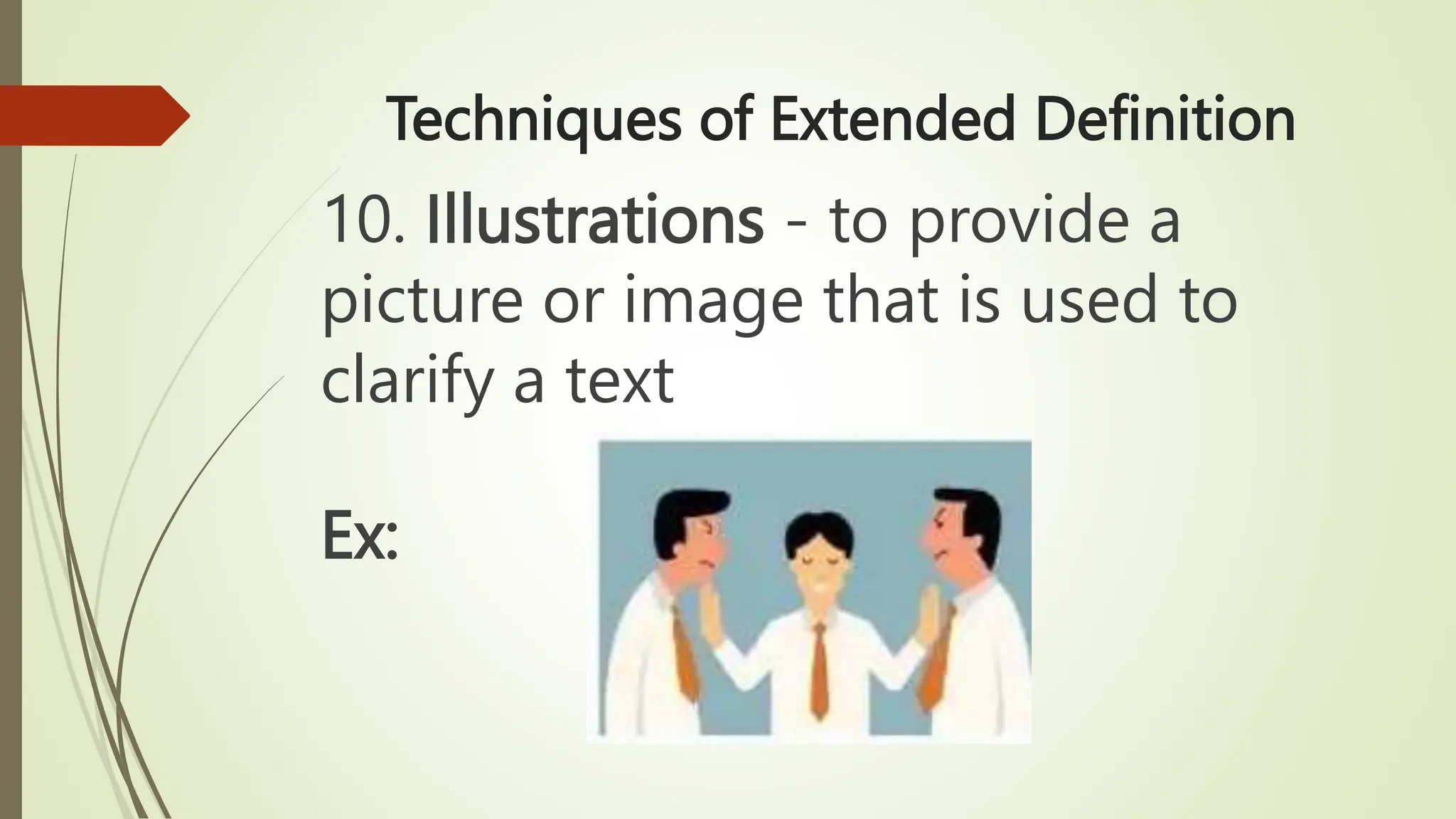
10. Illustrations - to provide a
picture or image that is used to
clarify a text
Ex:
Wrapping Up!
Earth is derived from the Old English eorthe, of
Germanic origin; related to Dutch aarde and German
Erde. It is the third planet from the sun in which humans
and other living things are its inhabitants. Earth has an
equatorial diameter of 7926 miles (12,755 km) and a
polar diameter of 7900 miles (12,714 km), a mean
distance. From the sun of 92.9 million miles (149.6
million km), a period of revolution of 365.26 days, and
having one satellite. On the Earth's surface, the oceans
and the continents form the stage on which the
evolution of life takes place.
Wrapping Up!
Earth is derived from the Old English eorthe, of
Germanic origin; related to Dutch aarde and German
Erde. It is the third planet from the sun in which humans
and other living things are its inhabitants. Earth has an
equatorial diameter of 7926 miles (12,755 km) and a
polar diameter of 7900 miles (12,714 km), a mean
distance. From the sun of 92.9 million miles (149.6
million km), a period of revolution of 365.26 days, and
having one satellite. On the Earth's surface, the oceans
and the continents form the stage on which the
evolution of life takes place.
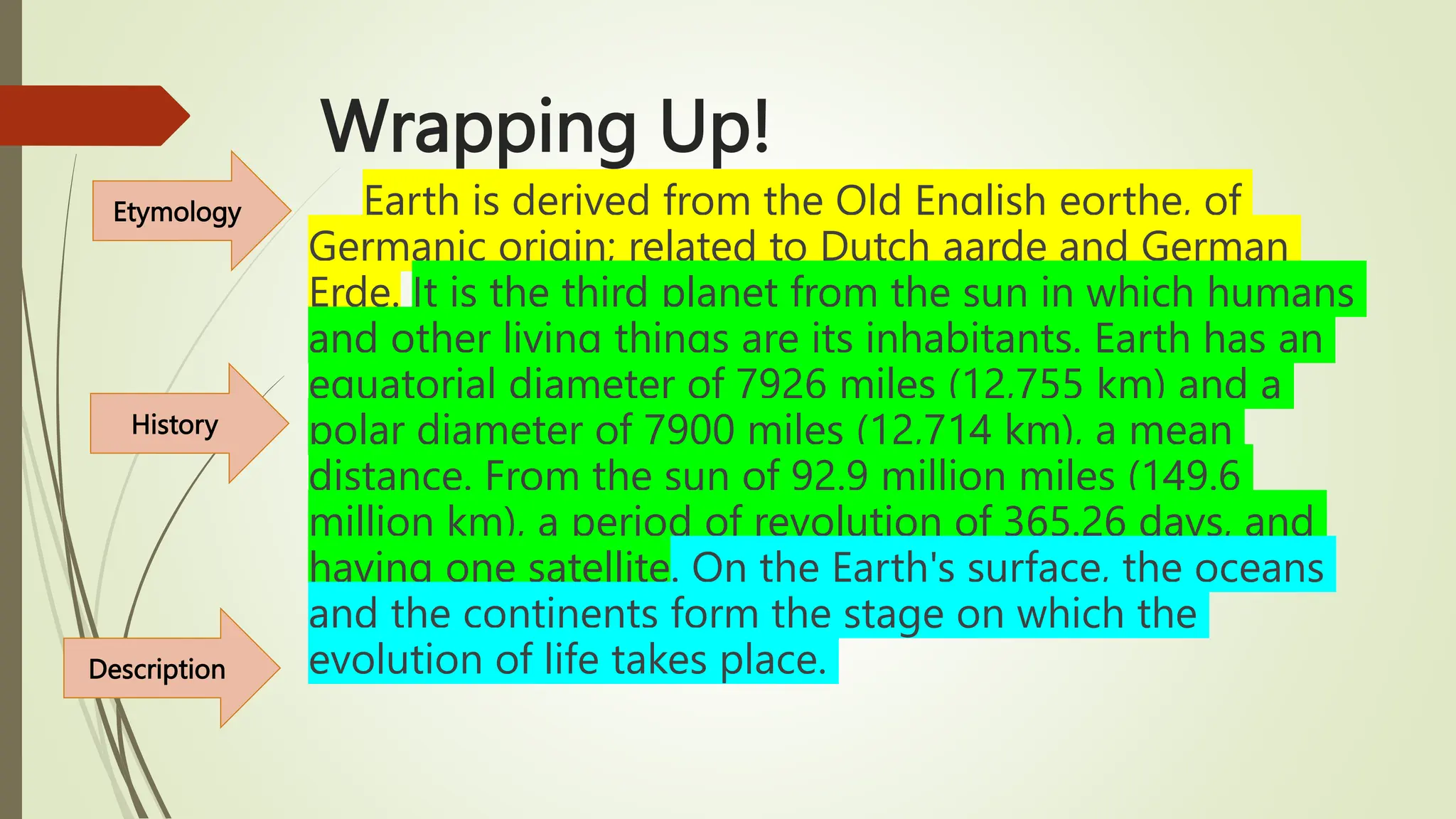
Etymology
History
Description
Wrapping Up!
How is expanded definition different from
the usual definition of a word?
Why do we need to know the history of
the term?
Group Activity
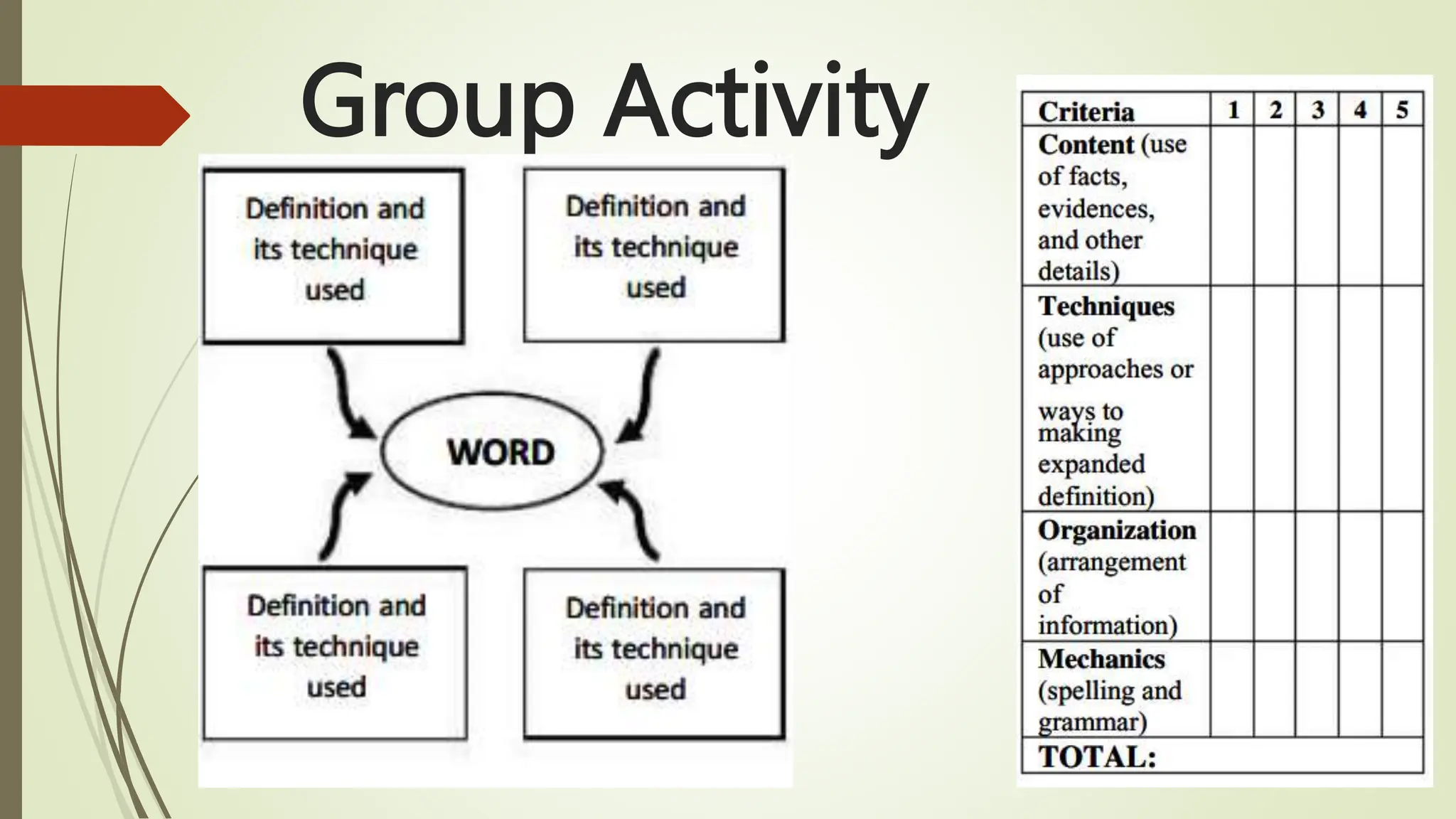
Direction: Each group will be given a word to
expand its definition. Fill in the definition. Fill in
the semantic web with your ideas on and
determine the technique used. Use the given
template for webbing. You can use dictionary or
online sources to provide ideas.
(Every group will be given 10 minutes to
accomplish the task)
Group Activity
Group 1 – Jeepney
Group 2 – Halo-Halo
Group 3 – Psychology
Group 4 – Volcano
Group 5- Basketball
Group Activity
Assessment
Direction: From the word pool
given, identify the term being
described in the following
statements.
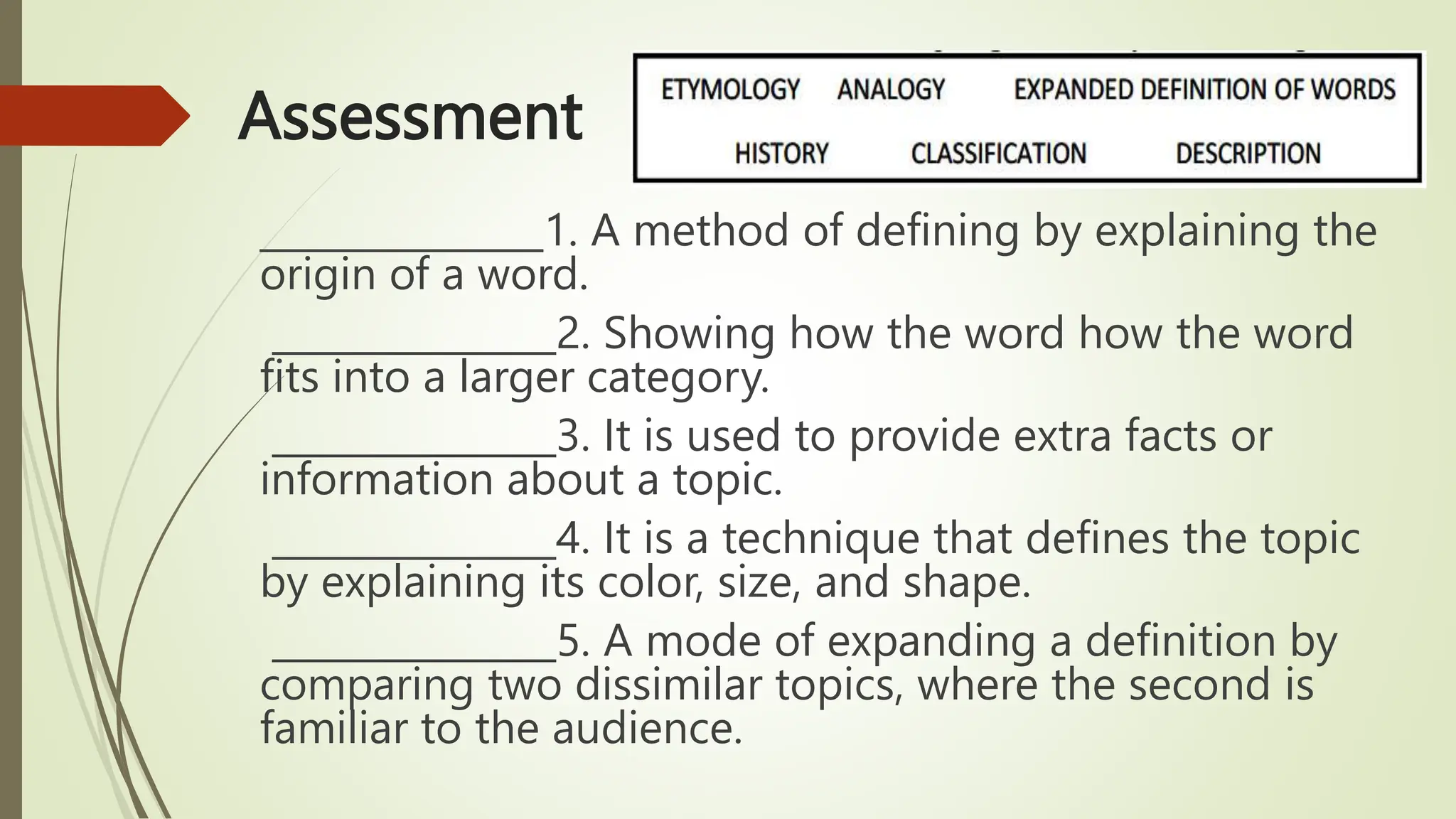
Assessment
_______________1. A method of defining by explaining the
origin of a word.
_______________2. Showing how the word how the word
fits into a larger category.
_______________3. It is used to provide extra facts or
information about a topic.
_______________4. It is a technique that defines the topic
by explaining its color, size, and shape.
_______________5. A mode of expanding a definition by
comparing two dissimilar topics, where the second is
familiar to the audience.

Expanded Definition English 10 .........

  • 1.
  • 2.
    Learning Objectives: Atthe end of the session, we are expected to:  Describe the purpose of expanded definition of words, Use a variety of techniques in expanding definitions. Determine the different techniques of expanded definition,
  • 3.
    Listen to theFilipino song “Da Coconut Nut” revived by BINI. I love the coconut Oh-oh my gosh! I love the coconut Come on baby-boy, come on ba-baby boy! Da coconut nut is a giant nut If you eat too much, you’ll get very fat Da coconut nut is a big, big nut But this delicious nut is not a nut (2x) It’s the coco fruit (it’s t the coco fruit (it’s the coco he coco fruit) Of the coco tree (of the coco tree) It’s the coco fruit (it’s the coco fruit) Of the coco palm family 3, 2, 1, Shout! I love the coconut (Come on) Oh-oh my gosh! (You wanna know?) I love the coconut Come on baby-boy, come on ba-baby boy! baby boy! (2x)
  • 4.
    Answer the followingquestions: 1. Based on the song, what is a coconut? 2. How is coconut described? 3. How many times is coconut defined in the song? 4. Based on our activity, do you think one definition is enough for you to know what a coconut is? Why?
  • 5.
    Expanded Definition ofWords • It is an explanation of the meaning of a certain word or phrase. • It is distinguishing the characteristics of a certain word, providing extra facts or information about it, giving examples, and saying what cannot be included to describe it.
  • 6.
    Techniques of ExtendedDefinition 1.Etymology – explains the origin of the word itself. Ex: Arbitration comes from the Latin judicium which means judgment.
  • 7.
    Techniques of ExtendedDefinition 2.History/Background – discusses the history of the term, its use, and controversies associated with it. Ex: The use of arbitration as arbitration as third-party mediation dates from the 1630s.
  • 8.
    Techniques of ExtendedDefinition 3.Description - to explain the color, size, and shape. Ex: Arbitration is the process of an argument between peoplesolving by helping them to agree to an acceptable solution.
  • 9.
    Techniques of ExtendedDefinition 4.Principle of Operation – discussing how topic in question functions, question functions, including any special materials or conditions required. Ex: Arbitration is conducted by a trained arbiter who sets down the rules that the parties must abide by.
  • 10.
    Techniques of ExtendedDefinition 5.Cause and Effect - to explain the causes and effects of the term. Ex: An arbitration clause is ambiguous when the parties do not express clearly, that in case of conflict, the method to use to settle the disagreements will be arbitration.
  • 11.
    Techniques of ExtendedDefinition 6.Classification - to show how the topic fits into a larger category Ex: Arbitration is one of the alternatives to going into a formal court to formal court to settle disputes.
  • 12.
    Techniques of ExtendedDefinition 7.Comparison/ Contrast - to show how the topic is similar or different from others in the class. Ex: The main difference between arbitration and litigation law is that the court is involved in the case of litigation, as it is litigation, as it is a lawsuit, whereas, in arbitration, a settlement between the parties is done outside of court.
  • 13.
    Techniques of ExtendedDefinition 8.Analogy - to explain by comparing two dissimilar topics, where the second is familiar to the audience. Ex: An arbiter is like a referee-he or she listens to both sides and decides as to who is at fault, without the intervention of outside parties.
  • 14.
    Techniques of ExtendedDefinition 9.Examples or Anecdotes – to tell a story or example that illustrates the term. Ex: Arbitration was used to settle the dispute between the labor union and management.
  • 15.
    Techniques of ExtendedDefinition 10. Illustrations - to provide a picture or image that is used to clarify a text Ex:
  • 16.
    Wrapping Up! Earth isderived from the Old English eorthe, of Germanic origin; related to Dutch aarde and German Erde. It is the third planet from the sun in which humans and other living things are its inhabitants. Earth has an equatorial diameter of 7926 miles (12,755 km) and a polar diameter of 7900 miles (12,714 km), a mean distance. From the sun of 92.9 million miles (149.6 million km), a period of revolution of 365.26 days, and having one satellite. On the Earth's surface, the oceans and the continents form the stage on which the evolution of life takes place.
  • 17.
    Wrapping Up! Earth isderived from the Old English eorthe, of Germanic origin; related to Dutch aarde and German Erde. It is the third planet from the sun in which humans and other living things are its inhabitants. Earth has an equatorial diameter of 7926 miles (12,755 km) and a polar diameter of 7900 miles (12,714 km), a mean distance. From the sun of 92.9 million miles (149.6 million km), a period of revolution of 365.26 days, and having one satellite. On the Earth's surface, the oceans and the continents form the stage on which the evolution of life takes place. Etymology History Description
  • 18.
    Wrapping Up! How isexpanded definition different from the usual definition of a word? Why do we need to know the history of the term?
  • 19.
    Group Activity Direction: Eachgroup will be given a word to expand its definition. Fill in the definition. Fill in the semantic web with your ideas on and determine the technique used. Use the given template for webbing. You can use dictionary or online sources to provide ideas. (Every group will be given 10 minutes to accomplish the task)
  • 20.
    Group Activity Group 1– Jeepney Group 2 – Halo-Halo Group 3 – Psychology Group 4 – Volcano Group 5- Basketball
  • 21.
  • 22.
    Assessment Direction: From theword pool given, identify the term being described in the following statements.
  • 23.
    Assessment _______________1. A methodof defining by explaining the origin of a word. _______________2. Showing how the word how the word fits into a larger category. _______________3. It is used to provide extra facts or information about a topic. _______________4. It is a technique that defines the topic by explaining its color, size, and shape. _______________5. A mode of expanding a definition by comparing two dissimilar topics, where the second is familiar to the audience.

Editor's Notes

  • #3 Technical Definition describes and explains the meaning of a word or phrase  based on the general references and other field of study sources. Operational Definition states and explains the meaning of a word or phrase based on specific context. In terms of research, operational definition explains or describes how the term is applied and measured in the study.
  • #19  Usual definition of a word is short but gives exact meaning while expanded definition gives broad meaning of the word to help visualize the ideas. To understand the use of word better.