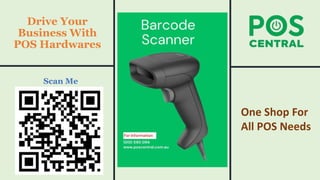
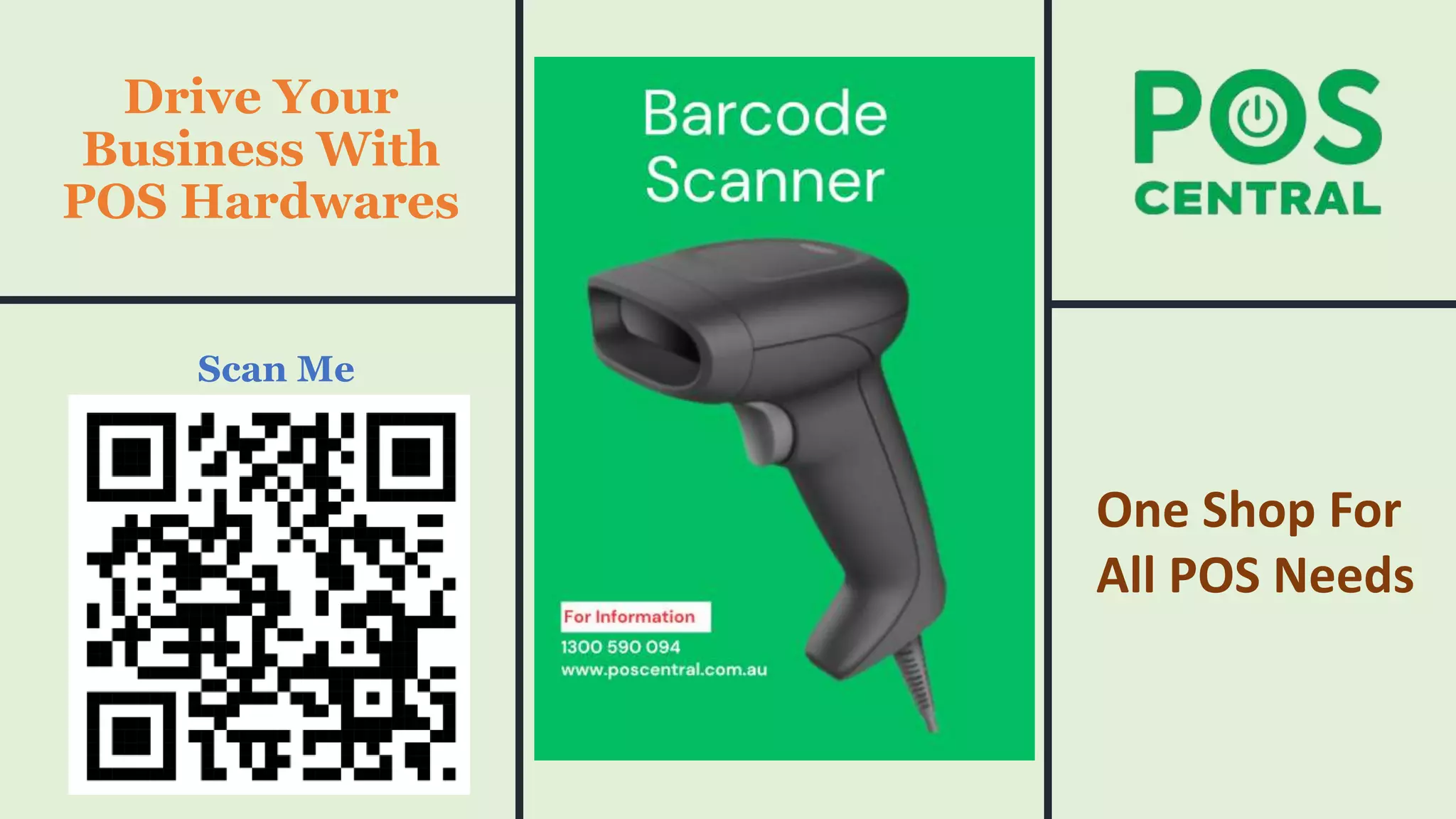
Drive Your
Business With
POS Hardwares
One Shop For
All POS Needs
Scan Me
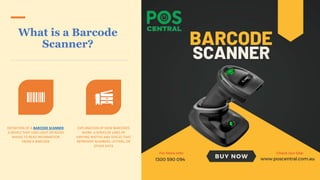
What is a Barcode
Scanner?
DEFINITION OF A BARCODE SCANNER:
A DEVICE THAT USES LIGHT OR RADIO
WAVES TO READ INFORMATION
FROM A BARCODE
EXPLANATION OF HOW BARCODES
WORK: A SERIES OF LINES OF
VARYING WIDTHS AND SPACES THAT
REPRESENT NUMBERS, LETTERS, OR
OTHER DATA
Types of Barcode
Scanners Handheld scanner: most common type, held by the
user and pointed at the barcode
Stationary scanner: fixed in place and the barcode is
passed in front of it
PDA scanner: barcode scanner integrated into a
handheld device like a smartphone or tablet
In-counter scanner: built into a counter or checkout
lane, with the barcode scanned as it passes over the
scanner
How Barcode Scanners
Work
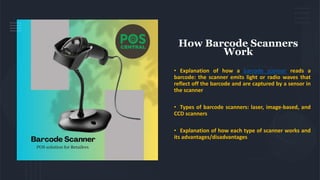
• Explanation of how a barcode scanner reads a
barcode: the scanner emits light or radio waves that
reflect off the barcode and are captured by a sensor in
the scanner
• Types of barcode scanners: laser, image-based, and
CCD scanners
• Explanation of how each type of scanner works and
its advantages/disadvantages
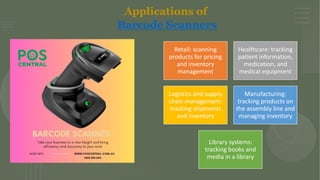
Applications of
Barcode Scanners
Retail: scanning
products for pricing
and inventory
management
Healthcare: tracking
patient information,
medication, and
medical equipment
Logistics and supply
chain management:
tracking shipments
and inventory
Manufacturing:
tracking products on
the assembly line and
managing inventory
Library systems:
tracking books and
media in a library
Advantages of Barcode Scanners
Speed: barcode scanners
can quickly read and
process large amounts of
data
Accuracy: reduces errors
in data entry and
inventory management
Efficiency: streamlines
workflows and reduces
the need for manual data
entry
Cost-effective: relatively
inexpensive compared to
other data capture
methods
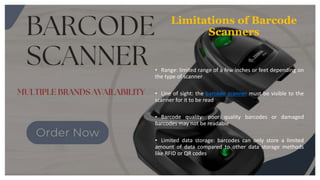
Limitations of Barcode
Scanners
• Range: limited range of a few inches or feet depending on
the type of scanner
• Line of sight: the barcode scanner must be visible to the
scanner for it to be read
• Barcode quality: poor quality barcodes or damaged
barcodes may not be readable
• Limited data storage: barcodes can only store a limited
amount of data compared to other data storage methods
like RFID or QR codes
Conclusion
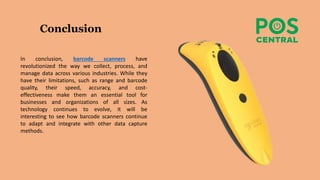
In conclusion, barcode scanners have
revolutionized the way we collect, process, and
manage data across various industries. While they
have their limitations, such as range and barcode
quality, their speed, accuracy, and cost-
effectiveness make them an essential tool for
businesses and organizations of all sizes. As
technology continues to evolve, it will be
interesting to see how barcode scanners continue
to adapt and integrate with other data capture
methods.
Visit : https://www.poscentral.com.au/
Address : Quantum Corporate Park, 27/287 Victoria Rd, Rydalmere, NSW 2116
Phone : 1300 590 094

Barcode Scanners Advantages, Limitations, and Applications.pptx

  • 1.
    Drive Your Business With POSHardwares One Shop For All POS Needs Scan Me
  • 3.
    What is aBarcode Scanner? DEFINITION OF A BARCODE SCANNER: A DEVICE THAT USES LIGHT OR RADIO WAVES TO READ INFORMATION FROM A BARCODE EXPLANATION OF HOW BARCODES WORK: A SERIES OF LINES OF VARYING WIDTHS AND SPACES THAT REPRESENT NUMBERS, LETTERS, OR OTHER DATA
  • 4.
    Types of Barcode ScannersHandheld scanner: most common type, held by the user and pointed at the barcode Stationary scanner: fixed in place and the barcode is passed in front of it PDA scanner: barcode scanner integrated into a handheld device like a smartphone or tablet In-counter scanner: built into a counter or checkout lane, with the barcode scanned as it passes over the scanner
  • 5.
    How Barcode Scanners Work •Explanation of how a barcode scanner reads a barcode: the scanner emits light or radio waves that reflect off the barcode and are captured by a sensor in the scanner • Types of barcode scanners: laser, image-based, and CCD scanners • Explanation of how each type of scanner works and its advantages/disadvantages
  • 6.
    Applications of Barcode Scanners Retail:scanning products for pricing and inventory management Healthcare: tracking patient information, medication, and medical equipment Logistics and supply chain management: tracking shipments and inventory Manufacturing: tracking products on the assembly line and managing inventory Library systems: tracking books and media in a library
  • 7.
    Advantages of BarcodeScanners Speed: barcode scanners can quickly read and process large amounts of data Accuracy: reduces errors in data entry and inventory management Efficiency: streamlines workflows and reduces the need for manual data entry Cost-effective: relatively inexpensive compared to other data capture methods
  • 8.
    Limitations of Barcode Scanners •Range: limited range of a few inches or feet depending on the type of scanner • Line of sight: the barcode scanner must be visible to the scanner for it to be read • Barcode quality: poor quality barcodes or damaged barcodes may not be readable • Limited data storage: barcodes can only store a limited amount of data compared to other data storage methods like RFID or QR codes
  • 9.
    Conclusion In conclusion, barcodescanners have revolutionized the way we collect, process, and manage data across various industries. While they have their limitations, such as range and barcode quality, their speed, accuracy, and cost- effectiveness make them an essential tool for businesses and organizations of all sizes. As technology continues to evolve, it will be interesting to see how barcode scanners continue to adapt and integrate with other data capture methods.
  • 10.
    Visit : https://www.poscentral.com.au/ Address: Quantum Corporate Park, 27/287 Victoria Rd, Rydalmere, NSW 2116 Phone : 1300 590 094