QR CODE
TECHNOLOGY
B Y B VA I J AYA N T H I
2 2 2 5 1 A 1 7 0 5
Introduction
• QR code technology is a two-
dimensional barcode that stores
data in black-and-white grid
patterns.
• It enables quick scanning of
links, contacts, and payments
with high data capacity, fast
readability, and strong error
correction.
1.
2.
3.
QR code is a 2D barcode
created in 1994 by Denso
Wave, Japan.
It enables quick access to digital
data using any smartphone
camera.
High speed, error correction,
and multi-data support make it
ideal for smart applications.
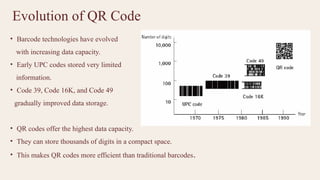
• Barcode technologies have evolved
with increasing data capacity.
• Early UPC codes stored very limited
information.
• Code 39, Code 16K, and Code 49
gradually improved data storage.
• QR codes offer the highest data capacity.
• They can store thousands of digits in a compact space.
• This makes QR codes more efficient than traditional barcodes.
Evolution of QR Code
• QR code stands for Quick Response code, a two-
dimensional barcode designed for fast scanning and
reading.
• They can be scanned using smartphones or dedicated
QR code readers.
• This figure shows how much data can a QR code store.
What is a QR Code ?
• QR codes store data both horizontally and vertically.
• This provides much higher data capacity than traditional
barcodes.
• Information is encoded in a grid of black squares and dots.
• The pattern appears on a white background.
• QR codes can store links, contact details, and payment
information.
How does a QR Code work?
• QR codes enable fast and reliable information sharing.
• They provide quick access with a single scan.
• Widely used in digital payments and e-tickets.
• Common in product tracking and supply chains.
• Used in authentication and access
control systems.
• Their versatility makes them
essential in today’s digital world.
• QR codes are angle-independent and can be
scanned from any direction.
• They support fast and reliable 360° scanning.
• Built-in error correction allows data recovery
from damage.
• Codes remain readable even if partially
obscured or scratched.
Key Features of QR Codes
• QR codes are compact and highly versatile.
• They play a key role in modern digital communication.
• Essential in smart technology solutions.
• Enable quick and contactless access.
• Used for information, services, and transactions across
industries.
• QR codes can store multiple types of data, most commonly
URLs or web addresses.
• By scanning a QR code, users can quickly access websites,
online forms, or digital content without typing the link
manually.
Types of Data Encoded in
QR Codes
• QR codes can also store plain text such as messages,
instructions, or notes.
• This text-based data can be read directly after scanning and
does not require an internet connection, making it useful for
offline information sharing.
• Another important use of QR codes is storing contact and network details.
• They can encode contact information in vCard or meCard formats, allowing users to save
phone numbers and email addresses instantly.
contact info QR code vCard QR
Contact Info with Vcard QR code
• QR codes can also store Wi-Fi credentials, enabling easy and password-free network access.
• This eliminates manual password entry and reduces connection errors, improving user
convenience.
• In addition, QR codes can encode geographical coordinates, event dates and times, and payment
information for digital transactions.
• Due to this versatility, they are widely used in marketing, digital payments, event management, and
logistics systems.
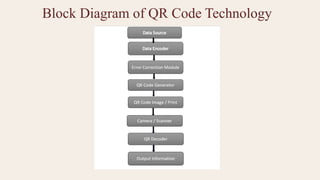
Block Diagram of QR Code Technology
They provide quick
access to information.
Data can be retrieved
with a single scan.
They speed up payments
and ticketing processes.
They minimize
manual data entry.
Benefits of Using QR Codes
Security risks from
malicious QR codes
Requires smartphone
and internet access
Offline access is limited
Privacy concerns and
lack of awareness
Risk & Safety Tips of QR Codes
Marketing and Advertising
• Used on posters, banners, product packaging, and business
cards
• Direct users to websites, promotional offers, and social
media pages
Digital Payments and Banking
• Support fast and secure contactless payments
• Widely used in UPI, mobile wallets, and retail POS
systems
Applications
Retail and E-Commerce
• Provide product details, price comparison, and reviews.
• Used for loyalty programs and digital coupons.
Logistics and Supply Chain
• Track packages and shipments in real time
• Improve inventory management and warehouse
automation
Healthcare
• Store patient identification and medical history links.
• Track medical equipment and medicines.
Transportation and Ticketing
• Used in e-tickets for buses, trains, metros, and flights.
• Enable fast entry and exit verification.
Japan – Origin and Standardization
• QR code technology was invented by Denso Wave.
China – Mobile Payment Revolution
• QR codes power platforms like Alipay and WeChat
Pay.
Global Initiatives of QR Code Technology
India – Digital India & UPI
• QR codes are a core component of UPI payments.
European Union – Digital Passes & Payment
• Used in digital COVID certificates.
• Adopted for event ticketing and cross-border payments.
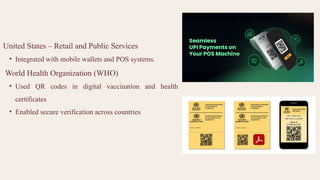
United States – Retail and Public Services
• Integrated with mobile wallets and POS systems.
World Health Organization (WHO)
• Used QR codes in digital vaccination and health
certificates
• Enabled secure verification across countries
• QR code technology is a key part of modern digital systems.
• It enables fast, efficient, and cost-effective information sharing.
• Supporting multiple data types, it serves industries like
payments, healthcare, education, and marketing.
• With proper security awareness, QR codes ensure safe and
reliable usage.
• Their simplicity and versatility make them essential in today’s
connected world.
CONCLUSION
• QR codes will integrate with AI, IoT, and Blockchain for
dynamic and personalized experiences.
• Adoption in AR applications for interactive and immersive
experiences.
• Enhanced asset tracking and supply chain transparency in
logistics.
• Smarter packaging with real-time updates and personalized
promotions.
FUTURE SCOPE
Technical Seminar for QRcode Tech Final .pptx

Technical Seminar for QRcode Tech Final .pptx

  • 1.
    QR CODE TECHNOLOGY B YB VA I J AYA N T H I 2 2 2 5 1 A 1 7 0 5
  • 2.
    Introduction • QR codetechnology is a two- dimensional barcode that stores data in black-and-white grid patterns. • It enables quick scanning of links, contacts, and payments with high data capacity, fast readability, and strong error correction. 1. 2. 3. QR code is a 2D barcode created in 1994 by Denso Wave, Japan. It enables quick access to digital data using any smartphone camera. High speed, error correction, and multi-data support make it ideal for smart applications.
  • 3.
    • Barcode technologieshave evolved with increasing data capacity. • Early UPC codes stored very limited information. • Code 39, Code 16K, and Code 49 gradually improved data storage. • QR codes offer the highest data capacity. • They can store thousands of digits in a compact space. • This makes QR codes more efficient than traditional barcodes. Evolution of QR Code
  • 4.
    • QR codestands for Quick Response code, a two- dimensional barcode designed for fast scanning and reading. • They can be scanned using smartphones or dedicated QR code readers. • This figure shows how much data can a QR code store. What is a QR Code ?
  • 5.
    • QR codesstore data both horizontally and vertically. • This provides much higher data capacity than traditional barcodes. • Information is encoded in a grid of black squares and dots. • The pattern appears on a white background. • QR codes can store links, contact details, and payment information. How does a QR Code work?
  • 6.
    • QR codesenable fast and reliable information sharing. • They provide quick access with a single scan. • Widely used in digital payments and e-tickets. • Common in product tracking and supply chains. • Used in authentication and access control systems. • Their versatility makes them essential in today’s digital world.
  • 7.
    • QR codesare angle-independent and can be scanned from any direction. • They support fast and reliable 360° scanning. • Built-in error correction allows data recovery from damage. • Codes remain readable even if partially obscured or scratched. Key Features of QR Codes
  • 8.
    • QR codesare compact and highly versatile. • They play a key role in modern digital communication. • Essential in smart technology solutions. • Enable quick and contactless access. • Used for information, services, and transactions across industries.
  • 9.
    • QR codescan store multiple types of data, most commonly URLs or web addresses. • By scanning a QR code, users can quickly access websites, online forms, or digital content without typing the link manually. Types of Data Encoded in QR Codes
  • 10.
    • QR codescan also store plain text such as messages, instructions, or notes. • This text-based data can be read directly after scanning and does not require an internet connection, making it useful for offline information sharing.
  • 11.
    • Another importantuse of QR codes is storing contact and network details. • They can encode contact information in vCard or meCard formats, allowing users to save phone numbers and email addresses instantly. contact info QR code vCard QR Contact Info with Vcard QR code
  • 12.
    • QR codescan also store Wi-Fi credentials, enabling easy and password-free network access. • This eliminates manual password entry and reduces connection errors, improving user convenience.
  • 13.
    • In addition,QR codes can encode geographical coordinates, event dates and times, and payment information for digital transactions. • Due to this versatility, they are widely used in marketing, digital payments, event management, and logistics systems.
  • 14.
    Block Diagram ofQR Code Technology
  • 15.
    They provide quick accessto information. Data can be retrieved with a single scan. They speed up payments and ticketing processes. They minimize manual data entry. Benefits of Using QR Codes
  • 16.
    Security risks from maliciousQR codes Requires smartphone and internet access Offline access is limited Privacy concerns and lack of awareness Risk & Safety Tips of QR Codes
  • 17.
    Marketing and Advertising •Used on posters, banners, product packaging, and business cards • Direct users to websites, promotional offers, and social media pages Digital Payments and Banking • Support fast and secure contactless payments • Widely used in UPI, mobile wallets, and retail POS systems Applications
  • 18.
    Retail and E-Commerce •Provide product details, price comparison, and reviews. • Used for loyalty programs and digital coupons. Logistics and Supply Chain • Track packages and shipments in real time • Improve inventory management and warehouse automation
  • 19.
    Healthcare • Store patientidentification and medical history links. • Track medical equipment and medicines. Transportation and Ticketing • Used in e-tickets for buses, trains, metros, and flights. • Enable fast entry and exit verification.
  • 20.
    Japan – Originand Standardization • QR code technology was invented by Denso Wave. China – Mobile Payment Revolution • QR codes power platforms like Alipay and WeChat Pay. Global Initiatives of QR Code Technology
  • 21.
    India – DigitalIndia & UPI • QR codes are a core component of UPI payments. European Union – Digital Passes & Payment • Used in digital COVID certificates. • Adopted for event ticketing and cross-border payments.
  • 22.
    United States –Retail and Public Services • Integrated with mobile wallets and POS systems. World Health Organization (WHO) • Used QR codes in digital vaccination and health certificates • Enabled secure verification across countries
  • 23.
    • QR codetechnology is a key part of modern digital systems. • It enables fast, efficient, and cost-effective information sharing. • Supporting multiple data types, it serves industries like payments, healthcare, education, and marketing. • With proper security awareness, QR codes ensure safe and reliable usage. • Their simplicity and versatility make them essential in today’s connected world. CONCLUSION
  • 24.
    • QR codeswill integrate with AI, IoT, and Blockchain for dynamic and personalized experiences. • Adoption in AR applications for interactive and immersive experiences. • Enhanced asset tracking and supply chain transparency in logistics. • Smarter packaging with real-time updates and personalized promotions. FUTURE SCOPE