Bar Code
By
Abinash Pati
PG/K/16/02
Indian Institute Of Packaging
Kolkata
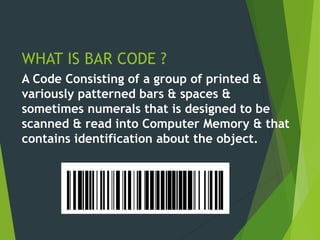
WHAT IS BAR CODE ?
A Code Consisting of a group of printed &
variously patterned bars & spaces &
sometimes numerals that is designed to be
scanned & read into Computer Memory & that
contains identification about the object.
Properties of Bar Code
• EAN 13(European Article Number)
• First & Reliable Data Collection
• Improved Management :
a. Better Decision Making
b. Easy tracking from central computer
• Point of sale:
a. Eliminate Human error
b. Customer satisfaction
c. Reduced Inventory Cost
 Advantage of Bar Code
• Time Saver
• Increased Efficiency
• Less Mistakes
• Smoother internal Operation
 Disadvantage
Thus printing bar code does not cost any
extra money. However precision in
printing bar codes is very critical. Any
smudging of ink on the substrate would
make scanning of bar code difficult.
 SOME COUNTRY CODES
EAN PREFIX COUNTRY /ECONOMIC REGION
00 to 13 U.S.A. and Canada
30 to 37 France
380 Bulgaria
383 Slovenia
385 Croatia
387 Bosnia-Herzegovina
400 – 440 Germany
45 + 49 Japan
460 - 469 Russian Federation
 CALCULATION OF CHECK DIGIT FOR EAN
13.
Step One:
Suppose you want to find the Check Digit for
the Number 8901030145216. Set up a table
with 13 columns, and put the number
890103014521 into Positions One through
Twelve. Position Thirteen will be blank because
it is reserved for the Check Digit.
CALCULATION OF CHECK DIGIT FOR EAN 13
 Add the numbers in Positions One, Three, Five,
Seven, Nine, and Eleven:
(8 + 0 + 0 + 0 + 4 + 2 = 14).
 Multiply the result of step four by 1.
i.e. 14 X 1 = 14.
 Add the numbers in Positions Two, Four, Six,
Eight, Ten and Twelve
9 + 1 + 3 + 1 + 5 + 1 = 20
Multiply the result of step six by 3.
i.e. 20 X 3 = 60
CALCULATION OF CHECK DIGIT FOR EAN 13
 Add the results of Step Five and Step
Seven.
i.e. 14 + 60 = 74.
 The Check Digit is the smallest
number needed to round the result of
Step Eight up to a multiple of 10. In
this example, the Check Digit is 6. [
74 + 6 = 80 ]
 New Developments of Bar
Code
QR Code
 QR code (abbreviated from Quick Response Code)
is the trademark for a type of matrix barcode (or
two-dimensional barcode) first designed for
the automotive industry in Japan. A barcode is a
machine-readable optical label that contains
information about the item to which it is attached.
A QR code uses four standardized encoding modes
(numeric, alphanumeric, byte/binary,) to efficiently
store data; extensions may also be used.
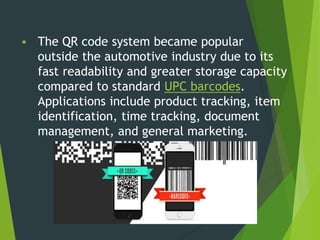
 The QR code system became popular
outside the automotive industry due to its
fast readability and greater storage capacity
compared to standard UPC barcodes.
Applications include product tracking, item
identification, time tracking, document
management, and general marketing.
CONCLUSION
Business industries and stores around the
world, flourished due to, the purpose of barcodes,
types of barcodes, as well as the way barcodes
gathered and transfer information. A quick blurb about
what happened is that the differences between 1D and
2D barcodes are tremendous and work for
different purposes. Same as the bar codes, some of
the scanners are different because of the code they
are scanning. Bar codes also help
with management and their point of view. Now you
may realize how big of an effect barcodes make in our
lives and how each product has a different barcode
out of thousands. It will change our future because
everything we would ever need, would be right at our
fingertips.
THANK YOU

Bar code by abinash

  • 1.
    Bar Code By Abinash Pati PG/K/16/02 IndianInstitute Of Packaging Kolkata
  • 2.
    WHAT IS BARCODE ? A Code Consisting of a group of printed & variously patterned bars & spaces & sometimes numerals that is designed to be scanned & read into Computer Memory & that contains identification about the object.
  • 3.
    Properties of BarCode • EAN 13(European Article Number) • First & Reliable Data Collection • Improved Management : a. Better Decision Making b. Easy tracking from central computer • Point of sale: a. Eliminate Human error b. Customer satisfaction c. Reduced Inventory Cost
  • 4.
     Advantage ofBar Code • Time Saver • Increased Efficiency • Less Mistakes • Smoother internal Operation
  • 5.
     Disadvantage Thus printingbar code does not cost any extra money. However precision in printing bar codes is very critical. Any smudging of ink on the substrate would make scanning of bar code difficult.
  • 6.
     SOME COUNTRYCODES EAN PREFIX COUNTRY /ECONOMIC REGION 00 to 13 U.S.A. and Canada 30 to 37 France 380 Bulgaria 383 Slovenia 385 Croatia 387 Bosnia-Herzegovina 400 – 440 Germany 45 + 49 Japan 460 - 469 Russian Federation
  • 7.
     CALCULATION OFCHECK DIGIT FOR EAN 13. Step One: Suppose you want to find the Check Digit for the Number 8901030145216. Set up a table with 13 columns, and put the number 890103014521 into Positions One through Twelve. Position Thirteen will be blank because it is reserved for the Check Digit.
  • 8.
    CALCULATION OF CHECKDIGIT FOR EAN 13  Add the numbers in Positions One, Three, Five, Seven, Nine, and Eleven: (8 + 0 + 0 + 0 + 4 + 2 = 14).  Multiply the result of step four by 1. i.e. 14 X 1 = 14.  Add the numbers in Positions Two, Four, Six, Eight, Ten and Twelve 9 + 1 + 3 + 1 + 5 + 1 = 20 Multiply the result of step six by 3. i.e. 20 X 3 = 60
  • 9.
    CALCULATION OF CHECKDIGIT FOR EAN 13  Add the results of Step Five and Step Seven. i.e. 14 + 60 = 74.  The Check Digit is the smallest number needed to round the result of Step Eight up to a multiple of 10. In this example, the Check Digit is 6. [ 74 + 6 = 80 ]
  • 10.
     New Developmentsof Bar Code QR Code  QR code (abbreviated from Quick Response Code) is the trademark for a type of matrix barcode (or two-dimensional barcode) first designed for the automotive industry in Japan. A barcode is a machine-readable optical label that contains information about the item to which it is attached. A QR code uses four standardized encoding modes (numeric, alphanumeric, byte/binary,) to efficiently store data; extensions may also be used.
  • 11.
     The QRcode system became popular outside the automotive industry due to its fast readability and greater storage capacity compared to standard UPC barcodes. Applications include product tracking, item identification, time tracking, document management, and general marketing.
  • 12.
    CONCLUSION Business industries andstores around the world, flourished due to, the purpose of barcodes, types of barcodes, as well as the way barcodes gathered and transfer information. A quick blurb about what happened is that the differences between 1D and 2D barcodes are tremendous and work for different purposes. Same as the bar codes, some of the scanners are different because of the code they are scanning. Bar codes also help with management and their point of view. Now you may realize how big of an effect barcodes make in our lives and how each product has a different barcode out of thousands. It will change our future because everything we would ever need, would be right at our fingertips.
  • 13.