Finance is a blood of trade, Commerce
and industry. Now a days banking sector
acts as the backbone of modern
business. Development of any country
mainly depends upon the banking
system…….
Banking Definition
The General terms, the business
activity of accepting and
safeguarding money owned by
other individuals and entities, and
then lending out this money in
order to earn an profits….
Banker and Customer
relationship
 The banker and customer relationship has subdivided by in a Two
parts:
1.General relationship (or) Primary
relationship.
2.Special relationship (or) subsidiary
relationship.
General relationship
Meaning
1)The general relationship between a banker and a
customers is mainly that of debtor and creditor.
2)When a banker receives deposit's from customer,
the banker becomes a debtor and the customers
becomes a creditor.
Special
relationship
Agent principal relationship
The banker collets cheques collects cheques,
dividend,interest,rent etc.. On behalf of his
customer,similarly, he makes payment of rent,
insurance premia, income tax etc. on behalf of his
customer. Besides , he buys and sells securities on
behalf of his customer. Under these circumstances,
the banker becomes an agent and the customer
becomes a principal.
Trustee-beneficiary(or) bailee-bailor relationship
 When a customer deposits
valuables for safe custody, the banker
becomes a trustee and the customer
becomes a beneficiary
 In this case ,only the possession of
the valuables on to the banker. The
ownership remains With the customer.
Chapter-2
Types of deposits accounts
Commercial banks receive various types of deposits from
the public. Generally speaking there are four major types
of deposit accounts. they are as follows:
Current account
Savings bank account
Recurring deposit account
Fixed deposit account
Origin and growth of commercial bank in india
 Economic used to distinguish between commercial banking,
investment banking mixed banking system.
 Industries requires short-term capital to purchase raw
materials, intermediate products and so an.
 Particularly during and after the first world war about
87banks liquidated.
 During great depression in 1930 the bank failure in India
was very severe.
 During 1937-48, as many as 620 banks failed.
 The government set up national credit council in 1968.
 The decade of 1960 also witnessed significant
consolidation in the Indian banking industry with more than
500 banks functioning in the 1950 reduced to 89 by 1969.
COLLECTING BANKERS
PAYING BANKER
DUTIES
STATUTORY PROTEUTION PAYMENT-IN DUE
COURSE
PAYMENT-CONCEPT OF NEGLIGENCE
Introduction
 Collecting banker is one, who undertakes the collection of
cheques for his customer. Now-a-days banks undertake
tocollecteven other instruments like bank drafts, bills of
exchange, dividend warrants etc.,
Role of a Collecting
Banker
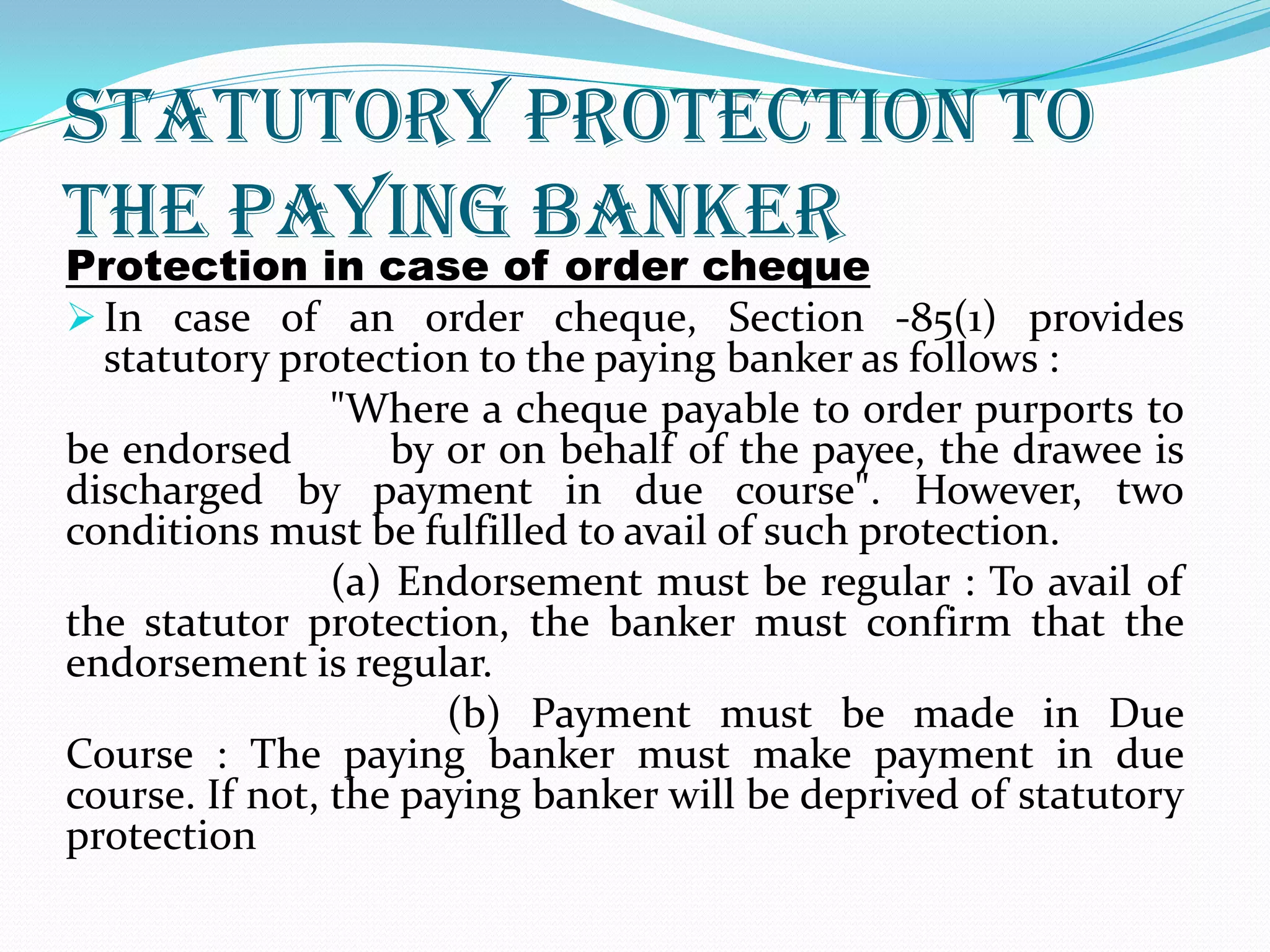
 Collection of Cheques from his customers.
 Segregating them into (a) Local Cheques and (b) Outstation
Cheques.
 a) In case of Local Cheques: The banker presents the cheque to
the paying banker/drawee and if cheque is honoured, he credits
the customer’s account with the amount realised.
 b) In case of Outstation Cheques: The banker will send the
cheque for clearance to the concerned bank through post and if
cheque is honoured, the account of the customer will be credited
with the realised money.
 3. If the cheque is dishonoured – the same will be informed to
the customer and the cheque will be returend with a remark- R.
D
General duties of a
Collecting Banker
Collecting Banker should undertake the collection of cheques,
drafts, bills etc., only for his customer.
 Before opening an account in the name of a new customer, he
should insist on satisfactory introduction or reference testifying
the integrity and honesty of the customer.
Before accepting a cheque for collection on behalf of a customer,
he should examine the validity of the title of the customer to the
cheque.
 Before accepting a cheque for collection, he should examine the
correctness of all endorsements of the cheque.
 If uncrossed cheques are deposited for collection, the collecting
banker should first get them crossed by the customer and then
accept them for collection. The banker should never take the
responsibility of crossing the cheque, after accepting it for
collection.
Collecting banker as a
Holder for Value
Collecting Banker becomes the holder for value, if he
pays the value of the cheque to the customer before
the cheque is actually collected. In this, the collecting
banker initially pays the amount to the customer, and
then presents the cheque for collection to the
Drawee/Paying banker as though, he himself is a
customer.
Paying Banker
Meaning
The bank on which a cheque is drawn
(the bank whose name is printed on the
cheque) and which pays the amount for which
the cheque is written and deducts that sum
from the customer's account
Precautions of a Paying Banker
Presentation of Cheque
 First of all a paying banker should note whether the presentation of the
cheque is correct. It can be found out by noting the following factors.
 a) Type of Cheque: Cheques may generally be of two types – open or
crossed. If it is open one, the payment may be paid at the counter. If it
is crossed, the payment must be made only to a fellow banker.
 b) Branch: The paying banker should see whether the cheque is rawn
on the branch where the account is kept.
 c) Banking Hours: The paying banker should also note whether the
cheque is presented during the banking hours on a business day.
 d) Mutilation: If the cheque is from into pieces or cancelled or
mutilated, then the paying banker should not honour it.
Statutory Protection to
the Paying Banker
Protection in case of order cheque
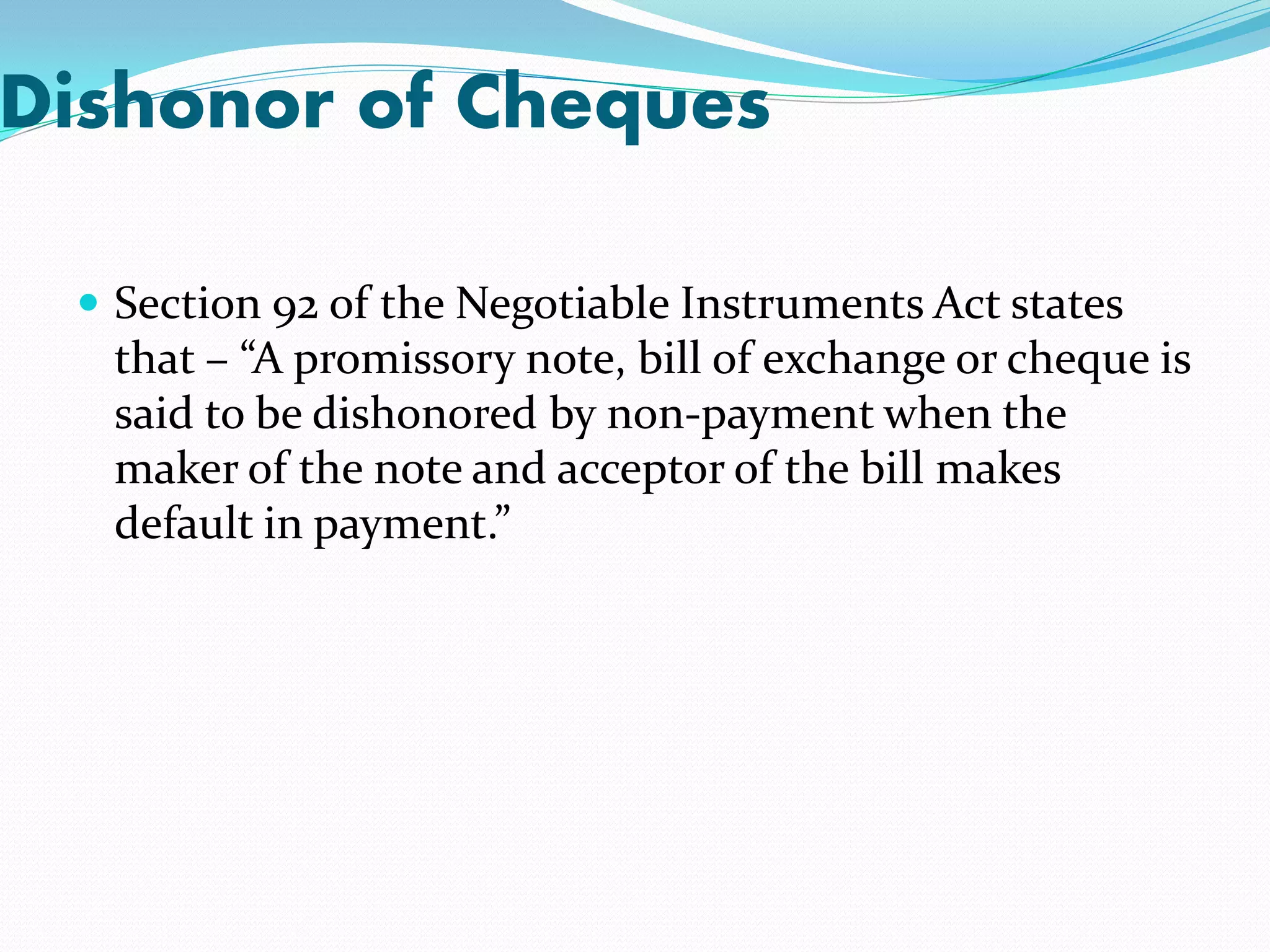
 In case of an order cheque, Section -85(1) provides
statutory protection to the paying banker as follows :
"Where a cheque payable to order purports to
be endorsed by or on behalf of the payee, the drawee is
discharged by payment in due course". However, two
conditions must be fulfilled to avail of such protection.
(a) Endorsement must be regular : To avail of
the statutor protection, the banker must confirm that the
endorsement is regular.
(b) Payment must be made in Due
Course : The paying banker must make payment in due
course. If not, the paying banker will be deprived of statutory
protection
Protection in case of Crossed
cheque
 The paying banker has to make payment of the crossed cheques as per
the instruction of the drawer reflected through the crossing.
 If it is done, he is protected by Section -128. This section states "Where
the banker on whom a crossed cheque is drawn has paid the same in
due course, the banker paying the cheque and (in case such cheque has
come to the hands of the payee) the drawer thereof shall respectively
be entitled to the same rights, and be placed in if the amount of the
cheque had been paid to and received by the true owner thereof".
 Thus, the paying banker is free from any liability on a crossed cheque
even if the payment was received by the collecting banker on behalf of
a person who was not a true owner. For example, a cheque in favour of
X is stolen by Y. He endorses it in his own favor by forging the signature
of X and deposits it in his bank for collection . In this case, the paying
banker shall be discharged if he makes payment as mentioned above
and shall not be liable to pay the same to X, the true owner of the
cheque.
Dishonor of Cheques
 Section 92 of the Negotiable Instruments Act states
that – “A promissory note, bill of exchange or cheque is
said to be dishonored by non-payment when the
maker of the note and acceptor of the bill makes
default in payment.”
Grounds of Dishonor
 Funds Insufficient: The amount of money standing to the credit
of the account of the drawer on which the cheque is drawn is
insufficient to honour the cheque, or the cheque amount exceeds
the amount that can be paid by the bank under an arrangement
entered into between the bank and the drawer of the cheque.
 Account Closed: It is an offence under section 138 of the Act –
Closure of account would be an eventuality after the entire
amount in the account is withdrawn. It means that there was no
amount in the credit of ‘that account’ on the relevant date when
the cheque was presented for honouring the same.
 Stop Payment instructions: Once the cheque has been drawn
and issued to the payee and the payee has presented the cheque,
‘stop payment’ instructions will amount to dishonour of cheque.
NEGOTIABLE
Introduction
 Negotiable instruments such as
cheques, bankers’ draft etc are
documents used in commercial and
financial transactions.
 The law of negotiable instruments is
governed by the Bills of Exchange Act
1949 ( Revised 1978).
ExamplesofNegotiableInstrument
 Promissory Notes
 Cheques
 Bankers’ draft Bank notes
 Traveler’s cheques
 Treasury bills
 Share warrants
 Dividend warrants
Concept of Negotiability
 It includes the quality of transferability i.e.
transfer of property (ownership) from one
person to another based on documents
which represents a contractual obligation for
payment of money.
 A negotiable instrument is a document
containing an undertaking to pay a definite
sum of money which may be transferred by
several ways such as delivery or indorsement
(signing on the back of the documents).
CHEQUE SAMPLE
ABC BANK Date: ………………………
Pay/Bayar: ………………………………………………………….. atau pembayar/or bearer
Ringgit Malaysia:………………………………………………….
………………………………………………………………………..
RM
Drawee
Date
Amount
in number
Amount in words Signature of drawer. If it is
Payee either name:
of individual or company

P.karthiga

  • 2.
    Finance is ablood of trade, Commerce and industry. Now a days banking sector acts as the backbone of modern business. Development of any country mainly depends upon the banking system…….
  • 3.
    Banking Definition The Generalterms, the business activity of accepting and safeguarding money owned by other individuals and entities, and then lending out this money in order to earn an profits….
  • 4.
    Banker and Customer relationship The banker and customer relationship has subdivided by in a Two parts: 1.General relationship (or) Primary relationship. 2.Special relationship (or) subsidiary relationship.
  • 5.
    General relationship Meaning 1)The generalrelationship between a banker and a customers is mainly that of debtor and creditor. 2)When a banker receives deposit's from customer, the banker becomes a debtor and the customers becomes a creditor.
  • 6.
    Special relationship Agent principal relationship Thebanker collets cheques collects cheques, dividend,interest,rent etc.. On behalf of his customer,similarly, he makes payment of rent, insurance premia, income tax etc. on behalf of his customer. Besides , he buys and sells securities on behalf of his customer. Under these circumstances, the banker becomes an agent and the customer becomes a principal.
  • 7.
    Trustee-beneficiary(or) bailee-bailor relationship When a customer deposits valuables for safe custody, the banker becomes a trustee and the customer becomes a beneficiary  In this case ,only the possession of the valuables on to the banker. The ownership remains With the customer.
  • 8.
    Chapter-2 Types of depositsaccounts Commercial banks receive various types of deposits from the public. Generally speaking there are four major types of deposit accounts. they are as follows: Current account Savings bank account Recurring deposit account Fixed deposit account
  • 9.
    Origin and growthof commercial bank in india  Economic used to distinguish between commercial banking, investment banking mixed banking system.  Industries requires short-term capital to purchase raw materials, intermediate products and so an.  Particularly during and after the first world war about 87banks liquidated.  During great depression in 1930 the bank failure in India was very severe.  During 1937-48, as many as 620 banks failed.  The government set up national credit council in 1968.  The decade of 1960 also witnessed significant consolidation in the Indian banking industry with more than 500 banks functioning in the 1950 reduced to 89 by 1969.
  • 10.
    COLLECTING BANKERS PAYING BANKER DUTIES STATUTORYPROTEUTION PAYMENT-IN DUE COURSE PAYMENT-CONCEPT OF NEGLIGENCE
  • 11.
    Introduction  Collecting bankeris one, who undertakes the collection of cheques for his customer. Now-a-days banks undertake tocollecteven other instruments like bank drafts, bills of exchange, dividend warrants etc.,
  • 12.
    Role of aCollecting Banker  Collection of Cheques from his customers.  Segregating them into (a) Local Cheques and (b) Outstation Cheques.  a) In case of Local Cheques: The banker presents the cheque to the paying banker/drawee and if cheque is honoured, he credits the customer’s account with the amount realised.  b) In case of Outstation Cheques: The banker will send the cheque for clearance to the concerned bank through post and if cheque is honoured, the account of the customer will be credited with the realised money.  3. If the cheque is dishonoured – the same will be informed to the customer and the cheque will be returend with a remark- R. D
  • 13.
    General duties ofa Collecting Banker Collecting Banker should undertake the collection of cheques, drafts, bills etc., only for his customer.  Before opening an account in the name of a new customer, he should insist on satisfactory introduction or reference testifying the integrity and honesty of the customer. Before accepting a cheque for collection on behalf of a customer, he should examine the validity of the title of the customer to the cheque.  Before accepting a cheque for collection, he should examine the correctness of all endorsements of the cheque.  If uncrossed cheques are deposited for collection, the collecting banker should first get them crossed by the customer and then accept them for collection. The banker should never take the responsibility of crossing the cheque, after accepting it for collection.
  • 14.
    Collecting banker asa Holder for Value Collecting Banker becomes the holder for value, if he pays the value of the cheque to the customer before the cheque is actually collected. In this, the collecting banker initially pays the amount to the customer, and then presents the cheque for collection to the Drawee/Paying banker as though, he himself is a customer.
  • 15.
    Paying Banker Meaning The bankon which a cheque is drawn (the bank whose name is printed on the cheque) and which pays the amount for which the cheque is written and deducts that sum from the customer's account
  • 16.
    Precautions of aPaying Banker Presentation of Cheque  First of all a paying banker should note whether the presentation of the cheque is correct. It can be found out by noting the following factors.  a) Type of Cheque: Cheques may generally be of two types – open or crossed. If it is open one, the payment may be paid at the counter. If it is crossed, the payment must be made only to a fellow banker.  b) Branch: The paying banker should see whether the cheque is rawn on the branch where the account is kept.  c) Banking Hours: The paying banker should also note whether the cheque is presented during the banking hours on a business day.  d) Mutilation: If the cheque is from into pieces or cancelled or mutilated, then the paying banker should not honour it.
  • 17.
    Statutory Protection to thePaying Banker Protection in case of order cheque  In case of an order cheque, Section -85(1) provides statutory protection to the paying banker as follows : "Where a cheque payable to order purports to be endorsed by or on behalf of the payee, the drawee is discharged by payment in due course". However, two conditions must be fulfilled to avail of such protection. (a) Endorsement must be regular : To avail of the statutor protection, the banker must confirm that the endorsement is regular. (b) Payment must be made in Due Course : The paying banker must make payment in due course. If not, the paying banker will be deprived of statutory protection
  • 18.
    Protection in caseof Crossed cheque  The paying banker has to make payment of the crossed cheques as per the instruction of the drawer reflected through the crossing.  If it is done, he is protected by Section -128. This section states "Where the banker on whom a crossed cheque is drawn has paid the same in due course, the banker paying the cheque and (in case such cheque has come to the hands of the payee) the drawer thereof shall respectively be entitled to the same rights, and be placed in if the amount of the cheque had been paid to and received by the true owner thereof".  Thus, the paying banker is free from any liability on a crossed cheque even if the payment was received by the collecting banker on behalf of a person who was not a true owner. For example, a cheque in favour of X is stolen by Y. He endorses it in his own favor by forging the signature of X and deposits it in his bank for collection . In this case, the paying banker shall be discharged if he makes payment as mentioned above and shall not be liable to pay the same to X, the true owner of the cheque.
  • 19.
    Dishonor of Cheques Section 92 of the Negotiable Instruments Act states that – “A promissory note, bill of exchange or cheque is said to be dishonored by non-payment when the maker of the note and acceptor of the bill makes default in payment.”
  • 20.
    Grounds of Dishonor Funds Insufficient: The amount of money standing to the credit of the account of the drawer on which the cheque is drawn is insufficient to honour the cheque, or the cheque amount exceeds the amount that can be paid by the bank under an arrangement entered into between the bank and the drawer of the cheque.  Account Closed: It is an offence under section 138 of the Act – Closure of account would be an eventuality after the entire amount in the account is withdrawn. It means that there was no amount in the credit of ‘that account’ on the relevant date when the cheque was presented for honouring the same.  Stop Payment instructions: Once the cheque has been drawn and issued to the payee and the payee has presented the cheque, ‘stop payment’ instructions will amount to dishonour of cheque.
  • 21.
    NEGOTIABLE Introduction  Negotiable instrumentssuch as cheques, bankers’ draft etc are documents used in commercial and financial transactions.  The law of negotiable instruments is governed by the Bills of Exchange Act 1949 ( Revised 1978).
  • 22.
    ExamplesofNegotiableInstrument  Promissory Notes Cheques  Bankers’ draft Bank notes  Traveler’s cheques  Treasury bills  Share warrants  Dividend warrants
  • 23.
    Concept of Negotiability It includes the quality of transferability i.e. transfer of property (ownership) from one person to another based on documents which represents a contractual obligation for payment of money.  A negotiable instrument is a document containing an undertaking to pay a definite sum of money which may be transferred by several ways such as delivery or indorsement (signing on the back of the documents).
  • 24.
    CHEQUE SAMPLE ABC BANKDate: ……………………… Pay/Bayar: ………………………………………………………….. atau pembayar/or bearer Ringgit Malaysia:…………………………………………………. ……………………………………………………………………….. RM Drawee Date Amount in number Amount in words Signature of drawer. If it is Payee either name: of individual or company