Banking Ombudsman?
The banking Ombudsman Scheme is an expeditious and expensive Forum for the bank customers for resolution
of complaints relating to services rendered by the banks.
 The rules and regulations and the guidelines are provided in the BANKING OMBUDSMAN SCHEME ,2006
 The scheme is introduced under Section 35A of Banking regulation act – 1949 by RBI with effect from 1995.
 All Scheduled Commercial Banks and Scheduled primary co-operative banks are covered under the scheme.
Who can be a Banking Ombudsman?
Banking Ombudsman is a senior official appointed by the RBI to redress the customer complaints against
deficiency in certain services offered by the banker.
Banking ombudsman shall be the decision making person while redressing the complaints of the customer.
There are 22 regional offices of Banking Ombudsmen in India. The latest offices are opened
Jammu, Raipur, Mumbai-II & New Delhi-III.
QUALIFICATION
The Banking Ombudsman will be a person of high standing in the legal, banking, financial services, public
administration or management sectors.
TENURE
The Banking Ombudsman will be appointed for a period not exceeding three years and be eligible for
extension for a further period not exceeding two years subject to an overall age limit of 65 years.
Consequent on appointment, the Banking Ombudsman shall devote his whole time to the affairs of his
office. Provided that the Reserve Bank may, if in its opinion it is necessary so to do, permit the Banking
0mbudsman to undertake such part time honorary work as is not likely to interfere with his duties as
Banking Ombudsman.
REMUNERATION
The remuneration and other perquisites payable/extended to the Banking Ombudsman will be determined
by the Reserve Bank from time to time and borne by the banks in such proportion and in such manner as
may be determined by the Reserve Bank.
STAFFING OF THE OFFICE OF THE BANKING OMBUDSMAN
1.The Banking Ombudsman shall be provided with a secretariat drawn from banks, Reserve Bank, etc.
who will be placed on duty with the Office of the Banking Ombudsman.
2.The cost of the secretariat will be shared by banks in such proportion as may be determined by the
Reserve Bank.
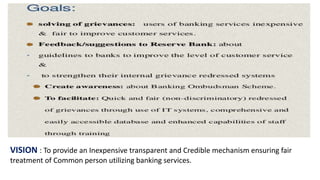
VISION : To provide an Inexpensive transparent and Credible mechanism ensuring fair
treatment of Common person utilizing banking services.
What complaints can one lodge with the Banking Ombudsman?
•An unhappy customer can lodge a complaint with the Banking Ombudsman with respect to the following banking
services Non-payment or unreasonable delay in the payment /collection/ issue of cheques, drafts, bills etc.;
•Non-acceptance, without sufficient cause, of small denomination notes and coins tendered for any purpose, and for
charging of commission in respect thereof;
•Non-payment or delay in payment of inward remittances;
•Non-adherence to prescribed working hours;
•Delay/failure to provide any banking facility (other than loans and advances) which has been promised in writing by
the Bank
•Delay/ non-credit of proceeds to the respective parties’ accounts, non-payment of deposit or non-observance of the
RBI directives, with respect to the rate of interest on bank deposits
•Complaints from NRIs having accounts in India in relation to their remittances from abroad, deposits and other bank
related matters;
•Refusal to open deposit accounts without any valid reason for this refusal;
•Levying charges without adequate prior notice to the customer;
•Non-adherence to RBI instructions on ATM / Debit Card /Prepaid Card / Credit Card operations in India by the bank or
its subsidiaries
•Non-adherence to RBI instruction with regard to Mobile Banking / Electronic Banking service in India.
NEXT PAGE………….
Take 2 Minutes and Go
through the types of
Complaints
•Non-disbursement or delay in disbursement of pension (to the extent the grievance can be attributed to
the action on the part of the bank concerned, but not with regard to its employees);
•Refusal to accept or delay in accepting payment towards taxes, as asked by Reserve
Bank/Government;
•Failure /Delay with regard to the issue, service or redemption of Government securities;
•Forced closure of deposit accounts without any notice or without giving sufficient reason;
•Refusal to close or delay in closing accounts;
•Not following the fair practices code as adopted by the bank;
•Non-observance of Reserve Bank guidelines on engagement of recovery agents by banks;
•Non-adherence to RBI guidelines on allied-banking activities like sale of insurance or mutual fund or
other investment products by banks
•Any other matter relating to the violation of RBI directives
•Regarding loans and advances, complaints with respect to the following areas can be lodged:Non-
observance of Reserve Bank Directives on interest rates;
•Delays in sanction, disbursement or non-observance of prescribed time schedule for disposal of loan
applications;
•Not accepting application for loans without furnishing valid reasons to the applicant; and
•Non-observance of any other direction or instruction given by the Reserve Bank as may be specified by
the RBI for this purpose from time to time.
What is the procedure for filing complaint with the Banking Ombudsman?
1.As the first point, there is no cost involved while filing a complaint with the Banking ombudsman
2.A complaint can be registered with the Banking Ombudsman online
•Visit the following address:
1.https://secweb.rbi.org.in/BO/precompltindex.htmFollowing questions will be asked:
2.Have you made a written complaint to the bank? YES/ NO
3.If yes, whether 30 days are over from the date of lodging the complaint? YES / NO
4.If the above two questions are answered YES, then the following details are required:
1. Bank Name
2. Account No
3. Complainant Name
4. Mobile No
Once the details are filled, the website is redirected to the complaint form. The applicable Banking Ombudsman
office under whose jurisdiction the case is applicable needs to be selected There is also an option to upload
documents as evidence against the concerned bank. 2. The complainant can be filed by an authorized
representative (other than an advocate).
Some Important Points
•Limit on the amount of compensation (Award): The amount, to be paid by the bank to the complainant (The
person registering the complaint) by way of compensation for any loss suffered by the complainant is the lower of
• Loss suffered due to any act or omission of the Bank
• ₹ 20 lakhs (₹ Two Million)
•In case of mental agony and harassment: The Banking Ombudsman may award compensation not exceeding
₹1 lakh (₹ One Hundred Thousand) to the complainant. While passing an award (giving compensation), the
Banking Ombudsman will consider the following factors
• Time lost by the complainant
• Expenses incurred by the complainant
• Harassment and mental agony suffered by the complainant
•After a receipt of complaint, the Banking Ombudsman will try to settle the complaint
through conciliation (agreement) between the aggrieved parties. If a complaint is not settled by an agreement
within a period of one month, the Ombudsman proceeds to pass an award. However, before doing so, reasonable
opportunity of being heard is given to the complainant and the Bank.
•If one is unhappy with the decision of the Banking Ombudsman, an option is given to file an appeal with the
Appellate Authority within a period of 30 days from the date of the receipt of award. Further, if the Appellate
Authority is satisfied an extension of another 30 days may be given.

Banking ombudsman

  • 2.
    Banking Ombudsman? The bankingOmbudsman Scheme is an expeditious and expensive Forum for the bank customers for resolution of complaints relating to services rendered by the banks.  The rules and regulations and the guidelines are provided in the BANKING OMBUDSMAN SCHEME ,2006  The scheme is introduced under Section 35A of Banking regulation act – 1949 by RBI with effect from 1995.  All Scheduled Commercial Banks and Scheduled primary co-operative banks are covered under the scheme. Who can be a Banking Ombudsman? Banking Ombudsman is a senior official appointed by the RBI to redress the customer complaints against deficiency in certain services offered by the banker. Banking ombudsman shall be the decision making person while redressing the complaints of the customer. There are 22 regional offices of Banking Ombudsmen in India. The latest offices are opened Jammu, Raipur, Mumbai-II & New Delhi-III.
  • 3.
    QUALIFICATION The Banking Ombudsmanwill be a person of high standing in the legal, banking, financial services, public administration or management sectors. TENURE The Banking Ombudsman will be appointed for a period not exceeding three years and be eligible for extension for a further period not exceeding two years subject to an overall age limit of 65 years. Consequent on appointment, the Banking Ombudsman shall devote his whole time to the affairs of his office. Provided that the Reserve Bank may, if in its opinion it is necessary so to do, permit the Banking 0mbudsman to undertake such part time honorary work as is not likely to interfere with his duties as Banking Ombudsman. REMUNERATION The remuneration and other perquisites payable/extended to the Banking Ombudsman will be determined by the Reserve Bank from time to time and borne by the banks in such proportion and in such manner as may be determined by the Reserve Bank. STAFFING OF THE OFFICE OF THE BANKING OMBUDSMAN 1.The Banking Ombudsman shall be provided with a secretariat drawn from banks, Reserve Bank, etc. who will be placed on duty with the Office of the Banking Ombudsman. 2.The cost of the secretariat will be shared by banks in such proportion as may be determined by the Reserve Bank.
  • 4.
    VISION : Toprovide an Inexpensive transparent and Credible mechanism ensuring fair treatment of Common person utilizing banking services.
  • 5.
    What complaints canone lodge with the Banking Ombudsman? •An unhappy customer can lodge a complaint with the Banking Ombudsman with respect to the following banking services Non-payment or unreasonable delay in the payment /collection/ issue of cheques, drafts, bills etc.; •Non-acceptance, without sufficient cause, of small denomination notes and coins tendered for any purpose, and for charging of commission in respect thereof; •Non-payment or delay in payment of inward remittances; •Non-adherence to prescribed working hours; •Delay/failure to provide any banking facility (other than loans and advances) which has been promised in writing by the Bank •Delay/ non-credit of proceeds to the respective parties’ accounts, non-payment of deposit or non-observance of the RBI directives, with respect to the rate of interest on bank deposits •Complaints from NRIs having accounts in India in relation to their remittances from abroad, deposits and other bank related matters; •Refusal to open deposit accounts without any valid reason for this refusal; •Levying charges without adequate prior notice to the customer; •Non-adherence to RBI instructions on ATM / Debit Card /Prepaid Card / Credit Card operations in India by the bank or its subsidiaries •Non-adherence to RBI instruction with regard to Mobile Banking / Electronic Banking service in India. NEXT PAGE…………. Take 2 Minutes and Go through the types of Complaints
  • 6.
    •Non-disbursement or delayin disbursement of pension (to the extent the grievance can be attributed to the action on the part of the bank concerned, but not with regard to its employees); •Refusal to accept or delay in accepting payment towards taxes, as asked by Reserve Bank/Government; •Failure /Delay with regard to the issue, service or redemption of Government securities; •Forced closure of deposit accounts without any notice or without giving sufficient reason; •Refusal to close or delay in closing accounts; •Not following the fair practices code as adopted by the bank; •Non-observance of Reserve Bank guidelines on engagement of recovery agents by banks; •Non-adherence to RBI guidelines on allied-banking activities like sale of insurance or mutual fund or other investment products by banks •Any other matter relating to the violation of RBI directives •Regarding loans and advances, complaints with respect to the following areas can be lodged:Non- observance of Reserve Bank Directives on interest rates; •Delays in sanction, disbursement or non-observance of prescribed time schedule for disposal of loan applications; •Not accepting application for loans without furnishing valid reasons to the applicant; and •Non-observance of any other direction or instruction given by the Reserve Bank as may be specified by the RBI for this purpose from time to time.
  • 8.
    What is theprocedure for filing complaint with the Banking Ombudsman? 1.As the first point, there is no cost involved while filing a complaint with the Banking ombudsman 2.A complaint can be registered with the Banking Ombudsman online •Visit the following address: 1.https://secweb.rbi.org.in/BO/precompltindex.htmFollowing questions will be asked: 2.Have you made a written complaint to the bank? YES/ NO 3.If yes, whether 30 days are over from the date of lodging the complaint? YES / NO 4.If the above two questions are answered YES, then the following details are required: 1. Bank Name 2. Account No 3. Complainant Name 4. Mobile No Once the details are filled, the website is redirected to the complaint form. The applicable Banking Ombudsman office under whose jurisdiction the case is applicable needs to be selected There is also an option to upload documents as evidence against the concerned bank. 2. The complainant can be filed by an authorized representative (other than an advocate).
  • 9.
    Some Important Points •Limiton the amount of compensation (Award): The amount, to be paid by the bank to the complainant (The person registering the complaint) by way of compensation for any loss suffered by the complainant is the lower of • Loss suffered due to any act or omission of the Bank • ₹ 20 lakhs (₹ Two Million) •In case of mental agony and harassment: The Banking Ombudsman may award compensation not exceeding ₹1 lakh (₹ One Hundred Thousand) to the complainant. While passing an award (giving compensation), the Banking Ombudsman will consider the following factors • Time lost by the complainant • Expenses incurred by the complainant • Harassment and mental agony suffered by the complainant •After a receipt of complaint, the Banking Ombudsman will try to settle the complaint through conciliation (agreement) between the aggrieved parties. If a complaint is not settled by an agreement within a period of one month, the Ombudsman proceeds to pass an award. However, before doing so, reasonable opportunity of being heard is given to the complainant and the Bank. •If one is unhappy with the decision of the Banking Ombudsman, an option is given to file an appeal with the Appellate Authority within a period of 30 days from the date of the receipt of award. Further, if the Appellate Authority is satisfied an extension of another 30 days may be given.