Lecture 9
Band Theory:
E-K Diagram, Energy Gaps and Effective Mass
Lecture Notes Prepared by:
Dr. Amr Bayoumi, Dr. Nadia Rafat
Solid State Electronics EC210
Arab Academy for Science and Technology
AAST – Cairo
Spring 2015
1
Lecture Notes Prepared by:
Dr. Amr Bayoumi, Dr. Nadia Rafat
Solid State Electronics EC210, Spring 2015
Arab Academy for Science and Technology
AAST – Cairo,
Lecture 9:E-K Diagram, Band Gap,
Effective Mass 2
From Principles of Electronic Materials and Devices, Third Edition, S.O. Kasap (© McGraw-Hill, 2005)
These PowerPoint color
diagrams can only be used by
instructors if the 3rd Edition
has been adopted for his/her
course. Permission is given to
individuals who have
purchased a copy of the third
edition with CD-ROM
Electronic Materials and
Devices to use these slides in
seminar, symposium and
conference presentations
provided that the book title,
author and © McGraw-Hill are
displayed under each diagram.
Lecture Notes Prepared by:
Dr. Amr Bayoumi, Dr. Nadia Rafat
Solid State Electronics EC210, Spring 2015
Arab Academy for Science and Technology
AAST – Cairo,
Lecture 9:E-K Diagram, Band Gap,
Effective Mass 3
From Principles of Electronic Materials and Devices, Third Edition, S.O. Kasap (© McGraw-Hill, 2005)
Pages
• Kasap:
– P.355 (Kronig Penny)
– P.303-304, p. 454-455 (Effective Mass)
Lecture 8: Band Theory: Kronig-Penny
Model and Effective Mass
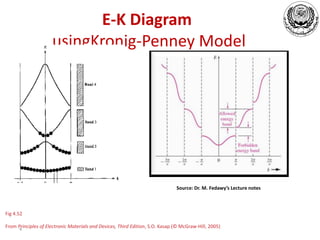
Fig 4.52
From Principles of Electronic Materials and Devices, Third Edition, S.O. Kasap (© McGraw-Hill, 2005)
E-K Diagram
usingKronig-Penney Model
4
Source: Dr. M. Fedawy’s Lecture notes
Lecture Notes Prepared by:
Dr. Amr Bayoumi, Dr. Nadia Rafat
Solid State Electronics EC210, Spring 2015
Arab Academy for Science and Technology
AAST – Cairo,
Lecture 9:E-K Diagram, Band Gap,
Effective Mass 5
From Principles of Electronic Materials and Devices, Third Edition, S.O. Kasap (© McGraw-Hill, 2005)
Energy Gap (Bandgaps, Eg)
Fig 4.54

a
E
[11]
k3
E
k1
[10]
Band
Band
Energy gap
Energy gap
Band
Band
First
Brillouin Zone
Second Brillouin
Zone
Second
Brillouin Zone
First
Brillouin Zone
a

The E-k behavior for the electron along different directions in the two
dimensional crystal. The energy gap along [10] is at /a whereas it is
at /a along [11].
From Principles of
Electronic Materials
and Devices, Third
Edition, S.O. Kasap (©
McGraw-Hill, 2005)
Lecture Notes Prepared by:
Dr. Amr Bayoumi, Dr. Nadia Rafat
Solid State Electronics EC210, Spring 2015
Arab Academy for Science and Technology
AAST – Cairo,
Lecture 9:E-K Diagram, Band Gap,
Effective Mass 6
From Principles of Electronic Materials and Devices, Third Edition, S.O. Kasap (© McGraw-Hill, 2005)
Energy Gaps (Eg)
Fig 4.55
(a) Metal: For the electron in a metal there is no apparent energy gap
because the 2nd BZ (Brillouin Zone) along [10] overlaps the 1st BZ along
[11]. Bands overlap the energy gaps. Thus the electron can always find any
energy by changing its direction.
(b) Semiconductor or insulator: For the electron in a semiconductor there is
an energy gap arising from the overlap of the energy gaps along [10] and
[11] directions. The electron can never have an energy within this energy
gap, Eg.
Energy gap
[11]
[10] Overlapped
energy gaps
Energy gap = Eg
1st BZ
band
2nd BZ
band
(b) Semiconductor and insulator
Energy gap
[11]
[10]
Bands overlap
energy gaps
Energy gap
1st BZ
band
2nd BZ
&
1st BZ
overlapped
band
2nd BZ
band
(a) Metal
From Principles of
Electronic Materials
and Devices, Third
Edition, S.O. Kasap (©
McGraw-Hill, 2005)
Lecture Notes Prepared by:
Dr. Amr Bayoumi, Dr. Nadia Rafat
Solid State Electronics EC210, Spring 2015
Arab Academy for Science and Technology
AAST – Cairo,
Lecture 9:E-K Diagram, Band Gap,
Effective Mass 7
From Principles of Electronic Materials and Devices, Third Edition, S.O. Kasap (© McGraw-Hill, 2005)
E-
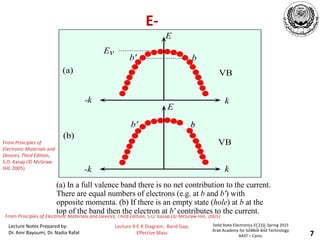
Fig 5.52
(a) In a full valence band there is no net contribution to the current.
There are equal numbers of electrons (e.g. at b and b') with
opposite momenta. (b) If there is an empty state (hole) at b at the
top of the band then the electron at b' contributes to the current.
Ev
VB
E
k
-k
b
b'
(a)
VB
E
k
-k
b'
(b)
From Principles of
Electronic Materials and
Devices, Third Edition,
S.O. Kasap (© McGraw-
Hill, 2005)
Lecture Notes Prepared by:
Dr. Amr Bayoumi, Dr. Nadia Rafat
Solid State Electronics EC210, Spring 2015
Arab Academy for Science and Technology
AAST – Cairo,
Lecture 9:E-K Diagram, Band Gap,
Effective Mass 8
From Principles of Electronic Materials and Devices, Third Edition, S.O. Kasap (© McGraw-Hill, 2005)
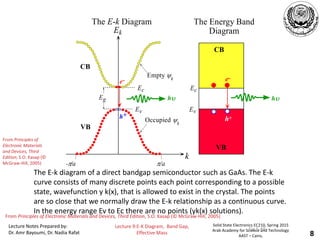
Fig 5.49
The E-k diagram of a direct bandgap semiconductor such as GaAs. The E-k
curve consists of many discrete points each point corresponding to a possible
state, wavefunction y k(x), that is allowed to exist in the crystal. The points
are so close that we normally draw the E-k relationship as a continuous curve.
In the energy range Ev to Ec there are no points (yk(x) solutions).
Ek
k
/a
-/a
Ec
Ev
CB
VB
Ec
Ev
The E-k Diagram The Energy Band
Diagram
Empty k
Occupied k
h+
e-
Eg
e-
h+
h
VB
h
CB
From Principles of
Electronic Materials
and Devices, Third
Edition, S.O. Kasap (©
McGraw-Hill, 2005)
Lecture Notes Prepared by:
Dr. Amr Bayoumi, Dr. Nadia Rafat
Solid State Electronics EC210, Spring 2015
Arab Academy for Science and Technology
AAST – Cairo,
Lecture 9:E-K Diagram, Band Gap,
Effective Mass 9
From Principles of Electronic Materials and Devices, Third Edition, S.O. Kasap (© McGraw-Hill, 2005)
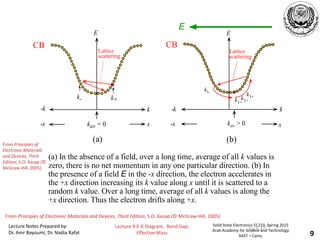
Fig 5.51
(a) In the absence of a field, over a long time, average of all k values is
zero, there is no net momentum in any one particular direction. (b) In
the presence of a field E in the -x direction, the electron accelerates in
the +x direction increasing its k value along x until it is scattered to a
random k value. Over a long time, average of all k values is along the
+x direction. Thus the electron drifts along +x.
E
k
CB
-k
k+
k-
Lattice
scattering
kav = 0
-x x
(a)
kav > 0
-x x
E
k
CB
-k
E
k1-
Lattice
scattering
k1+
k2+
k3+
(b)
From Principles of
Electronic Materials
and Devices, Third
Edition, S.O. Kasap (©
McGraw-Hill, 2005)
Effective Mass
10
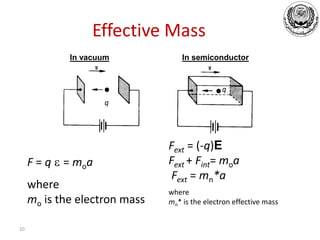
F = q e = moa
where
mo is the electron mass
Fext = (-q)E
Fext + Fint= moa
Fext = mn*a
where
mn* is the electron effective mass
In vacuum In semiconductor
q
q
Lecture Notes Prepared by:
Dr. Amr Bayoumi, Dr. Nadia Rafat
Solid State Electronics EC210, Spring 2015
Arab Academy for Science and Technology
AAST – Cairo,
Lecture 9:E-K Diagram, Band Gap,
Effective Mass 11
From Principles of Electronic Materials and Devices, Third Edition, S.O. Kasap (© McGraw-Hill, 2005)
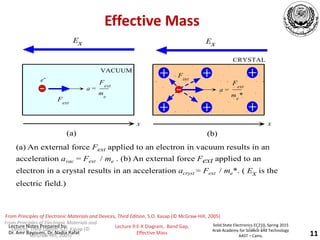
Effective Mass
Fig 4.19
From Principles of Electronic Materials and
Devices, Third Edition, S.O. Kasap (©
McGraw-Hill, 2005)
e-
Fext
VACUUM
x
Fext
me
a =
(a)
Ex
Fint
CRYSTAL
x
Fext
me
*
a =
(b)
(a) An external force Fext applied to an electron in vacuum results in an
acceleration avac = Fext / me . (b) An external force Fext applied to an
electron in a crystal results in an acceleration acryst = Fext / me*. ( Ex is the
electric field.)
Ex
Lecture Notes Prepared by:
Dr. Amr Bayoumi, Dr. Nadia Rafat
Solid State Electronics EC210, Spring 2015
Arab Academy for Science and Technology
AAST – Cairo,
Lecture 9:E-K Diagram, Band Gap,
Effective Mass 12
From Principles of Electronic Materials and Devices, Third Edition, S.O. Kasap (© McGraw-Hill, 2005)
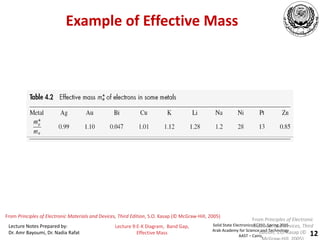
Example of Effective Mass
From Principles of Electronic
Materials and Devices, Third
Edition, S.O. Kasap (©
Lecture Notes Prepared by:
Dr. Amr Bayoumi, Dr. Nadia Rafat
Solid State Electronics EC210, Spring 2015
Arab Academy for Science and Technology
AAST – Cairo,
Lecture 9:E-K Diagram, Band Gap,
Effective Mass 13
From Principles of Electronic Materials and Devices, Third Edition, S.O. Kasap (© McGraw-Hill, 2005)
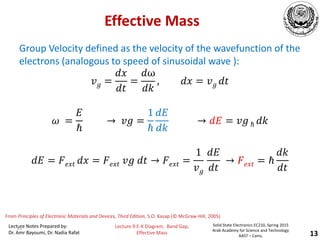
Effective Mass
Group Velocity defined as the velocity of the wavefunction of the
electrons (analogous to speed of sinusoidal wave ):
𝑣𝑔 =
𝑑𝑥
𝑑𝑡
=
𝑑ω
𝑑𝑘
, 𝑑𝑥 = 𝑣𝑔 𝑑𝑡
𝜔 =
𝐸
ℏ
→ 𝑣𝑔 =
1
ℏ
𝑑𝐸
𝑑𝑘
→ 𝑑𝐸 = 𝑣𝑔 ℏ 𝑑𝑘
𝑑𝐸 = 𝐹𝑒𝑥𝑡 𝑑𝑥 = 𝐹𝑒𝑥𝑡 𝑣𝑔 𝑑𝑡 → 𝐹𝑒𝑥𝑡 =
1
𝑣𝑔
𝑑𝐸
𝑑𝑡
→ 𝐹𝑒𝑥𝑡 = ℏ
𝑑𝑘
𝑑𝑡
13
Lecture Notes Prepared by:
Dr. Amr Bayoumi, Dr. Nadia Rafat
Solid State Electronics EC210, Spring 2015
Arab Academy for Science and Technology
AAST – Cairo,
Lecture 9:E-K Diagram, Band Gap,
Effective Mass 14
From Principles of Electronic Materials and Devices, Third Edition, S.O. Kasap (© McGraw-Hill, 2005)
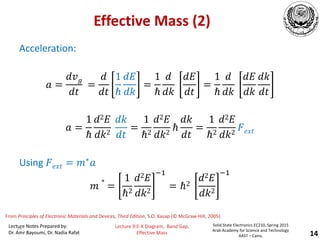
Effective Mass (2)
Acceleration:
𝑎 =
𝑑𝑣𝑔
𝑑𝑡
=
𝑑
𝑑𝑡
1
ℏ
𝑑𝐸
𝑑𝑘
=
1
ℏ
𝑑
𝑑𝑘
𝑑𝐸
𝑑𝑡
=
1
ℏ
𝑑
𝑑𝑘
𝑑𝐸
𝑑𝑘
𝑑𝑘
𝑑𝑡
𝑎 =
1
ℏ
𝑑2𝐸
𝑑𝑘2
𝑑𝑘
𝑑𝑡
=
1
ℏ2
𝑑2𝐸
𝑑𝑘2
ℏ
𝑑𝑘
𝑑𝑡
=
1
ℏ2
𝑑2𝐸
𝑑𝑘2
𝐹𝑒𝑥𝑡
Using 𝐹𝑒𝑥𝑡 = 𝑚∗
𝑎
𝑚
∗
=
1
ℏ2
𝑑2𝐸
𝑑𝑘2
−1
= ℏ2
𝑑2𝐸
𝑑𝑘2
−1
14

BAND THEORY.pdf

  • 1.
    Lecture 9 Band Theory: E-KDiagram, Energy Gaps and Effective Mass Lecture Notes Prepared by: Dr. Amr Bayoumi, Dr. Nadia Rafat Solid State Electronics EC210 Arab Academy for Science and Technology AAST – Cairo Spring 2015 1
  • 2.
    Lecture Notes Preparedby: Dr. Amr Bayoumi, Dr. Nadia Rafat Solid State Electronics EC210, Spring 2015 Arab Academy for Science and Technology AAST – Cairo, Lecture 9:E-K Diagram, Band Gap, Effective Mass 2 From Principles of Electronic Materials and Devices, Third Edition, S.O. Kasap (© McGraw-Hill, 2005) These PowerPoint color diagrams can only be used by instructors if the 3rd Edition has been adopted for his/her course. Permission is given to individuals who have purchased a copy of the third edition with CD-ROM Electronic Materials and Devices to use these slides in seminar, symposium and conference presentations provided that the book title, author and © McGraw-Hill are displayed under each diagram.
  • 3.
    Lecture Notes Preparedby: Dr. Amr Bayoumi, Dr. Nadia Rafat Solid State Electronics EC210, Spring 2015 Arab Academy for Science and Technology AAST – Cairo, Lecture 9:E-K Diagram, Band Gap, Effective Mass 3 From Principles of Electronic Materials and Devices, Third Edition, S.O. Kasap (© McGraw-Hill, 2005) Pages • Kasap: – P.355 (Kronig Penny) – P.303-304, p. 454-455 (Effective Mass) Lecture 8: Band Theory: Kronig-Penny Model and Effective Mass
  • 4.
    Fig 4.52 From Principlesof Electronic Materials and Devices, Third Edition, S.O. Kasap (© McGraw-Hill, 2005) E-K Diagram usingKronig-Penney Model 4 Source: Dr. M. Fedawy’s Lecture notes
  • 5.
    Lecture Notes Preparedby: Dr. Amr Bayoumi, Dr. Nadia Rafat Solid State Electronics EC210, Spring 2015 Arab Academy for Science and Technology AAST – Cairo, Lecture 9:E-K Diagram, Band Gap, Effective Mass 5 From Principles of Electronic Materials and Devices, Third Edition, S.O. Kasap (© McGraw-Hill, 2005) Energy Gap (Bandgaps, Eg) Fig 4.54  a E [11] k3 E k1 [10] Band Band Energy gap Energy gap Band Band First Brillouin Zone Second Brillouin Zone Second Brillouin Zone First Brillouin Zone a  The E-k behavior for the electron along different directions in the two dimensional crystal. The energy gap along [10] is at /a whereas it is at /a along [11]. From Principles of Electronic Materials and Devices, Third Edition, S.O. Kasap (© McGraw-Hill, 2005)
  • 6.
    Lecture Notes Preparedby: Dr. Amr Bayoumi, Dr. Nadia Rafat Solid State Electronics EC210, Spring 2015 Arab Academy for Science and Technology AAST – Cairo, Lecture 9:E-K Diagram, Band Gap, Effective Mass 6 From Principles of Electronic Materials and Devices, Third Edition, S.O. Kasap (© McGraw-Hill, 2005) Energy Gaps (Eg) Fig 4.55 (a) Metal: For the electron in a metal there is no apparent energy gap because the 2nd BZ (Brillouin Zone) along [10] overlaps the 1st BZ along [11]. Bands overlap the energy gaps. Thus the electron can always find any energy by changing its direction. (b) Semiconductor or insulator: For the electron in a semiconductor there is an energy gap arising from the overlap of the energy gaps along [10] and [11] directions. The electron can never have an energy within this energy gap, Eg. Energy gap [11] [10] Overlapped energy gaps Energy gap = Eg 1st BZ band 2nd BZ band (b) Semiconductor and insulator Energy gap [11] [10] Bands overlap energy gaps Energy gap 1st BZ band 2nd BZ & 1st BZ overlapped band 2nd BZ band (a) Metal From Principles of Electronic Materials and Devices, Third Edition, S.O. Kasap (© McGraw-Hill, 2005)
  • 7.
    Lecture Notes Preparedby: Dr. Amr Bayoumi, Dr. Nadia Rafat Solid State Electronics EC210, Spring 2015 Arab Academy for Science and Technology AAST – Cairo, Lecture 9:E-K Diagram, Band Gap, Effective Mass 7 From Principles of Electronic Materials and Devices, Third Edition, S.O. Kasap (© McGraw-Hill, 2005) E- Fig 5.52 (a) In a full valence band there is no net contribution to the current. There are equal numbers of electrons (e.g. at b and b') with opposite momenta. (b) If there is an empty state (hole) at b at the top of the band then the electron at b' contributes to the current. Ev VB E k -k b b' (a) VB E k -k b' (b) From Principles of Electronic Materials and Devices, Third Edition, S.O. Kasap (© McGraw- Hill, 2005)
  • 8.
    Lecture Notes Preparedby: Dr. Amr Bayoumi, Dr. Nadia Rafat Solid State Electronics EC210, Spring 2015 Arab Academy for Science and Technology AAST – Cairo, Lecture 9:E-K Diagram, Band Gap, Effective Mass 8 From Principles of Electronic Materials and Devices, Third Edition, S.O. Kasap (© McGraw-Hill, 2005) Fig 5.49 The E-k diagram of a direct bandgap semiconductor such as GaAs. The E-k curve consists of many discrete points each point corresponding to a possible state, wavefunction y k(x), that is allowed to exist in the crystal. The points are so close that we normally draw the E-k relationship as a continuous curve. In the energy range Ev to Ec there are no points (yk(x) solutions). Ek k /a -/a Ec Ev CB VB Ec Ev The E-k Diagram The Energy Band Diagram Empty k Occupied k h+ e- Eg e- h+ h VB h CB From Principles of Electronic Materials and Devices, Third Edition, S.O. Kasap (© McGraw-Hill, 2005)
  • 9.
    Lecture Notes Preparedby: Dr. Amr Bayoumi, Dr. Nadia Rafat Solid State Electronics EC210, Spring 2015 Arab Academy for Science and Technology AAST – Cairo, Lecture 9:E-K Diagram, Band Gap, Effective Mass 9 From Principles of Electronic Materials and Devices, Third Edition, S.O. Kasap (© McGraw-Hill, 2005) Fig 5.51 (a) In the absence of a field, over a long time, average of all k values is zero, there is no net momentum in any one particular direction. (b) In the presence of a field E in the -x direction, the electron accelerates in the +x direction increasing its k value along x until it is scattered to a random k value. Over a long time, average of all k values is along the +x direction. Thus the electron drifts along +x. E k CB -k k+ k- Lattice scattering kav = 0 -x x (a) kav > 0 -x x E k CB -k E k1- Lattice scattering k1+ k2+ k3+ (b) From Principles of Electronic Materials and Devices, Third Edition, S.O. Kasap (© McGraw-Hill, 2005)
  • 10.
    Effective Mass 10 F =q e = moa where mo is the electron mass Fext = (-q)E Fext + Fint= moa Fext = mn*a where mn* is the electron effective mass In vacuum In semiconductor q q
  • 11.
    Lecture Notes Preparedby: Dr. Amr Bayoumi, Dr. Nadia Rafat Solid State Electronics EC210, Spring 2015 Arab Academy for Science and Technology AAST – Cairo, Lecture 9:E-K Diagram, Band Gap, Effective Mass 11 From Principles of Electronic Materials and Devices, Third Edition, S.O. Kasap (© McGraw-Hill, 2005) Effective Mass Fig 4.19 From Principles of Electronic Materials and Devices, Third Edition, S.O. Kasap (© McGraw-Hill, 2005) e- Fext VACUUM x Fext me a = (a) Ex Fint CRYSTAL x Fext me * a = (b) (a) An external force Fext applied to an electron in vacuum results in an acceleration avac = Fext / me . (b) An external force Fext applied to an electron in a crystal results in an acceleration acryst = Fext / me*. ( Ex is the electric field.) Ex
  • 12.
    Lecture Notes Preparedby: Dr. Amr Bayoumi, Dr. Nadia Rafat Solid State Electronics EC210, Spring 2015 Arab Academy for Science and Technology AAST – Cairo, Lecture 9:E-K Diagram, Band Gap, Effective Mass 12 From Principles of Electronic Materials and Devices, Third Edition, S.O. Kasap (© McGraw-Hill, 2005) Example of Effective Mass From Principles of Electronic Materials and Devices, Third Edition, S.O. Kasap (©
  • 13.
    Lecture Notes Preparedby: Dr. Amr Bayoumi, Dr. Nadia Rafat Solid State Electronics EC210, Spring 2015 Arab Academy for Science and Technology AAST – Cairo, Lecture 9:E-K Diagram, Band Gap, Effective Mass 13 From Principles of Electronic Materials and Devices, Third Edition, S.O. Kasap (© McGraw-Hill, 2005) Effective Mass Group Velocity defined as the velocity of the wavefunction of the electrons (analogous to speed of sinusoidal wave ): 𝑣𝑔 = 𝑑𝑥 𝑑𝑡 = 𝑑ω 𝑑𝑘 , 𝑑𝑥 = 𝑣𝑔 𝑑𝑡 𝜔 = 𝐸 ℏ → 𝑣𝑔 = 1 ℏ 𝑑𝐸 𝑑𝑘 → 𝑑𝐸 = 𝑣𝑔 ℏ 𝑑𝑘 𝑑𝐸 = 𝐹𝑒𝑥𝑡 𝑑𝑥 = 𝐹𝑒𝑥𝑡 𝑣𝑔 𝑑𝑡 → 𝐹𝑒𝑥𝑡 = 1 𝑣𝑔 𝑑𝐸 𝑑𝑡 → 𝐹𝑒𝑥𝑡 = ℏ 𝑑𝑘 𝑑𝑡 13
  • 14.
    Lecture Notes Preparedby: Dr. Amr Bayoumi, Dr. Nadia Rafat Solid State Electronics EC210, Spring 2015 Arab Academy for Science and Technology AAST – Cairo, Lecture 9:E-K Diagram, Band Gap, Effective Mass 14 From Principles of Electronic Materials and Devices, Third Edition, S.O. Kasap (© McGraw-Hill, 2005) Effective Mass (2) Acceleration: 𝑎 = 𝑑𝑣𝑔 𝑑𝑡 = 𝑑 𝑑𝑡 1 ℏ 𝑑𝐸 𝑑𝑘 = 1 ℏ 𝑑 𝑑𝑘 𝑑𝐸 𝑑𝑡 = 1 ℏ 𝑑 𝑑𝑘 𝑑𝐸 𝑑𝑘 𝑑𝑘 𝑑𝑡 𝑎 = 1 ℏ 𝑑2𝐸 𝑑𝑘2 𝑑𝑘 𝑑𝑡 = 1 ℏ2 𝑑2𝐸 𝑑𝑘2 ℏ 𝑑𝑘 𝑑𝑡 = 1 ℏ2 𝑑2𝐸 𝑑𝑘2 𝐹𝑒𝑥𝑡 Using 𝐹𝑒𝑥𝑡 = 𝑚∗ 𝑎 𝑚 ∗ = 1 ℏ2 𝑑2𝐸 𝑑𝑘2 −1 = ℏ2 𝑑2𝐸 𝑑𝑘2 −1 14