

CHANNA
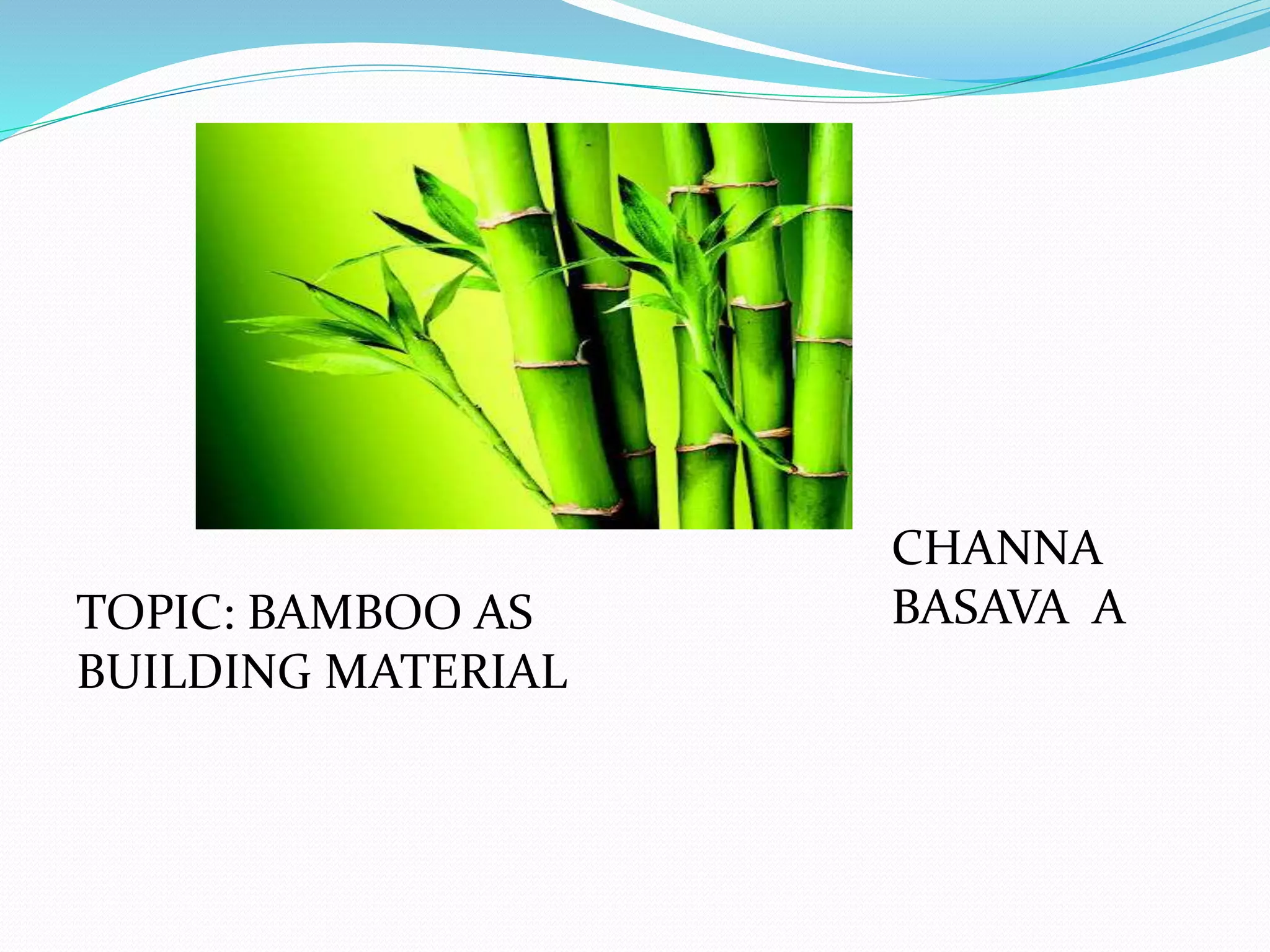
BASAVA ATOPIC: BAMBOO AS
BUILDING MATERIAL
CONTENTS
 INTRODUCTION
 GENERAL
USES
 PROPERTIES
 THE WORKING OF
BAMBOO
 PRESERVATION OF
BAMBOO
 BAMBOO
HOUSING
INTRODUCTION
 Bamboo has a long and well-established tradition as a building
material through out the world’s tropical and sub-tropical
regions.
 It is widely used for many forms of construction, in particular
for housing in rural areas.
 Bamboo is a renewable and versatile resource, characterized by
high strength and low weight, and is easily worked using
simple tools.
GENERAL USES
a) Soil stabilization, wind break, urban waste water treatment and
reduction of nitrates contamination
b) Creating a fire line in traditional forests-due to the high content of
silica.
c) Removing atmospheric carbon- bamboo can capture 17 metric tons
of carbon per hectare per year, i.e., effectively than any other species.
d) The shoots are edible.
e) Building and construction.
f) Small scale and cottage industries, for handicrafts and other products.
g) New generation products as wood substitutes
h) Industrial products
PROPERTIES
 TENSILE STRENGTH
 COMPRESSIVE STRENGTH
 ELASTIC MODULUS
 ANISOTROPIC PROPERTIES
 SHRINKAGE
 FIRE RESISTANCE
THE WORKING OF BAMBOO
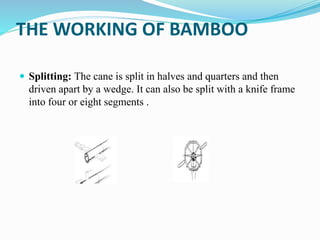
 Splitting: The cane is split in halves and quarters and then
driven apart by a wedge. It can also be split with a knife frame
into four or eight segments .
Shaping
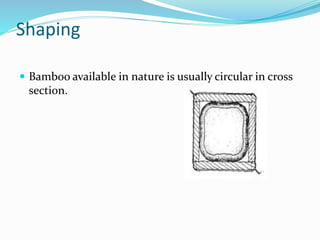
 Bamboo available in nature is usually circular in cross
section.
Bending
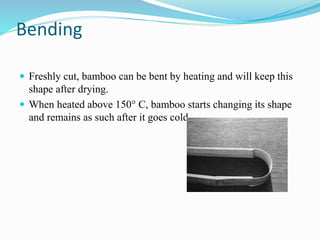
 Freshly cut, bamboo can be bent by heating and will keep this
shape after drying.
 When heated above 150° C, bamboo starts changing its shape
and remains as such after it goes cold.
PRESERVATION OF BAMBOO
 NON CHEMICAL METHODS OR TRADITIONAL
METHOD
 CHEMICAL METHODS
BAMBOO HOUSING
 The majority of bamboo construction relates to the rural
community needs in developing countries.
 As such domestic housing predominates and in accordance
with their rural origins, these buildings are often simple in
design and construction relying on a living tradition of local
skills and methods.
ADVANTAGES OF BAMBOO
 The various advantages of bamboo are mentioned below.
1) Light, strong and versatile.
2) Light, strong, versatile.
3) Environment friendly.
4) Accessible to the poor.
5) Self renewing resource
6) Fast growing.
7) Highly productive.
DISADVANTAGES OF BAMBOO
 The major disadvantages of bamboo are as follows:
1) Requires preservation
2) Shaped by nature
3) Jointing- although many jointing techniques exist, their
structural efficiency is low.
4) Lack of design guidance and codes.
5) Prone to catch fire very fast by the friction among the
culms during wind, and is seen to cause forest fires.
CONCLUSION
 Since time immemorial, bamboo has played an important role
in the development of mankind.
 It is used for a wide range of day-to-day purposes, both as a
woody material and as food.
 It has been the backbone of much of the world’s rural life and
will remain so as the population increases.
REFERENCES
 www.SeminarsTopics.com
www.google .com

Bamboo as building material

  • 1.
    CHANNA BASAVA ATOPIC: BAMBOOAS BUILDING MATERIAL
  • 2.
    CONTENTS  INTRODUCTION  GENERAL USES PROPERTIES  THE WORKING OF BAMBOO  PRESERVATION OF BAMBOO  BAMBOO HOUSING
  • 3.
    INTRODUCTION  Bamboo hasa long and well-established tradition as a building material through out the world’s tropical and sub-tropical regions.  It is widely used for many forms of construction, in particular for housing in rural areas.  Bamboo is a renewable and versatile resource, characterized by high strength and low weight, and is easily worked using simple tools.
  • 4.
    GENERAL USES a) Soilstabilization, wind break, urban waste water treatment and reduction of nitrates contamination b) Creating a fire line in traditional forests-due to the high content of silica. c) Removing atmospheric carbon- bamboo can capture 17 metric tons of carbon per hectare per year, i.e., effectively than any other species. d) The shoots are edible. e) Building and construction. f) Small scale and cottage industries, for handicrafts and other products. g) New generation products as wood substitutes h) Industrial products
  • 5.
    PROPERTIES  TENSILE STRENGTH COMPRESSIVE STRENGTH  ELASTIC MODULUS  ANISOTROPIC PROPERTIES  SHRINKAGE  FIRE RESISTANCE
  • 6.
    THE WORKING OFBAMBOO  Splitting: The cane is split in halves and quarters and then driven apart by a wedge. It can also be split with a knife frame into four or eight segments .
  • 7.
    Shaping  Bamboo availablein nature is usually circular in cross section.
  • 8.
    Bending  Freshly cut,bamboo can be bent by heating and will keep this shape after drying.  When heated above 150° C, bamboo starts changing its shape and remains as such after it goes cold.
  • 9.
    PRESERVATION OF BAMBOO NON CHEMICAL METHODS OR TRADITIONAL METHOD  CHEMICAL METHODS
  • 10.
    BAMBOO HOUSING  Themajority of bamboo construction relates to the rural community needs in developing countries.  As such domestic housing predominates and in accordance with their rural origins, these buildings are often simple in design and construction relying on a living tradition of local skills and methods.
  • 11.
    ADVANTAGES OF BAMBOO The various advantages of bamboo are mentioned below. 1) Light, strong and versatile. 2) Light, strong, versatile. 3) Environment friendly. 4) Accessible to the poor. 5) Self renewing resource 6) Fast growing. 7) Highly productive.
  • 12.
    DISADVANTAGES OF BAMBOO The major disadvantages of bamboo are as follows: 1) Requires preservation 2) Shaped by nature 3) Jointing- although many jointing techniques exist, their structural efficiency is low. 4) Lack of design guidance and codes. 5) Prone to catch fire very fast by the friction among the culms during wind, and is seen to cause forest fires.
  • 13.
    CONCLUSION  Since timeimmemorial, bamboo has played an important role in the development of mankind.  It is used for a wide range of day-to-day purposes, both as a woody material and as food.  It has been the backbone of much of the world’s rural life and will remain so as the population increases.
  • 14.

Editor's Notes