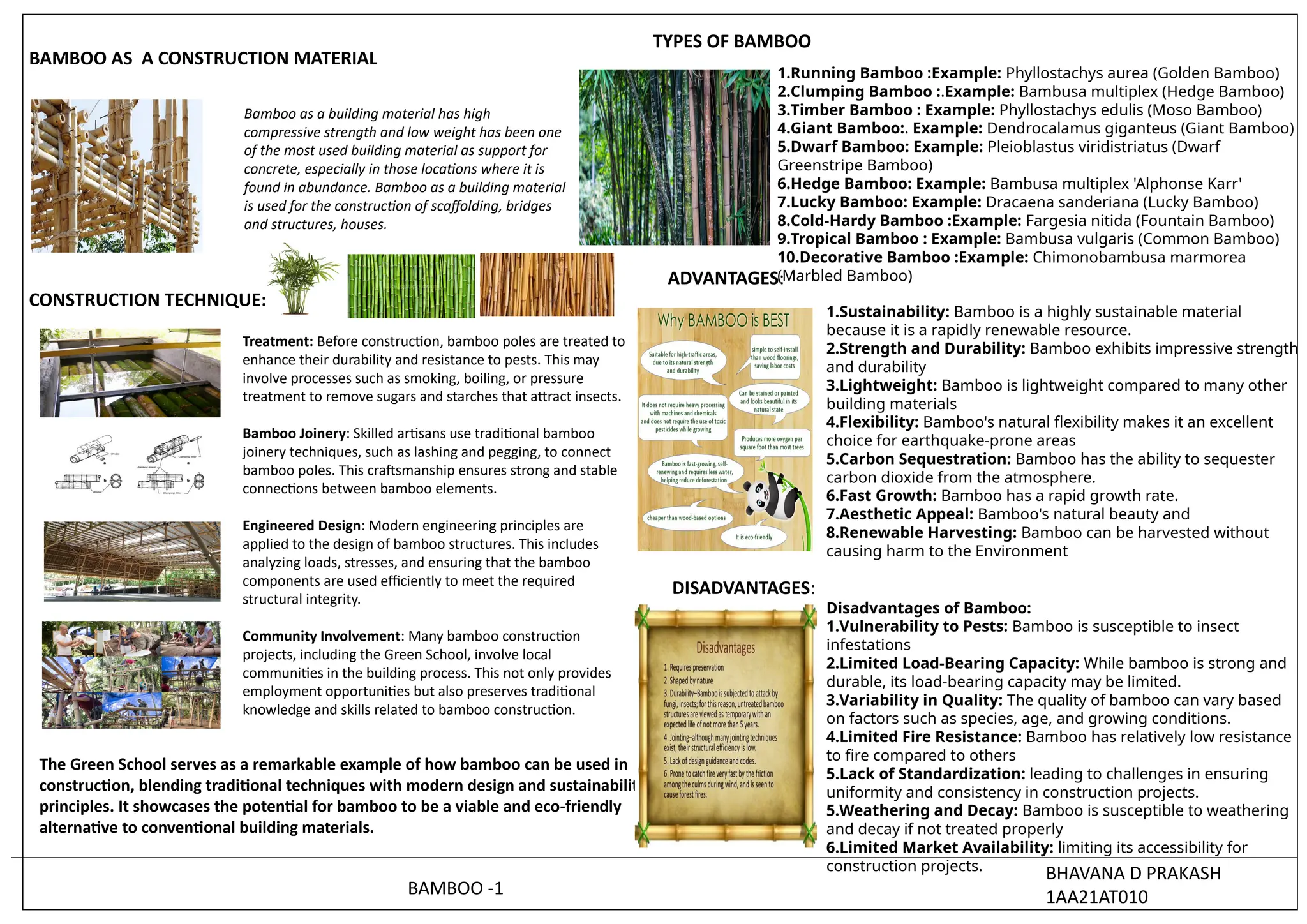
Treatment: Before construction,bamboo poles are treated to
enhance their durability and resistance to pests. This may
involve processes such as smoking, boiling, or pressure
treatment to remove sugars and starches that attract insects.
Bamboo Joinery: Skilled artisans use traditional bamboo
joinery techniques, such as lashing and pegging, to connect
bamboo poles. This craftsmanship ensures strong and stable
connections between bamboo elements.
Engineered Design: Modern engineering principles are
applied to the design of bamboo structures. This includes
analyzing loads, stresses, and ensuring that the bamboo
components are used efficiently to meet the required
structural integrity.
Community Involvement: Many bamboo construction
projects, including the Green School, involve local
communities in the building process. This not only provides
employment opportunities but also preserves traditional
knowledge and skills related to bamboo construction.
Bamboo as a building material has high
compressive strength and low weight has been one
of the most used building material as support for
concrete, especially in those locations where it is
found in abundance. Bamboo as a building material
is used for the construction of scaffolding, bridges
and structures, houses.
BAMBOO AS A CONSTRUCTION MATERIAL
The Green School serves as a remarkable example of how bamboo can be used in
construction, blending traditional techniques with modern design and sustainability
principles. It showcases the potential for bamboo to be a viable and eco-friendly
alternative to conventional building materials.
CONSTRUCTION TECHNIQUE:
ADVANTAGES:
1.Sustainability: Bamboo is a highly sustainable material
because it is a rapidly renewable resource.
2.Strength and Durability: Bamboo exhibits impressive strength
and durability
3.Lightweight: Bamboo is lightweight compared to many other
building materials
4.Flexibility: Bamboo's natural flexibility makes it an excellent
choice for earthquake-prone areas
5.Carbon Sequestration: Bamboo has the ability to sequester
carbon dioxide from the atmosphere.
6.Fast Growth: Bamboo has a rapid growth rate.
7.Aesthetic Appeal: Bamboo's natural beauty and
8.Renewable Harvesting: Bamboo can be harvested without
causing harm to the Environment
Disadvantages of Bamboo:
1.Vulnerability to Pests: Bamboo is susceptible to insect
infestations
2.Limited Load-Bearing Capacity: While bamboo is strong and
durable, its load-bearing capacity may be limited.
3.Variability in Quality: The quality of bamboo can vary based
on factors such as species, age, and growing conditions.
4.Limited Fire Resistance: Bamboo has relatively low resistance
to fire compared to others
5.Lack of Standardization: leading to challenges in ensuring
uniformity and consistency in construction projects.
5.Weathering and Decay: Bamboo is susceptible to weathering
and decay if not treated properly
6.Limited Market Availability: limiting its accessibility for
construction projects.
DISADVANTAGES:
1.Running Bamboo :Example: Phyllostachys aurea (Golden Bamboo)
2.Clumping Bamboo :.Example: Bambusa multiplex (Hedge Bamboo)
3.Timber Bamboo : Example: Phyllostachys edulis (Moso Bamboo)
4.Giant Bamboo:. Example: Dendrocalamus giganteus (Giant Bamboo)
5.Dwarf Bamboo: Example: Pleioblastus viridistriatus (Dwarf
Greenstripe Bamboo)
6.Hedge Bamboo: Example: Bambusa multiplex 'Alphonse Karr'
7.Lucky Bamboo: Example: Dracaena sanderiana (Lucky Bamboo)
8.Cold-Hardy Bamboo :Example: Fargesia nitida (Fountain Bamboo)
9.Tropical Bamboo : Example: Bambusa vulgaris (Common Bamboo)
10.Decorative Bamboo :Example: Chimonobambusa marmorea
(Marbled Bamboo)
TYPES OF BAMBOO
BAMBOO -1
BHAVANA D PRAKASH
1AA21AT010