Structural Lightweight
Concrete
Contents
 Introduction
 Properties of LWC
 Applications of LWC
 Advantages and disadvantages
 Case study
 conclusion
 References
Introduction
 Lightweight concrete can be defined as a type a
type of concrete which includes an expanding
agent in that it increases the volume of the
mixture while giving additional qualities and
lessened the dead weight.
 It is lighter than the conventional concrete.
 The use of lightweight concrete has been
widely spread across countries such as USA,
United Kingdom and Sweden.
Structural lightweight concrete
continue….
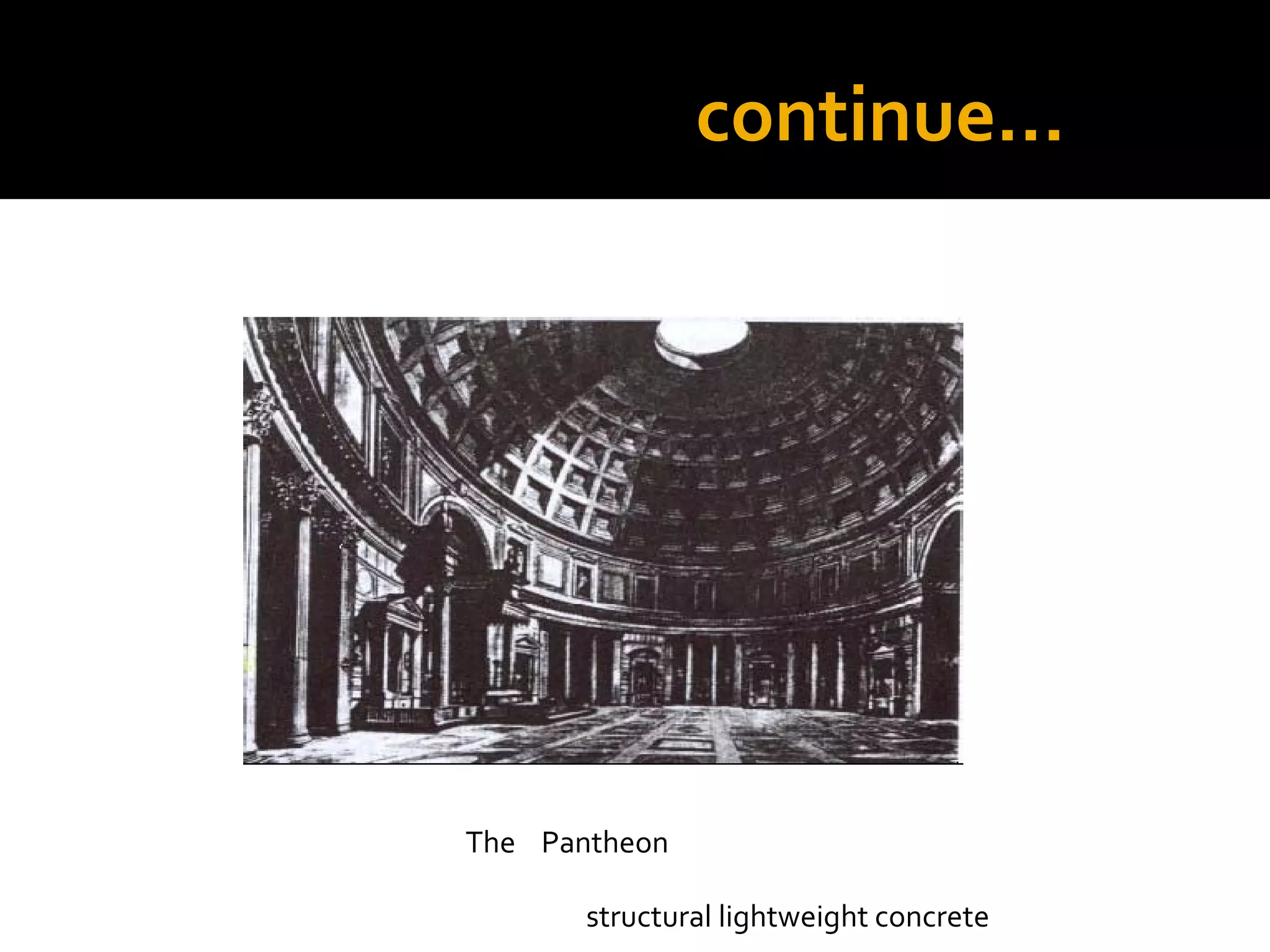
 It was first introduced by the Romans in the
second century where ‘The Pantheon’ has
been constructed using pumice, the most
common type of aggregate used.
 The building of ‘The Pantheon’ of lightweight
concrete material is still standing eminently in
Rome until now for about 18 centuries as
shown in Figure . It shows that the lighter
materials can be used in concrete .
Structural lightweight concrete
continue…
structural lightweight concrete
The Pantheon
Compressive Strength
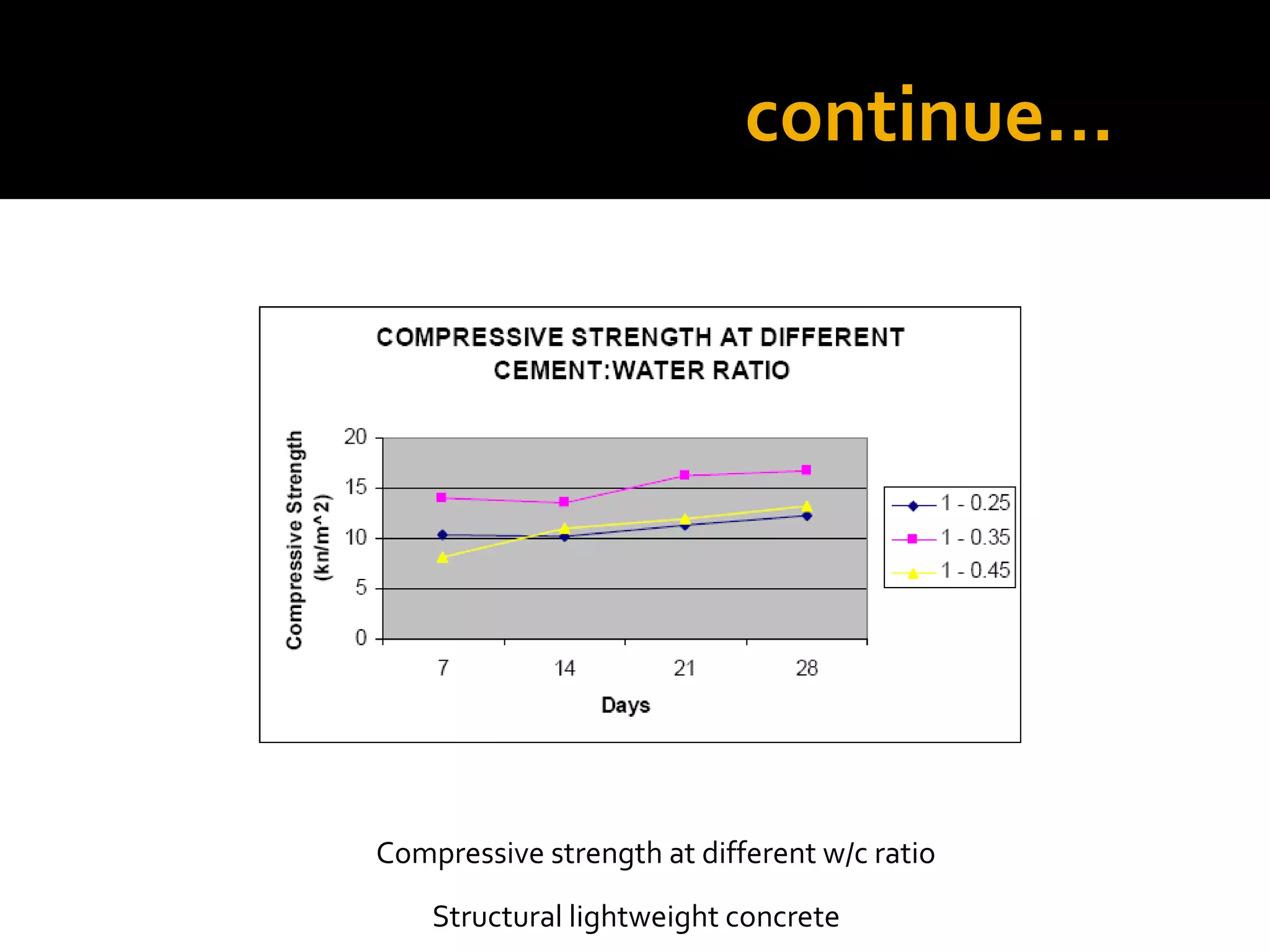
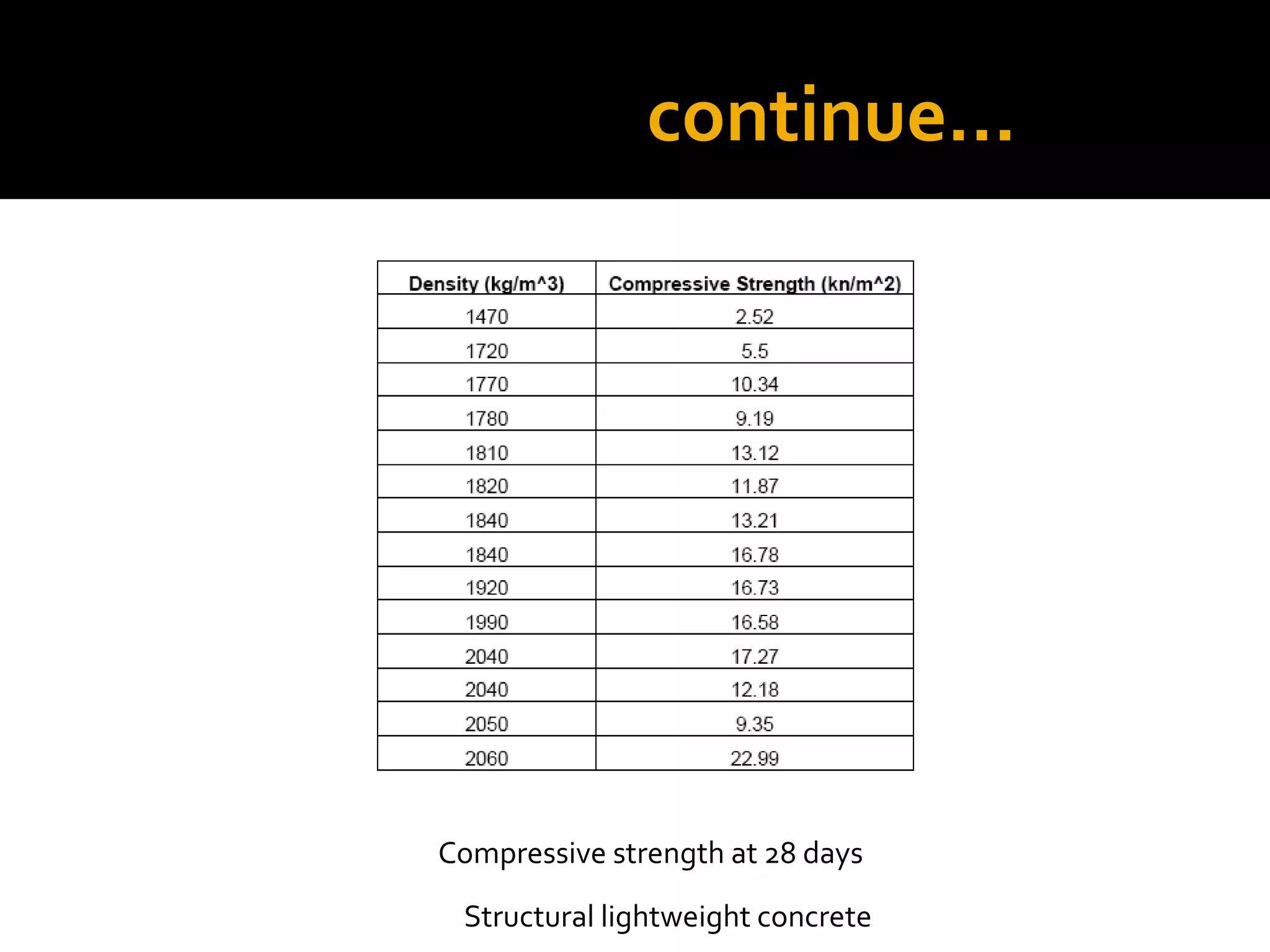
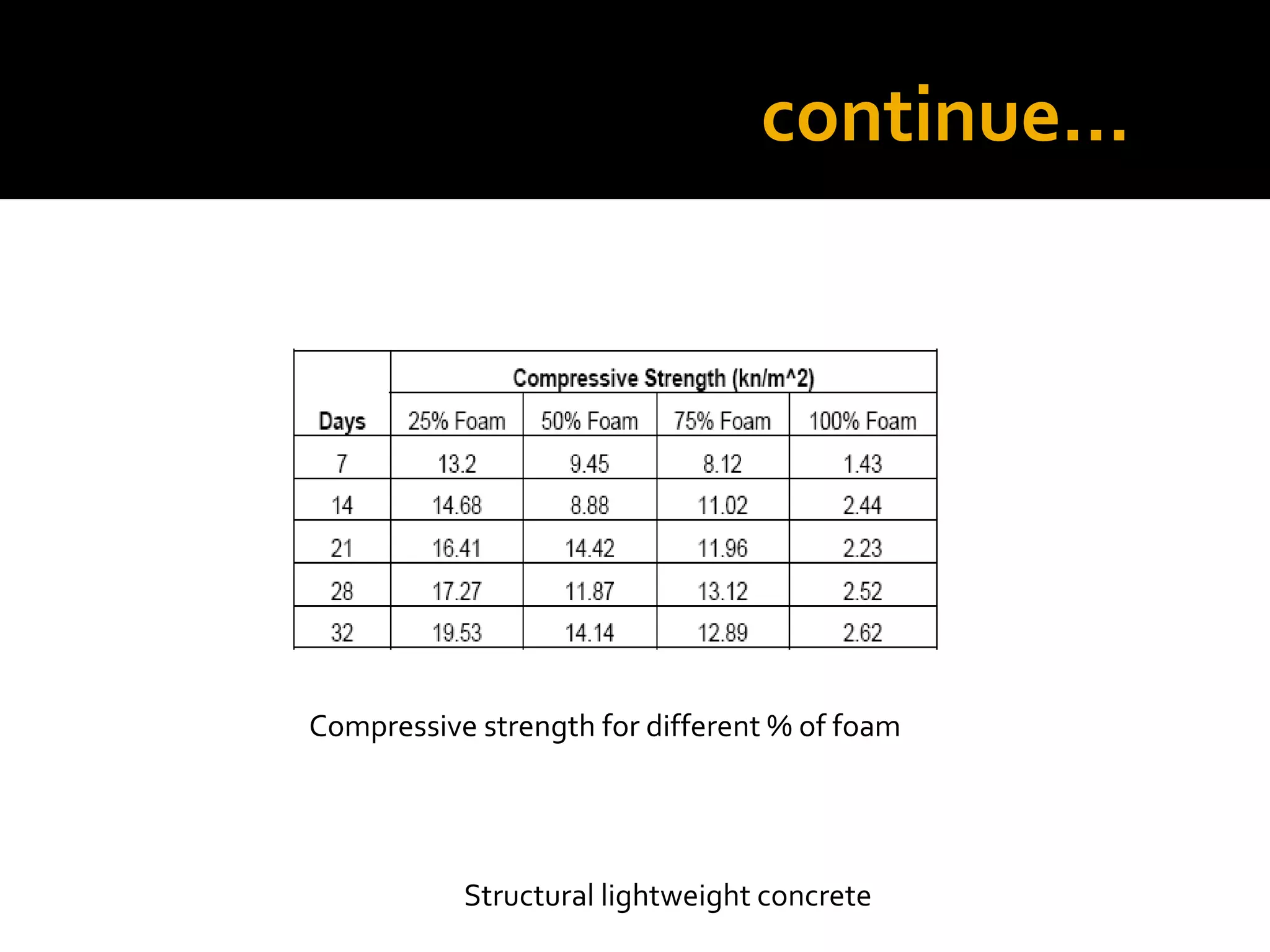
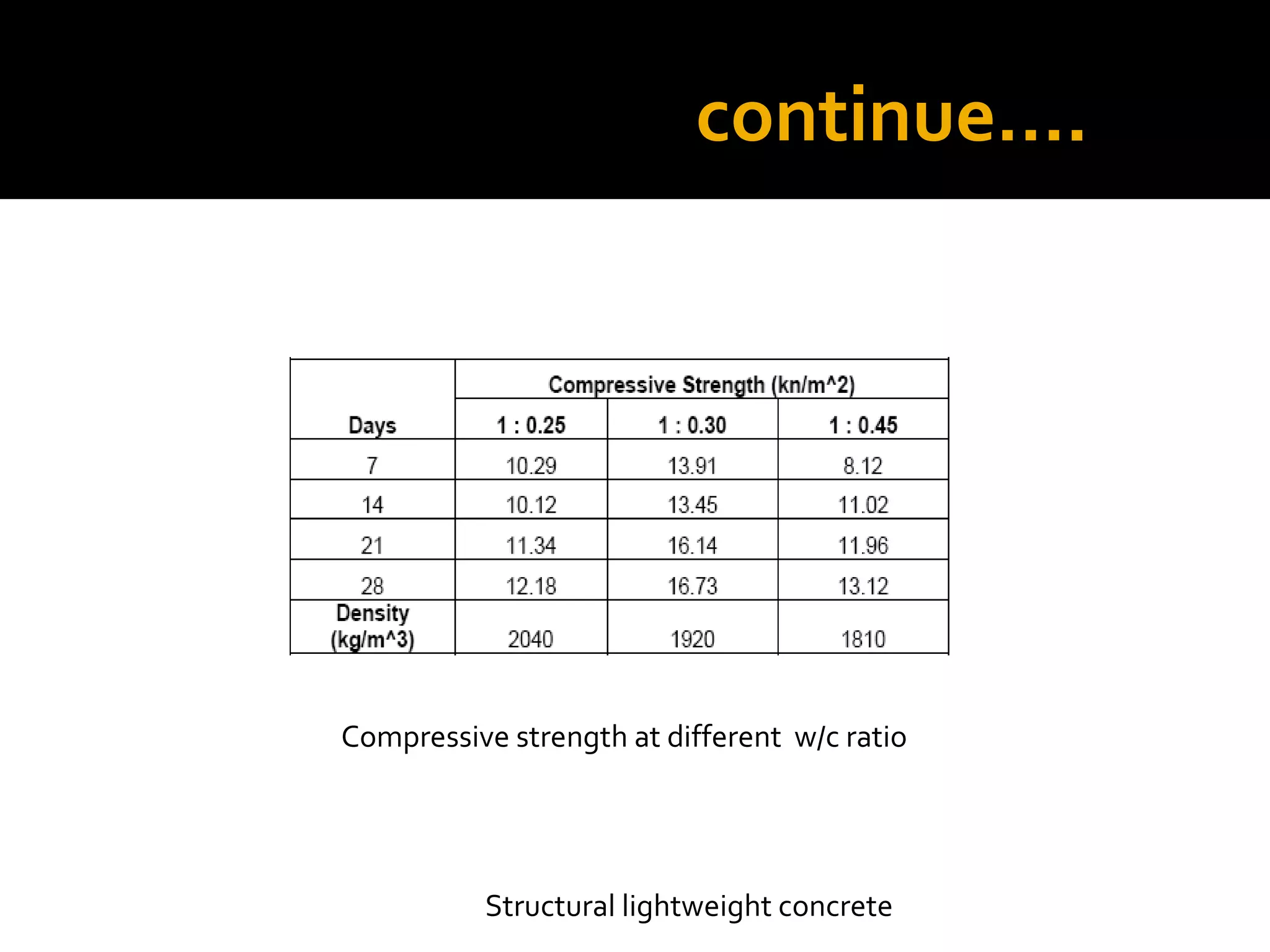
 Compressive strength is the primary physical
property of concrete and is the one most
used in design.
 Fourteen trial mixes had been prepared
during the research and from the results, the
mixture with the highest compressive strength
was used.
Structural lightweight concrete
continue….
Structural lightweight concrete
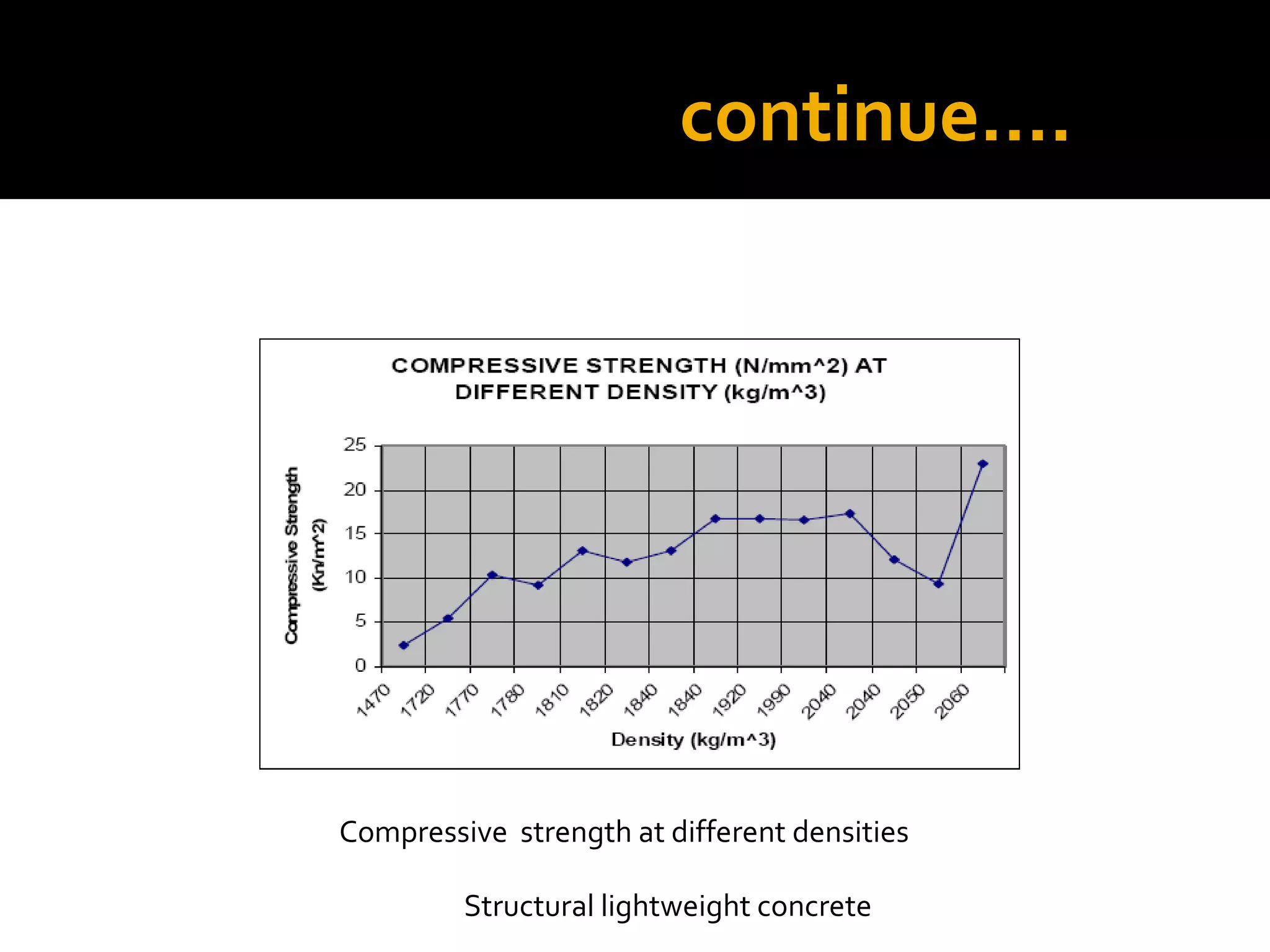
Compressive strength at different densities
continue….
Structural lightweight concrete
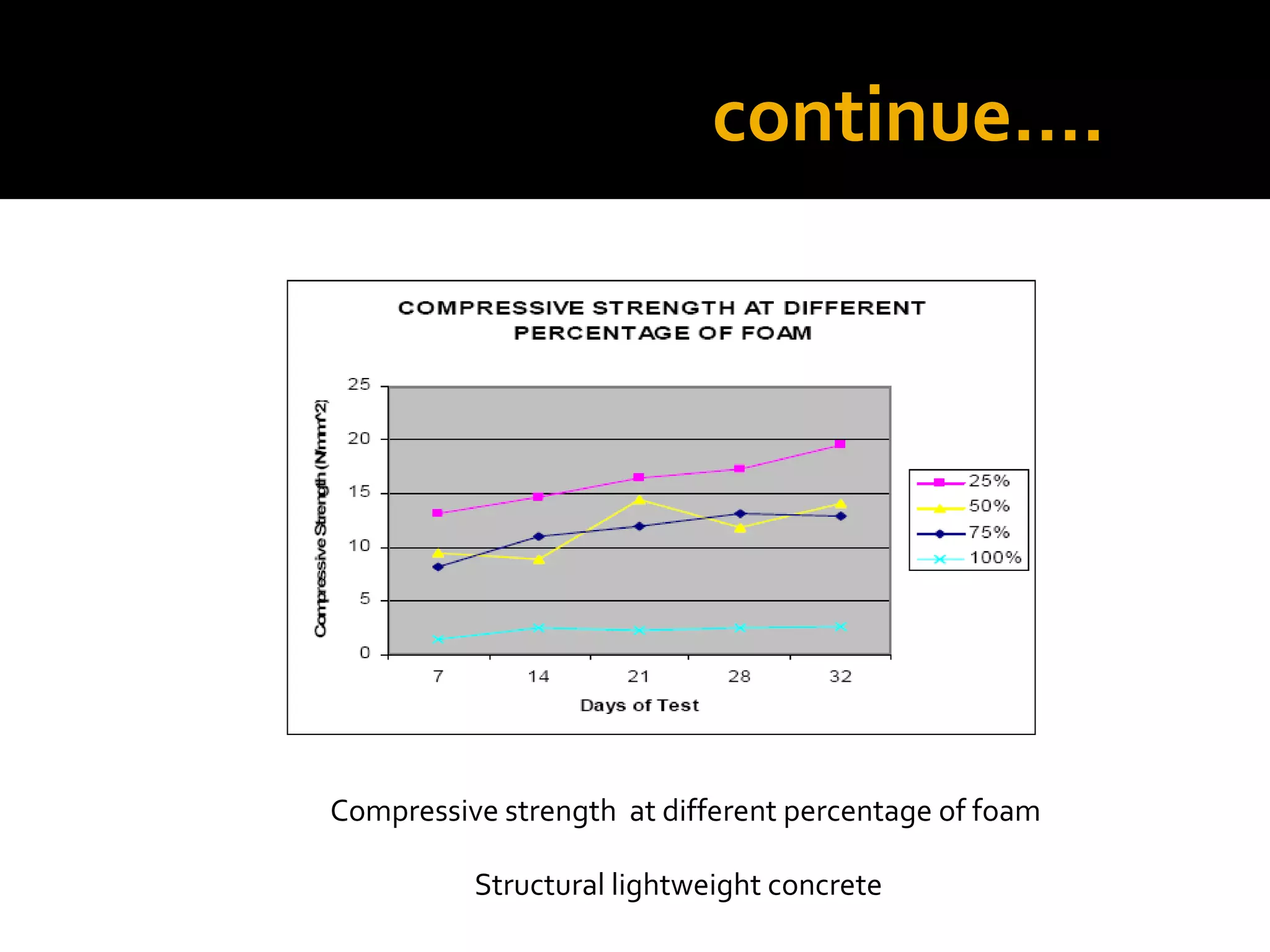
Compressive strength at different percentage of foam
continue…
Structural lightweight concrete
Compressive strength at different w/c ratio
continue…
Structural lightweight concrete
Compressive strength at 28 days
continue…
Structural lightweight concrete
Compressive strength for different % of foam
continue….
Structural lightweight concrete
Compressive strength at different w/c ratio
continue….
Structural lightweight concrete
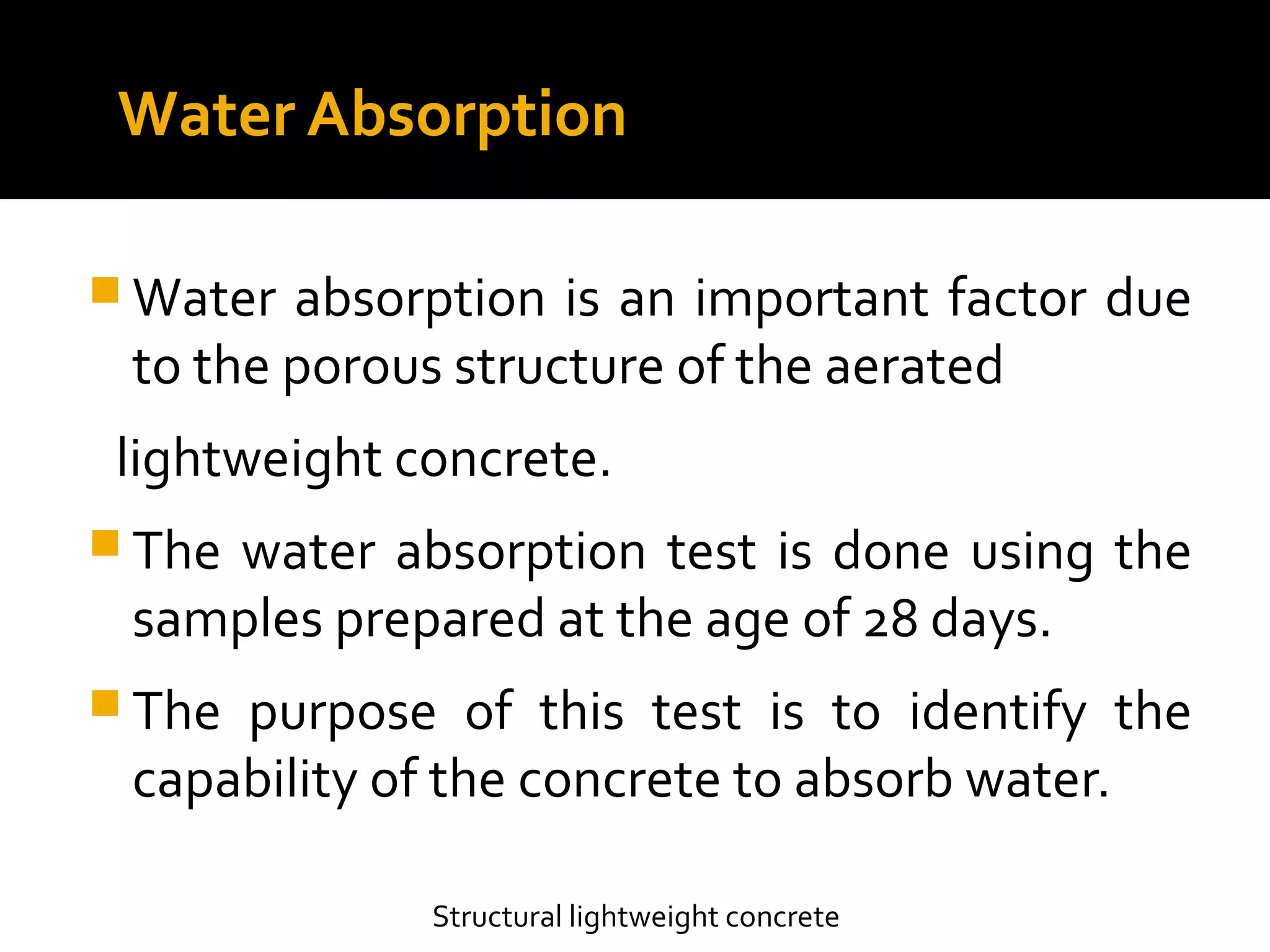
Water Absorption
 Water absorption is an important factor due
to the porous structure of the aerated
lightweight concrete.
 The water absorption test is done using the
samples prepared at the age of 28 days.
 The purpose of this test is to identify the
capability of the concrete to absorb water.
Structural lightweight concrete
continue…
Structural lightweight concrete
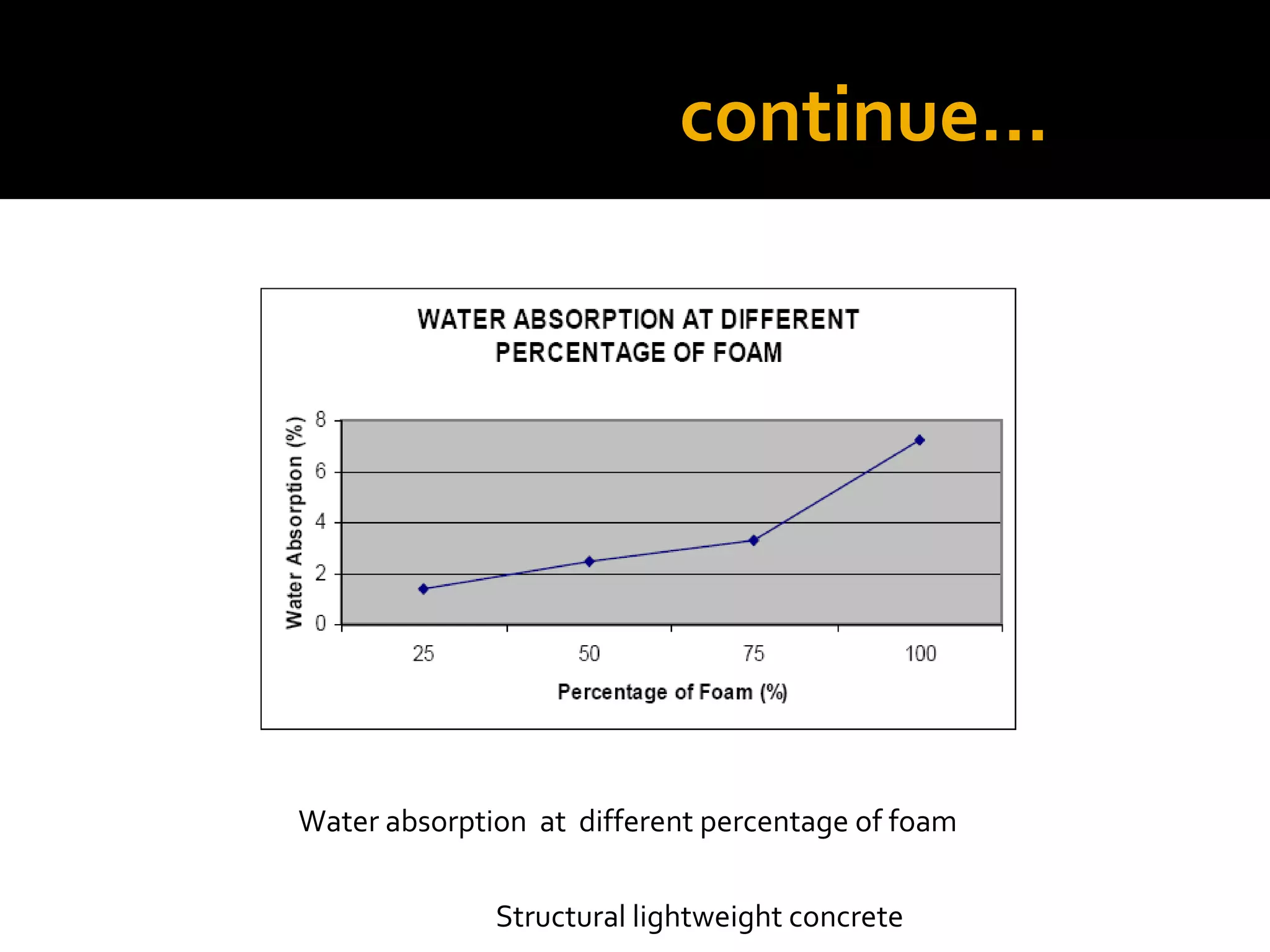
Water absorption at different percentage of foam
continue….
structural lightweight concrete
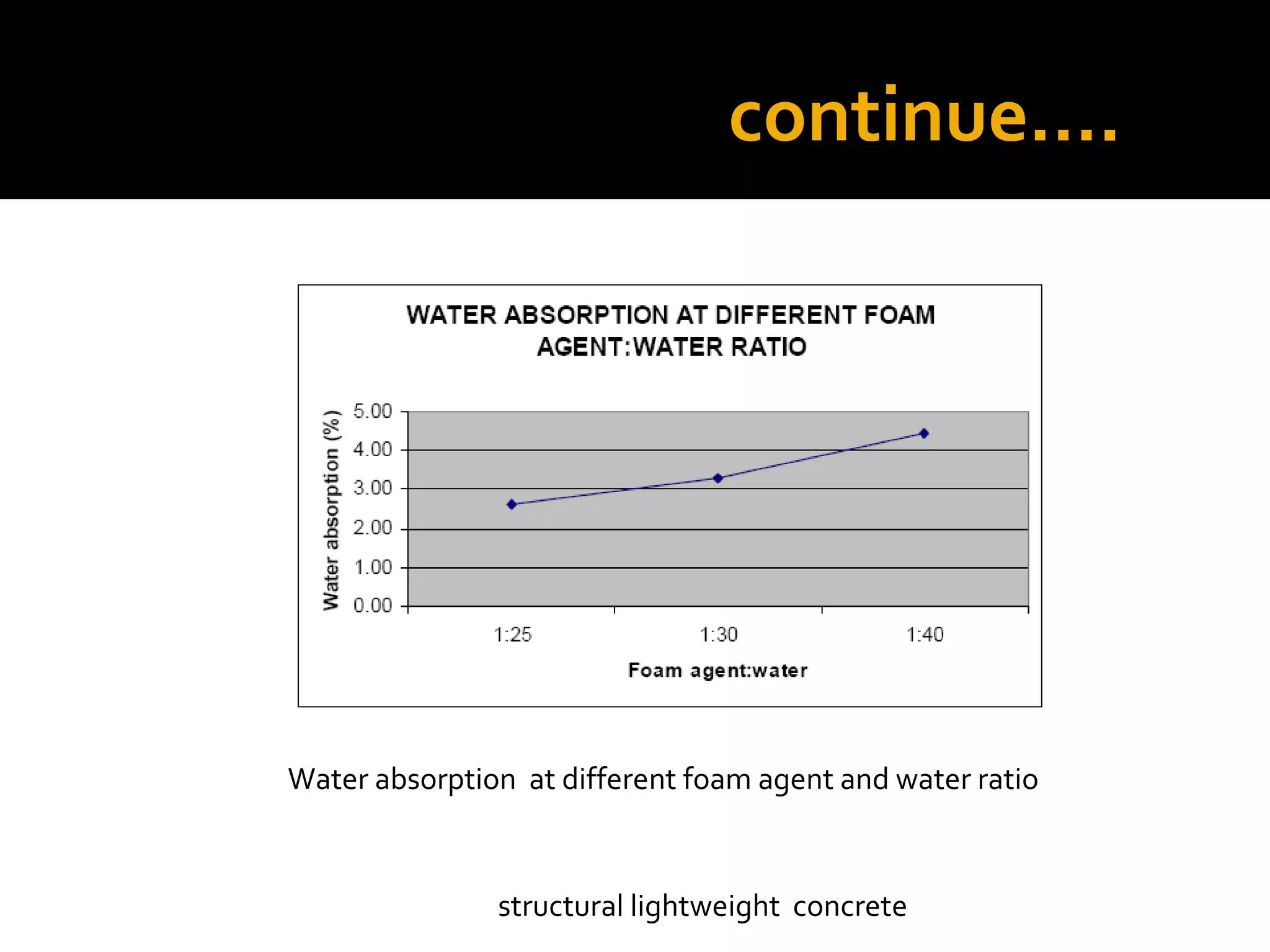
Water absorption at different foam agent and water ratio
continue….
Structural lightweight concrete
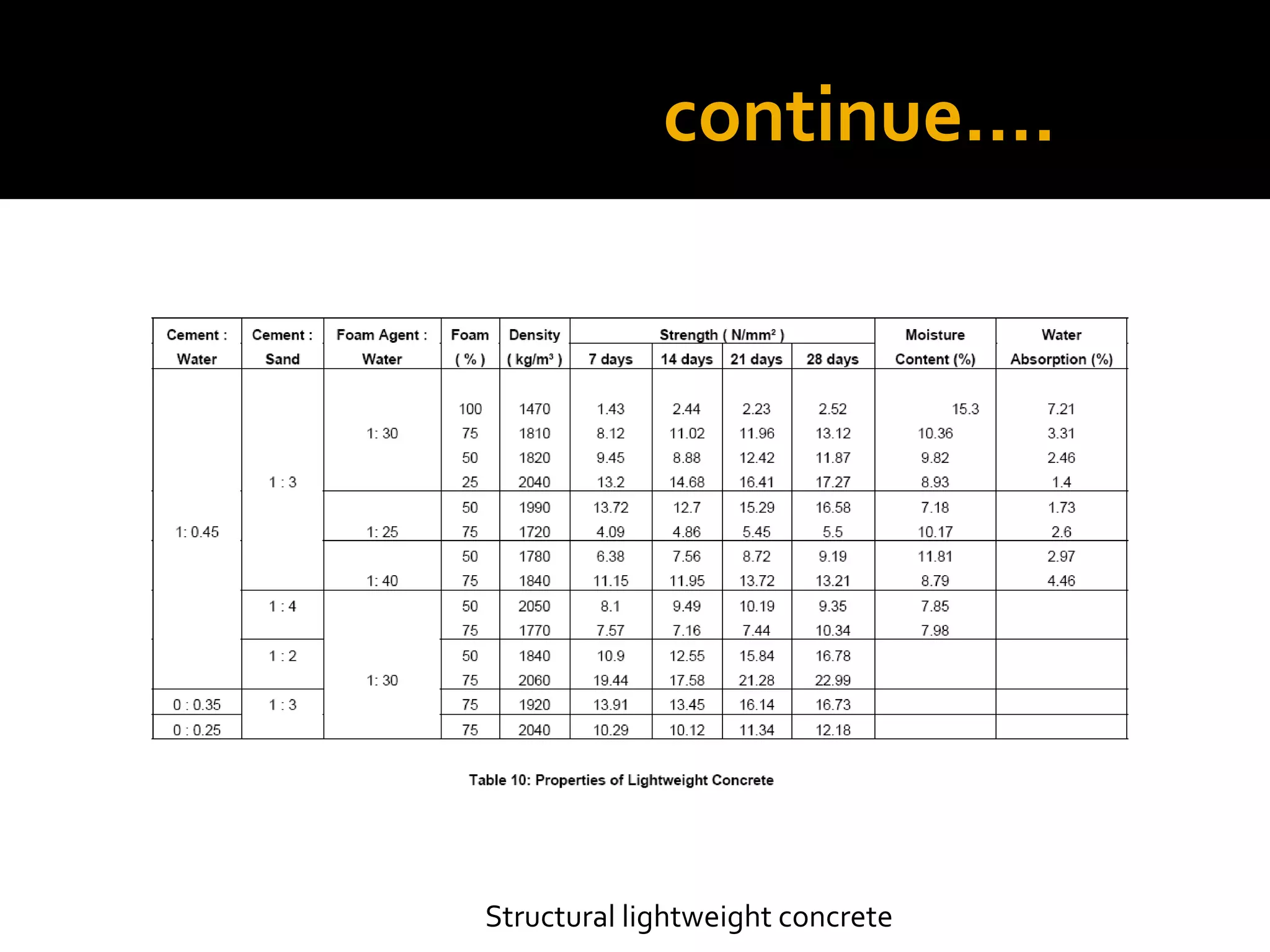
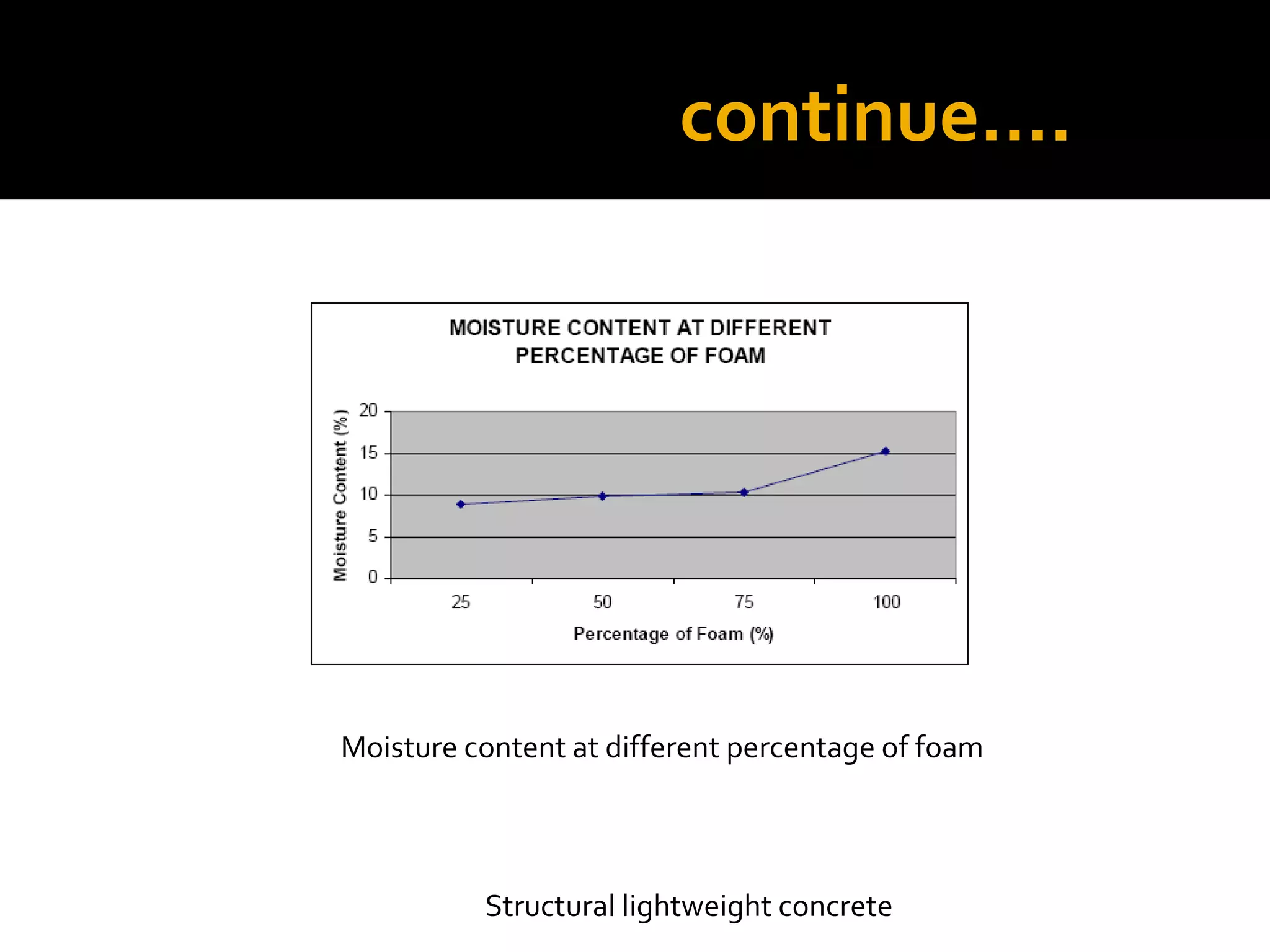
Moisture content at different percentage of foam
continue….
Structural lightweight concrete
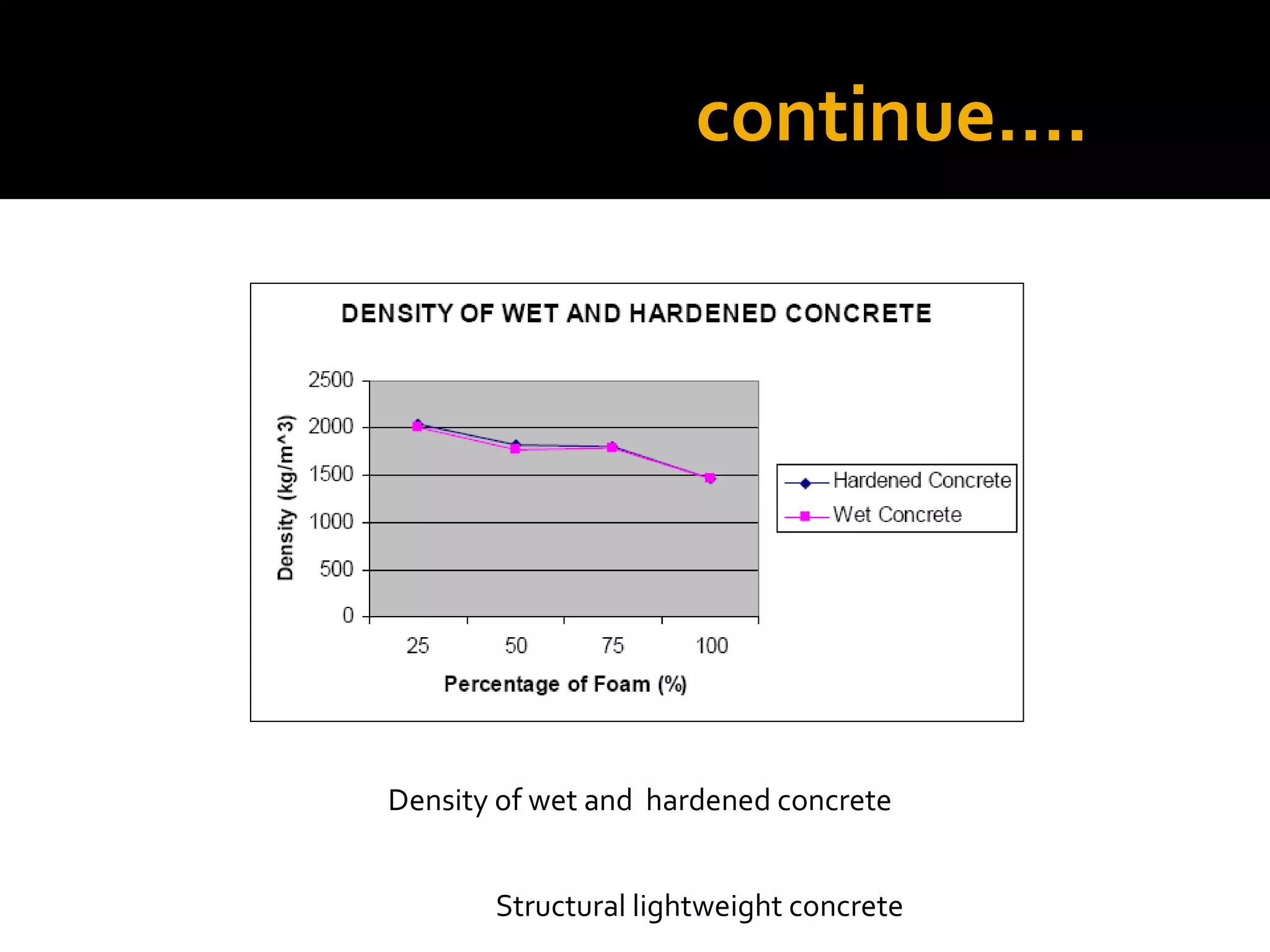
Density of wet and hardened concrete
Entrained Air
 As with normal-weight concrete, entrained
air in structural lightweight concrete ensures
resistance to freezing and thawing and to
deicer applications.
 It also improves workability, reduces bleeding
and segregation, and may compensate
for minor grading deficiencies in the
aggregate.
Structural lightweight concrete
continue…
 The amount of entrained air should be
sufficient to provide good workability to the
plastic concrete and adequate freeze-thaw
resistance to the hardened concrete.
 Air contents are generally between 5% and
8%, depending on the maximum size of
coarse aggregate used and the exposure
conditions.
Structural lightweight concrete
SLUMP
 Due to lower aggregate density, structural
lightweight concrete does not slump as much
as normal-weight concrete with the same
workability.
 It is seldom necessary to exceed slumps of
125 mm (5 in.) for normal placement of
structural lightweight concrete.
Structural lightweight concrete
VIBRATION
 As with normal-weight concrete, vibration
can be used effectively to consolidate
lightweight concrete; the same frequencies
commonly used for normal-density concrete
are recommended.
 Excessive vibration causes segregation by
forcing large aggregate particles to the
surface.
Structural lightweight concrete
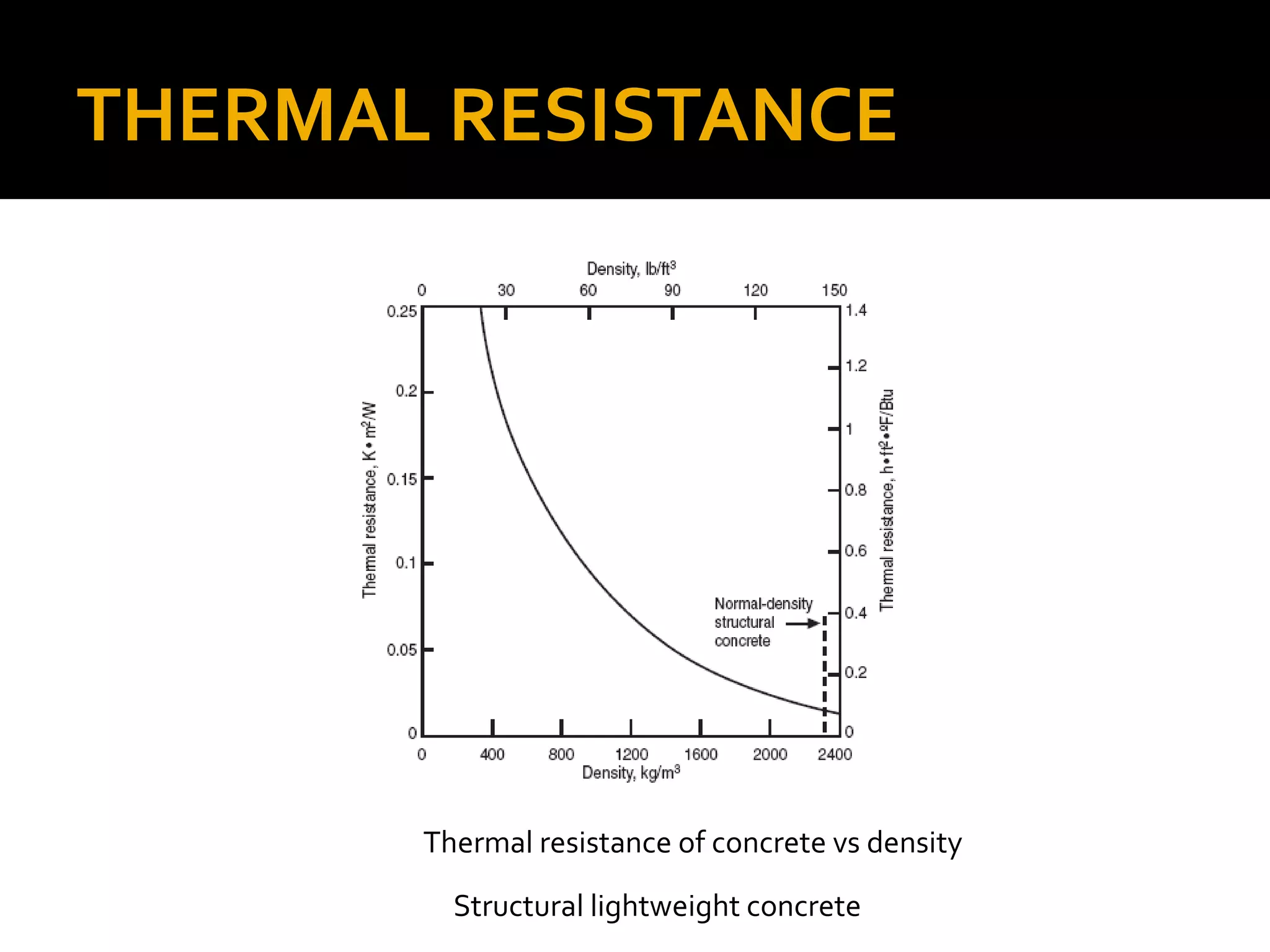
THERMAL RESISTANCE
Structural lightweight concrete
Thermal resistance of concrete vs density
APPLICATIONS
 Lightweight concrete has been used since the eighteen
centuries by the Romans.
 The lightweight concrete was also used in
construction during the First World War. The United
States used mainly for shipbuilding.
 It is widely used as loose-fill insulation in masonry
construction where it enhances fire
ratings, reduces noise transmission, does not rot and
termite resistant.
Structural lightweight concrete
continue…
 It is also used for vessels, roof decks and
other applications.
Structural lightweight concrete
ADVANTAGES
Structural lightweight concrete
 Rapid and relatively simple construction.
 Economical in terms of transportation as well
as reduction in manpower.
 Significant reduction of overall weight results
in saving structural frames, footing or piles.
 Most of lightweight concrete have better
nailing and sawing properties than heavier and
stronger conventional concrete.
DISADVANTAGES
 Very sensitive with water content in the
mixtures.
 Difficult to place and finish because of the
porosity and angularity of the aggregate.
 Mixing time is longer than conventional
concrete to assure proper mixing.
Structural lightweight concrete
CASE STUDY
 Wellington stadium.
 Location: New Zealand.
 Capacity of the stadium : 40000
 Architects : Hok-Lobb (brisbane),Warren & Mahoney.
 Structure consultants :Holmes Consulting Group
 Contractor : Fletcher Construction, Ltd.
 LWA Supplier :TXI -Pacific Custom Materials, Inc. (California).
Structural lightweight concrete
History And Layout
 The stadium is sited in a prominent location
on the harbour edge, in close proximity to the
main Wellington railway station, the
Parliament buildings.
 The site is exposed to wind blown sea spray
and is located just a few hundred metres from
one of the country's most active and violent
seismic fault lines.
Structural lightweight concrete
continue….
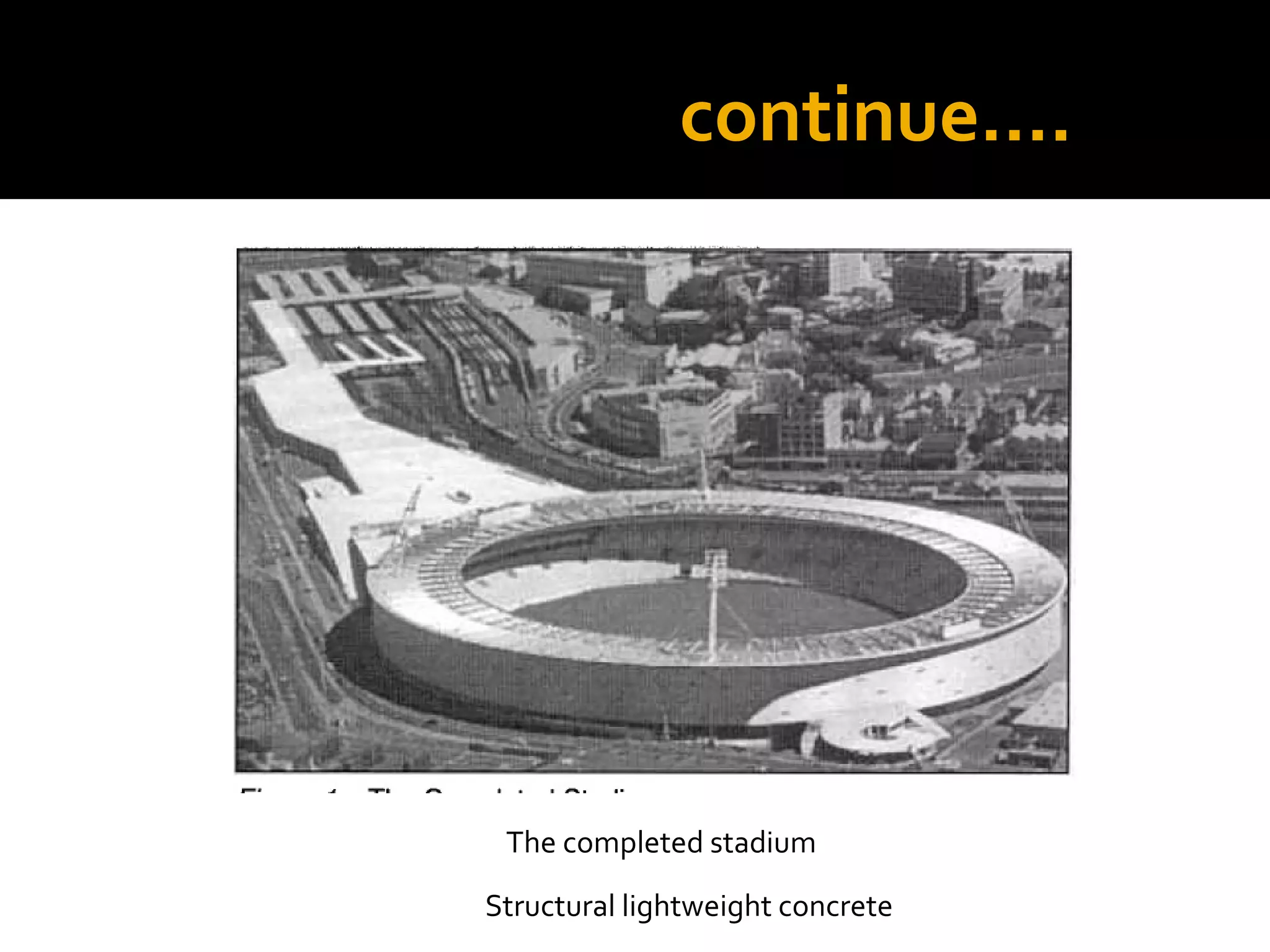
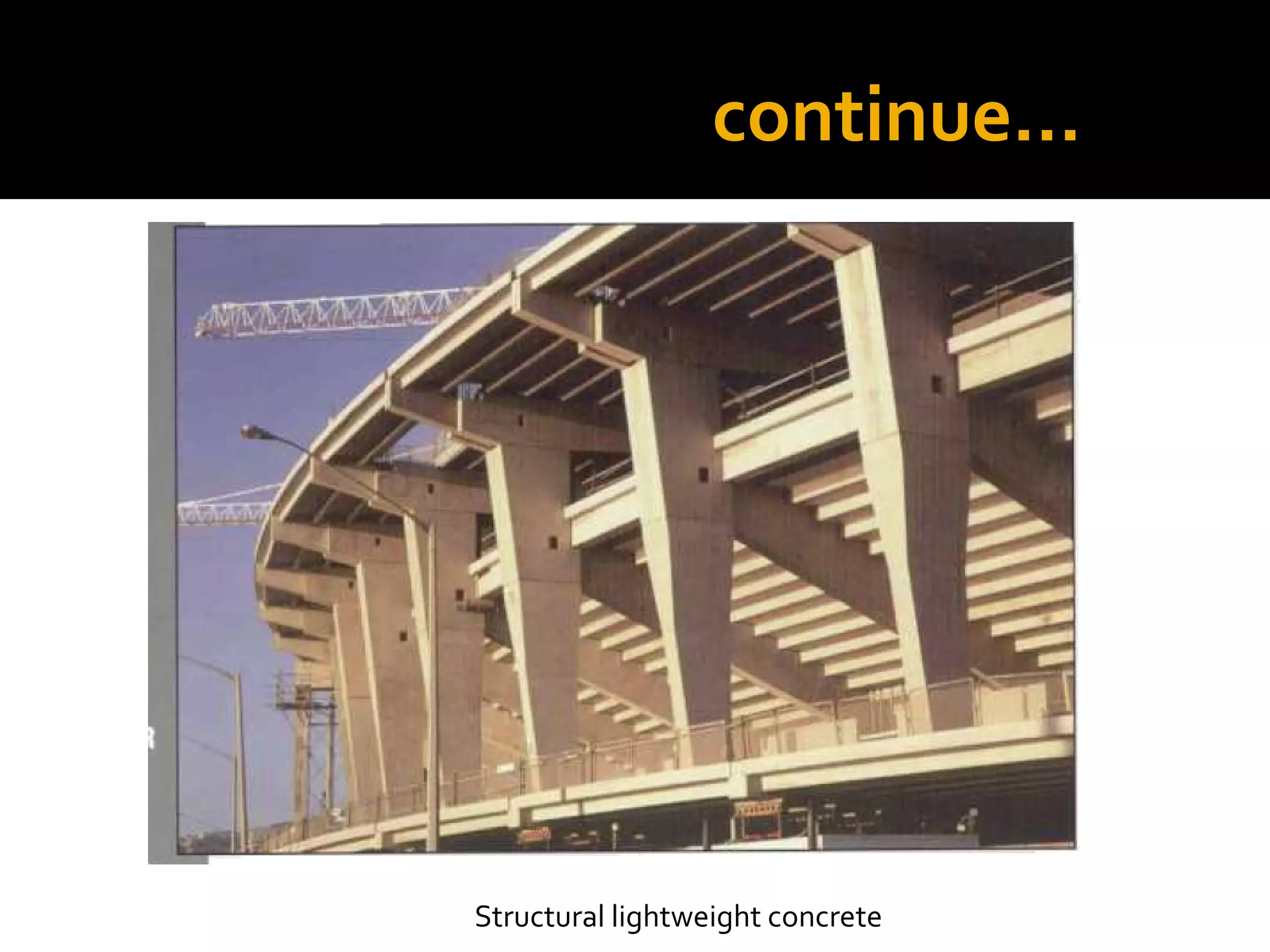
 The structural layout consists of an oval bowl
around the playing field (roofed only over the
spectator seating) and is connected by a two
level open walkway and parking building to
the railway station.
 At the southern end of the oval there is a
four-storey administration building that also
forms part of the main stand .
Structural lightweight concrete
continue….
Structural lightweight concrete
The completed stadium
FACTORS FAVOURING
 Poor foundation condition.
 Severe earthquake forces.
 Durability.
 Rapid construction.
 Space utilization.
 Reduced site work.
 Innovative spirit.
Structural lightweight concrete
DESIGN
 The use of lightweight concrete was initially
proposed by Stresscrete, the precast concrete
supplier.
 But it was also readily accepted by the project
structural consultants, Holmes Consulting
Group, who were impressed by the potential of
the product to reduce cost and responded
enthusiastically to the challenge of a new
material.
Structural lightweight concrete
continue….
 In the final analysis, the choice was between
a structure of lightweight concrete, or one of
steel. Normal weight concrete was ruled out
early in the final design process.
Structural lightweight concrete
continue…
Structural lightweight concrete
Properties
 Compressive strength : 44 MPa.
 Density : 1845 kg/m^3.
 Modulus Of Elasticity : 19 GPa.
 Creep : 2.3.
CONCLUSION
 The initial findings have shown that the
lightweight concrete has a desirable strength
to be an alternative construction material for
the industrialized building system.
 The strength of aerated lightweight concrete
are low for lower density mixture. This
resulted in the increment of voids throughout
the sample caused by the foam.
Structural lightweight concrete
continue….
 The foamed lightweight concrete is not
suitable to be used as non-load bearing as the
compressive strength is 27% less than
recommended. The compressive strength is
accepted to be produced as non-load bearing
structure.
Structural lightweight concrete
References
 Report on research project on lightweight
concrete.
 Formed Lightweight Concrete.
www.pearliteconcreteforrorepair.com
 A.M Neville (1985)
Properties of concrete
 Cellular Lightweight Concrete, Plan City/NCS
LLC.
www. Neoporsystem.com
Thank you

Structural lightweight concrete

  • 1.
  • 2.
    Contents  Introduction  Propertiesof LWC  Applications of LWC  Advantages and disadvantages  Case study  conclusion  References
  • 3.
    Introduction  Lightweight concretecan be defined as a type a type of concrete which includes an expanding agent in that it increases the volume of the mixture while giving additional qualities and lessened the dead weight.  It is lighter than the conventional concrete.  The use of lightweight concrete has been widely spread across countries such as USA, United Kingdom and Sweden. Structural lightweight concrete
  • 4.
    continue….  It wasfirst introduced by the Romans in the second century where ‘The Pantheon’ has been constructed using pumice, the most common type of aggregate used.  The building of ‘The Pantheon’ of lightweight concrete material is still standing eminently in Rome until now for about 18 centuries as shown in Figure . It shows that the lighter materials can be used in concrete . Structural lightweight concrete
  • 5.
  • 6.
    Compressive Strength  Compressivestrength is the primary physical property of concrete and is the one most used in design.  Fourteen trial mixes had been prepared during the research and from the results, the mixture with the highest compressive strength was used. Structural lightweight concrete
  • 7.
  • 8.
    continue…. Structural lightweight concrete Compressivestrength at different percentage of foam
  • 9.
  • 10.
  • 11.
  • 12.
  • 13.
  • 14.
    Water Absorption  Waterabsorption is an important factor due to the porous structure of the aerated lightweight concrete.  The water absorption test is done using the samples prepared at the age of 28 days.  The purpose of this test is to identify the capability of the concrete to absorb water. Structural lightweight concrete
  • 15.
    continue… Structural lightweight concrete Waterabsorption at different percentage of foam
  • 16.
    continue…. structural lightweight concrete Waterabsorption at different foam agent and water ratio
  • 17.
    continue…. Structural lightweight concrete Moisturecontent at different percentage of foam
  • 18.
  • 19.
    Entrained Air  Aswith normal-weight concrete, entrained air in structural lightweight concrete ensures resistance to freezing and thawing and to deicer applications.  It also improves workability, reduces bleeding and segregation, and may compensate for minor grading deficiencies in the aggregate. Structural lightweight concrete
  • 20.
    continue…  The amountof entrained air should be sufficient to provide good workability to the plastic concrete and adequate freeze-thaw resistance to the hardened concrete.  Air contents are generally between 5% and 8%, depending on the maximum size of coarse aggregate used and the exposure conditions. Structural lightweight concrete
  • 21.
    SLUMP  Due tolower aggregate density, structural lightweight concrete does not slump as much as normal-weight concrete with the same workability.  It is seldom necessary to exceed slumps of 125 mm (5 in.) for normal placement of structural lightweight concrete. Structural lightweight concrete
  • 22.
    VIBRATION  As withnormal-weight concrete, vibration can be used effectively to consolidate lightweight concrete; the same frequencies commonly used for normal-density concrete are recommended.  Excessive vibration causes segregation by forcing large aggregate particles to the surface. Structural lightweight concrete
  • 23.
    THERMAL RESISTANCE Structural lightweightconcrete Thermal resistance of concrete vs density
  • 24.
    APPLICATIONS  Lightweight concretehas been used since the eighteen centuries by the Romans.  The lightweight concrete was also used in construction during the First World War. The United States used mainly for shipbuilding.  It is widely used as loose-fill insulation in masonry construction where it enhances fire ratings, reduces noise transmission, does not rot and termite resistant. Structural lightweight concrete
  • 25.
    continue…  It isalso used for vessels, roof decks and other applications. Structural lightweight concrete
  • 26.
    ADVANTAGES Structural lightweight concrete Rapid and relatively simple construction.  Economical in terms of transportation as well as reduction in manpower.  Significant reduction of overall weight results in saving structural frames, footing or piles.  Most of lightweight concrete have better nailing and sawing properties than heavier and stronger conventional concrete.
  • 27.
    DISADVANTAGES  Very sensitivewith water content in the mixtures.  Difficult to place and finish because of the porosity and angularity of the aggregate.  Mixing time is longer than conventional concrete to assure proper mixing. Structural lightweight concrete
  • 28.
    CASE STUDY  Wellingtonstadium.  Location: New Zealand.  Capacity of the stadium : 40000  Architects : Hok-Lobb (brisbane),Warren & Mahoney.  Structure consultants :Holmes Consulting Group  Contractor : Fletcher Construction, Ltd.  LWA Supplier :TXI -Pacific Custom Materials, Inc. (California). Structural lightweight concrete
  • 29.
    History And Layout The stadium is sited in a prominent location on the harbour edge, in close proximity to the main Wellington railway station, the Parliament buildings.  The site is exposed to wind blown sea spray and is located just a few hundred metres from one of the country's most active and violent seismic fault lines. Structural lightweight concrete
  • 30.
    continue….  The structurallayout consists of an oval bowl around the playing field (roofed only over the spectator seating) and is connected by a two level open walkway and parking building to the railway station.  At the southern end of the oval there is a four-storey administration building that also forms part of the main stand . Structural lightweight concrete
  • 31.
  • 32.
    FACTORS FAVOURING  Poorfoundation condition.  Severe earthquake forces.  Durability.  Rapid construction.  Space utilization.  Reduced site work.  Innovative spirit. Structural lightweight concrete
  • 33.
    DESIGN  The useof lightweight concrete was initially proposed by Stresscrete, the precast concrete supplier.  But it was also readily accepted by the project structural consultants, Holmes Consulting Group, who were impressed by the potential of the product to reduce cost and responded enthusiastically to the challenge of a new material. Structural lightweight concrete
  • 34.
    continue….  In thefinal analysis, the choice was between a structure of lightweight concrete, or one of steel. Normal weight concrete was ruled out early in the final design process. Structural lightweight concrete
  • 35.
  • 36.
    Properties  Compressive strength: 44 MPa.  Density : 1845 kg/m^3.  Modulus Of Elasticity : 19 GPa.  Creep : 2.3.
  • 37.
    CONCLUSION  The initialfindings have shown that the lightweight concrete has a desirable strength to be an alternative construction material for the industrialized building system.  The strength of aerated lightweight concrete are low for lower density mixture. This resulted in the increment of voids throughout the sample caused by the foam. Structural lightweight concrete
  • 38.
    continue….  The foamedlightweight concrete is not suitable to be used as non-load bearing as the compressive strength is 27% less than recommended. The compressive strength is accepted to be produced as non-load bearing structure. Structural lightweight concrete
  • 39.
    Structural lightweight concrete References Report on research project on lightweight concrete.  Formed Lightweight Concrete. www.pearliteconcreteforrorepair.com  A.M Neville (1985) Properties of concrete  Cellular Lightweight Concrete, Plan City/NCS LLC. www. Neoporsystem.com
  • 40.

Editor's Notes

  • #4 <number> Failure On Expansive Soils