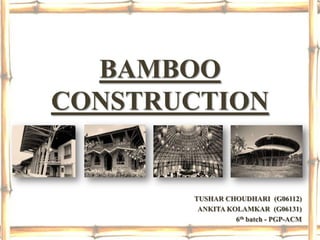
BAMBOO
CONSTRUCTION


       TUSHAR CHOUDHARI (G06112)
        ANKITA KOLAMKAR (G06131)
                 6th batch - PGP-ACM
INTRODUCTION…
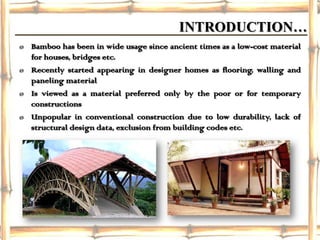
ø Bamboo has been in wide usage since ancient times as a low-cost material
  for houses, bridges etc.
ø Recently started appearing in designer homes as flooring, walling and
  paneling material
ø Is viewed as a material preferred only by the poor or for temporary
  constructions
ø Unpopular in conventional construction due to low durability, lack of
  structural design data, exclusion from building codes etc.
Facts about bamboo
ø Bamboo is a perennial grass.

ø 1450 species are found in diverse
  climates across the world.

ø One of the fastest growing plants on
  Earth.

ø The strongest part of a bamboo stalk is
  its node, where branching occurs.

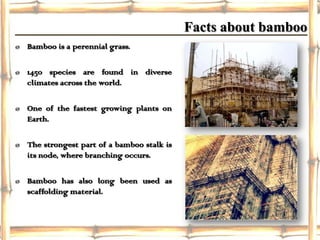
ø Bamboo has also long been used as
  scaffolding material.
MECHANICAL PROPERTIES
    PROPERTY                  VALUE

      Density             0.5 – 0.9 gm/cc

Compressive Strength    6.2 – 9.3 kN/sq. cm

  Tension Strength      14.8 – 38.4 kN/sq. cm

 Bending Strength       7.6 – 27.6 kN/sq. cm

Modulus of Elasticity     2000 kN/sq. cm

 Shearing Strength         2.0 kN/sq. cm
Usage Of Bamboo In Building
                           Construction
Typical Building Elements
• Foundations
• Floors
• Walls
• Roof
• Trusses
• Doors and Windows
Bamboo foundations
COMPOSITE BAMBOO-CONCRETE FOUNDATIONS


Single Post Footing           Strip Footing
Bamboo foundations
BAMBOO PILES
ø Bamboo        compacts      soft
soil, thus increasing the bearing
capacity of soil.

ø The friction provided by the
construction-grade      bamboo
increases    its   load-bearing
capacity.

ø Treated split bamboo piles 8m
long and 80 to 90mm in
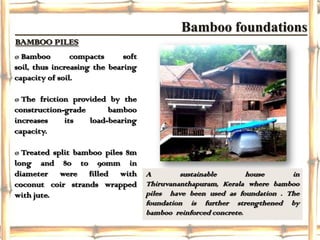
diameter were filled with A              sustainable      house       in
coconut coir strands wrapped Thiruvananthapuram, Kerala where bamboo
with jute.                      piles have been used as foundation . The
                                     foundation is further strengthened   by
                                     bamboo reinforced concrete.
Bamboo foundations
BAMBOO PILES
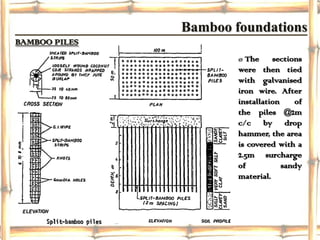
                       ø The sections
                       were then tied
                       with galvanised
                       iron wire. After
                       installation    of
                       the piles @2m
                       c/c by drop
                       hammer, the area
                       is covered with a
                       2.5m surcharge
                       of           sandy
                       material.
Bamboo WALLS


        WOVEN         VERTICAL
                                           BAJAREQUE
      BAMBOO WALL   HALVED CULMS


WHOLE BAMBOO
   CULMS                             WATTLE AND DAUB
Bamboo Roofs and Trusses


           Fink Truss


Bamboo Tiles used for Roofing
How to protect bamboo…
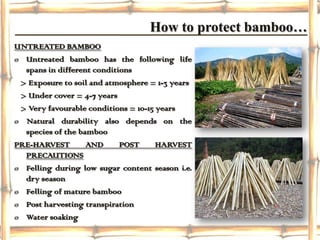
UNTREATED BAMBOO
ø Untreated bamboo has the following life
  spans in different conditions
 > Exposure to soil and atmosphere = 1-3 years
 > Under cover = 4-7 years
 > Very favourable conditions = 10-15 years
ø Natural durability also depends on the
  species of the bamboo
PRE-HARVEST        AND      POST      HARVEST
  PRECAUTIONS
ø Felling during low sugar content season i.e.
  dry season
ø Felling of mature bamboo
ø Post harvesting transpiration
ø Water soaking
How to protect bamboo…
BORAX – BORIC ACID PRESERVATION TREATMENT


 Drill bits attached to a long steel     At the preservation treatment
 rod, are used to drill into the         pool, bamboo soaks in borax-boric
 centre of bamboo culms through          acid solution (1:1.4) for 2 days to
 their whole length.                     allow the mineral to penetrate.
How to protect bamboo…
BORAX – BORIC ACID PRESERVATION TREATMENT


 Bamboo is removed and stacked       Next, the bamboo poles are left
 vertically so the solution can      to bask in the sun depending on
 drain and be reused.                the amount of sunlight
How to protect bamboo…
BORAX – BORIC ACID PRESERVATION TREATMENT


                                         Preservative solution is recharged
                                         after four cycles by adding water
The bamboo poles are left to dry         and the chemicals. Preservation
slowly in a cool, dry place until they   treatment costs a minimum charge
are used for construction.               of INR 4.50 per pole.
How to protect bamboo…


ø The swelling and shrinkage of bamboo in concrete is a serious limitation
in the use of bamboo as a substitute for steel in concrete.

ø Treatment - Application of a thin layer of epoxy to the bamboo surface
followed by a coating of fine sand.
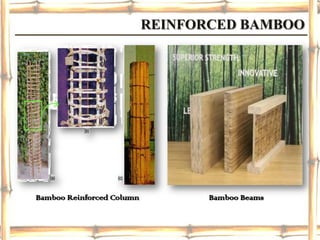
REINFORCED BAMBOO


Bamboo Reinforced Column          Bamboo Beams
Comparison Of Bamboo With Other
           Construction Materials
COMPARISON BETWEEN BAMBOO & STEEL

                          Bamboo          Steel
      Property
                        (kN/sq. cm)    (kN/sq. cm)

Modulus of Elasticity      2000           21000

Compressive Strength      6.2 – 9.3        14

  Tension Strength       14.8 – 38.4       16

 Bending Strength        7.6 – 27.6        14

   Shear Strength           2.0            9.2
advantages
ø Strength - Strong natural fibre, when
  cultivated, harvested, prepared and
  stored properly.

ø Flexibility – During its growth, it
  may be trained to grow in
  unconventional shapes and may be
  utilized in archways and other
  curved areas.

ø Earthquake-resistance – High shock
  absorption makes it particularly
  useful in earthquake-prone areas.
advantages
ø Lightweight - Thus, building with
  bamboo can be accomplished faster
  with simple tools than building with
  other materials.

ø Cost-effective – Especially in areas
  where it is cultivated and is readily
  available.

ø Durability - As long-lasting as its
  wooden correlates, when properly
  harvested and maintained.
RESISTANCE TO EARTHQUAKES
ø High residual strength to absorb
shocks and impacts.
ø Flexure coupled with its very low
mass.


                                      ø A house in Bhutan that withstood
                                      an earthquake measuring 6.9 in
                                      September 2011

                                      ø 30 houses at the epicenter of a 7.6
                                      magnitude earthquake survived
  Prototype house built by EEVRC      without any damage in Costa Rica
                                      in 1991
Comparative analysis


1200

1000

800

600

400

200

  0                                               Concrete
       Rate of construction per sq.foot in INR    Bamboo
Comparative analysis

               Energy consumption during construction


8
7
6
5
4
3
2
1
0
    Concrete structure    Wood structure   Bamboo structure
Limitations and drawbacks
Few considerations currently limit the use of bamboo as a universally
applicable construction material

ø Jointing techniques - Although many traditional joint types exist, their
  structural efficiency is low. Considerable research has been directed at
  the development of more effective methods.

ø Flammability - Bamboo structures are not fire-resistant, and the cost of
  treatment, where available, is relatively high.

ø Splitting – Low strength along fibres causes it to split or crack.

ø Lack of design guidance and codification - The engineering design of
  bamboo structures has not yet been fully addressed. There is little or no
  data containing specifications of bamboo.
CONCLUSIONS
ø Based on the research results of bamboo obtained in universities and
  other institutes around the world the first norms for bamboo were
  created determining the physical and mechanical properties of bamboo.

ø These norms have been evaluated by International Code Council and will
  be included in the ISO norms in near future.

ø The results of the investigations show that bamboo can substitute steel
  satisfactorily

ø There is a need to introduce formal education on the use of bamboo as a
  structural material in design and technical schools.
QUESTIONS   OPINIONS   IDEAS
Bamboo Construction

Bamboo Construction

  • 1.
    BAMBOO CONSTRUCTION TUSHAR CHOUDHARI (G06112) ANKITA KOLAMKAR (G06131) 6th batch - PGP-ACM
  • 2.
    INTRODUCTION… ø Bamboo hasbeen in wide usage since ancient times as a low-cost material for houses, bridges etc. ø Recently started appearing in designer homes as flooring, walling and paneling material ø Is viewed as a material preferred only by the poor or for temporary constructions ø Unpopular in conventional construction due to low durability, lack of structural design data, exclusion from building codes etc.
  • 3.
    Facts about bamboo øBamboo is a perennial grass. ø 1450 species are found in diverse climates across the world. ø One of the fastest growing plants on Earth. ø The strongest part of a bamboo stalk is its node, where branching occurs. ø Bamboo has also long been used as scaffolding material.
  • 4.
    MECHANICAL PROPERTIES PROPERTY VALUE Density 0.5 – 0.9 gm/cc Compressive Strength 6.2 – 9.3 kN/sq. cm Tension Strength 14.8 – 38.4 kN/sq. cm Bending Strength 7.6 – 27.6 kN/sq. cm Modulus of Elasticity 2000 kN/sq. cm Shearing Strength 2.0 kN/sq. cm
  • 5.
    Usage Of BambooIn Building Construction Typical Building Elements • Foundations • Floors • Walls • Roof • Trusses • Doors and Windows
  • 6.
    Bamboo foundations COMPOSITE BAMBOO-CONCRETEFOUNDATIONS Single Post Footing Strip Footing
  • 7.
    Bamboo foundations BAMBOO PILES øBamboo compacts soft soil, thus increasing the bearing capacity of soil. ø The friction provided by the construction-grade bamboo increases its load-bearing capacity. ø Treated split bamboo piles 8m long and 80 to 90mm in diameter were filled with A sustainable house in coconut coir strands wrapped Thiruvananthapuram, Kerala where bamboo with jute. piles have been used as foundation . The foundation is further strengthened by bamboo reinforced concrete.
  • 8.
    Bamboo foundations BAMBOO PILES ø The sections were then tied with galvanised iron wire. After installation of the piles @2m c/c by drop hammer, the area is covered with a 2.5m surcharge of sandy material.
  • 9.
    Bamboo WALLS WOVEN VERTICAL BAJAREQUE BAMBOO WALL HALVED CULMS WHOLE BAMBOO CULMS WATTLE AND DAUB
  • 10.
    Bamboo Roofs andTrusses Fink Truss Bamboo Tiles used for Roofing
  • 11.
    How to protectbamboo… UNTREATED BAMBOO ø Untreated bamboo has the following life spans in different conditions > Exposure to soil and atmosphere = 1-3 years > Under cover = 4-7 years > Very favourable conditions = 10-15 years ø Natural durability also depends on the species of the bamboo PRE-HARVEST AND POST HARVEST PRECAUTIONS ø Felling during low sugar content season i.e. dry season ø Felling of mature bamboo ø Post harvesting transpiration ø Water soaking
  • 12.
    How to protectbamboo… BORAX – BORIC ACID PRESERVATION TREATMENT Drill bits attached to a long steel At the preservation treatment rod, are used to drill into the pool, bamboo soaks in borax-boric centre of bamboo culms through acid solution (1:1.4) for 2 days to their whole length. allow the mineral to penetrate.
  • 13.
    How to protectbamboo… BORAX – BORIC ACID PRESERVATION TREATMENT Bamboo is removed and stacked Next, the bamboo poles are left vertically so the solution can to bask in the sun depending on drain and be reused. the amount of sunlight
  • 14.
    How to protectbamboo… BORAX – BORIC ACID PRESERVATION TREATMENT Preservative solution is recharged after four cycles by adding water The bamboo poles are left to dry and the chemicals. Preservation slowly in a cool, dry place until they treatment costs a minimum charge are used for construction. of INR 4.50 per pole.
  • 15.
    How to protectbamboo… ø The swelling and shrinkage of bamboo in concrete is a serious limitation in the use of bamboo as a substitute for steel in concrete. ø Treatment - Application of a thin layer of epoxy to the bamboo surface followed by a coating of fine sand.
  • 16.
  • 17.
    Comparison Of BambooWith Other Construction Materials
  • 18.
    COMPARISON BETWEEN BAMBOO& STEEL Bamboo Steel Property (kN/sq. cm) (kN/sq. cm) Modulus of Elasticity 2000 21000 Compressive Strength 6.2 – 9.3 14 Tension Strength 14.8 – 38.4 16 Bending Strength 7.6 – 27.6 14 Shear Strength 2.0 9.2
  • 19.
    advantages ø Strength -Strong natural fibre, when cultivated, harvested, prepared and stored properly. ø Flexibility – During its growth, it may be trained to grow in unconventional shapes and may be utilized in archways and other curved areas. ø Earthquake-resistance – High shock absorption makes it particularly useful in earthquake-prone areas.
  • 20.
    advantages ø Lightweight -Thus, building with bamboo can be accomplished faster with simple tools than building with other materials. ø Cost-effective – Especially in areas where it is cultivated and is readily available. ø Durability - As long-lasting as its wooden correlates, when properly harvested and maintained.
  • 21.
    RESISTANCE TO EARTHQUAKES øHigh residual strength to absorb shocks and impacts. ø Flexure coupled with its very low mass. ø A house in Bhutan that withstood an earthquake measuring 6.9 in September 2011 ø 30 houses at the epicenter of a 7.6 magnitude earthquake survived Prototype house built by EEVRC without any damage in Costa Rica in 1991
  • 22.
    Comparative analysis 1200 1000 800 600 400 200 0 Concrete Rate of construction per sq.foot in INR Bamboo
  • 23.
    Comparative analysis Energy consumption during construction 8 7 6 5 4 3 2 1 0 Concrete structure Wood structure Bamboo structure
  • 24.
    Limitations and drawbacks Fewconsiderations currently limit the use of bamboo as a universally applicable construction material ø Jointing techniques - Although many traditional joint types exist, their structural efficiency is low. Considerable research has been directed at the development of more effective methods. ø Flammability - Bamboo structures are not fire-resistant, and the cost of treatment, where available, is relatively high. ø Splitting – Low strength along fibres causes it to split or crack. ø Lack of design guidance and codification - The engineering design of bamboo structures has not yet been fully addressed. There is little or no data containing specifications of bamboo.
  • 25.
    CONCLUSIONS ø Based onthe research results of bamboo obtained in universities and other institutes around the world the first norms for bamboo were created determining the physical and mechanical properties of bamboo. ø These norms have been evaluated by International Code Council and will be included in the ISO norms in near future. ø The results of the investigations show that bamboo can substitute steel satisfactorily ø There is a need to introduce formal education on the use of bamboo as a structural material in design and technical schools.
  • 26.
    QUESTIONS OPINIONS IDEAS