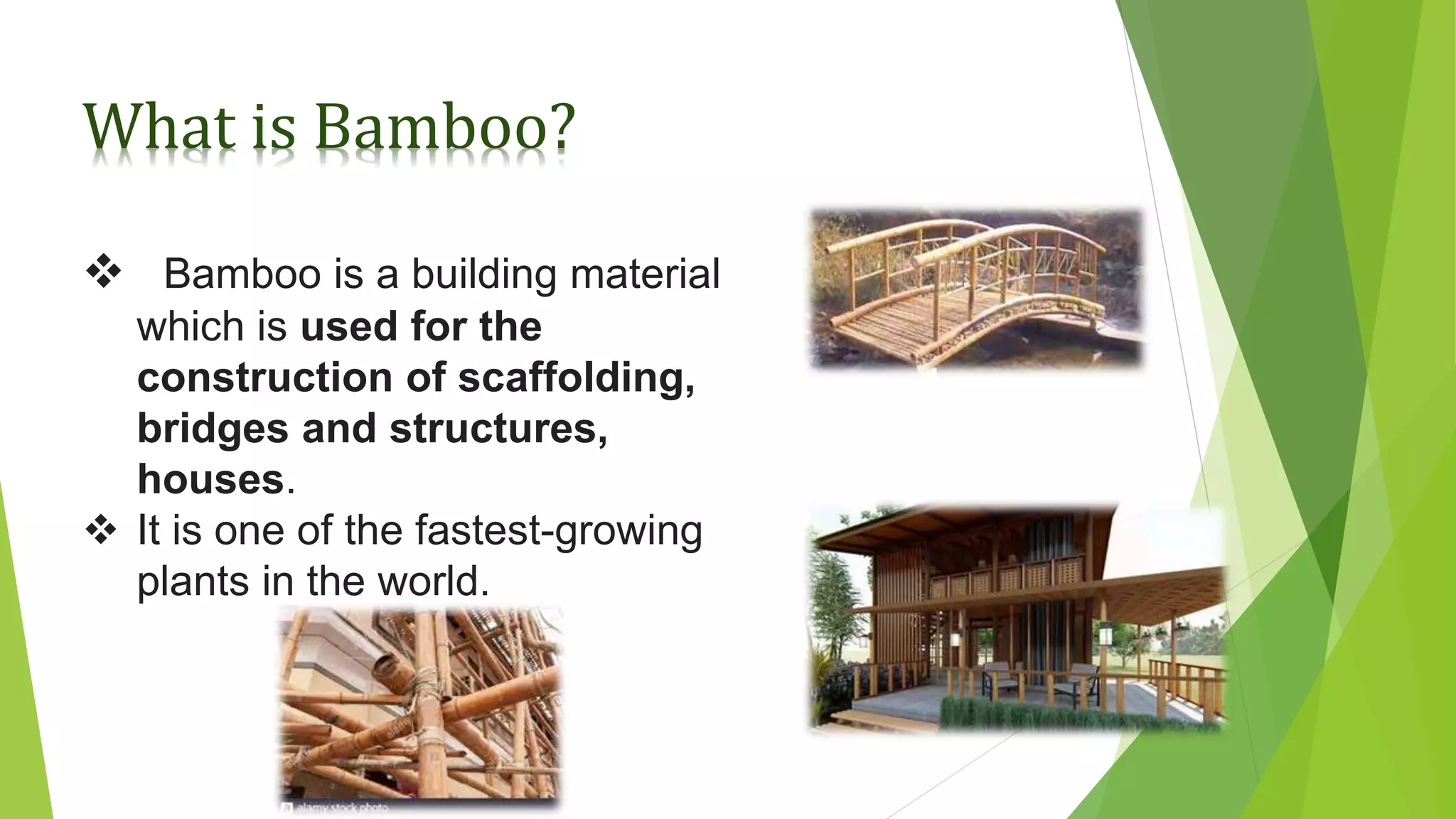
 Bamboo is a building material
which is used for the
construction of scaffolding,
bridges and structures,
houses.
 It is one of the fastest-growing
plants in the world.
What is Bamboo?
General Uses:
• Creating a flack line in traditional forests-due to
the huge content of silica.
• The shoots are edible.
• Building and construction.
• Small scale and cottage industries, for
handicrafts and other products.
• New generation products as wood substitutes.
• Industrial products.
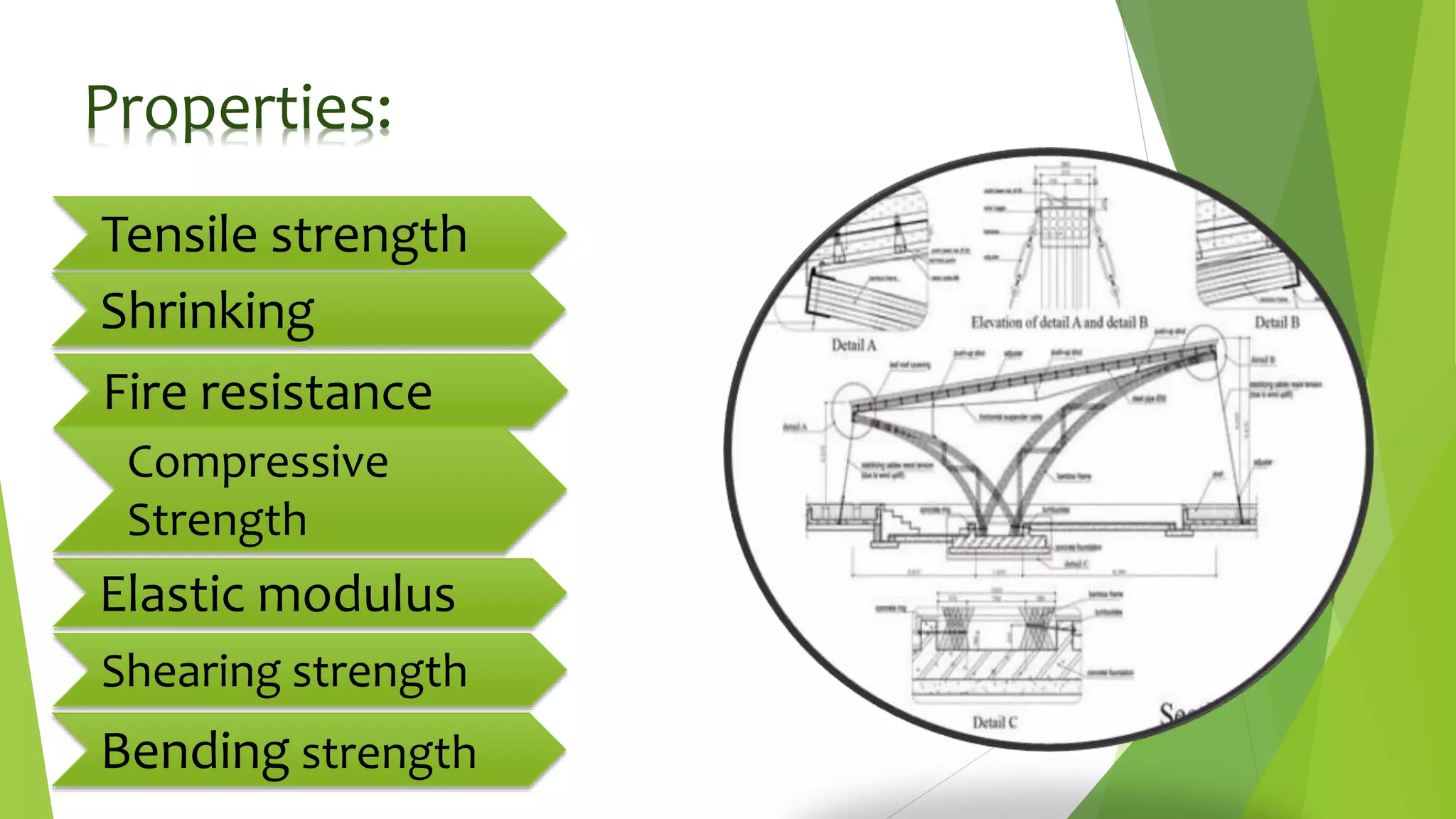
Tensile strength
Fire resistance
Shrinking
Bending strength
Elastic modulus
Shearing strength
Compressive
Strength
Properties:
Different works involved with
use of bamboo:
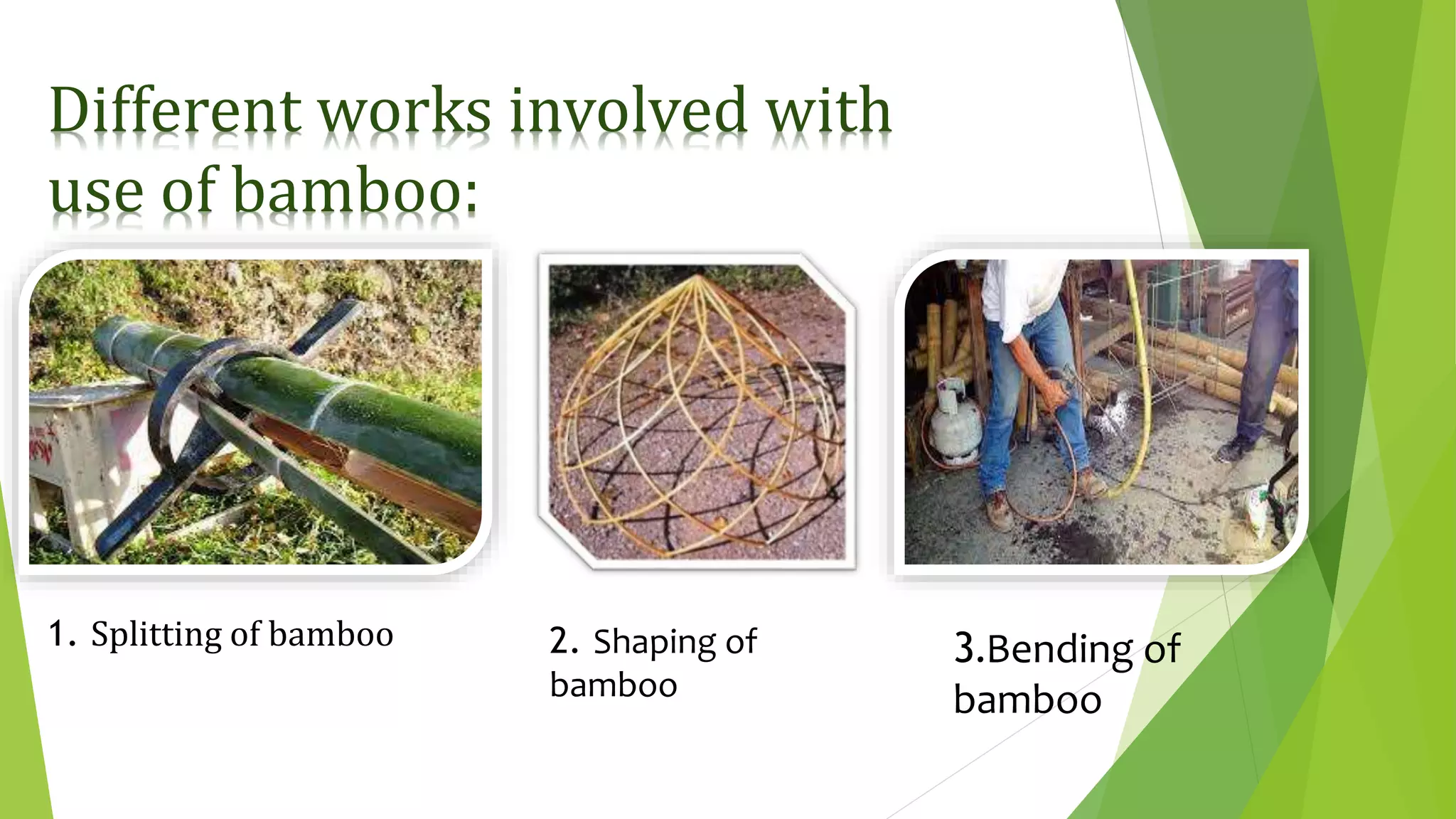
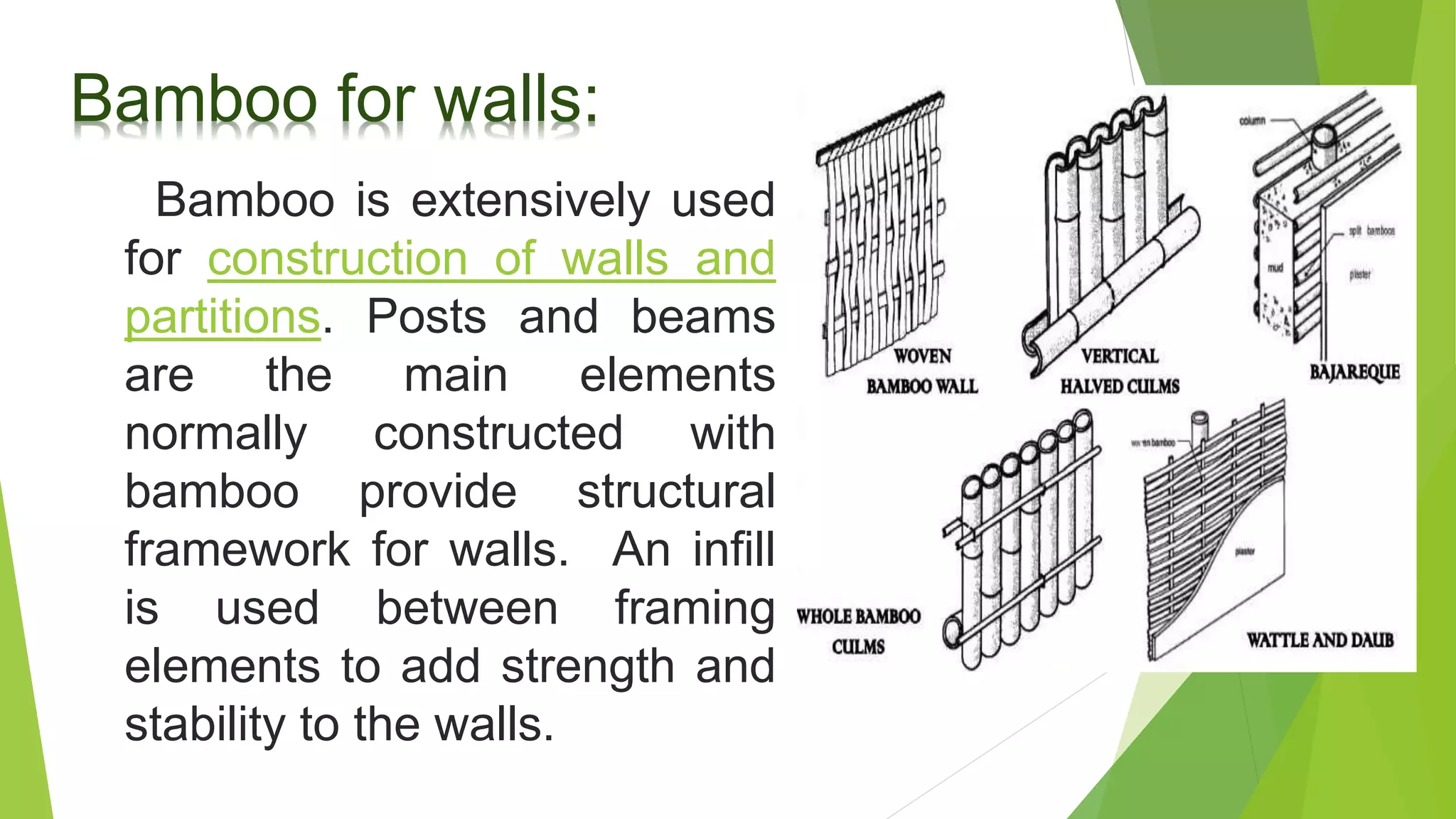
1. Splitting of bamboo 2. Shaping of
bamboo
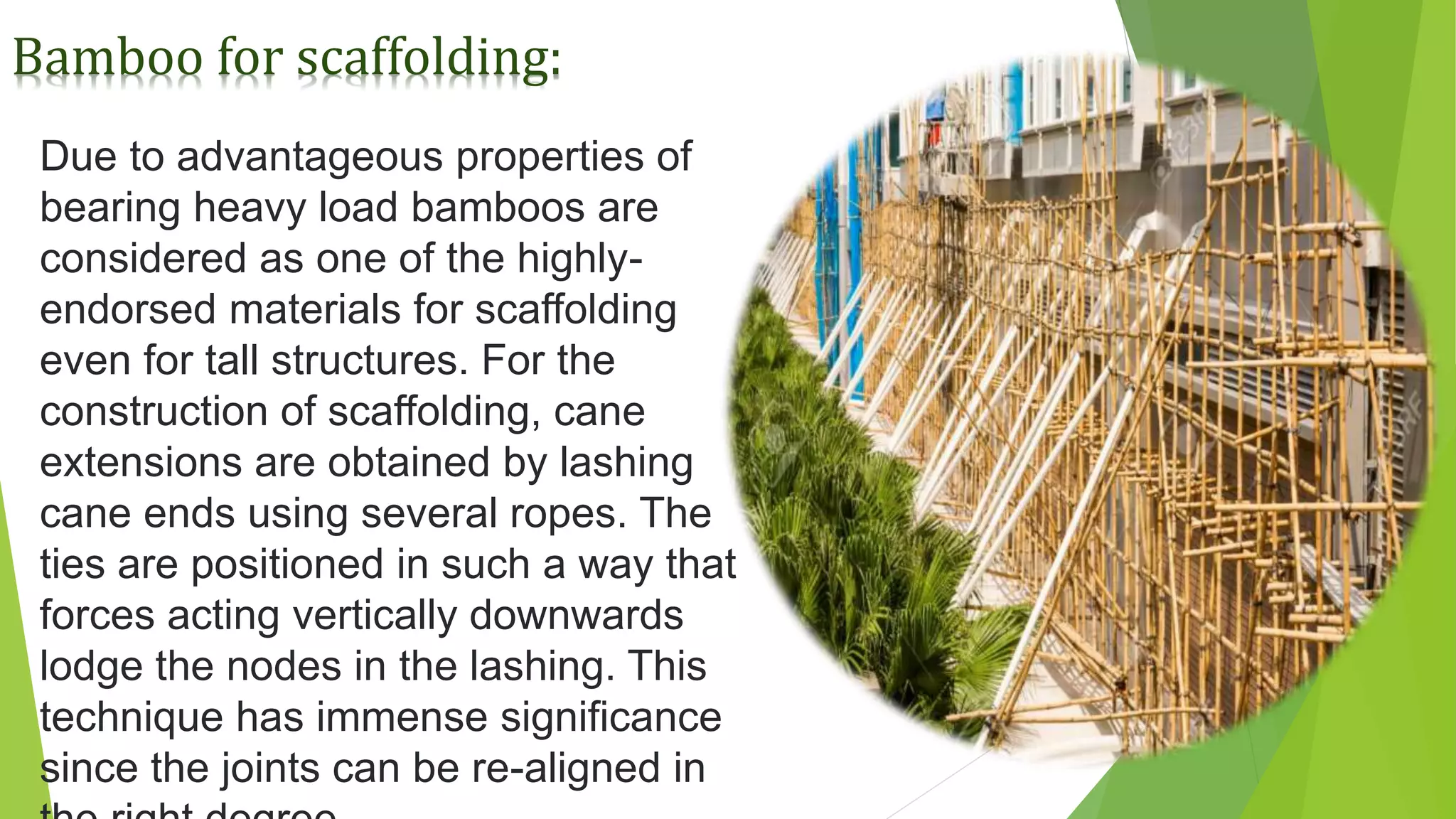
3.Bending of
bamboo
Different works involved with use of
bamboo:
Splitting of bamboo: The Bamboo Canes Are Split Into Halves Or Quarter Section Using
A Knife Ideal For The Jov And Setting Them Apart By A Wedge.
Shaping of bamboo: Even Though Bamboos Are Naturally Circular In Form But If They
Are Grown In A Box Of Square Shape They Acquire A Shape As Desired.
Bending of bamboo: It Can Be Bent While They Are Freshly Cut By Temperature Of 150˚C
There is a very limited use of bamboo as foundation
material because when in contact wirh moisture laden
surface they decay fast.However, this issue can be tackled
to quite an extent though proper treatment using
appropriate chemicals.
The various types of foundation constructed with
bamboo are,
 Bamboo fixed to rock or performed concrete
footings.
 Composite bamboo or concrete columns.
 Bamboo piles.
Bamboo for foundation:
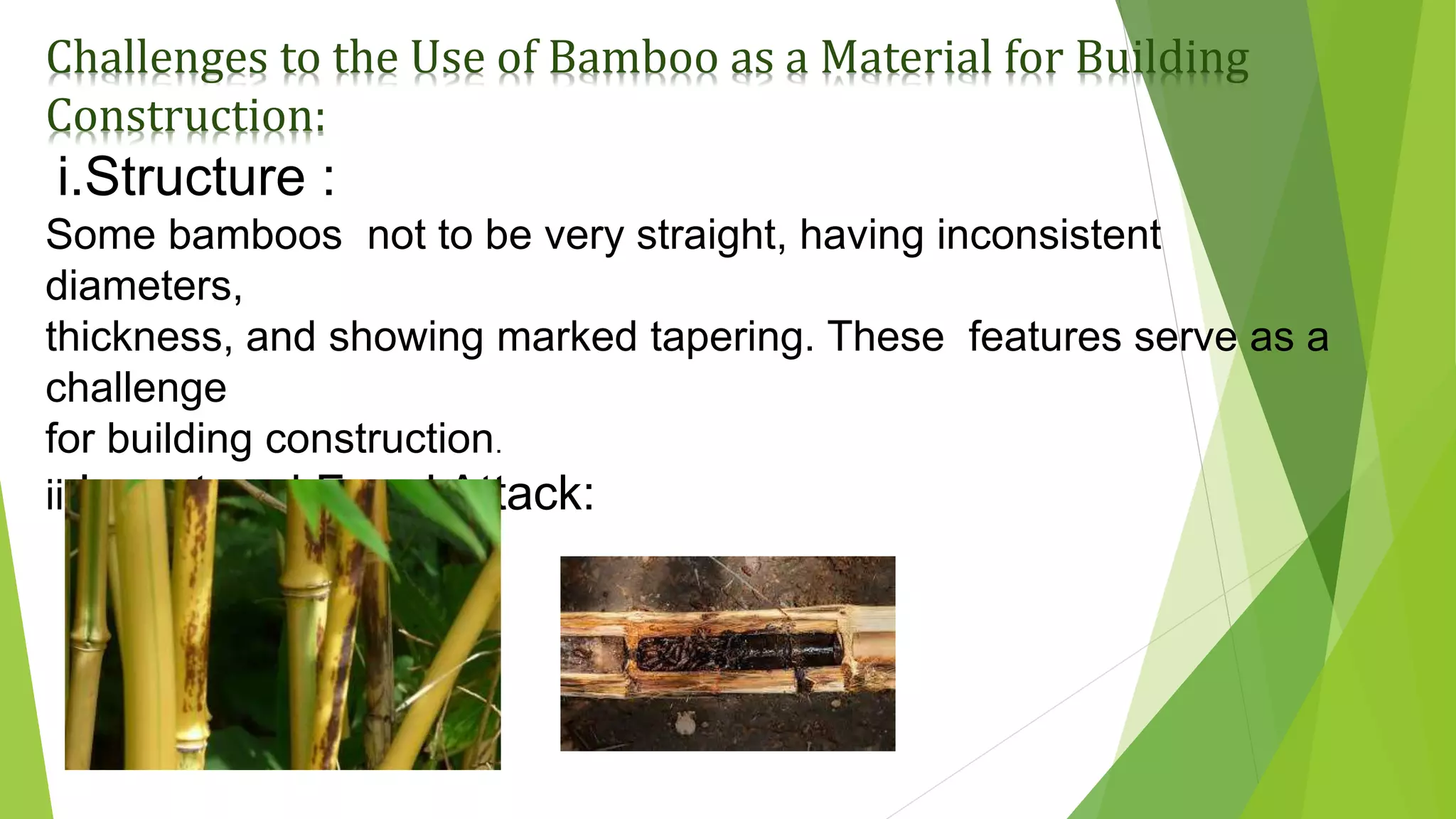
Bamboo for walls:
Bamboo is extensively used
for construction of walls and
partitions. Posts and beams
are the main elements
normally constructed with
bamboo provide structural
framework for walls. An infill
is used between framing
elements to add strength and
stability to the walls.
Bamboo is one of the best
roofing materials and provides
ample sturdiness to the
structure. It is a proven shield
against forces of nature or
animals and are considerably
light weighted which makes
them easy to install. The
bamboo roofs include purlins,
rafters and trusses.
Bamboo for roofing:
Due to advantageous properties of
bearing heavy load bamboos are
considered as one of the highly-
endorsed materials for scaffolding
even for tall structures. For the
construction of scaffolding, cane
extensions are obtained by lashing
cane ends using several ropes. The
ties are positioned in such a way that
forces acting vertically downwards
lodge the nodes in the lashing. This
technique has immense significance
since the joints can be re-aligned in
Bamboo for scaffolding:
Preservation methods:
1.NON CHEMICAL METHODS OR TRADITIONAL
METHOD:
It is otherwise known as traditional methods of
preservation are widely used by villagers . This method
includes ,
curing
smoking
whitewashing
soaking.
 Butt treatment
 Open tank method for cold soaking
 Hot and cold bath process
 Pressure treatment
 Glue line treatment
2.Chemical methods:
Challenges to the Use of Bamboo as a Material for Building
Construction:
i.Structure :
Some bamboos not to be very straight, having inconsistent
diameters,
thickness, and showing marked tapering. These features serve as a
challenge
for building construction.
ii.Insect and Fungi Attack:
Remedies to the Challenges of Bamboo as a Building
Material:
i.Non-fixed preservatives:
Boron salt+water ----->prevents mould ,fungi and termites
ii.Preservatives of the fixing type :
This type of chemical preservation of bamboo involves the use of a
various mixture of different chemicals in a quantitative ratio which
interacts with each other and becomes chemically fixed.
•Light, strong and
versatile.
•Light, strong, versatile.
•Environment friendly.
•Accessible to the poor.
•Self renewing resource
•Fast growing.
•Highly productive.
Advantages of Bamboo:
•Requires preservation
•Shaped by nature
•Jointing- although many jointing
techniques exist, their structural
efficiency is low.
•Lack of design guidance and
codes.
•Prone to catch fire very fast by
the friction mid the fuels during
wind, and is seen to cause forest
fires.
Disadvantages of Bamboo:
Since time immemorial, bamboo has played an
important role in the development of mankind.
It is used for a wide range of day-to-day
purposes, both as a woody material and as
food.
It has been the backbone of much of the
world’s rural life and will remain so as the
population increases.
Conclusion:
Bamboo as a construction material

Bamboo as a construction material

  • 3.
     Bamboo isa building material which is used for the construction of scaffolding, bridges and structures, houses.  It is one of the fastest-growing plants in the world. What is Bamboo?
  • 4.
    General Uses: • Creatinga flack line in traditional forests-due to the huge content of silica. • The shoots are edible. • Building and construction. • Small scale and cottage industries, for handicrafts and other products. • New generation products as wood substitutes. • Industrial products.
  • 5.
    Tensile strength Fire resistance Shrinking Bendingstrength Elastic modulus Shearing strength Compressive Strength Properties:
  • 6.
    Different works involvedwith use of bamboo: 1. Splitting of bamboo 2. Shaping of bamboo 3.Bending of bamboo
  • 7.
    Different works involvedwith use of bamboo: Splitting of bamboo: The Bamboo Canes Are Split Into Halves Or Quarter Section Using A Knife Ideal For The Jov And Setting Them Apart By A Wedge. Shaping of bamboo: Even Though Bamboos Are Naturally Circular In Form But If They Are Grown In A Box Of Square Shape They Acquire A Shape As Desired. Bending of bamboo: It Can Be Bent While They Are Freshly Cut By Temperature Of 150˚C
  • 8.
    There is avery limited use of bamboo as foundation material because when in contact wirh moisture laden surface they decay fast.However, this issue can be tackled to quite an extent though proper treatment using appropriate chemicals. The various types of foundation constructed with bamboo are,  Bamboo fixed to rock or performed concrete footings.  Composite bamboo or concrete columns.  Bamboo piles. Bamboo for foundation:
  • 9.
    Bamboo for walls: Bamboois extensively used for construction of walls and partitions. Posts and beams are the main elements normally constructed with bamboo provide structural framework for walls. An infill is used between framing elements to add strength and stability to the walls.
  • 10.
    Bamboo is oneof the best roofing materials and provides ample sturdiness to the structure. It is a proven shield against forces of nature or animals and are considerably light weighted which makes them easy to install. The bamboo roofs include purlins, rafters and trusses. Bamboo for roofing:
  • 11.
    Due to advantageousproperties of bearing heavy load bamboos are considered as one of the highly- endorsed materials for scaffolding even for tall structures. For the construction of scaffolding, cane extensions are obtained by lashing cane ends using several ropes. The ties are positioned in such a way that forces acting vertically downwards lodge the nodes in the lashing. This technique has immense significance since the joints can be re-aligned in Bamboo for scaffolding:
  • 12.
    Preservation methods: 1.NON CHEMICALMETHODS OR TRADITIONAL METHOD: It is otherwise known as traditional methods of preservation are widely used by villagers . This method includes , curing smoking whitewashing soaking.
  • 13.
     Butt treatment Open tank method for cold soaking  Hot and cold bath process  Pressure treatment  Glue line treatment 2.Chemical methods:
  • 14.
    Challenges to theUse of Bamboo as a Material for Building Construction: i.Structure : Some bamboos not to be very straight, having inconsistent diameters, thickness, and showing marked tapering. These features serve as a challenge for building construction. ii.Insect and Fungi Attack:
  • 15.
    Remedies to theChallenges of Bamboo as a Building Material: i.Non-fixed preservatives: Boron salt+water ----->prevents mould ,fungi and termites ii.Preservatives of the fixing type : This type of chemical preservation of bamboo involves the use of a various mixture of different chemicals in a quantitative ratio which interacts with each other and becomes chemically fixed.
  • 16.
    •Light, strong and versatile. •Light,strong, versatile. •Environment friendly. •Accessible to the poor. •Self renewing resource •Fast growing. •Highly productive. Advantages of Bamboo:
  • 17.
    •Requires preservation •Shaped bynature •Jointing- although many jointing techniques exist, their structural efficiency is low. •Lack of design guidance and codes. •Prone to catch fire very fast by the friction mid the fuels during wind, and is seen to cause forest fires. Disadvantages of Bamboo:
  • 18.
    Since time immemorial,bamboo has played an important role in the development of mankind. It is used for a wide range of day-to-day purposes, both as a woody material and as food. It has been the backbone of much of the world’s rural life and will remain so as the population increases. Conclusion: