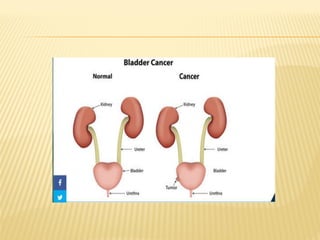
BLADDER CANCER
Presented by
Mr.B. kalyankumar Msc(N)
INTRODUCTION
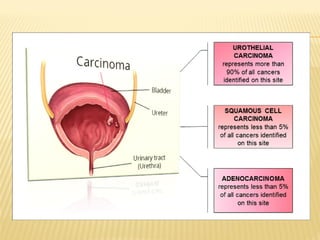
Bladder cancer refers to any of several types of
malignant growth of the urinary bladder. Any of
three different cell type can become cancerous.
The resulting cancers are named after the cell
types: Urothelial carcinoma, Squamous cell
carcinoma and Adenocarcinoma.
More common site of cancer is the urinary tract.
2.7 times more common in men. Men fourth
commonest cause of cancer.
CAUSES AND RISK FACTORS
 Cigarette smoking
 Chemical exposure at work
 Diet: Fried meats and animals
OTHER FACTORS INCLUDE
 Age: Seniors are at high risk of developing bladder
cancer.
 Sex: Men are three times more likely than women to
have bladder cancer.
 Race: whites have much higher risk of developing
cancer .
 Personal history of bladder cancer
 Family history of bladder cancer
 Chronic bladder inflammation
 Birth defects
 External beam radiation
CLINICAL MANIFESTATIONS
 Bladder cancer characteristically causes blood in the
urine : This may be visible to the naked eye or
detectable only by microscope .
 Pain during urination
 Frequent urination or feeling the need of
urinate without results
MANAGEMENT
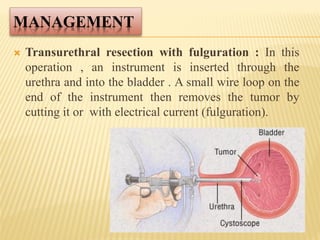
 Transurethral resection with fulguration : In this
operation , an instrument is inserted through the
urethra and into the bladder . A small wire loop on the
end of the instrument then removes the tumor by
cutting it or with electrical current (fulguration).
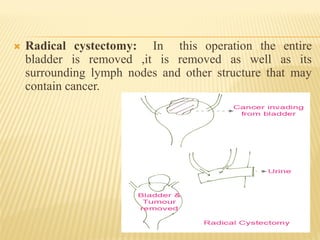
 Radical cystectomy: In this operation the entire
bladder is removed ,it is removed as well as its
surrounding lymph nodes and other structure that may
contain cancer.
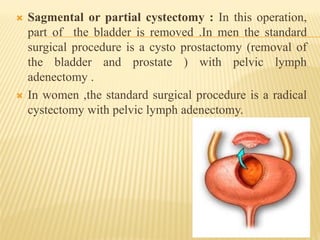
 Sagmental or partial cystectomy : In this operation,
part of the bladder is removed .In men the standard
surgical procedure is a cysto prostactomy (removal of
the bladder and prostate ) with pelvic lymph
adenectomy .
 In women ,the standard surgical procedure is a radical
cystectomy with pelvic lymph adenectomy.
 Chemotherapy : In early bladder cancer chemotherapy
may be infused into the bladder through the urethra .
Drugs commonly used to treat bladder cancer include
thiotepa ,mitomycin and doxorubicin.
 Radiation therapy: Radiation may be given for
small muscle invasive bladder cancer, radiation therapy
is also used relive symptoms (palliative treatment) of
advanced bladder.
 Immunization : A vaccine derived from the bacteria
that causes tuberculosis is infused through urethra into
the bladder ,once a week for 6 weeks to stimulate the
immune system to destroy cancer cells. Sometimes BCG
used with interferon.
NURSING MANAGEMENT
 Assist the patient to minimize irritative voiding
symptoms by fluid management and avoidance of
bladder irritants.
 Administer urinary analgesics or antispasmodic
medications.
 Provide frequent small meals to minimize nausea
related chemotherapy .
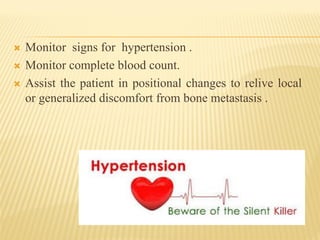
 Monitor signs for hypertension .
 Monitor complete blood count.
 Assist the patient in positional changes to relive local
or generalized discomfort from bone metastasis .
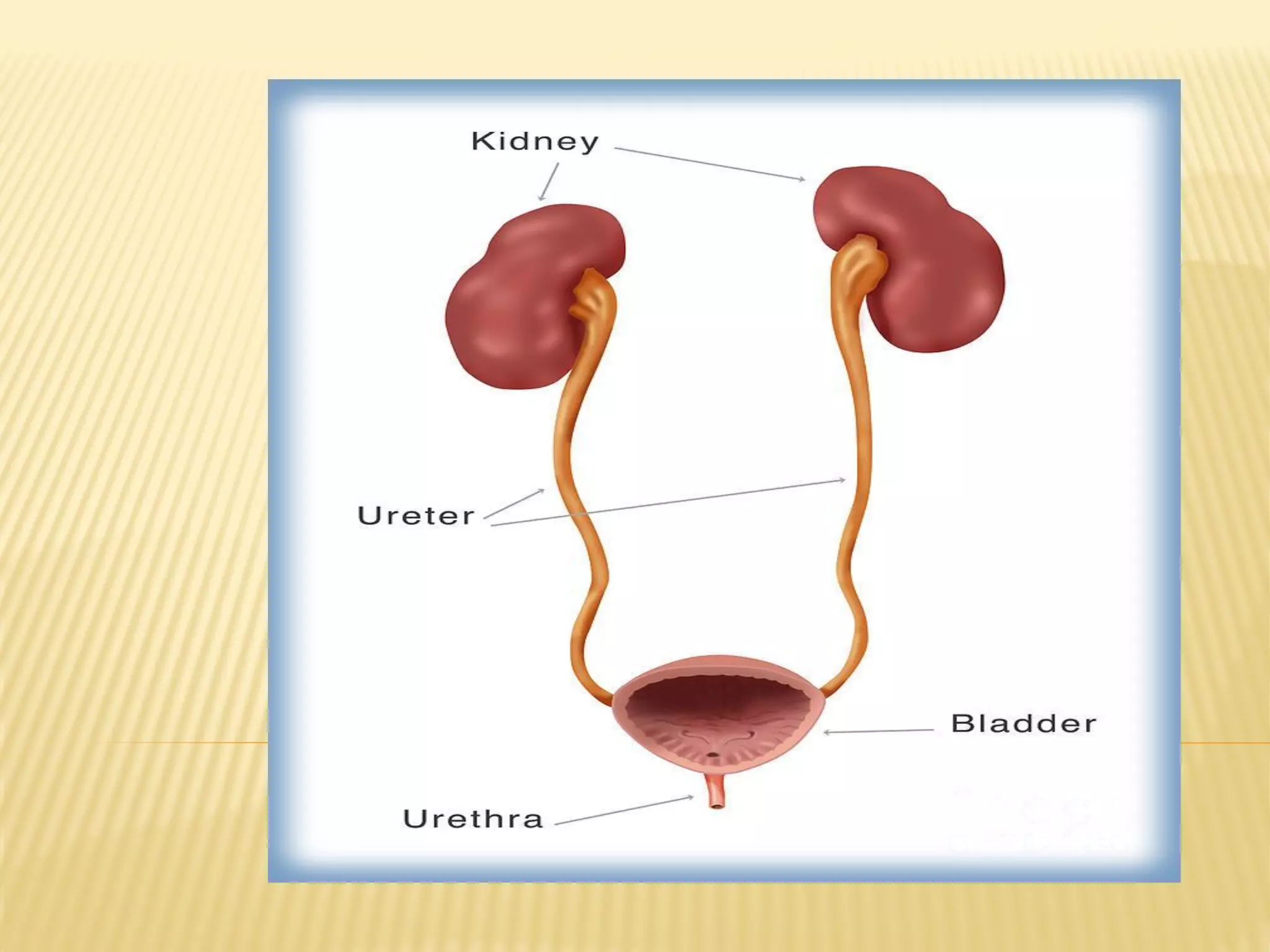
Draw urinary system
label the parts
GOOD TIME WITH YOU

Baldder cancer (Bladder carcinoma)

  • 3.
  • 4.
    INTRODUCTION Bladder cancer refersto any of several types of malignant growth of the urinary bladder. Any of three different cell type can become cancerous. The resulting cancers are named after the cell types: Urothelial carcinoma, Squamous cell carcinoma and Adenocarcinoma. More common site of cancer is the urinary tract. 2.7 times more common in men. Men fourth commonest cause of cancer.
  • 6.
    CAUSES AND RISKFACTORS  Cigarette smoking  Chemical exposure at work  Diet: Fried meats and animals
  • 7.
    OTHER FACTORS INCLUDE Age: Seniors are at high risk of developing bladder cancer.  Sex: Men are three times more likely than women to have bladder cancer.  Race: whites have much higher risk of developing cancer .  Personal history of bladder cancer  Family history of bladder cancer  Chronic bladder inflammation  Birth defects  External beam radiation
  • 8.
    CLINICAL MANIFESTATIONS  Bladdercancer characteristically causes blood in the urine : This may be visible to the naked eye or detectable only by microscope .
  • 9.
     Pain duringurination  Frequent urination or feeling the need of urinate without results
  • 10.
    MANAGEMENT  Transurethral resectionwith fulguration : In this operation , an instrument is inserted through the urethra and into the bladder . A small wire loop on the end of the instrument then removes the tumor by cutting it or with electrical current (fulguration).
  • 11.
     Radical cystectomy:In this operation the entire bladder is removed ,it is removed as well as its surrounding lymph nodes and other structure that may contain cancer.
  • 12.
     Sagmental orpartial cystectomy : In this operation, part of the bladder is removed .In men the standard surgical procedure is a cysto prostactomy (removal of the bladder and prostate ) with pelvic lymph adenectomy .  In women ,the standard surgical procedure is a radical cystectomy with pelvic lymph adenectomy.
  • 13.
     Chemotherapy :In early bladder cancer chemotherapy may be infused into the bladder through the urethra . Drugs commonly used to treat bladder cancer include thiotepa ,mitomycin and doxorubicin.  Radiation therapy: Radiation may be given for small muscle invasive bladder cancer, radiation therapy is also used relive symptoms (palliative treatment) of advanced bladder.
  • 14.
     Immunization :A vaccine derived from the bacteria that causes tuberculosis is infused through urethra into the bladder ,once a week for 6 weeks to stimulate the immune system to destroy cancer cells. Sometimes BCG used with interferon.
  • 15.
    NURSING MANAGEMENT  Assistthe patient to minimize irritative voiding symptoms by fluid management and avoidance of bladder irritants.  Administer urinary analgesics or antispasmodic medications.  Provide frequent small meals to minimize nausea related chemotherapy .
  • 16.
     Monitor signsfor hypertension .  Monitor complete blood count.  Assist the patient in positional changes to relive local or generalized discomfort from bone metastasis .
  • 18.
  • 19.