CARCINOMA
BLADDER
Moderator: Ms.Manju Presenter:Jiya Maria Thomas
Lecturer MSc Nsg 1 st yr
CON,AIIMS
At the end of the class….
Understand what is cancer bladder
Epidemiology
Risk factors
Pathophysiology
Types and clinical manifestations
Staging and grading
Management
Carcinoma Bladder
 Cancer that forms in tissues of the bladder and that
may infiltrate the bladder wall.
As tumor progresses it may extend in to the
retroperitoneal structures.
Layers Of Urinary Bladder
Epidemiology
In India 4th
common cancer in men &
8th
common cancer in females.
 2-3 times common in men
 Male to female ratio= 2.4:1
 Commonly occurs in people over 55yrs or above
Risk factors
Smoking-active and passive
Exposure to carcinogen (aniline, asbestos,
aromatic amines, arsenic)
Occupational risk (hair dressers,
painters, truck drivers, rubber,
textile, metal workers)
Chronic bladder irritation (UTI’s)
Risk factors…
Chemotherapy and Pelvic
radiation
Bladder birth defects
Diet high in saturated fat
Personal/family Hx of bladder
Cancer
Excessive Consumption of
coffee, artificial sweetners, low
fluid diet.
Pathophysiology
Exposure of the bladder wall to a carcinogen
Bladder wall irritation
Pre malignant changes start from the transitional layer
These changes are called as cell dysplasia
Formation of warts like growths in the wall
Pathophysiology
Formation of locally invasive carcinoma in situ
Penetrates the submucosal and mucosal layer of the
bladder forming deep invasive cancers
Progress to adjacent structures {retroperitoneal
structures}
Distant metastasis to liver,bone,lungs through LNs,Bld
Types
 Transitional cell
carcinomas
 Adenocarcinoma
 Squamous cell
carcinoma
Clinical manifestations
 Microscopic /gross painless hematuria
 Bladder irritative symptoms
 Obstructive symptoms
Urinary tract infections
Alterations in voiding pattern
Pelvic / back pain (metastasis)
Staging
TX: Main tumor cannot be
assessed due to lack of
information
T0: No evidence of a primary tumor
Ta: Non-invasive papillary carcinoma
Tis: Non-invasive flat carcinoma (flat carcinoma in
situ, or CIS)
T1: The tumor has grown from the layer of cells
lining the bladder into the connective tissue below. It
has not grown into the muscle layer of the bladder.
T2: The tumor has grown into the muscle layer.
T2a: The tumor has grown only into the inner half of
the muscle layer.
T2b: The tumor has grown into the outer half of the
muscle layer.
T3: The tumor has grown through the muscle layer
of the bladder and into the fatty tissue surrounding it
T3a: The spread to fatty tissue can only be seen by
using a microscope.
T3b: The spread to fatty tissue is large enough to be
seen on imaging tests or to be seen or felt by the
surgeon
T4: The tumor has spread beyond the fatty tissue and
into nearby organs or structures. It may be growing into
any of the following: the stroma (main tissue) of the
prostate, the seminal vesicles, uterus, vagina, pelvic wall,
or abdominal wall.
T4a: The tumor has spread to the stroma of the prostate
(in men), or to the uterus and/or vagina (in women).
T4b: The tumor has spread to the pelvic wall or the
abdominal wall
NX: Regional lymph nodes cannot be assessed due
to lack of information.
N0: There is no regional lymph node spread.
N1: The cancer has spread to a single lymph node in
the true pelvis.
N2: The cancer has spread to 2 or more lymph nodes
in the true pelvis.
N3: The cancer has spread to lymph nodes along the
common iliac artery
M0: There are no signs of distant spread.
M1: The cancer has spread to distant parts of the
body. (The most common sites are distant
lymph nodes, the bones, the lungs, and the liver).
Staging of Ca Bladder
Stage 0:Stage 0: Cancer cells are found only on the inner
lining of the bladder
Stage IStage I: Cancer cells have proliferated to the layer
beyond the inner lining of the urinary bladder but
not to the muscles of the urinary bladder.
Stage II:Stage II: Cancer cells have proliferated to the
muscles in the bladder wall but not to the fatty tissue
that surrounds the urinary bladder.
Stage IIIStage III:: Cancer cells have proliferated to the fatty
tissue surrounding the urinary bladder and to the
prostate gland, vagina, or uterus, but not to the lymph
nodes or other organs.
Stage IVStage IV: Cancer cells have proliferated to the lymph
nodes, pelvic or abdominal wall, and/or other organs.
RecurrentRecurrent: Cancer has recurred in the urinary bladder
or in another nearby organ after having been treated
Grading bladder cancer
Grading describes how aggressive the cancer cells
are:
• Low grade – The cancer cells look fairly normal
and behave similarly to healthy cells. The cells tend
to grow slowly. Most bladder tumours are low grade.
• High grade – The cancer cells look very abnormal
and grow in a disorderly way. These cells tend to
grow very quickly.
Bladder cancer can also be graded on a scale of 1–3.
Grade 1 cancers are the slowest growing and grade 3
cancers are the most aggressive
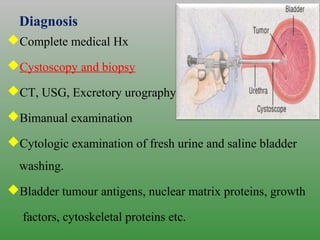
Diagnosis
Complete medical Hx
Cystoscopy and biopsy
CT, USG, Excretory urography
Bimanual examination
Cytologic examination of fresh urine and saline bladder
washing.
Bladder tumour antigens, nuclear matrix proteins, growth
factors, cytoskeletal proteins etc.
MANAGEMENTMANAGEMENT
1. Surgery
2. Chemotherapy
3. Radiation therapy
4. Intra vesical
therapy
Surgical Management
TURBT(Trans-Urethral Resection Of
Blader Tumour)
Surgical Management
CYSTECTOMY
 Partial cystectomy
 Radical cystectomy
with urinary diversion
Types of Urinary diversions
1. Cutaneous /Non-continent urinary diversion:
 Conventional Ileal conduit
 Cutaneous ureterostomy
 Vesicostomy
 Percutaneous Neprostomy
2. Continent urinary diversion:
 Indiana pouch
 Kock pouch
 Ureterosigmoidostomy
Illeal conduit Uretrostomy
Vesicostomy Nephrostomy
Percutaneous nephrostomy
Continent Urinary Diversions
Indiana pouch Kock Pouch
Ureterosigmoidostomy
Complications of urinary diversion
Major
Pyelonephritis, HDN
Minor
Obstruction,
stomal defects
leakage
skin irritation & ulceration,
peristomal hernia
Bacteriuria
Chemotherapy
Intravenous administration
Commonly used agents:
Cisplatin M - methotrexate
Doxorubicin V - vinblastin
Gemcitabin A - adriamycin
Methotrexate C - cisplatin
Vinblastin
Intravesical drug therapy
/Immunotherapy
Bacille Calmette-Guerin (BCG)
Complications of chemotherapy
Bladder irritation
Hemorrhage,
Fatigue, headache
Nausea, vomiting
Anemia
Abdominal pain
Kidney damage
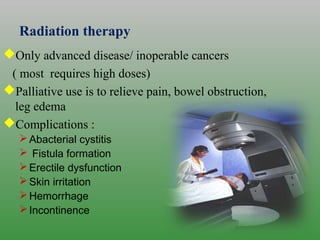
Radiation therapy
Only advanced disease/ inoperable cancers
( most requires high doses)
Palliative use is to relieve pain, bowel obstruction,
leg edema
Complications :
Abacterial cystitis
 Fistula formation
Erectile dysfunction
Skin irritation
Hemorrhage
Incontinence
Nursing ManagementNursing Management
Meet Sam….
Nursing assessment
Take careful health, medical and Sx history.
Assess for changes in urine or urination patterns.
Assess risk from carcinogen exposure.
Assess for any drug, chemical or food allergy.
Nursing assessment
Assessment of the client for anxiety, coping,
disease related knowledge.
Assist in Routine investigations
Written informed consent.
 monitoring pre-op vital signs
Complete self-care & functional assessment.
Pre-op Nursing Management
1. Deficient knowledge R/T Ca bladder diagnosis,
diagnostic testing, surgical intervention
 Provide teaching
 Encourage discussion
 Explain purpose of various tubings like catheters,
NG tube etc.
 Explanation abt various tubes ,catheters
 Discuss abt bowel preparation
 Pre –op teaching abt stoma care, catheterisation of
stoma.
Pre-op Nursing Management
2.Risk for disturbed body image R/t Sx, possible post op stoma,
sexual dysfunction, change in urinary elimination
 Explanation for surgical procedure
 Suggest a visit to a client with similar diagnosis and
procedure.
 Choosing the appropriate site for stoma construction
 Discuss lifestyle changes because of stoma or urinary
diversion
 Counselling for risk for sexual dysfunction
 Community support groups
 Family counselling
3.Anxiety related to crisis situations (cancer), health change,
socio-economics, the role and functions, form interaction,
preparation of death, separation of the family.
Determine the patient's experience prior to the illness.
Provide accurate information about prognosis
Give the client an opportunity to express anger, fear,
confrontation. Give the information with reasonable emotion
and expression of the corresponding
Explain the treatment, the purpose and side effects. Helps
patients prepare for treatment
Note the ineffective coping such as lack of social interaction,
impotence etc.
Encourage to develop interaction with the support system
Provide a quiet environment and comfortable
Maintain contact with patients, talk and touch with them.
Post –op Nursing Management
AssessmentAssessment
Routine post op evaluation
Stoma site monitoring
Maintaining NPO status untill bowel sounds returns
Assessment of nasogastric contents and stools
Minimal handling of the tubings
Monitor Hrly urine output, pH.
Post –op Nursing Management
AssessmentAssessment
Adequate fluid support
 patency & cont. drainage monitoring
Catheterise the client if stoma is present
Observe for hematuria, stenosis, incontinence,
difficult catheterazation
Prevent electrolyte imbalances
Post –op Nursing Management
Acute pain r/t surgical incision
 Administration of analgesic medication
 Deep breathing exercises
 Patient controlled analgesia
 Pain intensity scale is used to evaluate the adequacy
of the medication and the approach to pain
management
Post –op Nursing Management
Risk for injury R/t occlusion of urinary
drainage
 Monitor vitals, incision lines, s/s of bleeding
 Maintain continuous drainage of urine
 Frequent catheter irrigation with N/S
 Catheterise stoma until it heals
 Label & seperately monitor each tubes
 Inspect the abdomen for distention
Post –op Nursing Management
Risk for impaired skin integrity r/t problems
in managing the urine collection appliance
 Keep the drainage system intact
 Proper skin care
 Skin care techniques are teached to the family
members to prevent ulceration around the stoma
 Adequate nutrition
 Long –term management of the stoma is teached
Post-op care after urinary diversion
Altered urinary elimination related to urinary diversion
 Maintain a transparent urostomy pouch over the stoma
post operatively for easy assessment
 Inspect the stoma for colour and size
 Report any bleeding , necrosis, sloughing, suture
separation
 Check patency of ureteral stents
 Keep the pouch on at all times and observe normal urine
drainage
Post-op care after urinary diversion
2. Stoma care:
 Inspect the stoma every hr for first 24 hrs post-op,
and atleast 8 hrs thereafter.
 Note size, shape & colour of stoma
 Assess for any leakage, bleeding
 Aeration of skin
 Keep the area dry & clean
 Nystatin powder or cream application to avoid
yeast infection
 Check pH of urine
 Change appliances when necessary
 Assess for s/s of peritonitis
Post-op care after urinary diversion
3. Diet
 Fluids are very important.
Eat several small meals rather than fewer large meals
Take a multivitamin with iron daily after surgery
Keep bowel movements soft with stool softener of
choice
Avoid diet that gives urine a strong odor( high fat
diet)
take ascorbic acid tablets daily to maintain urine
acidity.
Post-op care after urinary diversion
4. Activity
Avoid lifting heavy wts for 6 weeks after surgery
Walk every day. Short frequent walks are better that
1 long walk
It is normal to be fatigued after surgery
Patients recover at different rates.
Post –op Nursing Management
Risk for sexual dysfunction r/t structural &
physiologic alterations
 Counseling the partners
 Encourage open discussions
 Sexual rehabilitation
 Encourage partners to seek sexual councelling and
alternate ways of expressing sexuality
 A visit from another ‘ostomate’ who is functioning
fully in society and family life
Post –op Nursing Management
Risk for complications r/t the condition
To reduce the risk take following interventions:
Adequate fluid intake
Regular stoma care
Acidification of urine
Prevent leakage of urine
Regular catheterisation
Prevent urinary stasis
Peritonitis
Post –op Nursing Management
Client education:
Teaching pt self-care for stoma
Managing the ostomy appliances
Changing the appliance
Controlling odour
Cleaning and deodorizing the appliance
Clean with soap & water, use white vinegar solution.
Teaching skin care: apply skin barrier
Teaching pt self-care for urine reservoir
catheterization of the reservoir
Irrigation
Encourage follow –up
Assist in intravesical drug administrations
Instruct the pt to retain fluid for atleast 2 hrs
Instruct to change position frequently
After voiding, instruct to drink fluids to flush the
bladder
Clean the toilet with bleach after voiding.
Assess for complications like bleeding, fever,
bladder irritation etc.
Nursing Management of pt
undergoing chemotherapy
Conclusion
Carcinoma bladder is one of the common urological
cancer . Patients with Cancer bladder requires
special care and attention during the treatment and
afterwards also.
Summary
What is carcinoma bladder?
Risk factors
Pathophysiology
Types
Clinical manifestations and diagnosis
Staging
Management – Sx, Chemotherapy, radiation therapy
Nursing management
References:
Brunner & Suddarth’s, Textbook of Medical
Surgical Nursing.10th ed. Lippincott.
Black M. Joyce, Hawks Hokanson Jane, Medical
Surgical nursing.7th ed.2005, Saunders
Harrison's Principles of internal medicine,
Seventeenth Edition, 2008, The McGraw-Hill
Companies.
www.cancer.gov
Ca bladder (2)

Ca bladder (2)

  • 1.
    CARCINOMA BLADDER Moderator: Ms.Manju Presenter:JiyaMaria Thomas Lecturer MSc Nsg 1 st yr CON,AIIMS
  • 2.
    At the endof the class…. Understand what is cancer bladder Epidemiology Risk factors Pathophysiology Types and clinical manifestations Staging and grading Management
  • 3.
    Carcinoma Bladder  Cancerthat forms in tissues of the bladder and that may infiltrate the bladder wall. As tumor progresses it may extend in to the retroperitoneal structures.
  • 4.
  • 5.
    Epidemiology In India 4th commoncancer in men & 8th common cancer in females.  2-3 times common in men  Male to female ratio= 2.4:1  Commonly occurs in people over 55yrs or above
  • 6.
    Risk factors Smoking-active andpassive Exposure to carcinogen (aniline, asbestos, aromatic amines, arsenic) Occupational risk (hair dressers, painters, truck drivers, rubber, textile, metal workers) Chronic bladder irritation (UTI’s)
  • 7.
    Risk factors… Chemotherapy andPelvic radiation Bladder birth defects Diet high in saturated fat Personal/family Hx of bladder Cancer Excessive Consumption of coffee, artificial sweetners, low fluid diet.
  • 8.
    Pathophysiology Exposure of thebladder wall to a carcinogen Bladder wall irritation Pre malignant changes start from the transitional layer These changes are called as cell dysplasia Formation of warts like growths in the wall
  • 9.
    Pathophysiology Formation of locallyinvasive carcinoma in situ Penetrates the submucosal and mucosal layer of the bladder forming deep invasive cancers Progress to adjacent structures {retroperitoneal structures} Distant metastasis to liver,bone,lungs through LNs,Bld
  • 10.
    Types  Transitional cell carcinomas Adenocarcinoma  Squamous cell carcinoma
  • 11.
    Clinical manifestations  Microscopic/gross painless hematuria  Bladder irritative symptoms  Obstructive symptoms Urinary tract infections Alterations in voiding pattern Pelvic / back pain (metastasis)
  • 12.
    Staging TX: Main tumorcannot be assessed due to lack of information T0: No evidence of a primary tumor Ta: Non-invasive papillary carcinoma Tis: Non-invasive flat carcinoma (flat carcinoma in situ, or CIS)
  • 13.
    T1: The tumorhas grown from the layer of cells lining the bladder into the connective tissue below. It has not grown into the muscle layer of the bladder. T2: The tumor has grown into the muscle layer. T2a: The tumor has grown only into the inner half of the muscle layer. T2b: The tumor has grown into the outer half of the muscle layer.
  • 14.
    T3: The tumorhas grown through the muscle layer of the bladder and into the fatty tissue surrounding it T3a: The spread to fatty tissue can only be seen by using a microscope. T3b: The spread to fatty tissue is large enough to be seen on imaging tests or to be seen or felt by the surgeon
  • 15.
    T4: The tumorhas spread beyond the fatty tissue and into nearby organs or structures. It may be growing into any of the following: the stroma (main tissue) of the prostate, the seminal vesicles, uterus, vagina, pelvic wall, or abdominal wall. T4a: The tumor has spread to the stroma of the prostate (in men), or to the uterus and/or vagina (in women). T4b: The tumor has spread to the pelvic wall or the abdominal wall
  • 17.
    NX: Regional lymphnodes cannot be assessed due to lack of information. N0: There is no regional lymph node spread. N1: The cancer has spread to a single lymph node in the true pelvis. N2: The cancer has spread to 2 or more lymph nodes in the true pelvis. N3: The cancer has spread to lymph nodes along the common iliac artery
  • 18.
    M0: There areno signs of distant spread. M1: The cancer has spread to distant parts of the body. (The most common sites are distant lymph nodes, the bones, the lungs, and the liver).
  • 19.
    Staging of CaBladder Stage 0:Stage 0: Cancer cells are found only on the inner lining of the bladder Stage IStage I: Cancer cells have proliferated to the layer beyond the inner lining of the urinary bladder but not to the muscles of the urinary bladder. Stage II:Stage II: Cancer cells have proliferated to the muscles in the bladder wall but not to the fatty tissue that surrounds the urinary bladder.
  • 20.
    Stage IIIStage III::Cancer cells have proliferated to the fatty tissue surrounding the urinary bladder and to the prostate gland, vagina, or uterus, but not to the lymph nodes or other organs. Stage IVStage IV: Cancer cells have proliferated to the lymph nodes, pelvic or abdominal wall, and/or other organs. RecurrentRecurrent: Cancer has recurred in the urinary bladder or in another nearby organ after having been treated
  • 22.
    Grading bladder cancer Gradingdescribes how aggressive the cancer cells are: • Low grade – The cancer cells look fairly normal and behave similarly to healthy cells. The cells tend to grow slowly. Most bladder tumours are low grade. • High grade – The cancer cells look very abnormal and grow in a disorderly way. These cells tend to grow very quickly. Bladder cancer can also be graded on a scale of 1–3. Grade 1 cancers are the slowest growing and grade 3 cancers are the most aggressive
  • 23.
    Diagnosis Complete medical Hx Cystoscopyand biopsy CT, USG, Excretory urography Bimanual examination Cytologic examination of fresh urine and saline bladder washing. Bladder tumour antigens, nuclear matrix proteins, growth factors, cytoskeletal proteins etc.
  • 24.
    MANAGEMENTMANAGEMENT 1. Surgery 2. Chemotherapy 3.Radiation therapy 4. Intra vesical therapy
  • 25.
  • 26.
    Surgical Management CYSTECTOMY  Partialcystectomy  Radical cystectomy with urinary diversion
  • 27.
    Types of Urinarydiversions 1. Cutaneous /Non-continent urinary diversion:  Conventional Ileal conduit  Cutaneous ureterostomy  Vesicostomy  Percutaneous Neprostomy 2. Continent urinary diversion:  Indiana pouch  Kock pouch  Ureterosigmoidostomy
  • 28.
  • 29.
  • 30.
  • 31.
  • 32.
  • 33.
    Complications of urinarydiversion Major Pyelonephritis, HDN Minor Obstruction, stomal defects leakage skin irritation & ulceration, peristomal hernia Bacteriuria
  • 34.
    Chemotherapy Intravenous administration Commonly usedagents: Cisplatin M - methotrexate Doxorubicin V - vinblastin Gemcitabin A - adriamycin Methotrexate C - cisplatin Vinblastin
  • 35.
  • 36.
    Complications of chemotherapy Bladderirritation Hemorrhage, Fatigue, headache Nausea, vomiting Anemia Abdominal pain Kidney damage
  • 37.
    Radiation therapy Only advanceddisease/ inoperable cancers ( most requires high doses) Palliative use is to relieve pain, bowel obstruction, leg edema Complications : Abacterial cystitis  Fistula formation Erectile dysfunction Skin irritation Hemorrhage Incontinence
  • 38.
  • 39.
  • 40.
    Nursing assessment Take carefulhealth, medical and Sx history. Assess for changes in urine or urination patterns. Assess risk from carcinogen exposure. Assess for any drug, chemical or food allergy.
  • 41.
    Nursing assessment Assessment ofthe client for anxiety, coping, disease related knowledge. Assist in Routine investigations Written informed consent.  monitoring pre-op vital signs Complete self-care & functional assessment.
  • 42.
    Pre-op Nursing Management 1.Deficient knowledge R/T Ca bladder diagnosis, diagnostic testing, surgical intervention  Provide teaching  Encourage discussion  Explain purpose of various tubings like catheters, NG tube etc.  Explanation abt various tubes ,catheters  Discuss abt bowel preparation  Pre –op teaching abt stoma care, catheterisation of stoma.
  • 43.
    Pre-op Nursing Management 2.Riskfor disturbed body image R/t Sx, possible post op stoma, sexual dysfunction, change in urinary elimination  Explanation for surgical procedure  Suggest a visit to a client with similar diagnosis and procedure.  Choosing the appropriate site for stoma construction  Discuss lifestyle changes because of stoma or urinary diversion  Counselling for risk for sexual dysfunction  Community support groups  Family counselling
  • 44.
    3.Anxiety related tocrisis situations (cancer), health change, socio-economics, the role and functions, form interaction, preparation of death, separation of the family. Determine the patient's experience prior to the illness. Provide accurate information about prognosis Give the client an opportunity to express anger, fear, confrontation. Give the information with reasonable emotion and expression of the corresponding Explain the treatment, the purpose and side effects. Helps patients prepare for treatment Note the ineffective coping such as lack of social interaction, impotence etc. Encourage to develop interaction with the support system Provide a quiet environment and comfortable Maintain contact with patients, talk and touch with them.
  • 45.
    Post –op NursingManagement AssessmentAssessment Routine post op evaluation Stoma site monitoring Maintaining NPO status untill bowel sounds returns Assessment of nasogastric contents and stools Minimal handling of the tubings Monitor Hrly urine output, pH.
  • 46.
    Post –op NursingManagement AssessmentAssessment Adequate fluid support  patency & cont. drainage monitoring Catheterise the client if stoma is present Observe for hematuria, stenosis, incontinence, difficult catheterazation Prevent electrolyte imbalances
  • 47.
    Post –op NursingManagement Acute pain r/t surgical incision  Administration of analgesic medication  Deep breathing exercises  Patient controlled analgesia  Pain intensity scale is used to evaluate the adequacy of the medication and the approach to pain management
  • 48.
    Post –op NursingManagement Risk for injury R/t occlusion of urinary drainage  Monitor vitals, incision lines, s/s of bleeding  Maintain continuous drainage of urine  Frequent catheter irrigation with N/S  Catheterise stoma until it heals  Label & seperately monitor each tubes  Inspect the abdomen for distention
  • 49.
    Post –op NursingManagement Risk for impaired skin integrity r/t problems in managing the urine collection appliance  Keep the drainage system intact  Proper skin care  Skin care techniques are teached to the family members to prevent ulceration around the stoma  Adequate nutrition  Long –term management of the stoma is teached
  • 50.
    Post-op care afterurinary diversion Altered urinary elimination related to urinary diversion  Maintain a transparent urostomy pouch over the stoma post operatively for easy assessment  Inspect the stoma for colour and size  Report any bleeding , necrosis, sloughing, suture separation  Check patency of ureteral stents  Keep the pouch on at all times and observe normal urine drainage
  • 51.
    Post-op care afterurinary diversion 2. Stoma care:  Inspect the stoma every hr for first 24 hrs post-op, and atleast 8 hrs thereafter.  Note size, shape & colour of stoma  Assess for any leakage, bleeding  Aeration of skin  Keep the area dry & clean  Nystatin powder or cream application to avoid yeast infection  Check pH of urine  Change appliances when necessary  Assess for s/s of peritonitis
  • 52.
    Post-op care afterurinary diversion 3. Diet  Fluids are very important. Eat several small meals rather than fewer large meals Take a multivitamin with iron daily after surgery Keep bowel movements soft with stool softener of choice Avoid diet that gives urine a strong odor( high fat diet) take ascorbic acid tablets daily to maintain urine acidity.
  • 53.
    Post-op care afterurinary diversion 4. Activity Avoid lifting heavy wts for 6 weeks after surgery Walk every day. Short frequent walks are better that 1 long walk It is normal to be fatigued after surgery Patients recover at different rates.
  • 54.
    Post –op NursingManagement Risk for sexual dysfunction r/t structural & physiologic alterations  Counseling the partners  Encourage open discussions  Sexual rehabilitation  Encourage partners to seek sexual councelling and alternate ways of expressing sexuality  A visit from another ‘ostomate’ who is functioning fully in society and family life
  • 55.
    Post –op NursingManagement Risk for complications r/t the condition To reduce the risk take following interventions: Adequate fluid intake Regular stoma care Acidification of urine Prevent leakage of urine Regular catheterisation Prevent urinary stasis Peritonitis
  • 56.
    Post –op NursingManagement Client education: Teaching pt self-care for stoma Managing the ostomy appliances Changing the appliance Controlling odour Cleaning and deodorizing the appliance Clean with soap & water, use white vinegar solution. Teaching skin care: apply skin barrier Teaching pt self-care for urine reservoir catheterization of the reservoir Irrigation Encourage follow –up
  • 57.
    Assist in intravesicaldrug administrations Instruct the pt to retain fluid for atleast 2 hrs Instruct to change position frequently After voiding, instruct to drink fluids to flush the bladder Clean the toilet with bleach after voiding. Assess for complications like bleeding, fever, bladder irritation etc. Nursing Management of pt undergoing chemotherapy
  • 58.
    Conclusion Carcinoma bladder isone of the common urological cancer . Patients with Cancer bladder requires special care and attention during the treatment and afterwards also.
  • 59.
    Summary What is carcinomabladder? Risk factors Pathophysiology Types Clinical manifestations and diagnosis Staging Management – Sx, Chemotherapy, radiation therapy Nursing management
  • 60.
    References: Brunner & Suddarth’s,Textbook of Medical Surgical Nursing.10th ed. Lippincott. Black M. Joyce, Hawks Hokanson Jane, Medical Surgical nursing.7th ed.2005, Saunders Harrison's Principles of internal medicine, Seventeenth Edition, 2008, The McGraw-Hill Companies. www.cancer.gov

Editor's Notes

  • #7 Infection with schistosoma haematobium: leads to UTI Bladder birth defects : extropy bladder esp. leads to adenocarcinoma
  • #9 Dysplasia: abnormality in maturation of cells within a tissue
  • #12 Symptoms of bladder irritation,dysuria,frequency,urgency. Obstructive symptoms hesitancy, intermittency, straining to begin urination, retention. Sterile pyuria is the presence of elevated numbers of white cells (>10/cubic mm) in a urine which appears sterile using standard culture techniques.
  • #20 stages are used to classify the location, size, and spread of the cancer, according to the TNM (tumor, lymph node, and metastasis) staging system:
  • #24 Bta= bladder tumor antigen test NMP22: nuclear matrix protein TRAP= telomeric repeat amplification protocol test Carcinoembryonic antigen (CEA) is a glycoprotein involved in cell adhesion. It is normally produced during fetal development, but the production of CEA stops before birth. CEA measurement is mainly used as a tumor marker to identify recurrences after surgical resection. Elevated CEA levels should return to normal after surgical resection, as elevation of CEA during follow up is an indicator of recurrence of tumour.
  • #27 Partial cystectomy: if pt is unable to tolerate radical cystectomy
  • #28 Non-continent urinary diversion: typically consists of a piece of bowel which acts as a conduit taking urine from the ureters through bowel to the skin in a continuous flow pattern. This requires an appliance (stoma bag) on the skin to collect the urine continent urinary diversion attempts to mimic the action of the normal bladder by storing urine for a period of time at low pressure. Drainage of urine is performed by either normal voiding through the urethra or catheterization of either the urethra or a reservoir of bowel. This type of diversion does not require a skin appliance (bag). Percutaneous nephrostmy, ureterostomy: for palliative sx
  • #35 Systemic CT-used to treat inoperable tumors/distant metastasis s/e : hemorrhagic cystitis bladder irritation, f ever, malaise, nausea,chills,arthralgia, pruritus
  • #36 Intravesical therapies are used in two general contexts: as an adjuvant to a complete endoscopic resection to prevent recurrence or, less commonly, to eliminate disease that cannot be controlled by endoscopic resection alone Mitomycin C which disrupts the normal DNA function in cancer cells. The mitomycins are a family of aziridine-containing natural products isolated fromStreptomyces caespitosus or Streptomyces lavendulae.[1] One of these compounds,mitomycin C, finds use as a chemotherapeutic agent by virtue of its antitumour antibiotic activity. It is given intravenously to treat upper gastro-intestinal (e.g. esophageal carcinoma) and breast cancers, as well as by bladder instillation for superficial bladder tumours. hold the medication in bladder for up to 2 hours, then urinate. If BCG is used, pour bleach into toilet after urinate. About 50-75% of patients with superficial bladder cancer have a very good response to intravesical therapy
  • #51 1. After surgery while your pouch is healing, a tube called a Foley catheter drains the urine from your pouch to a leg bag or bedside bag. A second catheter (called a suprapubic tube)