
This document provides information about breast cancer presented by a group of students. It defines breast cancer as abnormal cell growth that forms tumors in breast tissue. Breast cancer spreads mainly through the lymphatic system to lymph nodes under the arm, around the collarbone, and near the breastbone. Risk factors include gender, age, family history, lifestyle factors like alcohol consumption and obesity. Common symptoms are breast lumps, pain, skin changes, and nipple discharge. Diagnosis involves exams, mammograms, ultrasounds, and biopsies. Stages range from 0 to 4 based on tumor size and spread. Treatment includes surgery, radiation, chemotherapy, hormone therapy, and targeted drug therapy.
Cancer is theabnormal, uncontrollable , continuous
division of cells lead to the formation of a tumor.
5.
Forms in the
tissuesof the
breast
Spreads mainly
through the
Lymphatic system
Breast cancer is second only to lung cancer as a cause of
cancer deaths in women.
7.
Most of thelymph vessels
of the breast drain into:
Lymph nodes under the
arm (auxiliary nodes).
Lymph nodes around the
collar bone (supraclavicular
and infraclavicular lymph
nodes)
Lymph nodes inside the
chest near the breast bone
(internal mammary lymph
nodes)
Most lumpsare caused
by the combination of
cysts and fibrosis
Cysts are fluid-filled sacs.
Fibrosis is the formation of
scar - like tissue.
These changes can cause
breast swelling and
pain.
10.
Breast canceris a malignant (cancerous)
tumor that starts in the cells of the breast
and spread to other tissues. It is found
mostly in women, but men can get breast
cancer, too.
11.
Invasive
Cancerous
Malignant
Spreads to other organs
(metastasis)
Non - Invasive
Pre – Cancerous
Still in its original position
Eventually develops into
invasive breast cancer.
About 1in 10 Invasive
breast cancers are ILC.
Formed in the lobules.
Grows through the
wall of the lobules.
Spreads
21.
Gender
Age
Genetic risk factors
Family history
Personal history of breast cancer
Race
Menstrual periods
Breast radiation early in life
22.
Not havingchildren or having them later in
life.
Certain kinds of birth control
Using hormone therapy after menopause
Not breastfeeding
Alcohol
Being overweight or obese
24.
Alcohol consumption
Physical exercise
Diet
Postmenopausal hormone therapy
Bodyweight
Breast cancer screening
Breastfeeding
26.
A lumpin a breast.
A pain in the armpits or breast that does not seem to be
related to the woman's menstrual period.
Pitting or redness of the skin of the breast; like the skin
of an orange.
A rash around (or on) one of the nipples.
27.
A swelling(lump) in one of the armpits.
One of the nipples has a discharge; sometimes it
may contain blood
The nipple changes in appearance; it may
become inverted.
The size or the shape of the breast changes.
29.
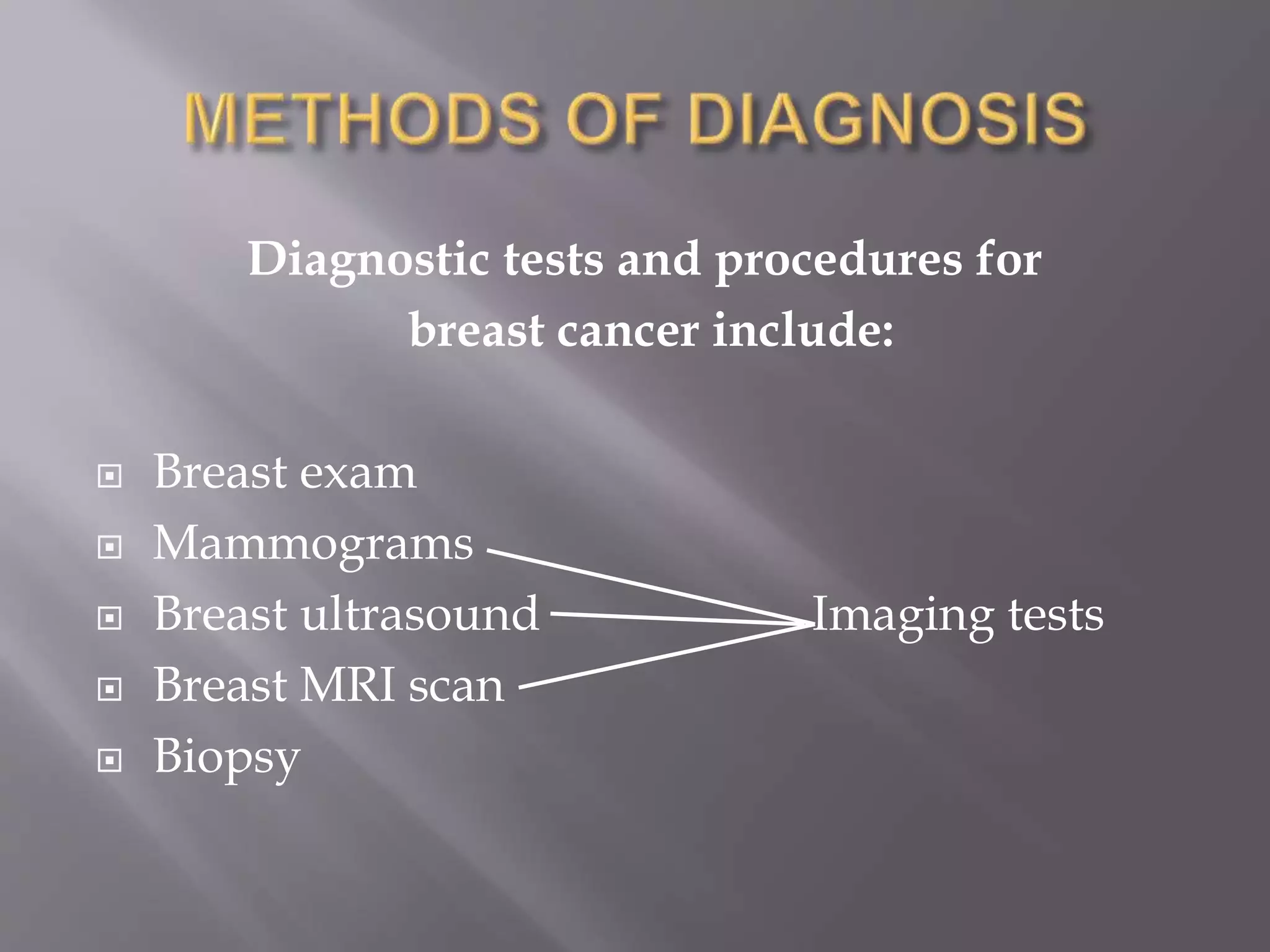
Diagnostic tests andprocedures for
breast cancer include:
Breast exam
Mammograms
Breast ultrasound Imaging tests
Breast MRI scan
Biopsy
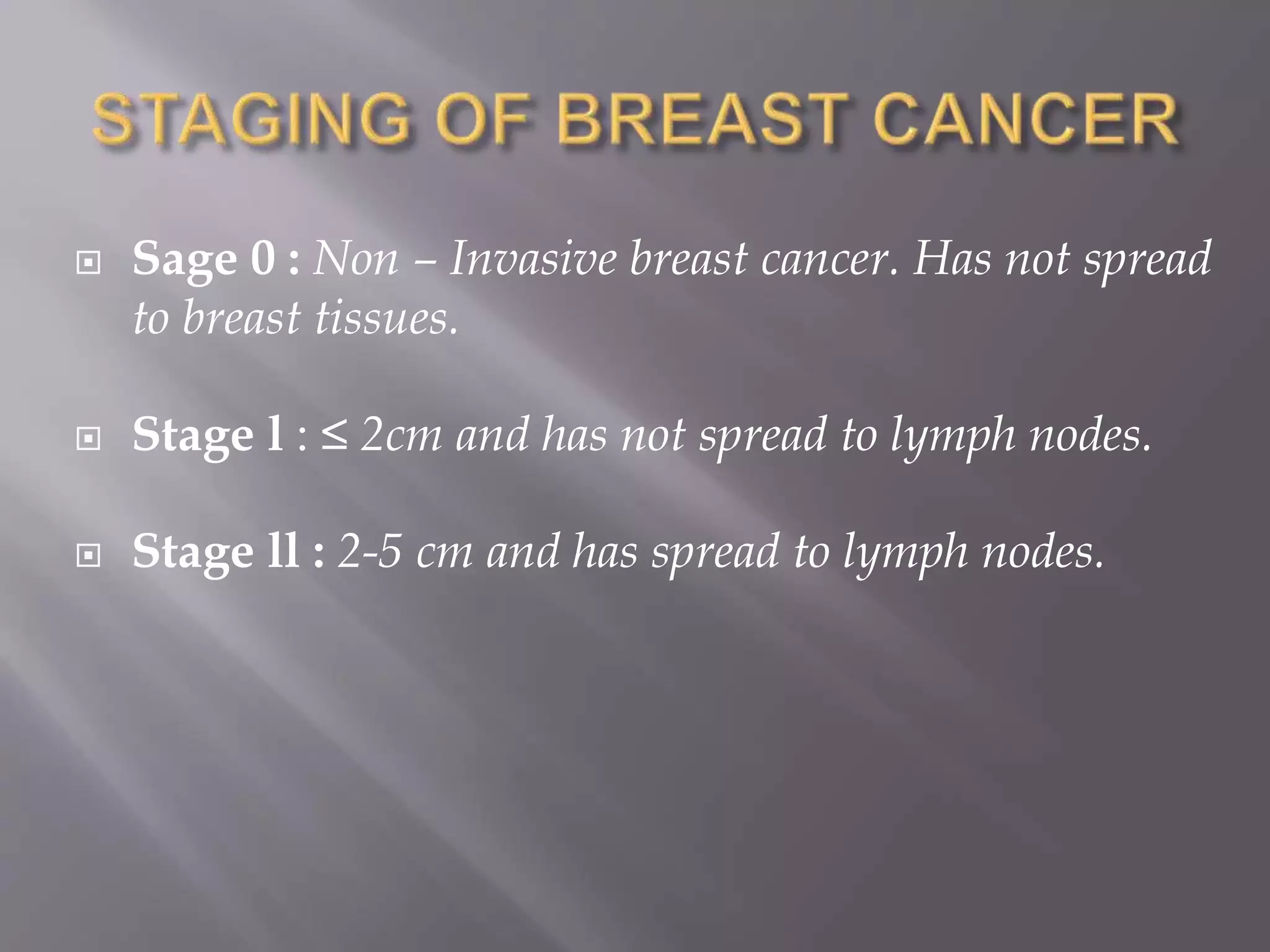
Sage 0: Non – Invasive breast cancer. Has not spread
to breast tissues.
Stage l : ≤ 2cm and has not spread to lymph nodes.
Stage ll : 2-5 cm and has spread to lymph nodes.
32.
Stage lll
StagelllA: >5 cm and spread to lymph
nodes without forming clumps.
Stage lllB: Any size and spread to the skin or
chest wall. Swelling.
Stage lllC: Any size , spread to lymph nodes, skin
and chest wall.
Stage lV: Metastasized
34.
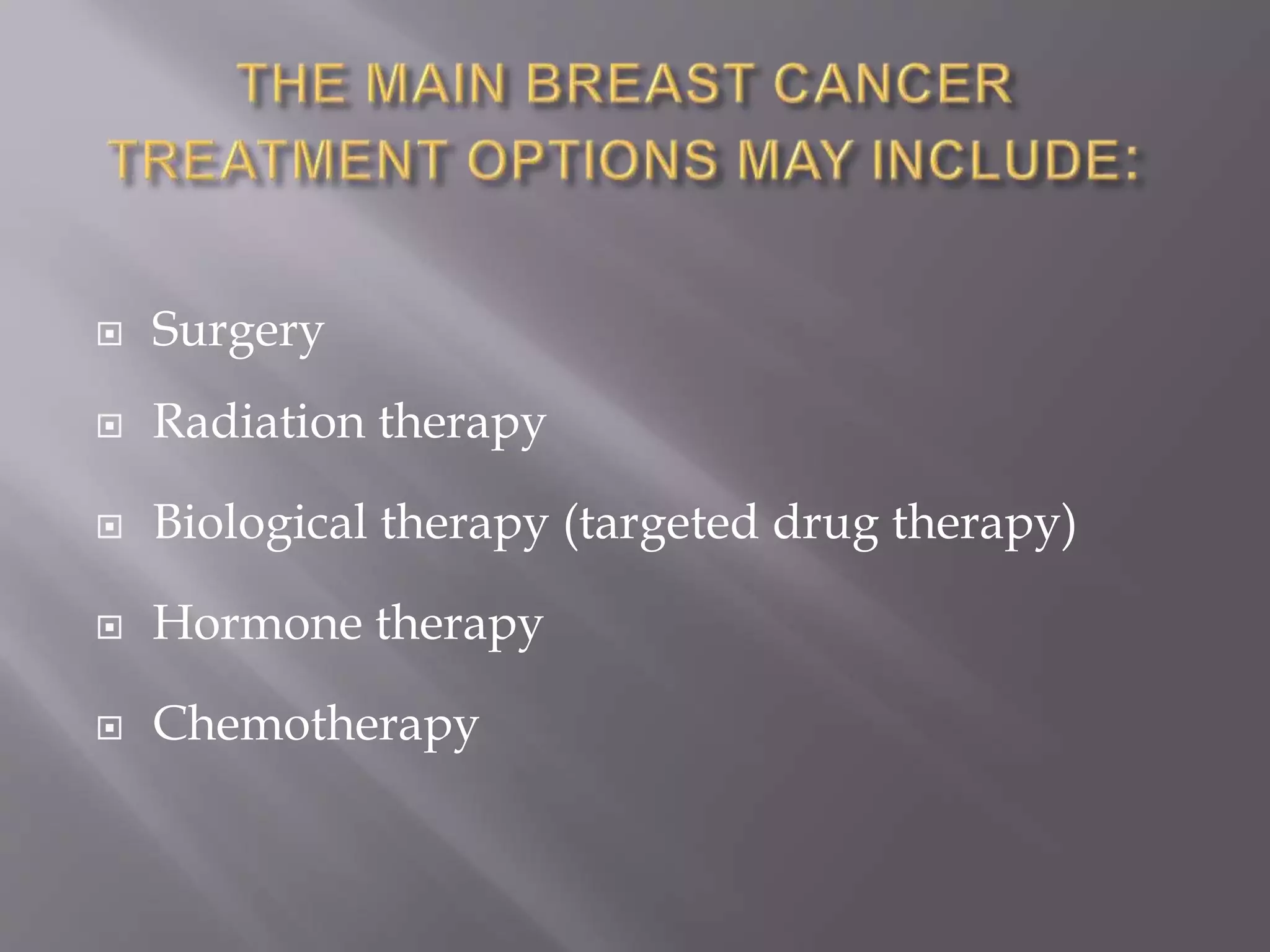
Surgery
Radiationtherapy
Biological therapy (targeted drug therapy)
Hormone therapy
Chemotherapy
35.
Surgery for breastcancer:
Lumpectomy
Mastectomy
Lymph node surgery:
Sentinel node biopsy
Axillary lymph node dissection
Breast reconstruction surgery
36.
Surgically removingthe tumor and a small
margin of healthy tissue around it.
Followed by radiation therapy
37.
Surgically removingthe breast and other
infected components.
Mastectomy
A simple
mastectomy.
A Radical
mastectomy.
Modified radical
mastectomy.
38.
Simple mastectomy: removing the lobules,
ducts, fatty tissue, nipple, areola, and some skin.
Modified radical mastectomy: simple
mastectomy combined with the removal of the
axillary lymph nodes.
Radical mastectomy: a simple mastectomy
combined with removing the lymph nodes and
muscles of the chest wall.
39.
Radiation therapyis treatment with high-
energy rays (such as x-rays) or particles to kill
cancer cells.
The patient may require three to five sessions
per week for three to six weeks.
40.
Breast radiationtherapy – applied after a
lumpectomy,.
Chest wall radiation therapy – applied after a
mastectomy
Breast boost - a high-dose of radiation therapy
is applied to where the tumor was surgically
removed.
Lymph nodes radiation therapy - aimed at the
axilla and surrounding area to destroy cancer
cells that have reached the lymph nodes
41.
Chemotherapy (chemo)is the use of cancer-killing
drugs.
Intravenously, given as a shot, or taken as a pill or
liquid.
They enter the bloodstream and reach most parts of
the body.
Combats metastasis.
Damage some normal cells.
42.
Used forbreast cancers that are sensitive to
hormones.
These types of cancer are often referred to as ER
positive (estrogen receptor positive) and PR
positive (progesterone receptor positive) cancers.
Estrogen and progesterone promotes cancer
growth.
Estrogen and progesterone are blocked using
certain drugs.
43.
Short – termside effects
· Hair loss
· Loss of appetite or increased appetite
· Nausea and vomiting
· A higher risk of infection (low WBC count)
· Stopping of menstrual periods
· Easy bruising or bleeding (low platelets)
· Being very tired
44.
Long - termside effects
Menstrual changes: infertility
Nerve damage: pain, burning or tingling and
sensitivity to cold or hot.
Heart damage