By- 
Shashank 
Surjeet 
Suma 
Joshpin Bala.B
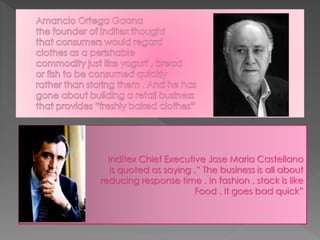
Inditex Chief Executive Jose Maria Castellano 
Is quoted as saying ,” The business is all about 
reducing response time . In fashion , stock is like 
Food . It goes bad quick”
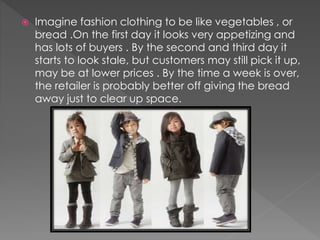
 Imagine fashion clothing to be like vegetables , or 
bread .On the first day it looks very appetizing and 
has lots of buyers . By the second and third day it 
starts to look stale, but customers may still pick it up, 
may be at lower prices . By the time a week is over, 
the retailer is probably better off giving the bread 
away just to clear up space.
 Zara which contributes around 80% of 
group sales concentrates on three 
winning formulae to bake its fresh 
fashions: 
 Short Lead Time=More fashionable clothes 
 Lower quantities=Scarce supply 
 More styles=More choice , and more 
chances of hitting it right.
 By focusing on shorter response time , the 
company ensures that its stores are able to 
carry clothes that the consumers want at 
that time. 
 Zara can move from identifying a trend to 
having clothes in its stores within 30 days. 
 Unlike other retailers , Zara’s machinery can 
react to the report immediately and 
produce a response in terms of a new style 
or a modification within 2 to 4 weeks.
 By reducing the quantity manufactured 
in each style, Zara not only reduces its 
exposure to any single product but also 
creates an artificial scarcity. 
 As with all things fashionable , the less its 
availability , the more desirable the 
object becomes.
 What sets Zara apart from many of its 
competitors is what it has done to its 
business information and business 
process. 
 Rather than concentrating on 
forecasting accurately , it has 
developed its business around reacting 
swiftly.
 Zara’s success is as much as result of its history and 
location , as its counter-intuitive business strategies. 
While it may not be possible for another company 
to exactly duplicate the conditions under which 
Zara grew but we can certainly try and learn from 
its experiences.
 Four critical information-related areas 
that give Zara its speed include: 
 Collecting information on consumer 
needs. 
 Standardization of product information. 
 Product information and inventory 
management. 
 Distribution management.
Thank you !!

Marketing case study

  • 1.
    By- Shashank Surjeet Suma Joshpin Bala.B
  • 2.
    Inditex Chief ExecutiveJose Maria Castellano Is quoted as saying ,” The business is all about reducing response time . In fashion , stock is like Food . It goes bad quick”
  • 3.
     Imagine fashionclothing to be like vegetables , or bread .On the first day it looks very appetizing and has lots of buyers . By the second and third day it starts to look stale, but customers may still pick it up, may be at lower prices . By the time a week is over, the retailer is probably better off giving the bread away just to clear up space.
  • 4.
     Zara whichcontributes around 80% of group sales concentrates on three winning formulae to bake its fresh fashions:  Short Lead Time=More fashionable clothes  Lower quantities=Scarce supply  More styles=More choice , and more chances of hitting it right.
  • 5.
     By focusingon shorter response time , the company ensures that its stores are able to carry clothes that the consumers want at that time.  Zara can move from identifying a trend to having clothes in its stores within 30 days.  Unlike other retailers , Zara’s machinery can react to the report immediately and produce a response in terms of a new style or a modification within 2 to 4 weeks.
  • 6.
     By reducingthe quantity manufactured in each style, Zara not only reduces its exposure to any single product but also creates an artificial scarcity.  As with all things fashionable , the less its availability , the more desirable the object becomes.
  • 8.
     What setsZara apart from many of its competitors is what it has done to its business information and business process.  Rather than concentrating on forecasting accurately , it has developed its business around reacting swiftly.
  • 9.
     Zara’s successis as much as result of its history and location , as its counter-intuitive business strategies. While it may not be possible for another company to exactly duplicate the conditions under which Zara grew but we can certainly try and learn from its experiences.
  • 10.
     Four criticalinformation-related areas that give Zara its speed include:  Collecting information on consumer needs.  Standardization of product information.  Product information and inventory management.  Distribution management.
  • 11.