BALANCE SCORE
CARD
&
JUST IN TIME
GROUP MEMBERS
GUNJAN BURGHATE 133
AJINKYA PALKAR 135
PRATHAMESH GAWANE 137
PRASHANSA MISHRA 139
NILESH POSAM 141
The Balanced Scorecard’s
Emergence
• Robert Kaplan and David Norton first
publicized the balanced scorecard in a series
of journal articles and published this concept
in their book, The Balanced Scorecard.
• Since then it has evolved to become more
workable in practice, focusing more on
design processes.
INTRODUCTION
The balanced scorecard is a strategic planning and
management system
used extensively in business and industry,
government, and nonprofit organizations
improve internal and external communications,
and monitor organization performance against
strategic goals.
WHAT IS THE BALANCED
SCORECARD (BSC)?
• The scorecard emerged in response to
organizations’ gap between short-term financial
activities and long-term strategy.
• It is not a replacement for budgeting but merely a
complement in the sense allows businesses to set
performance benchmarks in non-financial areas.
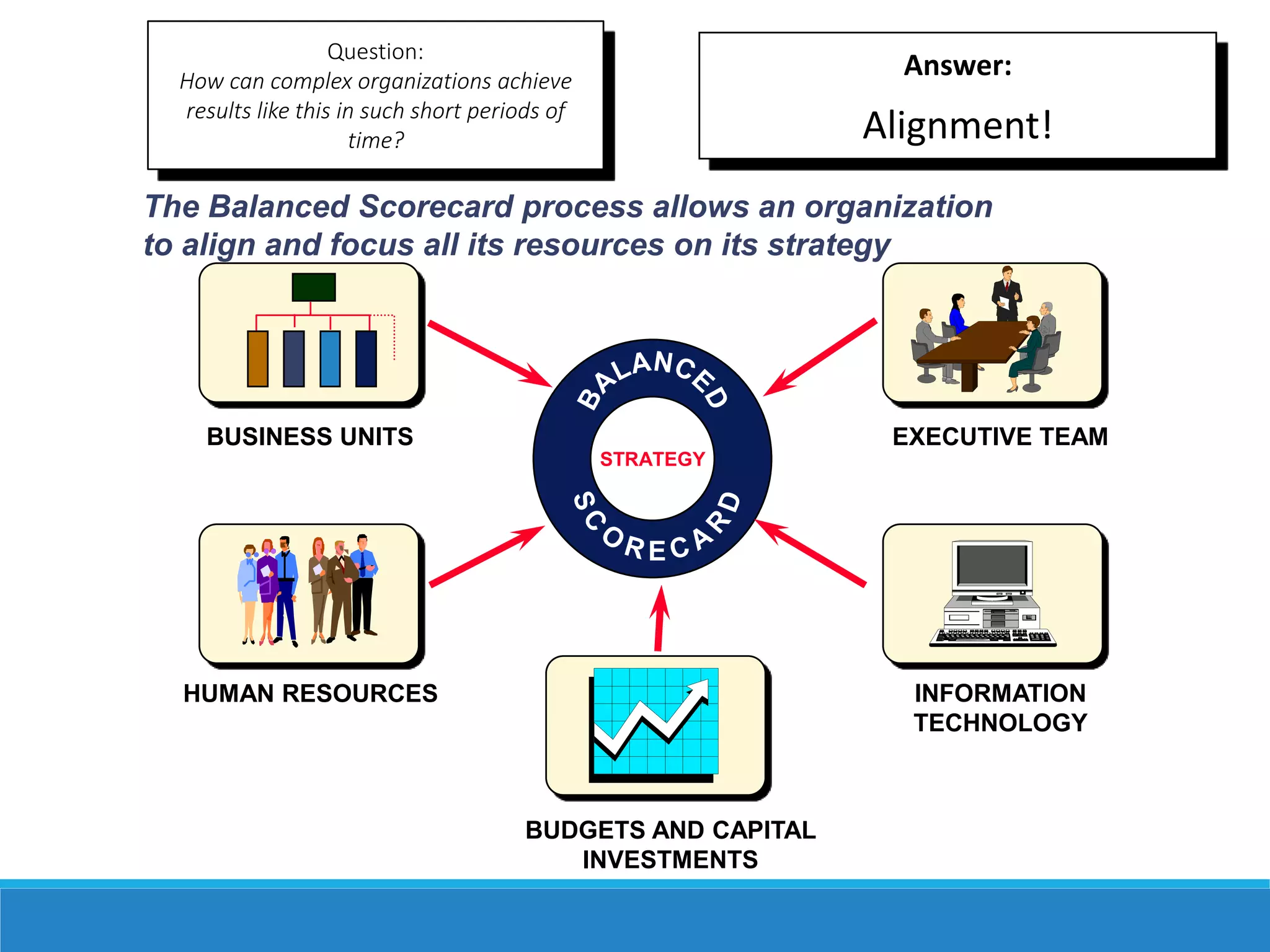
STRATEGY
HUMAN RESOURCES
BUSINESS UNITS EXECUTIVE TEAM
INFORMATION
TECHNOLOGY
BUDGETS AND CAPITAL
INVESTMENTS
The Balanced Scorecard process allows an organization
to align and focus all its resources on its strategy
Question:
How can complex organizations achieve
results like this in such short periods of
time?
Answer:
Alignment!
WHAT IS THE BALANCED
SCORECARD (BSC)?
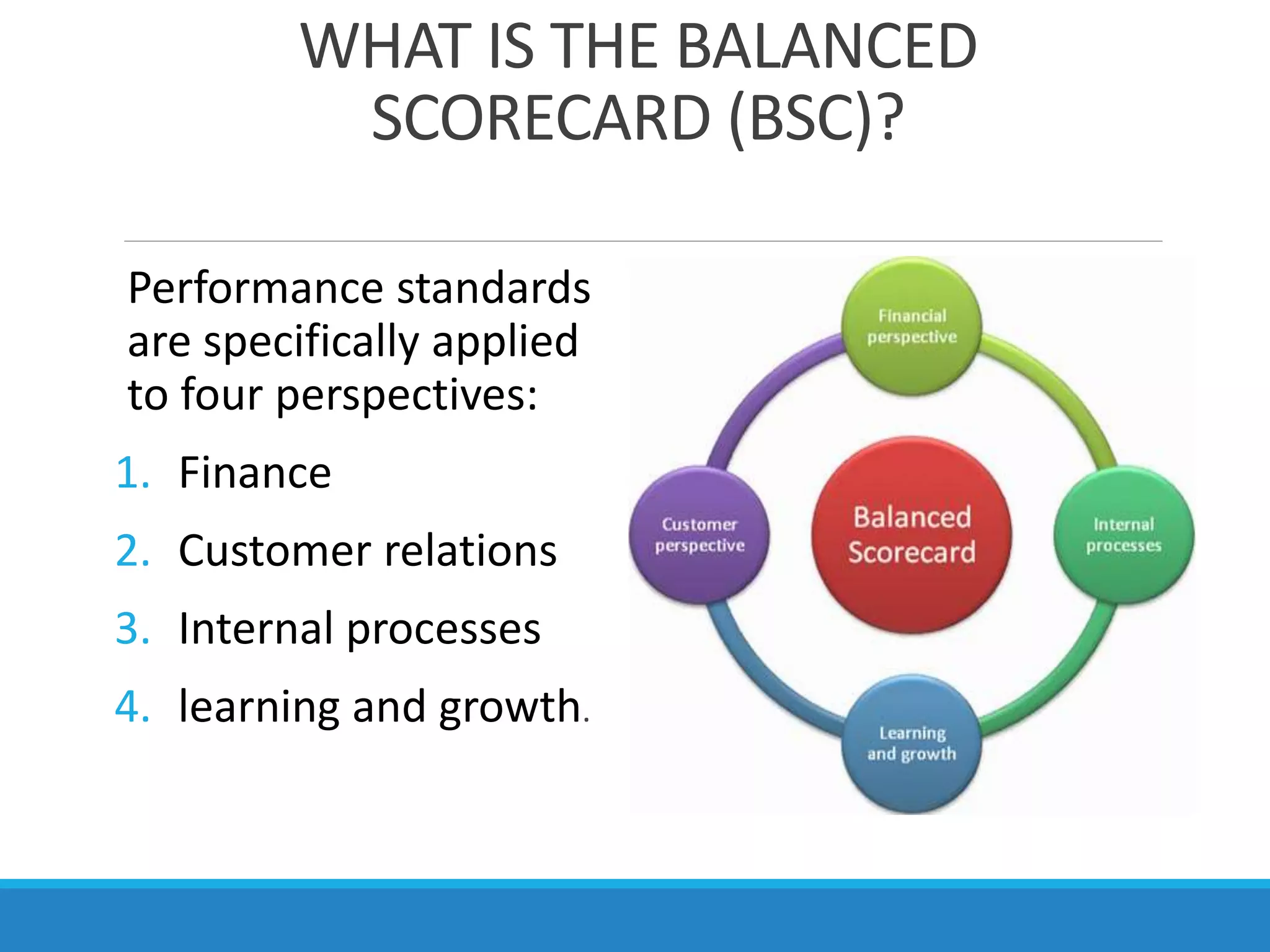
Performance standards
are specifically applied
to four perspectives:
1. Finance
2. Customer relations
3. Internal processes
4. learning and growth.
WHAT IS THE BALANCED
SCORECARD (BSC)?
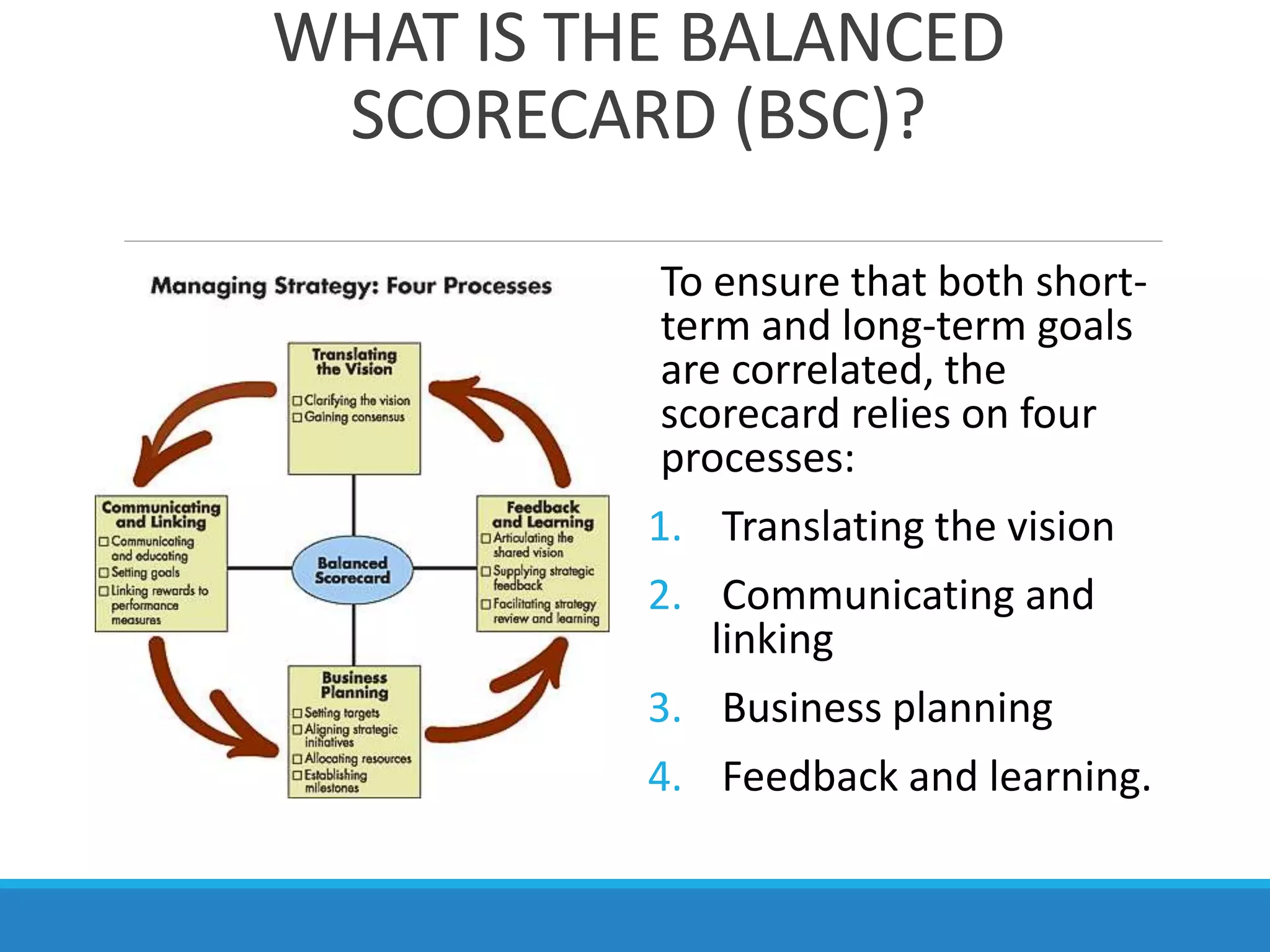
To ensure that both short-
term and long-term goals
are correlated, the
scorecard relies on four
processes:
1. Translating the vision
2. Communicating and
linking
3. Business planning
4. Feedback and learning.
HOW IS THE BALANCED
SCORECARD USED?
• Translating the vision: helping all employees
understand how their day-to-day work contributes
to long-term goals.
• Communicating and linking: disseminating long-
term goals both up and down an organizational
hierarchy, ensuring that both departmental and
individuals objectives are in alignment.
How is the Balanced Scorecard Used?
• Business planning: taking long-term strategy and
using it as the basis for how resources and capital
are allocated.
• Feedback and learning: the scorecard enables
strategic and real-time learning because it
measures daily performance and spending in the
context of overarching goals, allowing organizations
to make necessary changes.
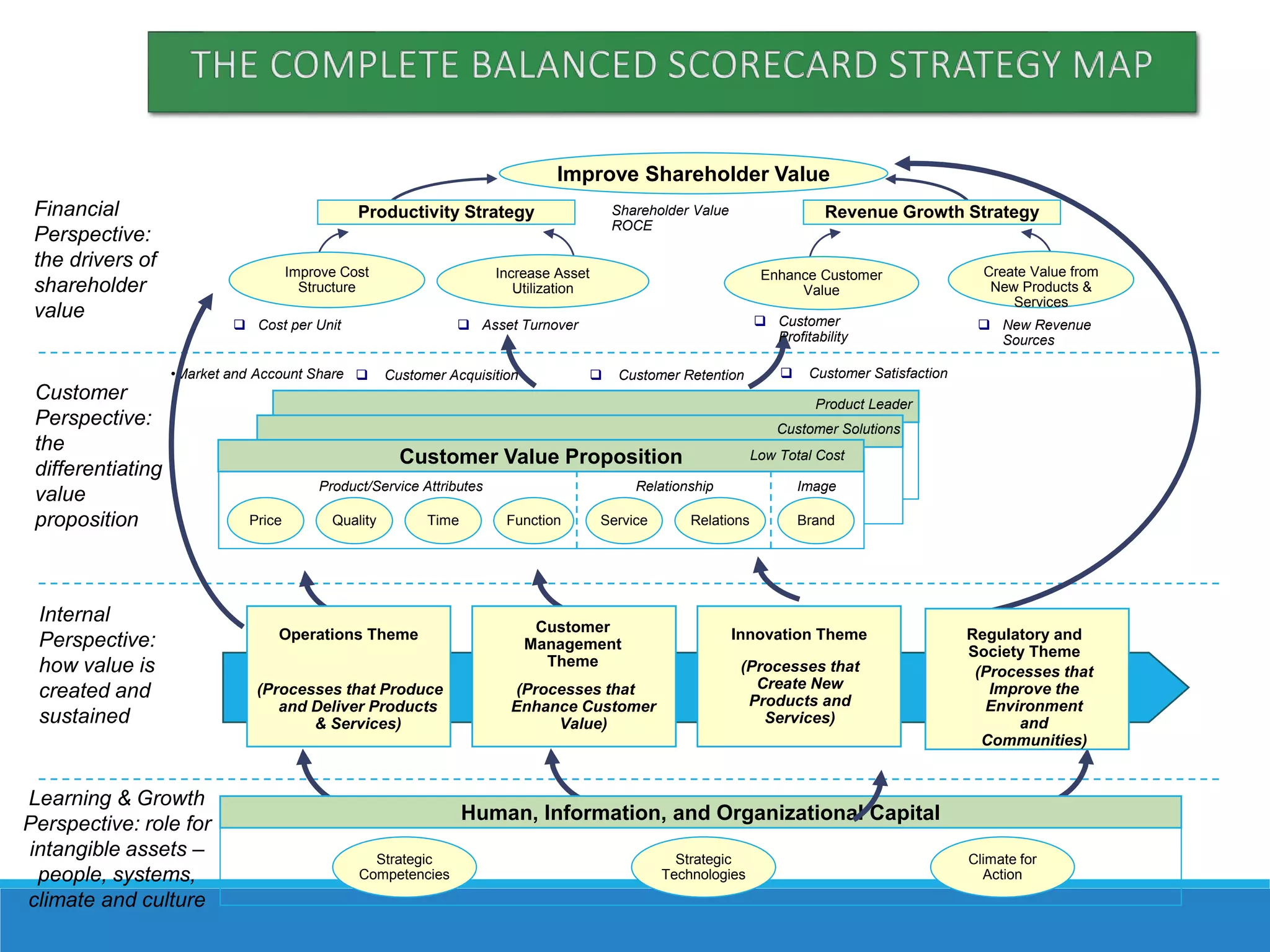
Improve Shareholder Value
Productivity Strategy Revenue Growth Strategy
Improve Cost
Structure
Increase Asset
Utilization
Enhance Customer
Value
Create Value from
New Products &
Services
Human, Information, and Organizational Capital
Shareholder Value
ROCE
 Cost per Unit  Asset Turnover  Customer
Profitability
 New Revenue
Sources
Price
Financial
Perspective:
the drivers of
shareholder
value
Product/Service Attributes
Strategic
Competencies
Strategic
Technologies
Climate for
Action
(Processes that Produce
and Deliver Products
& Services)
(Processes that
Enhance Customer
Value)
Operations Theme Customer
Management
Theme
Innovation Theme Regulatory and
Society Theme
Customer Value Proposition
Quality
Low Total Cost
Customer Solutions
Product Leader
 Customer Satisfaction Customer Acquisition  Customer Retention
Time Function Service Relations Brand
Relationship Image
•Market and Account Share
Customer
Perspective:
the
differentiating
value
proposition
Internal
Perspective:
how value is
created and
sustained
Learning & Growth
Perspective: role for
intangible assets –
people, systems,
climate and culture
(Processes that
Create New
Products and
Services)
(Processes that
Improve the
Environment
and
Communities)
INTRODUCTION
• Just in time (JIT) is a production strategy that
strives to improve a business return on
investment by reducing in-process inventory and
associated carrying costs.
• Implemented correctly, JIT focuses on continuous
improvement and can improve a manufacturing
organization's return on investment, quality, and
efficiency.
INTRODUCTION (contd)
• The philosophy of JIT is simple: the storage of
unused inventory is a waste of resources.
• JIT inventory systems expose hidden cost of
keeping inventory, and are therefore not a simple
solution for a company to adopt it.
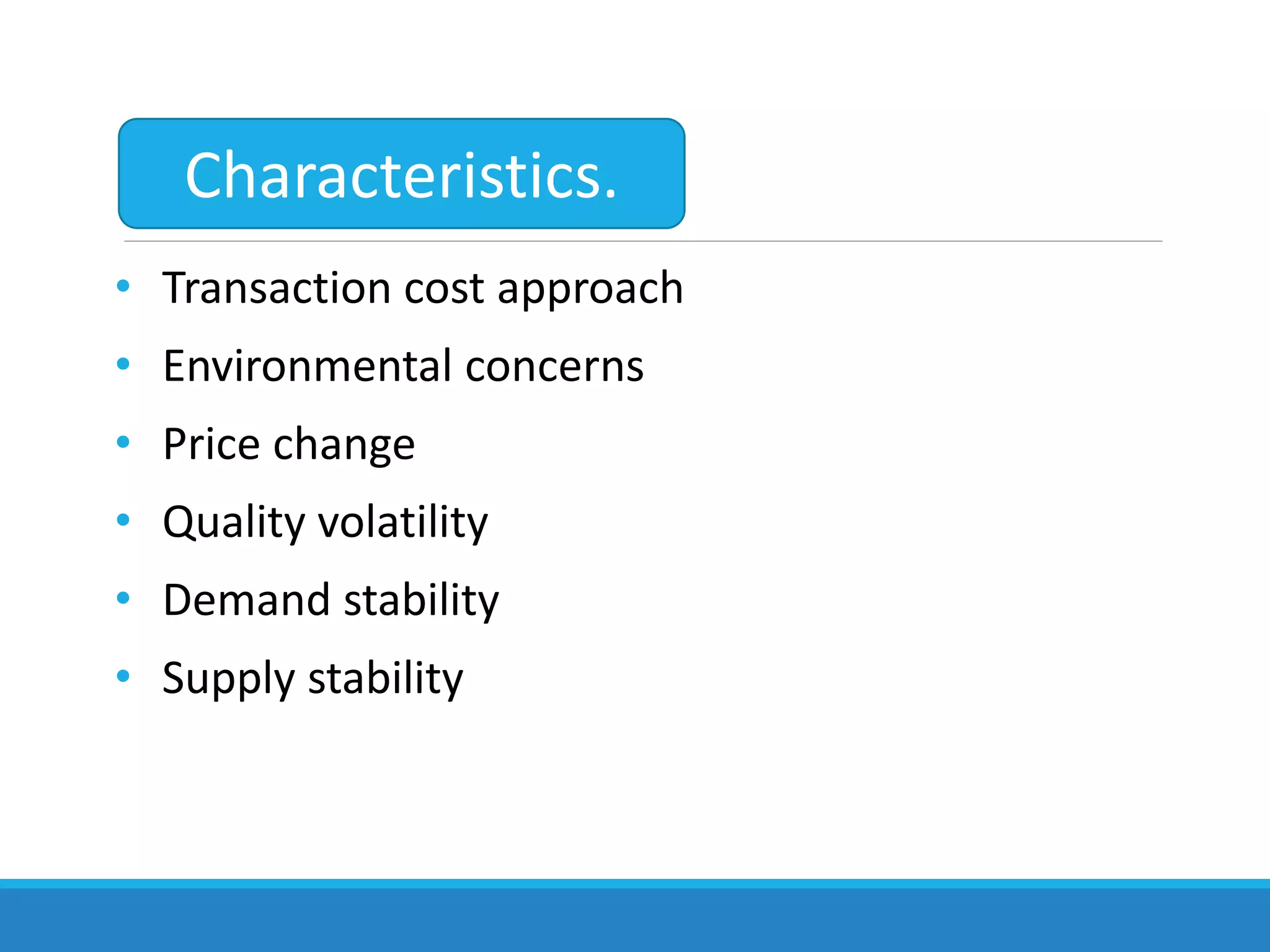
• Transaction cost approach
• Environmental concerns
• Price change
• Quality volatility
• Demand stability
• Supply stability
Characteristics.
• Vendor-managed inventory
• Customer-managed inventory
Business models following similar approach
• A surprising effect of JIT was that car factory response time
fell to about a day. This improved customer satisfaction by
providing vehicles within a day or two of the minimum
economic shipping delay.
• Also, the factory began building many vehicles to order,
eliminating the risk they would not be sold. This improved
the company's return on equity.
EFFECTS
•The result was a factory that has been studied
worldwide. It has been widely emulated, but not
always with the expected results, as many firms fail
to adopt the full system.
•The just-in-time philosophy was also applied to
other segments of the supply chain in several types
of industries.
• Within a JIT system
• Within a raw material stream
• Oil
PROBLEMS
ELEMENTS OF JIT
Stabilize and level the MPs with uniform plant
loading
Reduce or eliminate setup times
Reduce lot sizes
Reduce lead times
Flexible work force
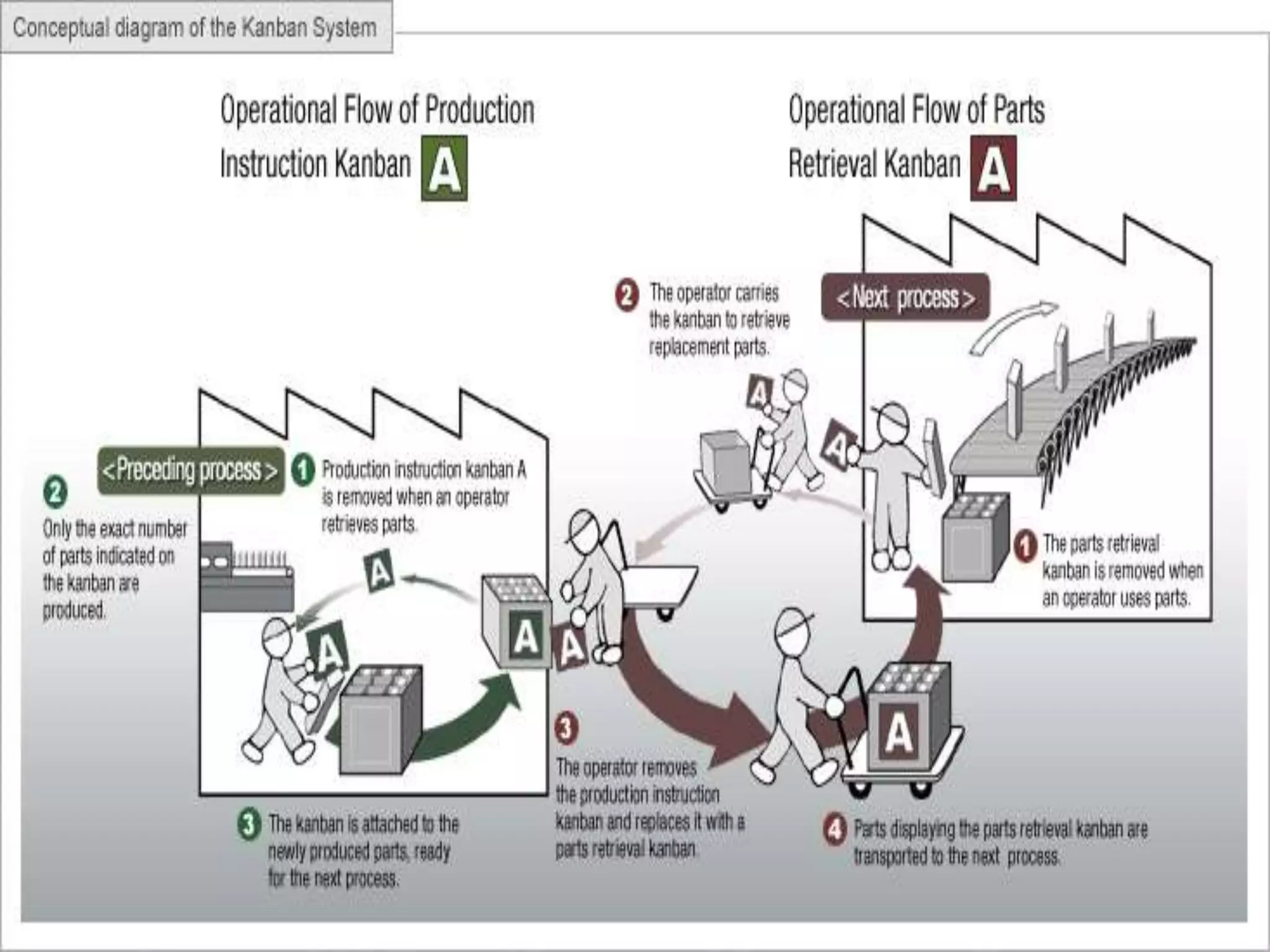
KANBAN
Kanban was developed by Taiichi Ohno, at Toyota,
to find a system to improve and maintain a high
level of production.
To meet JIT objectives, the process relies on signals
or Kanban.
Kanban is a system to control the logistical chain
from a production point of view, and is not
an inventory control system.
Kanban are usually 'tickets' but can be simple visual
signals, such as the presence of a part on a shelf.
EXAMPLES
A type of JIT was used successfully in the UK by Perkins to supply F3
engines to Ford from 1957 until 1964.
Applications Of Just-In-Time
Toyota
Toyota is considered by many to be the poster child for
JIT success. The Toyota production strategy is highlighted
by the fact that raw materials are not brought to the
production floor until an order is received and this
product is ready to be built. No parts are allowed at a
node unless they are required for the next node, or they
are part of an assembly for the next node
Dell
Dell is able to provide exceptionally short lead times
to their customers, by forcing their suppliers to
carry inventory instead of carrying it themselves
and then demanding (and receiving) short lead
times on components so that products can be
simply assembled by Dell quickly and then shipped
to the customer.
Harley Davidson
Applications of Balance Score
Card
Shat-R-Shield
Kenya Red Cross
Douglas County Government
VEOLIA Water
Etc
Conclusion
•Just-in-Time is an operational technique which
helps reduce the lead time which gives a higher
return on investment by reducing the in-process
inventory costs and the carrying cost of the
inventory.
•Has helped many Companies worldwide to reduce
their inventory carrying costs and as a result add to
the profit margin.

Balance Score Card & Just In Time

  • 1.
  • 2.
    GROUP MEMBERS GUNJAN BURGHATE133 AJINKYA PALKAR 135 PRATHAMESH GAWANE 137 PRASHANSA MISHRA 139 NILESH POSAM 141
  • 4.
    The Balanced Scorecard’s Emergence •Robert Kaplan and David Norton first publicized the balanced scorecard in a series of journal articles and published this concept in their book, The Balanced Scorecard. • Since then it has evolved to become more workable in practice, focusing more on design processes.
  • 5.
    INTRODUCTION The balanced scorecardis a strategic planning and management system used extensively in business and industry, government, and nonprofit organizations improve internal and external communications, and monitor organization performance against strategic goals.
  • 6.
    WHAT IS THEBALANCED SCORECARD (BSC)? • The scorecard emerged in response to organizations’ gap between short-term financial activities and long-term strategy. • It is not a replacement for budgeting but merely a complement in the sense allows businesses to set performance benchmarks in non-financial areas.
  • 7.
    STRATEGY HUMAN RESOURCES BUSINESS UNITSEXECUTIVE TEAM INFORMATION TECHNOLOGY BUDGETS AND CAPITAL INVESTMENTS The Balanced Scorecard process allows an organization to align and focus all its resources on its strategy Question: How can complex organizations achieve results like this in such short periods of time? Answer: Alignment!
  • 8.
    WHAT IS THEBALANCED SCORECARD (BSC)? Performance standards are specifically applied to four perspectives: 1. Finance 2. Customer relations 3. Internal processes 4. learning and growth.
  • 9.
    WHAT IS THEBALANCED SCORECARD (BSC)? To ensure that both short- term and long-term goals are correlated, the scorecard relies on four processes: 1. Translating the vision 2. Communicating and linking 3. Business planning 4. Feedback and learning.
  • 10.
    HOW IS THEBALANCED SCORECARD USED? • Translating the vision: helping all employees understand how their day-to-day work contributes to long-term goals. • Communicating and linking: disseminating long- term goals both up and down an organizational hierarchy, ensuring that both departmental and individuals objectives are in alignment.
  • 11.
    How is theBalanced Scorecard Used? • Business planning: taking long-term strategy and using it as the basis for how resources and capital are allocated. • Feedback and learning: the scorecard enables strategic and real-time learning because it measures daily performance and spending in the context of overarching goals, allowing organizations to make necessary changes.
  • 12.
    Improve Shareholder Value ProductivityStrategy Revenue Growth Strategy Improve Cost Structure Increase Asset Utilization Enhance Customer Value Create Value from New Products & Services Human, Information, and Organizational Capital Shareholder Value ROCE  Cost per Unit  Asset Turnover  Customer Profitability  New Revenue Sources Price Financial Perspective: the drivers of shareholder value Product/Service Attributes Strategic Competencies Strategic Technologies Climate for Action (Processes that Produce and Deliver Products & Services) (Processes that Enhance Customer Value) Operations Theme Customer Management Theme Innovation Theme Regulatory and Society Theme Customer Value Proposition Quality Low Total Cost Customer Solutions Product Leader  Customer Satisfaction Customer Acquisition  Customer Retention Time Function Service Relations Brand Relationship Image •Market and Account Share Customer Perspective: the differentiating value proposition Internal Perspective: how value is created and sustained Learning & Growth Perspective: role for intangible assets – people, systems, climate and culture (Processes that Create New Products and Services) (Processes that Improve the Environment and Communities)
  • 14.
    INTRODUCTION • Just intime (JIT) is a production strategy that strives to improve a business return on investment by reducing in-process inventory and associated carrying costs. • Implemented correctly, JIT focuses on continuous improvement and can improve a manufacturing organization's return on investment, quality, and efficiency.
  • 15.
    INTRODUCTION (contd) • Thephilosophy of JIT is simple: the storage of unused inventory is a waste of resources. • JIT inventory systems expose hidden cost of keeping inventory, and are therefore not a simple solution for a company to adopt it.
  • 16.
    • Transaction costapproach • Environmental concerns • Price change • Quality volatility • Demand stability • Supply stability Characteristics.
  • 17.
    • Vendor-managed inventory •Customer-managed inventory Business models following similar approach
  • 18.
    • A surprisingeffect of JIT was that car factory response time fell to about a day. This improved customer satisfaction by providing vehicles within a day or two of the minimum economic shipping delay. • Also, the factory began building many vehicles to order, eliminating the risk they would not be sold. This improved the company's return on equity. EFFECTS
  • 19.
    •The result wasa factory that has been studied worldwide. It has been widely emulated, but not always with the expected results, as many firms fail to adopt the full system. •The just-in-time philosophy was also applied to other segments of the supply chain in several types of industries.
  • 20.
    • Within aJIT system • Within a raw material stream • Oil PROBLEMS
  • 21.
    ELEMENTS OF JIT Stabilizeand level the MPs with uniform plant loading Reduce or eliminate setup times Reduce lot sizes Reduce lead times Flexible work force
  • 22.
    KANBAN Kanban was developedby Taiichi Ohno, at Toyota, to find a system to improve and maintain a high level of production. To meet JIT objectives, the process relies on signals or Kanban. Kanban is a system to control the logistical chain from a production point of view, and is not an inventory control system. Kanban are usually 'tickets' but can be simple visual signals, such as the presence of a part on a shelf.
  • 23.
    EXAMPLES A type ofJIT was used successfully in the UK by Perkins to supply F3 engines to Ford from 1957 until 1964.
  • 24.
    Applications Of Just-In-Time Toyota Toyotais considered by many to be the poster child for JIT success. The Toyota production strategy is highlighted by the fact that raw materials are not brought to the production floor until an order is received and this product is ready to be built. No parts are allowed at a node unless they are required for the next node, or they are part of an assembly for the next node
  • 25.
    Dell Dell is ableto provide exceptionally short lead times to their customers, by forcing their suppliers to carry inventory instead of carrying it themselves and then demanding (and receiving) short lead times on components so that products can be simply assembled by Dell quickly and then shipped to the customer. Harley Davidson
  • 27.
    Applications of BalanceScore Card Shat-R-Shield Kenya Red Cross Douglas County Government VEOLIA Water Etc
  • 28.
    Conclusion •Just-in-Time is anoperational technique which helps reduce the lead time which gives a higher return on investment by reducing the in-process inventory costs and the carrying cost of the inventory. •Has helped many Companies worldwide to reduce their inventory carrying costs and as a result add to the profit margin.

Editor's Notes

  • #15  To meet JIT objectives, the process relies on signals or Kanban (看板?, Kanban) between different points, which are involved in the process, which tell production when to make the next part. Kanban are usually 'tickets' but can be simple visual signals, such as the presence or absence of a part on a shelf. 
  • #17 -Transaction cost approach JIT helps in keeping inventory to minimum in a firm. However, a firm may simply be outsourcing their input inventory to suppliers, even if those suppliers don't use Just-in-Time (Naj 1993). Newman (1994) investigated this effect and found that suppliers in Japan charged JIT customers, on average, a 5% price premium. -Environmental concerns During the birth of JIT, multiple daily deliveries were often made by bicycle. Increased scale has required a move to vans and trucks (lorries). Cusumano (1994) highlighted the potential and actual problems this causes with regard to gridlock and burning of fossil fuels. This violates three JIT waste guidelines: 1.Time—wasted in traffic jams 2.Inventory—specifically pipeline (in transport) inventory 3.Scrap—fuel burned while not physically moving -Price change Because Just-In-Time manufacturer's do not store raw materials, they can be affected more drastically by the effects of changing prices. -Quality volatility JIT implicitly assumes that input parts quality remains constant over time. If not, firms may hoard high-quality inputs. As with price volatility, a solution is to work with selected suppliers to help them improve their processes to reduce variation and costs. Longer term price agreements can then be negotiated and agreed-on quality standards made the responsibility of the supplier. Fixing up of standards for volatility of quality according to the quality circle -Demand stability Karmarker (1989) highlights the importance of relatively stable demand, which helps ensure efficient capital utilization rates. Karmarker cost production. -Supply stability In the U.S., the 1992 railway strikes caused General Motors to idle a 75,000-worker plant because they had no supply.
  • #21 Within a JIT system Just-in-time operation leaves suppliers and downstream consumers open to supply shocks and large supply or demand changes. For internal reasons, Ohno saw this as a feature rather than a bug. He used an analogy of lowering the water level in a river to expose the rocks to explain how removing inventory showed where production flow was interrupted. Once barriers were exposed, they could be removed. Since one of the main barriers was rework, lowering inventory forced each shop to improve its own quality or cause a holdup downstream. A key tool to manage this weakness is production levelling to remove these variations. Just-in-time is a means to improving performance of the system, not an end. Very low stock levels means shipments of the same part can come in several times per day. This means Toyota is especially susceptible to flow interruption. For that reason, Toyota uses two suppliers for most assemblies. As noted in Liker (2003), there was an exception to this rule that put the entire company at risk because of the 1997 Aisin fire. However, since Toyota also makes a point of maintaining high quality relations with its entire supplier network, several other suppliers immediately took up production of the Aisin-built parts by using existing capability and documentation. Within a raw material stream This section contains wording that promotes the subject in a subjective manner without imparting real information. Please remove or replace such wording and instead of making proclamations about a subject's importance, use facts and attribution to demonstrate that importance. (October 2008)As noted by Liker (2003) and Womack and Jones (2003), it ultimately would be desirable to introduce synchronised flow and link JIT through the entire supply stream. However, none followed this in detail all the way back through the processes to the raw materials. With present technology, for example, an ear of corn cannot be grown and delivered to order. The same is true of most raw materials, which must be discovered and/or grown through natural processes that require time and must account for natural variability in weather and discovery. The part of this currently viewed as impossible is the synchronised part of flow and the linked part of JIT. It is for the reasons stated raw materials companies decouple their supply chain from their clients' demand by carrying large 'finished goods' stocks. Both flow and JIT can be implemented in isolated process islands within the raw materials stream. The challenge becomes to achieve that isolation by some means other than carrying huge stocks, as most do today. Because of this, almost all value chains are split into a part made-to-forecast and a part that could, by using JIT, become make-to-order. Historically, the make-to-order part has often been within the retailer portion of the value chain. Toyota took Piggly Wiggly's supermarket replenishment system and drove it at least halfway through their automobile factories. Their challenge today is to drive it all the way back to their goods-inwards dock. Of course, the mining of iron and making of steel is still not connected to an order for a particular car. Recognising JIT could be driven back up the supply chain has reaped Toyota huge benefits and a dominant position in the auto industry. Note that the advent of the mini mill steelmaking facility is starting to challenge how far back JIT can be implemented, as the electric arc furnaces at the heart of many mini-mills can be started and stopped quickly, and steel grades changed rapidly. Oil It has been frequently charged that the oil industry has been influenced by JIT. The argument is presented as follows: The number of refineries in the United States has fallen from 279 in 1975 to 205 in 1990 and further to 149 in 2004. As a result, the industry is susceptible to supply shocks, which cause spikes in prices and subsequently reduction in domestic manufacturing output. The effects of hurricanes Katrina and Rita are given as an example: in 2005, Katrina caused the shutdown of 9 refineries in Louisiana and 6 more in Mississippi, and a large number of oil production and transfer facilities, resulting in the loss of 20% of the US domestic refinery output. Rita subsequently shut down refineries in Texas, further reducing output. The GDP figures for the third and fourth quarters showed a slowdown from 3.5% to 1.2% growth. Similar arguments were made in earlier crises.Beside the obvious point that prices went up because of the reduction in supply and not for anything to do with the practice of JIT, JIT students and even oil and gas industry analysts question whether JIT as it has been developed by Ohno, Goldratt, and others is used by the petroleum industry. Companies routinely shut down facilities for reasons other than the application of JIT. One of those reasons may be economic rationalization: when the benefits of operating no longer outweigh the costs, including opportunity costs, the plant may be economically inefficient. JIT has never subscribed to such considerations directly; following Waddel and Bodek (2005), this ROI-based thinking conforms more to Brown-style accounting and Sloan management. Further, and more significantly, JIT calls for a reduction in inventory capacity, not production capacity. From 1975 to 1990 to 2005, the annual average stocks of gasoline have fallen by only 8.5% from 228,331 to 222,903 bbls to 208,986 (Energy Information Administration data). Stocks fluctuate seasonally by as much as 20,000 bbls. During the 2005 hurricane season, stocks never fell below 194,000,000 bbl (30,800,000 m3), while the low for the period 1990 to 2006 was 187,017,000 bbl (29,733,300 m3) in 1997. This shows that while industry storage capacity has decreased in the last 30 years, it hasn't been drastically reduced as JIT practitioners would prefer. Finally, as shown in a pair of articles in the "Oil & Gas Journal", JIT does not seem to have been a goal of the industry. In Waguespack and Cantor (1996), the authors point out that JIT would require a significant change in the supplier/refiner relationship, but the changes in inventories in the oil industry exhibit none of those tendencies. Specifically, the relationships remain cost-driven among many competing suppliers rather than quality-based among a select few long-term relationships. They find that a large part of the shift came about because of the availability of short-haul crudes from Latin America. In the follow-up editorial, the Oil & Gas Journal claimed that "casually adopting popular business terminology that doesn't apply" had provided a "rhetorical bogey" to industry critics. Confessing that they had been as guilty as other media sources, they confirmed that "It also happens not to be accurate."