
BALANCED SCORE CARD
AKHILESH DUBEY
LBSITM, INDORE
SYNOPSIS
• Introduction.
• What is Balance Score Card?
• Why are companies Adopting Balance
score card?
• Balance Score Card perspective
• Advantages & Disadvantages
• Conclusion.
 The balanced scorecard is a strategic planning and management
system that is used extensively in business and industry,
government, and nonprofit organizations worldwide to align
business activities to the vision and strategy of the organization,
improve internal and external communications, and monitor
organization performance against strategic goals.
Balance Score Card
History…
 It was originated by Drs. Robert Kaplan (Harvard Business School) and
David Norton as a performance measurement framework that added
strategic non-financial performance measures to traditional financial
metrics to give managers and executives a more 'balanced' view of
organizational performance.
 While the phrase balanced scorecard was coined in the early 1990s, the
roots of the this type of approach are deep, and include the pioneering
work of General Electric on performance measurement reporting in the
1950’s and the work of French process engineers (who created
the Tableau de Bord – literally, a "dashboard" of performance measures)
in the early part of the 20th century.
Robert KaplanDavid Norton
Facts about it..
 Gartner Group suggests that over 50% of large US firms have adopted
the BSC. More than half of major companies in the US, Europe and Asia
are using balanced scorecard approaches, with use growing in those
areas as well as in the Middle East and Africa.
 A recent global study by Bain & Co listed balanced scorecard fifth on its
top ten most widely used management tools around the world, a list
that includes closely-related strategic planning at number one.
 Balanced scorecard has also been selected by the editors of Harvard
Business Review as one of the most influential business ideas of the past
75 years.
balanced scorecard
 The balanced scorecard (BSC) is a
strategy performance management tool – a semi-
standard structured report, supported by design
methods and automation tools, that can be used by
managers to keep track of the execution of activities
by the staff within their control and to monitor the
consequences arising from these actions
The phrase 'balanced scorecard' is commonly used in two broad
forms:
 As individual scorecards that contain measures to manage
performance, those scorecards may be operational or have a
more strategic intent; and
 As a Strategic Management System, as originally defined by
Kaplan & Norton.
The critical characteristics that define a balanced
scorecard are:
 its focus on the strategic agenda of the organization
concerned
 the selection of a small number of data items to
monitor
 a mix of financial and non-financial data items.
Balance Score Card
• Four key Business Perspectives
• Internal & Business process of
Organization
• Short Run & Long Run
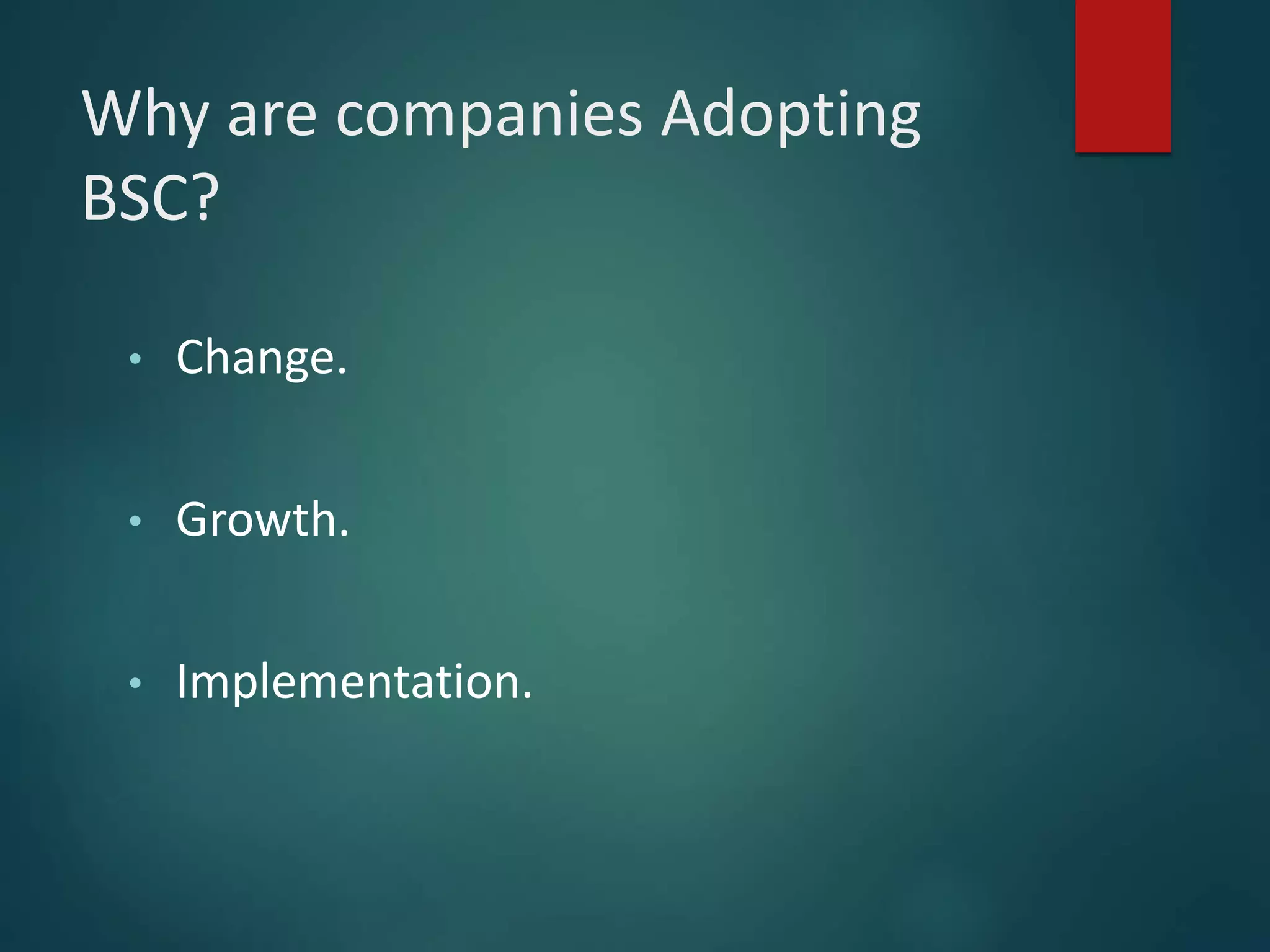
Why are companies Adopting
BSC?
• Change.
• Growth.
• Implementation.
Financial Perspective
Internal Process
Perspective
Learning & Growth
Perspective
Customer
Perspective Vision & Strategy
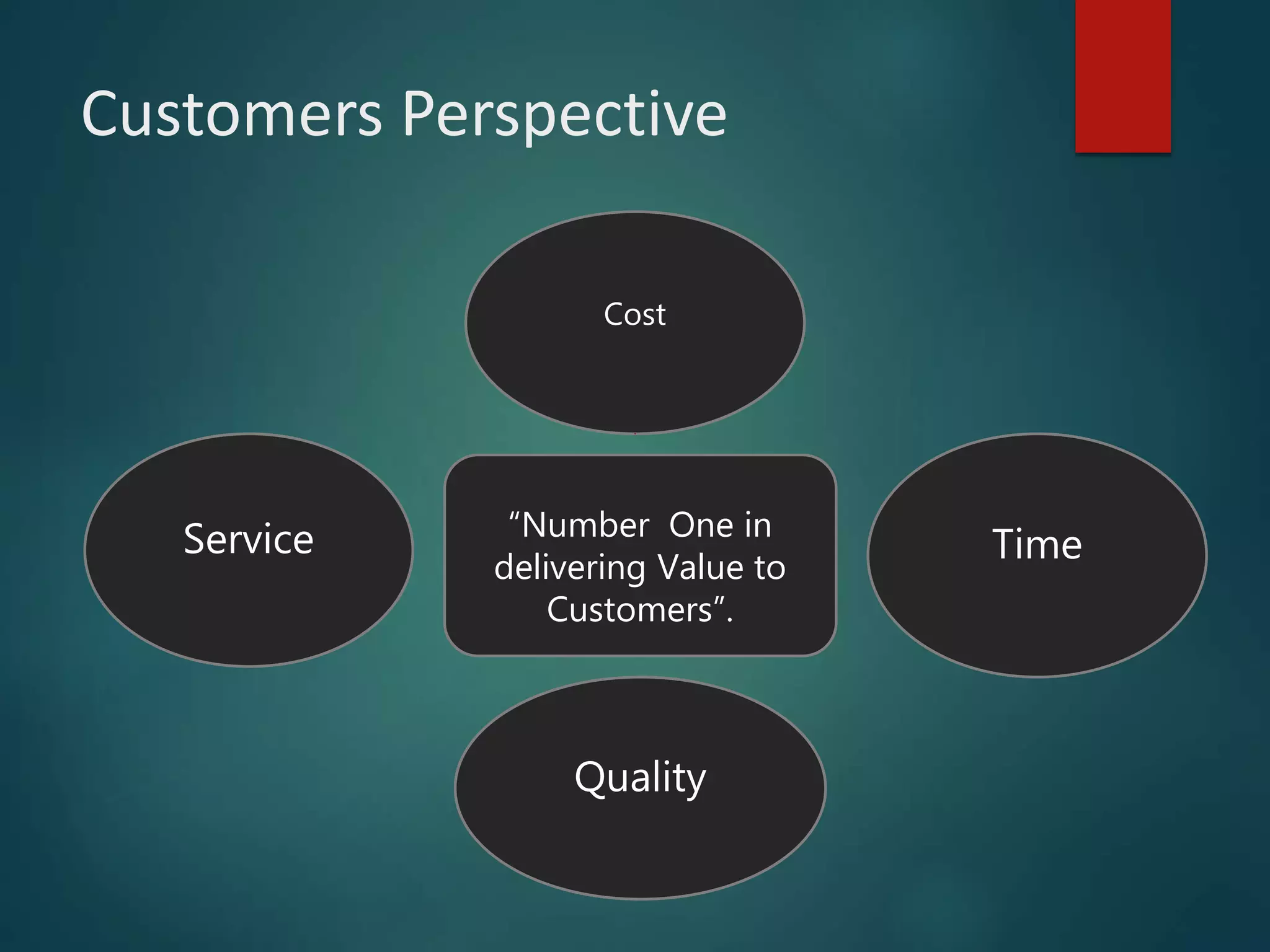
Customers Perspective
“Number One in
delivering Value to
Customers”.
Time
Quality
Service
Cost
Internal process perspective
Internal process
perspective
Process
alignment
Process
bottlenecks
Process
automation
No of activates
per function
Learning & Growth Perspective
Learning
& Growth
perspective
Training &
learning
opportunities
Employee
Turnover
Job satisfaction
Is there the
correct level of
expertise for the
job ?
Financial perspective
Financial
results
(Quat/year)
Cash flow
Return on
investment
Return on
capital
employed
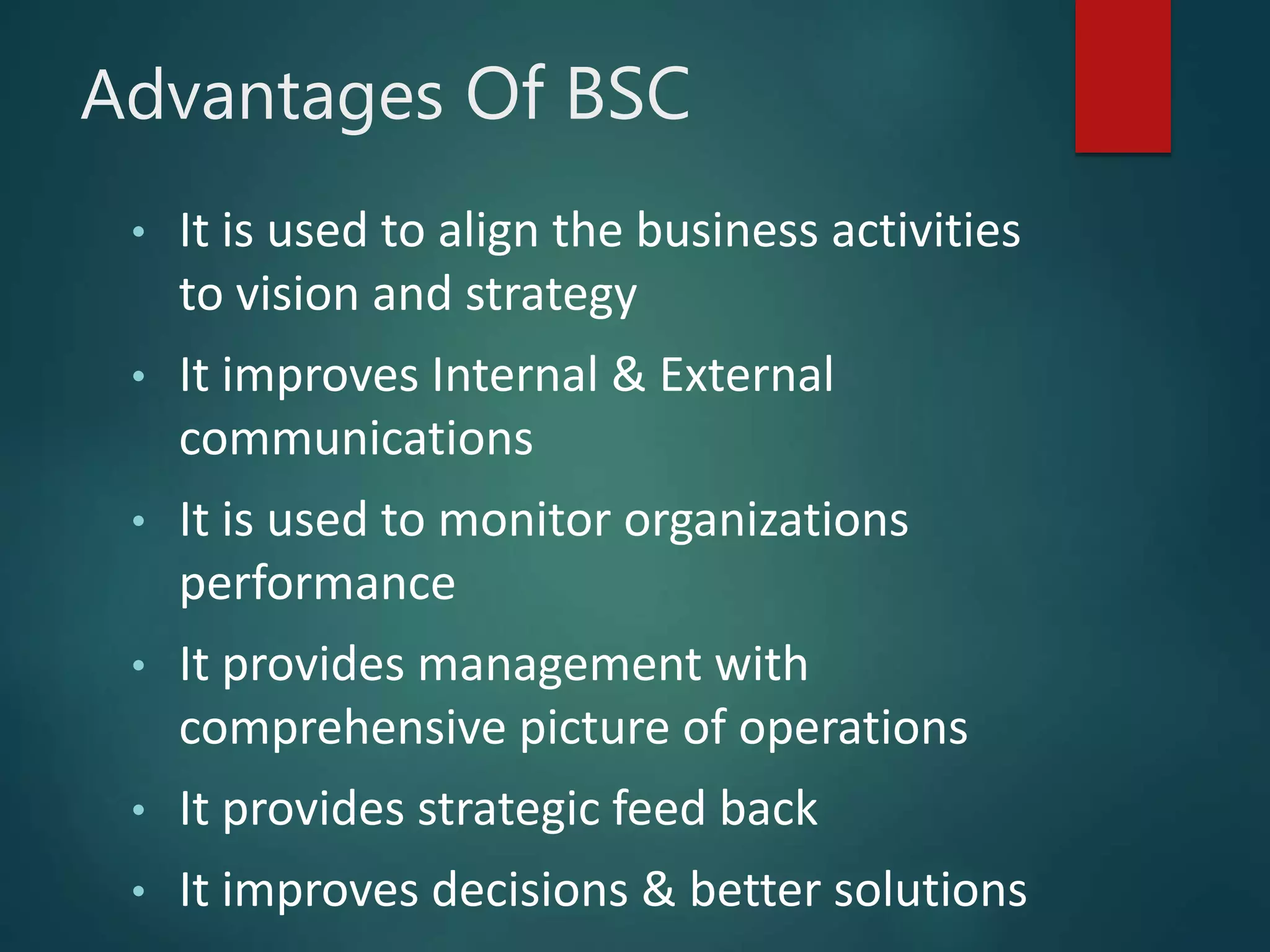
Advantages Of BSC
• It is used to align the business activities
to vision and strategy
• It improves Internal & External
communications
• It is used to monitor organizations
performance
• It provides management with
comprehensive picture of operations
• It provides strategic feed back
• It improves decisions & better solutions
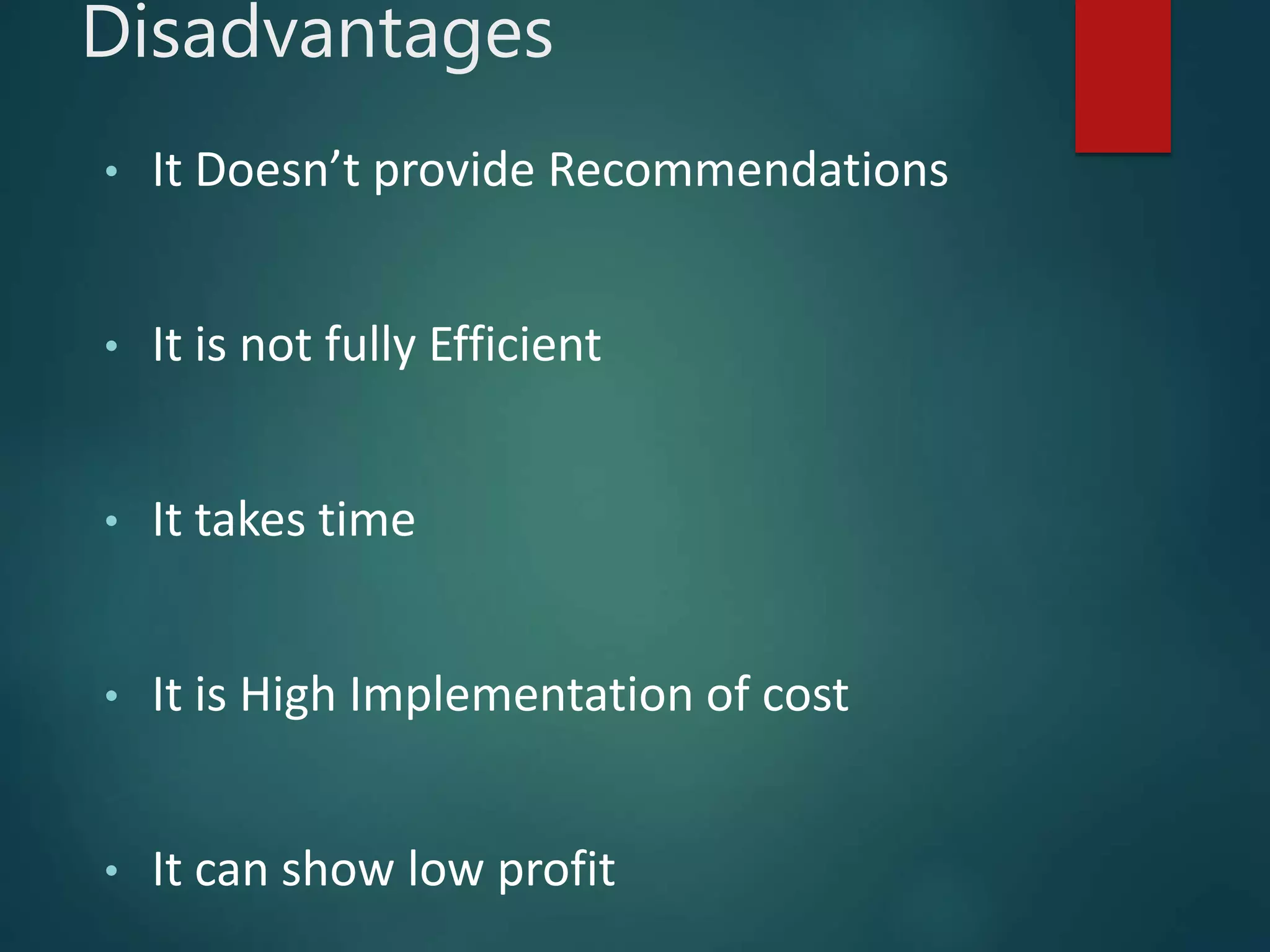
Disadvantages
• It Doesn’t provide Recommendations
• It is not fully Efficient
• It takes time
• It is High Implementation of cost
• It can show low profit
CONCLUSION
Balanace scorecard ppt

Balanace scorecard ppt

  • 1.
    BALANCED SCORE CARD AKHILESHDUBEY LBSITM, INDORE
  • 2.
    SYNOPSIS • Introduction. • Whatis Balance Score Card? • Why are companies Adopting Balance score card? • Balance Score Card perspective • Advantages & Disadvantages • Conclusion.
  • 3.
     The balancedscorecard is a strategic planning and management system that is used extensively in business and industry, government, and nonprofit organizations worldwide to align business activities to the vision and strategy of the organization, improve internal and external communications, and monitor organization performance against strategic goals.
  • 4.
  • 5.
    History…  It wasoriginated by Drs. Robert Kaplan (Harvard Business School) and David Norton as a performance measurement framework that added strategic non-financial performance measures to traditional financial metrics to give managers and executives a more 'balanced' view of organizational performance.  While the phrase balanced scorecard was coined in the early 1990s, the roots of the this type of approach are deep, and include the pioneering work of General Electric on performance measurement reporting in the 1950’s and the work of French process engineers (who created the Tableau de Bord – literally, a "dashboard" of performance measures) in the early part of the 20th century.
  • 6.
  • 7.
    Facts about it.. Gartner Group suggests that over 50% of large US firms have adopted the BSC. More than half of major companies in the US, Europe and Asia are using balanced scorecard approaches, with use growing in those areas as well as in the Middle East and Africa.  A recent global study by Bain & Co listed balanced scorecard fifth on its top ten most widely used management tools around the world, a list that includes closely-related strategic planning at number one.  Balanced scorecard has also been selected by the editors of Harvard Business Review as one of the most influential business ideas of the past 75 years.
  • 8.
    balanced scorecard  Thebalanced scorecard (BSC) is a strategy performance management tool – a semi- standard structured report, supported by design methods and automation tools, that can be used by managers to keep track of the execution of activities by the staff within their control and to monitor the consequences arising from these actions
  • 9.
    The phrase 'balancedscorecard' is commonly used in two broad forms:  As individual scorecards that contain measures to manage performance, those scorecards may be operational or have a more strategic intent; and  As a Strategic Management System, as originally defined by Kaplan & Norton.
  • 10.
    The critical characteristicsthat define a balanced scorecard are:  its focus on the strategic agenda of the organization concerned  the selection of a small number of data items to monitor  a mix of financial and non-financial data items.
  • 11.
    Balance Score Card •Four key Business Perspectives • Internal & Business process of Organization • Short Run & Long Run
  • 12.
    Why are companiesAdopting BSC? • Change. • Growth. • Implementation.
  • 13.
    Financial Perspective Internal Process Perspective Learning& Growth Perspective Customer Perspective Vision & Strategy
  • 14.
    Customers Perspective “Number Onein delivering Value to Customers”. Time Quality Service Cost
  • 15.
    Internal process perspective Internalprocess perspective Process alignment Process bottlenecks Process automation No of activates per function
  • 16.
    Learning & GrowthPerspective Learning & Growth perspective Training & learning opportunities Employee Turnover Job satisfaction Is there the correct level of expertise for the job ?
  • 17.
    Financial perspective Financial perspective Financial results (Quat/year) Cashflow Return on investment Return on capital employed
  • 18.
    Advantages Of BSC •It is used to align the business activities to vision and strategy • It improves Internal & External communications • It is used to monitor organizations performance • It provides management with comprehensive picture of operations • It provides strategic feed back • It improves decisions & better solutions
  • 19.
    Disadvantages • It Doesn’tprovide Recommendations • It is not fully Efficient • It takes time • It is High Implementation of cost • It can show low profit
  • 20.