Balanced Scorecard
Balance Scorecard
Meaning and
Definition
Meaning- It is a
connecting bridge
between the strategy and
operation elements of
the organization
Definition- It is a
performance based
metric which companies
used for strategic
management
Purpose of Balanced Scorecard
Ensure clear communication about goals
Align daily work with strategy of the company
Prioritize on product, project and services level
Monitor and measure organizational progress
Kaplan and
Norton balanced
scorecard
The balanced scorecard was developed in early 1990
It measures firms performance using both financial and
non-financial data
 Aim- 1. To align the work activities of organization to its vision
2 To improve communication
3.To monitor business performance with respect to strategic goals
Background to the
Balanced
Scorecard
A broad picture of status of organization can be created using
different perspectives
Composite scorecard is always preferable than single measure to
determine the performance progress of organization
Four important perspective of analysis of organization- customer,
finance, internal, learning and growth.
Critical measures should be selected for these perspectives
Four Perspectives
of balance
scorecard
1.Financial Perspective
2. Customer Perspective
3. Internal Process Perspective
4. Learning and Growth
Perspective
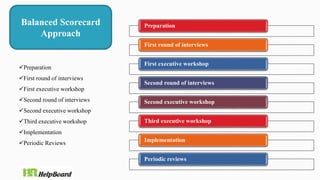
Balanced Scorecard
Approach
Preparation
First round of interviews
First executive workshop
Second round of interviews
Second executive workshop
Third executive workshop
Implementation
Periodic reviews
Preparation
First round of interviews
First executive workshop
Second round of interviews
Second executive workshop
Third executive workshop
Implementation
Periodic Reviews
Builds up the necessary focus which is needed to improve performance
Integrates the organization as one entity
Helps in reflecting organizational strategy through performance
Connects the corporate team with the operational team of organization
Improves clarity and communication among employees
Improves organizational efficiency
Advantage of
Balanced Scorecard
Disadvantages of
Balanced Scorecard
Can be confusing for employees due to large number of performance indicators
It is hard to manage balance between all four perspectives of balanced scorecard
The operational team might get busy in execution but the leadership team will still look for quick financial
results.
Need to be updated regularly to maintain its relevance for the organization.
Purpose and Objective of
Balanced Scorecard
Purpose
To integrate the organization on one platform
To empower the employees who can now contribute in the
organizational system
To measure both tangible and non-tangible aspects of performance
Overall performance improvement of organization
Objective
To ensure that at operational level the vision, mission
and value of the organization is properly reflected
To make sure that the set financial goal is achieved
through a planned workout
To uplift the organization at the skill and talent level
To understand the wants and needs of customer and to
set a internal processes to satisfy the customers
Thank You

Balanced Scorecard in HRM

  • 1.
  • 2.
    Balance Scorecard Meaning and Definition Meaning-It is a connecting bridge between the strategy and operation elements of the organization Definition- It is a performance based metric which companies used for strategic management Purpose of Balanced Scorecard Ensure clear communication about goals Align daily work with strategy of the company Prioritize on product, project and services level Monitor and measure organizational progress
  • 3.
    Kaplan and Norton balanced scorecard Thebalanced scorecard was developed in early 1990 It measures firms performance using both financial and non-financial data  Aim- 1. To align the work activities of organization to its vision 2 To improve communication 3.To monitor business performance with respect to strategic goals Background to the Balanced Scorecard A broad picture of status of organization can be created using different perspectives Composite scorecard is always preferable than single measure to determine the performance progress of organization Four important perspective of analysis of organization- customer, finance, internal, learning and growth. Critical measures should be selected for these perspectives
  • 4.
    Four Perspectives of balance scorecard 1.FinancialPerspective 2. Customer Perspective 3. Internal Process Perspective 4. Learning and Growth Perspective
  • 5.
    Balanced Scorecard Approach Preparation First roundof interviews First executive workshop Second round of interviews Second executive workshop Third executive workshop Implementation Periodic reviews Preparation First round of interviews First executive workshop Second round of interviews Second executive workshop Third executive workshop Implementation Periodic Reviews
  • 6.
    Builds up thenecessary focus which is needed to improve performance Integrates the organization as one entity Helps in reflecting organizational strategy through performance Connects the corporate team with the operational team of organization Improves clarity and communication among employees Improves organizational efficiency Advantage of Balanced Scorecard
  • 7.
    Disadvantages of Balanced Scorecard Canbe confusing for employees due to large number of performance indicators It is hard to manage balance between all four perspectives of balanced scorecard The operational team might get busy in execution but the leadership team will still look for quick financial results. Need to be updated regularly to maintain its relevance for the organization.
  • 8.
    Purpose and Objectiveof Balanced Scorecard Purpose To integrate the organization on one platform To empower the employees who can now contribute in the organizational system To measure both tangible and non-tangible aspects of performance Overall performance improvement of organization Objective To ensure that at operational level the vision, mission and value of the organization is properly reflected To make sure that the set financial goal is achieved through a planned workout To uplift the organization at the skill and talent level To understand the wants and needs of customer and to set a internal processes to satisfy the customers
  • 9.