BY
BISWAJIT SHAW
ROLL-20801914028
BHARAT TECHNOLOGY
BEER PRODUCTION
Introduction
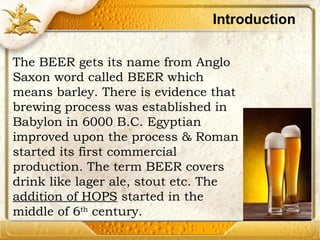
The BEER gets its name from Anglo
Saxon word called BEER which
means barley. There is evidence that
brewing process was established in
Babylon in 6000 B.C. Egyptian
improved upon the process & Roman
started its first commercial
production. The term BEER covers
drink like lager ale, stout etc. The
addition of HOPS started in the
middle of 6th
century.
Definition & Types
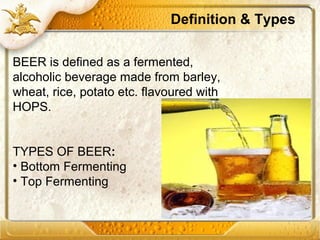
BEER is defined as a fermented,
alcoholic beverage made from barley,
wheat, rice, potato etc. flavoured with
HOPS.
TYPES OF BEER:
• Bottom Fermenting
• Top Fermenting
Bottom Fermenting Beer: Lager
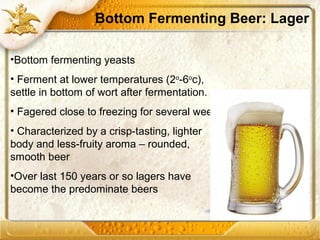
•Bottom fermenting yeasts
• Ferment at lower temperatures (2o
-6o
c),
settle in bottom of wort after fermentation.
• Fagered close to freezing for several weeks
• Characterized by a crisp-tasting, lighter
body and less-fruity aroma – rounded,
smooth beer
•Over last 150 years or so lagers have
become the predominate beers
Top Fermenting Beer: Ale
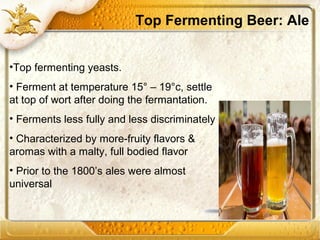
•Top fermenting yeasts.
• Ferment at temperature 15° – 19°c, settle
at top of wort after doing the fermantation.
• Ferments less fully and less discriminately .
• Characterized by more-fruity flavors &
aromas with a malty, full bodied flavor
• Prior to the 1800’s ales were almost
universal
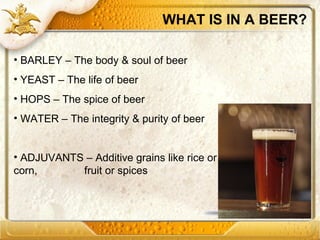
WHAT IS IN A BEER?
• BARLEY – The body & soul of beer
• YEAST – The life of beer
• HOPS – The spice of beer
• WATER – The integrity & purity of beer
• ADJUVANTS – Additive grains like rice or
corn, fruit or spices
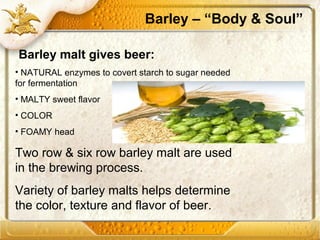
Barley – “Body & Soul”
Barley malt gives beer:
• NATURAL enzymes to covert starch to sugar needed
for fermentation
• MALTY sweet flavor
• COLOR
• FOAMY head
Two row & six row barley malt are used
in the brewing process.
Variety of barley malts helps determine
the color, texture and flavor of beer.
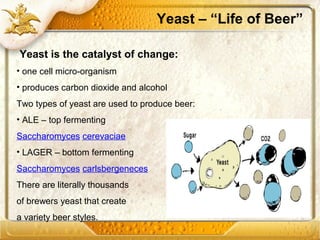
Yeast – “Life of Beer”
Yeast is the catalyst of change:
• one cell micro-organism
• produces carbon dioxide and alcohol
Two types of yeast are used to produce beer:
• ALE – top fermenting
Saccharomyces cerevaciae
• LAGER – bottom fermenting
Saccharomyces carlsbergeneces
There are literally thousands
of brewers yeast that create
a variety beer styles.
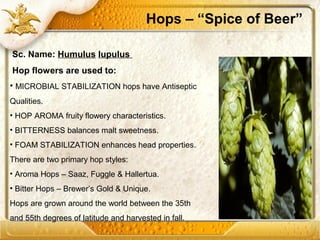
Hops – “Spice of Beer”
Sc. Name: Humulus lupulus
Hop flowers are used to:
• MICROBIAL STABILIZATION hops have Antiseptic
Qualities.
• HOP AROMA fruity flowery characteristics.
• BITTERNESS balances malt sweetness.
• FOAM STABILIZATION enhances head properties.
There are two primary hop styles:
• Aroma Hops – Saaz, Fuggle & Hallertua.
• Bitter Hops – Brewer’s Gold & Unique.
Hops are grown around the world between the 35th
and 55th degrees of latitude and harvested in fall.
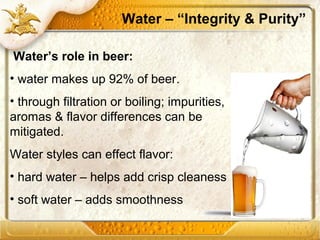
Water – “Integrity & Purity”
Water’s role in beer:
• water makes up 92% of beer.
• through filtration or boiling; impurities,
aromas & flavor differences can be
mitigated.
Water styles can effect flavor:
• hard water – helps add crisp cleaness
• soft water – adds smoothness
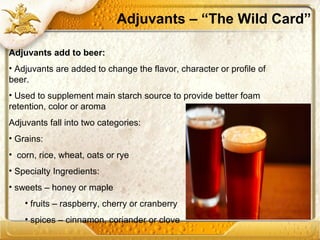
Adjuvants – “The Wild Card”
Adjuvants add to beer:
• Adjuvants are added to change the flavor, character or profile of
beer.
• Used to supplement main starch source to provide better foam
retention, color or aroma
Adjuvants fall into two categories:
• Grains:
• corn, rice, wheat, oats or rye
• Specialty Ingredients:
• sweets – honey or maple
• fruits – raspberry, cherry or cranberry
• spices – cinnamon, coriander or clove
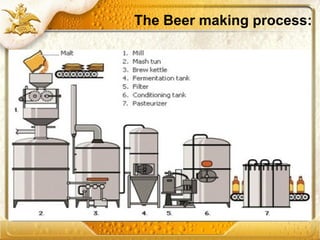
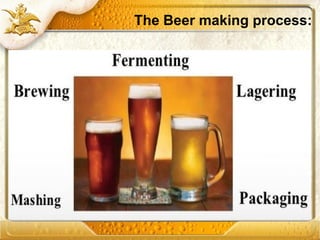
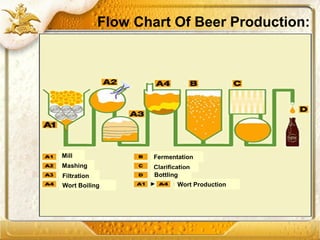
The Beer making process:
Mill
Mashing
Fermentation
Clarification
Bottling
Wort Production
Filtration
Wort Boiling
Flow Chart Of Beer Production:
Production Process Of Beer :
• Milling: In order for the malt components to be rapidly extracted and
converted, the malt is milled to obtain coarse flour.
• Mashing: The flour from the cereals (malt and other unmalted
cereals) is mixed with water and subjected to certain processes to
obtain a wort of a suitable composition for the kind of beer being
produced (varying times, temperatures and PH). Mashing lasts 2 to
4 hours and finishes with a temperature of approximately 75 ºC.
• Filtration of the wort: After mashing, the whole volume is filtered in
order to separate the spent grains (which is an excellent animal
feed) from the wort itself. This is done by passing water through the
mash at the right temperature in a filter press or lauter tun, which
lasts around 2-3 hours, conducted at a temperature of 75-80 ºC.
• Boiling the wort: The diluted and filtered wort is boiled for
around 2 hours. Hops are added at this stage. The purpose of
boiling is to:
– Transform and make soluble the bitter substances in the
hops
– Eliminate undesirable volatile substances.
– Sterilise the wort
– Provoke the precipitation of proteins of high molecular
weight
– Establish the final concentration of wort.
Production Process Of Beer Contd.:
• After boiling, it is necessary to separate the precipitated
protein and the insoluble hop components from the hot
wort.
• Before the hopped wort goes into the fermentation tanks,
it is cooled to a temperature of around 9 ºC and aired in
sterile conditions.
Production Process Of Beer Contd.:
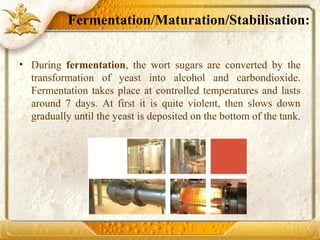
Fermentation/Maturation/Stabilisation:
• During fermentation, the wort sugars are converted by the
transformation of yeast into alcohol and carbondioxide.
Fermentation takes place at controlled temperatures and lasts
around 7 days. At first it is quite violent, then slows down
gradually until the yeast is deposited on the bottom of the tank.
• Maturation, the phase after fermentation, is the period in which the
beer is allowed to rest at suitable temperatures in order for the
undesirable volatile components, which might affect the final
«bouquet» of the beer, to be released.
• The next operation is stabilisation. This consists of letting the beer
stabilise at temperatures of between 0ºC and - 2ºC, to permit
colloidal stabilisation.
• Clarification is the operation that gives the beer its clear limpid
quality. It consists of pumping the liquid through a suitable filter. The
filtered beer is then stored in tanks, now ready to be bottled.
Fermentation/Maturation/Stabilisation Contd.:
Bottling:
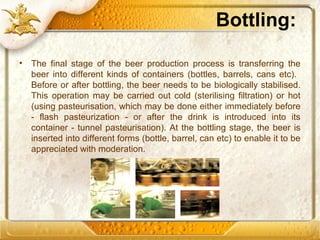
• The final stage of the beer production process is transferring the
beer into different kinds of containers (bottles, barrels, cans etc).
Before or after bottling, the beer needs to be biologically stabilised.
This operation may be carried out cold (sterilising filtration) or hot
(using pasteurisation, which may be done either immediately before
- flash pasteurization - or after the drink is introduced into its
container - tunnel pasteurisation). At the bottling stage, the beer is
inserted into different forms (bottle, barrel, can etc) to enable it to be
appreciated with moderation.
References:
• Bai J, Huang J, Rozelle S, Boswell M (2012) Beer battles in China: the
struggle over the world’s largest beer market. In: The economics of beer.
Oxford Scholarship Online, Chap. 15:267–286.
• Barrett J, Bathgate G, Clapperton J (1975) The composition of fine
particles which affect mash filtration. J Inst Brew 81(1):31–36
• Delvaux F, Gys W, Michiels J (2001) Contribution of wheat and wheat
protein fractions to the colloidal haze of wheat beers. J Am Soc Brew
Chem 59:135–140.
• Geller JR (1992) From prehistory to history: beer in Egypt. In: Friedman
RF, Adams B The followers of Horus. Oxbow Books, Oxford, England,
pp 19–26.
• Horn W, Born E (1979) The plan of St Gall: a study of the architecture and
economy of, and life in a paradigmatic Carolingian monastery. University
of California Press, Berkeley
Thank you.

Beer production

  • 1.
  • 2.
    Introduction The BEER getsits name from Anglo Saxon word called BEER which means barley. There is evidence that brewing process was established in Babylon in 6000 B.C. Egyptian improved upon the process & Roman started its first commercial production. The term BEER covers drink like lager ale, stout etc. The addition of HOPS started in the middle of 6th century.
  • 3.
    Definition & Types BEERis defined as a fermented, alcoholic beverage made from barley, wheat, rice, potato etc. flavoured with HOPS. TYPES OF BEER: • Bottom Fermenting • Top Fermenting
  • 4.
    Bottom Fermenting Beer:Lager •Bottom fermenting yeasts • Ferment at lower temperatures (2o -6o c), settle in bottom of wort after fermentation. • Fagered close to freezing for several weeks • Characterized by a crisp-tasting, lighter body and less-fruity aroma – rounded, smooth beer •Over last 150 years or so lagers have become the predominate beers
  • 5.
    Top Fermenting Beer:Ale •Top fermenting yeasts. • Ferment at temperature 15° – 19°c, settle at top of wort after doing the fermantation. • Ferments less fully and less discriminately . • Characterized by more-fruity flavors & aromas with a malty, full bodied flavor • Prior to the 1800’s ales were almost universal
  • 6.
    WHAT IS INA BEER? • BARLEY – The body & soul of beer • YEAST – The life of beer • HOPS – The spice of beer • WATER – The integrity & purity of beer • ADJUVANTS – Additive grains like rice or corn, fruit or spices
  • 7.
    Barley – “Body& Soul” Barley malt gives beer: • NATURAL enzymes to covert starch to sugar needed for fermentation • MALTY sweet flavor • COLOR • FOAMY head Two row & six row barley malt are used in the brewing process. Variety of barley malts helps determine the color, texture and flavor of beer.
  • 8.
    Yeast – “Lifeof Beer” Yeast is the catalyst of change: • one cell micro-organism • produces carbon dioxide and alcohol Two types of yeast are used to produce beer: • ALE – top fermenting Saccharomyces cerevaciae • LAGER – bottom fermenting Saccharomyces carlsbergeneces There are literally thousands of brewers yeast that create a variety beer styles.
  • 9.
    Hops – “Spiceof Beer” Sc. Name: Humulus lupulus Hop flowers are used to: • MICROBIAL STABILIZATION hops have Antiseptic Qualities. • HOP AROMA fruity flowery characteristics. • BITTERNESS balances malt sweetness. • FOAM STABILIZATION enhances head properties. There are two primary hop styles: • Aroma Hops – Saaz, Fuggle & Hallertua. • Bitter Hops – Brewer’s Gold & Unique. Hops are grown around the world between the 35th and 55th degrees of latitude and harvested in fall.
  • 10.
    Water – “Integrity& Purity” Water’s role in beer: • water makes up 92% of beer. • through filtration or boiling; impurities, aromas & flavor differences can be mitigated. Water styles can effect flavor: • hard water – helps add crisp cleaness • soft water – adds smoothness
  • 11.
    Adjuvants – “TheWild Card” Adjuvants add to beer: • Adjuvants are added to change the flavor, character or profile of beer. • Used to supplement main starch source to provide better foam retention, color or aroma Adjuvants fall into two categories: • Grains: • corn, rice, wheat, oats or rye • Specialty Ingredients: • sweets – honey or maple • fruits – raspberry, cherry or cranberry • spices – cinnamon, coriander or clove
  • 12.
  • 13.
  • 14.
  • 15.
    Production Process OfBeer : • Milling: In order for the malt components to be rapidly extracted and converted, the malt is milled to obtain coarse flour. • Mashing: The flour from the cereals (malt and other unmalted cereals) is mixed with water and subjected to certain processes to obtain a wort of a suitable composition for the kind of beer being produced (varying times, temperatures and PH). Mashing lasts 2 to 4 hours and finishes with a temperature of approximately 75 ºC. • Filtration of the wort: After mashing, the whole volume is filtered in order to separate the spent grains (which is an excellent animal feed) from the wort itself. This is done by passing water through the mash at the right temperature in a filter press or lauter tun, which lasts around 2-3 hours, conducted at a temperature of 75-80 ºC.
  • 16.
    • Boiling thewort: The diluted and filtered wort is boiled for around 2 hours. Hops are added at this stage. The purpose of boiling is to: – Transform and make soluble the bitter substances in the hops – Eliminate undesirable volatile substances. – Sterilise the wort – Provoke the precipitation of proteins of high molecular weight – Establish the final concentration of wort. Production Process Of Beer Contd.:
  • 17.
    • After boiling,it is necessary to separate the precipitated protein and the insoluble hop components from the hot wort. • Before the hopped wort goes into the fermentation tanks, it is cooled to a temperature of around 9 ºC and aired in sterile conditions. Production Process Of Beer Contd.:
  • 18.
    Fermentation/Maturation/Stabilisation: • During fermentation,the wort sugars are converted by the transformation of yeast into alcohol and carbondioxide. Fermentation takes place at controlled temperatures and lasts around 7 days. At first it is quite violent, then slows down gradually until the yeast is deposited on the bottom of the tank.
  • 19.
    • Maturation, thephase after fermentation, is the period in which the beer is allowed to rest at suitable temperatures in order for the undesirable volatile components, which might affect the final «bouquet» of the beer, to be released. • The next operation is stabilisation. This consists of letting the beer stabilise at temperatures of between 0ºC and - 2ºC, to permit colloidal stabilisation. • Clarification is the operation that gives the beer its clear limpid quality. It consists of pumping the liquid through a suitable filter. The filtered beer is then stored in tanks, now ready to be bottled. Fermentation/Maturation/Stabilisation Contd.:
  • 20.
    Bottling: • The finalstage of the beer production process is transferring the beer into different kinds of containers (bottles, barrels, cans etc). Before or after bottling, the beer needs to be biologically stabilised. This operation may be carried out cold (sterilising filtration) or hot (using pasteurisation, which may be done either immediately before - flash pasteurization - or after the drink is introduced into its container - tunnel pasteurisation). At the bottling stage, the beer is inserted into different forms (bottle, barrel, can etc) to enable it to be appreciated with moderation.
  • 21.
    References: • Bai J,Huang J, Rozelle S, Boswell M (2012) Beer battles in China: the struggle over the world’s largest beer market. In: The economics of beer. Oxford Scholarship Online, Chap. 15:267–286. • Barrett J, Bathgate G, Clapperton J (1975) The composition of fine particles which affect mash filtration. J Inst Brew 81(1):31–36 • Delvaux F, Gys W, Michiels J (2001) Contribution of wheat and wheat protein fractions to the colloidal haze of wheat beers. J Am Soc Brew Chem 59:135–140. • Geller JR (1992) From prehistory to history: beer in Egypt. In: Friedman RF, Adams B The followers of Horus. Oxbow Books, Oxford, England, pp 19–26. • Horn W, Born E (1979) The plan of St Gall: a study of the architecture and economy of, and life in a paradigmatic Carolingian monastery. University of California Press, Berkeley
  • 22.

Editor's Notes