Bacterial morphology
Gliding
and
fruiting
bacteria
• The organisms of this group are Gram-negative,
nonphototrophic, and nonflagellated.
• They exibit a creeping or gliding motility on
solid surfaces.
• It is independent of propulsive structures such
as flagella, pili, and fimbriae. Gliding allows
microorganisms to travel along the surface.
• The exact mechanism of gliding is not known.
• The mechanisms responsible for bacterial
gliding motility have been a mystery for almost
200 years.
• The mechanisms of movement employed by
these bacteria are still a matter of speculation.
Genetic, biochemical, ultrastructural, and
behavioral studies are providing insight into the
machineries employed by these diverse
bacteria that enable them to glide over
surfaces.
KKR1116 2
• . When the organisms are placed on a solid culture
medium,growth, which is frequently of a slimy consistency,
spreads rapidly over the surface. As the cells glide across the
surface of the medium, they leave a layer of slime behind
them.
• Indeed, the prefix myxo, which occurs in the name of
the order to which these bacteria belong, Myxobacterales,
reflects this property,being derived from the Greek noun
myxo, meaning “mucus, slime”.
• Although there are some exceptions, a remarkable and
striking feature of the myxobacters is that the vegetative cells
at some stage of growth, swarm together
in masses and form fruiting bodies [This behavior bears some
resemblance to that of slime molds.
KKR1116 3
Myxobacterial gliding motility.
KKR1116 4
• The fruiting bodies contain myxospores, which are shorter
and thicker than the vegetative cells and are resistant to
desiccation and ultraviolet radiation but not to heat. The
fruiting bodies range from simple to complex.
• The simplest fruiting bodies are merely heaps of myxospores
embedded in a mass of slime.
• The most elaborate fruiting bodies may have a stalk
composed of slime, and walled containers (sporongioles,
sometimes termed cysts) which enclose the myxospores.
• Myxobacters are strictly aerobic organisms found in surface
layers of soil, compost, manure. rotting wood, and animal
dung. Many myxobacters develop very colorful pigments in
their normal environment.
• Some species produce exocellular enzymes that degrade
complex substrates such as cellulose, agar, chitin, and even
the cell walls of other bacteria.
KKR1116 5
Stages in the
fruiting body formation of
the myxobacter
Chondromyces crocotus. Early
stages: (A) Initial stages of
vegetative cell aggregation;
(B) fried-egg stage showing
orientation of peripheral
cells; (C) bulb formation and
development of stalk. Late
stages: (U) Initial stages of
sporangiole formation; (B)
sporangiole formation after
elongation of stalk to
Maximum length. Structures
range in size from
approximately 10 to 60 p.m.
(From
P. L. Grilione and J. Pangborn
and J Bacterial
KKR1116 6
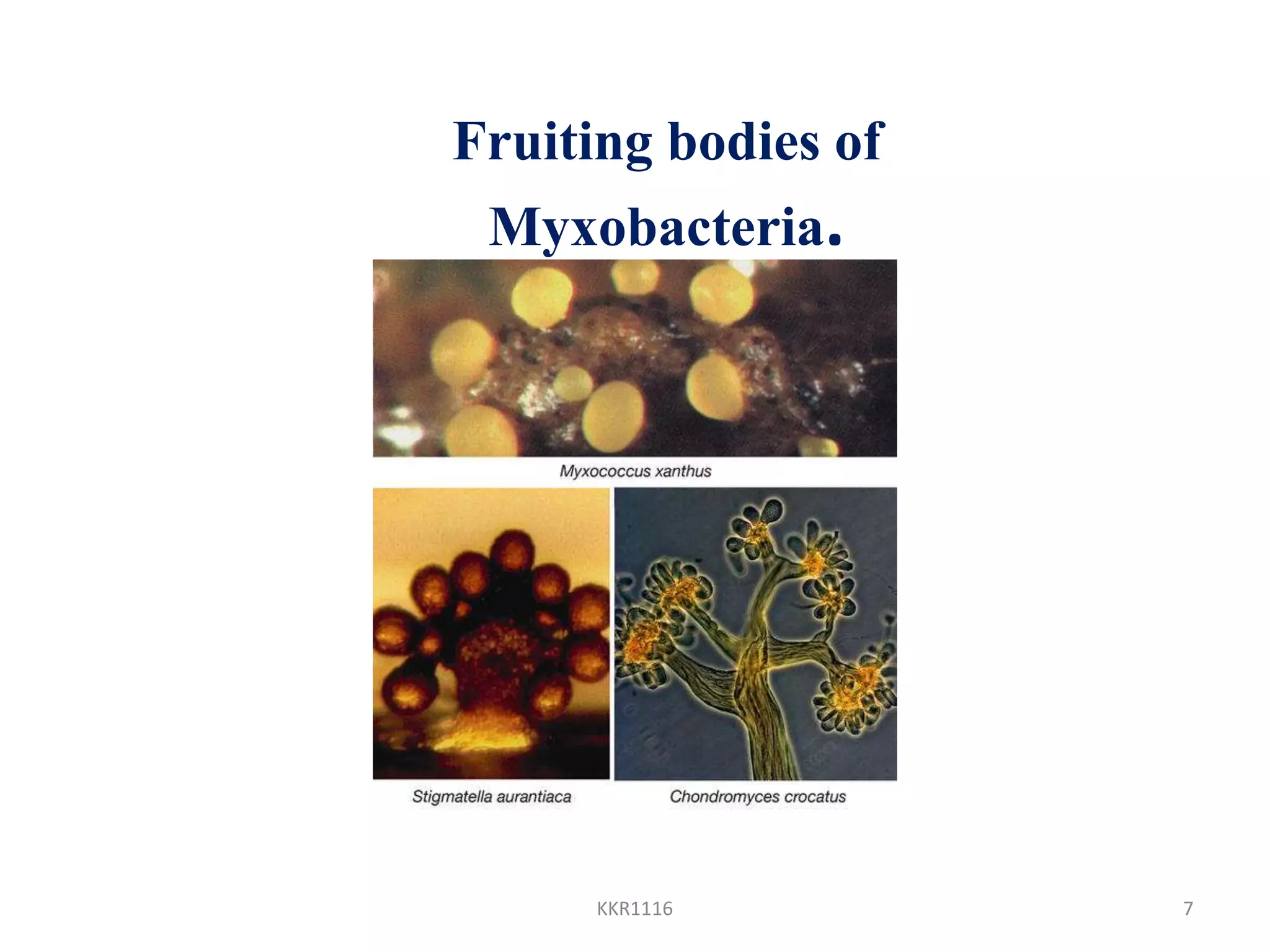
Fruiting bodies of
Myxobacteria.
KKR1116 7
Sheathed
bacteria
• Sheathed bacteria are bacteria that
grow as long filaments whose exterior
is covered by a layer known as a
sheath.
• Bacteria in this group are Gram-
negative, aerobic, and
nonphototrophic.
• Within the sheath, the bacteria can
be capable of growth and division.
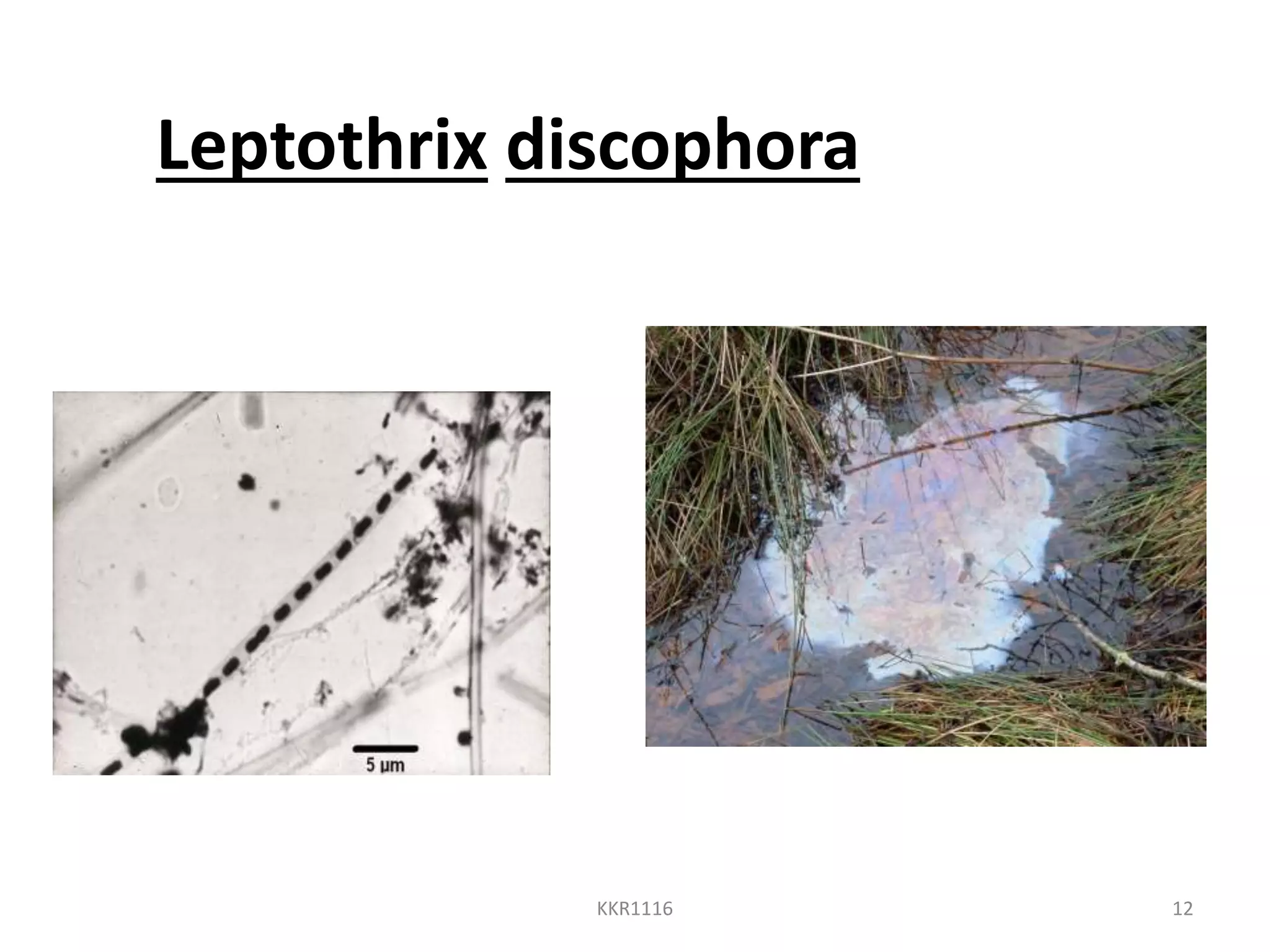
• Examples of sheathed bacteria
include Leptothrix discophora (also
known as "iron bacteria"),
and Sphaerotilus natans.
• Sheathed bacteria are common of the
bacterial communities in water and in
soil. KKR1116 8
• In these environments, the sheath is often coated
with precipitates of elements in the water or soil
environments, such as oxides of iron and manganese.
• The sheath that covers the bacteria can be of varied
construction. Much of the structural information has
been gleaned from the observation of thin slices of
sample using the transmission electron microscope .
KKR1116 9
• Bacterial sheaths tend to be manufactured when the
bacteria are in an aquatic or soil environment that
contains high amounts of organic matter.
• The sheath may serve to provide protection to the
bacteria in these environments, Also, the ability of
metallic compounds to precipitate on the sheath may
provide the bacteria with a ready supply of such
inorganic nutrients.
• Sheaths may also help the bacteria survive over a wide
range of temperature and pH , by providing a relatively
inert barrier to the external environment.
• The Sphaerotilus-Leptothrix group of organisms, also
known informally and collectively as ‘sewage fungus’.
KKR1116 10
Sphaerotilus natans
KKR1116 11
Leptothrix discophora
KKR1116 12
Actinomycetes
Classification
Kingdom: Bacteria
Phylum : Actinobacteria
Subclass: Actinobacteridae
Order : Actinomycetales
 Actinomycetes are unicellular, Gram-positive bacteria that belong to
the Order Actinomycetales.
 Members of this group are widely distributed in nature and can be
found in a variety of habitats across the world. They have been
shown to share a number of characteristics with fungi .
KKR1116 13
KKR1116 14
KKR1116 15
Actinomycetes are best known for nitogen
fixations in non-leguminous plants.
KKR1116 16
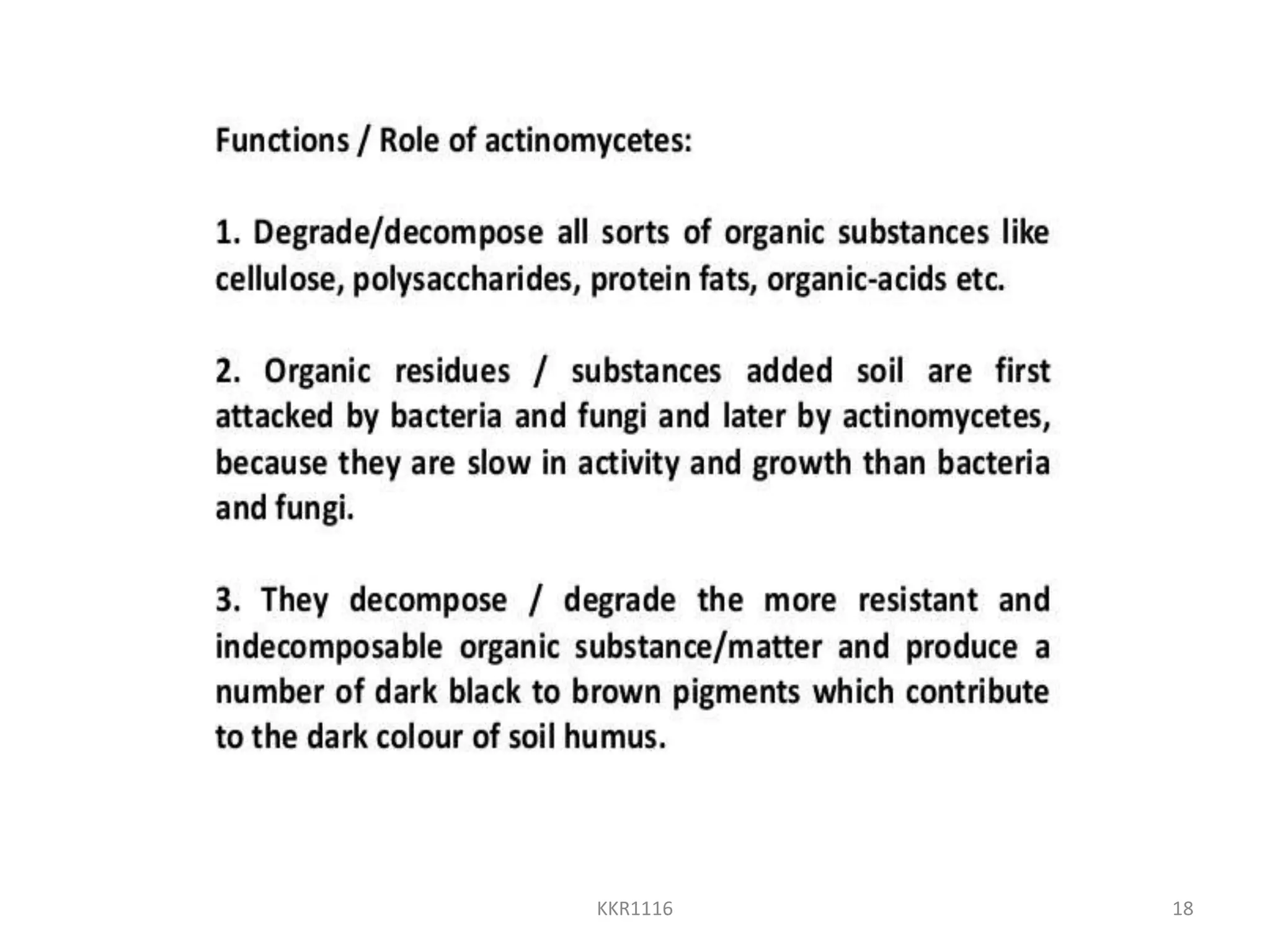
Microscopic view of actinomycetes .
KKR1116 17
KKR1116 18
KKR1116 19
Reproduction
• Actinomycetales have 2 main forms of
reproduction; spore formation and hyphae
fragmentation. During reproduction,
Actinomycetales can form conidiophores,
sporangiospores, and oidiospores. In
reproducing through hyphae fragmentation,
the hyphae formed by Actinomycetales can be
a fifth to half the size of fungal hyphae, and
bear long spore chains.
KKR1116 20
Antimicrobial properties:
• Many species of Actinomycetes produce
antimicrobial compounds under certain
conditions and growth
media. Streptomycin, actinomycin, and
streptothricin are all medically important
antibiotics isolated from Actinomycetes
bacteria.[1] Almost two-thirds of the natural
antimicrobial drug compounds used currently are
produced by different species of
Actinomycetes.[2]
KKR1116 21
Refreneces
• Microbiology by Michael j.pelczar
• www.encyclopedia.com
• www.britannica.com
• www.wikipedia.com
KKR1116 22

Bacterial morphology gliding and fruiting bacteria

  • 1.
  • 2.
    Gliding and fruiting bacteria • The organismsof this group are Gram-negative, nonphototrophic, and nonflagellated. • They exibit a creeping or gliding motility on solid surfaces. • It is independent of propulsive structures such as flagella, pili, and fimbriae. Gliding allows microorganisms to travel along the surface. • The exact mechanism of gliding is not known. • The mechanisms responsible for bacterial gliding motility have been a mystery for almost 200 years. • The mechanisms of movement employed by these bacteria are still a matter of speculation. Genetic, biochemical, ultrastructural, and behavioral studies are providing insight into the machineries employed by these diverse bacteria that enable them to glide over surfaces. KKR1116 2
  • 3.
    • . Whenthe organisms are placed on a solid culture medium,growth, which is frequently of a slimy consistency, spreads rapidly over the surface. As the cells glide across the surface of the medium, they leave a layer of slime behind them. • Indeed, the prefix myxo, which occurs in the name of the order to which these bacteria belong, Myxobacterales, reflects this property,being derived from the Greek noun myxo, meaning “mucus, slime”. • Although there are some exceptions, a remarkable and striking feature of the myxobacters is that the vegetative cells at some stage of growth, swarm together in masses and form fruiting bodies [This behavior bears some resemblance to that of slime molds. KKR1116 3
  • 4.
  • 5.
    • The fruitingbodies contain myxospores, which are shorter and thicker than the vegetative cells and are resistant to desiccation and ultraviolet radiation but not to heat. The fruiting bodies range from simple to complex. • The simplest fruiting bodies are merely heaps of myxospores embedded in a mass of slime. • The most elaborate fruiting bodies may have a stalk composed of slime, and walled containers (sporongioles, sometimes termed cysts) which enclose the myxospores. • Myxobacters are strictly aerobic organisms found in surface layers of soil, compost, manure. rotting wood, and animal dung. Many myxobacters develop very colorful pigments in their normal environment. • Some species produce exocellular enzymes that degrade complex substrates such as cellulose, agar, chitin, and even the cell walls of other bacteria. KKR1116 5
  • 6.
    Stages in the fruitingbody formation of the myxobacter Chondromyces crocotus. Early stages: (A) Initial stages of vegetative cell aggregation; (B) fried-egg stage showing orientation of peripheral cells; (C) bulb formation and development of stalk. Late stages: (U) Initial stages of sporangiole formation; (B) sporangiole formation after elongation of stalk to Maximum length. Structures range in size from approximately 10 to 60 p.m. (From P. L. Grilione and J. Pangborn and J Bacterial KKR1116 6
  • 7.
  • 8.
    Sheathed bacteria • Sheathed bacteriaare bacteria that grow as long filaments whose exterior is covered by a layer known as a sheath. • Bacteria in this group are Gram- negative, aerobic, and nonphototrophic. • Within the sheath, the bacteria can be capable of growth and division. • Examples of sheathed bacteria include Leptothrix discophora (also known as "iron bacteria"), and Sphaerotilus natans. • Sheathed bacteria are common of the bacterial communities in water and in soil. KKR1116 8
  • 9.
    • In theseenvironments, the sheath is often coated with precipitates of elements in the water or soil environments, such as oxides of iron and manganese. • The sheath that covers the bacteria can be of varied construction. Much of the structural information has been gleaned from the observation of thin slices of sample using the transmission electron microscope . KKR1116 9
  • 10.
    • Bacterial sheathstend to be manufactured when the bacteria are in an aquatic or soil environment that contains high amounts of organic matter. • The sheath may serve to provide protection to the bacteria in these environments, Also, the ability of metallic compounds to precipitate on the sheath may provide the bacteria with a ready supply of such inorganic nutrients. • Sheaths may also help the bacteria survive over a wide range of temperature and pH , by providing a relatively inert barrier to the external environment. • The Sphaerotilus-Leptothrix group of organisms, also known informally and collectively as ‘sewage fungus’. KKR1116 10
  • 11.
  • 12.
  • 13.
    Actinomycetes Classification Kingdom: Bacteria Phylum :Actinobacteria Subclass: Actinobacteridae Order : Actinomycetales  Actinomycetes are unicellular, Gram-positive bacteria that belong to the Order Actinomycetales.  Members of this group are widely distributed in nature and can be found in a variety of habitats across the world. They have been shown to share a number of characteristics with fungi . KKR1116 13
  • 14.
  • 15.
  • 16.
    Actinomycetes are bestknown for nitogen fixations in non-leguminous plants. KKR1116 16
  • 17.
    Microscopic view ofactinomycetes . KKR1116 17
  • 18.
  • 19.
  • 20.
    Reproduction • Actinomycetales have2 main forms of reproduction; spore formation and hyphae fragmentation. During reproduction, Actinomycetales can form conidiophores, sporangiospores, and oidiospores. In reproducing through hyphae fragmentation, the hyphae formed by Actinomycetales can be a fifth to half the size of fungal hyphae, and bear long spore chains. KKR1116 20
  • 21.
    Antimicrobial properties: • Manyspecies of Actinomycetes produce antimicrobial compounds under certain conditions and growth media. Streptomycin, actinomycin, and streptothricin are all medically important antibiotics isolated from Actinomycetes bacteria.[1] Almost two-thirds of the natural antimicrobial drug compounds used currently are produced by different species of Actinomycetes.[2] KKR1116 21
  • 22.
    Refreneces • Microbiology byMichael j.pelczar • www.encyclopedia.com • www.britannica.com • www.wikipedia.com KKR1116 22