Grade 6 Science 
Mr. Johnston 
Saigon South International School 
Bacteria
Lesson Overview 
Essential Questions 
◼ What are bacteria? 
◼ How to bacteria get food, 
get energy, and 
reproduce? 
◼ What is the role of 
bacteria in nature? 
Vocabulary 
◼ Bacteria Parts- 
▪ Cytoplasm 
▪ Flagellum 
◼ Cellular Respiration 
◼ Binary Fission 
◼ Conjugation 
◼ Decomposer
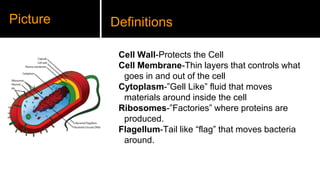
Picture 
Definitions 
Cell Wall-Protects the Cell 
Cell Membrane-Thin layers that controls what 
goes in and out of the cell 
Cytoplasm-”Gell Like” fluid that moves 
materials around inside the cell 
Ribosomes-”Factories” where proteins are 
produced. 
Flagellum-Tail like “flag” that moves bacteria 
around.
Facts about Bacteria: 
◼ Reproduction 
◼ Food intake 
◼ Prokaryotes 
◼ Needs…. 
◼ Domain 
◼ Sexually or asexually ( 
Binary Fission or 
conjugation) 
◼ Hetero. or auto. 
◼ No nucleus, but may 
have a flagellum 
◼ Oxygen to break down 
their food. This is called 
“Cellular Respiration” 
◼ Monera (Bacteria)
Binary Fission: Asexual Reproduction
Conjugation-Sexual Reproduction
Cellular Respiration 
The easy definition: 
“Breaking down food to release energy” 
The full definition: 
Cellular respiration
Some common bacteria shapes:
What are bacteria good for? 
◼ Oxygen and food production (try samples) 
◼ Health maintenance and health production 
◼ Environmental Cleanup and recycling 
◼ Did you know?-Most bacteria are helpful in fighting off 
bad bacteria, or do not harm you at all! 
◼ Did you know: There are millions of bacteria living on 
your body right now!
Microscope Activity: 
◼ Set up your microscope and observe bacteria 
◼ Draw what you see on a google drawing 
◼ Write about what you see in a textbox. How does the 
shape help it survive, reproduce?
Lab Activity: Design an Experiment 
◼ “Comparing surfaces” 
◼Which surfaces have the most bacteria? 
◼Design an investigation to help answer 
this question in small groups on your 
google doc!
Lesson Reflection-With Partner 
Essential Questions 
◼ What are bacteria? 
◼ How to bacteria get food, 
get energy, and 
reproduce? 
◼ What is the role of 
bacteria in nature? 
Vocabulary 
◼ Bacteria Parts- 
▪ Cytoplasm 
▪ Flagellum 
◼ Cellular Respiration 
◼ Binary Fission 
◼ Conjugation 
◼ Decomposer

Bacteria

  • 1.
    Grade 6 Science Mr. Johnston Saigon South International School Bacteria
  • 2.
    Lesson Overview EssentialQuestions ◼ What are bacteria? ◼ How to bacteria get food, get energy, and reproduce? ◼ What is the role of bacteria in nature? Vocabulary ◼ Bacteria Parts- ▪ Cytoplasm ▪ Flagellum ◼ Cellular Respiration ◼ Binary Fission ◼ Conjugation ◼ Decomposer
  • 3.
    Picture Definitions CellWall-Protects the Cell Cell Membrane-Thin layers that controls what goes in and out of the cell Cytoplasm-”Gell Like” fluid that moves materials around inside the cell Ribosomes-”Factories” where proteins are produced. Flagellum-Tail like “flag” that moves bacteria around.
  • 4.
    Facts about Bacteria: ◼ Reproduction ◼ Food intake ◼ Prokaryotes ◼ Needs…. ◼ Domain ◼ Sexually or asexually ( Binary Fission or conjugation) ◼ Hetero. or auto. ◼ No nucleus, but may have a flagellum ◼ Oxygen to break down their food. This is called “Cellular Respiration” ◼ Monera (Bacteria)
  • 5.
  • 6.
  • 7.
    Cellular Respiration Theeasy definition: “Breaking down food to release energy” The full definition: Cellular respiration
  • 8.
  • 9.
    What are bacteriagood for? ◼ Oxygen and food production (try samples) ◼ Health maintenance and health production ◼ Environmental Cleanup and recycling ◼ Did you know?-Most bacteria are helpful in fighting off bad bacteria, or do not harm you at all! ◼ Did you know: There are millions of bacteria living on your body right now!
  • 10.
    Microscope Activity: ◼Set up your microscope and observe bacteria ◼ Draw what you see on a google drawing ◼ Write about what you see in a textbox. How does the shape help it survive, reproduce?
  • 11.
    Lab Activity: Designan Experiment ◼ “Comparing surfaces” ◼Which surfaces have the most bacteria? ◼Design an investigation to help answer this question in small groups on your google doc!
  • 12.
    Lesson Reflection-With Partner Essential Questions ◼ What are bacteria? ◼ How to bacteria get food, get energy, and reproduce? ◼ What is the role of bacteria in nature? Vocabulary ◼ Bacteria Parts- ▪ Cytoplasm ▪ Flagellum ◼ Cellular Respiration ◼ Binary Fission ◼ Conjugation ◼ Decomposer