Ass. Prof. Sherif MohamedAbd El-Hamid
Al-Ayen University
Faculty of Health and Medical Technology
Chemistry (Advanced)
Ground Rules for Lectures
• Arrive on time.
• Listen actively and attentively.
• Mask must be worn.
• Keep the distance between you and your colleague.
• Bring something to write with and in.
• Turn your cell phone off.
• Do not leave class early without okaying it with
the instructor in advance.
• Ask questions if you are confused.
• Try not to distract or annoy your classmates
Introduction to Biochemistry (carbohydrates)
Objectives
:
• To know the formation of carbohydrates
• To understand the nature of glycosidic bonds
• To understand the structural organization of carbohydrates
• To appreciate the various functions of carbohydrates
Carbohydrates
• Carbohydrates, one of the four major classes of biomolecules along with
proteins, lipids, and nucleic acids.
• Carbohydrates are built from monosaccharides (carbon atoms bound to
hydroxyl groups, Empirical formula Cn(H2O)n.
• Monosaccharides are linked together by glycosidic bonds to form di, oligo-
and a huge variety of polysaccharides.
• Carbohydrates are aldehyde (CHO) or ketone (C=O) compounds with
multiple hydroxyl groups (Carbon-oxygen double bonds make the sugars
reactive).
Importance of carbohydrates
• Carbohydrates serve as energy store and metabolic intermediates.
• Ribose and deoxyribose sugars form part of the structural framework of
RNA and DNA.
• Carbohydrates are important for tissue formation.
• Carbohydrates form the basis of human blood groups.
• Polysaccharides are structural elements in the cell walls of bacteria
and plants and in the connective tissues of animals.
• Carbohydrates are linked to many proteins and lipids, where they play
key roles in mediating interactions among cells and interactions
between cells and other elements in the cellular environment.
Several classifications of carbohydrates
Classification of Carbohydrates
Carbohydrates can be classified into
:
1- Monosaccharides - simple sugars with multiple OH groups. Based on
number of carbons.
2
-
Disaccharides: two monosaccharides covalently linked by glycosidic bond
.
3
-
Oligosaccharides: several monosaccharides (3-9) joined by glycosidic bonds
.
4- Polysaccharides: polymers consisting of chains of monosaccharide or
disaccharide units.
Monosaccharides
• The simplest of the carbohydrates
• Aldehydes or ketones
• Colorless, crystalline solids that are freely soluble in water but insoluble
in
nonpolar solvents.
• They are important fuel molecules as well as building blocks for nucleic
acids.
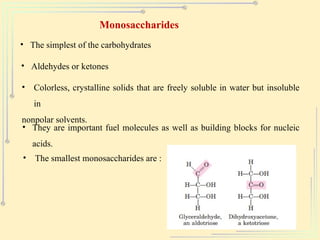
• The smallest monosaccharides are :
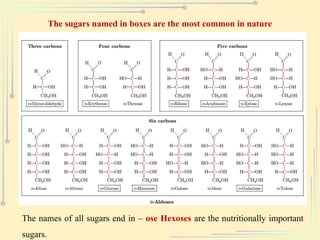
The sugars named in boxes are the most common in nature
The names of all sugars end in – ose Hexoses are the nutritionally important
sugars.
D and L isomerism
• Isomers are molecules with the same kinds and numbers of atoms joined up in
different ways.
• A carbon atom that contains 4 different chemical groups forms an asymmetric
(chiral) center.
• The prefixes D and L designate the absolute configuration of the asymmetric
carbon farthest from the aldehyde or keto group.
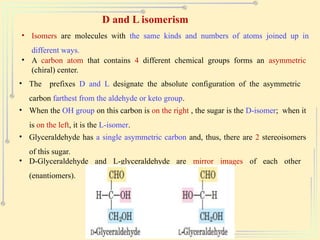
• When the OH group on this carbon is on the right , the sugar is the D-isomer; when it
is on the left, it is the L-isomer.
• Glyceraldehyde has a single asymmetric carbon and, thus, there are 2 stereoisomers
of this sugar.
• D-Glyceraldehyde and L-glyceraldehyde are mirror images of each other
(enantiomers).
Stereoisomers and Epimers
• Stereoisomers have the same chemical formula but differ in the position of the OH
group on 1 or more of their asymmetric carbons.
• Epimers are stereoisomers that differ in the position of the OH group at only 1 of
their asymmetric carbons.
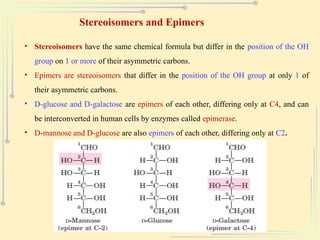
• D-glucose and D-galactose are epimers of each other, differing only at C4, and can
be interconverted in human cells by enzymes called epimerase.
• D-mannose and D-glucose are also epimers of each other, differing only at C2.
Cyclization of Monosaccharide
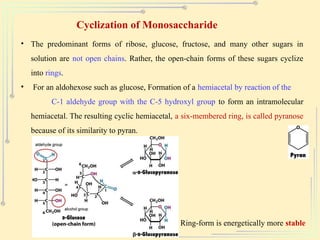
• The predominant forms of ribose, glucose, fructose, and many other sugars in
solution are not open chains. Rather, the open-chain forms of these sugars cyclize
into rings.
• For an aldohexose such as glucose, Formation of a hemiacetal by reaction of the
C-1 aldehyde group with the C-5 hydroxyl group to form an intramolecular
hemiacetal. The resulting cyclic hemiacetal, a six-membered ring, is called pyranose
because of its similarity to pyran.
Ring-form is energetically more stable
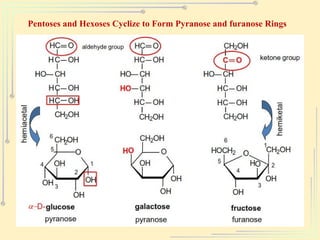
Pentoses and Hexoses Cyclize to Form Pyranose and furanose Rings
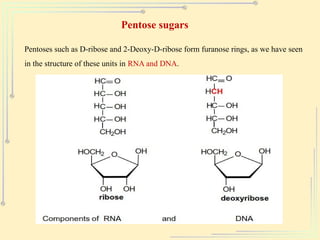
Pentose sugars
Pentoses such as D-ribose and 2-Deoxy-D-ribose form furanose rings, as we have seen
in the structure of these units in RNA and DNA.
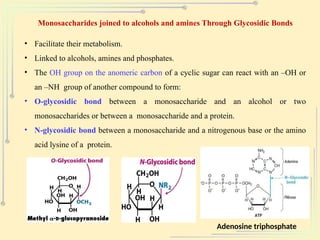
Monosaccharides joined to alcohols and amines Through Glycosidic Bonds
• Facilitate their metabolism.
• Linked to alcohols, amines and phosphates.
• The OH group on the anomeric carbon of a cyclic sugar can react with an –OH or
an –NH group of another compound to form:
• O-glycosidic bond between a monosaccharide and an alcohol or two
monosaccharides or between a monosaccharide and a protein.
• N-glycosidic bond between a monosaccharide and a nitrogenous base or the amino
acid lysine of a protein.
Adenosine triphosphate
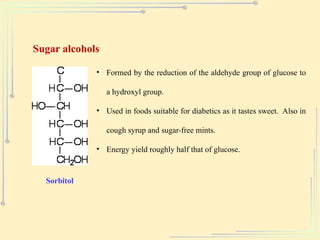
Sugar alcohols
Sorbitol
• Formed by the reduction of the aldehyde group of glucose to
a hydroxyl group.
• Used in foods suitable for diabetics as it tastes sweet. Also in
cough syrup and sugar-free mints.
• Energy yield roughly half that of glucose.
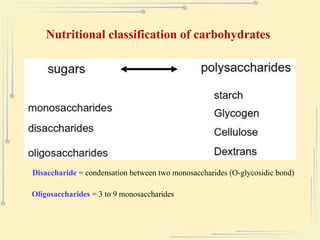
Nutritional classification of carbohydrates
Disaccharide = condensation between two monosaccharides (O-glycosidic bond)
Oligosaccharides = 3 to 9 monosaccharides
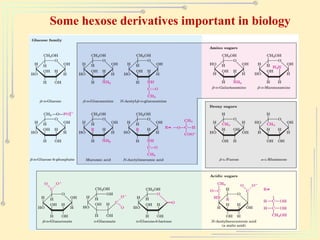
Some hexose derivatives important in biology
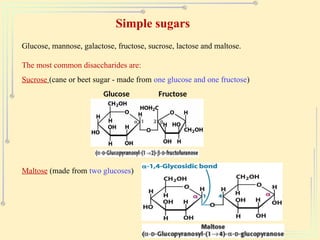
Simple sugars
Glucose, mannose, galactose, fructose, sucrose, lactose and maltose.
The most common disaccharides are:
Sucrose (cane or beet sugar - made from one glucose and one fructose)
Glucose Fructose
Maltose (made from two glucoses)
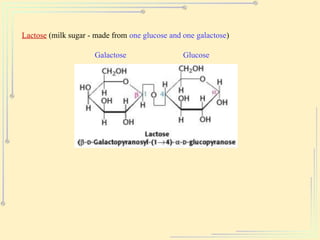
Lactose (milk sugar - made from one glucose and one galactose)
Galactose Glucose
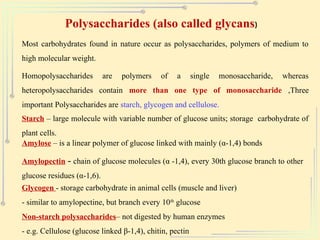
Polysaccharides (also called glycans)
Most carbohydrates found in nature occur as polysaccharides, polymers of medium to
high molecular weight.
Homopolysaccharides are polymers of a single monosaccharide, whereas
heteropolysaccharides contain more than one type of monosaccharide ,Three
important Polysaccharides are starch, glycogen and cellulose.
Starch – large molecule with variable number of glucose units; storage carbohydrate of
plant cells.
Amylose – is a linear polymer of glucose linked with mainly (α-1,4) bonds
Amylopectin – chain of glucose molecules (α -1,4), every 30th glucose branch to other
glucose residues (α-1,6).
Glycogen - storage carbohydrate in animal cells (muscle and liver)
- similar to amylopectine, but branch every 10th
glucose
Non-starch polysaccharides– not digested by human enzymes
- e.g. Cellulose (glucose linked β-1,4), chitin, pectin
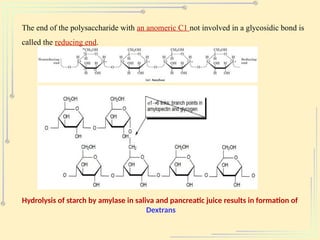
The end of the polysaccharide with an anomeric C1 not involved in a glycosidic bond is
called the reducing end.
Hydrolysis of starch by amylase in saliva and pancreatic juice results in formation of
Dextrans
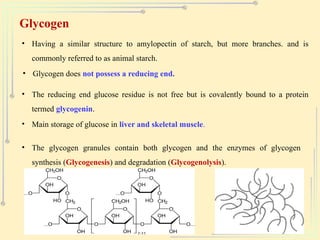
Glycogen
• Having a similar structure to amylopectin of starch, but more branches. and is
commonly referred to as animal starch.
• Glycogen does not possess a reducing end.
• The reducing end glucose residue is not free but is covalently bound to a protein
termed glycogenin.
• Main storage of glucose in liver and skeletal muscle.
• The glycogen granules contain both glycogen and the enzymes of glycogen
synthesis (Glycogenesis) and degradation (Glycogenolysis).
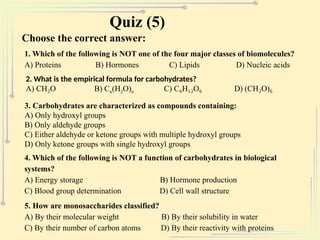
Quiz (5)
Choose the correct answer:
1. Which of the following is NOT one of the four major classes of biomolecules?
A) Proteins B) Hormones C) Lipids D) Nucleic acids
2. What is the empirical formula for carbohydrates?
A) CH O B) C
₂ n(H2O)n C) C H O D) (CH O)
₆ ₁₂ ₆ ₂ ₆
3. Carbohydrates are characterized as compounds containing:
A) Only hydroxyl groups
B) Only aldehyde groups
C) Either aldehyde or ketone groups with multiple hydroxyl groups
D) Only ketone groups with single hydroxyl groups
4. Which of the following is NOT a function of carbohydrates in biological
systems?
A) Energy storage B) Hormone production
C) Blood group determination D) Cell wall structure
5. How are monosaccharides classified?
A) By their molecular weight B) By their solubility in water
C) By their number of carbon atoms D) By their reactivity with proteins
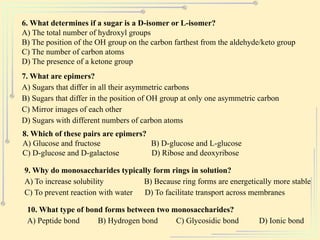
6. What determines if a sugar is a D-isomer or L-isomer?
A) The total number of hydroxyl groups
B) The position of the OH group on the carbon farthest from the aldehyde/keto group
C) The number of carbon atoms
D) The presence of a ketone group
7. What are epimers?
A) Sugars that differ in all their asymmetric carbons
B) Sugars that differ in the position of OH group at only one asymmetric carbon
C) Mirror images of each other
D) Sugars with different numbers of carbon atoms
8. Which of these pairs are epimers?
A) Glucose and fructose B) D-glucose and L-glucose
C) D-glucose and D-galactose D) Ribose and deoxyribose
9. Why do monosaccharides typically form rings in solution?
A) To increase solubility B) Because ring forms are energetically more stable
C) To prevent reaction with water D) To facilitate transport across membranes
10. What type of bond forms between two monosaccharides?
A) Peptide bond B) Hydrogen bond C) Glycosidic bond D) Ionic bond
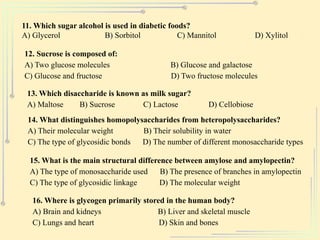
11. Which sugar alcohol is used in diabetic foods?
A) Glycerol B) Sorbitol C) Mannitol D) Xylitol
12. Sucrose is composed of:
A) Two glucose molecules B) Glucose and galactose
C) Glucose and fructose D) Two fructose molecules
13. Which disaccharide is known as milk sugar?
A) Maltose B) Sucrose C) Lactose D) Cellobiose
14. What distinguishes homopolysaccharides from heteropolysaccharides?
A) Their molecular weight B) Their solubility in water
C) The type of glycosidic bonds D) The number of different monosaccharide types
15. What is the main structural difference between amylose and amylopectin?
A) The type of monosaccharide used B) The presence of branches in amylopectin
C) The type of glycosidic linkage D) The molecular weight
16. Where is glycogen primarily stored in the human body?
A) Brain and kidneys B) Liver and skeletal muscle
C) Lungs and heart D) Skin and bones
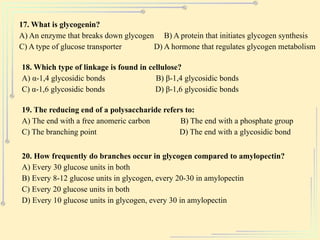
17. What is glycogenin?
A) An enzyme that breaks down glycogen B) A protein that initiates glycogen synthesis
C) A type of glucose transporter D) A hormone that regulates glycogen metabolism
18. Which type of linkage is found in cellulose?
A) α-1,4 glycosidic bonds B) β-1,4 glycosidic bonds
C) α-1,6 glycosidic bonds D) β-1,6 glycosidic bonds
19. The reducing end of a polysaccharide refers to:
A) The end with a free anomeric carbon B) The end with a phosphate group
C) The branching point D) The end with a glycosidic bond
20. How frequently do branches occur in glycogen compared to amylopectin?
A) Every 30 glucose units in both
B) Every 8-12 glucose units in glycogen, every 20-30 in amylopectin
C) Every 20 glucose units in both
D) Every 10 glucose units in glycogen, every 30 in amylopectin
Answer with true or false:
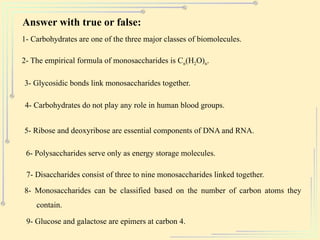
1- Carbohydrates are one of the three major classes of biomolecules.
2- The empirical formula of monosaccharides is Cn(H2O)n.
3- Glycosidic bonds link monosaccharides together.
4- Carbohydrates do not play any role in human blood groups.
5- Ribose and deoxyribose are essential components of DNA and RNA.
6- Polysaccharides serve only as energy storage molecules.
7- Disaccharides consist of three to nine monosaccharides linked together.
8- Monosaccharides can be classified based on the number of carbon atoms they
contain.
9- Glucose and galactose are epimers at carbon 4.
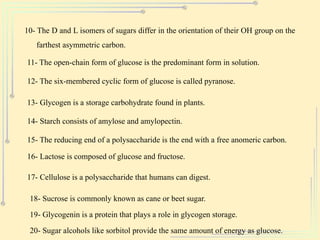
10- The D and L isomers of sugars differ in the orientation of their OH group on the
farthest asymmetric carbon.
11- The open-chain form of glucose is the predominant form in solution.
12- The six-membered cyclic form of glucose is called pyranose.
13- Glycogen is a storage carbohydrate found in plants.
14- Starch consists of amylose and amylopectin.
15- The reducing end of a polysaccharide is the end with a free anomeric carbon.
16- Lactose is composed of glucose and fructose.
17- Cellulose is a polysaccharide that humans can digest.
18- Sucrose is commonly known as cane or beet sugar.
19- Glycogenin is a protein that plays a role in glycogen storage.
20- Sugar alcohols like sorbitol provide the same amount of energy as glucose.
Carbohydrates, classifications, reaction

Carbohydrates, classifications, reaction

  • 1.
    Ass. Prof. SherifMohamedAbd El-Hamid Al-Ayen University Faculty of Health and Medical Technology Chemistry (Advanced)
  • 2.
    Ground Rules forLectures • Arrive on time. • Listen actively and attentively. • Mask must be worn. • Keep the distance between you and your colleague. • Bring something to write with and in. • Turn your cell phone off. • Do not leave class early without okaying it with the instructor in advance. • Ask questions if you are confused. • Try not to distract or annoy your classmates
  • 3.
    Introduction to Biochemistry(carbohydrates) Objectives : • To know the formation of carbohydrates • To understand the nature of glycosidic bonds • To understand the structural organization of carbohydrates • To appreciate the various functions of carbohydrates
  • 4.
    Carbohydrates • Carbohydrates, oneof the four major classes of biomolecules along with proteins, lipids, and nucleic acids. • Carbohydrates are built from monosaccharides (carbon atoms bound to hydroxyl groups, Empirical formula Cn(H2O)n. • Monosaccharides are linked together by glycosidic bonds to form di, oligo- and a huge variety of polysaccharides. • Carbohydrates are aldehyde (CHO) or ketone (C=O) compounds with multiple hydroxyl groups (Carbon-oxygen double bonds make the sugars reactive).
  • 5.
    Importance of carbohydrates •Carbohydrates serve as energy store and metabolic intermediates. • Ribose and deoxyribose sugars form part of the structural framework of RNA and DNA. • Carbohydrates are important for tissue formation. • Carbohydrates form the basis of human blood groups. • Polysaccharides are structural elements in the cell walls of bacteria and plants and in the connective tissues of animals. • Carbohydrates are linked to many proteins and lipids, where they play key roles in mediating interactions among cells and interactions between cells and other elements in the cellular environment.
  • 6.
  • 7.
    Classification of Carbohydrates Carbohydratescan be classified into : 1- Monosaccharides - simple sugars with multiple OH groups. Based on number of carbons. 2 - Disaccharides: two monosaccharides covalently linked by glycosidic bond . 3 - Oligosaccharides: several monosaccharides (3-9) joined by glycosidic bonds . 4- Polysaccharides: polymers consisting of chains of monosaccharide or disaccharide units.
  • 8.
    Monosaccharides • The simplestof the carbohydrates • Aldehydes or ketones • Colorless, crystalline solids that are freely soluble in water but insoluble in nonpolar solvents. • They are important fuel molecules as well as building blocks for nucleic acids. • The smallest monosaccharides are :
  • 9.
    The sugars namedin boxes are the most common in nature The names of all sugars end in – ose Hexoses are the nutritionally important sugars.
  • 10.
    D and Lisomerism • Isomers are molecules with the same kinds and numbers of atoms joined up in different ways. • A carbon atom that contains 4 different chemical groups forms an asymmetric (chiral) center. • The prefixes D and L designate the absolute configuration of the asymmetric carbon farthest from the aldehyde or keto group. • When the OH group on this carbon is on the right , the sugar is the D-isomer; when it is on the left, it is the L-isomer. • Glyceraldehyde has a single asymmetric carbon and, thus, there are 2 stereoisomers of this sugar. • D-Glyceraldehyde and L-glyceraldehyde are mirror images of each other (enantiomers).
  • 11.
    Stereoisomers and Epimers •Stereoisomers have the same chemical formula but differ in the position of the OH group on 1 or more of their asymmetric carbons. • Epimers are stereoisomers that differ in the position of the OH group at only 1 of their asymmetric carbons. • D-glucose and D-galactose are epimers of each other, differing only at C4, and can be interconverted in human cells by enzymes called epimerase. • D-mannose and D-glucose are also epimers of each other, differing only at C2.
  • 12.
    Cyclization of Monosaccharide •The predominant forms of ribose, glucose, fructose, and many other sugars in solution are not open chains. Rather, the open-chain forms of these sugars cyclize into rings. • For an aldohexose such as glucose, Formation of a hemiacetal by reaction of the C-1 aldehyde group with the C-5 hydroxyl group to form an intramolecular hemiacetal. The resulting cyclic hemiacetal, a six-membered ring, is called pyranose because of its similarity to pyran. Ring-form is energetically more stable
  • 13.
    Pentoses and HexosesCyclize to Form Pyranose and furanose Rings
  • 14.
    Pentose sugars Pentoses suchas D-ribose and 2-Deoxy-D-ribose form furanose rings, as we have seen in the structure of these units in RNA and DNA.
  • 15.
    Monosaccharides joined toalcohols and amines Through Glycosidic Bonds • Facilitate their metabolism. • Linked to alcohols, amines and phosphates. • The OH group on the anomeric carbon of a cyclic sugar can react with an –OH or an –NH group of another compound to form: • O-glycosidic bond between a monosaccharide and an alcohol or two monosaccharides or between a monosaccharide and a protein. • N-glycosidic bond between a monosaccharide and a nitrogenous base or the amino acid lysine of a protein. Adenosine triphosphate
  • 16.
    Sugar alcohols Sorbitol • Formedby the reduction of the aldehyde group of glucose to a hydroxyl group. • Used in foods suitable for diabetics as it tastes sweet. Also in cough syrup and sugar-free mints. • Energy yield roughly half that of glucose.
  • 17.
    Nutritional classification ofcarbohydrates Disaccharide = condensation between two monosaccharides (O-glycosidic bond) Oligosaccharides = 3 to 9 monosaccharides
  • 18.
    Some hexose derivativesimportant in biology
  • 19.
    Simple sugars Glucose, mannose,galactose, fructose, sucrose, lactose and maltose. The most common disaccharides are: Sucrose (cane or beet sugar - made from one glucose and one fructose) Glucose Fructose Maltose (made from two glucoses)
  • 20.
    Lactose (milk sugar- made from one glucose and one galactose) Galactose Glucose
  • 21.
    Polysaccharides (also calledglycans) Most carbohydrates found in nature occur as polysaccharides, polymers of medium to high molecular weight. Homopolysaccharides are polymers of a single monosaccharide, whereas heteropolysaccharides contain more than one type of monosaccharide ,Three important Polysaccharides are starch, glycogen and cellulose. Starch – large molecule with variable number of glucose units; storage carbohydrate of plant cells. Amylose – is a linear polymer of glucose linked with mainly (α-1,4) bonds Amylopectin – chain of glucose molecules (α -1,4), every 30th glucose branch to other glucose residues (α-1,6). Glycogen - storage carbohydrate in animal cells (muscle and liver) - similar to amylopectine, but branch every 10th glucose Non-starch polysaccharides– not digested by human enzymes - e.g. Cellulose (glucose linked β-1,4), chitin, pectin
  • 22.
    The end ofthe polysaccharide with an anomeric C1 not involved in a glycosidic bond is called the reducing end. Hydrolysis of starch by amylase in saliva and pancreatic juice results in formation of Dextrans
  • 23.
    Glycogen • Having asimilar structure to amylopectin of starch, but more branches. and is commonly referred to as animal starch. • Glycogen does not possess a reducing end. • The reducing end glucose residue is not free but is covalently bound to a protein termed glycogenin. • Main storage of glucose in liver and skeletal muscle. • The glycogen granules contain both glycogen and the enzymes of glycogen synthesis (Glycogenesis) and degradation (Glycogenolysis).
  • 24.
    Quiz (5) Choose thecorrect answer: 1. Which of the following is NOT one of the four major classes of biomolecules? A) Proteins B) Hormones C) Lipids D) Nucleic acids 2. What is the empirical formula for carbohydrates? A) CH O B) C ₂ n(H2O)n C) C H O D) (CH O) ₆ ₁₂ ₆ ₂ ₆ 3. Carbohydrates are characterized as compounds containing: A) Only hydroxyl groups B) Only aldehyde groups C) Either aldehyde or ketone groups with multiple hydroxyl groups D) Only ketone groups with single hydroxyl groups 4. Which of the following is NOT a function of carbohydrates in biological systems? A) Energy storage B) Hormone production C) Blood group determination D) Cell wall structure 5. How are monosaccharides classified? A) By their molecular weight B) By their solubility in water C) By their number of carbon atoms D) By their reactivity with proteins
  • 25.
    6. What determinesif a sugar is a D-isomer or L-isomer? A) The total number of hydroxyl groups B) The position of the OH group on the carbon farthest from the aldehyde/keto group C) The number of carbon atoms D) The presence of a ketone group 7. What are epimers? A) Sugars that differ in all their asymmetric carbons B) Sugars that differ in the position of OH group at only one asymmetric carbon C) Mirror images of each other D) Sugars with different numbers of carbon atoms 8. Which of these pairs are epimers? A) Glucose and fructose B) D-glucose and L-glucose C) D-glucose and D-galactose D) Ribose and deoxyribose 9. Why do monosaccharides typically form rings in solution? A) To increase solubility B) Because ring forms are energetically more stable C) To prevent reaction with water D) To facilitate transport across membranes 10. What type of bond forms between two monosaccharides? A) Peptide bond B) Hydrogen bond C) Glycosidic bond D) Ionic bond
  • 26.
    11. Which sugaralcohol is used in diabetic foods? A) Glycerol B) Sorbitol C) Mannitol D) Xylitol 12. Sucrose is composed of: A) Two glucose molecules B) Glucose and galactose C) Glucose and fructose D) Two fructose molecules 13. Which disaccharide is known as milk sugar? A) Maltose B) Sucrose C) Lactose D) Cellobiose 14. What distinguishes homopolysaccharides from heteropolysaccharides? A) Their molecular weight B) Their solubility in water C) The type of glycosidic bonds D) The number of different monosaccharide types 15. What is the main structural difference between amylose and amylopectin? A) The type of monosaccharide used B) The presence of branches in amylopectin C) The type of glycosidic linkage D) The molecular weight 16. Where is glycogen primarily stored in the human body? A) Brain and kidneys B) Liver and skeletal muscle C) Lungs and heart D) Skin and bones
  • 27.
    17. What isglycogenin? A) An enzyme that breaks down glycogen B) A protein that initiates glycogen synthesis C) A type of glucose transporter D) A hormone that regulates glycogen metabolism 18. Which type of linkage is found in cellulose? A) α-1,4 glycosidic bonds B) β-1,4 glycosidic bonds C) α-1,6 glycosidic bonds D) β-1,6 glycosidic bonds 19. The reducing end of a polysaccharide refers to: A) The end with a free anomeric carbon B) The end with a phosphate group C) The branching point D) The end with a glycosidic bond 20. How frequently do branches occur in glycogen compared to amylopectin? A) Every 30 glucose units in both B) Every 8-12 glucose units in glycogen, every 20-30 in amylopectin C) Every 20 glucose units in both D) Every 10 glucose units in glycogen, every 30 in amylopectin
  • 28.
    Answer with trueor false: 1- Carbohydrates are one of the three major classes of biomolecules. 2- The empirical formula of monosaccharides is Cn(H2O)n. 3- Glycosidic bonds link monosaccharides together. 4- Carbohydrates do not play any role in human blood groups. 5- Ribose and deoxyribose are essential components of DNA and RNA. 6- Polysaccharides serve only as energy storage molecules. 7- Disaccharides consist of three to nine monosaccharides linked together. 8- Monosaccharides can be classified based on the number of carbon atoms they contain. 9- Glucose and galactose are epimers at carbon 4.
  • 29.
    10- The Dand L isomers of sugars differ in the orientation of their OH group on the farthest asymmetric carbon. 11- The open-chain form of glucose is the predominant form in solution. 12- The six-membered cyclic form of glucose is called pyranose. 13- Glycogen is a storage carbohydrate found in plants. 14- Starch consists of amylose and amylopectin. 15- The reducing end of a polysaccharide is the end with a free anomeric carbon. 16- Lactose is composed of glucose and fructose. 17- Cellulose is a polysaccharide that humans can digest. 18- Sucrose is commonly known as cane or beet sugar. 19- Glycogenin is a protein that plays a role in glycogen storage. 20- Sugar alcohols like sorbitol provide the same amount of energy as glucose.