CARBOHYDRATES
Talk about
• What
• Function
• Structure
• Classification
• Properties
• Characteristic
What is?
• Carbohydrates are the sugars, starches and
fibers found in fruits, grains, vegetables and
milk products. Though often maligned in trendy
diets, carbohydrates — one of the basic food
groups — are important to a healthy life.
• Carbohydrates are macronutrients, meaning
they are one of the three main ways the body
obtains energy, or calories
• They are called carbohydrates because, at the
chemical level, they contain carbon, hydrogen
and oxygen.
• Carbohydrates are chief energy source, in many
animals, they are instant source of energy. Glucose is
broken down by glycolysis/ kreb's cycle to yield ATP.
• Glucose is the source of storage of energy. It is stored
as glycogen in animals and starch in plants.
• Stored carbohydrates acts as energy source instead of
proteins.
• Carbohydrates are intermediates in biosynthesis of
fats and proteins.
• Carbohydrates aid in regulation of nerve tissue and is
the energy source for brain.
• Carbohydrates gets associated with lipids and proteins
to form surface antigens, receptor molecules,
vitamins and antibiotics.
FUNCTION
• They form structural and protective components,
like in cell wall of plants and microorganisms.
• In animals they are important constituent of
connective tissues.
• They participate in biological transport, cell-cell
communication and activation of growth factors.
• Carbohydrates that are rich in fibre content help
to prevent constipation.
• Also they help in modulation of immune system.
Structure
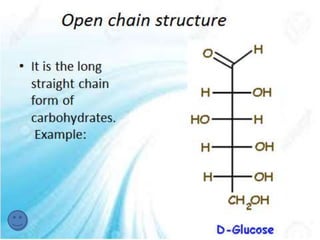
•Open chain structure
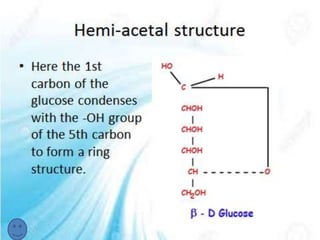
•Hemi-acetal structure
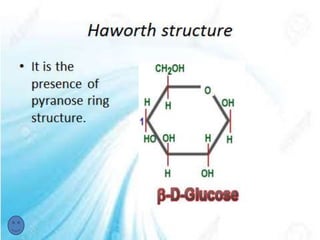
•Haworth structure
Classifications
Monosaccharide
Oligosaccharide
Polysaccharide
Properties
• Carbohydrates act as energy reserves, also stores
fuels, and metabolic intermediates.
• Ribose and deoxyribose sugars forms the structural
frame of the genetic material, RNA and DNA.
• Polysaccharides like cellulose are the structural
elements in the cell walls of bacteria and plants.
• Carbohydrates are linked to proteins and lipids
that play important roles in cell interactions.
• Carbohydrates are organic compounds, they are
aldehydes or ketones with many hydroxyl groups.
Characteristics
• They have carbon, hydrogen, and oxygen,
often in a ratio of or near 1:2:1.
• They are polar and therefore hydrophilic.
• Monomers often form ring structures in
water
• Individual carbohydrate molecules (called
monomers) can bind together forming
polymers of many individual carbohydrate
molecules attached together. An example of a
carbohydrate monomer is glucose with the
chemical formula of C6H12O6.
•THAT’S ALL

Carbohydrates

  • 1.
  • 2.
    Talk about • What •Function • Structure • Classification • Properties • Characteristic
  • 3.
    What is? • Carbohydratesare the sugars, starches and fibers found in fruits, grains, vegetables and milk products. Though often maligned in trendy diets, carbohydrates — one of the basic food groups — are important to a healthy life. • Carbohydrates are macronutrients, meaning they are one of the three main ways the body obtains energy, or calories • They are called carbohydrates because, at the chemical level, they contain carbon, hydrogen and oxygen.
  • 4.
    • Carbohydrates arechief energy source, in many animals, they are instant source of energy. Glucose is broken down by glycolysis/ kreb's cycle to yield ATP. • Glucose is the source of storage of energy. It is stored as glycogen in animals and starch in plants. • Stored carbohydrates acts as energy source instead of proteins. • Carbohydrates are intermediates in biosynthesis of fats and proteins. • Carbohydrates aid in regulation of nerve tissue and is the energy source for brain. • Carbohydrates gets associated with lipids and proteins to form surface antigens, receptor molecules, vitamins and antibiotics. FUNCTION
  • 5.
    • They formstructural and protective components, like in cell wall of plants and microorganisms. • In animals they are important constituent of connective tissues. • They participate in biological transport, cell-cell communication and activation of growth factors. • Carbohydrates that are rich in fibre content help to prevent constipation. • Also they help in modulation of immune system.
  • 6.
  • 10.
  • 13.
    Properties • Carbohydrates actas energy reserves, also stores fuels, and metabolic intermediates. • Ribose and deoxyribose sugars forms the structural frame of the genetic material, RNA and DNA. • Polysaccharides like cellulose are the structural elements in the cell walls of bacteria and plants. • Carbohydrates are linked to proteins and lipids that play important roles in cell interactions. • Carbohydrates are organic compounds, they are aldehydes or ketones with many hydroxyl groups.
  • 15.
    Characteristics • They havecarbon, hydrogen, and oxygen, often in a ratio of or near 1:2:1. • They are polar and therefore hydrophilic. • Monomers often form ring structures in water • Individual carbohydrate molecules (called monomers) can bind together forming polymers of many individual carbohydrate molecules attached together. An example of a carbohydrate monomer is glucose with the chemical formula of C6H12O6.
  • 16.