PROJETO DE CONCLUSÃO APLICADO
AULA 2 // JANEIRO 2014

ISABELLE GOLDFARB

RONALDO PORTO

ISABELLE.GOLDFARB@ESPM.BR
99193-8848

RONALDO.PORTO@GMAIL.COM
98863-8082
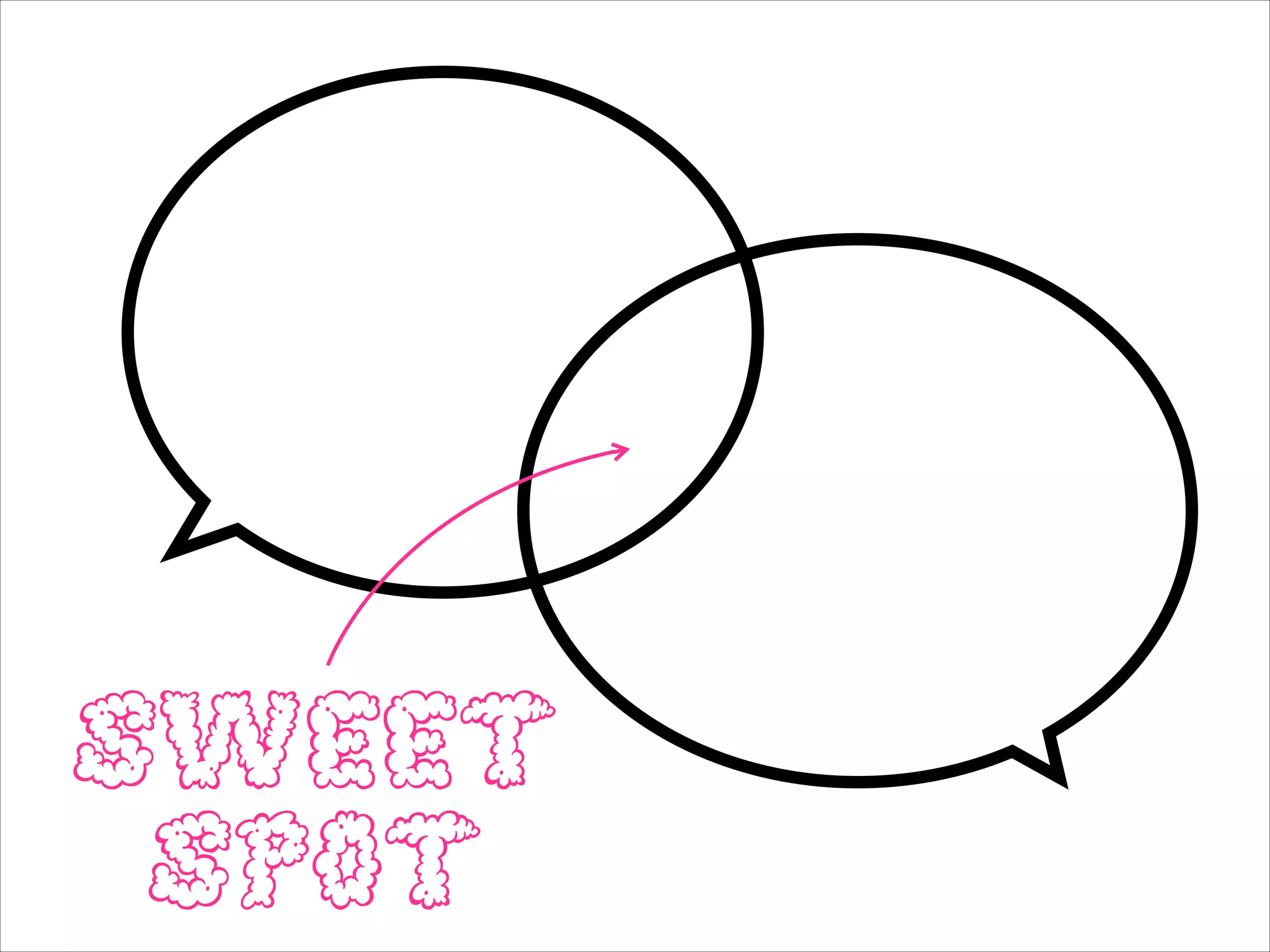
SWEET

SPOT
1

QUAL É O NEGÓCIO?

2

O QUE DESCOBRIU?
AGORA É A HORA

DE DESENVOLVER

NOSSOS PRODUTOS!
NÃO
AGORA É A HORA

DE DESENVOLVER

NOSSOS CLIENTES!
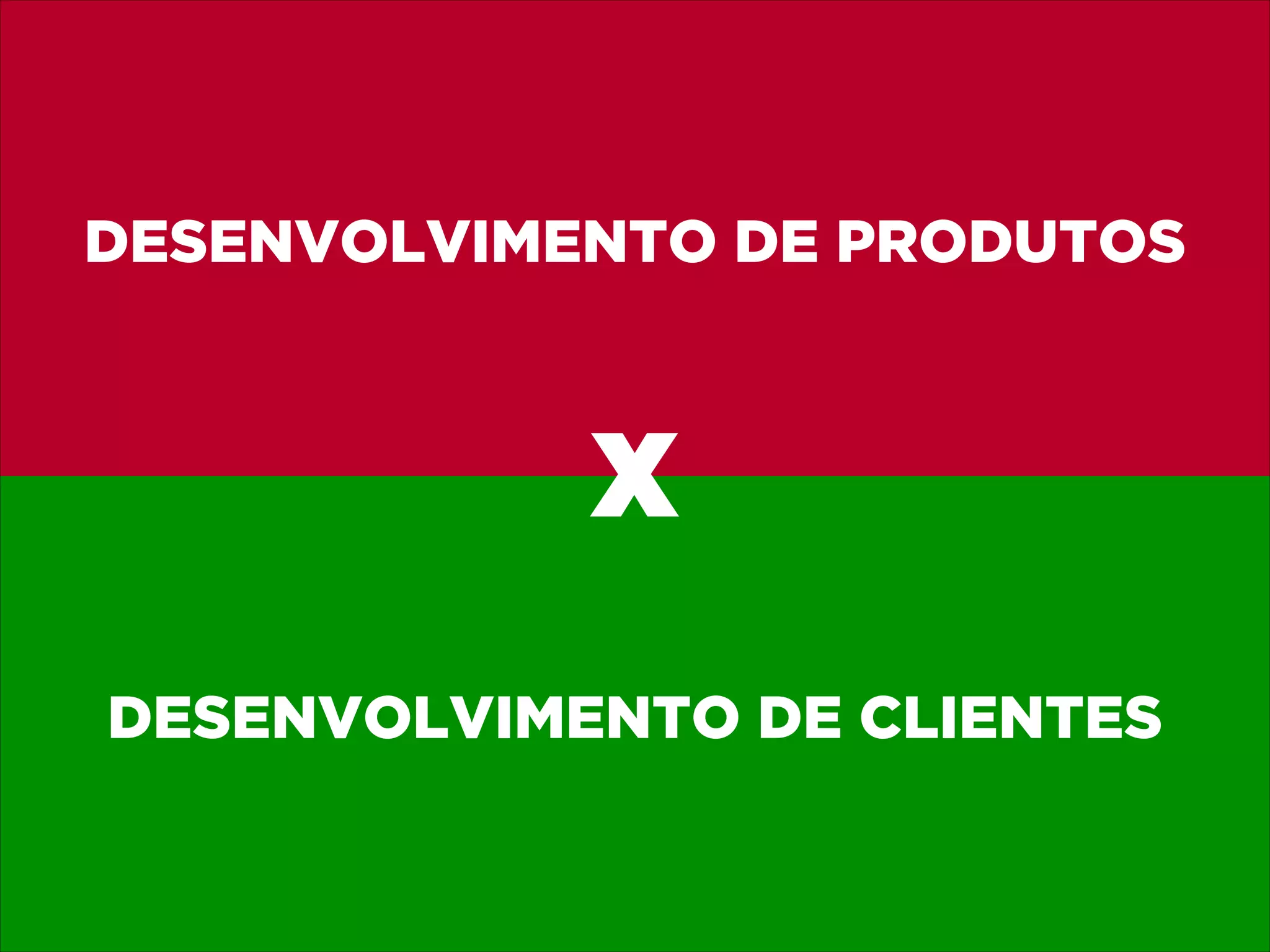
DESENVOLVIMENTO DE PRODUTOS

X
DESENVOLVIMENTO DE CLIENTES
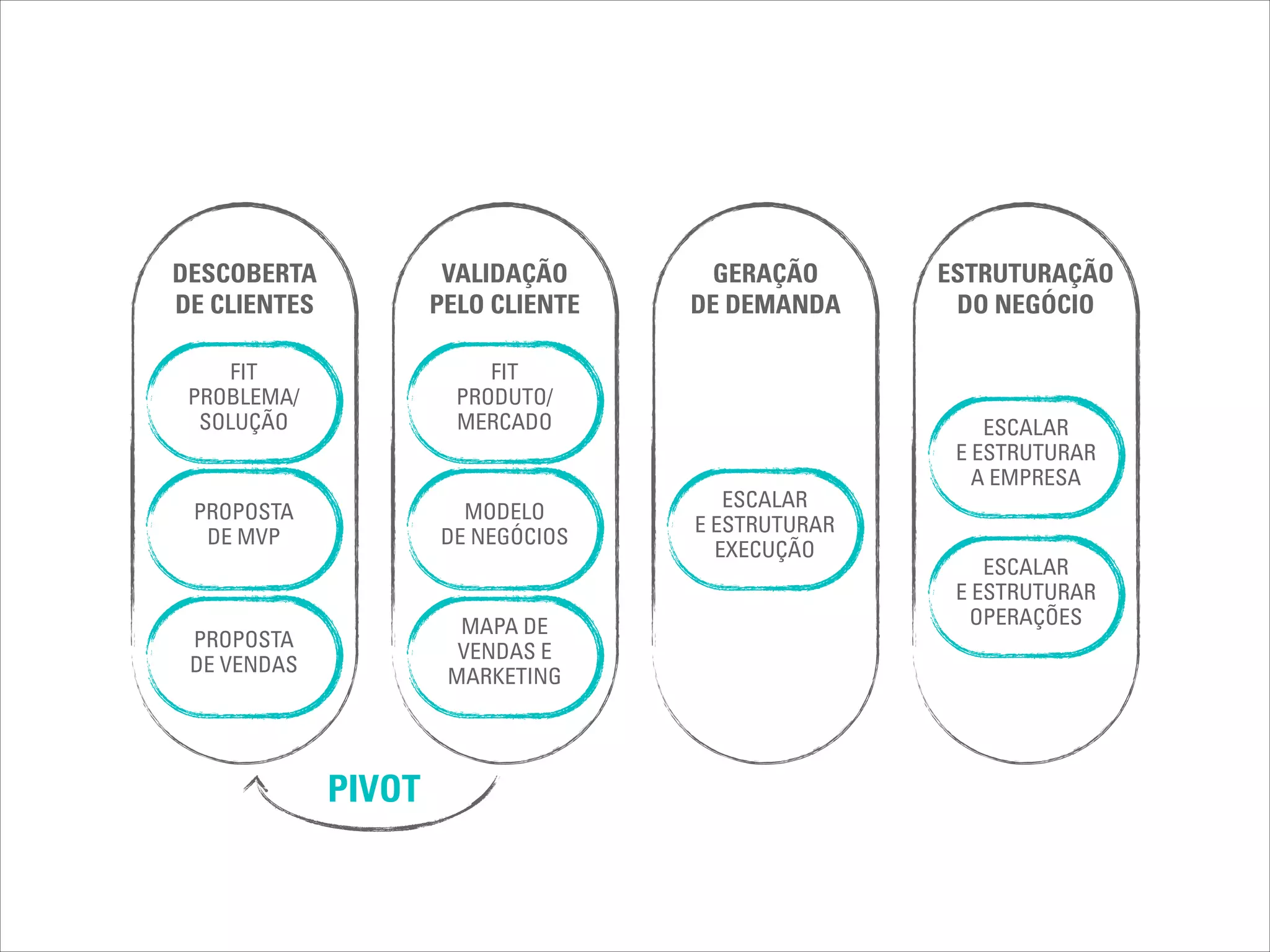
DESCOBERTA

DE CLIENTES

VALIDAÇÃO

PELO CLIENTE

FIT

PROBLEMA/

SOLUÇÃO

FIT

PRODUTO/

MERCADO

PROPOSTA

DE MVP

MODELO

DE NEGÓCIOS

MAPA DE

VENDAS E

MARKETING


PROPOSTA

DE VENDAS

PIVOT

GERAÇÃO

DE DEMANDA

ESCALAR

E ESTRUTURAR

EXECUÇÃO

ESTRUTURAÇÃO

DO NEGÓCIO

ESCALAR

E ESTRUTURAR

A EMPRESA

ESCALAR

E ESTRUTURAR

OPERAÇÕES
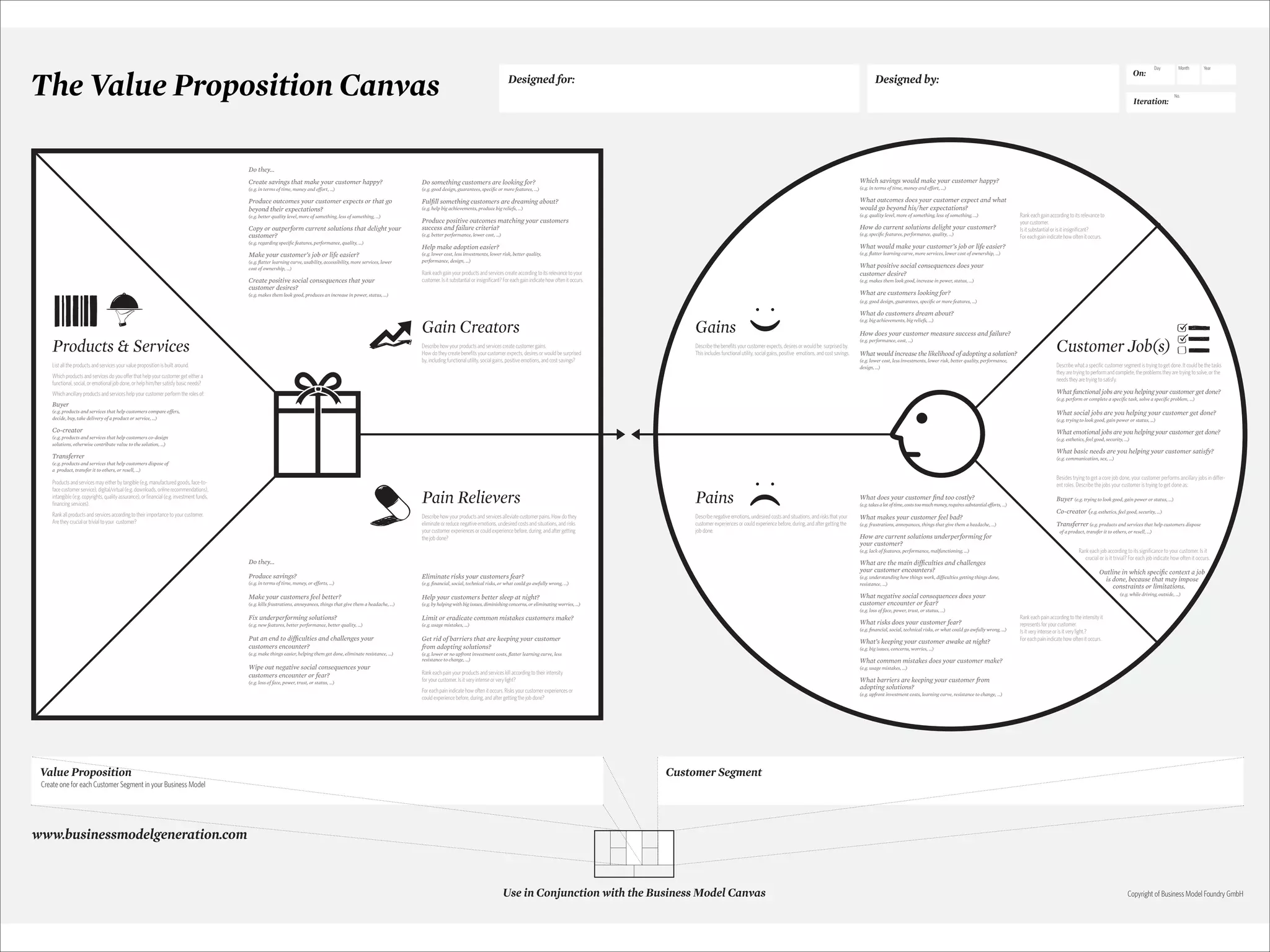
The Value Proposition Canvas

Designed for:

On:

Designed by:

Day

Iteration:

Month

Year

No.

Do they…
Which savings would make your customer happy?

Create savings that make your customer happy?

Do something customers are looking for?

(e.g. in terms of time, money and effort, …)

(e.g. good design, guarantees, specific or more features, …)

(e.g. in terms of time, money and effort, …)

Produce outcomes your customer expects or that go
beyond their expectations?

Fulfill something customers are dreaming about?

What outcomes does your customer expect and what
would go beyond his/her expectations?

(e.g. better quality level, more of something, less of something, …)

Copy or outperform current solutions that delight your
customer?
(e.g. regarding specific features, performance, quality, …)

Make your customer’s job or life easier?
(e.g. flatter learning curve, usability, accessibility, more services, lower
cost of ownership, …)

Create positive social consequences that your
customer desires?

(e.g. help big achievements, produce big reliefs, …)

(e.g. quality level, more of something, less of something, …)

Produce positive outcomes matching your customers
success and failure criteria?

How do current solutions delight your customer?

(e.g. better performance, lower cost, …)

(e.g. specific features, performance, quality, …)

Help make adoption easier?

Rank each gain according to its relevance to
your customer.
Is it substantial or is it insignificant?
For each gain indicate how often it occurs.

What would make your customer’s job or life easier?
(e.g. flatter learning curve, more services, lower cost of ownership, …)

(e.g. lower cost, less investments, lower risk, better quality,
performance, design, …)

What positive social consequences does your
customer desire?

Rank each gain your products and services create according to its relevance to your
customer. Is it substantial or insignificant? For each gain indicate how often it occurs.

(e.g. makes them look good, increase in power, status, …)

What are customers looking for?

(e.g. makes them look good, produces an increase in power, status, …)

(e.g. good design, guarantees, specific or more features, …)

Gain Creators
Describe how your products and services create customer gains.
How do they create benefits your customer expects, desires or would be surprised
by, including functional utility, social gains, positive emotions, and cost savings?

Products & Services
List all the products and services your value proposition is built around.

Gains
Describe the benefits your customer expects, desires or would be surprised by.
This includes functional utility, social gains, positive emotions, and cost savings.

What do customers dream about?
(e.g. big achievements, big reliefs, …)

How does your customer measure success and failure?
(e.g. performance, cost, …)

What would increase the likelihood of adopting a solution?
(e.g. lower cost, less investments, lower risk, better quality, performance,
design, …)

Which products and services do you offer that help your customer get either a
functional, social, or emotional job done, or help him/her satisfy basic needs?

Customer Job(s)
Describe what a specific customer segment is trying to get done. It could be the tasks
they are trying to perform and complete, the problems they are trying to solve, or the
needs they are trying to satisfy.

What functional jobs are you helping your customer get done?

Which ancillary products and services help your customer perform the roles of:

(e.g. perform or complete a specific task, solve a specific problem, …)

Buyer
(e.g. products and services that help customers compare offers,
decide, buy, take delivery of a product or service, …)

What social jobs are you helping your customer get done?

Co-creator

What emotional jobs are you helping your customer get done?

(e.g. trying to look good, gain power or status, …)

(e.g. products and services that help customers co-design
solutions, otherwise contribute value to the solution, …)

(e.g. esthetics, feel good, security, …)

What basic needs are you helping your customer satisfy?

Transferrer

(e.g. communication, sex, …)

(e.g. products and services that help customers dispose of
a product, transfer it to others, or resell, …)

Products and services may either by tangible (e.g. manufactured goods, face-toface customer service), digital/virtual (e.g. downloads, online recommendations),
intangible (e.g. copyrights, quality assurance), or financial (e.g. investment funds,
financing services).

Pain Relievers
Describe how your products and services alleviate customer pains. How do they
eliminate or reduce negative emotions, undesired costs and situations, and risks
your customer experiences or could experience before, during, and after getting
the job done?

Rank all products and services according to their importance to your customer.
Are they crucial or trivial to your customer?

Pains
Describe negative emotions, undesired costs and situations, and risks that your
customer experiences or could experience before, during, and after getting the
job done.

Besides trying to get a core job done, your customer performs ancillary jobs in different roles. Describe the jobs your customer is trying to get done as:

What does your customer find too costly?
(e.g. takes a lot of time, costs too much money, requires substantial efforts, …)

What makes your customer feel bad?
(e.g. frustrations, annoyances, things that give them a headache, …)

How are current solutions underperforming for
your customer?
(e.g. lack of features, performance, malfunctioning, …)

Do they…
Produce savings?

Eliminate risks your customers fear?

(e.g. in terms of time, money, or efforts, …)

What are the main difficulties and challenges
your customer encounters?

(e.g. financial, social, technical risks, or what could go awfully wrong, …)

Make your customers feel better?

Co-creator (e.g. esthetics, feel good, security, …)
Transferrer (e.g. products and services that help customers dispose
of a product, transfer it to others, or resell, …)

Rank each job according to its significance to your customer. Is it
crucial or is it trivial? For each job indicate how often it occurs.

Outline in which specific context a job
is done, because that may impose
constraints or limitations.
(e.g. while driving, outside, …)

What negative social consequences does your
customer encounter or fear?

Help your customers better sleep at night?

(e.g. kills frustrations, annoyances, things that give them a headache, …)

(e.g. understanding how things work, difficulties getting things done,
resistance, …)

Buyer (e.g. trying to look good, gain power or status, …)

(e.g. by helping with big issues, diminishing concerns, or eliminating worries, …)

(e.g. loss of face, power, trust, or status, …)

Fix underperforming solutions?

Limit or eradicate common mistakes customers make?

(e.g. new features, better performance, better quality, …)

(e.g. usage mistakes, …)

What risks does your customer fear?

Put an end to difficulties and challenges your
customers encounter?

Get rid of barriers that are keeping your customer
from adopting solutions?

(e.g. make things easier, helping them get done, eliminate resistance, …)

(e.g. lower or no upfront investment costs, flatter learning curve, less
resistance to change, …)

Wipe out negative social consequences your
customers encounter or fear?
(e.g. loss of face, power, trust, or status, …)

What’s keeping your customer awake at night?
What common mistakes does your customer make?
(e.g. usage mistakes, …)

Rank each pain your products and services kill according to their intensity
for your customer. Is it very intense or very light?

What barriers are keeping your customer from
adopting solutions?

For each pain indicate how often it occurs. Risks your customer experiences or
could experience before, during, and after getting the job done?

Value Proposition

Rank each pain according to the intensity it
represents for your customer.
Is it very intense or is it very light.?
For each pain indicate how often it occurs.

(e.g. big issues, concerns, worries, …)

(e.g. financial, social, technical risks, or what could go awfully wrong, …)

(e.g. upfront investment costs, learning curve, resistance to change, …)

Customer Segment

Create one for each Customer Segment in your Business Model

www.businessmodelgeneration.com

Use in Conjunction with the Business Model Canvas

Copyright of Business Model Foundry GmbH
OBRIGADO!

Pca1 mktdesdigital-espm-aula02-18 01 2013

  • 1.
    PROJETO DE CONCLUSÃOAPLICADO AULA 2 // JANEIRO 2014 ISABELLE GOLDFARB RONALDO PORTO ISABELLE.GOLDFARB@ESPM.BR 99193-8848 RONALDO.PORTO@GMAIL.COM 98863-8082
  • 4.
  • 7.
    1 QUAL É ONEGÓCIO? 2 O QUE DESCOBRIU?
  • 8.
    AGORA É AHORA
 DE DESENVOLVER
 NOSSOS PRODUTOS!
  • 9.
  • 10.
    AGORA É AHORA
 DE DESENVOLVER
 NOSSOS CLIENTES!
  • 11.
  • 12.
    DESCOBERTA
 DE CLIENTES VALIDAÇÃO
 PELO CLIENTE FIT
 PROBLEMA/
 SOLUÇÃO FIT
 PRODUTO/
 MERCADO PROPOSTA
 DEMVP MODELO
 DE NEGÓCIOS MAPA DE
 VENDAS E
 MARKETING
 PROPOSTA
 DE VENDAS PIVOT GERAÇÃO
 DE DEMANDA ESCALAR
 E ESTRUTURAR
 EXECUÇÃO ESTRUTURAÇÃO
 DO NEGÓCIO ESCALAR
 E ESTRUTURAR
 A EMPRESA ESCALAR
 E ESTRUTURAR
 OPERAÇÕES
  • 15.
    The Value PropositionCanvas Designed for: On: Designed by: Day Iteration: Month Year No. Do they… Which savings would make your customer happy? Create savings that make your customer happy? Do something customers are looking for? (e.g. in terms of time, money and effort, …) (e.g. good design, guarantees, specific or more features, …) (e.g. in terms of time, money and effort, …) Produce outcomes your customer expects or that go beyond their expectations? Fulfill something customers are dreaming about? What outcomes does your customer expect and what would go beyond his/her expectations? (e.g. better quality level, more of something, less of something, …) Copy or outperform current solutions that delight your customer? (e.g. regarding specific features, performance, quality, …) Make your customer’s job or life easier? (e.g. flatter learning curve, usability, accessibility, more services, lower cost of ownership, …) Create positive social consequences that your customer desires? (e.g. help big achievements, produce big reliefs, …) (e.g. quality level, more of something, less of something, …) Produce positive outcomes matching your customers success and failure criteria? How do current solutions delight your customer? (e.g. better performance, lower cost, …) (e.g. specific features, performance, quality, …) Help make adoption easier? Rank each gain according to its relevance to your customer. Is it substantial or is it insignificant? For each gain indicate how often it occurs. What would make your customer’s job or life easier? (e.g. flatter learning curve, more services, lower cost of ownership, …) (e.g. lower cost, less investments, lower risk, better quality, performance, design, …) What positive social consequences does your customer desire? Rank each gain your products and services create according to its relevance to your customer. Is it substantial or insignificant? For each gain indicate how often it occurs. (e.g. makes them look good, increase in power, status, …) What are customers looking for? (e.g. makes them look good, produces an increase in power, status, …) (e.g. good design, guarantees, specific or more features, …) Gain Creators Describe how your products and services create customer gains. How do they create benefits your customer expects, desires or would be surprised by, including functional utility, social gains, positive emotions, and cost savings? Products & Services List all the products and services your value proposition is built around. Gains Describe the benefits your customer expects, desires or would be surprised by. This includes functional utility, social gains, positive emotions, and cost savings. What do customers dream about? (e.g. big achievements, big reliefs, …) How does your customer measure success and failure? (e.g. performance, cost, …) What would increase the likelihood of adopting a solution? (e.g. lower cost, less investments, lower risk, better quality, performance, design, …) Which products and services do you offer that help your customer get either a functional, social, or emotional job done, or help him/her satisfy basic needs? Customer Job(s) Describe what a specific customer segment is trying to get done. It could be the tasks they are trying to perform and complete, the problems they are trying to solve, or the needs they are trying to satisfy. What functional jobs are you helping your customer get done? Which ancillary products and services help your customer perform the roles of: (e.g. perform or complete a specific task, solve a specific problem, …) Buyer (e.g. products and services that help customers compare offers, decide, buy, take delivery of a product or service, …) What social jobs are you helping your customer get done? Co-creator What emotional jobs are you helping your customer get done? (e.g. trying to look good, gain power or status, …) (e.g. products and services that help customers co-design solutions, otherwise contribute value to the solution, …) (e.g. esthetics, feel good, security, …) What basic needs are you helping your customer satisfy? Transferrer (e.g. communication, sex, …) (e.g. products and services that help customers dispose of a product, transfer it to others, or resell, …) Products and services may either by tangible (e.g. manufactured goods, face-toface customer service), digital/virtual (e.g. downloads, online recommendations), intangible (e.g. copyrights, quality assurance), or financial (e.g. investment funds, financing services). Pain Relievers Describe how your products and services alleviate customer pains. How do they eliminate or reduce negative emotions, undesired costs and situations, and risks your customer experiences or could experience before, during, and after getting the job done? Rank all products and services according to their importance to your customer. Are they crucial or trivial to your customer? Pains Describe negative emotions, undesired costs and situations, and risks that your customer experiences or could experience before, during, and after getting the job done. Besides trying to get a core job done, your customer performs ancillary jobs in different roles. Describe the jobs your customer is trying to get done as: What does your customer find too costly? (e.g. takes a lot of time, costs too much money, requires substantial efforts, …) What makes your customer feel bad? (e.g. frustrations, annoyances, things that give them a headache, …) How are current solutions underperforming for your customer? (e.g. lack of features, performance, malfunctioning, …) Do they… Produce savings? Eliminate risks your customers fear? (e.g. in terms of time, money, or efforts, …) What are the main difficulties and challenges your customer encounters? (e.g. financial, social, technical risks, or what could go awfully wrong, …) Make your customers feel better? Co-creator (e.g. esthetics, feel good, security, …) Transferrer (e.g. products and services that help customers dispose of a product, transfer it to others, or resell, …) Rank each job according to its significance to your customer. Is it crucial or is it trivial? For each job indicate how often it occurs. Outline in which specific context a job is done, because that may impose constraints or limitations. (e.g. while driving, outside, …) What negative social consequences does your customer encounter or fear? Help your customers better sleep at night? (e.g. kills frustrations, annoyances, things that give them a headache, …) (e.g. understanding how things work, difficulties getting things done, resistance, …) Buyer (e.g. trying to look good, gain power or status, …) (e.g. by helping with big issues, diminishing concerns, or eliminating worries, …) (e.g. loss of face, power, trust, or status, …) Fix underperforming solutions? Limit or eradicate common mistakes customers make? (e.g. new features, better performance, better quality, …) (e.g. usage mistakes, …) What risks does your customer fear? Put an end to difficulties and challenges your customers encounter? Get rid of barriers that are keeping your customer from adopting solutions? (e.g. make things easier, helping them get done, eliminate resistance, …) (e.g. lower or no upfront investment costs, flatter learning curve, less resistance to change, …) Wipe out negative social consequences your customers encounter or fear? (e.g. loss of face, power, trust, or status, …) What’s keeping your customer awake at night? What common mistakes does your customer make? (e.g. usage mistakes, …) Rank each pain your products and services kill according to their intensity for your customer. Is it very intense or very light? What barriers are keeping your customer from adopting solutions? For each pain indicate how often it occurs. Risks your customer experiences or could experience before, during, and after getting the job done? Value Proposition Rank each pain according to the intensity it represents for your customer. Is it very intense or is it very light.? For each pain indicate how often it occurs. (e.g. big issues, concerns, worries, …) (e.g. financial, social, technical risks, or what could go awfully wrong, …) (e.g. upfront investment costs, learning curve, resistance to change, …) Customer Segment Create one for each Customer Segment in your Business Model www.businessmodelgeneration.com Use in Conjunction with the Business Model Canvas Copyright of Business Model Foundry GmbH
  • 16.