1.6 - Customer Requirements
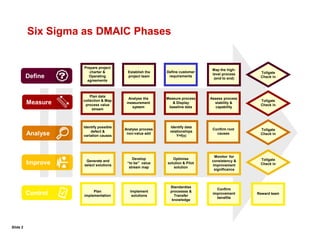
Slide 2TollgateCheck inDefine customer requirementsPrepare project charter & Operating agreementsMap the high-level process (end to end)Establish the project teamDefineTollgateCheck inAssess process stability & capabilityPlan data collection & Map process value streamMeasure process & Display baseline dataAnalyse the measurement systemMeasure TollgateCheck inConfirm root causesIdentify data relationships Y=f(x)Identify possible defect & variation causes Analyse process non-value addAnalyseTollgateCheck inMonitor  for consistency & improvement significanceOptimise solution & Pilot solutionGenerate and select solutionsDevelop “to be”  value stream mapImproveImplement solutionsStandardise processes &Transfer knowledgeConfirm improvement benefitsPlan implementationReward teamControlSix Sigma as DMAIC Phases
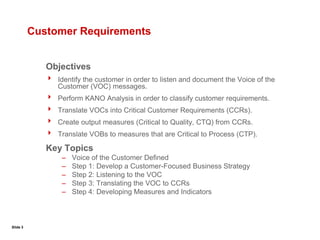
Slide 3Customer RequirementsObjectivesIdentify the customer in order to listen and document the Voice of the Customer (VOC) messages.Perform KANO Analysis in order to classify customer requirements.Translate VOCs into Critical Customer Requirements (CCRs).Create output measures (Critical to Quality, CTQ) from CCRs.Translate VOBs to measures that are Critical to Process (CTP).Key TopicsVoice of the Customer DefinedStep 1: Develop a Customer-Focused Business StrategyStep 2: Listening to the VOCStep 3: Translating the VOC to CCRsStep 4: Developing Measures and Indicators
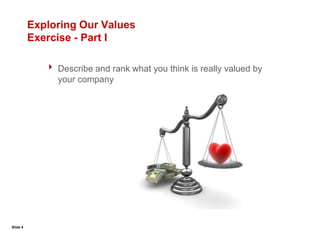
Slide 4Exploring Our Values Exercise - Part IDescribe and rank what you think is really valued by your company
Slide 5What Do We Measure Today?What numbers get the most attention?
What quality and performance measurements do we use?
Do we have a customer focus?
Do we have a quality focus?
Do we have an input/output focus?
Do we have a focus on waste elimination?
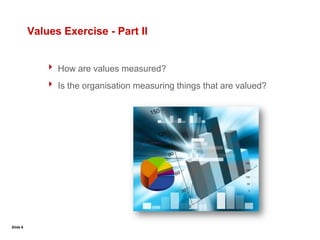
How do we use these measures?Slide 6Values Exercise - Part IIHow are values measured? Is the organisation measuring things that are valued?
Slide 7New Measures Arise When New Questions Are AskedNew measures, and new behaviors, require that we ask new questionsDo questions trigger actions? If we ask questions about outputs not inputs, we get a lot of focus and measures on outputsIf we ask questions about budgets, we measure budgetsHow many of our questions are focused on process and service quality? How many of our questions are focused on causes and inputs versus results and outputs?
Slide 8Imagine you are the General Manager of a very successful movie theatre chain with many employees. You will be out of the country for three months and have asked your staff to fax you a weekly report on Monday morning.  What information/metrics would you like to see in that fax?Theatre Exercise (Part 1)
Slide 9Theatre Exercise (Part 2)You are headed to the movies with some friends…The movie you would like to see is playing at several movie theatres in the area. All are about equidistant from your home.What criteria do you use to decide which theatre to attend?
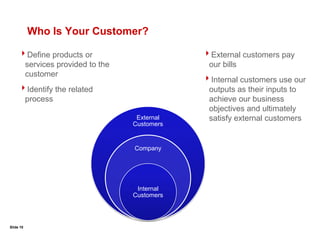
Slide 10Who Is Your Customer?Define products or services provided to the customerIdentify the related processExternal customers pay our bills Internal customers use our outputs as their inputs to achieve our business objectives and ultimately satisfy external customers
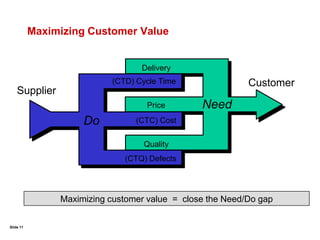
Slide 11Maximizing Customer ValueDeliveryCustomer(CTD) Cycle TimeSupplierNeedPriceDo(CTC) CostQuality(CTQ) DefectsMaximizing customer value  =  close the Need/Do gap
Slide 12What Is “Voice of the Customer”?“Voice of the Customer” (VOC) is the expression of customer needs and desiresMay be specific – “I need delivery within 3 days”May be ambiguous – “Deliver faster”The VOC can be compared to internal data (“Voice of the Process”) to assess our current process performance or process capability.To be useful in a process improvement project we often need to work with the customer to understand the “Ambiguous” and make it “Specific”
Slide 13Who Are the Customers?Who are they?Defined as: “Any person or organization that receives a product or service (Output) from the work activities (Process)”Those whose needs must be met for this process to be successful.Types of “customers”:External: Individuals or organizations outside of your business who are usually associated with paying money for your products and servicesInternal: Colleagues who receive products, services, support or information from your process – i.e. Engineering, Manufacturing, Quality, Marketing, Regulatory: Any government agency that has standards the process or product must conform to – i.e. ACCC, EPA, FDA, Which customer?Customers can often be logically aggregated into groups or segments (not all customers should be treated equally)
Slide 14Why Is VOC Important?They “pay the bills,” so it’s important to understand their needs:Customer behavior is a key input to strategy and process designUltimately, all the value driver “levers” get pulled by an external customerThey define the “playing field”They serve as the referee for all competitorsThey define what is a “value-added” activity or serviceThey are always right…Even if we cannot meet their needs, or do so profitably.To be more profitable, you have to convince your customers to…Buy more of your product / service	Revenue GrowthPay more for your product / service	Economic Value Add Serve their needs more efficiently	Economic Value Add (cost reduction)
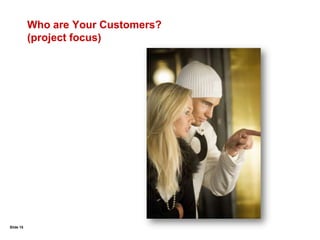
Slide 15Who are Your Customers? (project focus)
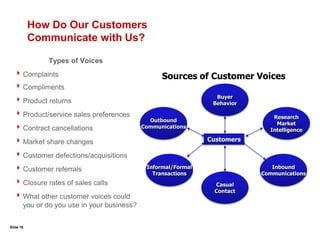
Slide 16How Do Our Customers Communicate with Us?BuyerBehaviorOutboundCommunicationsResearchMarketIntelligenceCustomersInformal/FormalTransactionsInboundCommunicationsCasualContactTypes of VoicesComplaints ComplimentsProduct returnsProduct/service sales preferencesContract cancellationsMarket share changesCustomer defections/acquisitionsCustomer referralsClosure rates of sales callsWhat other customer voices could you or do you use in your business?Sources of Customer Voices
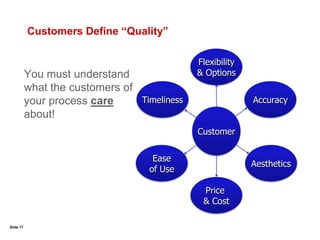
Slide 17Customers Define “Quality”TimelinessAccuracyEaseof UseAestheticsFlexibility& OptionsYou must understand what the customers of your process care about!CustomerPrice & Cost
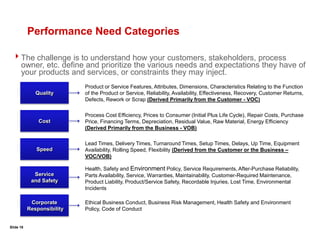
Slide 18Performance Need CategoriesThe challenge is to understand how your customers, stakeholders, process owner, etc. define and prioritize the various needs and expectations they have of your products and services, or constraints they may inject.Product or Service Features, Attributes, Dimensions, Characteristics Relating to the Function of the Product or Service, Reliability, Availability, Effectiveness, Recovery, Customer Returns, Defects, Rework or Scrap (Derived Primarily from the Customer - VOC)QualityProcess Cost Efficiency, Prices to Consumer (Initial Plus Life Cycle), Repair Costs, Purchase Price, Financing Terms, Depreciation, Residual Value, Raw Material, Energy Efficiency (Derived Primarily from the Business - VOB)CostSpeedLead Times, Delivery Times, Turnaround Times, Setup Times, Delays, Up Time, Equipment Availability, Rolling Speed, Flexibility (Derived from the Customer or the Business – VOC/VOB)Health, Safety and Environment Policy,Service Requirements, After-Purchase Reliability, Parts Availability, Service, Warranties, Maintainability, Customer-Required Maintenance, Product Liability, Product/Service Safety, Recordable Injuries, Lost Time, Environmental IncidentsServiceand SafetyCorporate ResponsibilityEthical Business Conduct, Business Risk Management, Health Safety and Environment Policy, Code of Conduct
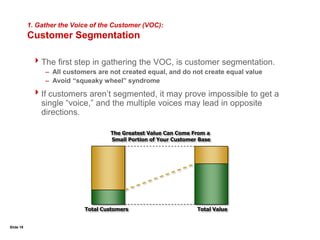
Slide 191. Gather the Voice of the Customer (VOC):Customer SegmentationThe first step in gathering the VOC, is customer segmentation.All customers are not created equal, and do not create equal valueAvoid “squeaky wheel” syndromeIf customers aren’t segmented, it may prove impossible to get a single “voice,” and the multiple voices may lead in opposite directions.The Greatest Value Can Come From a Small Portion of Your Customer BaseTotal CustomersTotal Value
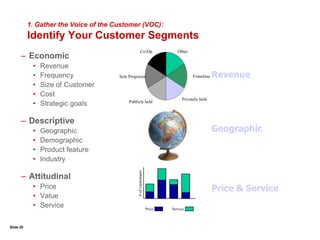
Slide 201. Gather the Voice of the Customer (VOC):Identify Your Customer SegmentsOtherCo-OpSole ProprietorFranchisePrivately heldPublicly held# of customersPriceServiceEconomicRevenueFrequencySize of CustomerCostStrategic goalsDescriptiveGeographicDemographicProduct featureIndustryAttitudinalPriceValueServiceRevenueGeographicPrice & Service
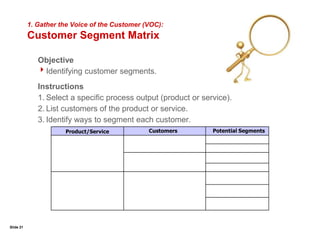
Slide 21ObjectiveIdentifying customer segments.Instructions1.	Select a specific process output (product or service).2.	List customers of the product or service.3.	Identify ways to segment each customer.Potential SegmentsCustomersProduct/Service1. Gather the Voice of the Customer (VOC):Customer Segment Matrix
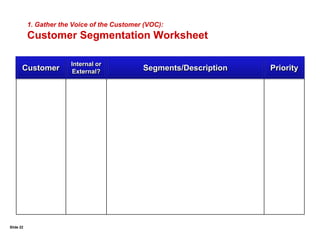
Slide 221. Gather the Voice of the Customer (VOC):Customer Segmentation WorksheetCustomerInternal orExternal?Segments/DescriptionPriority
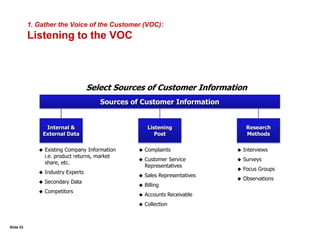
Slide 23Select Sources of Customer InformationSources of Customer InformationInternal &External DataListeningPostResearchMethodsComplaints
Customer Service Representatives
Sales Representatives
Billing
Accounts Receivable
Collection
Interviews
Surveys
Focus Groups
Observations
Existing Company Information i.e. product returns, market share, etc.
Industry Experts
Secondary Data
Competitors1. Gather the Voice of the Customer (VOC):Listening to the VOC
Slide 241. Gather the Voice of the Customer (VOC):Communicating with CustomersNo matter what source of customer information is used, customer communication has three basic parts:1.  Asking the right questions2.  Asking questions in the right way3.  Understanding the answers
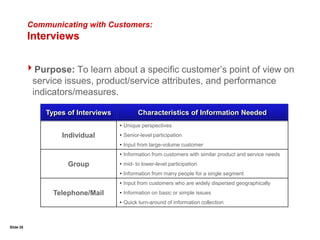
Slide 25Communicating with Customers:InterviewsPurpose: To learn about a specific customer’s point of view on service issues, product/service attributes, and performance indicators/measures.Types of InterviewsCharacteristics of Information Needed
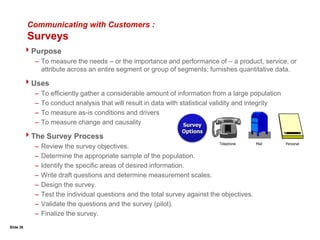
Slide 26Communicating with Customers :SurveysPurposeTo measure the needs – or the importance and performance of – a product, service, or attribute across an entire segment or group of segments; furnishes quantitative data.UsesTo efficiently gather a considerable amount of information from a large populationTo conduct analysis that will result in data with statistical validity and integrityTo measure as-is conditions and driversTo measure change and causalityThe Survey ProcessReview the survey objectives.Determine the appropriate sample of the population.Identify the specific areas of desired information.Write draft questions and determine measurement scales.Design the survey.Test the individual questions and the total survey against the objectives.Validate the questions and the survey (pilot).Finalize the survey.SurveyOptionsMailPersonalTelephone
Slide 27Communicating with Customers :Focus GroupsPurposeOrganize information from the collective point of view of a group of customers that represent a segmentUsesTo clarify and define customer needsTo gain insights into the prioritization of needsTo test concepts and get feedbackSometimes as a next step after customer interviews or a preliminary step in a survey processTypically composed of 7 to 13 participants who share characteristics that relate to the focus group topicParticipants will be asked to thoroughly discuss very few topics
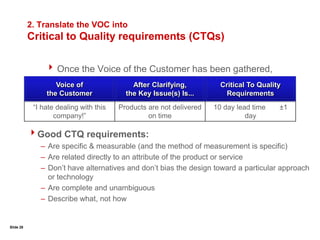
Slide 282. Translate the VOC into Critical to Quality requirements (CTQs)Voice of the CustomerAfter Clarifying,the Key Issue(s) Is...Critical To Quality RequirementsOnce the Voice of the Customer has been gathered, that information must be translated into Critical To Quality requirements (CTQs)Good CTQ requirements:
Are specific & measurable (and the method of measurement is specific)
Are related directly to an attribute of the product or service
Don’t have alternatives and don’t bias the design toward a particular approach or technology
Are complete and unambiguous
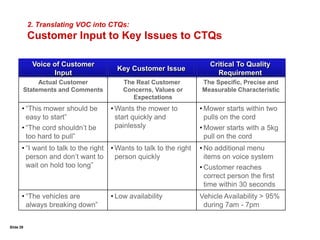
Describe what, not howSlide 292. Translating VOC into CTQs:Customer Input to Key Issues to CTQsCritical To Quality RequirementKey Customer IssueVoice of Customer Input
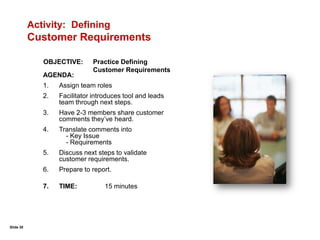
Slide 30Activity:  Defining  Customer RequirementsOBJECTIVE:	  Practice Defining      Customer RequirementsAGENDA:Assign team roles Facilitator introduces tool and leads team through next steps.3.	Have 2-3 members share customer comments they’ve heard.4.	Translate comments into	- Key Issue		- Requirements5.	Discuss next steps to validate customer requirements.Prepare to report.TIME:	15 minutes
Slide 312. Translating VOC into CTQs:Getting Value from VOC DataMaking sense of qualitative data is an iterative processIt involves interpretation and prioritizationOften requires follow-up with additional researchUseful tools:Affinity AnalysisTree Diagrams
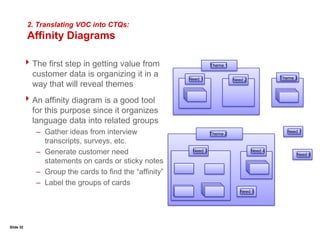
Slide 32Theme 1Theme 3Need 1Need 2Need 7Theme 2Need 3Need 4Need 8Need 52. Translating VOC into CTQs:Affinity DiagramsThe first step in getting value from customer data is organizing it in a way that will reveal themesAn affinity diagram is a good tool for this purpose since it organizes language data into related groupsGather ideas from interview transcripts, surveys, etc.Generate customer need statements on cards or sticky notesGroup the cards to find the “affinity”Label the groups of cards
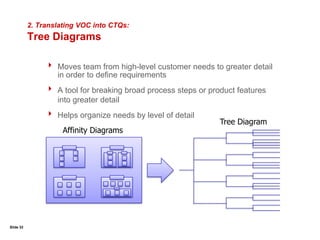
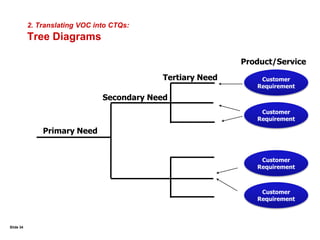
Moves team from high-level customer needs to greater detail in order to define requirementsA tool for breaking broad process steps or product features into greater detailHelps organize needs by level of detailSlide 33Tree DiagramAffinity Diagrams2. Translating VOC into CTQs:Tree Diagrams
Slide 342. Translating VOC into CTQs:Tree DiagramsProduct/ServiceCustomerRequirementTertiary NeedSecondary NeedCustomerRequirementPrimary NeedCustomerRequirementCustomerRequirement
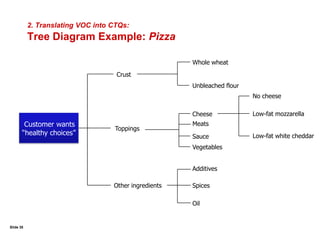
Slide 352. Translating VOC into CTQs:Tree Diagram Example: PizzaWhole wheatCrust Unbleached flourNo cheeseLow-fat mozzarellaCheese Customer wants“healthy choices”MeatsToppingsLow-fat white cheddarSauceVegetablesAdditivesOther ingredientsSpicesOil
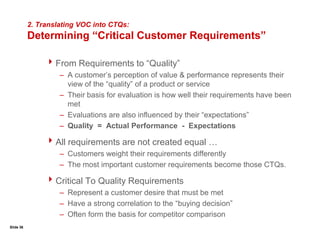
Slide 362. Translating VOC into CTQs:Determining “Critical Customer Requirements”From Requirements to “Quality” A customer’s perception of value & performance represents their view of the “quality” of a product or serviceTheir basis for evaluation is how well their requirements have been metEvaluations are also influenced by their “expectations”Quality  =  Actual Performance  -  ExpectationsAll requirements are not created equal …Customers weight their requirements differentlyThe most important customer requirements become those CTQs.Critical To Quality RequirementsRepresent a customer desire that must be metHave a strong correlation to the “buying decision”Often form the basis for competitor comparison
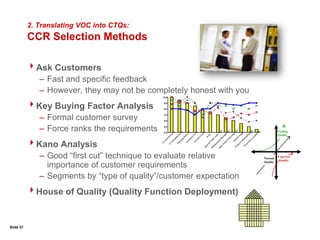
Slide 372. Translating VOC into CTQs:CCR Selection Methods10.09.08.07.06.05.04.0Price Brand ImageCorrect InvoiceInventory TurnsOn-time DeliveryWarranty Returns% Complete OrderProximity to CustomerProduct Offering BreadthSpecial Order Lead TimeNew Product DevelopmentRelationship ManagementAsk CustomersFast and specific feedbackHowever, they may not be completely honest with youKey Buying Factor AnalysisFormal customer surveyForce ranks the requirementsKano AnalysisGood “first cut” technique to evaluate relative importance of customer requirementsSegments by “type of quality”/customer expectationHouse of Quality (Quality Function Deployment)ExcitingQualityExpectedQualityNormalQuality
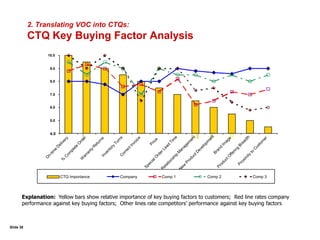
Slide 382. Translating VOC into CTQs:CTQ Key Buying Factor Analysis10.09.08.07.06.05.04.0Price Brand ImageCorrect InvoiceInventory TurnsOn-time DeliveryWarranty Returns% Complete OrderProximity to CustomerProduct Offering BreadthSpecial Order Lead TimeNew Product DevelopmentRelationship ManagementCTQ ImportanceCompanyComp 1Comp 2Comp 3Explanation:  Yellow bars show relative importance of key buying factors to customers;  Red line rates company performance against key buying factors;  Other lines rate competitors’ performance against key buying factors
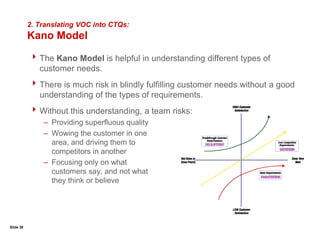
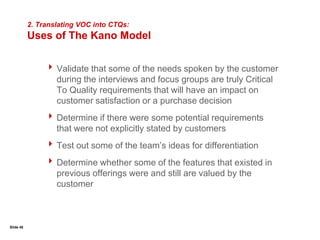
Slide 392. Translating VOC into CTQs:Kano ModelThe Kano Model is helpful in understanding different types of customer needs. There is much risk in blindly fulfilling customer needs without a good understanding of the types of requirements. Without this understanding, a team risks:Providing superfluous qualityWowing the customer in one area, and driving them to competitors in anotherFocusing only on what customers say, and not what they think or believe
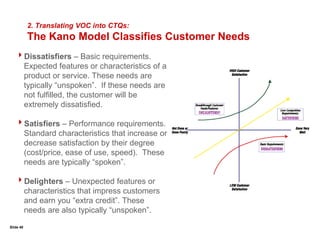
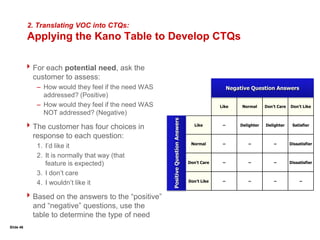
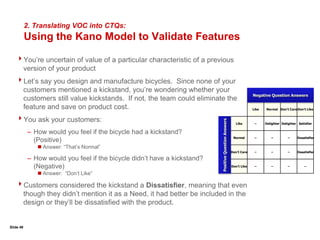
Slide 402. Translating VOC into CTQs:The Kano Model Classifies Customer NeedsDissatisfiers– Basic requirements.      Expected features or characteristics of a product or service. These needs are typically “unspoken”.  If these needs are not fulfilled, the customer will be extremely dissatisfied. Satisfiers – Performance requirements. Standard characteristics that increase or decrease satisfaction by their degree (cost/price, ease of use, speed).  These needs are typically “spoken”. Delighters – Unexpected features or characteristics that impress customers and earn you “extra credit”. These needs are also typically “unspoken”.
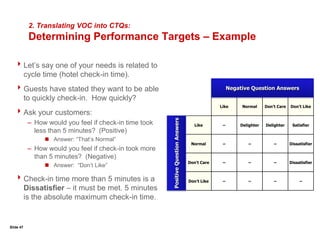
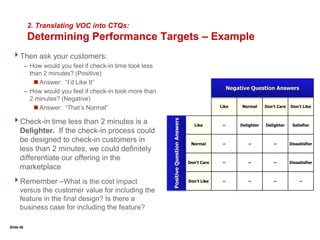
Slide 412. Translating VOC into CTQs:Collecting the VOC based on Kano analysisDissatisfiers (Typically Unspoken) – Gather them using 1-on-1 interviews and focus groupsThe discussion points are not well established – often not discussed at all unless there’s a reason to – but there is often consensus after the factFor example, in a hotel bathroom, it’s the provision of soap, towels, toilet paper, hot water – none of which are ordinarily worthy of comment unless they are missing!Satisfiers (Typically Spoken) – Gather them using surveys (phone, email, etc.)The discussion points are well established – it’s the issues that advertisements address, it’s the basis of discussions with our neighborsFor example, in a hotel, it’s how long the wait is to check-in, availability of a coffee maker in the room, Internet access, size of the TV, etc.
Slide 422. Translating VOC into CTQs:Collecting the VOC (cont.)Delighters (Typically Unspoken) – Gather them using carefully orchestrated focus groups preceded by 1-on-1 and small group interviews to establish several bases for further expansion The specific points of discussion are not known (except in the most general sense in some cases)For example, being able to check into a hotel by swiping the credit card you used for guaranteeing the reservation – one swipe of the card, one signature on the surface of the computer monitor and your room key is issued.
Slide 432. Translating VOC into CTQs:The Difficulty in Collecting DelightersVery often, Delighters are a unique combination that is really the intersection of: Demand on the part of the customer for products that s/he is unaware could be made available, andSupply technologists are unaware of possibilities for product innovations So, the customer doesn’t know it is possible, and the business doesn’t know there is a demandNote: Delighters are not just added features that the customer did not expect.  They must truly be of value to the customer.
Slide 442. Translating VOC into CTQs:Getting to DelightersIn spite of the difficulties, there are ways to spur creative thinking – sometimes it is as simple as well-planned focus groups that have a balance of:Early adopters: progressive individuals who are able to appreciate the impact on their lives of alternative services, or combinations of services/products not offered now, andOpen minded technologists with an understanding of the possibilities, both of specific concepts as well as combinationsWork with customers and suppliers to explore where there might be matches of the customers’ needs to the suppliers’ potential range of product offerings
Understanding Customer Needs

  • 1.
    1.6 - CustomerRequirements
  • 2.
    Slide 2TollgateCheck inDefinecustomer requirementsPrepare project charter & Operating agreementsMap the high-level process (end to end)Establish the project teamDefineTollgateCheck inAssess process stability & capabilityPlan data collection & Map process value streamMeasure process & Display baseline dataAnalyse the measurement systemMeasure TollgateCheck inConfirm root causesIdentify data relationships Y=f(x)Identify possible defect & variation causes Analyse process non-value addAnalyseTollgateCheck inMonitor for consistency & improvement significanceOptimise solution & Pilot solutionGenerate and select solutionsDevelop “to be” value stream mapImproveImplement solutionsStandardise processes &Transfer knowledgeConfirm improvement benefitsPlan implementationReward teamControlSix Sigma as DMAIC Phases
  • 3.
    Slide 3Customer RequirementsObjectivesIdentifythe customer in order to listen and document the Voice of the Customer (VOC) messages.Perform KANO Analysis in order to classify customer requirements.Translate VOCs into Critical Customer Requirements (CCRs).Create output measures (Critical to Quality, CTQ) from CCRs.Translate VOBs to measures that are Critical to Process (CTP).Key TopicsVoice of the Customer DefinedStep 1: Develop a Customer-Focused Business StrategyStep 2: Listening to the VOCStep 3: Translating the VOC to CCRsStep 4: Developing Measures and Indicators
  • 4.
    Slide 4Exploring OurValues Exercise - Part IDescribe and rank what you think is really valued by your company
  • 5.
    Slide 5What DoWe Measure Today?What numbers get the most attention?
  • 6.
    What quality andperformance measurements do we use?
  • 7.
    Do we havea customer focus?
  • 8.
    Do we havea quality focus?
  • 9.
    Do we havean input/output focus?
  • 10.
    Do we havea focus on waste elimination?
  • 11.
    How do weuse these measures?Slide 6Values Exercise - Part IIHow are values measured? Is the organisation measuring things that are valued?
  • 12.
    Slide 7New MeasuresArise When New Questions Are AskedNew measures, and new behaviors, require that we ask new questionsDo questions trigger actions? If we ask questions about outputs not inputs, we get a lot of focus and measures on outputsIf we ask questions about budgets, we measure budgetsHow many of our questions are focused on process and service quality? How many of our questions are focused on causes and inputs versus results and outputs?
  • 13.
    Slide 8Imagine youare the General Manager of a very successful movie theatre chain with many employees. You will be out of the country for three months and have asked your staff to fax you a weekly report on Monday morning. What information/metrics would you like to see in that fax?Theatre Exercise (Part 1)
  • 14.
    Slide 9Theatre Exercise(Part 2)You are headed to the movies with some friends…The movie you would like to see is playing at several movie theatres in the area. All are about equidistant from your home.What criteria do you use to decide which theatre to attend?
  • 15.
    Slide 10Who IsYour Customer?Define products or services provided to the customerIdentify the related processExternal customers pay our bills Internal customers use our outputs as their inputs to achieve our business objectives and ultimately satisfy external customers
  • 16.
    Slide 11Maximizing CustomerValueDeliveryCustomer(CTD) Cycle TimeSupplierNeedPriceDo(CTC) CostQuality(CTQ) DefectsMaximizing customer value = close the Need/Do gap
  • 17.
    Slide 12What Is“Voice of the Customer”?“Voice of the Customer” (VOC) is the expression of customer needs and desiresMay be specific – “I need delivery within 3 days”May be ambiguous – “Deliver faster”The VOC can be compared to internal data (“Voice of the Process”) to assess our current process performance or process capability.To be useful in a process improvement project we often need to work with the customer to understand the “Ambiguous” and make it “Specific”
  • 18.
    Slide 13Who Arethe Customers?Who are they?Defined as: “Any person or organization that receives a product or service (Output) from the work activities (Process)”Those whose needs must be met for this process to be successful.Types of “customers”:External: Individuals or organizations outside of your business who are usually associated with paying money for your products and servicesInternal: Colleagues who receive products, services, support or information from your process – i.e. Engineering, Manufacturing, Quality, Marketing, Regulatory: Any government agency that has standards the process or product must conform to – i.e. ACCC, EPA, FDA, Which customer?Customers can often be logically aggregated into groups or segments (not all customers should be treated equally)
  • 19.
    Slide 14Why IsVOC Important?They “pay the bills,” so it’s important to understand their needs:Customer behavior is a key input to strategy and process designUltimately, all the value driver “levers” get pulled by an external customerThey define the “playing field”They serve as the referee for all competitorsThey define what is a “value-added” activity or serviceThey are always right…Even if we cannot meet their needs, or do so profitably.To be more profitable, you have to convince your customers to…Buy more of your product / service Revenue GrowthPay more for your product / service Economic Value Add Serve their needs more efficiently Economic Value Add (cost reduction)
  • 20.
    Slide 15Who areYour Customers? (project focus)
  • 21.
    Slide 16How DoOur Customers Communicate with Us?BuyerBehaviorOutboundCommunicationsResearchMarketIntelligenceCustomersInformal/FormalTransactionsInboundCommunicationsCasualContactTypes of VoicesComplaints ComplimentsProduct returnsProduct/service sales preferencesContract cancellationsMarket share changesCustomer defections/acquisitionsCustomer referralsClosure rates of sales callsWhat other customer voices could you or do you use in your business?Sources of Customer Voices
  • 22.
    Slide 17Customers Define“Quality”TimelinessAccuracyEaseof UseAestheticsFlexibility& OptionsYou must understand what the customers of your process care about!CustomerPrice & Cost
  • 23.
    Slide 18Performance NeedCategoriesThe challenge is to understand how your customers, stakeholders, process owner, etc. define and prioritize the various needs and expectations they have of your products and services, or constraints they may inject.Product or Service Features, Attributes, Dimensions, Characteristics Relating to the Function of the Product or Service, Reliability, Availability, Effectiveness, Recovery, Customer Returns, Defects, Rework or Scrap (Derived Primarily from the Customer - VOC)QualityProcess Cost Efficiency, Prices to Consumer (Initial Plus Life Cycle), Repair Costs, Purchase Price, Financing Terms, Depreciation, Residual Value, Raw Material, Energy Efficiency (Derived Primarily from the Business - VOB)CostSpeedLead Times, Delivery Times, Turnaround Times, Setup Times, Delays, Up Time, Equipment Availability, Rolling Speed, Flexibility (Derived from the Customer or the Business – VOC/VOB)Health, Safety and Environment Policy,Service Requirements, After-Purchase Reliability, Parts Availability, Service, Warranties, Maintainability, Customer-Required Maintenance, Product Liability, Product/Service Safety, Recordable Injuries, Lost Time, Environmental IncidentsServiceand SafetyCorporate ResponsibilityEthical Business Conduct, Business Risk Management, Health Safety and Environment Policy, Code of Conduct
  • 24.
    Slide 191. Gatherthe Voice of the Customer (VOC):Customer SegmentationThe first step in gathering the VOC, is customer segmentation.All customers are not created equal, and do not create equal valueAvoid “squeaky wheel” syndromeIf customers aren’t segmented, it may prove impossible to get a single “voice,” and the multiple voices may lead in opposite directions.The Greatest Value Can Come From a Small Portion of Your Customer BaseTotal CustomersTotal Value
  • 25.
    Slide 201. Gatherthe Voice of the Customer (VOC):Identify Your Customer SegmentsOtherCo-OpSole ProprietorFranchisePrivately heldPublicly held# of customersPriceServiceEconomicRevenueFrequencySize of CustomerCostStrategic goalsDescriptiveGeographicDemographicProduct featureIndustryAttitudinalPriceValueServiceRevenueGeographicPrice & Service
  • 26.
    Slide 21ObjectiveIdentifying customersegments.Instructions1. Select a specific process output (product or service).2. List customers of the product or service.3. Identify ways to segment each customer.Potential SegmentsCustomersProduct/Service1. Gather the Voice of the Customer (VOC):Customer Segment Matrix
  • 27.
    Slide 221. Gatherthe Voice of the Customer (VOC):Customer Segmentation WorksheetCustomerInternal orExternal?Segments/DescriptionPriority
  • 28.
    Slide 23Select Sourcesof Customer InformationSources of Customer InformationInternal &External DataListeningPostResearchMethodsComplaints
  • 29.
  • 30.
  • 31.
  • 32.
  • 33.
  • 34.
  • 35.
  • 36.
  • 37.
  • 38.
    Existing Company Informationi.e. product returns, market share, etc.
  • 39.
  • 40.
  • 41.
    Competitors1. Gather theVoice of the Customer (VOC):Listening to the VOC
  • 42.
    Slide 241. Gatherthe Voice of the Customer (VOC):Communicating with CustomersNo matter what source of customer information is used, customer communication has three basic parts:1. Asking the right questions2. Asking questions in the right way3. Understanding the answers
  • 43.
    Slide 25Communicating withCustomers:InterviewsPurpose: To learn about a specific customer’s point of view on service issues, product/service attributes, and performance indicators/measures.Types of InterviewsCharacteristics of Information Needed
  • 44.
    Slide 26Communicating withCustomers :SurveysPurposeTo measure the needs – or the importance and performance of – a product, service, or attribute across an entire segment or group of segments; furnishes quantitative data.UsesTo efficiently gather a considerable amount of information from a large populationTo conduct analysis that will result in data with statistical validity and integrityTo measure as-is conditions and driversTo measure change and causalityThe Survey ProcessReview the survey objectives.Determine the appropriate sample of the population.Identify the specific areas of desired information.Write draft questions and determine measurement scales.Design the survey.Test the individual questions and the total survey against the objectives.Validate the questions and the survey (pilot).Finalize the survey.SurveyOptionsMailPersonalTelephone
  • 45.
    Slide 27Communicating withCustomers :Focus GroupsPurposeOrganize information from the collective point of view of a group of customers that represent a segmentUsesTo clarify and define customer needsTo gain insights into the prioritization of needsTo test concepts and get feedbackSometimes as a next step after customer interviews or a preliminary step in a survey processTypically composed of 7 to 13 participants who share characteristics that relate to the focus group topicParticipants will be asked to thoroughly discuss very few topics
  • 46.
    Slide 282. Translatethe VOC into Critical to Quality requirements (CTQs)Voice of the CustomerAfter Clarifying,the Key Issue(s) Is...Critical To Quality RequirementsOnce the Voice of the Customer has been gathered, that information must be translated into Critical To Quality requirements (CTQs)Good CTQ requirements:
  • 47.
    Are specific &measurable (and the method of measurement is specific)
  • 48.
    Are related directlyto an attribute of the product or service
  • 49.
    Don’t have alternativesand don’t bias the design toward a particular approach or technology
  • 50.
    Are complete andunambiguous
  • 51.
    Describe what, nothowSlide 292. Translating VOC into CTQs:Customer Input to Key Issues to CTQsCritical To Quality RequirementKey Customer IssueVoice of Customer Input
  • 52.
    Slide 30Activity: Defining Customer RequirementsOBJECTIVE: Practice Defining Customer RequirementsAGENDA:Assign team roles Facilitator introduces tool and leads team through next steps.3. Have 2-3 members share customer comments they’ve heard.4. Translate comments into - Key Issue - Requirements5. Discuss next steps to validate customer requirements.Prepare to report.TIME: 15 minutes
  • 53.
    Slide 312. TranslatingVOC into CTQs:Getting Value from VOC DataMaking sense of qualitative data is an iterative processIt involves interpretation and prioritizationOften requires follow-up with additional researchUseful tools:Affinity AnalysisTree Diagrams
  • 54.
    Slide 32Theme 1Theme3Need 1Need 2Need 7Theme 2Need 3Need 4Need 8Need 52. Translating VOC into CTQs:Affinity DiagramsThe first step in getting value from customer data is organizing it in a way that will reveal themesAn affinity diagram is a good tool for this purpose since it organizes language data into related groupsGather ideas from interview transcripts, surveys, etc.Generate customer need statements on cards or sticky notesGroup the cards to find the “affinity”Label the groups of cards
  • 55.
    Moves team fromhigh-level customer needs to greater detail in order to define requirementsA tool for breaking broad process steps or product features into greater detailHelps organize needs by level of detailSlide 33Tree DiagramAffinity Diagrams2. Translating VOC into CTQs:Tree Diagrams
  • 56.
    Slide 342. TranslatingVOC into CTQs:Tree DiagramsProduct/ServiceCustomerRequirementTertiary NeedSecondary NeedCustomerRequirementPrimary NeedCustomerRequirementCustomerRequirement
  • 57.
    Slide 352. TranslatingVOC into CTQs:Tree Diagram Example: PizzaWhole wheatCrust Unbleached flourNo cheeseLow-fat mozzarellaCheese Customer wants“healthy choices”MeatsToppingsLow-fat white cheddarSauceVegetablesAdditivesOther ingredientsSpicesOil
  • 58.
    Slide 362. TranslatingVOC into CTQs:Determining “Critical Customer Requirements”From Requirements to “Quality” A customer’s perception of value & performance represents their view of the “quality” of a product or serviceTheir basis for evaluation is how well their requirements have been metEvaluations are also influenced by their “expectations”Quality = Actual Performance - ExpectationsAll requirements are not created equal …Customers weight their requirements differentlyThe most important customer requirements become those CTQs.Critical To Quality RequirementsRepresent a customer desire that must be metHave a strong correlation to the “buying decision”Often form the basis for competitor comparison
  • 59.
    Slide 372. TranslatingVOC into CTQs:CCR Selection Methods10.09.08.07.06.05.04.0Price Brand ImageCorrect InvoiceInventory TurnsOn-time DeliveryWarranty Returns% Complete OrderProximity to CustomerProduct Offering BreadthSpecial Order Lead TimeNew Product DevelopmentRelationship ManagementAsk CustomersFast and specific feedbackHowever, they may not be completely honest with youKey Buying Factor AnalysisFormal customer surveyForce ranks the requirementsKano AnalysisGood “first cut” technique to evaluate relative importance of customer requirementsSegments by “type of quality”/customer expectationHouse of Quality (Quality Function Deployment)ExcitingQualityExpectedQualityNormalQuality
  • 60.
    Slide 382. TranslatingVOC into CTQs:CTQ Key Buying Factor Analysis10.09.08.07.06.05.04.0Price Brand ImageCorrect InvoiceInventory TurnsOn-time DeliveryWarranty Returns% Complete OrderProximity to CustomerProduct Offering BreadthSpecial Order Lead TimeNew Product DevelopmentRelationship ManagementCTQ ImportanceCompanyComp 1Comp 2Comp 3Explanation: Yellow bars show relative importance of key buying factors to customers; Red line rates company performance against key buying factors; Other lines rate competitors’ performance against key buying factors
  • 61.
    Slide 392. TranslatingVOC into CTQs:Kano ModelThe Kano Model is helpful in understanding different types of customer needs. There is much risk in blindly fulfilling customer needs without a good understanding of the types of requirements. Without this understanding, a team risks:Providing superfluous qualityWowing the customer in one area, and driving them to competitors in anotherFocusing only on what customers say, and not what they think or believe
  • 62.
    Slide 402. TranslatingVOC into CTQs:The Kano Model Classifies Customer NeedsDissatisfiers– Basic requirements. Expected features or characteristics of a product or service. These needs are typically “unspoken”. If these needs are not fulfilled, the customer will be extremely dissatisfied. Satisfiers – Performance requirements. Standard characteristics that increase or decrease satisfaction by their degree (cost/price, ease of use, speed). These needs are typically “spoken”. Delighters – Unexpected features or characteristics that impress customers and earn you “extra credit”. These needs are also typically “unspoken”.
  • 63.
    Slide 412. TranslatingVOC into CTQs:Collecting the VOC based on Kano analysisDissatisfiers (Typically Unspoken) – Gather them using 1-on-1 interviews and focus groupsThe discussion points are not well established – often not discussed at all unless there’s a reason to – but there is often consensus after the factFor example, in a hotel bathroom, it’s the provision of soap, towels, toilet paper, hot water – none of which are ordinarily worthy of comment unless they are missing!Satisfiers (Typically Spoken) – Gather them using surveys (phone, email, etc.)The discussion points are well established – it’s the issues that advertisements address, it’s the basis of discussions with our neighborsFor example, in a hotel, it’s how long the wait is to check-in, availability of a coffee maker in the room, Internet access, size of the TV, etc.
  • 64.
    Slide 422. TranslatingVOC into CTQs:Collecting the VOC (cont.)Delighters (Typically Unspoken) – Gather them using carefully orchestrated focus groups preceded by 1-on-1 and small group interviews to establish several bases for further expansion The specific points of discussion are not known (except in the most general sense in some cases)For example, being able to check into a hotel by swiping the credit card you used for guaranteeing the reservation – one swipe of the card, one signature on the surface of the computer monitor and your room key is issued.
  • 65.
    Slide 432. TranslatingVOC into CTQs:The Difficulty in Collecting DelightersVery often, Delighters are a unique combination that is really the intersection of: Demand on the part of the customer for products that s/he is unaware could be made available, andSupply technologists are unaware of possibilities for product innovations So, the customer doesn’t know it is possible, and the business doesn’t know there is a demandNote: Delighters are not just added features that the customer did not expect. They must truly be of value to the customer.
  • 66.
    Slide 442. TranslatingVOC into CTQs:Getting to DelightersIn spite of the difficulties, there are ways to spur creative thinking – sometimes it is as simple as well-planned focus groups that have a balance of:Early adopters: progressive individuals who are able to appreciate the impact on their lives of alternative services, or combinations of services/products not offered now, andOpen minded technologists with an understanding of the possibilities, both of specific concepts as well as combinationsWork with customers and suppliers to explore where there might be matches of the customers’ needs to the suppliers’ potential range of product offerings