 Name :- HITARTHSINH.D.SOLANKI
 Roll No. :- 50
 Subject :- Seminar Presentation
 Topic :- Histology of Root,Stem and Leaf
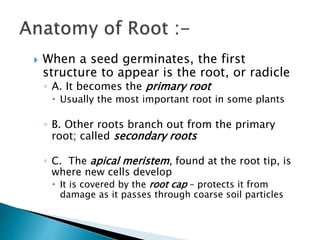
 When a seed germinates, the first
structure to appear is the root, or radicle
◦ A. It becomes the primary root
 Usually the most important root in some plants
◦ B. Other roots branch out from the primary
root; called secondary roots
◦ C. The apical meristem, found at the root tip, is
where new cells develop
 It is covered by the root cap – protects it from
damage as it passes through coarse soil particles
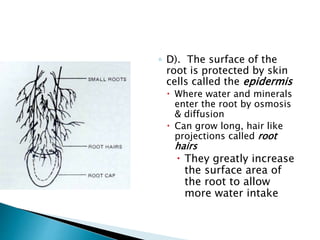
◦ D). The surface of the
root is protected by skin
cells called the epidermis
 Where water and minerals
enter the root by osmosis
& diffusion
 Can grow long, hair like
projections called root
hairs
 They greatly increase
the surface area of
the root to allow
more water intake
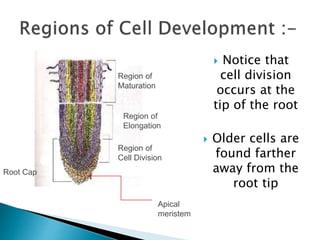
 Notice that
cell division
occurs at the
tip of the root
 Older cells are
found farther
away from the
root tip
Root Cap
Region of
Maturation
Region of
Elongation
Region of
Cell Division
Apical
meristem
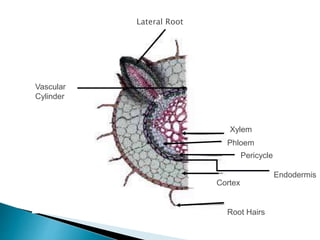
◦ A). Cortex – this is where the root stores the food
produced by the leaves; it is made out of
parenchyma tissue
◦ B). Endodermis – the inner boundary of the
cortex; one cell layer thick; controls the
movement of water and minerals into the xylem
and phloem
◦ C). Pericycle – a layer found inside the
endodermis which may produce lateral roots; also
produces vascular cambium in dicots
◦ D). Vascular cylinder, or stele – forms the central
cylinder of the root; it is made out of two secondary
transport tissues
 1. Xylem – carries the water taken in by the root hairs
and epidermis up the plant to the stems and leaves
 2. Phloem – carries the food produced by the leaves
down to the roots to be stored in the cortex
Lateral Root
Vascular
Cylinder
Xylem
Phloem
Pericycle
Endodermis
Cortex
Root Hairs
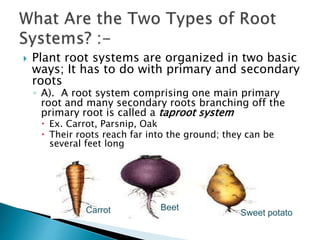
 Plant root systems are organized in two basic
ways; It has to do with primary and secondary
roots
◦ A). A root system comprising one main primary
root and many secondary roots branching off the
primary root is called a taproot system
 Ex. Carrot, Parsnip, Oak
 Their roots reach far into the ground; they can be
several feet long
Carrot Beet
Sweet potato
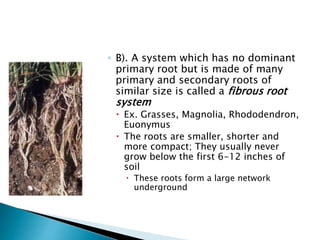
◦ B). A system which has no dominant
primary root but is made of many
primary and secondary roots of
similar size is called a fibrous root
system
 Ex. Grasses, Magnolia, Rhododendron,
Euonymus
 The roots are smaller, shorter and
more compact; They usually never
grow below the first 6-12 inches of
soil
 These roots form a large network
underground
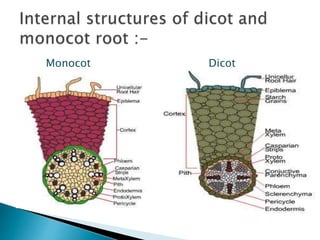
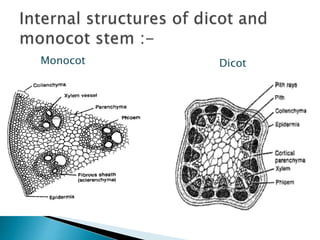
Monocot Dicot
Monocot Dicot
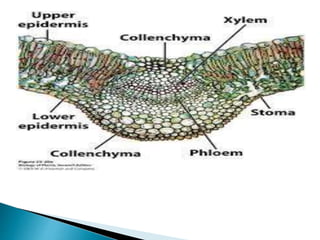
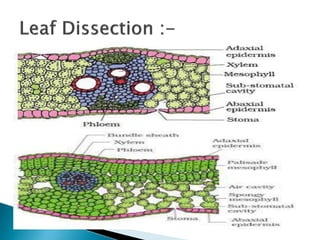
 Typical dorsiventral leaf
 T.S of leaf lamina show three main parts
Epidermis
Mesophyll
Vascular system
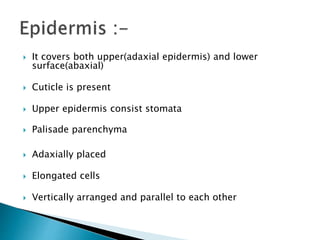
 It covers both upper(adaxial epidermis) and lower
surface(abaxial)
 Cuticle is present
 Upper epidermis consist stomata
 Palisade parenchyma
 Adaxially placed
 Elongated cells
 Vertically arranged and parallel to each other
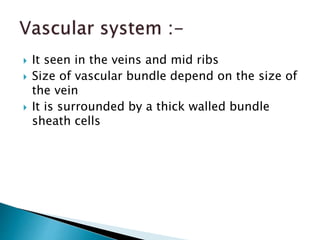
 It seen in the veins and mid ribs
 Size of vascular bundle depend on the size of
the vein
 It is surrounded by a thick walled bundle
sheath cells
 Typical isobilateral leaf
 Three main parts
Epidermis
Mesophyll
Vascular system
 Stomata present on both epidermis
 Mesophyll is not differentiated in to palisade
and spongy parenchyma
 Bulliform cells- modified adaxial epidermis
cells and veins
 It absorb water and become turgid-leaf
surface exposed
 It become flaccid due to water stress-leaves
curl inward
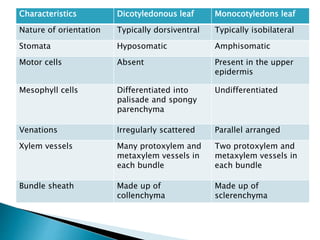
Characteristics Dicotyledonous leaf Monocotyledons leaf
Nature of orientation Typically dorsiventral Typically isobilateral
Stomata Hyposomatic Amphisomatic
Motor cells Absent Present in the upper
epidermis
Mesophyll cells Differentiated into
palisade and spongy
parenchyma
Undifferentiated
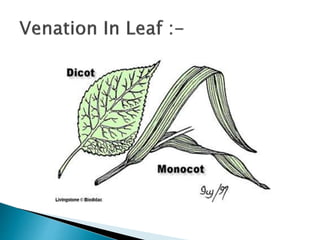
Venations Irregularly scattered Parallel arranged
Xylem vessels Many protoxylem and
metaxylem vessels in
each bundle
Two protoxylem and
metaxylem vessels in
each bundle
Bundle sheath Made up of
collenchyma
Made up of
sclerenchyma
 Reference :- Textbookof Botany.
 Author :- A.C.Dutta.
 Publication:- Oxford UniversityPress.

Histology of root,stem and leaf

  • 1.
     Name :-HITARTHSINH.D.SOLANKI  Roll No. :- 50  Subject :- Seminar Presentation  Topic :- Histology of Root,Stem and Leaf
  • 2.
     When aseed germinates, the first structure to appear is the root, or radicle ◦ A. It becomes the primary root  Usually the most important root in some plants ◦ B. Other roots branch out from the primary root; called secondary roots ◦ C. The apical meristem, found at the root tip, is where new cells develop  It is covered by the root cap – protects it from damage as it passes through coarse soil particles
  • 3.
    ◦ D). Thesurface of the root is protected by skin cells called the epidermis  Where water and minerals enter the root by osmosis & diffusion  Can grow long, hair like projections called root hairs  They greatly increase the surface area of the root to allow more water intake
  • 4.
     Notice that celldivision occurs at the tip of the root  Older cells are found farther away from the root tip Root Cap Region of Maturation Region of Elongation Region of Cell Division Apical meristem
  • 5.
    ◦ A). Cortex– this is where the root stores the food produced by the leaves; it is made out of parenchyma tissue ◦ B). Endodermis – the inner boundary of the cortex; one cell layer thick; controls the movement of water and minerals into the xylem and phloem ◦ C). Pericycle – a layer found inside the endodermis which may produce lateral roots; also produces vascular cambium in dicots
  • 6.
    ◦ D). Vascularcylinder, or stele – forms the central cylinder of the root; it is made out of two secondary transport tissues  1. Xylem – carries the water taken in by the root hairs and epidermis up the plant to the stems and leaves  2. Phloem – carries the food produced by the leaves down to the roots to be stored in the cortex
  • 7.
  • 8.
     Plant rootsystems are organized in two basic ways; It has to do with primary and secondary roots ◦ A). A root system comprising one main primary root and many secondary roots branching off the primary root is called a taproot system  Ex. Carrot, Parsnip, Oak  Their roots reach far into the ground; they can be several feet long Carrot Beet Sweet potato
  • 9.
    ◦ B). Asystem which has no dominant primary root but is made of many primary and secondary roots of similar size is called a fibrous root system  Ex. Grasses, Magnolia, Rhododendron, Euonymus  The roots are smaller, shorter and more compact; They usually never grow below the first 6-12 inches of soil  These roots form a large network underground
  • 10.
  • 12.
  • 15.
     Typical dorsiventralleaf  T.S of leaf lamina show three main parts Epidermis Mesophyll Vascular system
  • 17.
     It coversboth upper(adaxial epidermis) and lower surface(abaxial)  Cuticle is present  Upper epidermis consist stomata  Palisade parenchyma  Adaxially placed  Elongated cells  Vertically arranged and parallel to each other
  • 18.
     It seenin the veins and mid ribs  Size of vascular bundle depend on the size of the vein  It is surrounded by a thick walled bundle sheath cells
  • 21.
     Typical isobilateralleaf  Three main parts Epidermis Mesophyll Vascular system
  • 22.
     Stomata presenton both epidermis  Mesophyll is not differentiated in to palisade and spongy parenchyma  Bulliform cells- modified adaxial epidermis cells and veins  It absorb water and become turgid-leaf surface exposed  It become flaccid due to water stress-leaves curl inward
  • 23.
    Characteristics Dicotyledonous leafMonocotyledons leaf Nature of orientation Typically dorsiventral Typically isobilateral Stomata Hyposomatic Amphisomatic Motor cells Absent Present in the upper epidermis Mesophyll cells Differentiated into palisade and spongy parenchyma Undifferentiated Venations Irregularly scattered Parallel arranged Xylem vessels Many protoxylem and metaxylem vessels in each bundle Two protoxylem and metaxylem vessels in each bundle Bundle sheath Made up of collenchyma Made up of sclerenchyma
  • 24.
     Reference :-Textbookof Botany.  Author :- A.C.Dutta.  Publication:- Oxford UniversityPress.