 B cells( B lymphocytes), are a type of white blood cell of the
lymphocyte subtype. It comes from the name of bursa of
fabricius in bird.
 B cells are generated in the bone marrow
 Takes 1-2 weeks to develop from hematopoietic
stem cells to mature B cells
Hematopoietic stem cells (HSC)
Common lymphoid progenitor
(CLP)
Some of them migrate to
thymus & Tcells will be
formed
Majority of them remain
in bone marrow
&differentiated to B cells
Common myeloid
progenitor(CMP)
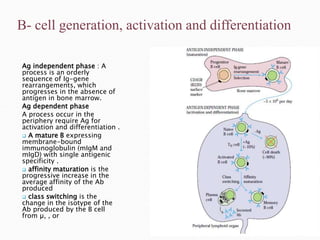
B- cell generation, activation and differentiation
Ag independent phase : A
process is an orderly
sequence of Ig-gene
rearrangements, which
progresses in the absence of
antigen in bone marrow.
Ag dependent phase
A process occur in the
periphery require Ag for
activation and differentiation .
 A mature B expressing
membrane-bound
immunoglobulin (mIgM and
mIgD) with single antigenic
specificity .
 affinity maturation is the
progressive increase in the
average affinity of the Ab
produced
 class switching is the
change in the isotype of the
Ab produced by the B cell
from µ, , or
 Bone-marrow stromal cells are required for maturation of progenitor
B cells(pro-B cells) into precursor B cells(pre-B cell).
 Pro-B cells bind to stromal cells by means of an interaction between
VCAM-1 on the stromal cell and VLA-4 on the pro-B cell.
 This interaction promotes the binding of c-Kit on the pro-B cell to
stem cell factor (SCF) on the stromal cell, which triggers a signal,
mediated by the tyrosine kinase activity of c-Kit
 stimulates the pro-B cell to express receptors for IL-7. IL-7 released
from the stromal cell then binds to the IL-7 receptors, inducing the
pro-B cell to mature into a pre-B cell.
 Pre-B cells completes its differentiation &leave the bon marrow as
immature B-cells.
 During early stages of B cell development, functional
rearrangements of the heavy chain gene locus (IgH) allows for
assembly of the pre-B cell receptor complex cessation of
IgH rearrangements (allelic exclusion) light chain
rearrangements (kappa, then lambda)
 Production of complete Ig (2 heavy chains, 2 light chains)
allows for assembly of mature B cell receptor on the cell
surface signals cessation of light chain gene rearrangement
mature B cell stage
•IL-7 stimulate STAT5
transcriptional factors.
•STAT5 activate the proliferating
control proteins C-myc & N-myc
that enhance B-cells proliferation..
•STATA with E2A proteins
promotes the expression of early
B cells factors 1 (EBF1).
• EBF1 in turn promotes the
expression of PAX5 , and together
the E2A proteins , EBF1,and
PAX5 activate many genes
leading to B-cell lineage
specification .
 Express CD45R, a B-cell lineage-specific marker.
 Increase expression of EBF-1(early B-cell factor 1).
 EBF-1 and E2A bind the Ig gene, promoting
accessibility of D-JH locus, preparing for the 1st
step in Ig gene recombination.
 EBF-1 also important for expression of other B cell
proteins, including CD79α/β and genes encoding
the pre-B cell receptor.
 D-JH recombination complete
 Require IL-3, IL-7, insulin-like growth factor 1, stem cell factor
 Pax5 expression (target of EBF-1)
• Master transcription factor (essential for all subsequent stages of
B cell development)
• Promotes VH to D recombination
 RAG1 and RAG2 expression
Catalyze D-JH rearrangements within the Ig heavy chain gene .
 Surface expression of CD19
• Component of multimolecular surface complex involved in
signaling in response to antigen and T cell help
 Expression of HLA-DR and CD34
 By late pro-B cell stage, most cells have initiated VH to DJH Ig
gene segment recombination.
 Ig heavy chain genes complete V-D-J recombination
–Allows surface expression of Ig heavy chain and surrogate light chains complex = pre-B cell
receptor
 CD79a and CD79b (Ig-α and Ig-β)
–signal transducing components of the pre-B cell receptor
–components of the Ig receptors on the surface of mature B cells
 Signaling through the pre-B cell receptor induces a few rounds of proliferation; at the end
of this the pre-B cell receptor is lost from the surface late pre B cell stage
 If pre B cell receptor cannot be displayed on cell surface because of nonproductive
VHDJH gene rearrangement, then B cell development stops and the cell undergoes
apoptosis (1st checkpoint)
 Pre-B cell receptor signaling causes transient decrease in RAG1/2 and loss of Tdt
 Ensures that as soon as one heavy chain gene has been rearranged, no further
recombination is possible (allelic exclusion)
 Light chain rearrangement is initiated following re-expression of RAG1/2
 Once light chain rearrangement has been successfully completed, the intact IgM receptor
can be expressed
 –If light chain rearrangement does not occur successfully, then the 2nd checkpoint occurs
 Have functional IgM but no other Ig expression
 Express B220, CD25, IL-7R, CD19.
 Once there is a functional BCR on the membrane, it has to be tested
for its ability to bind self-antigens to ensure that few auto-reactive B
cells are released.
 Three fates if autoreactive
1-Clonal deletion via BCR-mediated apoptosis
2-Reactivation of RAG to initiate process of light chain receptor editing
3-Survive and escape the BM but become anergic
 B cell loss prior to leaving the BM = central tolerance
 Export to spleen where further development occurs
 Very susceptible to tolerance induction
Sequence of Events and Characteristics of the
Stages
in B-cell Maturation in the Bone Marrow
Sequence of Events and Characteristics of the
Stages
in B-cell Maturation in the Bone Marrow
lymphoid pro-B pre-B immature
mature
stem cell cell cell B cell
B cell
mIgM
+
mIgD
(IL-2R a)
CD45R: a protein tyrosine phosphatase
CD19: part of the B-cell coreceptor
CD43: leukosialin
CD24: heat-stable antigen (HAS)
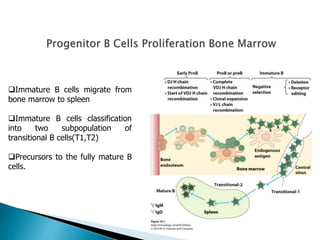
Immature B cells migrate from
bone marrow to spleen
Immature B cells classification
into two subpopulation of
transitional B cells(T1,T2)
Precursors to the fully mature B
cells.
T1: mIgMhi, mIgD-/lo, CD21-, CD23-,
CD24+, CD93+
T2: higher levels of mIgD, CD21+,
BAFF-R
T1 T2 mature B cells
Most T1 transitional B cells differentiate
to T2 within the spleen but ~25% of T2
emerge directly from the BM
T2 cells capable of recirculation among
the blood, lymph nodes, spleen
T2 cells can enter B cell follicles
Self-reactive T1 B cells eliminated by
apoptosis in response to strong
antigenic signal (peripheral tolerance)
55-75% of immature B cells lost this
way
T2 cells become resistant to antigen-
induced apoptosis Increased Bcl-X1
expression
BAFF receptor expression first
detected in T1 B cells, increases
thereafter Promotes survival of
transitional B cells
 Complete IgM molecule on cell surface
 Mature resting B cells express HLA-DR, CD19, CD20, CD40 but no
longer express CD10, CD34, RAG1, RAG2, or Tdt
 Exit bone marrow, migrate to secondary lymphoid organs, then
express both surface IgM and IgD as well as other molecules that
mediate cell-cell and cell-ECM adhesive interactions
 Can recirculate between blood and lymphoid organs, entering B cell
follicles in lymph nodes and spleen, responding to antigen
encounter with T cell help, leading to antibody production.
Plasma cells  class switching
Memory B cells  class switch but non-proliferating, long-lived
Follicular (B-2)
B cells
(conventional B
cells)
B-1 B cells
Marginal Zone
B cells
 30-50% of the B cells in the pleural and peritoneal cavities,
only small % of splenic B cell population
 Limited receptor repertoire, primarily directed towards
commonly expressed microbial carbohydrate antigens
 Transitional B-1 cells undergo apoptosis unless they interact
with self-antigens
◦ Constantly regenerated in the periphery Bone marrow
ablation causes depletion of B-2 pool but not B-1 pool
 Exposure to antigen leads to plasma cell formation and to
clonal expansion and persistence of antigen-specific memory
B1 cells
 Located in outer zones of white pulp of the spleen
 Derived from the T2 transitional population
 Specialized for recognizing blood-borne antigens
 Can respond to both protein and carbohydrate antigens
 Produce broadly cross-reactive IgM antibodies
 High levels of membrane IgM and CD21, low levels of
membrane IgD and CD23
 Long lived
Two major types:
A- thymus-dependent (TD) antigens
involves protein antigens and CD4+ helper T cells
 Multivalent antigen binds and cross-links membrane Ig
receptors
 Activated T cell binds B cell thru antigen receptor and via
 CD40L (T)/CD40 (B) interaction
B- thymus-independent (TI) antigens
 involves multivalent or highly polymerized antigens, does not
require T cell help
 TI-1: e.g., LPS.activate B cells that bind the antigen via the Ig
receptor
 –TI-2: e.g., bacterial capsular polysaccharide.Many are bound by
C3d
 BCR consist of an antigen-binding mIg and one signal-
transducing Ig-α /Ig-β heterodimer.
 The immunoreceptor tyrosine-based activation motifs (ITAMs)
are activating with several members of the Src family of
tyrosinekinases (Lyn, Blk, and Fyn).
 Assembly of large signaling lead to creating docking sites for
Syk kinase , which is activated.
 Changes in gene expression.
 The B-Cell-Co receptor Complex Can Enhance B-Cell
Responses : TAPA-1 (CD81), CR2 (CD21), and CD19 for
destroying invaders.
 b-cells bind Ag via Ig receptors.
 B-cells processed this Ag & re-expressed to
form peptide presented by MHC II.
 T-cells interact with B cells by CD40L on T-
cells & CD40 on B-cells,CD28 co receptors
on T-cells engaged with (B7) CD 80 or
CD86 on B-cells.
 Induced T-cells to release activating
cytokine for B cells activation.
 some activated B cells differentiate into plasma cells are outside of
the follicles, then migrate to the lymph node or the bone marrow.
Secrete IgM within 4 days
 Other activated B cells enter the follicle, divide and differentiate;
germinal centers form.
 •Ig genes undergo class switching: the μ constant regions replaced
by other constant regions and the variable region is subject to
somatic hypermutation.
 •Mutated variable region subject to antigen-mediated selection
 •Low affinity and autoreactive B cells die while those with improved
affinity leave the germinal centers.
 •Antibodies with mutations in the variable region appear in the
circulation within 6-10 days
Marginal Zone
Germinal Center
Naïve Immigrant
From Marrow
Low affinity IgM
High affinity IgG
Memory Cell
antigen
IgM
MHCII
IgG
2. FDC-
1. Ag-sp T cell
1.Affinity
Maturation
2. Isotype
Switching
 Introduce point mutation at very high rate
into the variable region of rearranged heavy
chian and light chain genes VDJ.
 Produced Ab with high affinity to Ag during
process of the immune response.
 Abs with mutation in their variable region
appears in the circulation 6 to 10 days
following onset of the immune response.
Class switching :is change a B cells production of immunoglobulin from one
type to another.
• The constant region of the Abs heavy chain is changed
• The variable region of heavy chain stays the same.
• Don’t affect Ags specificity , but the Abs retains affinity for the same Ags.
• Occurs only during active immune response
 RNA splicing
 DNA recombination
 To switch the IgM expression of any of the
other classes of Abs except δ heavy chain
results in irreversible loss of the intervening
of DNA.
 The formation of γ ,Є and α heavy chain
genes require cutting & re joining of the
heavy chain DNA.
 Genes for constant region lies down stream
from rearranged VDJ region.
RNA SPLICING
 Naïve B-cells could simultaneously expressed
both IgM & IgD.
 Both Igs are encoded on the same transcript.
 µ( IgM) versus δ (IgD) genes for heavy chain is
made by level of RNA splicing.
VDJ δ
VDJ µ δ
VDJ
µ
RNA
TRAS
Ig
D
IgM
AID
(activation induced cytine deaminase)
 In SHM : induced loss of amino group from
cytidine residues ,located in mutation hot
spots results in formation of uradile &this
creates u-G miss match & that creats of
shorter or longer stretches of mutated DNA.
In CSR:
Initiate the deaminating within the switch
region , upstream into both strand.
 T-dependent B-Cell Response
 primary immune response two sets of long-lived cells
remain:
 Memory B cells On secondary exposure to the same
antigen, the memory B cells will be stimulated and result
in production of high-affinity, heavy-chain class-
switched antibodies
Plasma cells
 Majority of the expanded population of antigen-specific B
cells undergo apoptosis
 Secrete antibodies, have few surface antibodies
 Those that arise from follicular B cells are found mainly in the
bone marrow and are long-lived (months)
 Those that arise from non-follicular B cells are short lived
(days to weeks)
 Plasma cell differentiation involves
 loss of Bcl6, Pax-5, CD19, CD20, and B cell activation
antigens
Appearance of XBP-1, BLIMP-1, CD38, CD138,
cytoplasmic Ig
 5-15 days after initial antigen exposure, a portion of the
germinal center B cells will upregulate IRF-4 (critical for
plasma cell differentiation).
 IRF-4 knockout mice lack Ig-secreting plasma cells
 IRF-4 over expression promotes plasma cell differentiation
 (IRF-4, BLIMP-1) down regulation of genes important for B
cell proliferation, class switching and somatic hypermutation
while upregulating synthetic rate of Ig synthesis and secretion
 Downregulation of CXCR5 (has kept the B cell in the germinal
center), upregulation of CXCR4 , leave the lymph node
Dendritic cell presents antigen
to developing B cells to see
which B cells are producing
antibody with high-affinity
for that antigen
 Genetic defects that prevent expression of the pre-B cell receptor or
that prohibit the transduction of signals via the receptor leads to
absence of B cells and agammaglobulinemia
 •Congenital agammaglobulinemia: loss-of-function mutations in
genes that encode components of the pre-B cell receptor or
downstream signaling molecules IgM
 Lambda 5 surrogate light chain
 CD79a, CD79b
 Bruton tyrosine kinase (BTK)
 B cell linker protein (BLNK)
 Characterized by markedly low serum IgG levels and low IgA
or IgM, poor/absent response to immunization
 Failed B cell differentiation with impaired secretion of
immunoglobulin
 reduced percentages of isotype switched memory B cells
 Variety of gene defects, most of which are sporadic
 Maturation of activated B cells in
absence of T cells
 Rapidly mature into short-lived plasma
cells without undergoing somatic
hypermutation or class switching
 Secrete IgM antibodies of low affinity
 Do not contribute to memory B cell
pools
 B-1 cells may preferentially follow this
non-follicular differentiation pathway
as they appear to be much less
dependent on T cell help for antibody
production

B cells generation 2019.ppt

  • 2.
     B cells(B lymphocytes), are a type of white blood cell of the lymphocyte subtype. It comes from the name of bursa of fabricius in bird.  B cells are generated in the bone marrow  Takes 1-2 weeks to develop from hematopoietic stem cells to mature B cells
  • 3.
    Hematopoietic stem cells(HSC) Common lymphoid progenitor (CLP) Some of them migrate to thymus & Tcells will be formed Majority of them remain in bone marrow &differentiated to B cells Common myeloid progenitor(CMP)
  • 4.
    B- cell generation,activation and differentiation Ag independent phase : A process is an orderly sequence of Ig-gene rearrangements, which progresses in the absence of antigen in bone marrow. Ag dependent phase A process occur in the periphery require Ag for activation and differentiation .  A mature B expressing membrane-bound immunoglobulin (mIgM and mIgD) with single antigenic specificity .  affinity maturation is the progressive increase in the average affinity of the Ab produced  class switching is the change in the isotype of the Ab produced by the B cell from µ, , or
  • 5.
     Bone-marrow stromalcells are required for maturation of progenitor B cells(pro-B cells) into precursor B cells(pre-B cell).  Pro-B cells bind to stromal cells by means of an interaction between VCAM-1 on the stromal cell and VLA-4 on the pro-B cell.  This interaction promotes the binding of c-Kit on the pro-B cell to stem cell factor (SCF) on the stromal cell, which triggers a signal, mediated by the tyrosine kinase activity of c-Kit  stimulates the pro-B cell to express receptors for IL-7. IL-7 released from the stromal cell then binds to the IL-7 receptors, inducing the pro-B cell to mature into a pre-B cell.  Pre-B cells completes its differentiation &leave the bon marrow as immature B-cells.
  • 7.
     During earlystages of B cell development, functional rearrangements of the heavy chain gene locus (IgH) allows for assembly of the pre-B cell receptor complex cessation of IgH rearrangements (allelic exclusion) light chain rearrangements (kappa, then lambda)  Production of complete Ig (2 heavy chains, 2 light chains) allows for assembly of mature B cell receptor on the cell surface signals cessation of light chain gene rearrangement mature B cell stage
  • 9.
    •IL-7 stimulate STAT5 transcriptionalfactors. •STAT5 activate the proliferating control proteins C-myc & N-myc that enhance B-cells proliferation.. •STATA with E2A proteins promotes the expression of early B cells factors 1 (EBF1). • EBF1 in turn promotes the expression of PAX5 , and together the E2A proteins , EBF1,and PAX5 activate many genes leading to B-cell lineage specification .
  • 10.
     Express CD45R,a B-cell lineage-specific marker.  Increase expression of EBF-1(early B-cell factor 1).  EBF-1 and E2A bind the Ig gene, promoting accessibility of D-JH locus, preparing for the 1st step in Ig gene recombination.  EBF-1 also important for expression of other B cell proteins, including CD79α/β and genes encoding the pre-B cell receptor.
  • 11.
     D-JH recombinationcomplete  Require IL-3, IL-7, insulin-like growth factor 1, stem cell factor  Pax5 expression (target of EBF-1) • Master transcription factor (essential for all subsequent stages of B cell development) • Promotes VH to D recombination  RAG1 and RAG2 expression Catalyze D-JH rearrangements within the Ig heavy chain gene .  Surface expression of CD19 • Component of multimolecular surface complex involved in signaling in response to antigen and T cell help  Expression of HLA-DR and CD34  By late pro-B cell stage, most cells have initiated VH to DJH Ig gene segment recombination.
  • 12.
     Ig heavychain genes complete V-D-J recombination –Allows surface expression of Ig heavy chain and surrogate light chains complex = pre-B cell receptor  CD79a and CD79b (Ig-α and Ig-β) –signal transducing components of the pre-B cell receptor –components of the Ig receptors on the surface of mature B cells  Signaling through the pre-B cell receptor induces a few rounds of proliferation; at the end of this the pre-B cell receptor is lost from the surface late pre B cell stage  If pre B cell receptor cannot be displayed on cell surface because of nonproductive VHDJH gene rearrangement, then B cell development stops and the cell undergoes apoptosis (1st checkpoint)  Pre-B cell receptor signaling causes transient decrease in RAG1/2 and loss of Tdt  Ensures that as soon as one heavy chain gene has been rearranged, no further recombination is possible (allelic exclusion)  Light chain rearrangement is initiated following re-expression of RAG1/2  Once light chain rearrangement has been successfully completed, the intact IgM receptor can be expressed  –If light chain rearrangement does not occur successfully, then the 2nd checkpoint occurs
  • 13.
     Have functionalIgM but no other Ig expression  Express B220, CD25, IL-7R, CD19.  Once there is a functional BCR on the membrane, it has to be tested for its ability to bind self-antigens to ensure that few auto-reactive B cells are released.  Three fates if autoreactive 1-Clonal deletion via BCR-mediated apoptosis 2-Reactivation of RAG to initiate process of light chain receptor editing 3-Survive and escape the BM but become anergic  B cell loss prior to leaving the BM = central tolerance  Export to spleen where further development occurs  Very susceptible to tolerance induction
  • 14.
    Sequence of Eventsand Characteristics of the Stages in B-cell Maturation in the Bone Marrow Sequence of Events and Characteristics of the Stages in B-cell Maturation in the Bone Marrow lymphoid pro-B pre-B immature mature stem cell cell cell B cell B cell mIgM + mIgD (IL-2R a) CD45R: a protein tyrosine phosphatase CD19: part of the B-cell coreceptor CD43: leukosialin CD24: heat-stable antigen (HAS)
  • 15.
    Immature B cellsmigrate from bone marrow to spleen Immature B cells classification into two subpopulation of transitional B cells(T1,T2) Precursors to the fully mature B cells.
  • 16.
    T1: mIgMhi, mIgD-/lo,CD21-, CD23-, CD24+, CD93+ T2: higher levels of mIgD, CD21+, BAFF-R T1 T2 mature B cells Most T1 transitional B cells differentiate to T2 within the spleen but ~25% of T2 emerge directly from the BM T2 cells capable of recirculation among the blood, lymph nodes, spleen T2 cells can enter B cell follicles
  • 17.
    Self-reactive T1 Bcells eliminated by apoptosis in response to strong antigenic signal (peripheral tolerance) 55-75% of immature B cells lost this way T2 cells become resistant to antigen- induced apoptosis Increased Bcl-X1 expression BAFF receptor expression first detected in T1 B cells, increases thereafter Promotes survival of transitional B cells
  • 18.
     Complete IgMmolecule on cell surface  Mature resting B cells express HLA-DR, CD19, CD20, CD40 but no longer express CD10, CD34, RAG1, RAG2, or Tdt  Exit bone marrow, migrate to secondary lymphoid organs, then express both surface IgM and IgD as well as other molecules that mediate cell-cell and cell-ECM adhesive interactions  Can recirculate between blood and lymphoid organs, entering B cell follicles in lymph nodes and spleen, responding to antigen encounter with T cell help, leading to antibody production. Plasma cells  class switching Memory B cells  class switch but non-proliferating, long-lived
  • 19.
    Follicular (B-2) B cells (conventionalB cells) B-1 B cells Marginal Zone B cells
  • 20.
     30-50% ofthe B cells in the pleural and peritoneal cavities, only small % of splenic B cell population  Limited receptor repertoire, primarily directed towards commonly expressed microbial carbohydrate antigens  Transitional B-1 cells undergo apoptosis unless they interact with self-antigens ◦ Constantly regenerated in the periphery Bone marrow ablation causes depletion of B-2 pool but not B-1 pool  Exposure to antigen leads to plasma cell formation and to clonal expansion and persistence of antigen-specific memory B1 cells
  • 21.
     Located inouter zones of white pulp of the spleen  Derived from the T2 transitional population  Specialized for recognizing blood-borne antigens  Can respond to both protein and carbohydrate antigens  Produce broadly cross-reactive IgM antibodies  High levels of membrane IgM and CD21, low levels of membrane IgD and CD23  Long lived
  • 23.
    Two major types: A-thymus-dependent (TD) antigens involves protein antigens and CD4+ helper T cells  Multivalent antigen binds and cross-links membrane Ig receptors  Activated T cell binds B cell thru antigen receptor and via  CD40L (T)/CD40 (B) interaction B- thymus-independent (TI) antigens  involves multivalent or highly polymerized antigens, does not require T cell help  TI-1: e.g., LPS.activate B cells that bind the antigen via the Ig receptor  –TI-2: e.g., bacterial capsular polysaccharide.Many are bound by C3d
  • 25.
     BCR consistof an antigen-binding mIg and one signal- transducing Ig-α /Ig-β heterodimer.  The immunoreceptor tyrosine-based activation motifs (ITAMs) are activating with several members of the Src family of tyrosinekinases (Lyn, Blk, and Fyn).  Assembly of large signaling lead to creating docking sites for Syk kinase , which is activated.  Changes in gene expression.  The B-Cell-Co receptor Complex Can Enhance B-Cell Responses : TAPA-1 (CD81), CR2 (CD21), and CD19 for destroying invaders.
  • 27.
     b-cells bindAg via Ig receptors.  B-cells processed this Ag & re-expressed to form peptide presented by MHC II.  T-cells interact with B cells by CD40L on T- cells & CD40 on B-cells,CD28 co receptors on T-cells engaged with (B7) CD 80 or CD86 on B-cells.  Induced T-cells to release activating cytokine for B cells activation.
  • 28.
     some activatedB cells differentiate into plasma cells are outside of the follicles, then migrate to the lymph node or the bone marrow. Secrete IgM within 4 days  Other activated B cells enter the follicle, divide and differentiate; germinal centers form.  •Ig genes undergo class switching: the μ constant regions replaced by other constant regions and the variable region is subject to somatic hypermutation.  •Mutated variable region subject to antigen-mediated selection  •Low affinity and autoreactive B cells die while those with improved affinity leave the germinal centers.  •Antibodies with mutations in the variable region appear in the circulation within 6-10 days
  • 29.
    Marginal Zone Germinal Center NaïveImmigrant From Marrow Low affinity IgM High affinity IgG Memory Cell antigen IgM MHCII IgG 2. FDC- 1. Ag-sp T cell 1.Affinity Maturation 2. Isotype Switching
  • 30.
     Introduce pointmutation at very high rate into the variable region of rearranged heavy chian and light chain genes VDJ.  Produced Ab with high affinity to Ag during process of the immune response.  Abs with mutation in their variable region appears in the circulation 6 to 10 days following onset of the immune response.
  • 31.
    Class switching :ischange a B cells production of immunoglobulin from one type to another. • The constant region of the Abs heavy chain is changed • The variable region of heavy chain stays the same. • Don’t affect Ags specificity , but the Abs retains affinity for the same Ags. • Occurs only during active immune response  RNA splicing  DNA recombination
  • 32.
     To switchthe IgM expression of any of the other classes of Abs except δ heavy chain results in irreversible loss of the intervening of DNA.  The formation of γ ,Є and α heavy chain genes require cutting & re joining of the heavy chain DNA.  Genes for constant region lies down stream from rearranged VDJ region.
  • 33.
    RNA SPLICING  NaïveB-cells could simultaneously expressed both IgM & IgD.  Both Igs are encoded on the same transcript.  µ( IgM) versus δ (IgD) genes for heavy chain is made by level of RNA splicing.
  • 34.
    VDJ δ VDJ µδ VDJ µ RNA TRAS Ig D IgM
  • 36.
    AID (activation induced cytinedeaminase)  In SHM : induced loss of amino group from cytidine residues ,located in mutation hot spots results in formation of uradile &this creates u-G miss match & that creats of shorter or longer stretches of mutated DNA.
  • 37.
    In CSR: Initiate thedeaminating within the switch region , upstream into both strand.
  • 40.
     T-dependent B-CellResponse  primary immune response two sets of long-lived cells remain:  Memory B cells On secondary exposure to the same antigen, the memory B cells will be stimulated and result in production of high-affinity, heavy-chain class- switched antibodies Plasma cells  Majority of the expanded population of antigen-specific B cells undergo apoptosis
  • 41.
     Secrete antibodies,have few surface antibodies  Those that arise from follicular B cells are found mainly in the bone marrow and are long-lived (months)  Those that arise from non-follicular B cells are short lived (days to weeks)  Plasma cell differentiation involves  loss of Bcl6, Pax-5, CD19, CD20, and B cell activation antigens Appearance of XBP-1, BLIMP-1, CD38, CD138, cytoplasmic Ig
  • 42.
     5-15 daysafter initial antigen exposure, a portion of the germinal center B cells will upregulate IRF-4 (critical for plasma cell differentiation).  IRF-4 knockout mice lack Ig-secreting plasma cells  IRF-4 over expression promotes plasma cell differentiation  (IRF-4, BLIMP-1) down regulation of genes important for B cell proliferation, class switching and somatic hypermutation while upregulating synthetic rate of Ig synthesis and secretion  Downregulation of CXCR5 (has kept the B cell in the germinal center), upregulation of CXCR4 , leave the lymph node
  • 43.
    Dendritic cell presentsantigen to developing B cells to see which B cells are producing antibody with high-affinity for that antigen
  • 47.
     Genetic defectsthat prevent expression of the pre-B cell receptor or that prohibit the transduction of signals via the receptor leads to absence of B cells and agammaglobulinemia  •Congenital agammaglobulinemia: loss-of-function mutations in genes that encode components of the pre-B cell receptor or downstream signaling molecules IgM  Lambda 5 surrogate light chain  CD79a, CD79b  Bruton tyrosine kinase (BTK)  B cell linker protein (BLNK)
  • 48.
     Characterized bymarkedly low serum IgG levels and low IgA or IgM, poor/absent response to immunization  Failed B cell differentiation with impaired secretion of immunoglobulin  reduced percentages of isotype switched memory B cells  Variety of gene defects, most of which are sporadic
  • 49.
     Maturation ofactivated B cells in absence of T cells  Rapidly mature into short-lived plasma cells without undergoing somatic hypermutation or class switching  Secrete IgM antibodies of low affinity  Do not contribute to memory B cell pools  B-1 cells may preferentially follow this non-follicular differentiation pathway as they appear to be much less dependent on T cell help for antibody production