Orientation to Medical Terminology
Dr. Sarah Abdulsalam
1st STAGE / LEC1/ Medical Terminology theory
Introduction
• Medicine: is the science dealing with the maintenance of
health, prevention and cure of disease.
• A term: is a word or expression that has a precise meaning
in some uses or its peculiar to science art, profession or
subject, e.g. medical term, legal term, trade term……ect.
• Medical terminology: is the professional langue of those
who are directly or indirectly engaged in the art of healing,
it is deal with a particular terms which are specific for the
fields of Medicine.
• Understanding terminology involves breaking words down
into their separate components of prefix, suffix, and root
word and having a good working knowledge of those parts.
Basic Concepts
• The majority of medical terms from Greek and Latin
ancestry. Some have been adopted from modern
language, especially German and French. The study of
medical terminology can enrich one’s understanding of
history, language and medicine
• In analyzing terms, students need to understand the
key concepts that will enable them to break terms into
their component elements (e.g., identifying roots,
prefixes, suffixes, combining form elements, and
compound words).
• The following list presents these key concepts:
• 1- Root or base word element : refers to the main part or
stem of a word is called a root word.
• A root word conveys the essential meaning of the word and
frequently indicates a body part.
• With a combining form, the root word and a combining vowel
such as i, e, o, or a may be combined with another root word, a
prefix, or a suffix to describe a particular structure or condition.
• - Example: adenoma
• Aden= (base or root) = gland
• Oma = suffix = tumor
• Adenoma = gland tumor
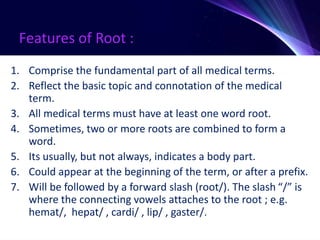
Features of Root :
1. Comprise the fundamental part of all medical terms.
2. Reflect the basic topic and connotation of the medical
term.
3. All medical terms must have at least one word root.
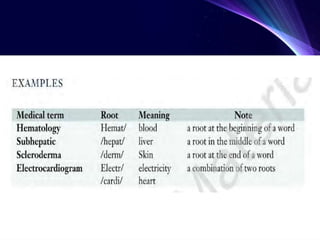
4. Sometimes, two or more roots are combined to form a
word.
5. Its usually, but not always, indicates a body part.
6. Could appear at the beginning of the term, or after a prefix.
7. Will be followed by a forward slash (root/). The slash “/” is
where the connecting vowels attaches to the root ; e.g.
hemat/, hepat/ , cardi/ , lip/ , gaster/.
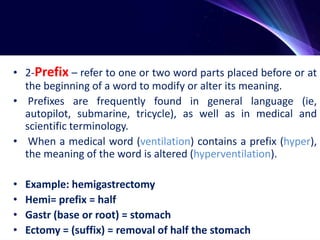
• 2-Prefix – refer to one or two word parts placed before or at
the beginning of a word to modify or alter its meaning.
• Prefixes are frequently found in general language (ie,
autopilot, submarine, tricycle), as well as in medical and
scientific terminology.
• When a medical word (ventilation) contains a prefix (hyper),
the meaning of the word is altered (hyperventilation).
• Example: hemigastrectomy
• Hemi= prefix = half
• Gastr (base or root) = stomach
• Ectomy = (suffix) = removal of half the stomach
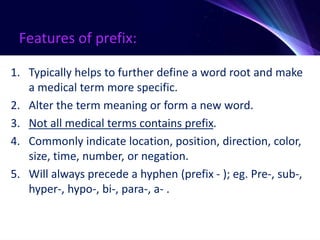
Features of prefix:
1. Typically helps to further define a word root and make
a medical term more specific.
2. Alter the term meaning or form a new word.
3. Not all medical terms contains prefix.
4. Commonly indicate location, position, direction, color,
size, time, number, or negation.
5. Will always precede a hyphen (prefix - ); eg. Pre-, sub-,
hyper-, hypo-, bi-, para-, a- .
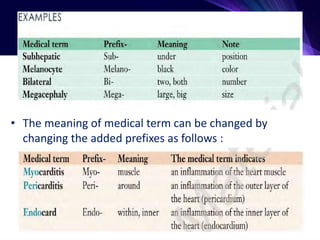
• The meaning of medical term can be changed by
changing the added prefixes as follows :
• 3-Suffix – one or two of word parts attached to the end
of a word to modify or alter its meaning.
• In medical terminology, a suffix usually indicates a
procedure, condition, disease, or part of speech.
• A commonly used suffix is -itis, which means
“inflammation.”
• When this suffix is paired with the prefix arthro-,
meaning joint, the resulting word is arthritis, an
inflammation of the joints.
Feature of suffix :
1. Comprise a fundamental part of medical terms. All
medical terms have an ending , either a suffix or a
complete word .
2. Can modify or alter the meaning or function of a word
root.
3. Can either make the term a noun or an adjective.
4. Often used to refer to a specialty, disease, condition or
procedure.
5. Will always follow a hyphen (-suffix) ; e.g. -itis, -ic, -ac,
-ical , -logy, -lysis.
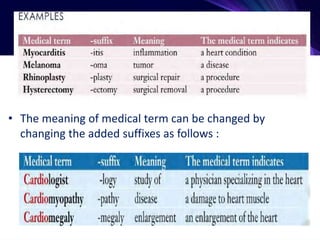
• The meaning of medical term can be changed by
changing the added suffixes as follows :
med. terminology 1.pptx

med. terminology 1.pptx

  • 1.
    Orientation to MedicalTerminology Dr. Sarah Abdulsalam 1st STAGE / LEC1/ Medical Terminology theory
  • 2.
    Introduction • Medicine: isthe science dealing with the maintenance of health, prevention and cure of disease. • A term: is a word or expression that has a precise meaning in some uses or its peculiar to science art, profession or subject, e.g. medical term, legal term, trade term……ect. • Medical terminology: is the professional langue of those who are directly or indirectly engaged in the art of healing, it is deal with a particular terms which are specific for the fields of Medicine. • Understanding terminology involves breaking words down into their separate components of prefix, suffix, and root word and having a good working knowledge of those parts.
  • 3.
    Basic Concepts • Themajority of medical terms from Greek and Latin ancestry. Some have been adopted from modern language, especially German and French. The study of medical terminology can enrich one’s understanding of history, language and medicine • In analyzing terms, students need to understand the key concepts that will enable them to break terms into their component elements (e.g., identifying roots, prefixes, suffixes, combining form elements, and compound words).
  • 4.
    • The followinglist presents these key concepts: • 1- Root or base word element : refers to the main part or stem of a word is called a root word. • A root word conveys the essential meaning of the word and frequently indicates a body part. • With a combining form, the root word and a combining vowel such as i, e, o, or a may be combined with another root word, a prefix, or a suffix to describe a particular structure or condition. • - Example: adenoma • Aden= (base or root) = gland • Oma = suffix = tumor • Adenoma = gland tumor
  • 5.
    Features of Root: 1. Comprise the fundamental part of all medical terms. 2. Reflect the basic topic and connotation of the medical term. 3. All medical terms must have at least one word root. 4. Sometimes, two or more roots are combined to form a word. 5. Its usually, but not always, indicates a body part. 6. Could appear at the beginning of the term, or after a prefix. 7. Will be followed by a forward slash (root/). The slash “/” is where the connecting vowels attaches to the root ; e.g. hemat/, hepat/ , cardi/ , lip/ , gaster/.
  • 7.
    • 2-Prefix –refer to one or two word parts placed before or at the beginning of a word to modify or alter its meaning. • Prefixes are frequently found in general language (ie, autopilot, submarine, tricycle), as well as in medical and scientific terminology. • When a medical word (ventilation) contains a prefix (hyper), the meaning of the word is altered (hyperventilation). • Example: hemigastrectomy • Hemi= prefix = half • Gastr (base or root) = stomach • Ectomy = (suffix) = removal of half the stomach
  • 8.
    Features of prefix: 1.Typically helps to further define a word root and make a medical term more specific. 2. Alter the term meaning or form a new word. 3. Not all medical terms contains prefix. 4. Commonly indicate location, position, direction, color, size, time, number, or negation. 5. Will always precede a hyphen (prefix - ); eg. Pre-, sub-, hyper-, hypo-, bi-, para-, a- .
  • 9.
    • The meaningof medical term can be changed by changing the added prefixes as follows :
  • 10.
    • 3-Suffix –one or two of word parts attached to the end of a word to modify or alter its meaning. • In medical terminology, a suffix usually indicates a procedure, condition, disease, or part of speech. • A commonly used suffix is -itis, which means “inflammation.” • When this suffix is paired with the prefix arthro-, meaning joint, the resulting word is arthritis, an inflammation of the joints.
  • 11.
    Feature of suffix: 1. Comprise a fundamental part of medical terms. All medical terms have an ending , either a suffix or a complete word . 2. Can modify or alter the meaning or function of a word root. 3. Can either make the term a noun or an adjective. 4. Often used to refer to a specialty, disease, condition or procedure. 5. Will always follow a hyphen (-suffix) ; e.g. -itis, -ic, -ac, -ical , -logy, -lysis.
  • 12.
    • The meaningof medical term can be changed by changing the added suffixes as follows :