Phd.dr.sarah
abdulsalam
MAJOR
HISTOCOMPATABILITY
COMPLEX
3rd stage / immunology theory/ lec5
Major Histocompatibility Complex(MHC)
 Cluster of genes found in all mammals
 Its products play role in discriminating self/non-self
 Participant in both humoral and cell-mediated immunity
 MHC Act As Antigen Presenting Structures
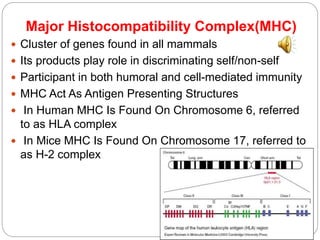
 In Human MHC Is Found On Chromosome 6, referred
to as HLA complex
 In Mice MHC Is Found On Chromosome 17, referred to
as H-2 complex
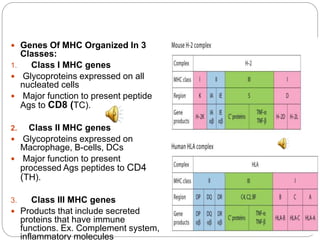
 Genes Of MHC Organized In 3
Classes:
1. Class I MHC genes
 Glycoproteins expressed on all
nucleated cells
 Major function to present peptide
Ags to CD8 (TC).
2. Class II MHC genes
 Glycoproteins expressed on
Macrophage, B-cells, DCs
 Major function to present
processed Ags peptides to CD4
(TH).
3. Class III MHC genes
 Products that include secreted
proteins that have immune
functions. Ex. Complement system,
inflammatory molecules
MHC Molecules
1. Class I MHC Molecule
 Comprised of 2 molecules:  chain and
2-microglobulin
 Non-covalently associated with each
other.
  Chain Made Up Of 3 Domains (1,
2 and 3)
 2-microglobulin Similar To 3
 1 And 2 Form Peptide Binding Cleft
 Interacts with CD8 (TC) molecule .
2. Class II MHC Molecule
 Comprised of  and  chains
  chain and  chain associate non-
covalently
  and  chains Made Up Of
Domains
 1 and 2 ( chain)
 1 and 2 ( chain)
 1and 1 Form Antigen Binding
Cleft
Peptide
binding cleft
HLA - Human Leukocyte Antigen
 HLA is the MHC molecules present in human
beings.
 HLA is a set of surface protein present on the
surface of all nucleated cells.
 They are responsible for graft rejection,
adaptive immunity, defense against
infection, some time it is expressed on
cancer cell destruction, certain
autoimmune diseases and certain
complements.
 MHC is the general term referring to the cell
surface antigen of vertebrates.
Antigen Processing and presenting
 Extracellular (exogenous) antigens are eliminated by
secreted antibody whereas intracellular (endogenous)
antigens are eliminated by CTLs.
 There are 2 different antigen-presenting pathway to
mediate responses.
- Endocytic pathway
- Cytosolic pathway
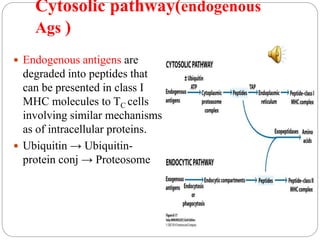
Cytosolic pathway(endogenous
Ags )
 Endogenous antigens are
degraded into peptides that
can be presented in class I
MHC molecules to TC cells
involving similar mechanisms
as of intracellular proteins.
 Ubiquitin → Ubiquitin-
protein conj → Proteosome
Endocytic (exogenous)Pathway
 APCs can internalize antigen by phagocytosis &/or endocytosis.
 Macrophages do both; B cells use receptor-mediated endocytosis.
 After antigen is internalized, it is degraded into peptides.
 The pathway begins by phagocytosis by the cell of a foreign
agent, an organism, bacteria, etc…
 The antigen is now in a phagosome. A lysosome will fuse with
the phagosome to become a phagolysosome.
 The antigen will be degraded into smaller peptides.
Endocytic (exogenous)Pathway
 A helper T cell will recognize the complex and trigger
the appropriate response, such as secreting
cytokines and chemokines to control whatever kind
of infection is taking place.
 Internalized antigen takes 1-3 hours to traverse the
endocytic pathway & appear on cell membrane in the
form of peptide-class II MHC complexes.
مناعة نظري mhc - lec 7.pptx

مناعة نظري mhc - lec 7.pptx

  • 1.
  • 2.
    Major Histocompatibility Complex(MHC) Cluster of genes found in all mammals  Its products play role in discriminating self/non-self  Participant in both humoral and cell-mediated immunity  MHC Act As Antigen Presenting Structures  In Human MHC Is Found On Chromosome 6, referred to as HLA complex  In Mice MHC Is Found On Chromosome 17, referred to as H-2 complex
  • 3.
     Genes OfMHC Organized In 3 Classes: 1. Class I MHC genes  Glycoproteins expressed on all nucleated cells  Major function to present peptide Ags to CD8 (TC). 2. Class II MHC genes  Glycoproteins expressed on Macrophage, B-cells, DCs  Major function to present processed Ags peptides to CD4 (TH). 3. Class III MHC genes  Products that include secreted proteins that have immune functions. Ex. Complement system, inflammatory molecules
  • 4.
    MHC Molecules 1. ClassI MHC Molecule  Comprised of 2 molecules:  chain and 2-microglobulin  Non-covalently associated with each other.   Chain Made Up Of 3 Domains (1, 2 and 3)  2-microglobulin Similar To 3  1 And 2 Form Peptide Binding Cleft  Interacts with CD8 (TC) molecule . 2. Class II MHC Molecule  Comprised of  and  chains   chain and  chain associate non- covalently   and  chains Made Up Of Domains  1 and 2 ( chain)  1 and 2 ( chain)  1and 1 Form Antigen Binding Cleft Peptide binding cleft
  • 5.
    HLA - HumanLeukocyte Antigen  HLA is the MHC molecules present in human beings.  HLA is a set of surface protein present on the surface of all nucleated cells.  They are responsible for graft rejection, adaptive immunity, defense against infection, some time it is expressed on cancer cell destruction, certain autoimmune diseases and certain complements.  MHC is the general term referring to the cell surface antigen of vertebrates.
  • 6.
    Antigen Processing andpresenting  Extracellular (exogenous) antigens are eliminated by secreted antibody whereas intracellular (endogenous) antigens are eliminated by CTLs.  There are 2 different antigen-presenting pathway to mediate responses. - Endocytic pathway - Cytosolic pathway
  • 7.
    Cytosolic pathway(endogenous Ags ) Endogenous antigens are degraded into peptides that can be presented in class I MHC molecules to TC cells involving similar mechanisms as of intracellular proteins.  Ubiquitin → Ubiquitin- protein conj → Proteosome
  • 9.
    Endocytic (exogenous)Pathway  APCscan internalize antigen by phagocytosis &/or endocytosis.  Macrophages do both; B cells use receptor-mediated endocytosis.  After antigen is internalized, it is degraded into peptides.  The pathway begins by phagocytosis by the cell of a foreign agent, an organism, bacteria, etc…  The antigen is now in a phagosome. A lysosome will fuse with the phagosome to become a phagolysosome.  The antigen will be degraded into smaller peptides.
  • 10.
    Endocytic (exogenous)Pathway  Ahelper T cell will recognize the complex and trigger the appropriate response, such as secreting cytokines and chemokines to control whatever kind of infection is taking place.  Internalized antigen takes 1-3 hours to traverse the endocytic pathway & appear on cell membrane in the form of peptide-class II MHC complexes.

Editor's Notes

  • #4 DCs= dendritic cells