B cell development, activation
and differentiation
The process is divided into three stages
– Generation of mature immunocompetent B
cells (maturation)
– Activation of mature B cells
– Differentiation into plasma and memory B
cells
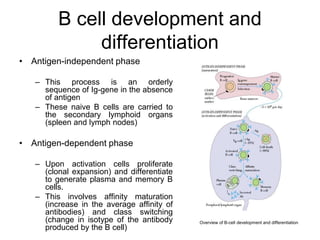
• Antigen-independent phase
– This process is an orderly
sequence of Ig-gene in the absence
of antigen
– These naive B cells are carried to
the secondary lymphoid organs
(spleen and lymph nodes)
• Antigen-dependent phase
– Upon activation cells proliferate
(clonal expansion) and differentiate
to generate plasma and memory B
cells.
– This involves affinity maturation
(increase in the average affinity of
antibodies) and class switching
(change in isotype of the antibody
produced by the B cell)
Overview of B-cell development and differentiation
B cell development and
differentiation
• The generation of mature B cells starts in
embryo and continues throughout life
• Before birth, yolk sac, fetal liver and fetal
bone marrow are major sites of B-cell
maturation
• After birth generation of mature B cells
occurs in bone marrow
B cell maturation
Progenitor B cells proliferate
in bone marrow
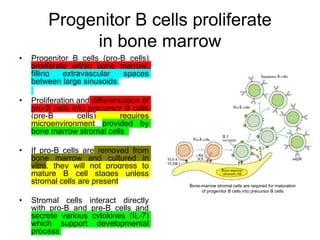
• Progenitor B cells (pro-B cells)
proliferate within bone marrow,
filling extravascular spaces
between large sinusoids
• Proliferation and differentiation of
pro-B cells into precursor B cells
(pre-B cells) requires
microenvironment provided by
bone marrow stromal cells
• If pro-B cells are removed from
bone marrow and cultured in
vitro, they will not progress to
mature B cell stages unless
stromal cells are present
• Stromal cells interact directly
with pro-B and pre-B cells and
secrete various cytokines (IL-7)
which support developmental
process
Bone-marrow stromal cells are required for maturation
of progenitor B cells into precursor B cells
Ig-gene rearrangment produces
immature B Cells
• First to occur in the pro-B cell stage is a heavy-chain DH-to-JH gene rearrangement
followed by a VH-to-DHJH rearrangement
• If first heavy-chain rearrangement is not productive, then VH-DH-JH rearrangement
continues on the other chromosome
• Upon completion of heavy-chain rearrangement, the cell is classified as a pre-B cell.
• Development of a pre-B cell into an immature B cell requires a productive light-
chain gene rearrangement
• Because of allelic exclusion, only one light-chain isotype is expressed on the
membrane of a B cell
• Completion of a productive light-chain rearrangement commits the now immature B
cell to a particular antigenic specificity determined by cell’s heavy-chain VDJ
sequence and light-chain VJ sequence
• Immature B cells express mIgM (membrane IgM) on cell surface
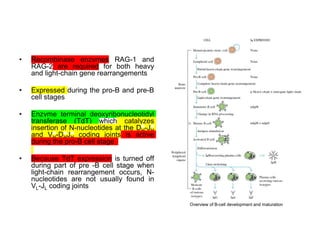
• Recombinase enzymes RAG-1 and
RAG-2 are required for both heavy
and light-chain gene rearrangements
• Expressed during the pro-B and pre-B
cell stages
• Enzyme terminal deoxyribonucleotidyl
transferase (TdT) which catalyzes
insertion of N-nucleotides at the DH-JH
and VH-DHJH coding joints is active
during the pro-B cell stage
• Because TdT expression is turned off
during part of pre -B cell stage when
light-chain rearrangement occurs, N-
nucleotides are not usually found in
VL-JL coding joints
Overview of B-cell development and maturation
Thymus dependent and independent antigens
have different requirements for response
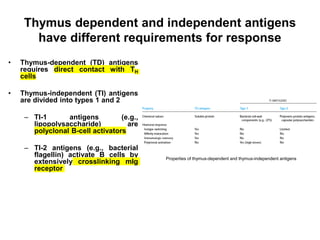
• Thymus-dependent (TD) antigens
requires direct contact with TH
cells
• Thymus-independent (TI) antigens
are divided into types 1 and 2
– TI-1 antigens (e.g.,
lipopolysaccharide) are
polyclonal B-cell activators
– TI-2 antigens (e.g., bacterial
flagellin) activate B cells by
extensively crosslinking mIg
receptor
Properties of thymus-dependent and thymus-independent antigens
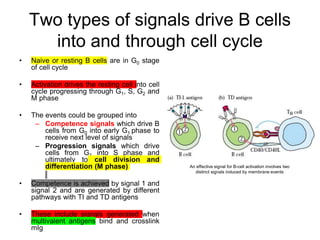
Two types of signals drive B cells
into and through cell cycle
• Naive or resting B cells are in G0 stage
of cell cycle
• Activation drives the resting cell into cell
cycle progressing through G1, S, G2 and
M phase
• The events could be grouped into
– Competence signals which drive B
cells from G0 into early G1 phase to
receive next level of signals
– Progression signals which drive
cells from G1 into S phase and
ultimately to cell division and
differentiation (M phase)
• Competence is achieved by signal 1 and
signal 2 and are generated by different
pathways with TI and TD antigens
• These include signals generated when
multivalent antigens bind and crosslink
mIg
An effective signal for B-cell activation involves two
distinct signals induced by membrane events
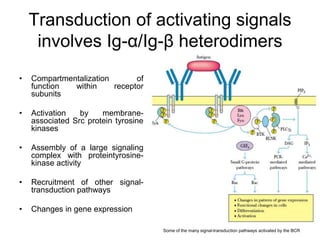
Transduction of activating signals
involves Ig-α/Ig-β heterodimers
• Compartmentalization of
function within receptor
subunits
• Activation by membrane-
associated Src protein tyrosine
kinases
• Assembly of a large signaling
complex with proteintyrosine-
kinase activity
• Recruitment of other signal-
transduction pathways
• Changes in gene expression
Some of the many signal-transduction pathways activated by the BCR
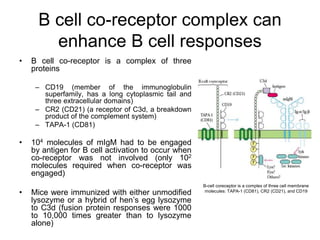
B cell co-receptor complex can
enhance B cell responses
• B cell co-receptor is a complex of three
proteins
– CD19 (member of the immunoglobulin
superfamily, has a long cytoplasmic tail and
three extracellular domains)
– CR2 (CD21) (a receptor of C3d, a breakdown
product of the complement system)
– TAPA-1 (CD81)
• 104 molecules of mIgM had to be engaged
by antigen for B cell activation to occur when
co-receptor was not involved (only 102
molecules required when co-receptor was
engaged)
• Mice were immunized with either unmodified
lysozyme or a hybrid of hen’s egg lysozyme
to C3d (fusion protein responses were 1000
to 10,000 times greater than to lysozyme
alone)
B-cell coreceptor is a complex of three cell membrane
molecules: TAPA-1 (CD81), CR2 (CD21), and CD19
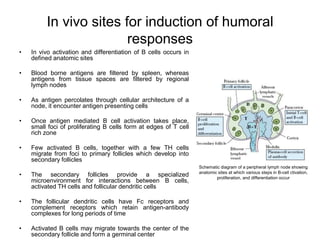
In vivo sites for induction of humoral
responses
• In vivo activation and differentiation of B cells occurs in
defined anatomic sites
• Blood borne antigens are filtered by spleen, whereas
antigens from tissue spaces are filtered by regional
lymph nodes
• As antigen percolates through cellular architecture of a
node, it encounter antigen presenting cells
• Once antigen mediated B cell activation takes place,
small foci of proliferating B cells form at edges of T cell
rich zone
• Few activated B cells, together with a few TH cells
migrate from foci to primary follicles which develop into
secondary follicles
• The secondary follicles provide a specialized
microenvironment for interactions between B cells,
activated TH cells and follicular dendritic cells
• The follicular dendritic cells have Fc receptors and
complement receptors which retain antigen-antibody
complexes for long periods of time
• Activated B cells may migrate towards the center of the
secondary follicle and form a germinal center
Schematic diagram of a peripheral lymph node showing
anatomic sites at which various steps in B-cell ctivation,
proliferation, and differentiation occur
Germinal centers and antigen induced B cell
differentiation
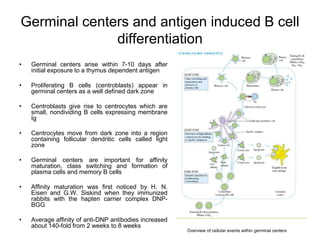
• Germinal centers arise within 7-10 days after
initial exposure to a thymus dependent antigen
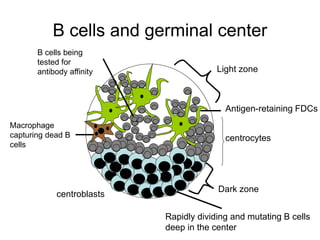
• Proliferating B cells (centroblasts) appear in
germinal centers as a well defined dark zone
• Centroblasts give rise to centrocytes which are
small, nondividing B cells expressing membrane
Ig
• Centrocytes move from dark zone into a region
containing follicular dendritic cells called light
zone
• Germinal centers are important for affinity
maturation, class switching and formation of
plasma cells and memory B cells
• Affinity maturation was first noticed by H. N.
Eisen and G.W. Siskind when they immunized
rabbits with the hapten carrier complex DNP-
BGG
• Average affinity of anti-DNP antibodies increased
about 140-fold from 2 weeks to 8 weeks
Overview of cellular events within germinal centers
B cells and germinal center
Rapidly dividing and mutating B cells
deep in the center
Antigen-retaining FDCs
Macrophage
capturing dead B
cells
B cells being
tested for
antibody affinity
Dark zone
Light zone
centrocytes
centroblasts
Role of cytokines in B cell differentiation
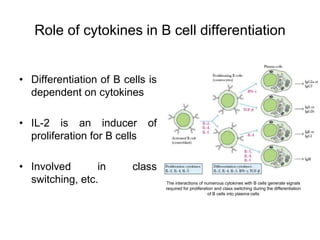
• Differentiation of B cells is
dependent on cytokines
• IL-2 is an inducer of
proliferation for B cells
• Involved in class
switching, etc. The interactions of numerous cytokines with B cells generate signals
required for proliferation and class switching during the differentiation
of B cells into plasma cells

Activation of B Cells.ppt

  • 1.
    B cell development,activation and differentiation
  • 2.
    The process isdivided into three stages – Generation of mature immunocompetent B cells (maturation) – Activation of mature B cells – Differentiation into plasma and memory B cells
  • 3.
    • Antigen-independent phase –This process is an orderly sequence of Ig-gene in the absence of antigen – These naive B cells are carried to the secondary lymphoid organs (spleen and lymph nodes) • Antigen-dependent phase – Upon activation cells proliferate (clonal expansion) and differentiate to generate plasma and memory B cells. – This involves affinity maturation (increase in the average affinity of antibodies) and class switching (change in isotype of the antibody produced by the B cell) Overview of B-cell development and differentiation B cell development and differentiation
  • 4.
    • The generationof mature B cells starts in embryo and continues throughout life • Before birth, yolk sac, fetal liver and fetal bone marrow are major sites of B-cell maturation • After birth generation of mature B cells occurs in bone marrow B cell maturation
  • 5.
    Progenitor B cellsproliferate in bone marrow • Progenitor B cells (pro-B cells) proliferate within bone marrow, filling extravascular spaces between large sinusoids • Proliferation and differentiation of pro-B cells into precursor B cells (pre-B cells) requires microenvironment provided by bone marrow stromal cells • If pro-B cells are removed from bone marrow and cultured in vitro, they will not progress to mature B cell stages unless stromal cells are present • Stromal cells interact directly with pro-B and pre-B cells and secrete various cytokines (IL-7) which support developmental process Bone-marrow stromal cells are required for maturation of progenitor B cells into precursor B cells
  • 6.
    Ig-gene rearrangment produces immatureB Cells • First to occur in the pro-B cell stage is a heavy-chain DH-to-JH gene rearrangement followed by a VH-to-DHJH rearrangement • If first heavy-chain rearrangement is not productive, then VH-DH-JH rearrangement continues on the other chromosome • Upon completion of heavy-chain rearrangement, the cell is classified as a pre-B cell. • Development of a pre-B cell into an immature B cell requires a productive light- chain gene rearrangement • Because of allelic exclusion, only one light-chain isotype is expressed on the membrane of a B cell • Completion of a productive light-chain rearrangement commits the now immature B cell to a particular antigenic specificity determined by cell’s heavy-chain VDJ sequence and light-chain VJ sequence • Immature B cells express mIgM (membrane IgM) on cell surface
  • 7.
    • Recombinase enzymesRAG-1 and RAG-2 are required for both heavy and light-chain gene rearrangements • Expressed during the pro-B and pre-B cell stages • Enzyme terminal deoxyribonucleotidyl transferase (TdT) which catalyzes insertion of N-nucleotides at the DH-JH and VH-DHJH coding joints is active during the pro-B cell stage • Because TdT expression is turned off during part of pre -B cell stage when light-chain rearrangement occurs, N- nucleotides are not usually found in VL-JL coding joints Overview of B-cell development and maturation
  • 8.
    Thymus dependent andindependent antigens have different requirements for response • Thymus-dependent (TD) antigens requires direct contact with TH cells • Thymus-independent (TI) antigens are divided into types 1 and 2 – TI-1 antigens (e.g., lipopolysaccharide) are polyclonal B-cell activators – TI-2 antigens (e.g., bacterial flagellin) activate B cells by extensively crosslinking mIg receptor Properties of thymus-dependent and thymus-independent antigens
  • 9.
    Two types ofsignals drive B cells into and through cell cycle • Naive or resting B cells are in G0 stage of cell cycle • Activation drives the resting cell into cell cycle progressing through G1, S, G2 and M phase • The events could be grouped into – Competence signals which drive B cells from G0 into early G1 phase to receive next level of signals – Progression signals which drive cells from G1 into S phase and ultimately to cell division and differentiation (M phase) • Competence is achieved by signal 1 and signal 2 and are generated by different pathways with TI and TD antigens • These include signals generated when multivalent antigens bind and crosslink mIg An effective signal for B-cell activation involves two distinct signals induced by membrane events
  • 10.
    Transduction of activatingsignals involves Ig-α/Ig-β heterodimers • Compartmentalization of function within receptor subunits • Activation by membrane- associated Src protein tyrosine kinases • Assembly of a large signaling complex with proteintyrosine- kinase activity • Recruitment of other signal- transduction pathways • Changes in gene expression Some of the many signal-transduction pathways activated by the BCR
  • 11.
    B cell co-receptorcomplex can enhance B cell responses • B cell co-receptor is a complex of three proteins – CD19 (member of the immunoglobulin superfamily, has a long cytoplasmic tail and three extracellular domains) – CR2 (CD21) (a receptor of C3d, a breakdown product of the complement system) – TAPA-1 (CD81) • 104 molecules of mIgM had to be engaged by antigen for B cell activation to occur when co-receptor was not involved (only 102 molecules required when co-receptor was engaged) • Mice were immunized with either unmodified lysozyme or a hybrid of hen’s egg lysozyme to C3d (fusion protein responses were 1000 to 10,000 times greater than to lysozyme alone) B-cell coreceptor is a complex of three cell membrane molecules: TAPA-1 (CD81), CR2 (CD21), and CD19
  • 12.
    In vivo sitesfor induction of humoral responses • In vivo activation and differentiation of B cells occurs in defined anatomic sites • Blood borne antigens are filtered by spleen, whereas antigens from tissue spaces are filtered by regional lymph nodes • As antigen percolates through cellular architecture of a node, it encounter antigen presenting cells • Once antigen mediated B cell activation takes place, small foci of proliferating B cells form at edges of T cell rich zone • Few activated B cells, together with a few TH cells migrate from foci to primary follicles which develop into secondary follicles • The secondary follicles provide a specialized microenvironment for interactions between B cells, activated TH cells and follicular dendritic cells • The follicular dendritic cells have Fc receptors and complement receptors which retain antigen-antibody complexes for long periods of time • Activated B cells may migrate towards the center of the secondary follicle and form a germinal center Schematic diagram of a peripheral lymph node showing anatomic sites at which various steps in B-cell ctivation, proliferation, and differentiation occur
  • 13.
    Germinal centers andantigen induced B cell differentiation • Germinal centers arise within 7-10 days after initial exposure to a thymus dependent antigen • Proliferating B cells (centroblasts) appear in germinal centers as a well defined dark zone • Centroblasts give rise to centrocytes which are small, nondividing B cells expressing membrane Ig • Centrocytes move from dark zone into a region containing follicular dendritic cells called light zone • Germinal centers are important for affinity maturation, class switching and formation of plasma cells and memory B cells • Affinity maturation was first noticed by H. N. Eisen and G.W. Siskind when they immunized rabbits with the hapten carrier complex DNP- BGG • Average affinity of anti-DNP antibodies increased about 140-fold from 2 weeks to 8 weeks Overview of cellular events within germinal centers
  • 14.
    B cells andgerminal center Rapidly dividing and mutating B cells deep in the center Antigen-retaining FDCs Macrophage capturing dead B cells B cells being tested for antibody affinity Dark zone Light zone centrocytes centroblasts
  • 15.
    Role of cytokinesin B cell differentiation • Differentiation of B cells is dependent on cytokines • IL-2 is an inducer of proliferation for B cells • Involved in class switching, etc. The interactions of numerous cytokines with B cells generate signals required for proliferation and class switching during the differentiation of B cells into plasma cells