Contracting for Effective Collaborations in
            Complex Projects

-what the   findings of the ICPM Taskforce Report mean for
               contracting in complex programs

                NASA PM CHALLENGE 2012
                        February 2012
                                                Bretton Ackroyd
                                                  COO ICCPM
                                                  Email: coo@iccpm.com
                                                  Phone: +61 406 420 642
Introduction
• Speaker – Bretton Ackroyd COO ICCPM

• ICCPM – who we are

• ICPM Taskforce Report – Overview

• ICPM KD2 and ongoing Research Agenda
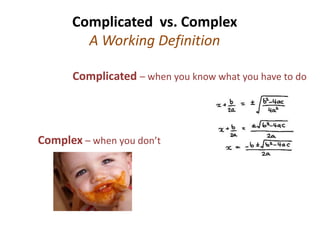
Complicated vs. Complex
        A Working Definition

      Complicated – when you know what you have to do


Complex – when you don’t
Overview
• Introduction
• The Problem
• ICPM Taskforce Report findings
• Key traits for delivering Complex
  Projects
• Giving effect to the Report findings
    – Proposed Practical Contract and Organisational
      measures
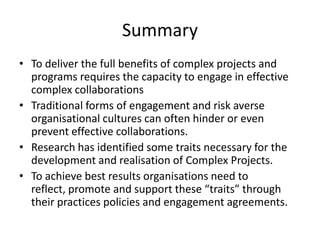
Summary
• To deliver the full benefits of complex projects and
  programs requires the capacity to engage in effective
  complex collaborations
• Traditional forms of engagement and risk averse
  organisational cultures can often hinder or even
  prevent effective collaborations.
• Research has identified some traits necessary for the
  development and realisation of Complex Projects.
• To achieve best results organisations need to
  reflect, promote and support these “traits” through
  their practices policies and engagement agreements.
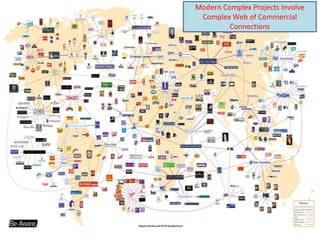
Modern Complex Projects Involve
 Complex Web of Commercial
         Connections
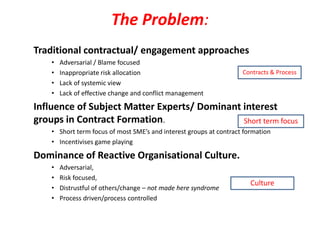
The Problem:
Traditional contractual/ engagement approaches
    •   Adversarial / Blame focused
    •   Inappropriate risk allocation                               Contracts & Process
    •   Lack of systemic view
    •   Lack of effective change and conflict management

Influence of Subject Matter Experts/ Dominant interest
groups in Contract Formation.                 Short term focus
    • Short term focus of most SME’s and interest groups at contract formation
    • Incentivises game playing

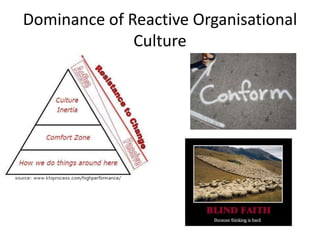
Dominance of Reactive Organisational Culture.
    •   Adversarial,
    •   Risk focused,
                                                                       Culture
    •   Distrustful of others/change – not made here syndrome
    •   Process driven/process controlled
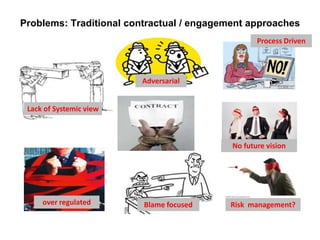
Problems: Traditional contractual / engagement approaches
                                                  Process Driven


                         Adversarial


 Lack of Systemic view


                                           No future vision


     over regulated      Blame focused    Risk management?
Dominance of Reactive Organisational
              Culture
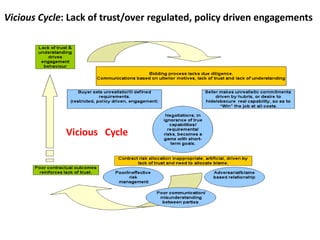
Vicious Cycle: Lack of trust/over regulated, policy driven engagements


              Vicious Cycle
ICPM Taskforce Report
Findings:
• Competition needs to be selectively applied and targeted to
   provide effective outcomes and best benefit realisation.
• Processes that facilitate early supplier/industry
   involvement essential for complex projects.
• Contracts need to acknowledge and support the iterative &
   collaborative nature of effective risk management.
• Contracts need to promote and support the growth of both
   strategic and tactical level collaboration.
• Need to develop commercial advisors and related key
   subject matter experts that have the capacity to take a
   systemic view to contract formation and realising long term
   benefits benefits.
Contractual and Organisational Traits Required
 to Maximise Benefits from Complex Projects?
• Flexible outcome focused Organisation;
  Creation of entity with processes, people and leaders flexible
  enough to address complexity and evolve throughout life of
  the program
• Portfolio of Interrelated Projects; Systemic
  approach look at the whole as well as the parts; addressing
  the entire supply chain and beyond.
• Long Term Benefits Driven Contracting
  Strategies; nuanced, targeted and Informed by clear
  understanding of the benefits sought by Stakeholders.
Flexible Outcome Focused
                 Organisation
• Flexibility essential to delivering effective solutions and
  realising total benefits. Must be nimble enough to address
  Unknown Unknowns.
• Recognition of role as Steward/Champion of the capability
  being developed.
• Processes and procedures that support collaborations and
  the focus on benefits realisation instead of risk transfer.
• Leaders that develop and project the shadow of the future
  and have cognitive flexibility to manage emergence.
• Transparent and efficient governance regimes that support
  achievement of benefits not hinder it.
Portfolio of Interrelated Contracts

• Systemic approach – look at the whole as well as
  the parts. Influencing the entire supply chain.
• Manage as an integrated program rather than
  individual projects.
• Active Identification and management of
  interrelationships to enhance overall benefits
  realisation.
• Active promotion of cross portfolio knowledge
  sharing and collaboration.
“Benefits Driven” Contracting
                 Strategies
• Multiple Contracting strategies applied to different
  components of capability
   – Nuanced, targeted and informed by clear understanding
      of the benefits sought by stakeholders.
   – Targeted use of competition as one of a range of
      approaches underpinning value, not as a weapon.
• Recognition that the owner organisation (gov. or private)
  cannot walk away from the program and risk is shared not
  transferred.
• Mechanisms for collaboratively managing unknown
  unknowns as they emerge.
• Iterative implementation – opportunities to pause, learn and
  adapt.
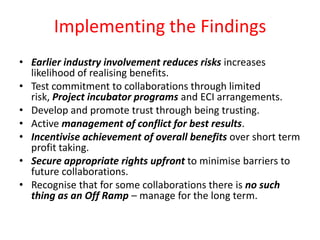
Implementing the Findings
• Earlier industry involvement reduces risks increases
  likelihood of realising benefits.
• Test commitment to collaborations through limited
  risk, Project incubator programs and ECI arrangements.
• Develop and promote trust through being trusting.
• Active management of conflict for best results.
• Incentivise achievement of overall benefits over short term
  profit taking.
• Secure appropriate rights upfront to minimise barriers to
  future collaborations.
• Recognise that for some collaborations there is no such
  thing as an Off Ramp – manage for the long term.
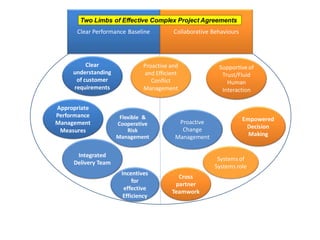
Two Limbs of Effective Complex Project Agreements
      Clear Performance Baseline          Collaborative Behaviours


          Clear                Proactive and              Supportive of
     understanding             and Efficient               Trust/Fluid
      of customer                 Conflict                   Human
     requirements              Management                  Interaction

Appropriate
Performance           Flexible &
                                           Proactive                 Empowered
Management           Cooperative
                                            Change                    Decision
 Measures                Risk
                     Management           Management                   Making


      Integrated
                                                          Systems of
     Delivery Team
                                                         Systems role
                      Incentives
                                           Cross
                           for
                                          partner
                       effective
                                         Teamwork
                       Efficiency
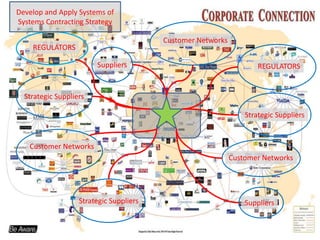
Develop and Apply Systems of
Systems Contracting Strategy

                                         Customer Networks
    REGULATORS

                        Suppliers                                    REGULATORS


  Strategic Suppliers

                                                                 Strategic Suppliers


   Customer Networks
                                                             Customer Networks


                   Strategic Suppliers                           Suppliers
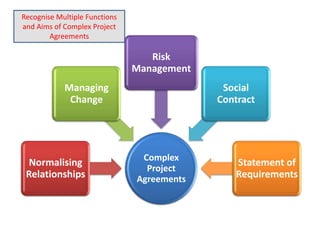
Recognise Multiple Functions
and Aims of Complex Project
        Agreements

                                  Risk
                               Management
            Managing                         Social
             Change                         Contract


                                Complex
  Normalising                                  Statement of
                                 Project
 Relationships                 Agreements      Requirements
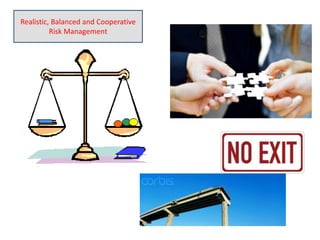
Realistic, Balanced and Cooperative
          Risk Management
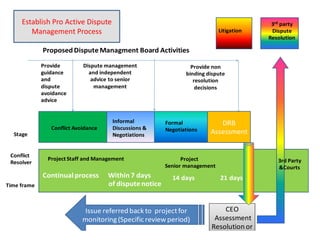
Establish Pro Active Dispute                                                          3rd party
        Management Process                                                   Litigation    Dispute
                                                                                          Resolution

             Proposed Dispute Managment Board Activities

             Provide        Dispute management                    Provide non
             guidance         and independent                   binding dispute
             and               advice to senior                    resolution
             dispute            management                          decisions
             avoidance
             advice


                                      Informal           Formal             DRB
                Conflict Avoidance    Discussions &      Negotiations
  Stage                               Negotiations                       Assessment


 Conflict
               Project Staff and Management                    Project                       3rd Party
 Resolver
                                                         Senior management                   &Courts
             Continual process       Within 7 days         14 days           21 days
Time frame                           of dispute notice


                            Issue referred back to project for               CEO
                            monitoring (Specific review period)           Assessment
                                                                         Resolution or
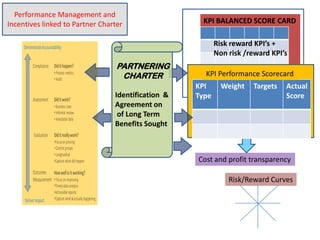
Performance Management and
Incentives linked to Partner Charter                                                 KPI BALANCED SCORE CARD


     Demonstrate Accountability
                                                                                          Risk reward KPI’s +
                                                                                          Non risk /reward KPI’s
           Compliance Did it happen?                            PARTNERING
                          • Process metrics                                          KPI Performance Scorecard
                          • Audit                                CHARTER
                                                                                   KPI      Weight   Targets   Actual
                                                                Identification &   Type                        Score
           Assessment     Did it work?
                          • Business case                       Agreement on
                          • Informal review                      of Long Term
                          • Anecdotal data
                                                                Benefits Sought
           Evaluation     Did it really work?
                          •Focus on proving
                          • Control groups
                          • Longitudinal
                          •Capture what did happen                                 Cost and profit transparency
           Outcomes How well is it working?
           Measurement • Focus on improving                                                   Risk/Reward Curves
                          •Timely data analysis
                          •Actionable reports
     Deliver impact       •Capture what is actually happening
Contracts that Incubate Project
Collaborations & Support integrated
            Team Work
• Flexible Outcome Focused PM/
  Acquisition Organisation
• Holistic System of Systems Approach
• Nuanced Benefits Driven Acquisition
  Strategy
• Effective Collaborations focused on
  return of long term Benefits.
Questions

B ackroyd

  • 1.
    Contracting for EffectiveCollaborations in Complex Projects -what the findings of the ICPM Taskforce Report mean for contracting in complex programs NASA PM CHALLENGE 2012 February 2012 Bretton Ackroyd COO ICCPM Email: coo@iccpm.com Phone: +61 406 420 642
  • 2.
    Introduction • Speaker –Bretton Ackroyd COO ICCPM • ICCPM – who we are • ICPM Taskforce Report – Overview • ICPM KD2 and ongoing Research Agenda
  • 3.
    Complicated vs. Complex A Working Definition Complicated – when you know what you have to do Complex – when you don’t
  • 4.
    Overview • Introduction • TheProblem • ICPM Taskforce Report findings • Key traits for delivering Complex Projects • Giving effect to the Report findings – Proposed Practical Contract and Organisational measures
  • 5.
    Summary • To deliverthe full benefits of complex projects and programs requires the capacity to engage in effective complex collaborations • Traditional forms of engagement and risk averse organisational cultures can often hinder or even prevent effective collaborations. • Research has identified some traits necessary for the development and realisation of Complex Projects. • To achieve best results organisations need to reflect, promote and support these “traits” through their practices policies and engagement agreements.
  • 6.
    Modern Complex ProjectsInvolve Complex Web of Commercial Connections
  • 7.
    The Problem: Traditional contractual/engagement approaches • Adversarial / Blame focused • Inappropriate risk allocation Contracts & Process • Lack of systemic view • Lack of effective change and conflict management Influence of Subject Matter Experts/ Dominant interest groups in Contract Formation. Short term focus • Short term focus of most SME’s and interest groups at contract formation • Incentivises game playing Dominance of Reactive Organisational Culture. • Adversarial, • Risk focused, Culture • Distrustful of others/change – not made here syndrome • Process driven/process controlled
  • 8.
    Problems: Traditional contractual/ engagement approaches Process Driven Adversarial Lack of Systemic view No future vision over regulated Blame focused Risk management?
  • 9.
    Dominance of ReactiveOrganisational Culture
  • 10.
    Vicious Cycle: Lackof trust/over regulated, policy driven engagements Vicious Cycle
  • 11.
    ICPM Taskforce Report Findings: •Competition needs to be selectively applied and targeted to provide effective outcomes and best benefit realisation. • Processes that facilitate early supplier/industry involvement essential for complex projects. • Contracts need to acknowledge and support the iterative & collaborative nature of effective risk management. • Contracts need to promote and support the growth of both strategic and tactical level collaboration. • Need to develop commercial advisors and related key subject matter experts that have the capacity to take a systemic view to contract formation and realising long term benefits benefits.
  • 12.
    Contractual and OrganisationalTraits Required to Maximise Benefits from Complex Projects? • Flexible outcome focused Organisation; Creation of entity with processes, people and leaders flexible enough to address complexity and evolve throughout life of the program • Portfolio of Interrelated Projects; Systemic approach look at the whole as well as the parts; addressing the entire supply chain and beyond. • Long Term Benefits Driven Contracting Strategies; nuanced, targeted and Informed by clear understanding of the benefits sought by Stakeholders.
  • 13.
    Flexible Outcome Focused Organisation • Flexibility essential to delivering effective solutions and realising total benefits. Must be nimble enough to address Unknown Unknowns. • Recognition of role as Steward/Champion of the capability being developed. • Processes and procedures that support collaborations and the focus on benefits realisation instead of risk transfer. • Leaders that develop and project the shadow of the future and have cognitive flexibility to manage emergence. • Transparent and efficient governance regimes that support achievement of benefits not hinder it.
  • 14.
    Portfolio of InterrelatedContracts • Systemic approach – look at the whole as well as the parts. Influencing the entire supply chain. • Manage as an integrated program rather than individual projects. • Active Identification and management of interrelationships to enhance overall benefits realisation. • Active promotion of cross portfolio knowledge sharing and collaboration.
  • 15.
    “Benefits Driven” Contracting Strategies • Multiple Contracting strategies applied to different components of capability – Nuanced, targeted and informed by clear understanding of the benefits sought by stakeholders. – Targeted use of competition as one of a range of approaches underpinning value, not as a weapon. • Recognition that the owner organisation (gov. or private) cannot walk away from the program and risk is shared not transferred. • Mechanisms for collaboratively managing unknown unknowns as they emerge. • Iterative implementation – opportunities to pause, learn and adapt.
  • 16.
    Implementing the Findings •Earlier industry involvement reduces risks increases likelihood of realising benefits. • Test commitment to collaborations through limited risk, Project incubator programs and ECI arrangements. • Develop and promote trust through being trusting. • Active management of conflict for best results. • Incentivise achievement of overall benefits over short term profit taking. • Secure appropriate rights upfront to minimise barriers to future collaborations. • Recognise that for some collaborations there is no such thing as an Off Ramp – manage for the long term.
  • 17.
    Two Limbs ofEffective Complex Project Agreements Clear Performance Baseline Collaborative Behaviours Clear Proactive and Supportive of understanding and Efficient Trust/Fluid of customer Conflict Human requirements Management Interaction Appropriate Performance Flexible & Proactive Empowered Management Cooperative Change Decision Measures Risk Management Management Making Integrated Systems of Delivery Team Systems role Incentives Cross for partner effective Teamwork Efficiency
  • 18.
    Develop and ApplySystems of Systems Contracting Strategy Customer Networks REGULATORS Suppliers REGULATORS Strategic Suppliers Strategic Suppliers Customer Networks Customer Networks Strategic Suppliers Suppliers
  • 19.
    Recognise Multiple Functions andAims of Complex Project Agreements Risk Management Managing Social Change Contract Complex Normalising Statement of Project Relationships Agreements Requirements
  • 20.
    Realistic, Balanced andCooperative Risk Management
  • 21.
    Establish Pro ActiveDispute 3rd party Management Process Litigation Dispute Resolution Proposed Dispute Managment Board Activities Provide Dispute management Provide non guidance and independent binding dispute and advice to senior resolution dispute management decisions avoidance advice Informal Formal DRB Conflict Avoidance Discussions & Negotiations Stage Negotiations Assessment Conflict Project Staff and Management Project 3rd Party Resolver Senior management &Courts Continual process Within 7 days 14 days 21 days Time frame of dispute notice Issue referred back to project for CEO monitoring (Specific review period) Assessment Resolution or
  • 22.
    Performance Management and Incentiveslinked to Partner Charter KPI BALANCED SCORE CARD Demonstrate Accountability Risk reward KPI’s + Non risk /reward KPI’s Compliance Did it happen? PARTNERING • Process metrics KPI Performance Scorecard • Audit CHARTER KPI Weight Targets Actual Identification & Type Score Assessment Did it work? • Business case Agreement on • Informal review of Long Term • Anecdotal data Benefits Sought Evaluation Did it really work? •Focus on proving • Control groups • Longitudinal •Capture what did happen Cost and profit transparency Outcomes How well is it working? Measurement • Focus on improving Risk/Reward Curves •Timely data analysis •Actionable reports Deliver impact •Capture what is actually happening
  • 23.
    Contracts that IncubateProject Collaborations & Support integrated Team Work
  • 24.
    • Flexible OutcomeFocused PM/ Acquisition Organisation • Holistic System of Systems Approach • Nuanced Benefits Driven Acquisition Strategy • Effective Collaborations focused on return of long term Benefits.
  • 25.

Editor's Notes

  • #12 The majority of complex mega projects are given effect to through some form of collaboration which in turn is undertaken via specific legal arrangements. Further complex projects tend to involve their own procurement processes or be subject to institutionalised procurement process of the sponsoring organisation . In this light a significant theme of the Complex Project Management Report has been investigations around collaboration and competition and the role of contracting and procurement processes.