Got Progress?


Three Key Elements for Successful Project Management

                    Norm Smith
                     SmithOps
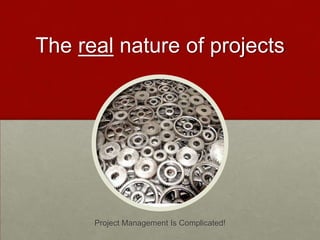
The real nature of projects


      Project Management Is Complicated!
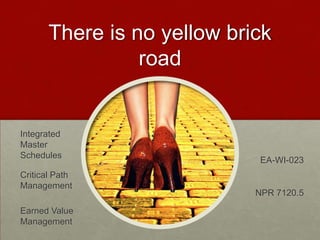
There is no yellow brick
                 road


Integrated
Master
Schedules
                              EA-WI-023
Critical Path
Management
                             NPR 7120.5

Earned Value
Management
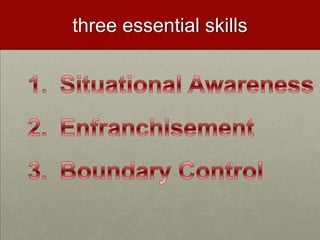
three essential skills
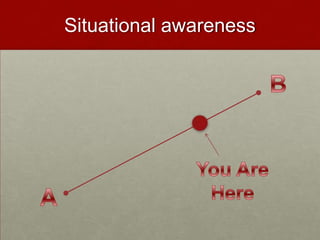
Situational awareness
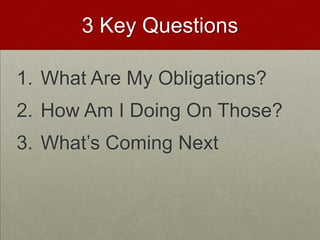
3 Key Questions

1. What Are My Obligations?
2. How Am I Doing On Those?
3. What’s Coming Next
Great DETAIL ≠ SUCCESS


   Polymer Mesh Under Scanning Electron Microscope
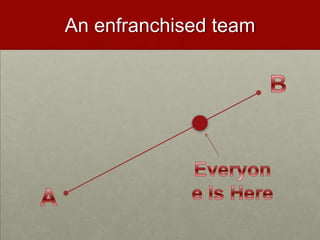
An enfranchised team
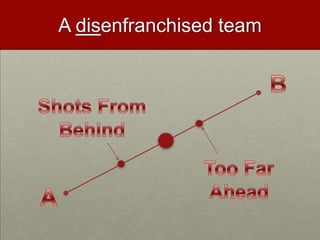
A disenfranchised team
SEE THE PEOPLE


 Read The Body Language
Boundary Control
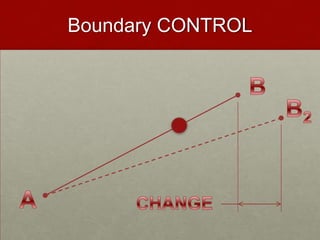
Boundary CONTROL
Learn to Say “NO” … With
          Style


    (Or When To Say “Yes”)
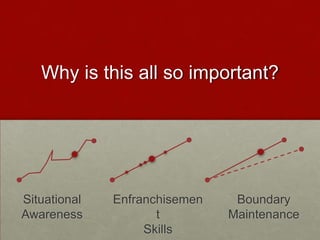
Why is this all so important?


Situational   Enfranchisemen    Boundary
Awareness            t         Maintenance
                   Skills
When Projects Fail?
When Projects Fail?


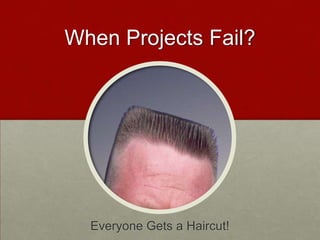
  Everyone Gets a Haircut!
When projects succeed ?


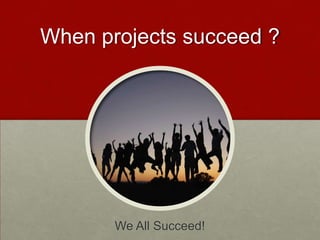
       We All Succeed!

Backup norm.smith

Editor's Notes

  • #2 Thank you. Glad to be here today.You know when I started as a young engineer – many years ago – I didn’t think I had what it took. I believed what the Dilbert cartoons said. I believed to be a project manager you had to be tall. I’m only 6’. I thought you had to be at least 6 foot 5. And I didn’t have a deep commanding voice. That’s it for me I thought. No hope. Thankfully what I found was those things don’t matter (much) to being a successful project manager. There are other much more important things that do matter. And that’s what we are going to talk about today. We are going to talk about progressmanagement. This is what happens after you start a project. If Point A is when you start and Point B is where you finish. We want to talk about how to make progress – how to be successful - in between those two points.1:40 Practice
  • #3 REAL nature of projects before we get started.Early idea was projects are like a group of meshed gears.Each gear was a part of the project.Job of PM was to get all gears to engage in the right way.Real nature of projects complicated that model … a lotIt’s not gears. IT’S PEOPLE.People are … complicated. Especially for technical types to understand.Engineers prefer gears. Equations.Each person brings skills/knowledge that add value and habits that detract.Good days and bad.Every day, every month new challenges. People are dynamic.2:00 Good
  • #4 This leads us to the conclusion …There is no yellow brick road. No single guide. Follow this and you’ll be OK.We’ve all been taught technical skills about project management that are pieces of the puzzle.When we started our consulting firm over 10 years it was to get tease out and understand the ESSENTIAL elements of project management.When I say ESSENTIAL I mean you can’t do without it.It’s not been easy. Frankly I thought one of these would be on the list.We’ve all been influenced by these. Good stuff here. Especially NPR 7120.5.Are Integrated Master Schedules ESSENTIAL? No.We see successful projects all the time without IMS’s. Some without a schedule at all. EVM? Ditto.2:30 Good
  • #5 So what’s ESSENTIAL. We’ve found 3 things – skills really – that all successful projects we’ve ever worked with, or have ever seen, have had.Have these and you’ll be successful. Don’t and you wont.Read them.These terms seem strange … you don’t read about them in project management text books. They sound more like something you’d hear from a psychologist talking about relationship theory.Guess what! We ARE talking about relationships. Projects are about people!Less of a foreign concept when you think of it that way.1:30
  • #6 Simply put … it’s knowing where you are.You and your teams position between Point A and B, between start and finish.Sounds simple but this get to be a problem even for small teams.Especially when teams are geographically dispersed. Perhaps at other centers.The bigger the team and more dispersed the more we find delays in reporting.Not by weeks but sometimes by a month or more.This means is decisions are being made here … based on data from back here.Big problems because we all know to make good decisions you need good data.We find this is the No. 1 reason projects run into problems.Your project will run into the ditch before you know it.Someone else may know it. But you – the manager – won’t.I want you to be the first to know when that happens.Then you can be the first to do something about it.
  • #7 Only three questions to answer.Same for every levels: team, manager, bosses.Read them …Use whatever tool you want to get these answers down on paper.Excel. MS Project. Primavera.Be warned. No push the button solutions here.Takes people and process. More important than software.Consistently show good answers here and your job gets easier.People are doing what you want.Less “help” from your own management when you have these answers.Primary reason for getting too much “help” is because you have these answered ..2:30
  • #8 A word of caution. Don’t go too far.Electron microscope image. Beautiful detail.We don’t need that kind of detail for the right level of situational awareness.Too much detail actually hurts.First… It bogs down your process, your people, and your progress.Understand this is counter-intuitiveWe KNOW people can create very detailed schedules … at the start.However, we routinely see teams stumble trying to MAINTAIN too much detail …AND keep up with the battle rhythm of the project.The reason is … CHANGE. You know change is going to happen.All that detail, all those links and constraints have to be changed too.Huge burden. Costly in terms of man-hours.Start with an idea of how much detail you/team can MAINTAIN. Hold the line.Second … Intricately detailed schedules are almost impossible to read.Sometimes not even the people who built it can follow it (warning sign).If your team can’t read it. They aren’t following it. Might as well not have it.Conclusion. Projects overburdened by too much detail. It’s like a disease.See it happen all the time. Not just at NASA.One message that you walk away with today. Don’t go too deep in your schedules. Less is more.2:30
  • #9 What is enfranchisement?It’s having EVERYONE on board with your plan.At the same point between A and B.Certification in the formal definition. Everyone agrees – that’s where are.Strive for this. It’s hard to maintain.Here today. Gone tomorrow without constant vigilance.This subject is so important I dedicate 3 chapters in the book to it.It involves such page turner subjects as …Holding people accountable without micromanaging.Working with difficult people. We all experience that.These things effect, positively or negatively, enfranchisement.2:00
  • #10 This is what happens when things go wrong. A disenfranchised team. We have gaps.In the back. Someone left behind– or – don’t agree with where you are going.They drag on your progress. Fire shots at you from behind. Wastes energy.It’s hard enough defending up front.Make the effort to bring them in. Meet with them. Listen to them.Give them opportunities to re-engage. Perhaps there’s good reason.If they can’t join, remove them. I said can’t because some people/groups just can’t keep up. I recently had to let an engineering firm go. The weren’t a good fit for the type of work we were doing and wouldn’t make the effort to keep up.Painful but worth it.Opposite problem. Too far ahead.What happens here is decisions are being made for the team without the team.Resentment builds as the team has to clean up the mess created by those ahead.Reel them in – or - diffuse this person’s authorityto make binding decisions.This is internal team dynamics. What about customers? Same thing applies.Equally important to keep customers/stakeholders enfranchised.Conclusion. Some PM’s resent the need … having to spend energy to do this.Big deal. Lack … is the REAL reason we find projects get cancelled.At the core it’s not so much the technical reasons, disenfranchised stakeholders.3:40
  • #11 How do you spot disenfranchised people?You have to be able to see them and hear them.You have to look and listen. And be sensitive to the messages being sent.What’s the message here? I’m not buying it.Say to this person, “Stacy, Is there something here that doesn’t sound right to you?”Your job as PM is to tease out the disenfranchisement.Bring it out in the open. Let them have a voice. Just being heard can re-enfranchise people.Email is the least effective way to work with disenfrachised people. Why? So few cues. So many opportunities to misread intentions.You have to see the people – second best hear the people (by conference calls) - to connect the people on your project.
  • #12 The last essential skill for successful projects is boundary control.What does that mean?It means being accountable for your commitments – no more, no less.Commitments are spelled out in your contract, your requirements, your project plan.You job is to live up to those commitments.However! Every project faces changes. It’s a given.HOW you respond to change is the key here.First, where do changes come from?Customers of course. Sometimes distinct change orders. Or slow and subtle.Requirements creep.Where else? We often find just as many changes originate from within the team.Internal sources. Better is the enemy here. Most people like better … or even better than better they like best!It takes disciplined boundary control skills as a project manager to say “no, what we have is good enough, it meets our requirements, and we don’t have budget for anything more.”1:30
  • #13 Graphically. This is what change look like.Changes move the end-point.More distance. More cost. More time.THIS IS ONE OF THE BIGGEST AREAS WE SEE PROJECTS LOOSE MONEY.-> Agreeing to changes without fair and reasonable compensation.It’s just smart project management to give changes a close look. Requirements creep. Favors. We all want customer to be happy.If we give the customers everything they want, we’ll go broke.We’ll both be unhappy then.
  • #14 That’s why we need to learn to say “NO” … with STYLE.No one likes to hear the word NO. Least of all our customers.It’s offensive. Makes customers mad. Poisons relationships. You need those …Never, ever blurt out “That’s not a requirement” … even though it may be true.Some guidelines on how to say “No” … with style:Never say “No” on the spot. Hard for engineers.Repeat the request. “Just to be clear, you want us to look at adding …”Bring it home to discuss.Give it a fair shake.When you return. Walk them through what you found.Understand – Found – Feel this is not a good idea – Instead we recommendLeave your customers feeling you’ve heard themGivetheir request fair consideration. This only shows respect to your customer.You’ll find that what you might have said “No” to offhand can be modified into a “Yes” situation. That’s even better. Of course additional scope = additional budget.Formal change process a good idea. Even for small projects.It captures all of thison paper.2:05
  • #15 Here they are again. All 3 ESSENTIAL skills for successful projects.Now to wrap this up. Why is all this so important?Think about all the projects happening right now at this Center, community, Houston.Think how much economic activity is engaged in projects. It’s measured in BILLIONS.Think how much the success of your career, your center, and community is LINKED to those projects and their successful completion. 1:00
  • #17 Everyone gets a haircut!Most of us wouldn’t enjoy this haircut.People get re-assigned. Careers are diverted.Budgets get pulled.Real economic value is lost.Relationships damaged.Our credibility takes a hit <- Hardest of all to repair0:45
  • #18 What happens when projects succeed?It’s all good!!!Our mission. Our careers. Our credibility.Think of the delta between failure and success?What would be the value of that? $100k per project, $1M … often times even more.With multiple projects it really adds up.With success comes VALUE. Very important for future business and careers.We can do this!!!Thank you.