Confidence Level Estimating and Budgeting


             February 2011

              Tom Coonce
Topics

• A brief review of confidence level
  estimating, budget-setting policy and
  rationale
• Status of program and project Joint
  Cost and Schedule Confidence Level
  (JCL) calculations
• JCL issues and lessons learned
• Actions completed or planned to
  address lessons learned
                                          2
Recap of JCL Policy and Rationale
•   NPD 1000.5
    – Programs are to be baselined at a 70% joint confidence level
    – Projects are to be baselined/budgeted at JCL that supports
      the program approved JCL
    – Projects are to be funded at no less than a 50% JCL
    – JCLs are to be developed and maintained through launch
    – Program and project proposed cost and schedule baselines
      will be assessed by an independent review team
• Policy Rationale
    –   Improve cost and schedule performance
    –   Improve expectations with stakeholders
    –   Improve project planning
    –   Improve understanding of project plans
                                                                     3
JCL – Defined by a Product, Refers to a
                       Process
•   JCL = Joint Confidence Level
     – Identifies probability that a given project or
       program’s cost will be equal or less then
       the targeted cost AND the schedule will be
       equal or less then the targeted schedule
       date
     – Per NPD 1000.5 used at KDP-C to set
       Program/Project Budget Baseline


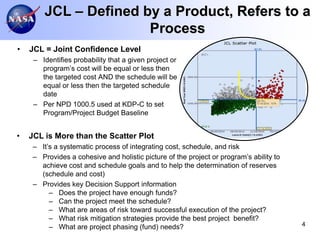
•   JCL is More than the Scatter Plot
     – It’s a systematic process of integrating cost, schedule, and risk
     – Provides a cohesive and holistic picture of the project or program’s ability to
       achieve cost and schedule goals and to help the determination of reserves
       (schedule and cost)
     – Provides key Decision Support information
          – Does the project have enough funds?
          – Can the project meet the schedule?
          – What are areas of risk toward successful execution of the project?
          – What risk mitigation strategies provide the best project benefit?
          – What are project phasing (fund) needs?                                       4
Acceptable JCL Methods
• Resource-Loaded Schedule with Monte-Carlo simulation, with
  three different techniques
   – Bottoms-up Resource Loaded Schedule or BURLS technique is
     based on resource or cost-loaded schedule that focuses on the
     project risk lists (known-known risks) and uncertainties (known and
     unknown unknowns) to set the cost and schedule possibilities
   – Cost Estimate/Program Assessment (CEPA) technique is based on
     a top-level resource or cost loaded schedule that focuses on project
     performance as well as project risks to set cost and schedule
     possibilities
   – Project Risk Evaluation Process or PREP technique is based on
     the projects’ top-level resource or cost loaded schedule that
     focuses on the project’s risk list as well as the views of an
     Independent panel of experts to set cost and schedule possibilities
• Parametric
   – Uses cost and schedule estimating relationships, data dispersion,
     and relationships between cost and schedule to determine the
     overall cost and schedule target and associated JCL                    5
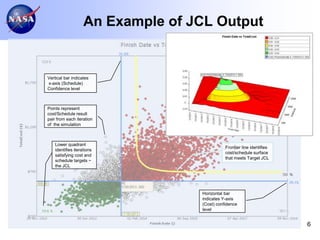
An Example of JCL Output


Vertical bar indicates
x-axis (Schedule)
Confidence level


Points represent
cost/Schedule result
pair from each iteration
of the simulation


    Lower quadrant
                                              Frontier line identifies
    identifies iterations
                                              cost/schedule surface
    satisfying cost and
                                              that meets Target JCL
    schedule targets ~
    the JCL


                                   Horizontal bar
                                   indicates Y-axis
                                   (Cost) confidence
                                   level


                                                                         6
Management Councils Revisions the
             Policies and Expectations
•   Eliminated the requirement at KDP-B and D, but stipulated that KDP-Cs
    JCL must be based on probabilistic resource loaded schedules (May
    2009 SMC)
     –   Directed pilot projects be completed for projects at KDP-B
•   Eliminated the requirement to maintain the JCL during implementation
    (November 2009 PMC)
     – Project are not required to develop a JCL at any other time during
       implementation if it is “on plan”
     – Projects are to be monitored as part of the Baseline Performance Review
       (BPR) process
     – If a project is re-baselined, scored red in the BPR, or if BPR leadership
       directs, it must re-compute a JCL
     – The agency is to use existing metrics and/or establish new factors for
       determining when a project turns Red
•   Eliminated JCL requirement for loosely coupled programs, retained the
    requirement for tightly coupled programs, and required MDs to submit
    program impact assessment whenever a new project enters the program
    (June 2010 PMC)
     –   Eliminate JCL language from NPD 1000.5; reconstitute and update in NPD 7120.5E   7
Management Councils Revisions the
  Policies and Expectations (Continued)

• Include cost and schedule range
  estimates and associated probabilities
  for all projects at KDP-B with LCC
  >$250M (June and Aug 2010 PMCs)
  – Coordinate policy language and place into
    7120.5E
• Projects must develop, explain and
  defend plans and associated probability
  calculations at KDP-B and C (June
  2010 PMC)
                                                8
Final Proposed 7120.5E Language
           (After the 4 August 2010 PMC)
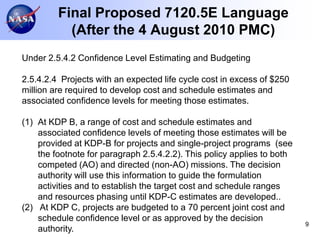
Under 2.5.4.2 Confidence Level Estimating and Budgeting

2.5.4.2.4 Projects with an expected life cycle cost in excess of $250
million are required to develop cost and schedule estimates and
associated confidence levels for meeting those estimates.

(1) At KDP B, a range of cost and schedule estimates and
    associated confidence levels of meeting those estimates will be
    provided at KDP-B for projects and single-project programs (see
    the footnote for paragraph 2.5.4.2.2). This policy applies to both
    competed (AO) and directed (non-AO) missions. The decision
    authority will use this information to guide the formulation
    activities and to establish the target cost and schedule ranges
    and resources phasing until KDP-C estimates are developed..
(2) At KDP C, projects are budgeted to a 70 percent joint cost and
    schedule confidence level or as approved by the decision
                                                                         9
    authority.
So, What is Required to Meet the
    KDP-B Programmatic Requirements?
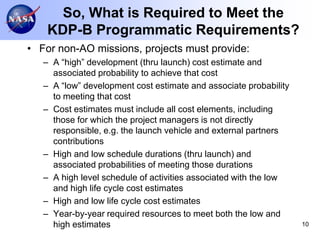
• For non-AO missions, projects must provide:
   – A “high” development (thru launch) cost estimate and
     associated probability to achieve that cost
   – A “low” development cost estimate and associate probability
     to meeting that cost
   – Cost estimates must include all cost elements, including
     those for which the project managers is not directly
     responsible, e.g. the launch vehicle and external partners
     contributions
   – High and low schedule durations (thru launch) and
     associated probabilities of meeting those durations
   – A high level schedule of activities associated with the low
     and high life cycle cost estimates
   – High and low life cycle cost estimates
   – Year-by-year required resources to meet both the low and
     high estimates                                                10
Programmatic Expectations at KDP-B
      Non-AO Missions (Concluded)
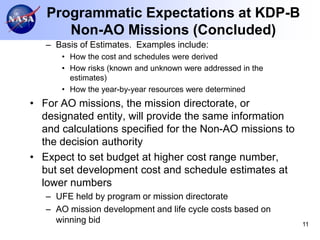
   – Basis of Estimates. Examples include:
      • How the cost and schedules were derived
      • How risks (known and unknown were addressed in the
        estimates)
      • How the year-by-year resources were determined
• For AO missions, the mission directorate, or
  designated entity, will provide the same information
  and calculations specified for the Non-AO missions to
  the decision authority
• Expect to set budget at higher cost range number,
  but set development cost and schedule estimates at
  lower numbers
   – UFE held by program or mission directorate
   – AO mission development and life cycle costs based on
     winning bid                                             11
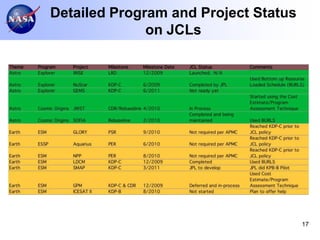
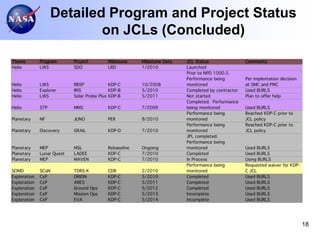
Status of Program and Project JCLs

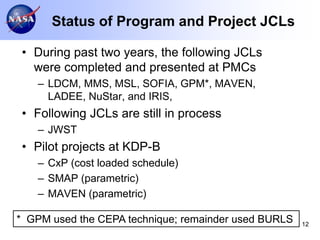
• During past two years, the following JCLs
  were completed and presented at PMCs
   – LDCM, MMS, MSL, SOFIA, GPM*, MAVEN,
     LADEE, NuStar, and IRIS,
• Following JCLs are still in process
   – JWST
• Pilot projects at KDP-B
   – CxP (cost loaded schedule)
   – SMAP (parametric)
   – MAVEN (parametric)

* GPM used the CEPA technique; remainder used BURLS   12
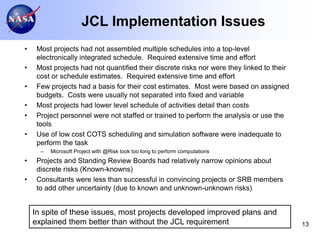
JCL Implementation Issues
•    Most projects had not assembled multiple schedules into a top-level
     electronically integrated schedule. Required extensive time and effort
•    Most projects had not quantified their discrete risks nor were they linked to their
     cost or schedule estimates. Required extensive time and effort
•    Few projects had a basis for their cost estimates. Most were based on assigned
     budgets. Costs were usually not separated into fixed and variable
•    Most projects had lower level schedule of activities detail than costs
•    Project personnel were not staffed or trained to perform the analysis or use the
     tools
•    Use of low cost COTS scheduling and simulation software were inadequate to
     perform the task
      –   Microsoft Project with @Risk took too long to perform computations
•    Projects and Standing Review Boards had relatively narrow opinions about
     discrete risks (Known-knowns)
•    Consultants were less than successful in convincing projects or SRB members
     to add other uncertainty (due to known and unknown-unknown risks)


    In spite of these issues, most projects developed improved plans and
    explained them better than without the JCL requirement                                 13
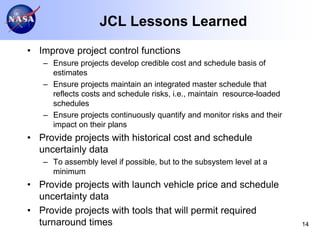
JCL Lessons Learned
• Improve project control functions
   – Ensure projects develop credible cost and schedule basis of
     estimates
   – Ensure projects maintain an integrated master schedule that
     reflects costs and schedule risks, i.e., maintain resource-loaded
     schedules
   – Ensure projects continuously quantify and monitor risks and their
     impact on their plans
• Provide projects with historical cost and schedule
  uncertainly data
   – To assembly level if possible, but to the subsystem level at a
     minimum
• Provide projects with launch vehicle price and schedule
  uncertainty data
• Provide projects with tools that will permit required
  turnaround times                                                       14
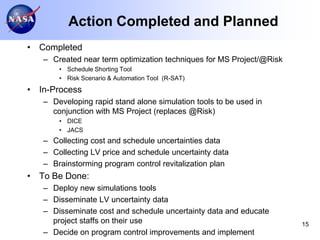
Action Completed and Planned
• Completed
   – Created near term optimization techniques for MS Project/@Risk
       • Schedule Shorting Tool
       • Risk Scenario & Automation Tool (R-SAT)
• In-Process
   – Developing rapid stand alone simulation tools to be used in
     conjunction with MS Project (replaces @Risk)
       • DICE
       • JACS
   – Collecting cost and schedule uncertainties data
   – Collecting LV price and schedule uncertainty data
   – Brainstorming program control revitalization plan
• To Be Done:
   – Deploy new simulations tools
   – Disseminate LV uncertainty data
   – Disseminate cost and schedule uncertainty data and educate
     project staffs on their use                                      15
   – Decide on program control improvements and implement
Backup
Detailed Program and Project Status
              on JCLs


                                      17
Detailed Program and Project Status
        on JCLs (Concluded)


                                      18

Coonce.tom

  • 1.
    Confidence Level Estimatingand Budgeting February 2011 Tom Coonce
  • 2.
    Topics • A briefreview of confidence level estimating, budget-setting policy and rationale • Status of program and project Joint Cost and Schedule Confidence Level (JCL) calculations • JCL issues and lessons learned • Actions completed or planned to address lessons learned 2
  • 3.
    Recap of JCLPolicy and Rationale • NPD 1000.5 – Programs are to be baselined at a 70% joint confidence level – Projects are to be baselined/budgeted at JCL that supports the program approved JCL – Projects are to be funded at no less than a 50% JCL – JCLs are to be developed and maintained through launch – Program and project proposed cost and schedule baselines will be assessed by an independent review team • Policy Rationale – Improve cost and schedule performance – Improve expectations with stakeholders – Improve project planning – Improve understanding of project plans 3
  • 4.
    JCL – Definedby a Product, Refers to a Process • JCL = Joint Confidence Level – Identifies probability that a given project or program’s cost will be equal or less then the targeted cost AND the schedule will be equal or less then the targeted schedule date – Per NPD 1000.5 used at KDP-C to set Program/Project Budget Baseline • JCL is More than the Scatter Plot – It’s a systematic process of integrating cost, schedule, and risk – Provides a cohesive and holistic picture of the project or program’s ability to achieve cost and schedule goals and to help the determination of reserves (schedule and cost) – Provides key Decision Support information – Does the project have enough funds? – Can the project meet the schedule? – What are areas of risk toward successful execution of the project? – What risk mitigation strategies provide the best project benefit? – What are project phasing (fund) needs? 4
  • 5.
    Acceptable JCL Methods •Resource-Loaded Schedule with Monte-Carlo simulation, with three different techniques – Bottoms-up Resource Loaded Schedule or BURLS technique is based on resource or cost-loaded schedule that focuses on the project risk lists (known-known risks) and uncertainties (known and unknown unknowns) to set the cost and schedule possibilities – Cost Estimate/Program Assessment (CEPA) technique is based on a top-level resource or cost loaded schedule that focuses on project performance as well as project risks to set cost and schedule possibilities – Project Risk Evaluation Process or PREP technique is based on the projects’ top-level resource or cost loaded schedule that focuses on the project’s risk list as well as the views of an Independent panel of experts to set cost and schedule possibilities • Parametric – Uses cost and schedule estimating relationships, data dispersion, and relationships between cost and schedule to determine the overall cost and schedule target and associated JCL 5
  • 6.
    An Example ofJCL Output Vertical bar indicates x-axis (Schedule) Confidence level Points represent cost/Schedule result pair from each iteration of the simulation Lower quadrant Frontier line identifies identifies iterations cost/schedule surface satisfying cost and that meets Target JCL schedule targets ~ the JCL Horizontal bar indicates Y-axis (Cost) confidence level 6
  • 7.
    Management Councils Revisionsthe Policies and Expectations • Eliminated the requirement at KDP-B and D, but stipulated that KDP-Cs JCL must be based on probabilistic resource loaded schedules (May 2009 SMC) – Directed pilot projects be completed for projects at KDP-B • Eliminated the requirement to maintain the JCL during implementation (November 2009 PMC) – Project are not required to develop a JCL at any other time during implementation if it is “on plan” – Projects are to be monitored as part of the Baseline Performance Review (BPR) process – If a project is re-baselined, scored red in the BPR, or if BPR leadership directs, it must re-compute a JCL – The agency is to use existing metrics and/or establish new factors for determining when a project turns Red • Eliminated JCL requirement for loosely coupled programs, retained the requirement for tightly coupled programs, and required MDs to submit program impact assessment whenever a new project enters the program (June 2010 PMC) – Eliminate JCL language from NPD 1000.5; reconstitute and update in NPD 7120.5E 7
  • 8.
    Management Councils Revisionsthe Policies and Expectations (Continued) • Include cost and schedule range estimates and associated probabilities for all projects at KDP-B with LCC >$250M (June and Aug 2010 PMCs) – Coordinate policy language and place into 7120.5E • Projects must develop, explain and defend plans and associated probability calculations at KDP-B and C (June 2010 PMC) 8
  • 9.
    Final Proposed 7120.5ELanguage (After the 4 August 2010 PMC) Under 2.5.4.2 Confidence Level Estimating and Budgeting 2.5.4.2.4 Projects with an expected life cycle cost in excess of $250 million are required to develop cost and schedule estimates and associated confidence levels for meeting those estimates. (1) At KDP B, a range of cost and schedule estimates and associated confidence levels of meeting those estimates will be provided at KDP-B for projects and single-project programs (see the footnote for paragraph 2.5.4.2.2). This policy applies to both competed (AO) and directed (non-AO) missions. The decision authority will use this information to guide the formulation activities and to establish the target cost and schedule ranges and resources phasing until KDP-C estimates are developed.. (2) At KDP C, projects are budgeted to a 70 percent joint cost and schedule confidence level or as approved by the decision 9 authority.
  • 10.
    So, What isRequired to Meet the KDP-B Programmatic Requirements? • For non-AO missions, projects must provide: – A “high” development (thru launch) cost estimate and associated probability to achieve that cost – A “low” development cost estimate and associate probability to meeting that cost – Cost estimates must include all cost elements, including those for which the project managers is not directly responsible, e.g. the launch vehicle and external partners contributions – High and low schedule durations (thru launch) and associated probabilities of meeting those durations – A high level schedule of activities associated with the low and high life cycle cost estimates – High and low life cycle cost estimates – Year-by-year required resources to meet both the low and high estimates 10
  • 11.
    Programmatic Expectations atKDP-B Non-AO Missions (Concluded) – Basis of Estimates. Examples include: • How the cost and schedules were derived • How risks (known and unknown were addressed in the estimates) • How the year-by-year resources were determined • For AO missions, the mission directorate, or designated entity, will provide the same information and calculations specified for the Non-AO missions to the decision authority • Expect to set budget at higher cost range number, but set development cost and schedule estimates at lower numbers – UFE held by program or mission directorate – AO mission development and life cycle costs based on winning bid 11
  • 12.
    Status of Programand Project JCLs • During past two years, the following JCLs were completed and presented at PMCs – LDCM, MMS, MSL, SOFIA, GPM*, MAVEN, LADEE, NuStar, and IRIS, • Following JCLs are still in process – JWST • Pilot projects at KDP-B – CxP (cost loaded schedule) – SMAP (parametric) – MAVEN (parametric) * GPM used the CEPA technique; remainder used BURLS 12
  • 13.
    JCL Implementation Issues • Most projects had not assembled multiple schedules into a top-level electronically integrated schedule. Required extensive time and effort • Most projects had not quantified their discrete risks nor were they linked to their cost or schedule estimates. Required extensive time and effort • Few projects had a basis for their cost estimates. Most were based on assigned budgets. Costs were usually not separated into fixed and variable • Most projects had lower level schedule of activities detail than costs • Project personnel were not staffed or trained to perform the analysis or use the tools • Use of low cost COTS scheduling and simulation software were inadequate to perform the task – Microsoft Project with @Risk took too long to perform computations • Projects and Standing Review Boards had relatively narrow opinions about discrete risks (Known-knowns) • Consultants were less than successful in convincing projects or SRB members to add other uncertainty (due to known and unknown-unknown risks) In spite of these issues, most projects developed improved plans and explained them better than without the JCL requirement 13
  • 14.
    JCL Lessons Learned •Improve project control functions – Ensure projects develop credible cost and schedule basis of estimates – Ensure projects maintain an integrated master schedule that reflects costs and schedule risks, i.e., maintain resource-loaded schedules – Ensure projects continuously quantify and monitor risks and their impact on their plans • Provide projects with historical cost and schedule uncertainly data – To assembly level if possible, but to the subsystem level at a minimum • Provide projects with launch vehicle price and schedule uncertainty data • Provide projects with tools that will permit required turnaround times 14
  • 15.
    Action Completed andPlanned • Completed – Created near term optimization techniques for MS Project/@Risk • Schedule Shorting Tool • Risk Scenario & Automation Tool (R-SAT) • In-Process – Developing rapid stand alone simulation tools to be used in conjunction with MS Project (replaces @Risk) • DICE • JACS – Collecting cost and schedule uncertainties data – Collecting LV price and schedule uncertainty data – Brainstorming program control revitalization plan • To Be Done: – Deploy new simulations tools – Disseminate LV uncertainty data – Disseminate cost and schedule uncertainty data and educate project staffs on their use 15 – Decide on program control improvements and implement
  • 16.
  • 17.
    Detailed Program andProject Status on JCLs 17
  • 18.
    Detailed Program andProject Status on JCLs (Concluded) 18