Benefits Management
The Process
Overview

•   The following slide pack details the Benefits Management
    Process from start to finish
•   It is broken down into four work streams:
        1. Identifying and Structuring
        2. Planning for Benefits
        3. General Management
        4. Evaluation
•   Current thinking from the OGC is incorporated to assist with
    implementing best practice
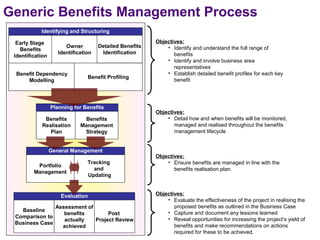
Generic Benefits Management Process
            Identifying and Structuring

  Early Stage                                             Objectives:
                        Owner         Detailed Benefits       • Identify and understand the full range of
   Benefits
                     Identification    Identification            benefits
 Identification
                                                              • Identify and involve business area
                                                                 representatives
 Benefit Dependency                                           • Establish detailed benefit profiles for each key
                                 Benefit Profiling
     Modelling                                                   benefit


                  Planning for Benefits
                                                          Objectives:
             Benefits          Benefits                       • Detail how and when benefits will be monitored,
            Realisation       Management                         managed and realised throughout the benefits
               Plan            Strategy                          management lifecycle


                  General Management
                                                          Objectives:
                                 Tracking                     • Ensure benefits are managed in line with the
          Portfolio
                                   and                           benefits realisation plan.
         Management
                                 Updating


                      Evaluation                          Objectives:
                                                              • Evaluate the effectiveness of the project in realising the
                    Assessment of                                proposed benefits as outlined in the Business Case
   Baseline                                                   • Capture and document any lessons learned
                       benefits        Post
 Comparison to                                                • Reveal opportunities for increasing the project’s yield of
                       actually   Project Review
 Business Case
                      achieved                                   benefits and make recommendations on actions
                                                                 required for these to be achieved.
Identifying and Structuring   Planning for Benefits   General Management   Evaluation


      Identifying and Structuring
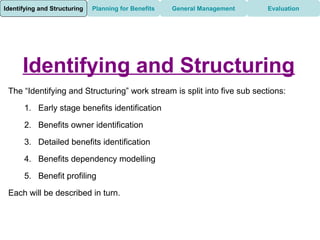
 The “Identifying and Structuring” work stream is split into five sub sections:

      1. Early stage benefits identification

      2. Benefits owner identification

      3. Detailed benefits identification

      4. Benefits dependency modelling

      5. Benefit profiling

 Each will be described in turn.
Identifying and Structuring   Planning for Benefits           General Management                        Evaluation


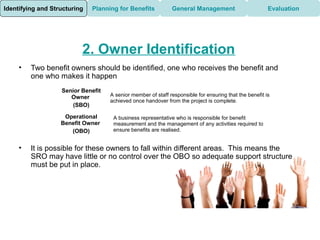
                          2. Owner Identification
     •   Two benefit owners should be identified, one who receives the benefit and
         one who makes it happen
                   Senior Benefit
                      Owner         A senior member of staff responsible for ensuring that the benefit is
                                    achieved once handover from the project is complete.
                       (SBO)

                    Operational      A business representative who is responsible for benefit
                   Benefit Owner     measurement and the management of any activities required to
                      (OBO)          ensure benefits are realised.


     •   It is possible for these owners to fall within different areas. This means the
         SRO may have little or no control over the OBO so adequate support structure
         must be put in place.
Identifying and Structuring   Planning for Benefits   General Management   Evaluation


           1. Early Stage Benefits Identification
 • Gather all stakeholders to agree on the high
   level benefits of a project.
 • Must consider “dis-benefits” as well.

 • Discussion should be kept at a reasonably high
   level as benefit identification will take place at a
   later stage.
 • Clarifies the underlying reason for the
   investment.
Identifying and Structuring    Planning for Benefits     General Management          Evaluation


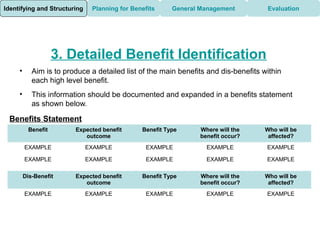
                    3. Detailed Benefit Identification
     •      Aim is to produce a detailed list of the main benefits and dis-benefits within
            each high level benefit.
     •      This information should be documented and expanded in a benefits statement
            as shown below.

 Benefits Statement
          Benefit        Expected benefit      Benefit Type      Where will the     Who will be
                            outcome                              benefit occur?      affected?
         EXAMPLE              EXAMPLE            EXAMPLE           EXAMPLE           EXAMPLE

         EXAMPLE              EXAMPLE            EXAMPLE           EXAMPLE           EXAMPLE

         Dis-Benefit     Expected benefit      Benefit Type      Where will the     Who will be
                            outcome                              benefit occur?      affected?
         EXAMPLE              EXAMPLE            EXAMPLE           EXAMPLE           EXAMPLE
Identifying and Structuring   Planning for Benefits   General Management   Evaluation


              4. Benefit Dependency Modelling
 •    The aim of this section is to document the
      relationships between different benefits

 •    Additional benefits and/or dis-benefits my occur
      and should also be formally captured

 •    Project outputs (enablers) should be linked to the
      benefits they generate

 •    This information can be represented in a benefits
      model as shown on the next slide
Identifying and Structuring   Planning for Benefits   General Management   Evaluation


              4. Benefit Dependency Modelling
Identifying and Structuring    Planning for Benefits         General Management              Evaluation


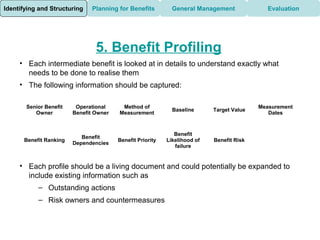
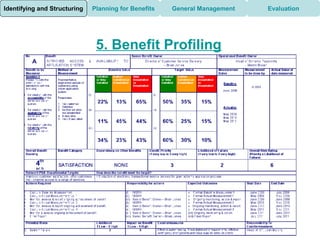
                                5. Benefit Profiling
     • Each intermediate benefit is looked at in details to understand exactly what
       needs to be done to realise them
     • The following information should be captured:

       Senior Benefit    Operational     Method of                                        Measurement
                                                             Baseline      Target Value
          Owner         Benefit Owner   Measurement                                          Dates


                                                              Benefit
                           Benefit
      Benefit Ranking                   Benefit Priority   Likelihood of   Benefit Risk
                        Dependencies
                                                              failure


     • Each profile should be a living document and could potentially be expanded to
       include existing information such as
           – Outstanding actions
           – Risk owners and countermeasures
Identifying and Structuring   Planning for Benefits   General Management   Evaluation


                               5. Benefit Profiling
Identifying and Structuring   Planning for Benefits   General Management   Evaluation


                Planning for Benefits
 The “Planning for Benefits” work stream is split into two sub sections:

       1. Benefits Realisation Plan

       2. Benefits Management Strategy
Identifying and Structuring   Planning for Benefits   General Management   Evaluation


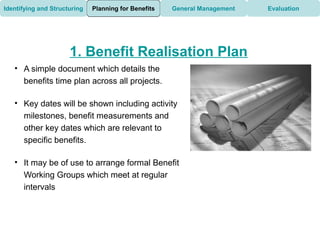
                      1. Benefit Realisation Plan
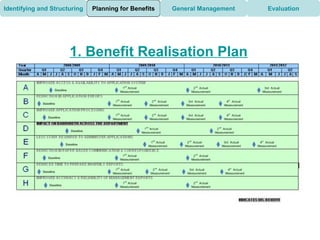
   • A simple document which details the
     benefits time plan across all projects.

   • Key dates will be shown including activity
     milestones, benefit measurements and
     other key dates which are relevant to
     specific benefits.

   • It may be of use to arrange formal Benefit
     Working Groups which meet at regular
     intervals
Identifying and Structuring   Planning for Benefits   General Management   Evaluation


                      1. Benefit Realisation Plan
Identifying and Structuring   Planning for Benefits   General Management   Evaluation


               2. Benefit Management Strategy
 • A document designed to encompass all the
   information and rationalle leading up to this point
 • It should include
       – Summary of benefits
       – Description of roles, functions and
         responsibilities for benefits planning and
         realisation
       – All the benefits statement
       – Benefit dependency nmodel
       – Benefit profile for each benefit
       – Benefit realisation plan
       – Details of how and when a Post Project
         Review (PPR) will be completed.
Identifying and Structuring   Planning for Benefits   General Management   Evaluation


                General Management
 This work stream focusses on the day to management of the benefits
 plan. The following slides give a general overview of what should be
 done but the reality will be heavily dependent on the individual
 organisation. The two management areas are as follows:

                1. Portfolio Management

                2. Tracking and Updating
Identifying and Structuring    Planning for Benefits     General Management             Evaluation


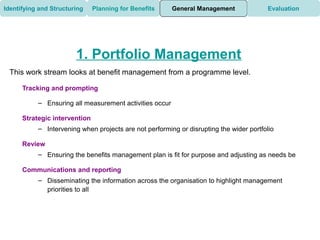
                        1. Portfolio Management
 This work stream looks at benefit management from a programme level.

      Tracking and prompting

           – Ensuring all measurement activities occur

      Strategic intervention
           – Intervening when projects are not performing or disrupting the wider portfolio

      Review
           – Ensuring the benefits management plan is fit for purpose and adjusting as needs be

      Communications and reporting
           – Disseminating the information across the organisation to highlight management
             priorities to all
Identifying and Structuring   Planning for Benefits       General Management               Evaluation


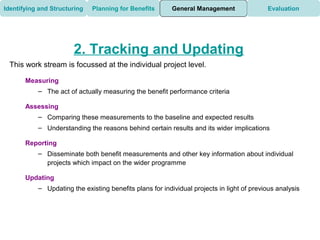
                       2. Tracking and Updating
 This work stream is focussed at the individual project level.

       Measuring
           – The act of actually measuring the benefit performance criteria

       Assessing
           – Comparing these measurements to the baseline and expected results
           – Understanding the reasons behind certain results and its wider implications

       Reporting
           – Disseminate both benefit measurements and other key information about individual
             projects which impact on the wider programme

       Updating
           – Updating the existing benefits plans for individual projects in light of previous analysis
Identifying and Structuring   Planning for Benefits   General Management         Evaluation


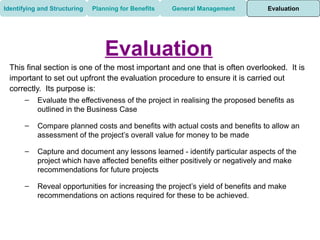
                                  Evaluation
 This final section is one of the most important and one that is often overlooked. It is
 important to set out upfront the evaluation procedure to ensure it is carried out
 correctly. Its purpose is:
       –   Evaluate the effectiveness of the project in realising the proposed benefits as
           outlined in the Business Case

       –   Compare planned costs and benefits with actual costs and benefits to allow an
           assessment of the project’s overall value for money to be made

       –   Capture and document any lessons learned - identify particular aspects of the
           project which have affected benefits either positively or negatively and make
           recommendations for future projects

       –   Reveal opportunities for increasing the project’s yield of benefits and make
           recommendations on actions required for these to be achieved.
Summary
•   The Benefits Management Process is broken down into four work
    streams:
        1. Identifying and Structuring
        2. Planning for Benefits
        3. General Management
        4. Evaluation
•   Work streams 3 and 4 will be heavily dependent on the individual
    organisation
•   All information shown within this slide pack is merely guidelines and
    suggestions of best practice
•   A clear and logical approach to Benefits Management will increase its
    likelihood of successful implementation

Benefits management process issue 1.0

  • 1.
  • 2.
    Overview • The following slide pack details the Benefits Management Process from start to finish • It is broken down into four work streams: 1. Identifying and Structuring 2. Planning for Benefits 3. General Management 4. Evaluation • Current thinking from the OGC is incorporated to assist with implementing best practice
  • 3.
    Generic Benefits ManagementProcess Identifying and Structuring Early Stage Objectives: Owner Detailed Benefits • Identify and understand the full range of Benefits Identification Identification benefits Identification • Identify and involve business area representatives Benefit Dependency • Establish detailed benefit profiles for each key Benefit Profiling Modelling benefit Planning for Benefits Objectives: Benefits Benefits • Detail how and when benefits will be monitored, Realisation Management managed and realised throughout the benefits Plan Strategy management lifecycle General Management Objectives: Tracking • Ensure benefits are managed in line with the Portfolio and benefits realisation plan. Management Updating Evaluation Objectives: • Evaluate the effectiveness of the project in realising the Assessment of proposed benefits as outlined in the Business Case Baseline • Capture and document any lessons learned benefits Post Comparison to • Reveal opportunities for increasing the project’s yield of actually Project Review Business Case achieved benefits and make recommendations on actions required for these to be achieved.
  • 4.
    Identifying and Structuring Planning for Benefits General Management Evaluation Identifying and Structuring The “Identifying and Structuring” work stream is split into five sub sections: 1. Early stage benefits identification 2. Benefits owner identification 3. Detailed benefits identification 4. Benefits dependency modelling 5. Benefit profiling Each will be described in turn.
  • 5.
    Identifying and Structuring Planning for Benefits General Management Evaluation 2. Owner Identification • Two benefit owners should be identified, one who receives the benefit and one who makes it happen Senior Benefit Owner A senior member of staff responsible for ensuring that the benefit is achieved once handover from the project is complete. (SBO) Operational A business representative who is responsible for benefit Benefit Owner measurement and the management of any activities required to (OBO) ensure benefits are realised. • It is possible for these owners to fall within different areas. This means the SRO may have little or no control over the OBO so adequate support structure must be put in place.
  • 6.
    Identifying and Structuring Planning for Benefits General Management Evaluation 1. Early Stage Benefits Identification • Gather all stakeholders to agree on the high level benefits of a project. • Must consider “dis-benefits” as well. • Discussion should be kept at a reasonably high level as benefit identification will take place at a later stage. • Clarifies the underlying reason for the investment.
  • 7.
    Identifying and Structuring Planning for Benefits General Management Evaluation 3. Detailed Benefit Identification • Aim is to produce a detailed list of the main benefits and dis-benefits within each high level benefit. • This information should be documented and expanded in a benefits statement as shown below. Benefits Statement Benefit Expected benefit Benefit Type Where will the Who will be outcome benefit occur? affected? EXAMPLE EXAMPLE EXAMPLE EXAMPLE EXAMPLE EXAMPLE EXAMPLE EXAMPLE EXAMPLE EXAMPLE Dis-Benefit Expected benefit Benefit Type Where will the Who will be outcome benefit occur? affected? EXAMPLE EXAMPLE EXAMPLE EXAMPLE EXAMPLE
  • 8.
    Identifying and Structuring Planning for Benefits General Management Evaluation 4. Benefit Dependency Modelling • The aim of this section is to document the relationships between different benefits • Additional benefits and/or dis-benefits my occur and should also be formally captured • Project outputs (enablers) should be linked to the benefits they generate • This information can be represented in a benefits model as shown on the next slide
  • 9.
    Identifying and Structuring Planning for Benefits General Management Evaluation 4. Benefit Dependency Modelling
  • 10.
    Identifying and Structuring Planning for Benefits General Management Evaluation 5. Benefit Profiling • Each intermediate benefit is looked at in details to understand exactly what needs to be done to realise them • The following information should be captured: Senior Benefit Operational Method of Measurement Baseline Target Value Owner Benefit Owner Measurement Dates Benefit Benefit Benefit Ranking Benefit Priority Likelihood of Benefit Risk Dependencies failure • Each profile should be a living document and could potentially be expanded to include existing information such as – Outstanding actions – Risk owners and countermeasures
  • 11.
    Identifying and Structuring Planning for Benefits General Management Evaluation 5. Benefit Profiling
  • 12.
    Identifying and Structuring Planning for Benefits General Management Evaluation Planning for Benefits The “Planning for Benefits” work stream is split into two sub sections: 1. Benefits Realisation Plan 2. Benefits Management Strategy
  • 13.
    Identifying and Structuring Planning for Benefits General Management Evaluation 1. Benefit Realisation Plan • A simple document which details the benefits time plan across all projects. • Key dates will be shown including activity milestones, benefit measurements and other key dates which are relevant to specific benefits. • It may be of use to arrange formal Benefit Working Groups which meet at regular intervals
  • 14.
    Identifying and Structuring Planning for Benefits General Management Evaluation 1. Benefit Realisation Plan
  • 15.
    Identifying and Structuring Planning for Benefits General Management Evaluation 2. Benefit Management Strategy • A document designed to encompass all the information and rationalle leading up to this point • It should include – Summary of benefits – Description of roles, functions and responsibilities for benefits planning and realisation – All the benefits statement – Benefit dependency nmodel – Benefit profile for each benefit – Benefit realisation plan – Details of how and when a Post Project Review (PPR) will be completed.
  • 16.
    Identifying and Structuring Planning for Benefits General Management Evaluation General Management This work stream focusses on the day to management of the benefits plan. The following slides give a general overview of what should be done but the reality will be heavily dependent on the individual organisation. The two management areas are as follows: 1. Portfolio Management 2. Tracking and Updating
  • 17.
    Identifying and Structuring Planning for Benefits General Management Evaluation 1. Portfolio Management This work stream looks at benefit management from a programme level. Tracking and prompting – Ensuring all measurement activities occur Strategic intervention – Intervening when projects are not performing or disrupting the wider portfolio Review – Ensuring the benefits management plan is fit for purpose and adjusting as needs be Communications and reporting – Disseminating the information across the organisation to highlight management priorities to all
  • 18.
    Identifying and Structuring Planning for Benefits General Management Evaluation 2. Tracking and Updating This work stream is focussed at the individual project level. Measuring – The act of actually measuring the benefit performance criteria Assessing – Comparing these measurements to the baseline and expected results – Understanding the reasons behind certain results and its wider implications Reporting – Disseminate both benefit measurements and other key information about individual projects which impact on the wider programme Updating – Updating the existing benefits plans for individual projects in light of previous analysis
  • 19.
    Identifying and Structuring Planning for Benefits General Management Evaluation Evaluation This final section is one of the most important and one that is often overlooked. It is important to set out upfront the evaluation procedure to ensure it is carried out correctly. Its purpose is: – Evaluate the effectiveness of the project in realising the proposed benefits as outlined in the Business Case – Compare planned costs and benefits with actual costs and benefits to allow an assessment of the project’s overall value for money to be made – Capture and document any lessons learned - identify particular aspects of the project which have affected benefits either positively or negatively and make recommendations for future projects – Reveal opportunities for increasing the project’s yield of benefits and make recommendations on actions required for these to be achieved.
  • 20.
    Summary • The Benefits Management Process is broken down into four work streams: 1. Identifying and Structuring 2. Planning for Benefits 3. General Management 4. Evaluation • Work streams 3 and 4 will be heavily dependent on the individual organisation • All information shown within this slide pack is merely guidelines and suggestions of best practice • A clear and logical approach to Benefits Management will increase its likelihood of successful implementation